8 illustrations · 0:57
Watch & listen.
Follow the images with a narrated journey through the book.



Overview
The earliest Christian documents are Paul’s letters, conventionally dated to the 50s. The earliest outside notice with a secure date is a governor’s file of about 112. This book cannot open on a scene, and does not try. What Marcion, Valentinus and Montanus taught is known almost entirely from the men who wrote against them. Nothing here reconstructs what they would have said in their own hands.
The coverage period and the earliest secure evidence are different dates. A tradition’s own account of its beginnings may differ from both.
Historical setting
The Stone at Caesarea
The founding decade left no paper of its own, and the honest inventory of what the 30s actually left behind — one reused stone, two Roman paragraphs, one contested Jewish paragraph, and letters written twenty years later — is the method the whole volume runs on.
A Synagogue with Guest Rooms
The movement did not build its first network because a network already existed: a Greek inscription from Jerusalem advertises a synagogue with guest rooms and water for travellers from abroad, and that diaspora infrastructure is what the first missionaries walked into.
Explore the illustrations2 scenes · The household gathering
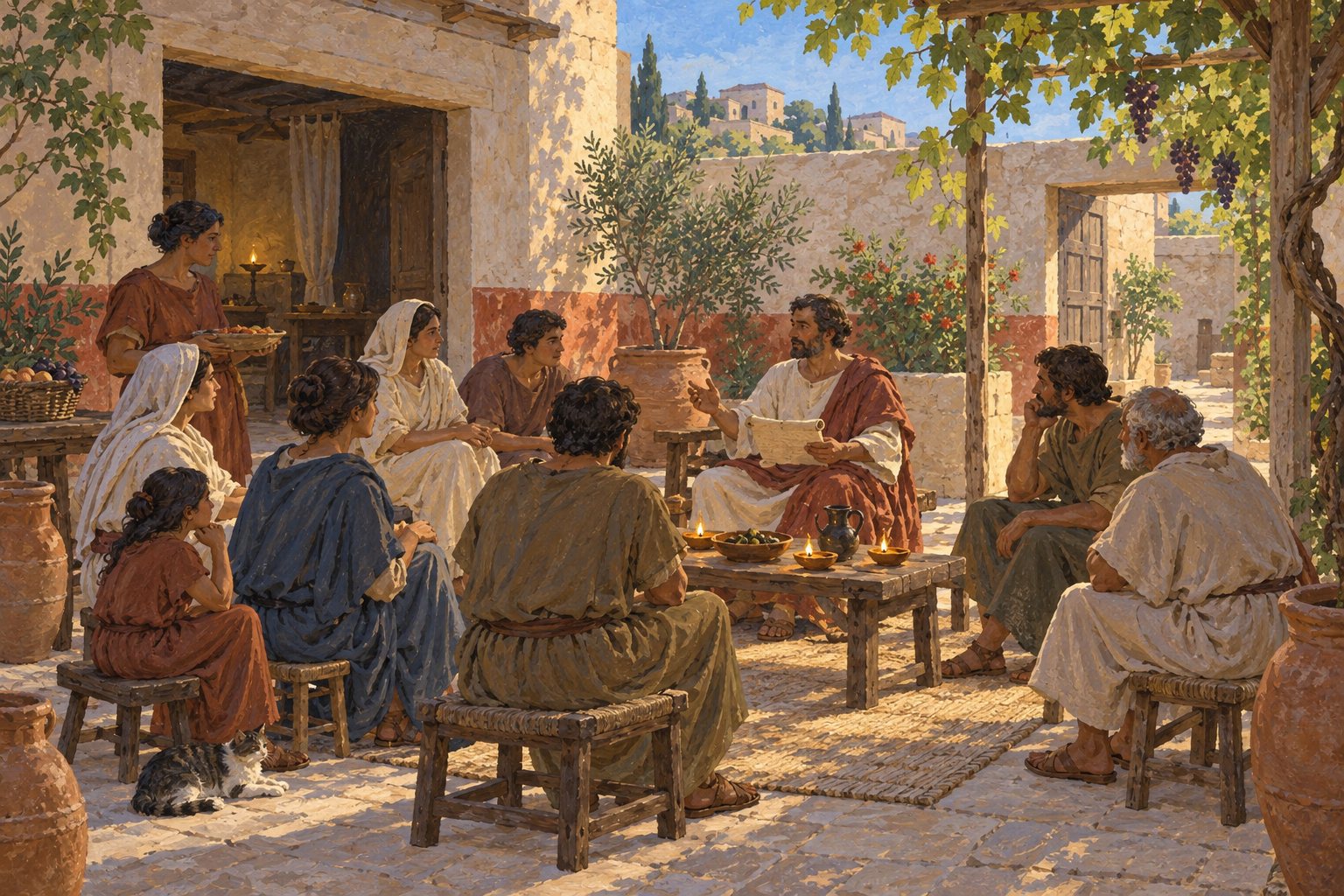
The household gathering. For most of this span the unit of Christianity was not a building but a household — the name-list closing Paul’s letter to Rome and the one excavated house church are the two ends of the same fact.
How it was transmitted
The Page That Turns
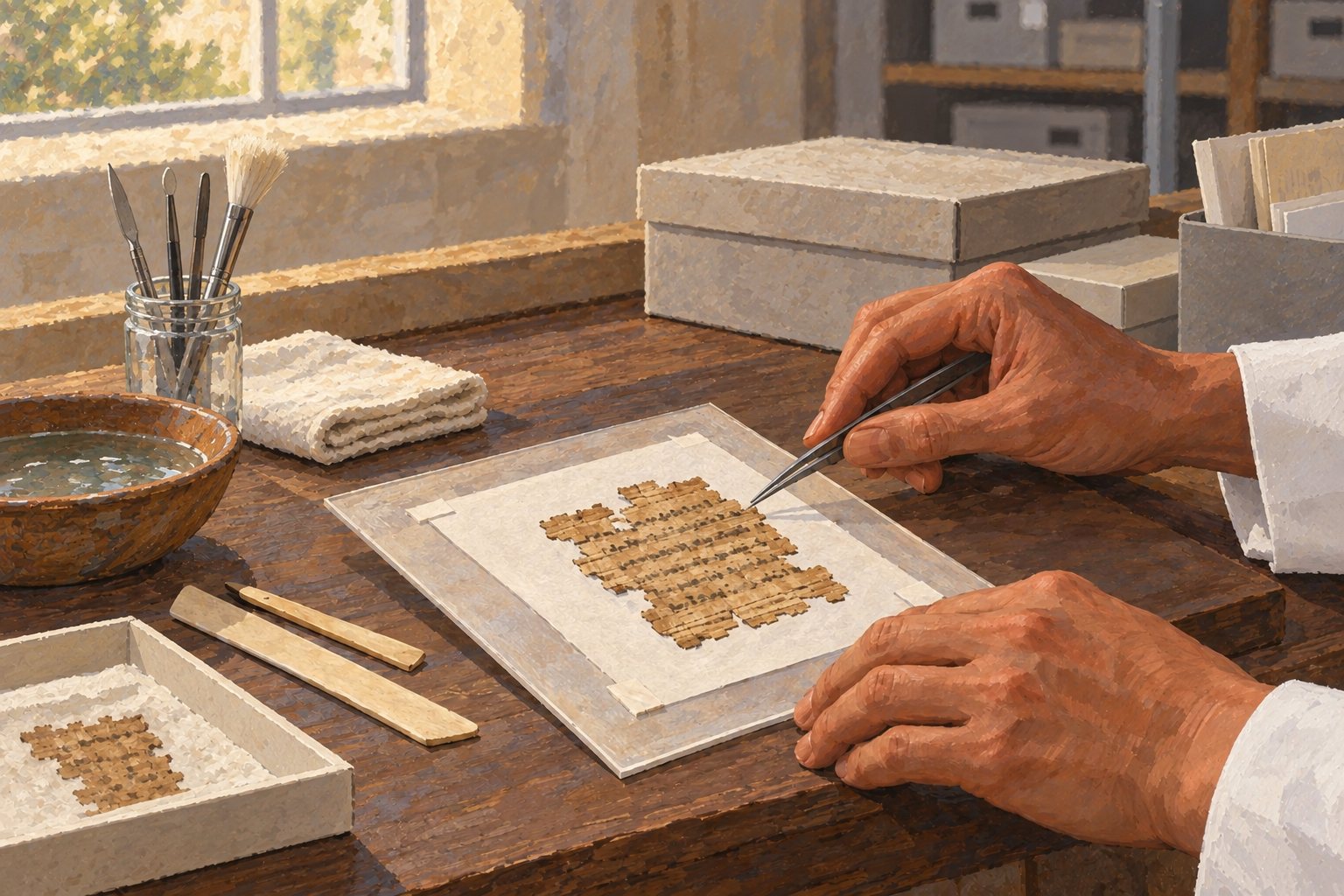
The oldest generally accepted piece of the New Testament is a scrap the size of a credit card with writing on both sides — a codex leaf — and that physical fact, repeated across nearly every early Christian book that survives while the literary world stayed on the scroll, is the best-attested thing in this volume.
Four Gospels, One Object
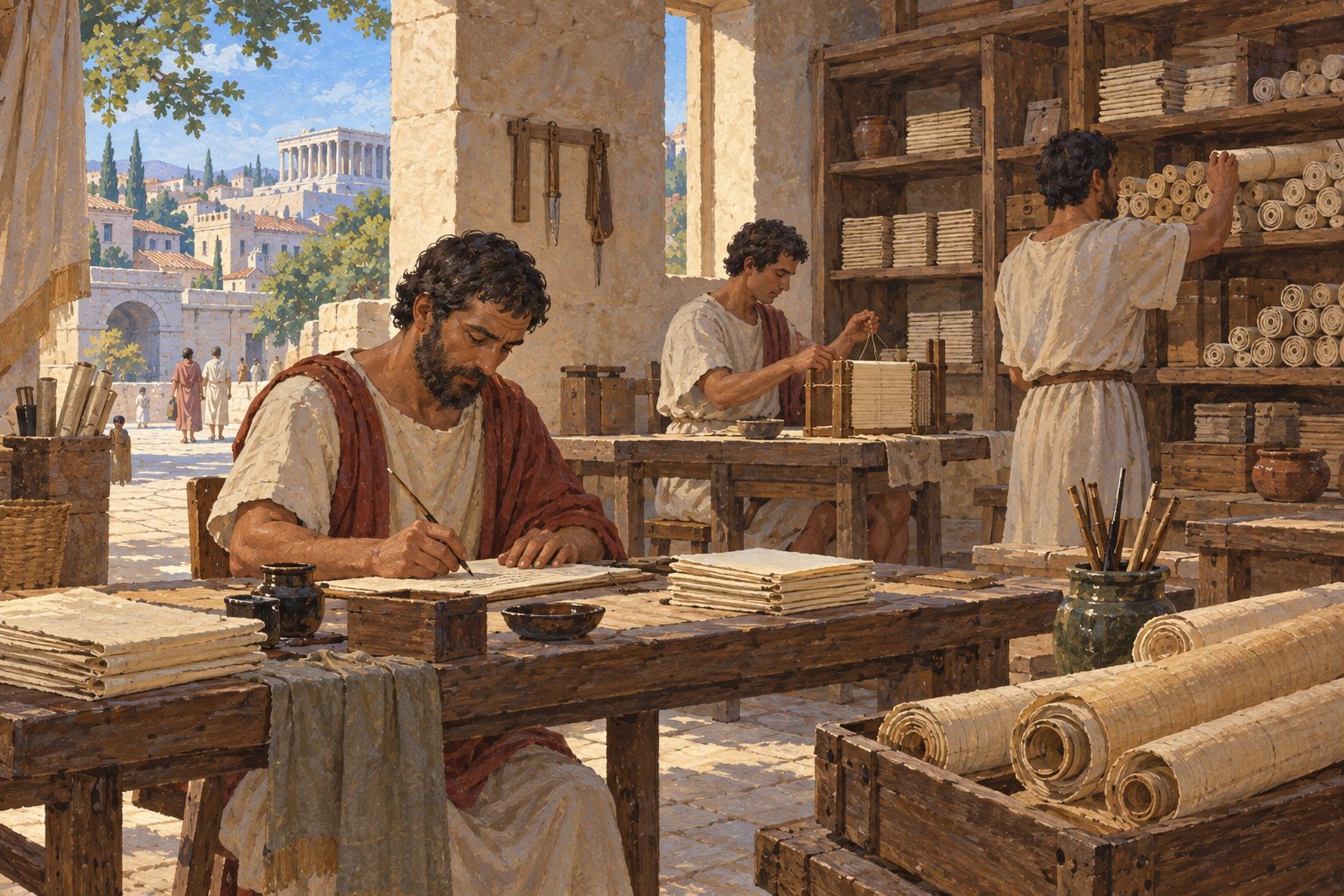
A roll holds one gospel; a codex could hold four gospels and Acts between two covers by the 250s — and the volume’s claim that a page you can flip to wins arguments is an inference from the object’s design, labelled as such.
Explore the illustrations3 scenes · A page that turns
A page that turns. The oldest generally accepted piece of the New Testament is a scrap the size of a credit card with writing on both sides — a codex leaf — and that physical fact, repeated across nearly every early Christian book that survives while the literary world stayed on the scroll, is the best-attested thing in this volume.
Texts and authority
Marcion Forces the Question
Before 140 the churches had a library but no list; the first person known to have published a fixed list of Christian scriptures — one gospel and ten letters of Paul — was expelled from the Roman church in 144, and everything known about him comes from the men who wrote against him.
Four Winds, Four Gospels
Around 180 Irenaeus argued that there are four gospels because there are four winds — and the evidence is not the argument’s quality but its existence, because nobody defends a number that nobody is disputing.
Institutions and resources
The Bishop’s Payroll, Itemised
In 251 the bishop of Rome itemised his own operation — 46 presbyters, 7 deacons, 7 subdeacons, 42 acolytes, 52 exorcists, readers and doorkeepers, and more than 1,500 widows and persons in distress on support — and the letter survives because a historian copied it into his book seventy years later, in the middle of the schism it was written to win.
The Common Chest and the Burial Bill
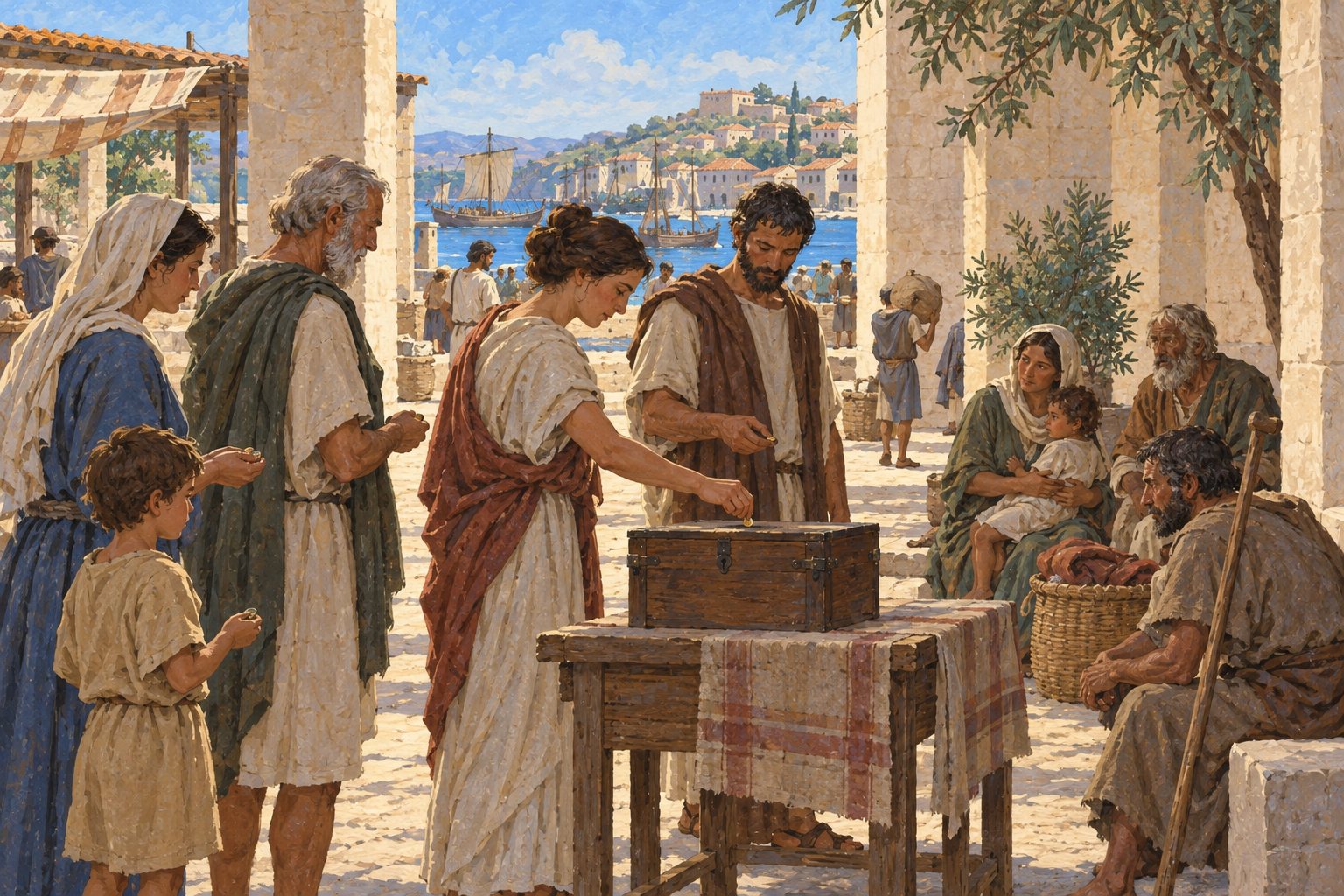
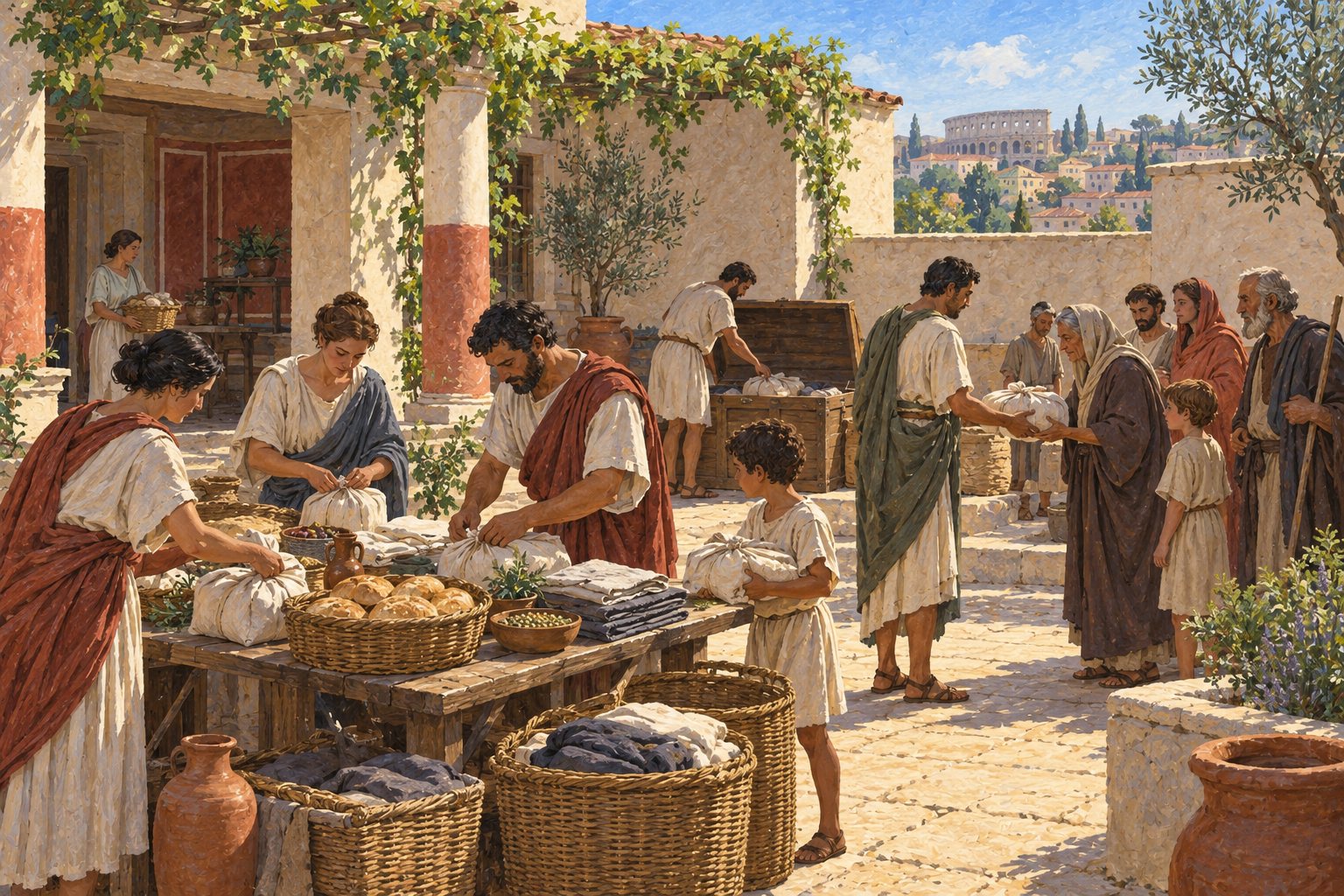
Tertullian describes the mechanism in one page around 197 — a monthly voluntary deposit into a common chest, spent on the poor, the orphaned, the shipwrecked, the imprisoned and the buried — and Rome’s perfectly legal burial clubs, with their fee tables carved in stone, show exactly what the church was competing with and undercutting.
Explore the illustrations3 scenes · The common chest
The common chest. Tertullian describes the mechanism in one page around 197 — a monthly voluntary deposit into a common chest, spent on the poor, the orphaned, the shipwrecked, the imprisoned and the buried — and Rome’s perfectly legal burial clubs, with their fee tables carved in stone, show exactly what the church was competing with and undercutting.
Changes and divisions
How Many Christianities
In the second century the movement was plural — Marcionite churches across the empire, Valentinian teachers inside and beside the mainstream, and a library of other gospels — and this volume reports the plurality from the objects rather than refereeing the fight about which version was original.
The New Prophecy
Montanism forced the question underneath every later split — whether God still speaks through prophets or now only through the office and the book — and the movement is dated two different ways by the two ancient authorities, fifteen years apart, which the chapter prints side by side.
Limits of the evidence
These limits are stated in the book before its argument.
- Anything from the founding decade on the founding decade’s own paper The earliest Christian documents are Paul’s letters, conventionally dated to the 50s; the earliest outside notice with a secure date is a governor’s letter of about 112. Nothing written in Judaea in the 30s survives, on any side of the question.
- Whether any of the tradition’s claims are true Reported, never adjudicated. The series has no instrument for the question and does not pretend to one — and in this volume the debunking register is the likelier trap, because the genre invites it.
- The movement’s size at any date Every surviving number is a model, an estimate or a polemic — including the payroll letter this volume is built around, which was written to make a rival look small.
Sources and reading
This article brings together the series’ existing overview and chapter summaries. The linked book page provides the full outline and bibliography.
- Pilate inscription, Caesarea Maritimafound reused as a theatre step, 1961. the one contemporary artefact naming a figure in the founding story
- Tacitus, Annals 15.44, Church and Brodribbwritten c. 116; trans. 1876. Christus under Tiberius; Nero’s scapegoating after the fire of 64
- Josephus, Antiquities 18 and 20, William Whistonfinished mid-90s; Whiston 1737. shorter James notice; longer Jesus passage contested for Christian insertions
- Paul’s lettersconventionally the 50s. earliest Christian documents; Romans 16 as a name-list
- Suetonius on Claudius and the Chrestus expulsionearly 2nd c.. outside notice named in the volume’s Sources
- Theodotos synagogue inscription, City of Davidfound 1913; conventionally before 70 CE. guest rooms and water for travellers from abroad
- Philo, In Flaccum, C. D. Yongeafter 38 CE. “not less than a million” Jews in Egypt — a partisan number
- Acts, used for geography onlylater 1st c. on specialist convention. route map from synagogue to synagogue; labelled as a source with its own argument
Illustrations are newly generated interpretations of themes in the book. They are not surviving artifacts, historical photographs or evidence for the events described.