12 illustrations · 1:26
Watch & listen.
Follow the images with a narrated journey through the book.



Overview
- Coverage
- c.100 BCE onward
- Earliest secure evidence
- c.100 CE
- Transmission
- merit as a print run
No author, no place and no date of composition has been established for one of the sutras, and this book supplies none. The Perfection of Wisdom is filed by size, at eight thousand lines, twenty-five thousand and a hundred thousand, which is the tradition’s own shelving half-agreeing with the philologists’ growth account.
The coverage period and the earliest secure evidence are different dates. A tradition’s own account of its beginnings may differ from both.
Historical setting
A Jar of Birch Bark
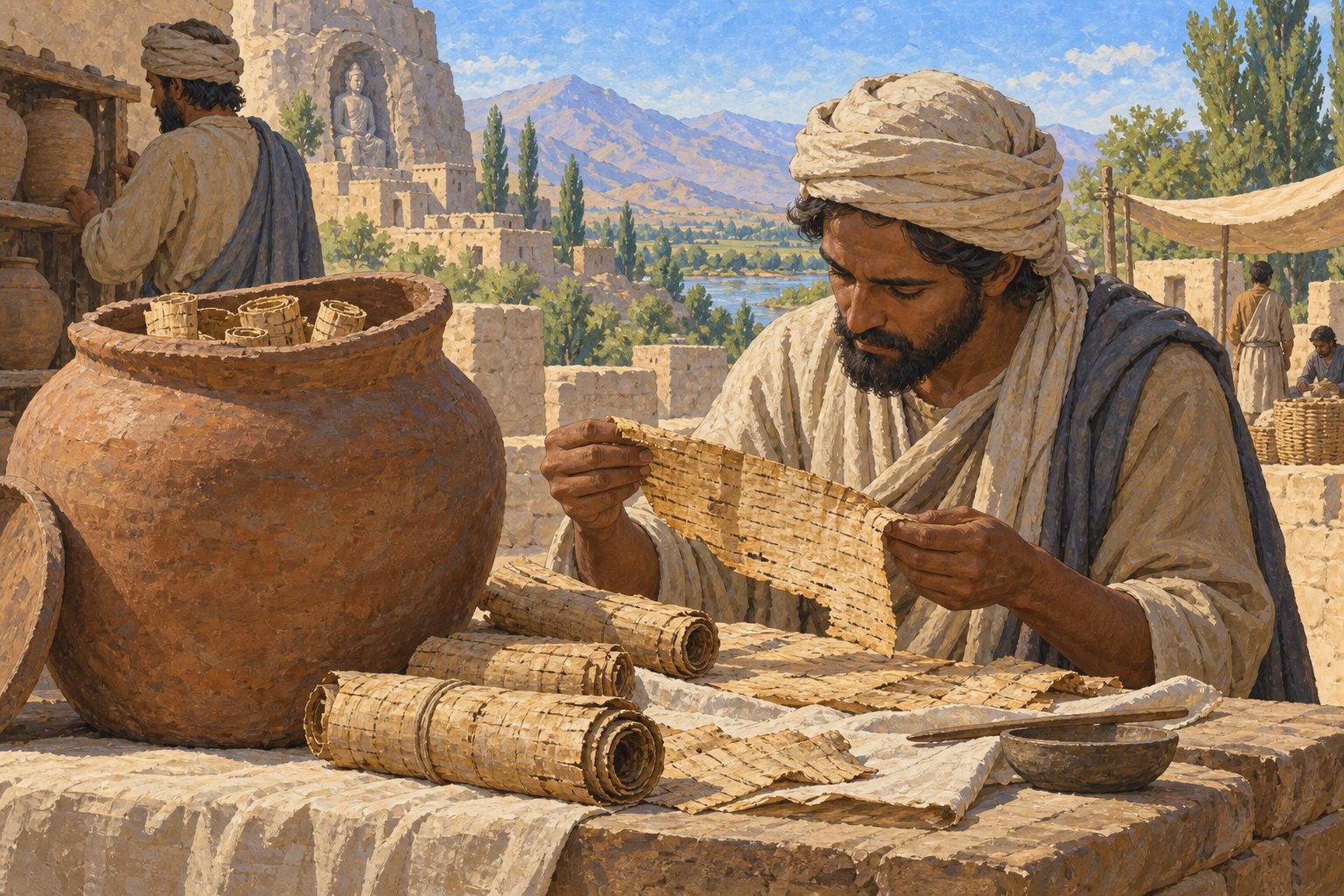
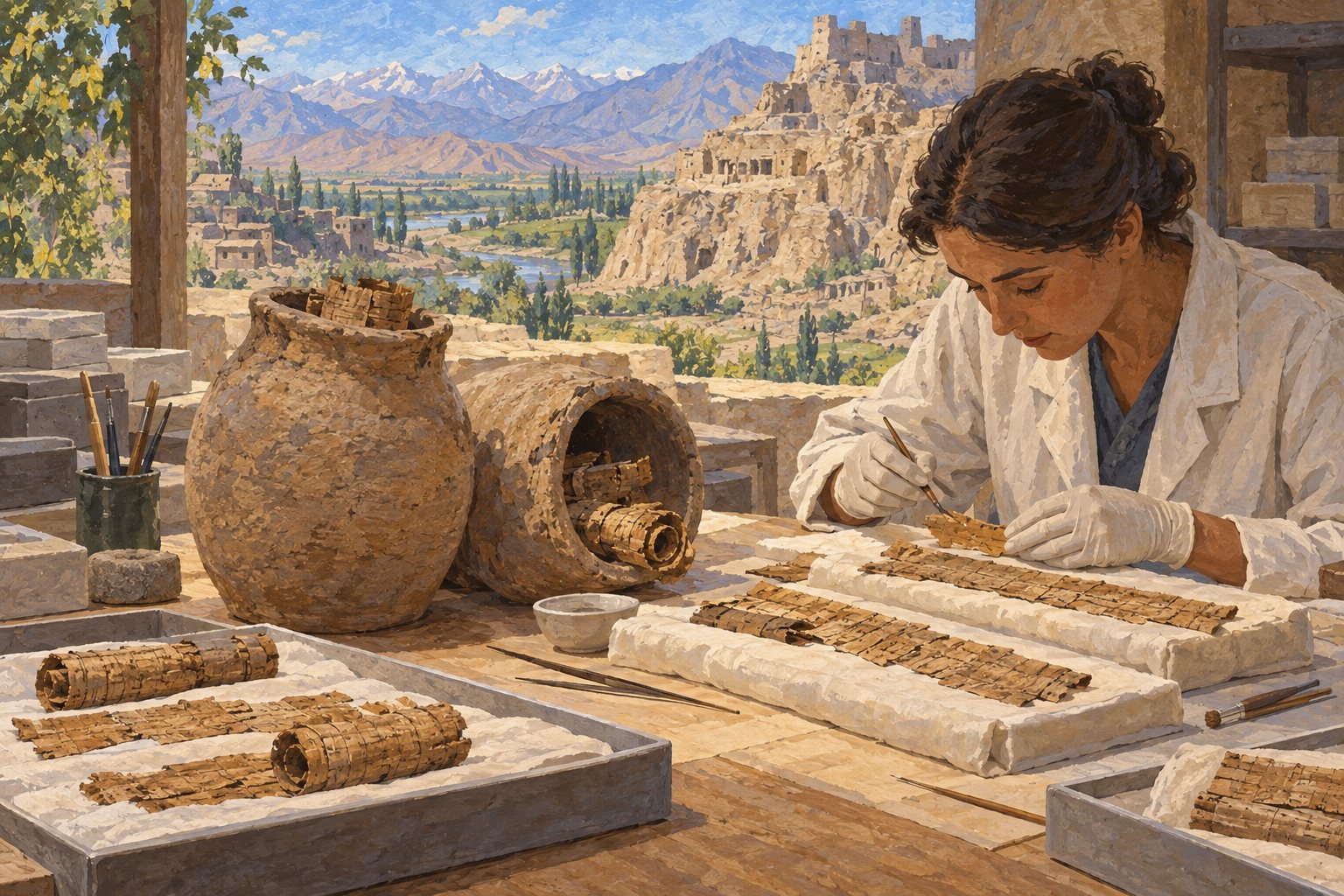
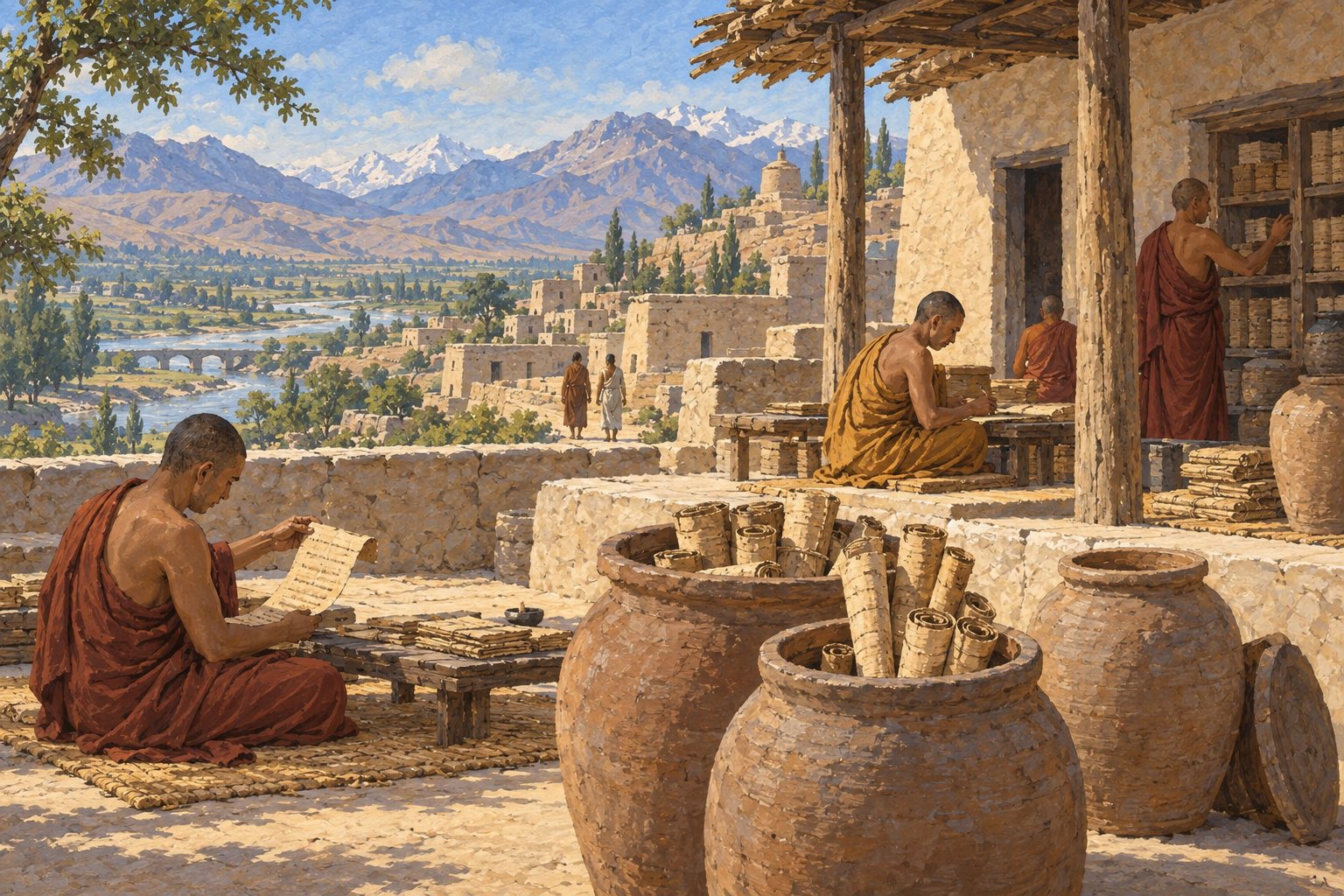
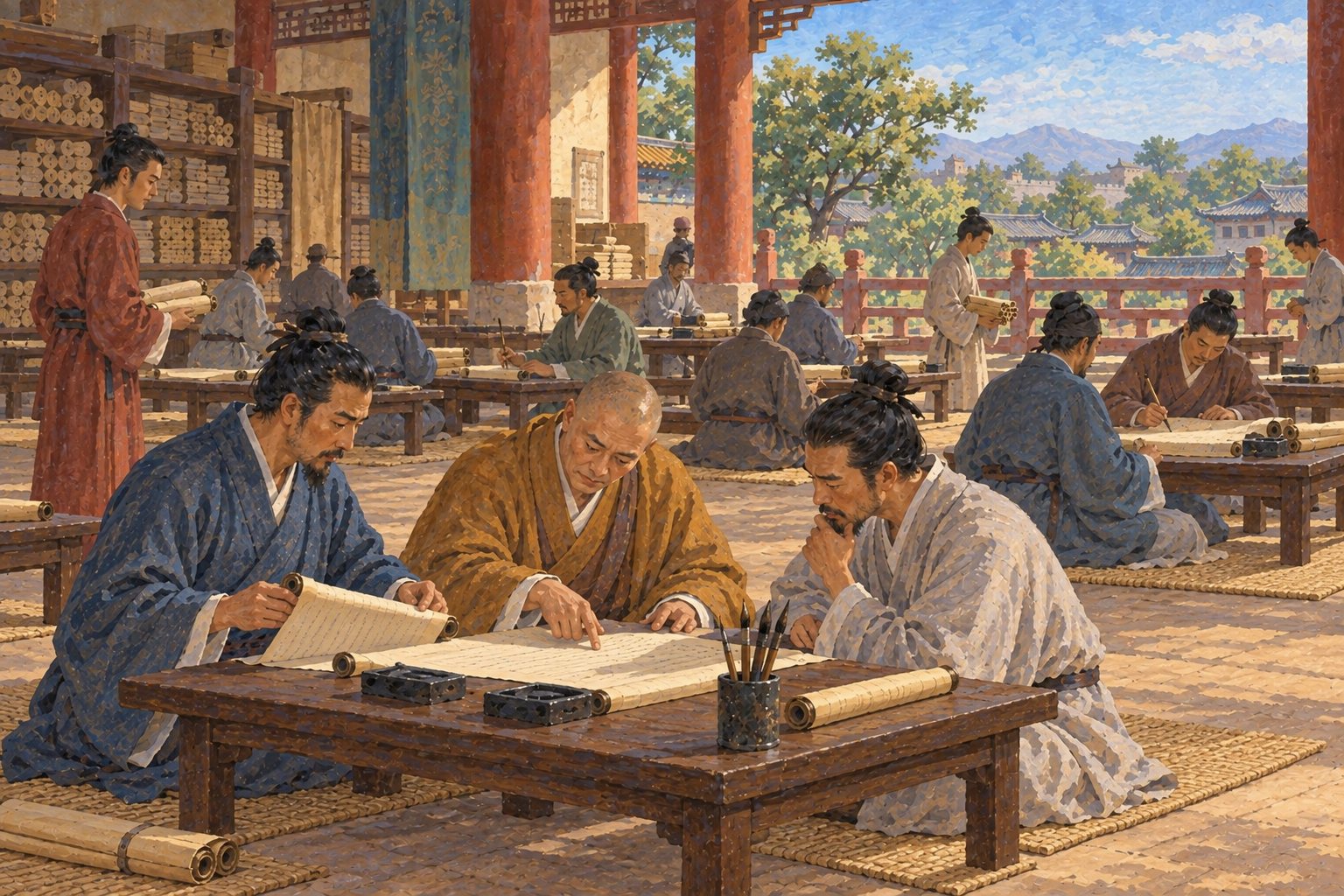
Open on the object: birch-bark scrolls in clay jars, acquired by the British Library in 1994 — the oldest Buddhist manuscripts in existence, from Gandhara, conventionally dated between the first century BCE and the second century CE — and the physical horizon in which Mahayana texts first become visible: among the recovered collections are a Prajnaparamita and a Mahayana sutra in Gandhari, older than any surviving text of the canon they sit beside.
The Empire in the Middle
The world is the Kushan empire astride the Silk Road — a state minting gods from three pantheons, taxing the caravan trade between Rome and China, and putting the Buddha on a gold coin with his name in Greek letters — the commercial cosmopolis in which a Buddhism built for travel appears.
Explore the illustrations4 scenes · Birch bark and clay
Birch bark and clay. Open on the object: birch-bark scrolls in clay jars, acquired by the British Library in 1994 — the oldest Buddhist manuscripts in existence, from Gandhara, conventionally dated between the first century BCE and the second century CE — and the physical horizon in which Mahayana texts first become visible: among the recovered collections are a Prajnaparamita and a Mahayana sutra in Gandhari, older than any surviving text of the canon they sit beside.
How it was transmitted
The Sutra That Advertises Itself
The Mahayana sutras carry their own reproduction clause: copying, reciting and venerating this text generates merit exceeding any material gift — so the incentive runs opposite to every other tradition in this series, where copying is a cost to be borne; here more copies is more devotion, and mechanical reproduction, when it arrives, will arrive as worship.
The Translation Bureau
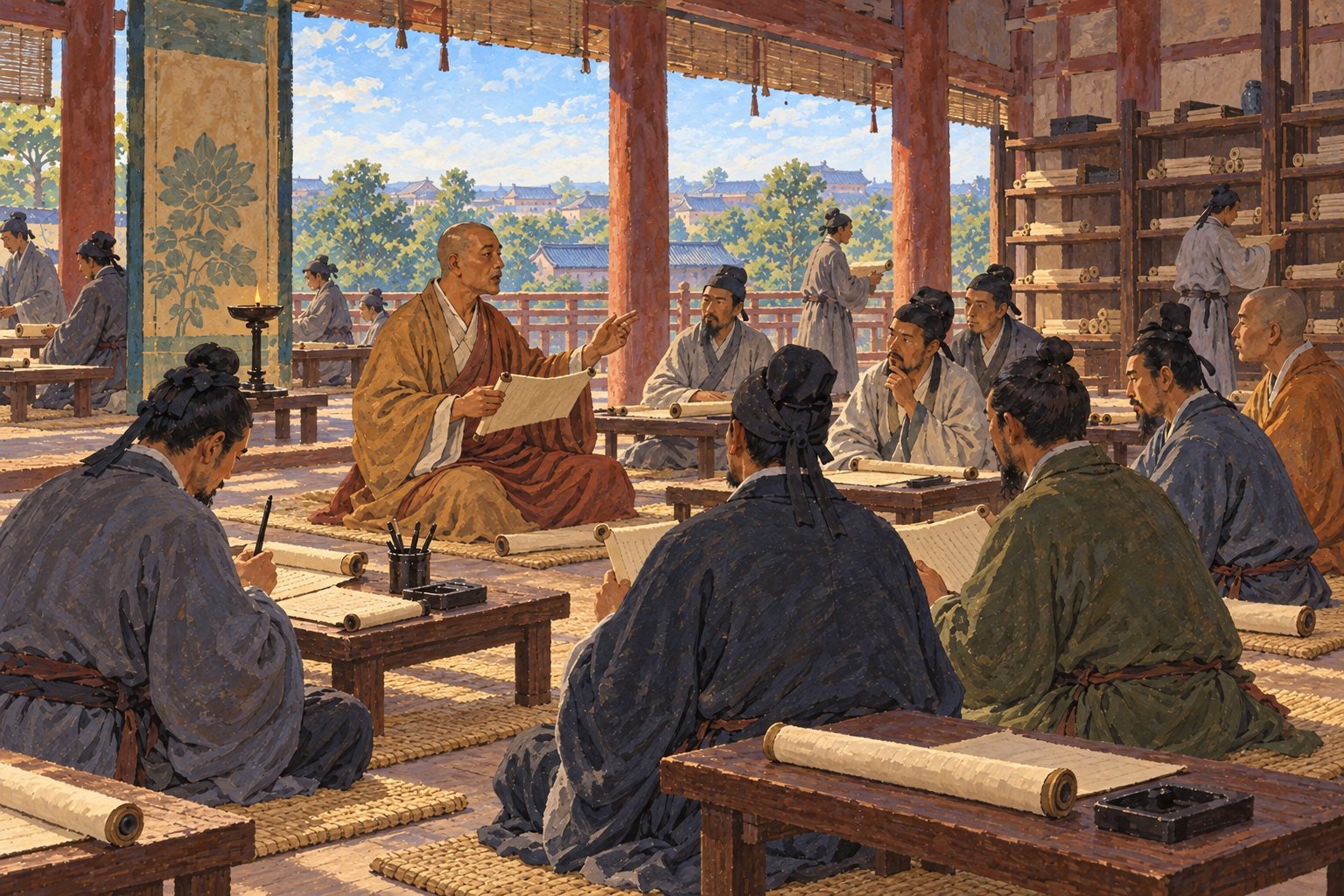
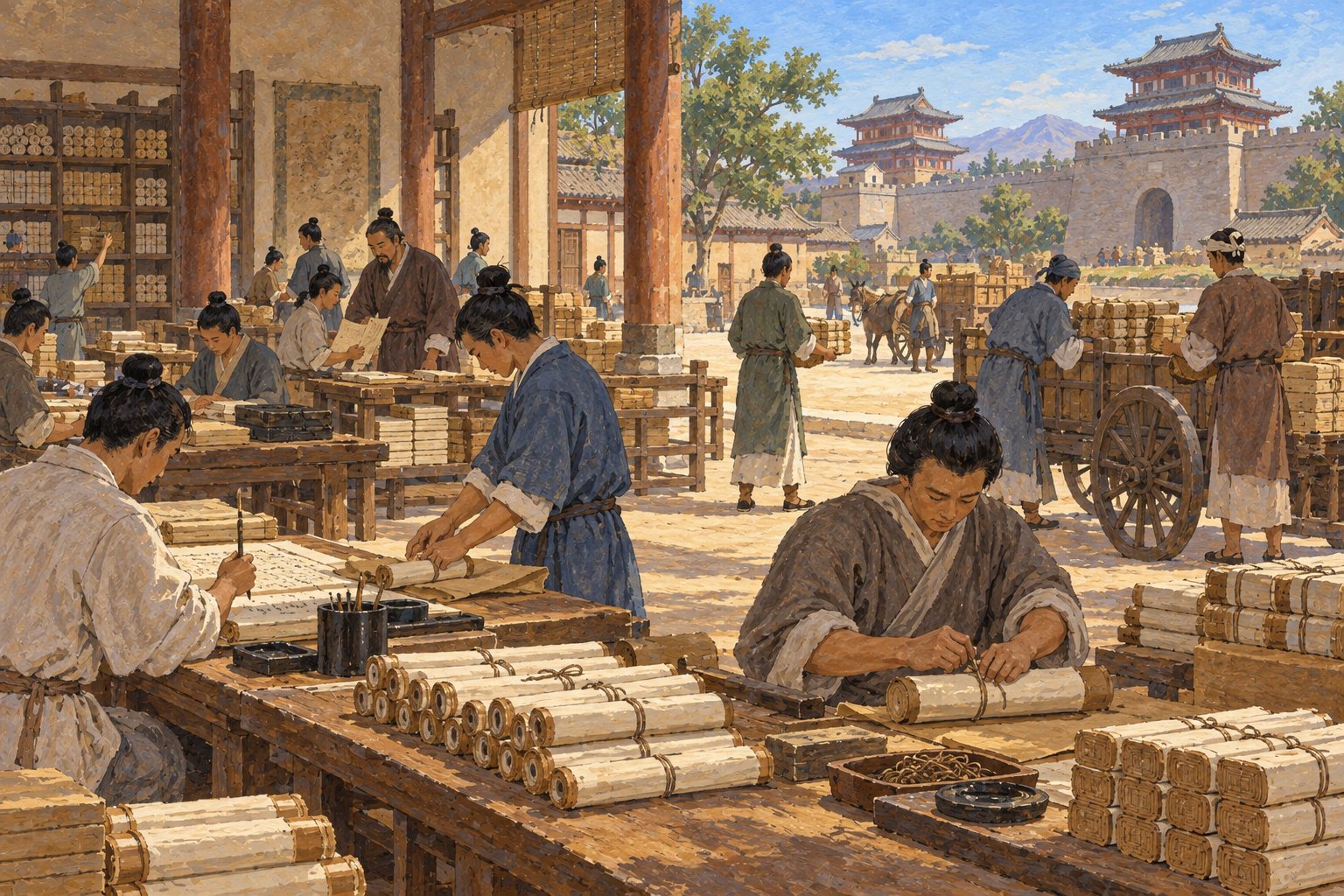
Before the press there was the assembly line: Kumarajiva’s state-funded translation workshop at Chang’an from 401, with a staff the tradition counts in the hundreds, produced the Chinese Lotus, Diamond and Amitabha texts East Asia actually reads — and the bureau’s word-by-word decisions are themselves historical events, because a billion people inherited them.
Explore the illustrations4 scenes · The translation workshop
The translation workshop. Before the press there was the assembly line: Kumarajiva’s state-funded translation workshop at Chang’an from 401, with a staff the tradition counts in the hundreds, produced the Chinese Lotus, Diamond and Amitabha texts East Asia actually reads — and the bureau’s word-by-word decisions are themselves historical events, because a billion people inherited them.
Texts and authority
Thus Have I Heard
Every closing this series has reported — a council’s list, a caliph’s recension, a commentator’s boundary — required an authority; the Mahayana’s problem was the inverse: new sutras kept appearing for centuries, each opening with the closed canon’s own authentication formula, evam maya srutam, “thus have I heard”, and no institution existed anywhere with the standing to refuse them — an open canon is the opposite problem to closing one, and the tradition solved it without ever acquiring a door.
The Buried Treasure
The tradition’s own answer to “where did these texts come from”: they are the Buddha’s word, taught once, withheld until hearers were ready — kept by the nagas until Nagarjuna retrieved them, on the traditional biography; released as later “turnings of the wheel”, on the sutras’ own self-ranking; justified by upaya, skilful means, in the Lotus’s parable of the father who promises the wrong toys to get his children out of a burning house — a complete, internally coherent doctrine of delayed publication, reported in the tradition’s voice and adjudicated nowhere.
Institutions and resources
The Emperor’s Grain Households
In China the sangha’s corporate design met a state willing to endow it with people: the Northern Wei assigned grain-levy households to the monasteries and convict “Buddha households” to temple service, while in the south an emperor donated himself to a monastery four times and made the treasury ransom him back — the state was the biggest donor, and both mechanisms are recorded in the dynastic histories, not in sermons.
The Mill, the Press and the Ledger
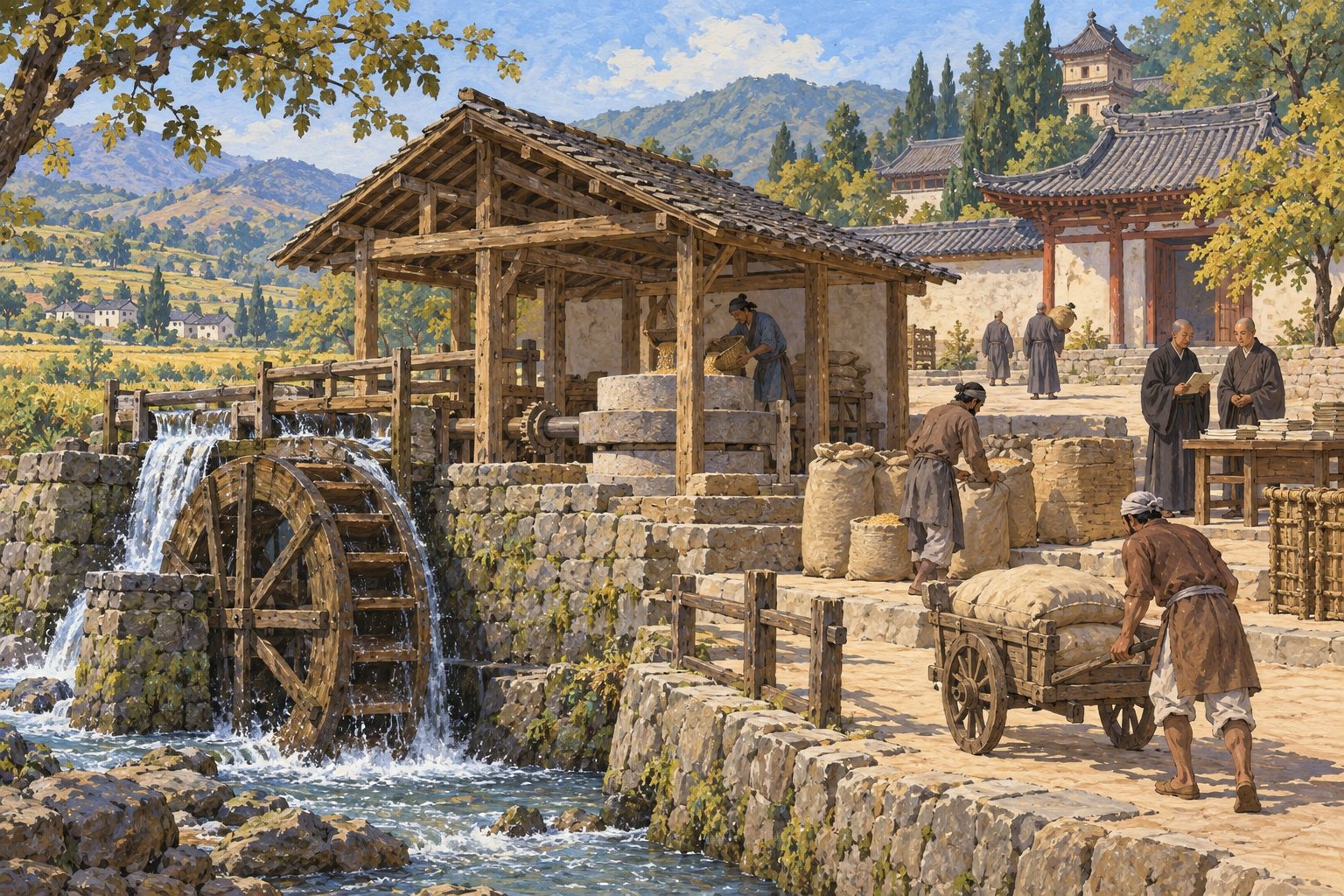
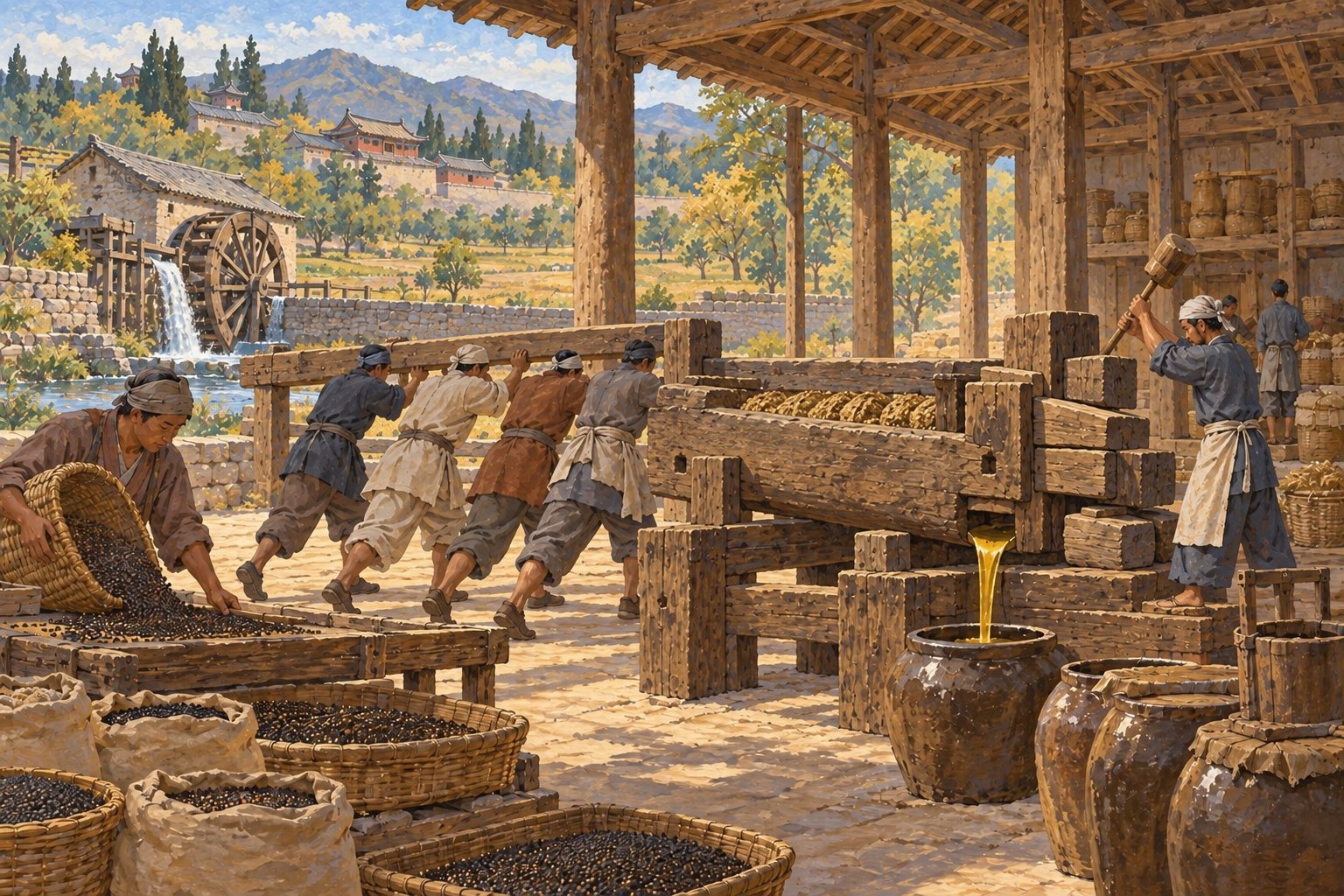
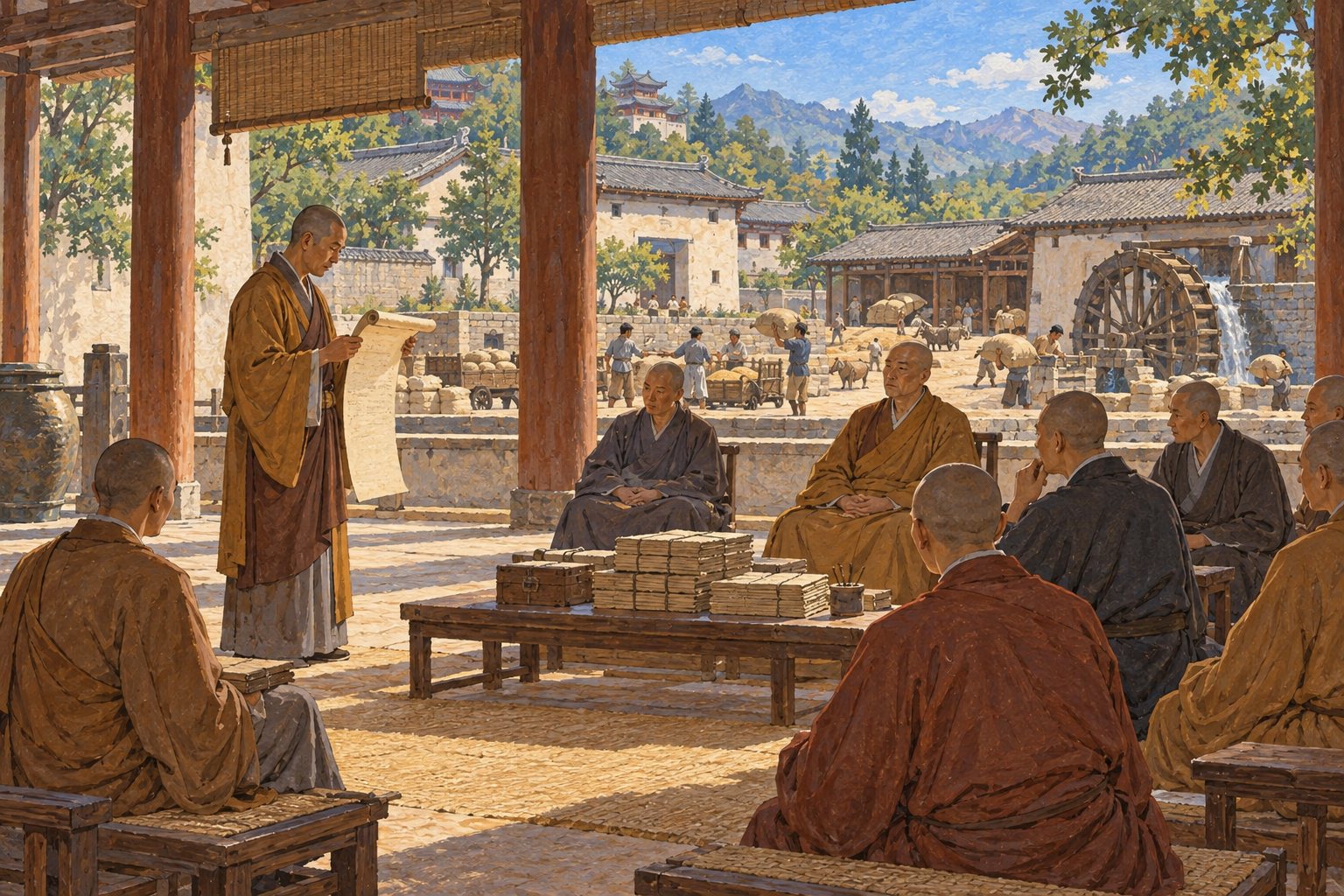
The monasteries ran the industrial plant of their regions — water mills, oil presses, grain loans at interest, rents from dependent households — and the evidence is not accusation but accountancy: the Dunhuang library cave preserved the monasteries’ own account rolls, audited annually and read out to the assembly, which makes this the rare volume in the series whose money chapter can cite the ledgers themselves.
Explore the illustrations4 scenes · The monastery mill
The monastery mill. The monasteries ran the industrial plant of their regions — water mills, oil presses, grain loans at interest, rents from dependent households — and the evidence is not accusation but accountancy: the Dunhuang library cave preserved the monasteries’ own account rolls, audited annually and read out to the assembly, which makes this the rare volume in the series whose money chapter can cite the ledgers themselves.
Changes and divisions
The Schism That Never Happened
Mahayana never established a separate vinaya: it produced sutras, treatises and philosophies, but no rival code of discipline and no ordination lineage of its own — Mahayana and non-Mahayana monks ordained in the same lineages and lived in the same monasteries, the Chinese pilgrims say exactly that, and stating it cleanly is this volume’s most useful correction, because nearly every shelf treats “Mahayana versus Theravada” as a schism on the model of the ones this series has reported elsewhere.
The Second Ordination
What Mahayana added was a layer, not a replacement: the bodhisattva precepts — from the Brahma Net Sutra the canon movement reported as a Chinese-milieu composition — were conferred on top of a vinaya ordination that remained a non-Mahayana school’s code, and the exception proves the rule’s age: only in Japan, a millennium after the first Mahayana texts, did Saicho win a separate ordination platform on the bodhisattva precepts alone.
Limits of the evidence
These limits are stated in the book before its argument.
- Where, when, or by whom any Mahayana sutra was composed Every one is anonymous and speaks in the Buddha’s voice. No author’s name, no place of composition and no date of composition has been established for a single text; the earliest hard evidence is manuscripts and dated translations, and both are downstream of composition.
- What early “Mahayana” was institutionally — one movement, several movements, or a genre of books. The word appears in Indian donative inscriptions only from about the fifth to sixth century CE (Schopen’s demonstration), four or more centuries after the texts exist. A movement identifiable in texts before it is identifiable in institutions is a movement whose early sociology cannot be recovered, and this volume reports the competing reconstructions without joining them.
- Whether the Kanishka council happened It is reported by Xuanzang five centuries later; no inscription mentions it.
Sources and reading
This article brings together the series’ existing overview and chapter summaries. The linked book page provides the full outline and bibliography.
- British Library Kharosthi fragments; Richard Salomon, Ancient Buddhist Scrolls from Gandharaacquired 1994; Salomon 1999. oldest Buddhist manuscripts; Dharmaguptaka pot inscription
- Senior collectionearly centuries CE. further Gandhari bark in a pot with its own inscription
- Bajaur collection, Ingo Strauchearly centuries CE. a Mahayana sutra in Gandhari
- Split collection Prajnaparamita, Harry Falk and Seishi Karashimabark 1st or 2nd c. CE. radiocarbon interval named to the publication, not approximated
- Rabatak inscriptionfound 1993. Bactrian in Greek script: Kanishka’s era and four royal ancestors
- Harry Falk on Kanishka’s accession127 CE now conventional. 78, 115, 127 and 144 have all been defended
- Kanishka BODDO gold coin, British MuseumKanishka’s reign. standing Buddha labelled in Greek letters
- Begram hoard, Joseph Hackinexcavated 1930s. Roman glass, Chinese lacquer and Indian ivory in one storeroom
Illustrations are newly generated interpretations of themes in the book. They are not surviving artifacts, historical photographs or evidence for the events described.