Belief System
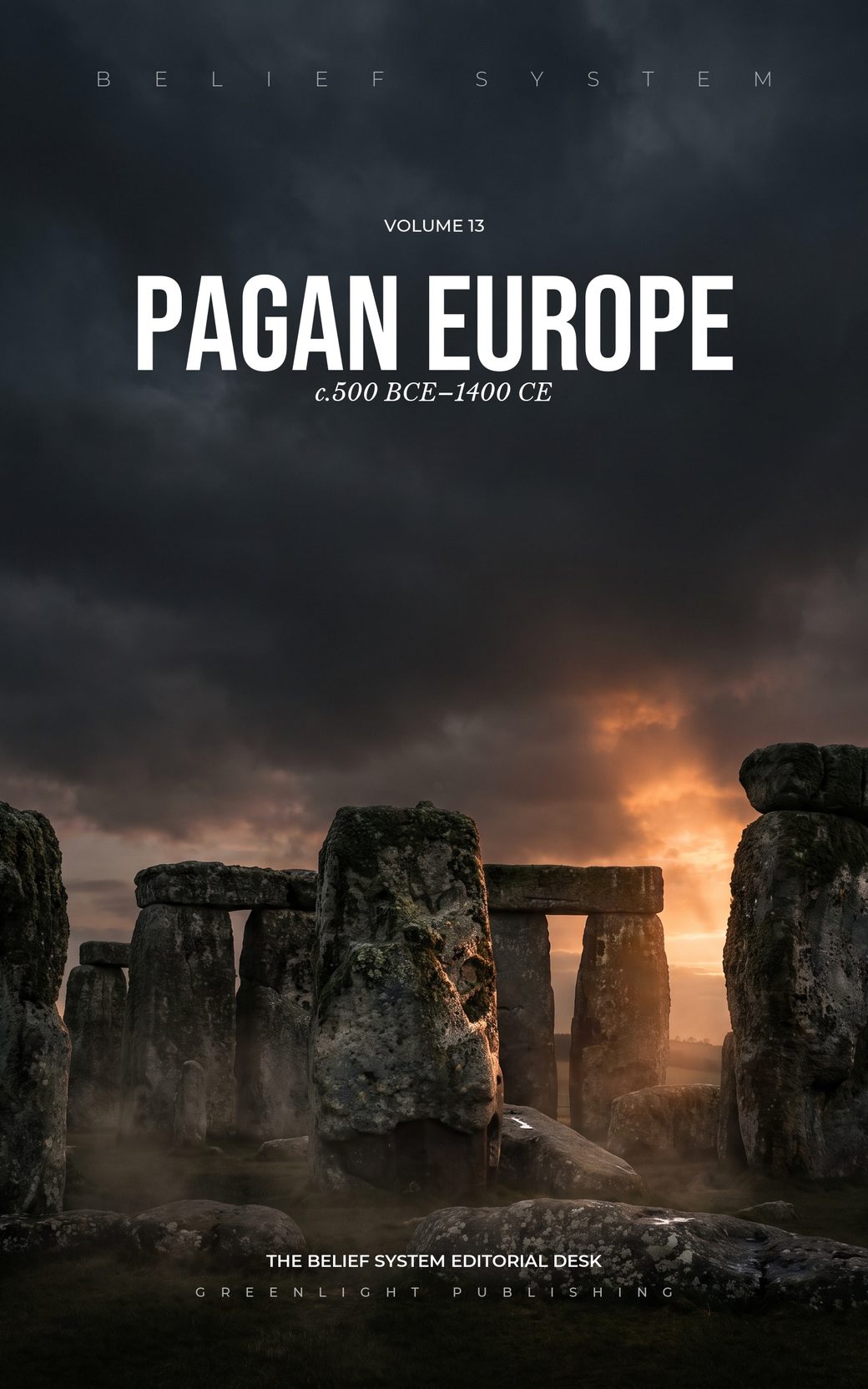
Jacket of Belief System volume 13, Pagan Europe
$12.99paperback

128 pages, 5.5 × 8.5 in. Three or more volumes in one order and every copy drops to $11.99.

copies

United States, 8 to 11 days. All destinations

Volume 13 Belief System c.500 BCE–1400 CE

Pagan Europe

The machinenone of its own — recorded by its conquerors

Attested from
c.50 BCE

The earliest secure evidence, and the key this volume is filed under. All thirty-one

Narrates
c.500 BCE–1400 CE

The period the book actually covers. It is rarely the same figure.

The argument in one sentence

The pre-Christian religions of northern and eastern Europe built no transmission machine of their own — no scripture, no reciter corps, no institution whose job was to keep the words — so almost every word about them was written by their conquerors or their converted grandchildren, and an honest history of them has to be, on every page, a history of its own evidence.

Iceland changed religion by arbitration. Around the year 1000 the Althing handed the decision to one pagan lawspeaker, who lay silent under a cloak for a day and then ruled the whole country Christian.The commissioning line

What it is

Iceland changed religion by arbitration. Around the year 1000 the Althing handed the decision to one pagan lawspeaker, who lay silent under a cloak for a day and then ruled the whole country Christian.

This is a history of traditions that left almost no inside, and of how we know anything at all.

No connected statement by a practising pagan of what a rite or a god was for survives from anywhere in this book’s range. The longest thing of that kind is four words on a Danish memorial stone. Two popular registers — brutes, or a murdered green religion — are both verdicts passed on people who left nothing behind to answer them with. This book uses neither.

Five movements: the world the conquerors wrote down, the machine none of these traditions built for themselves, the canon that is mostly other people’s, the money, and the ending.

Modern Heathen, Wiccan and Romuva practice is not evidence for any of it and does not appear. Revival is not survival.

The book never adjudicates, and it does not smirk.

Belief System, Volume 13.

In full

Pagan Europe is the volume whose machine is an absence. The longest surviving text in Gaulish is a bronze liturgical timetable with no doctrine in it. The runic corpus is names, ownership and charms; nothing in it is scripture. A poetry handbook written by a Christian chieftain in Iceland around 1220 kept young poets using pagan kennings, which is why anybody today can name a Norse god. A treaty of 1249 has defeated Prussians renounce an idol by name in a legal instrument.

Every figure arrives with the object or the hostile author it came out of, and with that author’s distance from the event in the same sentence. The set pieces everyone knows — the druids’ twenty years of training, the beheadings at Verden — are printed as the reports they are.

Ceremonial text still in use by a named nation is declined. Public and published material is nearly everything that survives, and that is the live constraint, not the whole corpus.

The volume uses five fixed phrases, and no sixth. It reports no god as fact and denies none. It never tells you what anybody believed. And it does not write about a dead tradition in the knowing tone that dead traditions invite.

Belief System is a history of world religion, one tradition at a time. Thirty-one volumes, ordered by earliest secure attestation.

The contents

26 chapters in five movements. Every volume in the series has the same five, in the same order, and each chapter below is printed with the idea it carries.

Movement OneThe World

What can actually be established, and by whom. The movement’s real subject is the witness list: the ground, the conquerors, the grandchildren, and a handful of outsiders passing through.

  1. 1The Man in the BogA man dug out of a Danish bog in 1950 with the rope still round his neck and his last meal still in his stomach shows exactly what the evidence for this volume can and cannot do — excavation establishes the deposition, the date and the diet to a margin of decades, while the reason he died there is an inference that specialists still argue case by case, and the whole book works inside that gap.
  2. 2A Map Without a CentreFrom Ireland to the Volga and across nearly two thousand years there was no founder, no centre, no membership and no name — paganus is the church’s word, its religious sense a fourth-century Christian coinage — and what the evidence actually shows is local, plural cult tied to place: a map of groves, springs, islands and enclosures recoverable today mainly through the names still sitting on it.
  3. 3The Ethnographer with an ArmyThe earliest connected accounts are Caesar describing the religion of a country he was conquering and Tacitus describing one he had never seen as a moral mirror for Rome — both working from the earlier lost ethnography of Posidonius, both translating foreign gods into Roman names by a habit Tacitus himself calls interpretatio romana — so the classical file is real evidence, but evidence written for a purpose, and the purpose has to be read alongside every sentence of it.
  4. 4The Grandchildren’s VersionThe fullest descriptions were written by Christians between one and three centuries after conversion — Adam of Bremen on Uppsala at second hand around 1075, Saxo and Snorri around 1200–1220, Ari on Iceland’s conversion a lifetime after it — and each admits or betrays his method, so the chapter reads them as what they are: a hostile deposition, a courtier’s chronicle, an antiquarian’s handbook and a careful lawyer’s memorandum, none of them a window.
  5. 5What the Ground EstablishesStripped of every text, the archaeology alone still establishes a religion-shaped pattern — weapons of defeated armies sunk in lakes for six centuries, gold taken out of circulation into hoards and bogs, buildings set apart beside great halls, the dead sent off in ships with extravagant goods — and the chapter builds that text-free minimum first, because it is the firmest floor the volume has.
  6. 6The Eyewitness ProblemThe tradition has a tiny handful of near-eyewitnesses and every one is an outsider — an Arab envoy watching a Rus ship-cremation on the Volga in 922 through an interpreter, a missionary’s biographer at Birka, the biographers of Otto of Bamberg inside the Szczecin temples in the 1120s, an enemy bishop describing Rethra — so even at its best the record shows what a stranger could see, which is ritual action, and never what it meant, which is the gap the rest of the book lives in.

Movement TwoThe Machine

The transmission technology, named as a concrete object or institution — not an abstraction. Here the finding is a negative, and it is the volume’s argument: there was no machine of the tradition’s own, and everything else in the book follows from that.

  1. 7The RefusalCaesar reports that the druids considered it wrong to entrust their teaching to writing while using Greek letters for almost everything else, and whatever that policy’s real reason — his own guesses are memory-training and secrecy, and he offers them as guesses — the reported result is a doctrine held in trained memory across a reported twenty years of schooling, resting entirely on one conqueror’s paragraph; the refusal, if it was one, worked so completely that nothing of what was refused survives to check him against.
  2. 8Letters for Everything but DoctrineWriting was present in this world for most of the volume’s span and was never once used to carry scripture — Gaulish in Greek and Roman letters yields a great bronze cult calendar and lead curse-prayers but no teaching, and the runic corpus, thousands of inscriptions across a millennium, is names, ownership, memorial formulas and charms, of which the most theological complete sentence is a three-word hallowing — so the machine-shaped hole is not illiteracy, it is allocation: letters served cult without ever carrying doctrine.
  3. 9The Metre That RememberedThe nearest thing to an error-correcting machine here is verse form itself — the skalds’ dróttkvætt binds every line with syllable count, alliteration and internal rhyme so tightly that corruption tends to break audibly, which is why ninth-century praise-poems could survive four centuries of mouths to be quoted by Snorri as evidence — but it was a court technology preserving the praise of kings, not a liturgical one preserving a cult’s words, and one runestone title is the only trace of anything like a reciter’s office.
  4. 10Three Oral Traditions, One Empty ChairSet this tradition beside the two great oral machines elsewhere in this series — the Vedic reciters running their braided cross-checking recitation modes, the Masoretes counting every letter of a text they would not alter — and the difference is not capacity but institution: those traditions built professional corps whose whole economy existed to keep the words, and northern Europe’s part-time chieftain-priests never did, so when the paying context died, the words died with it, and this became the tradition in the series least able to speak for itself.
  5. 11Four Channels, All DistortedSince the tradition built no channel of its own, everything reached us through four channels built by others — the ground, which preserves behaviour without meaning; the enemy’s report, written to justify; the convert’s literature, written to explain and entertain; and fossilised language, the weekday names and place-names that carry god-names with no theology attached — and each channel’s characteristic distortion can be stated, which is as close to source criticism as this subject allows and is the method the next three movements apply.

Movement ThreeThe Canon

What is in, what is out, who decided, when, and what the decision cost. Here nobody ever had the authority to close a canon, and the movement’s case study is what happened instead: a thirteenth-century Christian rescue operation whose motive was poetics, not piety. The movement opens with that argument, never with a manuscript.

  1. 12A Canon Nobody ClosedEvery canon in this series was closed by somebody with authority to close it — a council, a caliph, a scribal college — and this tradition had no text, no council and no office, so it never closed anything; what it has instead is the accident that one Christian island in the North Atlantic, for reasons of law, genealogy and poetry, wrote down in the thirteenth century a version of what its great-grandparents had believed, and the movement’s real question is why Iceland wrote at all and what its writers selected.
  2. 13The Handbook That Saved the MythsOur fullest account of Norse mythology is a technical manual — Snorri Sturluson, a Christian chieftain writing around 1220, composed the Prose Edda so that young poets could keep using the pagan kennings that court verse required, wrapped the god-stories in a frame that explains them away, prefaced them with a genealogy making the Æsir migrating Trojans, and warned Christian readers not to believe what follows — and the volume sits with that fact rather than rushing past it, because everything the modern world knows as “Norse mythology” passed through this one author’s editorial hands, for this purpose.
  3. 14One Manuscript in CopenhagenThe Poetic Edda — the older-looking verse behind Snorri’s prose — survives substantially in a single Icelandic manuscript of the 1270s that spent centuries unrecorded, was sent as a curiosity to the Danish king in 1662, lost eight leaves at some unrecorded point, and went home to Reykjavík by ship in 1971; the poems it carries are copies of compositions of contested date, argued on language and metre poem by poem, so the question “is this the pagans’ own voice?” has no general answer, and the honest position — pre-Christian matter, post-Christian pen, proportions unknowable — has to be re-earned stanza by stanza.
  4. 15The God on the TreeHávamál has Odin hang nine nights on a windswept tree, wounded by a spear, given to Odin, “myself to myself”, to win the runes — and the reader’s problem is the volume’s problem in one stanza: recorded by Christians two centuries after conversion, the image reads either as the deepest surviving pagan mystery or as a crucifixion remembered sideways, scholars have argued both for a century and a half, and the honest verdict is that it cannot be established; Baldr makes the same point structurally, since the Icelandic and Danish witnesses tell his death in versions too different to descend from one fixed text.
  5. 16The Canon the Church WroteOutside Iceland even the rescue was thinner — the Slavic world’s entire native mythology survives as lists inside Christian documents (treaty oaths sworn by Perun and Volos, a chronicle’s inventory of the idols one prince erected and then drowned), the Baltic god-lists come from crusade chronicles and a sixteenth-century Polish catalogue that scholars trust almost nowhere, and not one native myth narrative survives from either — so the chapter’s subject is an absence with edges, and its discipline is refusing to let reconstruction fill it.

Movement FourThe Money

Who paid, who was paid, and how we know. Headnote, stated in the book as well as here: this is the weakest Money movement in the series and the volume says so plainly — there are no ledgers, no deeds and no temple archives from inside the tradition, the measurable core is wealth destroyed rather than wealth accounted, and the record only becomes bookkeeping at the exact moment the church arrives and starts keeping books. Four chapters, not five, because padding it would be a claim the evidence cannot cash.

  1. 17Wealth Thrown AwayThe one cult expenditure that can actually be measured is the wealth this world destroyed on purpose — armies’ worth of weapons bent and sunk in lakes over six centuries, gold torcs buried by the hoard, coins accumulating in sacred springs for four hundred years — and while no text explains the transaction, the scale is countable in kilograms and coin-counts, which makes deliberate deposition the volume’s only auditable economic behaviour: an economy visible in what it removed from circulation.
  2. 18The Vow Was a ContractFor roughly four Roman centuries the Celtic and Germanic provinces did leave receipts, because the empire brought writing into cult: hundreds of stone altars closing with votum solvit libens merito — “paid the vow, willingly, deservedly” — record completed bargains with named gods, and at the shrines of Nehalennia merchants shipping to Britain had their trades carved into the stone, so the one period with documented cult finance is precisely the period under an occupier’s literacy, which is the volume’s source problem restated in money.
  3. 19Treasuries Counted by Their PlunderersThe famous pagan temple treasuries are all described by the people who ended them — Adam’s informants deck Uppsala in gold a generation before it fell, Saxo itemises Arkona’s revenues (a coin from every adult, a share of war-spoils, a three-hundred-horse fighting retinue, merchants’ dues) in the chronicle of the Danish army that took the treasury in 1168, and Thietmar inventories Rethra as its neighbour-enemy — so the record improves exactly as the tradition dies, every figure is the plunderer’s, and the chapter prints them only as such while noting the one control we have: the conquerors thought these places worth conquering.
  4. 20The Books Begin at the FuneralThe moment conversion wins, the money record snaps into focus, because the church counted — Charlemagne’s Saxon capitularies impose the tithe by law and Alcuin protests in writing that tithing new converts wrecks the mission, Iceland’s tithe law of 1096/97 is the island’s first tax and the making of its church-owning chieftain families, and Vladimir endows Kiev’s Church of the Tithes with a tenth of princely revenue in 996 — so the confiscations and grants at conversion are the best-documented economic events in the whole volume, and the pre-Christian cult economy they replaced is visible mainly as the shadow they were sized to fill; for that economy itself, almost every number cannot be established.

Movement FiveThe Split

What divided it, what it became, what it handed on. The split here is conversion itself, and the finding is its variety: Europe left paganism by at least four different instruments — the missionary’s staged wager, the sword, the law-court, and the dynastic contract — over eight hundred years. Names the next tradition by NAME, never by number. The register trap is romance: the last pagans get described, not mourned.

  1. 21The Missionary’s WagerThe mission’s characteristic instrument was the staged confrontation with a god who fails to defend his property — Willibrord slaughters Fosite’s sacred cattle and baptises converts in the holy spring, Boniface fells the Oak of Jupiter at Geismar and builds an oratory from the planks, Poppo carries hot iron before Harald Bluetooth — and whether each scene happened as written or was written as a scene, the genre itself is evidence of the theology being replaced: a religion of local power meets a demonstration that the local power does not retaliate; Rome’s own instruction, meanwhile, was subtler — Gregory’s letter tells the English mission to convert the temples and keep the festival days, substitution rather than demolition.
  2. 22The Sword at VerdenThe other instrument was force of state: Charlemagne destroys the Irminsul in 772, the Royal Frankish Annals report 4,500 Saxons beheaded at Verden in 782 — the figure is the annalist’s, historians contest it, and the sentence carries both — and the Capitulatio de partibus Saxonum makes paganism capital by statute, death for cremation, death for refusing baptism, while the surviving Old Saxon baptismal vow requires converts to renounce Thunaer, Woden and Saxnot by name; thirty years of revolt and the Stellinga rising a generation later measure the resistance, and Alcuin’s protest letters show the method was contested inside the church that used it.
  3. 23The Man Under the CloakIceland converted by procedure: with the Althing of 999/1000 splitting into two law-communities, both sides put the decision to arbitration by the pagan lawspeaker Thorgeir, who lay a day and a night under his cloak and then ruled that all Icelanders be baptised under one law — with private sacrifice, infant exposure and horseflesh left legal for a transition, repealed, Ari says, a few years later — a religious revolution executed as a feud settlement, our account of it written within a long lifetime on a named chain of informants; what happened under the cloak — divination, deliberation, sleep — cannot be established, and the chapter names the readings and leaves them open.
  4. 24The Kings Change FirstEverywhere else the crown moved and the cult followed: Harald Bluetooth’s Jelling stone — the closest thing this volume has to a native first-person document of conversion — announces in the king’s own runes that he “made the Danes Christian” around 965; Norway’s conversion is remembered through the kings’ sagas as two Olafs’ statecraft and coercion, two centuries after the fact and labelled so; and in Kiev, where the Primary Chronicle has Vladimir erect Perun’s silver-headed idol in 980 and lot-chosen sacrifice claim two Christian Varangians in 983, the same prince in 988 has Perun dragged behind a horse into the Dnieper and the city baptised in the river — the chronicle’s shopping-among-religions embassy tale is a literary set piece and is presented as one, but the demolition orders read operational, and the pattern is the movement’s: conversion arrives as an act of state.
  5. 25The Long FrontierBetween the Elbe and the Baltic the change came by war and treaty over four centuries: the Wendish rising of 983 threw the German church back across the Elbe for a hundred years, Rethra’s sacred horse was led home as plunder by a bishop in 1068, the crusade of 1147 was preached against the Wends by name, and Arkona’s Svantevit was chopped and burned before his own worshippers in 1168; the Baltic crusades then made religion a treaty clause — at Christburg in 1249 defeated Prussians renounced the idol Curche in a written instrument, a god named in a legal document — while Lithuania alone ran a pagan grand duchy that dealt with Christendom as a power for a century, Gediminas dictating letters to papal envoys in the 1320s, until the crown of Poland was worth a baptism: Jogaila in 1386, Lithuania’s official conversion in 1387, Samogitia not until 1413–17 — Europe’s last pagan state ended by dynastic contract, not conquest.
  6. 26What Did Not DieConversion ended the cult but not the practices, and for once the church’s own paperwork is the evidence — the eighth-century Indiculus superstitionum lists thirty things the newly baptised were still doing, Burchard of Worms’s penitential around 1010 interrogates weather-magic and night-riding beliefs by name, a Jutland smith’s surviving soapstone mould casts crosses and Thor’s hammers side by side, and the hammer-pendant fashion itself appears precisely in the conversion century, an answer to the cross in silver — while at the far edge the countryside practice of the Baltic was still being catalogued by churchmen in the sixteenth century; whether any given recorded practice is unbroken survival or post-Christian growth usually cannot be established, and the chapter says so each time rather than romancing continuity. Then the hand-offs, by name: the church that absorbed all this is the business of the imperial Christianity volume; the Eddas pass into world literature; and the modern movements that rebuilt religions from these same problematic books — Ásatrú, Wicca, Romuva — are a different subject with a different ignition, and they belong to the volume on the unaffiliated, where this series treats them in their own right rather than as this tradition’s afterlife.

What this volume cannot establish

Printed in the book before the argument is, and printed here for the same reason. A history of a tradition that will not say where its evidence runs out is not a history.

    Sources

    88 works, dated, and specific enough that a reader can go and look at the thing. Nothing is on this list that the desk did not consult.

    The bibliography, as the volume prints it
    # Document or work Date Evidence for
    1Tollund Man, Bjældskovdal; Silkeborg Museum radiocarbon intervalfound 8 May 1950; death 405–380 BCEdeposition, diet and noose; reason cannot be established
    2Grauballe Man, Nebelgård Fenfound 1952a second bog death, throat cut
    3Lindow Man, Lindow Moss; British Museumfound 1 Aug 1984; deposition 2 BCE–119 CEdating spread that straddles the Roman conquest
    4Anne Ross and Don Robins, The Life and Death of a Druid Prince1989the “triple death” reading of Lindow Man
    5Ronald Hutton on the Lindow dating and the triple-death readinglate 20th c.the contest named against Ross and Robins
    6P. V. Glob, The Bog People1965classic sacrifice argument, cited as argument not verdict
    7Miranda Aldhouse-Green, Dying for the Gods2001fuller sacrifice case across a wider field
    8Tacitus, Germania, Church and Brodribblate 1st c. CE; trans. 1876bog punishments; Nerthus cart; interpretatione romana; Mercury among the Germani
    9Strabo, Geography, Bohn Classical Libraryturn of the era; Bohn 1903Galatian council at the Drynemetum
    10Per Vikstrand, Gudarnas platser2001theophoric and cult place-names of the Mälaren region
    11Stefan Brink, survey articles on Scandinavian cult-place nameslate 20th–early 21st c., lundr, hörgr, hof elements across the map
    12Margareta Hildebrandt, Frösö kyrka på hednisk grundexcavation 1984; pub. 1989birch stump and animal bones under the church choir
    13Caesar, Gallic War Book 6, McDevitte and Bohnmid-1st c. BCE; trans. 1869druid jurisdiction, twenty-year training, writing refusal, wicker figures
    14J. J. Tierney, “The Celtic Ethnography of Posidonius”1960Caesar’s excursus as substantially Posidonian
    15Stuart Piggott, The Druids1968how little independent testimony survives once borrowings are set aside
    16Pliny the Elder, mistletoe rite, Bostock and Riley1st c. CE; trans. 1855white robe and golden sickle; uncorroborated set-piece
    17Lucan, Riley’s prose rendering; Berne scholia1st c. CE; Riley 1853; scholia medievalTeutates, Esus and Taranis; sacrifice details only in the later commentary
    18Adam of Bremen, Gesta Hammaburgensis ecclesiae pontificum Book 4c. 1075Uppsala at second hand; gold, nine-year feast, scholia kept distinct
    19Snorri Sturluson, Prose Edda, Arthur Gilchrist Brodeurc. 1220; Brodeur 1916euhemerising prologue; Gylfaginning frame; warning to Christian readers; kenning handbook
    20Saxo Grammaticus, Gesta Danorum Books 1–9, Oliver Eltonc. 1200; Elton 1894euhemerised Odin; Balderus and Hother in Book 3
    21Ari Þorgilsson, Íslendingabók1120s–early 1130snamed informant chain; conversion arbitration; tithe law and taxpayer count
    22John Lindow and Margaret Clunies Ross on thirteenth-century Icelandlate 20th–early 21st c.what Iceland could and could not have known
    23Hjortspring boat and war-kitradiocarbon 381–161 BCE; excavated 1921–22earliest large war-booty deposit
    24Illerup Ådal, Jørgen Ilkjær and colleaguesc. 200–500 CE; excavated 1950–56, 1975–85more than 15,000 items of a defeated force
    25Snettisham torc hoards; British Museum Great Torcfinds 1948–92; Great Torc 1950gold taken out of circulation, often cut first
    26Llyn Cerrig Bach, Anglesey1942–43181 objects including a slave gang-chain
    27Gundestrup cauldron, Rævemosefound 1891contested manufacture; deliberately dismantled in a bog
    28Uppåkra cult house, Lars Larssonexcavated 2000–04building rebuilt on one footprint beside the hall
    29Lake Tissø / Fugledegård, Lars Jørgensenlate Iron Agehall with fenced enclosure and animal remains
    30Oseberg ship burial, Gustafson and Sheteligexcavated 1904–05; dendro no earlier than 834expensive burial without a caption
    31Sutton Hoo Mound 1, Basil Brown and Charles Phillipsfound 1939; coins 610–635ship burial; identification of the dead contested
    32Sune Lindqvist, Gamla Uppsala postholes; Alkarp and Price re-reading1926; 2005temple reading of postholes disputed as several phases
    33Ibn Fadlan, Risala; Mashhad manuscriptmission 921–22; MS identified 1923Rus ship-cremation through an interpreter
    34Rimbert, Life of Anskar, Charles H. Robinsonwritten after 865; Robinson 1921Birka lot-casting and assembly procedure
    35Lives of Otto of Bamberg (Prüfening; Ebo; Herbord)1146; c. 1151; c. 1158–59Szczecin temples and the three-headed Triglav image
    36Thietmar of Merseburg, chroniclefinished 1010sRethra as frontier-enemy inventory; 983 Wendish rising
    37Coligny calendar, Gallo-Roman Museum, Lyonfound 1897; lettering 2nd c. CElongest Gaulish text, and it is a liturgical timetable
    38Chamalières lead tabletfound 1971; 1st c. BCE–1st c. CEprayer or curse invoking Maponos; no doctrine
    39Larzac lead tabletfound 1983longest continuous Gaulish text; a curse
    40Vimose combdeposited c. 160 CEearliest datable runic object: one word, harja
    41Kylver stone, G 88found 1903; c. 400earliest full elder-futhark row
    42Glavendrup stonefirst half of the 10th c.þur uiki þasi runaʀ — the corpus’s theological high-water mark
    43Scandinavian Runic-text Database, Uppsala; Judith Jesch in Futharkdatabase ed. 2008; Jesch 2013thousands of inscriptions, zero scripture
    44Margaret Clunies Ross, A History of Old Norse Poetry and Poetics2005skaldic transmission as an employment record
    45Snoldelev stone, DR 2489th c.þulaʀ title; meaning contested
    46Grágás law manuscriptslaw written 1117–18; MSS c. 1260 and 1280goði as chieftain-priest; lawspeaker’s recitation of the law
    47Olof Sundqvist, An Arena for Higher Powers2016Scandinavian cult leadership as a ruler’s activity
    48Landnámabóksurviving copies 13th–14th c.settlement register; temple-ring oaths as later literary traces
    49Anthony Faulkes, editions of the Prose Eddalate 20th c.Uppsala rubric naming Snorri; no two main manuscripts carry the same book
    50Codex Regius of the Poetic Edda, GKS 2365 4to1270s; to Denmark 1662; home 21 Apr 1971the poems’ principal medieval witness; Great Lacuna of eight leaves
    51Sophus Bugge, Norrœn Fornkvæði; The Home of the Eddic Poems1867; Eng. 1899critical edition and the Christian-influence thesis
    52Benjamin Thorpe, Edda Sæmundar1866Poetic Edda in English, including the heroic cycle
    53Olive Bray, The Elder or Poetic Edda1908mythological poems only; divergence from Thorpe shown
    54Primary Chronicle (Rus), author’s rendering of Old East Slaviccompiled early 12th c.treaty oaths by Perun and Volos; 980 idol inventory; 988 demolition and tithe church
    55Helmold of Bosau, Chronica Slavorum2nd half of the 12th c.Wendish temple dues; Zcerneboch; 1147 crusade
    56Jan Łasicki, De diis Samagitarumwritten c. 1582; printed 1615seventy-six Samogitian names; exhibit of how god-lists inflate
    57Zbruch idol; Komar and Khamaiko authenticity argumentfound 1848; argument 2011contested Slavic cult object
    58Leszek Słupecki, Slavic Pagan Sanctuaries1994modern reconstruction, labelled as reconstruction
    59Paulus Orosius on the Cimbri after Arausioearly 5th c.outsider’s account of deliberate destruction of spoils
    60John Clayton, Coventina’s Well, Carrawburghexcavated 187613,487 coins as a votive flow; RIB 1526 vow-receipt
    61Bath sacred spring, Cunliffe and Davenport; Roger Tomlin, curse tabletsexcavated 1978–83; Tomlin 1988more than 12,000 coins; lead complaints transferring stolen title
    62Nehalennia altars, Domburg and Colijnsplaatfound 1647; recovered 1970–74merchants’ completed vows, including a pottery dealer to Britain
    63Saxo, Gesta Danorum Book 14, author’s LatinArkona 1168 or 1169Svantevit’s revenues counted by the plunderer’s clerk
    64Carl Schuchhardt, Arkona excavation1921the cape’s archaeology, since partly lost to erosion
    65Capitulatio de partibus Saxoniae, Munroconventionally 782 or 785; Munro 1900tithe and land for new churches; pagan rites made capital
    66Alcuin, letters of 796796tithe on new Saxon converts contested inside the court
    67Eyrbyggja saga on hoftollr13th c.temple-due as post-conversion literary trace
    68Pope Gregory I to Mellitus, in Bede, A. M. Sellarletter 18 July 601; Sellar 1907convert the temples, keep the festival days
    69Willibald, Life of Bonifacewithin living memory of BonifaceOak of Jupiter at Geismar
    70Alcuin, Life of Willibrorda generation after the Frisian missionFositesland cattle and spring
    71Widukind of Corvey960sPoppo’s hot-iron ordeal before Harald; Irminsul as memory
    72Royal Frankish Annals8th–9th c. compilationIrminsul destroyed 772; 4,500 beheaded at Verden 782, figure transmitted
    73Old Saxon baptismal vow, Vatican manuscript with the Indiculus8th c.Thunaer ende Uuoden ende Saxnote named in the renunciation
    74Nithard on the Stellinga840sSaxon rising to recover the old law
    75Dag Strömbäck, The Conversion of Iceland1975source criticism of the Althing decision
    76Jón Hnefill Aðalsteinsson, Under the Cloak1978the divination reading of Thorgeir’s day, held as a reading
    77Kristni sagalater than Aripayment to Thorgeir, labelled later
    78Larger Jelling stone, DR 42c. 965Harald’s own runes: he made the Danes Christian
    79Snorri, Heimskringla, Samuel Laing13th c.; Laing 1844two Olafs’ conversions as thirteenth-century retrospect
    80Annales Augustaninotice for 1068Bishop Burchard riding Rethra’s horse home
    81Treaty of Christburg1249defeated Prussians renounce the idol Curche in a written instrument
    82Peter of Dusburg1326Prussian religion by the crusade’s own historian; Criwe claim contested
    83Henry of Livoniaearly 13th c.Liv horse-and-spear divination, a missionary’s notice
    84Gediminas correspondence; S. C. Rowell, Lithuania Ascendingletters 1320s; envoys’ report 1324; Rowell 1994“one God” declaration checked against Rowell’s edition
    85Jan Długosz on Vilnius’s sacred firetwo generations after 1387late notice of the 1387 conversion
    86Indiculus superstitionum et paganiarum8th c.thirty headings of what the newly baptised were still doing
    87Burchard of Worms, Decretum Book 19 (Corrector)c. 1010confessor’s questions on springs, trees and night-riding
    88Trendgården soapstone mould, National Museum of Denmarkconversion-century horizonmatrices for a cross and Thor’s hammers side by side

    Common questions

    When is Pagan Europe first securely attested?

    c.50 BCE. That is the earliest date the surviving evidence supports, and it is the key this volume is filed under. It is not the same claim as when the tradition began: the tradition’s own account of its beginning is printed beside it in the book’s front matter, never instead of it.

    What period does the book cover?

    c.500 BCE–1400 CE. The coverage span and the attestation date are two different facts, and the gap between them is often the most interesting thing about a volume.

    What carried Pagan Europe?

    None of its own — recorded by its conquerors. Movement Two of every volume is about the transmission technology — the concrete object or institution that made copying possible, and would not have existed a century earlier.

    How long is it?

    About 29,500 words, roughly 125 minutes’ reading, 128 pages in the paperback. The audiobook runs 3h 07m, measured from the finished masters.

    Does the book say which tradition is true?

    No. Belief System does not adjudicate. Where the tradition’s account and the earliest evidence disagree, both are given, in their own vocabulary, attributed, and neither is given the last word. No miracle is reported as fact and none is denied.

    Can I buy Pagan Europe in print?

    Yes. It is a 5.5 × 8.5 in paperback, 128 pages, $12.99 a copy, bought direct rather than through a retailer. All thirty-one together are $199.00, with the ebook and the audiobook of every volume included.

    The edition

    The paperback
    Trim5.5 × 8.5 in  /  140 × 216 mm
    BindingPerfect-bound paperback, matte laminate
    Paper60# uncoated cream, black ink
    Extent128 pages
    Editions and ISBNs
    EditionExtentISBN
    Paperback128 pages, 5.5 × 8.5 inISBN not yet issued
    EbookEPUB979-8-90623-837-5
    Audiobook3h 07m979-8-90623-838-2
    Filed under
    BISAC 1`REL017000` RELIGION / Comparative Religion
    BISAC 2`REL114000` RELIGION / Ancient
    BISAC 3`REL033000` RELIGION / History
    • pagan Europe
    • Norse religion
    • druids
    • Iceland Althing
    • runes
    • Gaulish
    • history of religion
    • conversion of Europe
    • Roman religion
    • comparative religion