130 pages, 5.5 × 8.5 in. Three or more volumes in one order and every copy drops to $11.99.
United States, 8 to 11 days. All destinations
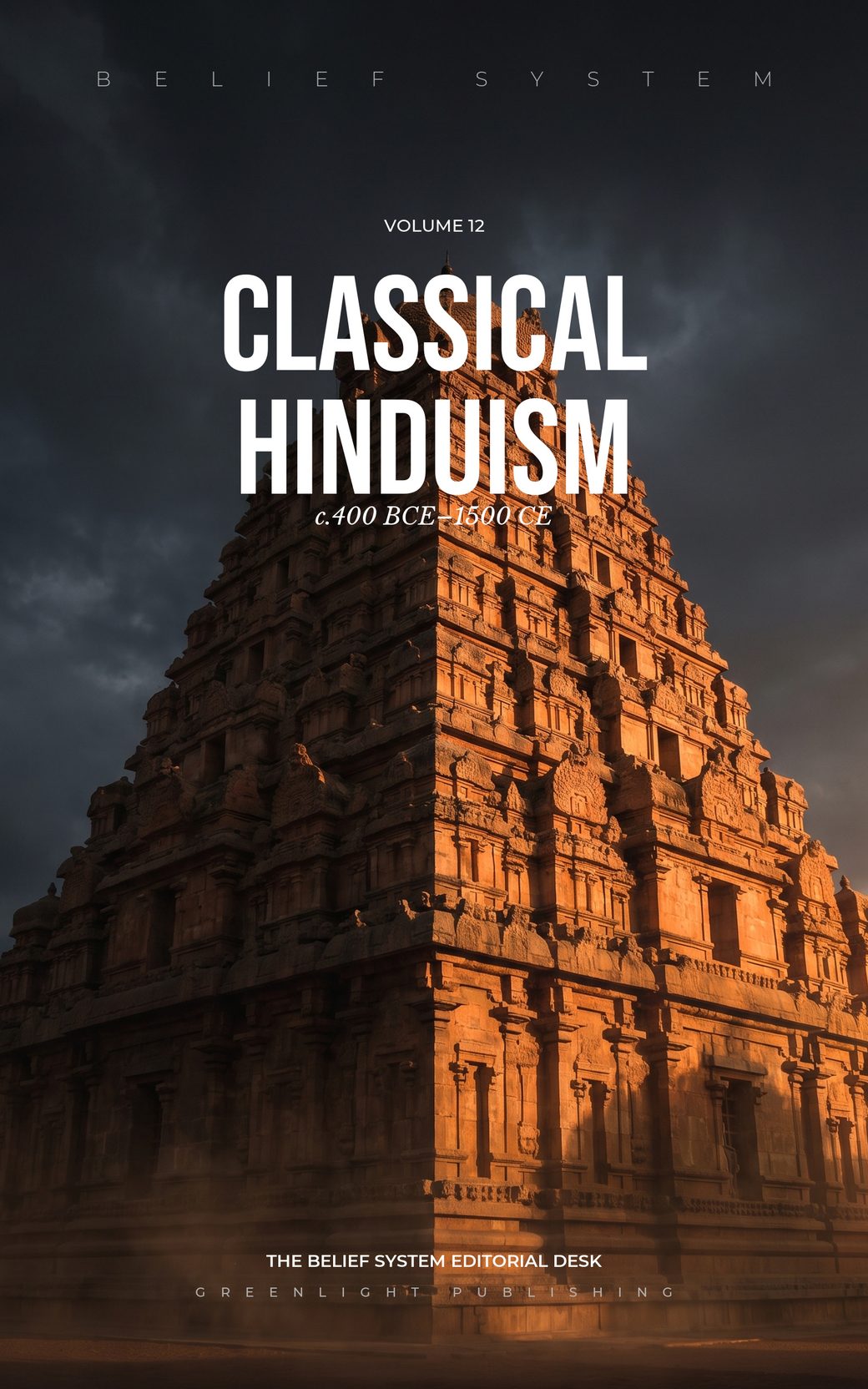
Volume 12 Belief System c.400 BCE–1500 CE
Classical Hinduism
The machinethe deed engraved in copper
- Attested from
- c.400 BCE
- Narrates
- c.400 BCE–1500 CE
The earliest secure evidence, and the key this volume is filed under. All thirty-one
The period the book actually covers. It is rarely the same figure.
The argument in one sentence
A tradition with no founder, no council and no closed canon held itself together for nineteen centuries on institutions instead of lists — the lineage that licenses the teacher, the temple that employs the district, and the inscription that makes the whole arrangement auditable in stone — so that when it divided, the divisions were commented, endowed and eventually litigated rather than decreed.
temple walls were public ledgers: donations, staff and salaries carved into stone for anyone to audit, permanently.The commissioning line
What it is
A land grant engraved on copper plates, strung on a ring and closed with a royal seal, promises the giver sixty thousand years in heaven and whoever takes the land back as long in hell. Temple walls were public ledgers: donations, staff and salaries carved into stone for anyone to audit, permanently.
This is a history of that documentary religion, and of how we know.
Śaṅkara’s own monasteries put him in 509 BCE. Specialists conventionally place him around 700 to 750 of our era. Twelve centuries lie between them. Both are printed here, each labelled, and neither corrected into the other.
Five movements: the world of the law books and the epics, the machine of the copper plate, the canon nobody closed, the money on the plinth, and the split the poets already argued from inside.
Caste runs through all nineteen centuries of this material. All three of its documentary forms are here, in the terms their own documents use, neither defended nor denounced.
The book never adjudicates. Every figure arrives with the stone or plate it was read off.
Belief System, Volume 12.
In full
Classical Hinduism is the most documentary book in the early set, and it is documentary because the temples made it so. A village assembly drawing its committee members by ticket from a pot, under a clause disqualifying any man who has not rendered his accounts, and his relatives with him. A temple plinth carrying its own staff schedule in paddy — singers, drummers, accountants, watchmen. A flock of sheep held as principal, its ghee paid as interest by a named shepherd for a named lamp.
Two figures a reader might expect are absent: the interest rate usually quoted for Chola temple lending, which did not verify against a named inscription in the form the popular literature repeats, and any date closer than a century for almost any teacher.
What any of this has to do with the Hinduism argued over in India today is not answered here. That question is politically live, it belongs to the Modern Hinduism volume, and this one stops at 1500.
The volume uses five fixed phrases, and no sixth. Tamil singers are described, never quoted from copyrighted editions. It reports no avatar as fact and denies none. It never tells you what anybody was thinking.
Belief System is a history of world religion, one tradition at a time. Thirty-one volumes, ordered by earliest secure attestation.
The contents
26 chapters in five movements. Every volume in the series has the same five, in the same order, and each chapter below is printed with the idea it carries.
Movement OneThe World
From sacrifice to temple, from ritual specialist to deity in a building. The evidence for the early centuries is grammarians, foreigners and stone; the confidence falls with it, in the same sentence.
- 1A Name from a River“Hindu” began as Persian geography — the people beyond the Sindhu — and “Hinduism” as an English noun is a nineteenth-century convenience; the chapter’s job is to say what it is a convenience for, which is not the same as calling it a fiction: a family of streams that shared an epic reference frame, a ritual profession, a pilgrimage map and a habit of recognising each other, without ever sharing a founder, a council or a list.
- 2The Sacrifice Loses Its MonopolyAround 400 BCE the Vedic sacrificial system was one option in a crowded market — renouncer movements were winning royal patronage, and the response of the ritualists’ world was not a counter-church but a literature: dharma codified on paper, an ordered society of four varṇas that the inscriptions’ messier world of jātis, guilds and mobile fortunes never quite matches — and the gap between śāstra and deed is this volume’s standing method.
- 3The God Moves Into a HouseThe span’s structural event: the deity acquires an address. Sacrifice was a service performed by a specialist and consumed by fire; pūjā is hospitality offered to a resident — and a resident god needs a building, a staff, a kitchen and an income, which is how a form of worship became a form of institution.
- 4A Hundred Thousand VersesThe epics are the shared reference frame — the stories every stream, region and century in this volume can assume — and their size is the point: the Mahābhārata’s own round number for itself is a hundred thousand verses, roughly seven times the Iliad and Odyssey together, a text big enough to hold the whole culture’s arguments inside one plot.
- 5Three Worships, Not One ChurchVaiṣṇava, Śaiva and Śākta are not departments of one thing; each is an institutional world — its own revealed corpus, its own initiation, its own temple network and monastic orders — and the earliest dated evidence for such a world is a lineage carved in stone: a Śaiva teacher in 380 CE counting his masters ten generations back.
- 6The Singers at the DoorBhakti changed who could participate: devotion to a named god, sung in the vernacular, made a religious career possible for people the Vedic schools excluded — and the tradition’s own canonised rosters prove the point, counting a woman among the twelve Āḻvārs and an untouchable among the sixty-three Nāyaṉmār.
Movement TwoThe Machine
The transmission technology, named as a concrete object or institution — not an abstraction. Here: the copper-plate deed and the temple wall — an audit trail as architecture — plus the lineage that licenses, the language of record, and the festival as synchroniser.
- 7The Deed on CopperThe tāmraśāsana — a land grant engraved on copper plates, strung on a ring closed with the royal seal — is the subcontinent’s registry office: fireproof, portable, forgeable only with difficulty, and treated by the law books themselves as evidence; the genre runs for over a millennium and survives in the thousands, which makes it the single richest documentary corpus this volume has.
- 8The Wall That Keeps the BooksThe temple wall is a public ledger: donations, staff, salaries and interest rates carved into the fabric of the building itself, in a form no clerk could quietly amend and any literate visitor could audit, permanently — and when a shrine was rebuilt, the old records were re-engraved onto the new walls, because the building understood itself as the archive.
- 9Three Kings, One RockA single granite boulder at Junagadh carries Aśoka’s edicts in Prakrit, Rudradāman’s Sanskrit praise-inscription of c. 150 CE recording repair of the Sudarśana dam — the first long royal Sanskrit inscription, and it is about waterworks and tax policy — and Skandagupta’s record of repairing the same dam again three centuries later: seven centuries of state self-description on one stone, and the debut of Sanskrit as the transregional language of record.
- 10The Licence and the LineageAuthority travels by initiation: the guru–śiṣya line transmits, the dīkṣā licenses, and the sampradāya is a franchise — a named method, a certified chain of transmission, and replicable houses — which is how a tradition with no head office enforced quality control across a subcontinent.
- 11The Festival as SynchroniserPilgrimage is the network layer: the tīrtha list gives the streams one shared map, the festival calendar gives them one shared clock, and the processional bronze takes the god out of the sanctum and into the street — the tradition’s broadcast medium, funded line-by-line in the inscriptions.
Movement ThreeThe Canon
What is in, what is out, who decided, when, and what the decision cost. The real subject is who had the authority to close it — and this volume’s answer is that nobody did, on purpose, and the movement opens with that argument, never with a text list.
- 12The Canon That Never ClosedThe argument chapter: śruti was fixed — the Veda, frozen by the recitation machine of the Vedic World volume — and everything after it accretes: epic, Purāṇa, Āgama, Tantra, commentary. Three traditions in this series solved the authority problem by closing a list — the councils of the Buddhism volume, the Vallabhī recension of the Jainism volume, the canon lists of the Early Christianity volume — and this one solved it by not having one: authority here is established by lineage and by use, and the boundary that was policed was allegiance to the Veda’s authority, not the contents of a shelf.
- 13The Epic That Ate the LibraryThe Mahābhārata canonised itself: it calls itself the fifth Veda, boasts that what it omits does not exist, and — the claim that matters for this volume — presents itself as scripture for those the Vedic schools excluded; and its growth is not an embarrassment to the tradition but the mechanism, visible today because a critical edition spent half a century reconstructing the shorter text the manuscripts descend from.
- 14Updates in the Future TenseThe Purāṇas are the operating literature — cosmology, ritual, genealogy, site-charters — and they are versionless by design: the genre’s own definition promises five topics, the actual contents are whatever the tradition currently needs, and the dynastic chapters are cast as prophecy, future-tense king lists that stop at datable dynasties — which is precisely how scholars date the redactions.
- 15Rival RevelationsEach sectarian world wrote its own śruti-equivalent — Śaiva Āgamas, Pāñcarātra Saṁhitās, Śākta Tantras — claiming direct revelation, prescribing its own initiation and its own temple ritual; and the fact that their validity was attacked and formally defended is the best evidence that scriptural authority in this tradition was contestable, contested, and settled by argument and use rather than by any council’s verdict.
- 16Authority by CommentaryWhere other traditions closed a canon, this one standardised a syllabus: the prasthānatraya — Upaniṣads, Brahmasūtra, Gītā — and to found a school is to write a commentary on it; lineage plus commentary does the work a council does elsewhere, and canon-by-use gets its purest demonstration in the Tamil country, where four thousand vernacular hymns were installed in temple liturgy beside the Veda itself.
Movement FourThe Money
Who paid, who was paid, and how we know. The Chola-era inscriptions are the best religious accounting in the pre-modern world outside China — temple as landowner, employer, banker and irrigation authority, with named donors, named staff and stated rates. Numbers get their provenance in the same sentence, and a figure that did not verify is printed UNVERIFIED, never approximated.
- 17The Village Given AwayThe standard instrument of religious finance is the tax-free village: the brahmadeya granted to brahmins, the devadāna to a temple — land, water rights, house sites and exemptions itemised on copper — and the grant creates a governing assembly whose own election rules, carved on a temple wall, include the pre-modern world’s most explicit audit clause.
- 18Four Hundred Dancers on the PayrollRājarāja I’s Rājarājeśvaram at Thanjavur (consecrated conventionally 1010) carries its own endowment ledger cut into the plinth: the transfer of four hundred temple women from other temples, each named, each assigned a house in a named street and an allowance in paddy — plus singers, drummers, accountants, goldsmiths, tailors and watchmen at stated rates, and treasury lists itemising gifted jewels down to pearl counts. That is an audit trail as architecture, and it is this volume’s reason for existing.
- 19The God Who Lends at InterestThe temple is a bank and a waterworks: endowed capital is deposited with village assemblies and guilds at inscribed interest paid in paddy, ghee or cash; a flock of sheep is principal and its ghee is interest, owed by a named shepherd for a named lamp; and the same institution maintains the tanks that irrigate the district — which is why the strongest claim this series makes anywhere about a temple economy is made here: largest landholder, employer and creditor in its district.
- 20Who Gave, and What They GotThe donor base is far wider than the donee base: queens, merchants, guilds, herders, soldiers and potters appear in the record by name — and what they bought was durable: the name in stone in perpetuity, shares in prasāda, and temple honours that behaved as property — recorded, inherited, sold and disputed, which is how the temple became a redistribution engine and its honours became litigable assets.
- 21The Price of LegitimacyPatronage was the legitimacy market: for centuries most dynasties took Śaiva initiation and kept a rājaguru beside the throne, each imperial temple outbid the last, and a treasury advertised on a wall was a treasury advertised to everybody — kings seized rivals’ images as trophies, raiders came for the gold, and the machine’s transparency had a price.
Movement FiveThe Split
What divided it, what it became, what it handed on. The philosophical division ran on commentaries, the economic one on patronage, and the sharpest one — Vaṭakalai and Teṉkalai — generated a case file that outlived the span by five centuries. Names the next volumes by NAME, never by number.
- 22Three Readings of One SentenceAdvaita, Viśiṣṭādvaita, Dvaita — non-dualism, qualified non-dualism, dualism — are rival readings of the same three texts, and the split they made was conducted without a council, an expulsion or a war: it ran on commentaries, monasteries and patronage, which is what schism looks like in a tradition whose canon never closed.
- 23The Competition for the KingThe Śaiva–Vaiṣṇava division was also economic — two institutional worlds bidding for the same royal patronage — and its memory is double-layered: hagiographies of persecution and triumph written generations later, over an inscriptional record that shows something less dramatic and better documented: patronage shifting, and dynasties endowing across sectarian lines even while court religion tilted.
- 24The Cat, the Monkey, and the ElephantVaṭakalai and Teṉkalai — the northern and southern Śrīvaiṣṇava schools — divided over the theology of grace: whether surrender cooperates like the monkey’s infant clinging, or is simply carried like the kitten in the cat’s mouth; the tradition counts eighteen points of difference, wears the difference as a forehead mark — applied to members, manuscripts and the temples’ property, including the temple elephant — and has litigated temple control, recitation rights and the mark itself from the eighteenth century into the present: a doctrinal split with a case file.
- 25New Rulers, Old EndowmentsThe span’s last three centuries put many temples under rulers of another religion: the record holds both destruction — desecration as a political act aimed at temples that embodied an enemy dynasty — and continuity, including the era’s biggest endowment boom; the volume prints both halves at their documented size, and neither as the whole story.
- 26The Open LedgerAt 1500 the tradition has acquired no founder, closed no canon and built no centre — and needs none: the lineage licenses, the temple employs, the deed survives fire and dynasty, and the festival keeps the clock; what it hands on, it hands on in writing, because this is the tradition that kept its books in stone.
What this volume cannot establish
Printed in the book before the argument is, and printed here for the same reason. A history of a tradition that will not say where its evidence runs out is not a history.
- A founding date, a founder, or a founding text. There are none to establish, and the volume’s opening chapter states why the noun “Hinduism” — a nineteenth-century English convenience — is nonetheless a convenience for something demonstrable: a shared epic reference frame, a shared pilgrimage map, interlocking canon claims and mutual recognition among the streams. What cannot be established is that any practitioner in this span would have used one noun for all of it.
- The date of almost any text or teacher, closer than a century. The epics’ composition is conventionally spread across centuries; Manu’s code is conventionally dated within a four-century window; Śaṅkara’s own monasteries date him to 509 BCE while scholars conventionally put him around 700–750 CE, and the volume prints both without repair. Rāmānuja’s traditional dates span a 120-year life and are labelled as the tradition’s.
- Any aggregate number. Adherents, temple wealth totals, land shares: the inscriptions record particular endowments with named donors and stated rates, never totals, and there is no census. Where a figure is printed it is one record’s figure with its inscription named; where a widely repeated figure did not verify, the text writes UNVERIFIED rather than approximating.
- The lived experience behind the payroll. The Thanjavur inscriptions record four hundred temple women’s names, house assignments and paddy allowances; they record property and obligation, not experience, and the sentence that reports them says so. The modern controversies about the institution belong to the Modern Hinduism volume.
- The historicity of the persecution and conversion narratives. The impalement of the Jains at Madurai, Rāmānuja’s flight from a Chola persecutor, the Hoysala king’s conversion — all reach us in hagiography written generations to centuries later, and their historicity is contested. What the inscriptions independently show is patronage shifting; the volume reports both layers, labelled.
- What this volume’s tradition has to do with modern Hinduism. The question is politically contested in present-day India, and it is the Modern Hinduism volume’s to handle. This volume ends at 1500 and hands the word, the reform arguments and the temple case files forward by name, taking no position on the continuity dispute.
- Anyone’s interior state.
Hinduism, three ignitions
This tradition ignites more than once in the chronology. The other slots are The Vedic World, Modern Hinduism. See the thread.
Sources
64 works, dated, and specific enough that a reader can go and look at the thing. Nothing is on this list that the desk did not consult.
| # | Document or work | Date | Evidence for |
|---|---|---|---|
| 1 | al-Bīrūnī, Edward Sachau trans. | c. 1030; trans. 1888 | India organised as a country, not a church |
| 2 | Wilfred Cantwell Smith, The Meaning and End of Religion | 1962 | the reification case against the English noun |
| 3 | David Lorenzen, “Who Invented Hinduism?”, Comparative Studies in Society and History | 1999 | a self-conscious Hindu identity before any British administrator |
| 4 | Phillip B. Wagoner, “Sultan among Hindu Kings,” Journal of Asian Studies | 1996 | Hindurāya-suratrāṇa as a political label, not a doctrine |
| 5 | Aśoka, Girnar rock edict 3, Eugen Hultzsch | 3rd c. BCE | śramaṇa and brāhmaṇa as twin categories of the worthy |
| 6 | Megasthenes via Arrian, J. W. McCrindle trans. | c. 300 BCE; trans. 1877 | Sourasenoi, Methora, a god a Greek called Herakles |
| 7 | Patañjali, Mahābhāṣya | conventionally c. 150 BCE | images of Śiva and Skanda shown for money |
| 8 | Manu, Georg Bühler, Sacred Books of the East 25 | code c. 200 BCE–200 CE; trans. 1886 | four varṇas on paper; sources of dharma; the nāstika |
| 9 | Heliodorus pillar, Lüders no. 669, appendix to Epigraphia Indica X | conventionally c. 113 BCE; list 1912 | a Greek bhāgavata of Vāsudeva |
| 10 | Ghasundi inscriptions, Lüders nos. 6–7 | 1st c. BCE; list 1912 | a stone enclosure for Saṁkarṣaṇa and Vāsudeva |
| 11 | Sanchi Temple 17 | early 5th c. | earliest freestanding Gupta temple type — a cell with a porch |
| 12 | Deogarh Daśāvatāra temple | c. 500 | the same box, a little later |
| 13 | Mahābhārata, Kisari Mohan Ganguli trans. | 1883–96 | self-length of 100,000 verses; “what is not in this is nowhere” |
| 14 | Rāmāyaṇa, Ralph Griffith trans. | 1870–74 | the poem’s own distribution plan — hermitage, house and court |
| 15 | Bhandarkar Oriental Research Institute, Pune critical edition | 1919–1966 | a shorter reconstructed text; manuscript counts not checked here |
| 16 | Mathura pilaster of Uditācārya, D. R. Bhandarkar, Epigraphia Indica XXI | Gupta year 61 / 380–81 CE | a Pāśupata teacher counting ten generations to Kuśika |
| 17 | Alexis Sanderson, “The Śaiva Age” | 2009 | Śaiva institutional dominance; rājaguru; export with the cosmopolis |
| 18 | Devī Māhātmya inside the Mārkaṇḍeya Purāṇa, F. Eden Pargiter trans. | conventionally 6th c.; trans. 1904 | the Śākta charter text |
| 19 | Bhagavadgītā 9.32 and the four-order duties, K. T. Telang, SBE 8 | trans. 1882 | the door verse and the ranking in the same book |
| 20 | Cēkkiḻār, Periya Purāṇam | 12th c. | hagiography of the sixty-three, three to six centuries late |
| 21 | Nālāyira Divya Prabandham | hymns 6th–9th c.; installation credited to the 10th | four thousand Tamil verses installed in temple liturgy |
| 22 | Hirahadagalli copper plates, Bühler, Epigraphia Indica I | Pallava, conventionally 4th c. | earliest South Indian plate-set described as an object |
| 23 | Nārada-smṛti, Julius Jolly, SBE 33 | Jolly: not later than 5th c.; trans. 1889 | the written document (lekhya) as proof |
| 24 | Larger Leiden plates, Archaeological Survey of Southern India IV | early 11th c. | a Śaiva emperor endowing a Buddhist vihāra on copper |
| 25 | J. F. Fleet, Gupta Inscriptions | 1888 | the land-grant imprecation repeated; Skandagupta at Junagadh |
| 26 | South-Indian Inscriptions II, E. Hultzsch | 1891 onward | Thanjavur filing order; the wall as ledger |
| 27 | South-Indian Inscriptions III, H. Krishna Sastri | early 20th c. | an audit meeting; the Ukkal deposits |
| 28 | Rudradāman, Junagadh inscription, F. Kielhorn, Epigraphia Indica VIII | c. 150 CE | first long royal Sanskrit inscription; dam rebuilt without forced labour |
| 29 | James Prinsep’s first reading of the Junagadh rock | 1838 | the start of a century-long reading history |
| 30 | Bhau Dājī on the same rock | 1862 | the reading substantially advanced |
| 31 | Skandagupta, Junagadh inscription, Fleet | 455–457/8 CE | the same dam repaired again three centuries later |
| 32 | Sheldon Pollock, The Language of the Gods in the World of Men | 2006 | Sanskrit cosmopolis as scholarly frame, not as a document |
| 33 | Kōyil Oḻugu | late compilation | Rāmānuja’s temple reorganisation, labelled as the temple’s own chronicle |
| 34 | Xuanzang, Samuel Beal, Si-yu-ki | 7th c.; trans. 1884 | Harṣa’s Prayāga distribution every five years |
| 35 | Vidya Dehejia on the Chola bronzes | late 20th century | scholarly guide to the processional images; finance is in the inscriptions |
| 36 | V. S. Sukthankar, Prolegomena | 1933 | the method of the Pune edition |
| 37 | Horace Hayman Wilson, The Vishṇu Purāṇa | 1840 | pañcalakṣaṇa; Kali-age rank by wealth alone |
| 38 | F. E. Pargiter, The Purāṇa Text of the Dynasties of the Kali Age | 1913 | future-tense king lists as a dating method |
| 39 | Ludo Rocher, The Purāṇas | 1986 | the gap between the five-topic definition and the contents |
| 40 | Yāmuna, Āgamaprāmāṇya | 11th c. | a formal defence of Pāñcarātra scriptural validity — described, not quoted |
| 41 | George Thibaut, Vedānta-Sūtras with Śaṅkara, SBE 34 and 38 | 1890, 1896 | one opening aphorism, non-dual reading |
| 42 | Thibaut, Vedānta-Sūtras with Rāmānuja, SBE 48 | 1904 | the same aphorism, qualified-non-dual reading |
| 43 | Tandantottam plates, SII II.99 | Pallava, 58th year of Vijaya-Nandivikramavarman | itemised immunities of a brahmadeya |
| 44 | Uttaramerur inscriptions, V. Venkayya, ASI Annual Report for 1904-05 | 918–19 and 920–21 | pot-ticket committees; disqualification for failing to render accounts |
| 45 | SII II.66, Thanjavur temple-women roll | 29th year of Rājarāja I | four hundred named women, houses and paddy shares — count checked |
| 46 | Leslie Orr, Donors, Devotees, and Daughters of God | 2000 | the records show property and obligation, not experience |
| 47 | Ukkal paddy deposits, SII III | Ganga-Pallava / early Chola | one-in-four interest in kind, village as debtor |
| 48 | Burton Stein, “The Economic Function of a Medieval South Indian Temple,” Journal of Asian Studies | 1960 | temple as largest landholder, employer and creditor in its district |
| 49 | George Spencer, temple lending and livestock at Thanjavur, Indian Economic and Social History Review | 1968 | the same claim from the early Thanjavur file |
| 50 | SII II.2, Kundavai’s gifts | 25th–29th years of Rājarāja I | a queen’s vessels and gold on the west wall |
| 51 | Konerirajapuram inscriptions | 10th–11th c. | Sembiyan Mahādēvī as builder and issuer of written orders |
| 52 | James Heitzman, Gifts of Power | 1997 | endowments as the Chola state’s integrating mechanism |
| 53 | Richard H. Davis, Lives of Indian Images | 1997 | image-seizure as normal Indian statecraft, before any raid from the northwest |
| 54 | Romila Thapar, Somanatha: The Many Voices of a History | 2004 | Turko-Persian celebration of 1025/6 against local Sanskrit silence |
| 55 | Madhvavijaya | near-contemporary and partisan | life of Madhva (conventionally 1238–1317) by a disciple’s son |
| 56 | Patricia Y. Mumme, The Śrīvaiṣṇava Theological Dispute | 1988 | cat-and-monkey theology of grace |
| 57 | Monier Monier-Williams, Religious Thought and Life in India | 1883 | two forehead marks then in daily use; the eighteen-point count |
| 58 | Arjun Appadurai, Worship and Conflict under Colonial Rule | 1981 | litigation history of a Teṉkalai temple in Madras |
| 59 | Richard Eaton, Frontline | December 2000 | eighty instances of temple desecration, 1192–1729 — his count, and contested |
| 60 | Anantārya, Prapannāmṛta, via S. Krishnaswami Aiyangar, Sources of Vijayanagar History | 1919 | 1311 raid, image exile, Gopana’s restoration |
| 61 | Namburi Keśavācārya, Ācāryasūktimuktāvalī, via Aiyangar | 1919 | the other Śrīvaiṣṇava raid memory |
| 62 | Tirumala–Tirupati inscriptions, Sadhu Subrahmanya Sastry, Devasthanam volumes | classified 1920s | fifteenth- and sixteenth-century endowment boom |
| 63 | M. A. Macauliffe, The Sikh Religion | 1909 | Kabīr and Ravidās verses handed to the Sikhism volume |
| 64 | Heinrich Lüders, List of Brahmi Inscriptions, appendix to Epigraphia Indica X | 1912 | the catalogue that carries Besnagar and Ghasundi |
Common questions
When is Classical Hinduism first securely attested?
c.400 BCE. That is the earliest date the surviving evidence supports, and it is the key this volume is filed under. It is not the same claim as when the tradition began: the tradition’s own account of its beginning is printed beside it in the book’s front matter, never instead of it.
What period does the book cover?
c.400 BCE–1500 CE. The coverage span and the attestation date are two different facts, and the gap between them is often the most interesting thing about a volume.
What carried Classical Hinduism?
The deed engraved in copper. Movement Two of every volume is about the transmission technology — the concrete object or institution that made copying possible, and would not have existed a century earlier.
How long is it?
About 30,500 words, roughly 130 minutes’ reading, 130 pages in the paperback. The audiobook runs 3h 10m, measured from the finished masters.
What does this volume not claim to establish?
A founding date, a founder, or a founding text. There are none to establish, and the volume’s opening chapter states why the noun “Hinduism” — a nineteenth-century English convenience — is nonetheless a convenience for something demonstrable: a shared epic reference frame, a shared pilgrimage map, interlocking canon claims and mutual recognition among the streams. What cannot be established is that any practitioner in this span would have used one noun for all of it. Every volume prints its own limits before it prints its argument; there are 7 on this one’s list.
Does the book say which tradition is true?
No. Belief System does not adjudicate. Where the tradition’s account and the earliest evidence disagree, both are given, in their own vocabulary, attributed, and neither is given the last word. No miracle is reported as fact and none is denied.
Can I buy Classical Hinduism in print?
Yes. It is a 5.5 × 8.5 in paperback, 130 pages, $12.99 a copy, bought direct rather than through a retailer. All thirty-one together are $199.00, with the ebook and the audiobook of every volume included.
The edition
| Trim | 5.5 × 8.5 in / 140 × 216 mm |
|---|---|
| Binding | Perfect-bound paperback, matte laminate |
| Paper | 60# uncoated cream, black ink |
| Extent | 130 pages |
| Edition | Extent | ISBN |
|---|---|---|
| Paperback | 130 pages, 5.5 × 8.5 in | ISBN not yet issued |
| Ebook | EPUB | 979-8-90623-835-1 |
| Audiobook | 3h 10m | 979-8-90623-836-8 |
| BISAC 1 | `REL017000` RELIGION / Comparative Religion |
|---|---|
| BISAC 2 | `REL032010` RELIGION / Hinduism / History |
| BISAC 3 | `REL033000` RELIGION / History |