132 pages, 5.5 × 8.5 in. Three or more volumes in one order and every copy drops to $11.99.
United States, 8 to 11 days. All destinations
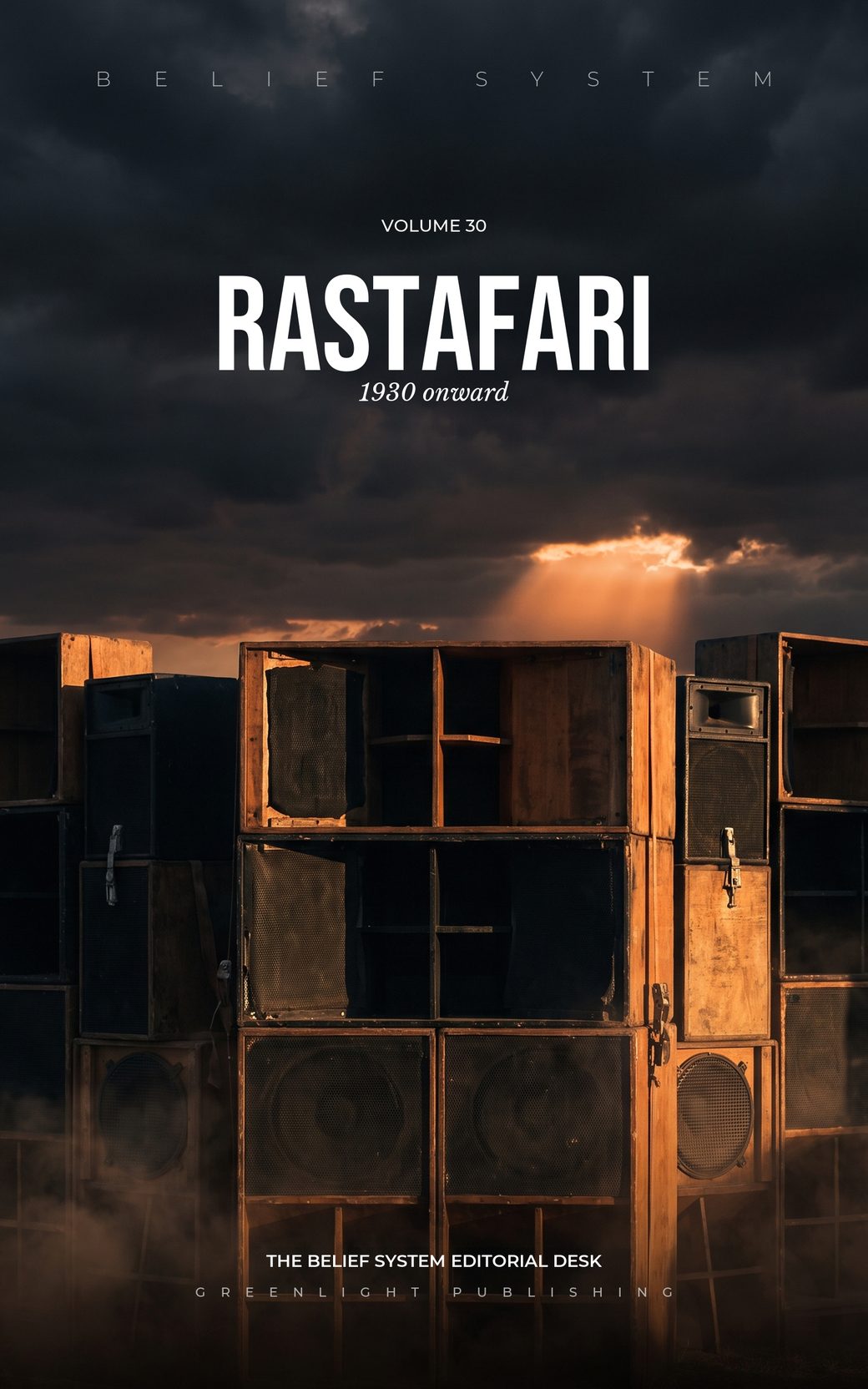
Volume 30 Belief System 1930 onward
Rastafari
The machinethe record
- Attested from
- 1930
- Narrates
- 1930 onward
The earliest secure evidence, and the key this volume is filed under. All thirty-one
The period the book actually covers. It is rarely the same figure.
The argument in one sentence
A movement that has never counted a million members, never built a central church, never closed a canon and never kept a treasury put its God’s name, its scripture’s cadence and its deliberately remade English into the ears of the whole world, because — alone in this series — its transmission machine was the commercial phonograph record: a consumer product that carried the doctrine to hundreds of millions who never converted, and carried the money to companies and estates that were never part of the movement.
the movement’s living God was a lifelong Ethiopian Orthodox Christian who publicly denied being divine in 1967, and some believers took the denial itself as proof.The commissioning line
What it is
The drums were on a dance record. The movement got onto it as a session act, and stayed.
A movement that has never counted a million members, never built a central church, never closed a canon and never kept a treasury put its name for God, its scripture’s cadence and its deliberately remade English into the ears of the whole world, because, alone in this series, its transmission technology was a consumer product.
A record asks nobody to join. How many people heard the doctrine without converting cannot be established, and the money reached companies and estates that were never part of the movement. Both are this book’s subject, and the second is the half usually left out.
From a coronation reported in the Jamaican press in 1930 to a movement whose vocabulary is worldwide. Four preachers who read the same news independently. A commune the police destroyed repeatedly. A Bible held to be authoritative and altered in transmission at the same time, read against itself. Houses rather than denominations, and what they said when the emperor died.
Five movements: the world it began in, the machine that carried it, the canon it never closed, the money, and the split.
The book never adjudicates, neither in the tourist register nor in the debunking register applied to the divinity of Haile Selassie. Much of the early record was made by colonial police, a hostile press and researchers the movement did not trust, and every one of them is named as such.
Belief System, Volume 30.
In full
This is the youngest tradition in the series with a real claim to be one, the smallest by adherents, and the one whose reach is most wildly out of proportion to its size. That disproportion is the volume’s question.
Rastafari is the only tradition here whose primary transmission technology is commercially recorded popular music: a doctrine distributed through a consumer product, to an audience that mostly did not convert and absorbed the theology anyway. The volume takes that seriously as engineering rather than as colour, and it takes equally seriously the two older machines that were not enough on their own, the reasoning session and the movement’s deliberate reconstruction of English to remove what its speakers identified as colonial assumptions. A transmission technology aimed at the grammar itself.
The canon movement is unusual. The King James Bible is the text, and it is read against itself, held to be authoritative and to have been altered in transmission by the powers the movement opposes, which is an unusual hermeneutic and gets a chapter of its own. The movement’s authoritative statements are events rather than documents.
The money movement is the thinnest in the series and says so rather than filling the space. Pinnacle’s extent and any adherent count are held at unverified rather than resolved into a number. What can be established is the largest and most awkward fact: the value generated by this movement’s cultural products went overwhelmingly to record companies and estates, while practitioners still carry convictions for a sacrament that is now an industry.
No lyrics are quoted. Reggae lyrics are in copyright and this series does not license them, so where a reader would expect one the book says what it is not printing and why. Selassie’s own recorded statements about his divinity are given beside the movement’s readings of him, and neither is given the last word.
Belief System is a history of world religion, one tradition at a time. Thirty-one volumes, ordered by earliest secure attestation.
The contents
26 chapters in five movements. Every volume in the series has the same five, in the same order, and each chapter below is printed with the idea it carries.
Movement OneThe World
Jamaica in 1930, and the question the movement answered. The evidence problem is stated at the start: the early history was recorded by colonial police, by a hostile press and by researchers, and each is named with their position every time they are used.
- 1The Coronation in the NewspaperOn 2 November 1930 Ras Tafari Makonnen was crowned in Addis Ababa as Haile Selassie I, King of Kings, Lord of Lords, Conquering Lion of the Tribe of Judah — and the event reached Kingston not by missionary or miracle but as press coverage, which several Jamaican preachers, independently of one another, read against the Book of Revelation and concluded that the King had come; a doctrine that arrived through mass media at its first moment is the volume’s whole story in miniature.
- 2The Garvey InheritanceThe political vocabulary was already on the island: Marcus Garvey’s UNIA — its membership claims printed as the organisation’s own numbers — had made Africa a destination and a black king thinkable, and a pageant at his Kingston headquarters staged the coronation of an African king months before Addis Ababa staged a real one; but the famous prophecy attributed to him is disputed, and Garvey’s own recorded verdict on Haile Selassie, in his 1937 editorials, was contempt — the movement’s regard for Garvey was never reciprocated, and both halves are reported.
- 3Ethiopia Stretches Out Her HandsThe theological vocabulary was older still: Ethiopianism — the Black Atlantic reading of Psalm 68’s promise that Ethiopia shall stretch out her hands unto God — had run through Black churches since the eighteenth century, George Liele’s Kingston congregation had called itself the Ethiopian Baptist Church in the 1780s, and Adwa in 1896, where an African empire defeated a European army, had given the reading a living state to point at; 1930 supplied that tradition with a coronation.
- 4The Island’s Own ChurchesRastafari did not land on empty religious ground: Jamaica’s own stream — Myal, the Native Baptists, the Great Revival of 1860–61, Revival Zion, and Alexander Bedward’s August Town movement, whose leader was committed to an asylum after announcing his own ascension — supplied the forms the first Rastafari used, and one founder, Robert Hinds, came directly out of Bedwardism; whether Rastafari is Revival’s child or its repudiation is contested among the scholars, and the contest is reported.
- 5Four Preachers, No FounderBetween 1931 and 1933 at least four men — Leonard Howell, Joseph Hibbert, Archibald Dunkley, Robert Hinds — began preaching the divinity of the crowned Emperor independently and nearly simultaneously, which means the movement has multiple founders and no origin point; the colony answered with a sedition trial in 1934, and the prosecution’s file is the first thick documentation of the doctrine — the movement enters the written record in its enemy’s handwriting, a fact the whole volume has to manage and says so here.
- 6The Year the Island BurnedThe material conditions did not stay abstract: depression wages, land hunger and unemployment broke open in the labour rebellion of 1938 — Frome, the Kingston waterfront, dead strikers, the Moyne Commission taking evidence — and out of it came unions, parties and eventual self-government; Rastafari watched the same conditions and drew the opposite conclusion, that no Jamaican politics could answer them, and its refusal of the 1938 settlement is what a transmission machine would have to carry — which hands the next movement its subject.
Movement TwoThe Machine
The transmission technology, named as a concrete object or institution — not an abstraction. Here: the commercially recorded popular song — the only tradition in this series whose primary transmission technology is a consumer product — and, before it, the two machines that were not enough on their own: the reasoning session and the remade language.
- 7The Reasoning and the GroundationThe movement’s first machine was talk with a discipline: the reasoning session — unchaired, scripture-anchored argument in which doctrine is made, tested and remembered without any clergy to close it — and the groundation, the drummed assembly that binds the camps together; it is a complete oral transmission system and it worked, but its range was the yard and the hill, and a movement carried only by reasoning would have stayed a Jamaican one.
- 8Word, Sound and PowerThe second machine is aimed at the grammar itself: the I-words — I-and-I for me and for us, I-man, Ital, overstand for understand, downpression for oppression — a deliberate reconstruction of English on the stated principle that a word’s sound should not contradict its sense, built by speakers who identified the inherited language as a colonial instrument; it is a transmission technology for a worldview, installed syllable by syllable, and it travels inside every sentence a believer speaks.
- 9From Wareika Hill to Brentford RoadThe drums walked into the recording industry: Count Ossie’s camp above East Kingston taught the burru-derived Rasta hand-drumming, and when his drummers backed the Folkes Brothers’ “Oh Carolina” — produced by Prince Buster around 1960 — Rastafari sound entered the Jamaican hit parade; the sound systems, and then Clement Dodd’s Studio One on Brentford Road and Duke Reid’s Treasure Isle, industrialised the channel, and by the mid-sixties the island’s popular music was carrying the movement’s drums, themes and men — including three Trench Town singers called the Wailers — while radio largely would not.
- 10Catch a FireIn 1972 Island Records signed the Wailers and sold Rastafari to the world as an album: Catch a Fire (1973) was re-engineered in London for the rock market — overdubbed guitars, a gatefold sleeve — which is the machine visible in the act of export, a doctrine remastered for listeners who had never seen Jamaica; within four years a Kingston vocal group fronted by a Rastafari convert was an international touring act whose set list included a song, “War,” whose text is Haile Selassie’s 1963 address to the United Nations nearly verbatim — so the chapter quotes the speech from the General Assembly’s official record, names the song and its arrangers, and quotes no lyric.
- 11The Audience That Did Not ConvertThe machine’s oddity is the point: reggae carried a scriptural and political vocabulary — Babylon, Zion, Exodus, I-and-I, the name of Haile Selassie — into countries where the movement had no members at all, to an audience that mostly did not convert and largely absorbed the theology anyway; a German-based disco group took a Rastafari setting of Psalm 137 to the top of European charts, a Rastafari band played Zimbabwe’s independence ceremony in 1980, and communities from West Africa to Aotearoa formed around records before any elder arrived — and the chapter also names what the record cannot carry: reasoning, livity, the sacrament, a congregation.
Movement ThreeThe Canon
What is in, what is out, who decided, when, and what the decision cost. The real subject is who had the authority to close it — and this movement’s answer, unique in the series, is that nobody did, on purpose, and it never closed.
- 12The Canon That Never ClosedRastafari has no creed, no catechism, no ordination, no membership roll and no body empowered to issue one — doctrine is made in reasoning and held by elders, which means the authority question every canon chapter in this series asks is answered here in the negative; the cost is genuine doctrinal range on first-order questions (who Selassie is, what repatriation means), the benefit is that no institution exists for a state to capture or a schism to fight over, and the chapter opens with that argument, not with a text.
- 13The Stolen BookThe movement’s one text is the King James Bible, and it is read through an unusual hermeneutic that deserves this full chapter: the book is held to be the true history of the black race and a translation altered in transmission by the very powers the movement opposes — authoritative and suspect in the same breath — so reading is recovery: citing chapter and verse aloud, correcting “corruption” against the reader’s own inspiration, finding the black Messiah in the texture of the English text itself; the proof texts are quoted, in the King James rendering, because that rendering is itself the subject.
- 14The Piby and the Kebra NagastAround the Bible circulate texts with contested status and no authority to settle it: Robert Athlyi Rogers’s Holy Piby (1924) and Fitz Balintine Pettersburgh’s Royal Parchment Scroll of Black Supremacy (1926), both public domain and quoted here; Howell’s The Promised Key (c. 1935, under the pen name G. G. Maragh), which Hill showed to be substantially derived from Pettersburgh; and the Kebra Nagast, the fourteenth-century Ethiopian national epic that grounds the Solomonic line, quoted in Budge’s 1922 rendering, named — texts in circulation, revered by some and unread by others, and none of them ever closed into a canon, which is the finding.
- 15The Convention Is the TextWith no synod and no press office, the movement’s authoritative statements are events: Prince Emanuel Edwards’s twenty-one-day Universal Convention at Back-o-Wall in March 1958; Claudius Henry’s sale of cards for an October 1959 repatriation day on which no ships came, and the treason case that followed in 1960; and, in their wake, the closest thing Rastafari has to an authorised self-description — a university report the elders themselves asked for, whose recommendations produced an official Mission to Africa in 1961 that published majority and minority reports; gatherings, cards, missions and commissioned scholarship are what this tradition has instead of council minutes, and the chapter reads them as its conciliar record.
- 16The VisitOn 21 April 1966 Haile Selassie landed at Palisadoes airport and the crowd covered the tarmac so completely that the Emperor did not leave the plane until Mortimo Planno was brought forward to clear a path — an event the movement keeps as Groundation Day, in the calendar where its canon lives; what the visit settled is reported in the movement’s own terms, what it is said to have produced — the counsel of “liberation before repatriation” — is attributed through Planno’s circle with no primary record and is labelled so; and the state’s side of the decade is in the frame: three years earlier at Coral Gardens the security forces had answered an incident with mass detention of Rastafari, for which a Jamaican prime minister apologised in 2017.
Movement FourThe Money
Who paid, who was paid, and how we know. This is the thinnest money movement in the series, the volume says so instead of filling the space, and UNVERIFIED stands wherever a figure cannot be sourced. Numbers get their provenance in the same sentence.
- 17The Missing TreasuryEvery other volume in this series found an economy — temple estates, tithes, a waqf, a printing concession; Rastafari has no tithe, no collection plate, no central fund and no body that could hold one, and this chapter argues that the absence is the same fact as the absent canon: no centre, so no treasury — what exists instead is small and personal, the trades of men outside Babylon’s payroll (fishing, farming, craft, later the broom-making of one mansion), and the earliest recorded transaction in the movement’s history is Howell selling pictures of the Emperor at about a shilling, a figure that comes from his prosecutors and is labelled so.
- 18PinnacleIn 1940 Howell established Pinnacle, a commune in the hills of St Catherine — the movement’s one attempt at a landed economy: subsistence crops and, per the prosecution at his trials, ganja as the cash crop — and the state destroyed it in instalments: raided in 1941, broken up in 1954, finally cleared in 1958, its people scattering into West Kingston with their locks and their doctrine, which is one reason the movement’s next stronghold was a slum within walking distance of the recording studios; the dates are in the court and press record, the acreage and revenue are not, and where the figures should stand the text says UNVERIFIED.
- 19The Land at ShashamaneThe movement’s one land asset abroad came from the man it holds divine: land at Shashamane, conventionally dated to a 1948 grant, administered through the Ethiopian World Federation — founded in New York in 1937 to fund Ethiopia’s war resistance, with locals in Jamaica — and settled from the 1950s onward by families who paid their own way; the Derg’s land nationalisation after 1974 cut the settlement down, the surviving community holds residence without citizenship, and every figure in the chapter — the grant’s extent, the settler counts, the reduction — is taken from the one archival study or not printed at all.
- 20Who Got PaidThe largest and most awkward fact in the movement’s economics: the value its culture generated went overwhelmingly to record companies and estates rather than to the movement — session men paid flat fees while catalogues compounded abroad, the Marley estate litigated for a decade after an intestate death and the catalogue’s subsequent sales involved sums the movement never saw — and the modern cannabis industry has commercialised the sacrament while practitioners still carry convictions under the laws that criminalised it, a fact Jamaica’s 2015 statute, which decriminalised possession and recognised sacramental use, acknowledges without undoing; enormous value, almost none captured, and the chapter says exactly that.
Movement FiveThe Split
What divided it, what it became, what it handed on. Rastafari’s divisions are houses — Mansions — rather than schisms, because there was never a centre to break from; the movement had to survive its God’s reported death; and the Ethiopian Orthodox Church complicates every account. Names the next volume by NAME, never by number.
- 21Many MansionsThe movement’s own word for its divisions is taken from the King James rendering of John — “In my Father’s house are many mansions” — and it is doing real work: the Mansions are not denominations, because there is no communion to be out of; they differ along three axes — organisation, the status of Selassie, and separatism — and the differences were prefigured in the late 1940s by the House of Youth Black Faith, whose young “Dreadfuls” argued the older “combsomes” down and made the matted locks a covenant; the origin of dreadlocks itself is contested — camp discipline, Kenyan newspaper photographs, the Nazirite vow — and the volume names the positions rather than picking one.
- 22The Order of the NyabinghiThe eldest house is barely an organisation at all: the Nyabinghi Order — its name arriving in Jamaica through a 1935 newspaper article about a supposed African order sworn against the colonisers, a text now traced to Italian propaganda, which the young movement adopted and made its own — keeps the drums, the groundation calendar of imperial anniversaries, and the strictest Selassie-centred doctrine, and holds that organisation itself is Babylon’s habit; it is the movement’s liturgical spine, and it owns the assemblies at which the other houses must still drum.
- 23The Priest at Bull BayBobo Ashanti — the Ethiopia Africa Black International Congress, founded by Prince Emanuel Edwards, visible since his 1958 convention — is the house that did build an institution: a hill commune above Bull Bay under a priestly rule of robes and turbans, sabbaths and psalms, with a working economy of brooms and handicrafts that makes it the one mansion whose money is visible; its doctrine adds a black trinity — Garvey the prophet, Emanuel the priest, Selassie the king — and its separatism is total: repatriation with reparations, demanded of the state in petitions it has never stopped writing.
- 24The Twelve Tribes of IsraelThe youngest large house is the most organised and the least separatist: founded in Kingston in 1968 by Vernon Carrington, called Prophet Gad, the Twelve Tribes of Israel assigns members to tribes by birth month, keeps an executive and collects dues — the movement’s one formal membership structure — reads the Bible on a fixed programme of a chapter a day, holds a reading of Selassie closer to Christ-centred than the Nyabinghi’s, and recruited the middle class and the musicians: it is the mansion that plugged into the machine, and the reason the reggae the world heard carries one house’s accent.
- 25The News from Addis AbabaIn September 1974 the Derg deposed the Emperor and in August 1975 announced his death, and the movement met the event every believing community dreads — and did not break: the range of answers, reported here as the movement’s own positions and adjudicated by nobody, ran from flat denial (Babylon’s press, no body shown) through the doctrine that God cannot die and the flesh was a vehicle, to the reading that His life continues in I-and-I; within weeks a record — named here, its argument described, its lyric unquoted — carried the theological answer to the world’s shops, which is this volume’s machine working at the exact moment of crisis; the remains identified in 1992 and buried in 2000 changed less inside the movement than outside observers expected, and the outsiders’ favourite frame is named as an outsider’s frame.
- 26The Emperor’s ChurchThe complication that runs through every account gets the last chapter: Haile Selassie was a lifelong communicant of the Ethiopian Orthodox Church — a church whose separate history goes back to the council disputes told in the Imperial Christianity volume — and that church, which does not hold him divine, came to Jamaica at his instance in 1970 under Abuna Yesehaq and baptised Rastafari by the hundreds, including, days before his death, the movement’s most famous voice; the Emperor’s own recorded denial of divinity, broadcast in a 1967 interview, is reported in his interpreter’s words, and the movement’s readings of the denial — including the reading that God would say exactly that — are reported beside it, held by nobody here; what Rastafari hands on is its strangest legacy: an audience of millions holding pieces of a theology without joining anything, which is the world of the volume on the unaffiliated.
What this volume cannot establish
Printed in the book before the argument is, and printed here for the same reason. A history of a tradition that will not say where its evidence runs out is not a history.
- Whether Marcus Garvey ever said “Look to Africa, where a black king shall be crowned.”. The line is attributed to him everywhere and attested nowhere contemporary; the earliest attributions postdate the coronation, and the sentence is also attributed to the preacher James Morris Webb. It is reported in this volume as an attributed and disputed saying, never as a quotation — and what the record does show is printed beside it: Garvey’s own paper published sharply critical editorials about Haile Selassie in 1937.
- How many Rastafari there are, now or at any date. The movement keeps no rolls, and much of it regards being counted as Babylon’s business. The 2011 Jamaican census figure is printed as the census’s own number; the circulating global figure of “about a million” is an estimate with no defensible method behind it, and the volume says so each time it appears. The volume’s own framing — a movement of perhaps a million — is UNVERIFIED at its core, and that is stated on the first page it is used.
- Pinnacle’s extent, population and revenue. The founding (1940), the first raid (1941), the destruction (1954) and the final clearance (1958) are in the court and press record. The acreage and income figures that circulate are unsourced and are not printed. UNVERIFIED stands where a number would otherwise go, until a title deed or survey is found.
- The movement’s early doctrine in its own words. Before the 1950s, Rastafari speaks in the surviving record almost entirely through police testimony, sedition prosecutions and a hostile press. The volume quotes those records — they are most of what exists — and names the recorder and the recorder’s position every time, in the sentence.
- What Haile Selassie made of the movement. His recorded public statements exist and are reported, including his 1967 broadcast denial of divinity; his interior state does not, and is not invented. Whether he said “liberation before repatriation” during or after the 1966 visit is attributed through oral accounts, chiefly Mortimo Planno’s circle, with no primary record — it is reported as attributed, not as speech.
- What the records sold and who heard them. Jamaican chart and studio paperwork is fragmentary; international sales totals in circulation are promotional numbers. A figure is printed only with an audited or documentary source in the same sentence, and otherwise the word is UNVERIFIED.
- Anyone’s interior state.
Sources
56 works, dated, and specific enough that a reader can go and look at the thing. Nothing is on this list that the desk did not consult.
| # | Document or work | Date | Evidence for |
|---|---|---|---|
| 1 | Daily Gleaner coronation coverage | November 1930 | the crowning as foreign news in Kingston |
| 2 | Robert A. Hill, “Leonard P. Howell and Millenarian Visions in Early Rastafari,” Jamaica Journal | 1983 | four preachers dated from late interviews; Howell’s millenarian sources |
| 3 | Barry Chevannes, Rastafari: Roots and Ideology | 1994 | Revival parentage; the four careers; Youth Black Faith; Bobo rule |
| 4 | King James Bible | 1611 | the movement’s own text: Revelation 5:5 and 19:16 against the imperial style |
| 5 | Amy Jacques Garvey ed., The Philosophy and Opinions of Marcus Garvey | 1923–25 | “the God of Ethiopia” read through Ethiopian spectacles |
| 6 | UNIA, Declaration of the Rights of the Negro Peoples of the World | August 1920 | Africa for the Africans; red, black and green |
| 7 | Marcus Garvey, The Black Man editorials | 1937 | contempt for Selassie after the exile; paraphrased, issues not obtained |
| 8 | Horace Campbell, Rasta and Resistance | 1985 | Ethiopianism as anti-colonial politics; Mau Mau photographs and the locks |
| 9 | Ennis B. Edmonds, Rastafari: From Outcasts to Culture Bearers | 2003 | later export identity; the 1935 article as Italian propaganda |
| 10 | Daily Gleaner on Alexander Bedward | 1920–21 | announced ascension; march; asylum; death 8 November 1930 |
| 11 | Daily Gleaner court reporting, Morant Bay | 13 March 1934 | Howell and Hinds sedition trial; picture sales as prosecution testimony |
| 12 | West India Royal Commission (Moyne), recommendations and withheld body | 1940; body 1945 | wages, housing, the labour rebellion of 1938 |
| 13 | Ethiopian World Federation constitution and by-laws | 25 August 1937 | one-dollar joining fee; a treasury that was not Rastafari’s |
| 14 | M. G. Smith, Roy Augier and Rex Nettleford, The Ras Tafari Movement in Kingston, Jamaica | 1960 | meetings, doctrine summary, distinctive speech; asked for by brethren |
| 15 | Joseph Owens, Dread: The Rastafarians of Jamaica | 1976 | resident Jesuit observer of yards and livity |
| 16 | John P. Homiak, Dub History: Soundings on Rastafari Livity and Language | 1995 | elder speech and ritual; the 1966 visit as state strategy |
| 17 | Velma Pollard, Dread Talk: The Language of Rastafari | 1994; reissued 2000 | the I-words as a reconstruction of English |
| 18 | Velma Pollard, article on Rastafari speech, Caribbean Quarterly | 1980 | earlier description of the same vocabulary |
| 19 | Midas Chawane, New Contree | 2014 | I-and-I, overstand, downpression, outernational |
| 20 | Erna Brodber, New West Indian Guide | 1987 | sound-system sales versus radio playlists |
| 21 | The Wailers, Catch a Fire, Island ILPS 9241 | 13 April 1973 | London overdubs and the Zippo sleeve; doctrine remastered for export |
| 22 | UN General Assembly official record, 1229th plenary, 18th session | 4 October 1963 | Selassie’s address; the English supplied by the delegation; source of “War” |
| 23 | Official Charts Company listing, Boney M, “Rivers of Babylon” | 29 April 1978 | five weeks at British number one |
| 24 | Neil J. Savishinsky, New West Indian Guide | 1994 | communities formed around records before any elder arrived |
| 25 | Barry Chevannes, New West Indian Guide | 1990 | no united body; the Assembly of Elders as recognition, not office |
| 26 | Colonial Office files recovered by Frank Jan van Dijk | 1957–59 | constabulary counts; Henry’s card; the telegram to the Queen |
| 27 | Charles Price, New West Indian Guide | 2003 | the Holy Piby as a stolen-book precedent, via Sundkler |
| 28 | Bengt Sundkler on independent churches | 1964 | a book called the Holy Piby among South African readers |
| 29 | Robert Athlyi Rogers, The Holy Piby | 1924 | the first of the circulating extra-biblical books |
| 30 | Fitz Balintine Pettersburgh, Royal Parchment Scroll of Black Supremacy | conventionally dated 1926 | the second; source of much of Howell’s pamphlet |
| 31 | Leonard Howell, The Promised Key, as G. G. Maragh | mid-1930s | described, not quoted at length; Hill’s derivation from Pettersburgh |
| 32 | Kebra Nagast, E. A. Wallis Budge, The Queen of Sheba and Her Only Son Menyelek | 14th c. text; trans. 1922 | the Solomonic line in named English |
| 33 | Public Opinion on the Universal Convention | March 1958 | Edwards’s twenty-one-day gathering at Back-o-Wall |
| 34 | Claudius Henry’s repatriation card, Colonial Office copy | 1959 | “Pioneering” wording; a court exhibit |
| 35 | The Report of the Mission to Africa, majority and minority | 1961 | official self-description after the 1960 study |
| 36 | Rastafari: The Reports reprint | 2010 | the 1961 Mission reports as later circulated |
| 37 | Daily Gleaner on the Palisadoes landing | April 1966 | the tarmac crowd; Groundation Day |
| 38 | Public Defender’s findings and the parliamentary apology | April 2017 | Coral Gardens detentions; trust fund; six lots at Pinnacle |
| 39 | Jamaica Registration of Titles Act | as cited in the chapter | no deed or survey for Pinnacle in the surviving file |
| 40 | Ethiopian World Federation website statement of the Shashamane grant | grant conventionally 1948 | five hundred acres as the Federation’s own figure, no deed seen |
| 41 | Giulia Bonacci, Exodus! Heirs and Pioneers: Rastafari Return to Ethiopia | 2015 | the archival study of the return; counts left in her archive |
| 42 | Fifty-Six Hope Road Music v. A.V.E.L.A., 688 F. Supp. 2d 1148 | 25 February 2010 | “Bob Marley died intestate in 1981”; the trademark chain |
| 43 | Ninth Circuit opinion, 778 F.3d 1059 | 20 February 2015 | merchandise profits and the fee award |
| 44 | Dangerous Drugs (Amendment) Act (Jamaica) | in force 15 April 2015 | sacramental exception; the Minister decides who is an adherent |
| 45 | Ministry of Justice fact sheet and sacramental-cultivation forms | 2015–16 | title, roll, leader, receipt — what the movement has never had |
| 46 | David Katz and Lloyd Bradley, interview material | as used 2000, 2003 | session flat fees as recollection, not ledgers |
| 47 | King James rendering of John 14:2 | 1611 | “many mansions” as the movement’s own word for its houses |
| 48 | King James rendering of Numbers 6:5 | 1611 | the Nazirite vow read as a permanent lock |
| 49 | Jamaica Times “Nya-Binghi” article | 1935 | Italian propaganda that supplied the Order’s name |
| 50 | Frank Jan van Dijk, New West Indian Guide | 1988 | the Twelve Tribes’ executive, dues and membership |
| 51 | Scofield Reference Bible | 1909; revised 1917 | the edition the Twelve Tribes reads, notes and all |
| 52 | Leon Festinger, Henry Riecken and Stanley Schachter, When Prophecy Fails | 1956 | an outside “failed prophecy” frame, named and not adopted |
| 53 | Ethiopian state media death announcement | 28 August 1975 | the reported death; no body shown |
| 54 | Canadian broadcast interview, Bill McNeil | 1967 | Selassie’s denial of divinity, reported in indirect speech |
| 55 | Ethiopian Orthodox mission under Abuna Yesehaq | from 1970; baptism 4 November 1980 | hundreds baptised; Marley named; the church does not hold him divine |
| 56 | Charles Price, Becoming Rasta | 2009 | how doctrine is transmitted and tested, labelled ethnography |
Common questions
When is Rastafari first securely attested?
1930. That is the earliest date the surviving evidence supports, and it is the key this volume is filed under. It is not the same claim as when the tradition began: the tradition’s own account of its beginning is printed beside it in the book’s front matter, never instead of it.
What period does the book cover?
1930 onward. The coverage span and the attestation date are two different facts, and the gap between them is often the most interesting thing about a volume.
What carried Rastafari?
The record. Movement Two of every volume is about the transmission technology — the concrete object or institution that made copying possible, and would not have existed a century earlier.
How long is it?
About 31,000 words, roughly 130 minutes’ reading, 132 pages in the paperback. The audiobook runs 3h 11m, measured from the finished masters.
What does this volume not claim to establish?
Whether Marcus Garvey ever said “Look to Africa, where a black king shall be crowned.”. The line is attributed to him everywhere and attested nowhere contemporary; the earliest attributions postdate the coronation, and the sentence is also attributed to the preacher James Morris Webb. It is reported in this volume as an attributed and disputed saying, never as a quotation — and what the record does show is printed beside it: Garvey’s own paper published sharply critical editorials about Haile Selassie in 1937. Every volume prints its own limits before it prints its argument; there are 7 on this one’s list.
Does the book say which tradition is true?
No. Belief System does not adjudicate. Where the tradition’s account and the earliest evidence disagree, both are given, in their own vocabulary, attributed, and neither is given the last word. No miracle is reported as fact and none is denied.
Can I buy Rastafari in print?
Yes. It is a 5.5 × 8.5 in paperback, 132 pages, $12.99 a copy, bought direct rather than through a retailer. All thirty-one together are $199.00, with the ebook and the audiobook of every volume included.
The edition
| Trim | 5.5 × 8.5 in / 140 × 216 mm |
|---|---|
| Binding | Perfect-bound paperback, matte laminate |
| Paper | 60# uncoated cream, black ink |
| Extent | 132 pages |
| Edition | Extent | ISBN |
|---|---|---|
| Paperback | 132 pages, 5.5 × 8.5 in | ISBN not yet issued |
| Ebook | EPUB | 979-8-90623-871-9 |
| Audiobook | 3h 11m | 979-8-90623-872-6 |
| BISAC 1 | `REL017000` RELIGION / Comparative Religion |
|---|---|
| BISAC 2 | `REL033000` RELIGION / History |
| BISAC 3 | `REL000000` RELIGION / General |