19 illustrations · 2:12
Watch & listen.
Follow the images with a narrated journey through the book.










Overview
- Coverage
- 1930 onward
- Earliest secure evidence
- 1930
- Transmission
- the record
Rastafari is the only tradition here whose primary transmission technology is commercially recorded popular music: a doctrine distributed through a consumer product, to an audience that mostly did not convert and absorbed the theology anyway. The volume takes that seriously as engineering rather than as colour, and it takes equally seriously the two older machines that were not enough on their own, the reasoning session and the movement’s deliberate reconstruction of English to remove what its speakers identified as colonial assumptions. A transmission technology aimed at the grammar itself.
The coverage period and the earliest secure evidence are different dates. A tradition’s own account of its beginnings may differ from both.
Historical setting
The Coronation in the Newspaper
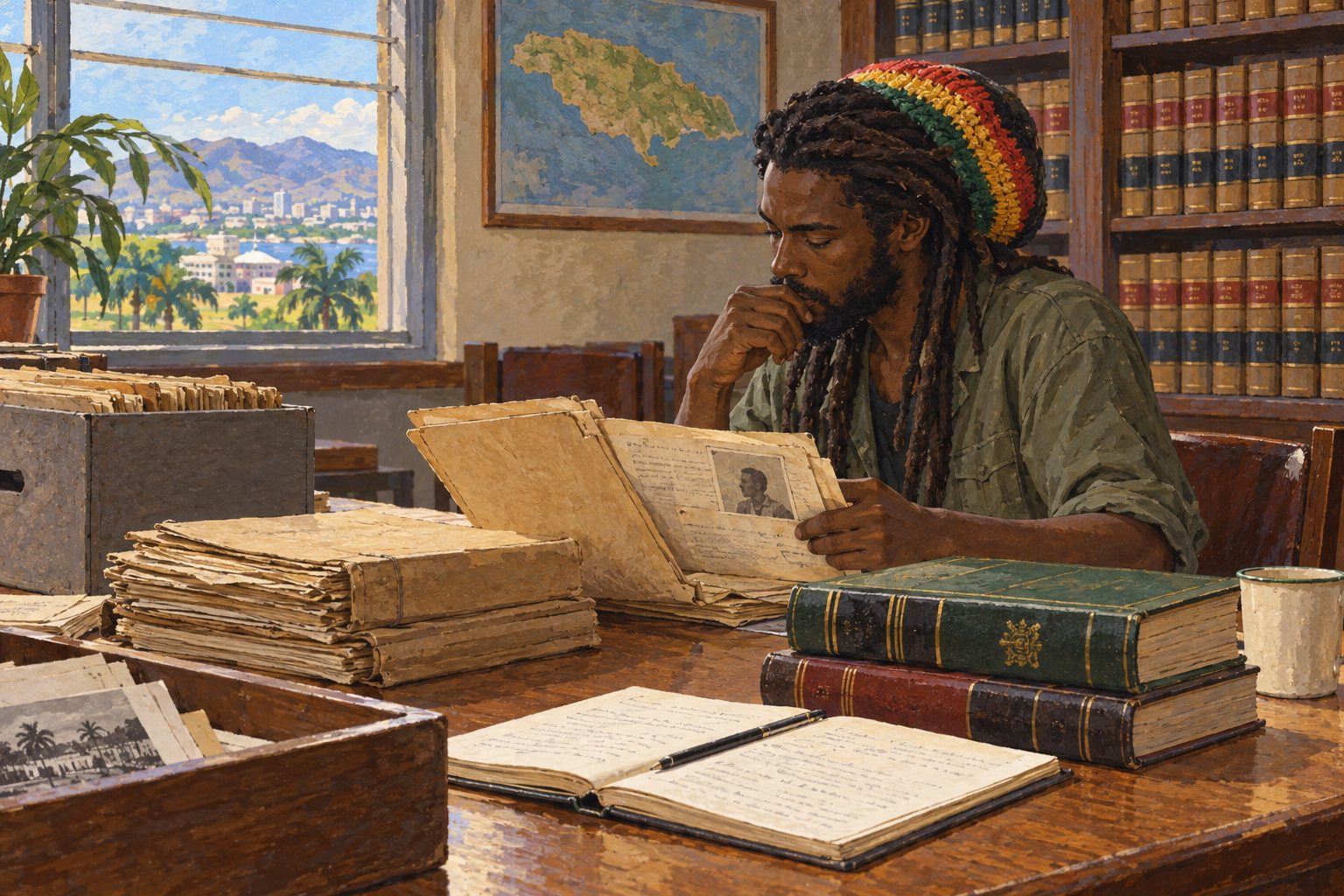
On 2 November 1930 Ras Tafari Makonnen was crowned in Addis Ababa as Haile Selassie I, King of Kings, Lord of Lords, Conquering Lion of the Tribe of Judah — and the event reached Kingston not by missionary or miracle but as press coverage, which several Jamaican preachers, independently of one another, read against the Book of Revelation and concluded that the King had come; a doctrine that arrived through mass media at its first moment is the volume’s whole story in miniature.
The Garvey Inheritance
The political vocabulary was already on the island: Marcus Garvey’s UNIA — its membership claims printed as the organisation’s own numbers — had made Africa a destination and a black king thinkable, and a pageant at his Kingston headquarters staged the coronation of an African king months before Addis Ababa staged a real one; but the famous prophecy attributed to him is disputed, and Garvey’s own recorded verdict on Haile Selassie, in his 1937 editorials, was contempt — the movement’s regard for Garvey was never reciprocated, and both halves are reported.
Explore the illustrations6 scenes · Cultivation in the Hills
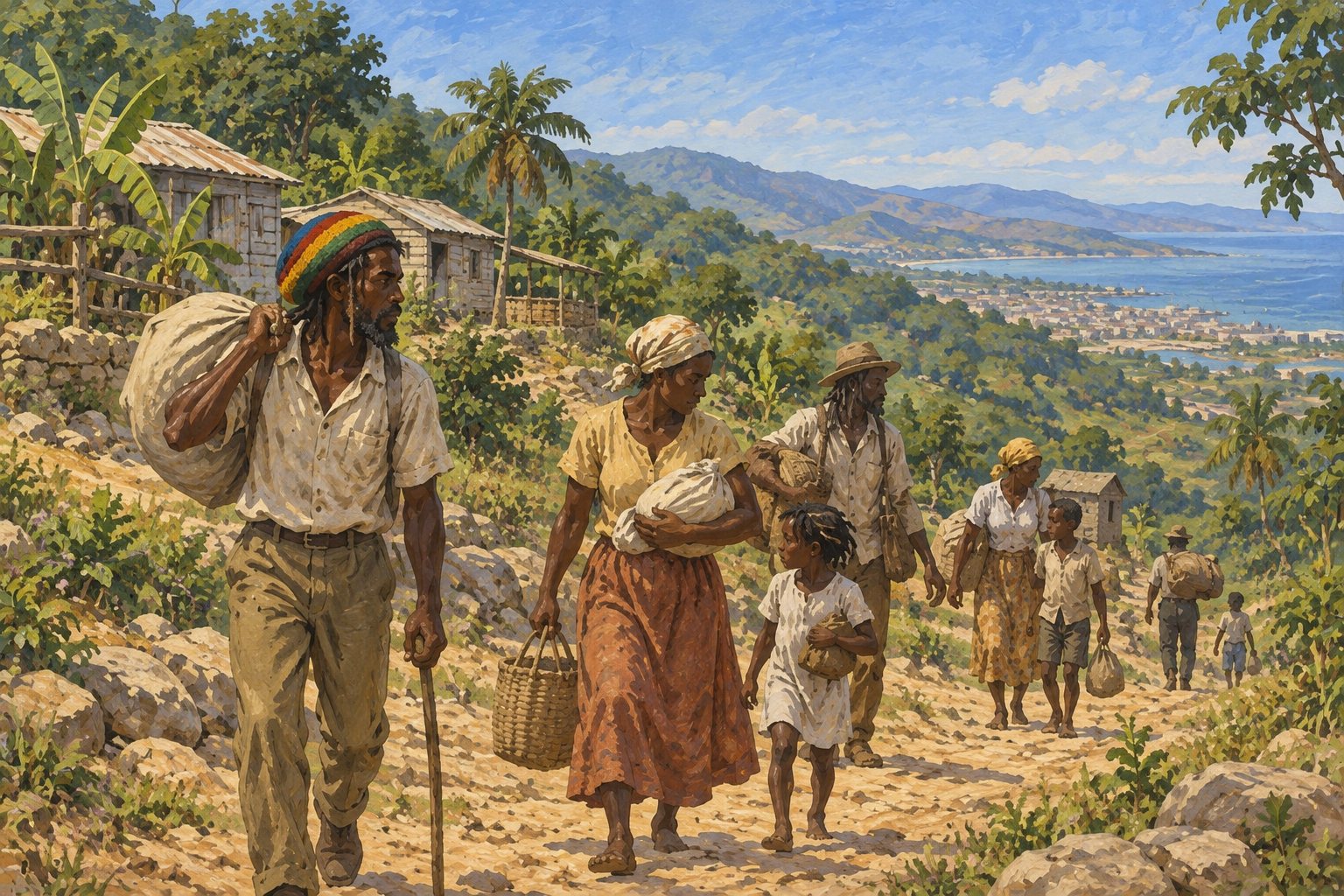
Cultivation in the Hills. In 1940 Howell established Pinnacle, a commune in the hills of St Catherine — the movement’s one attempt at a landed economy: subsistence crops and, per the prosecution at his trials, ganja as the cash crop — and the state destroyed it in instalments: raided in 1941, broken up in 1954, finally cleared in 1958, its people scattering into West Kingston with their locks and their doctrine, which is one reason the movement’s next stronghold was a slum within walking distance of the recording studios; the dates are in the court and press record, the acreage and revenue are not, and where the figures should stand the text says UNVERIFIED.
How it was transmitted
The Reasoning and the Groundation
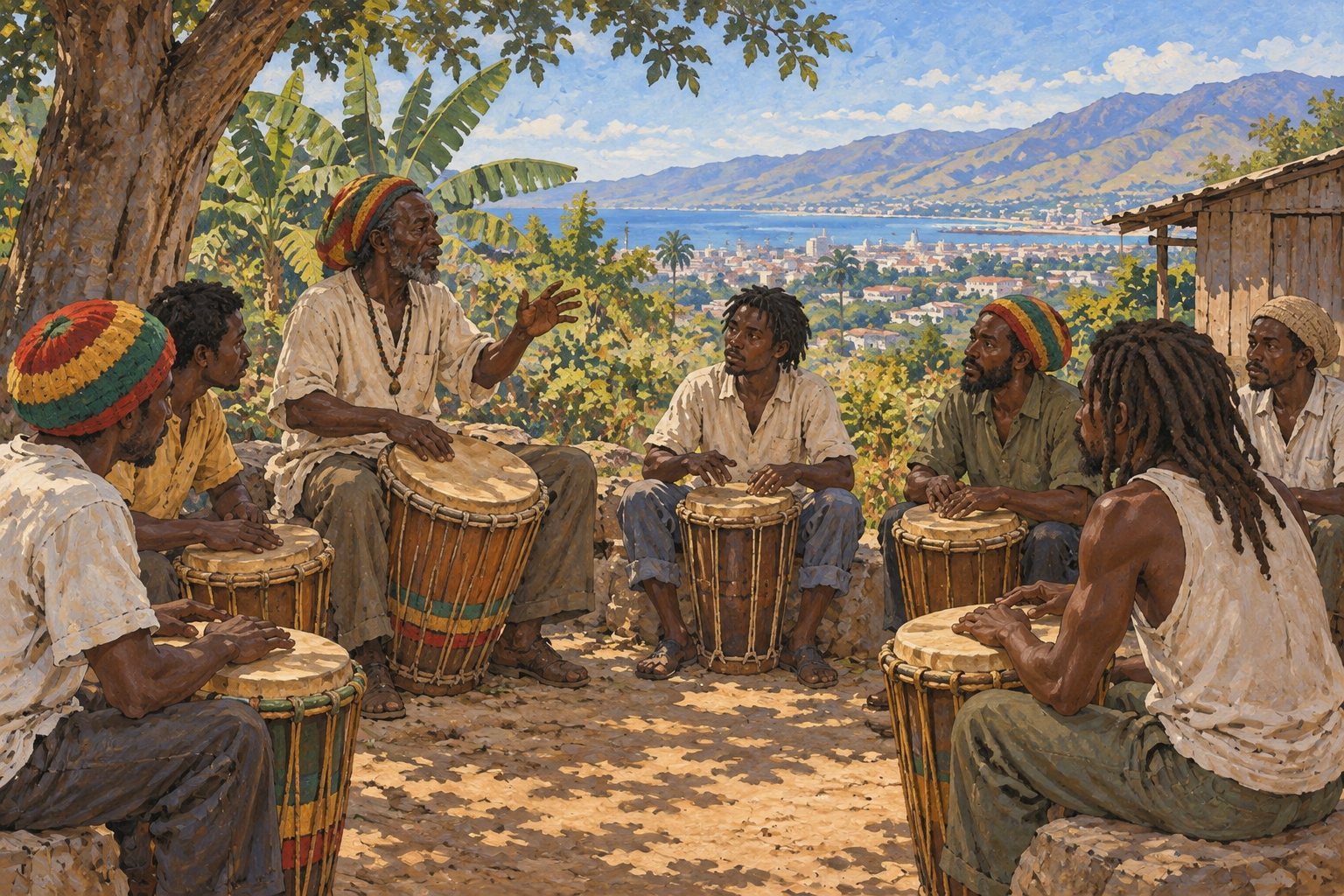
The movement’s first machine was talk with a discipline: the reasoning session — unchaired, scripture-anchored argument in which doctrine is made, tested and remembered without any clergy to close it — and the groundation, the drummed assembly that binds the camps together; it is a complete oral transmission system and it worked, but its range was the yard and the hill, and a movement carried only by reasoning would have stayed a Jamaican one.
Word, Sound and Power
The second machine is aimed at the grammar itself: the I-words — I-and-I for me and for us, I-man, Ital, overstand for understand, downpression for oppression — a deliberate reconstruction of English on the stated principle that a word’s sound should not contradict its sense, built by speakers who identified the inherited language as a colonial instrument; it is a transmission technology for a worldview, installed syllable by syllable, and it travels inside every sentence a believer speaks.
Explore the illustrations6 scenes · Drums Enter the Studio
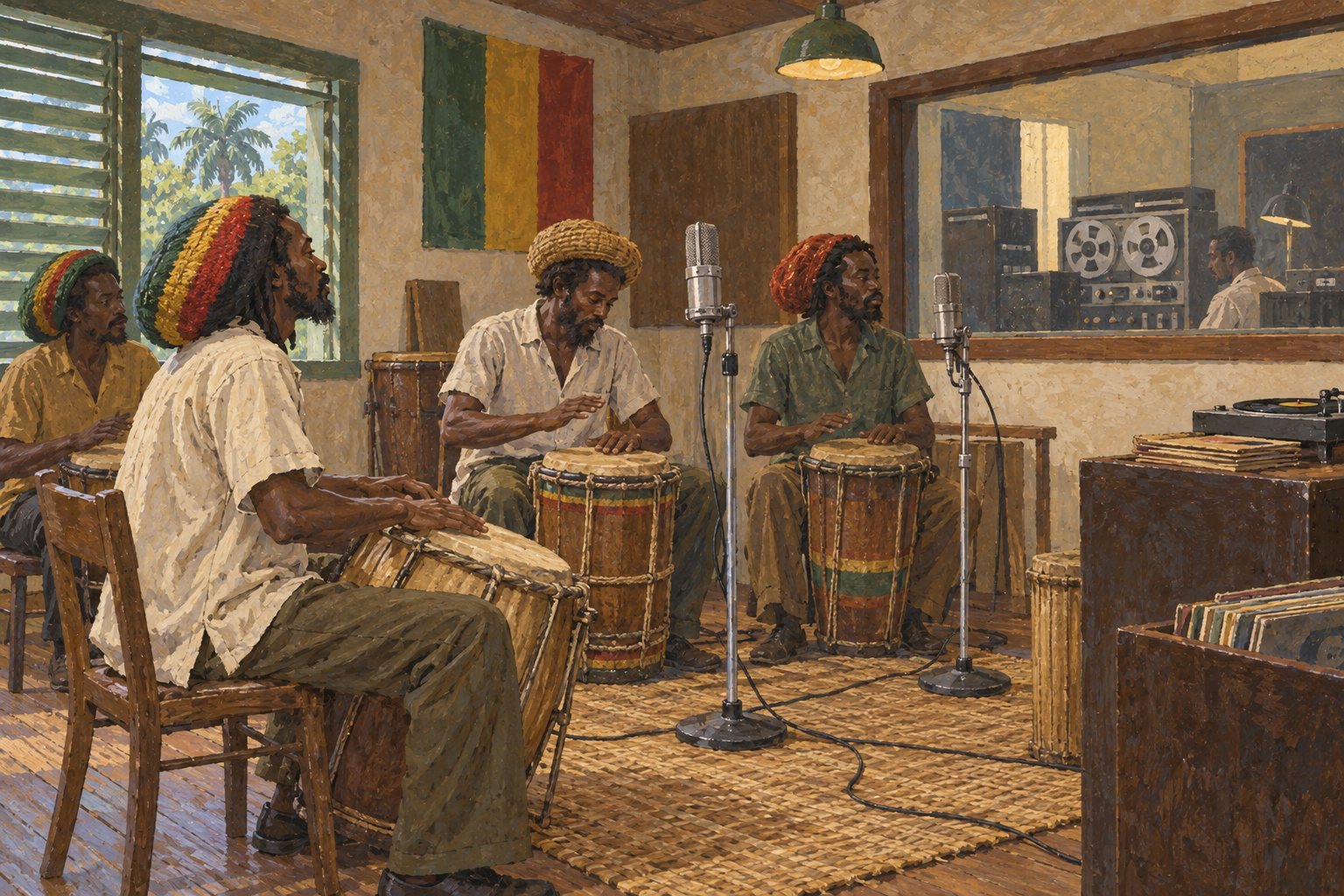
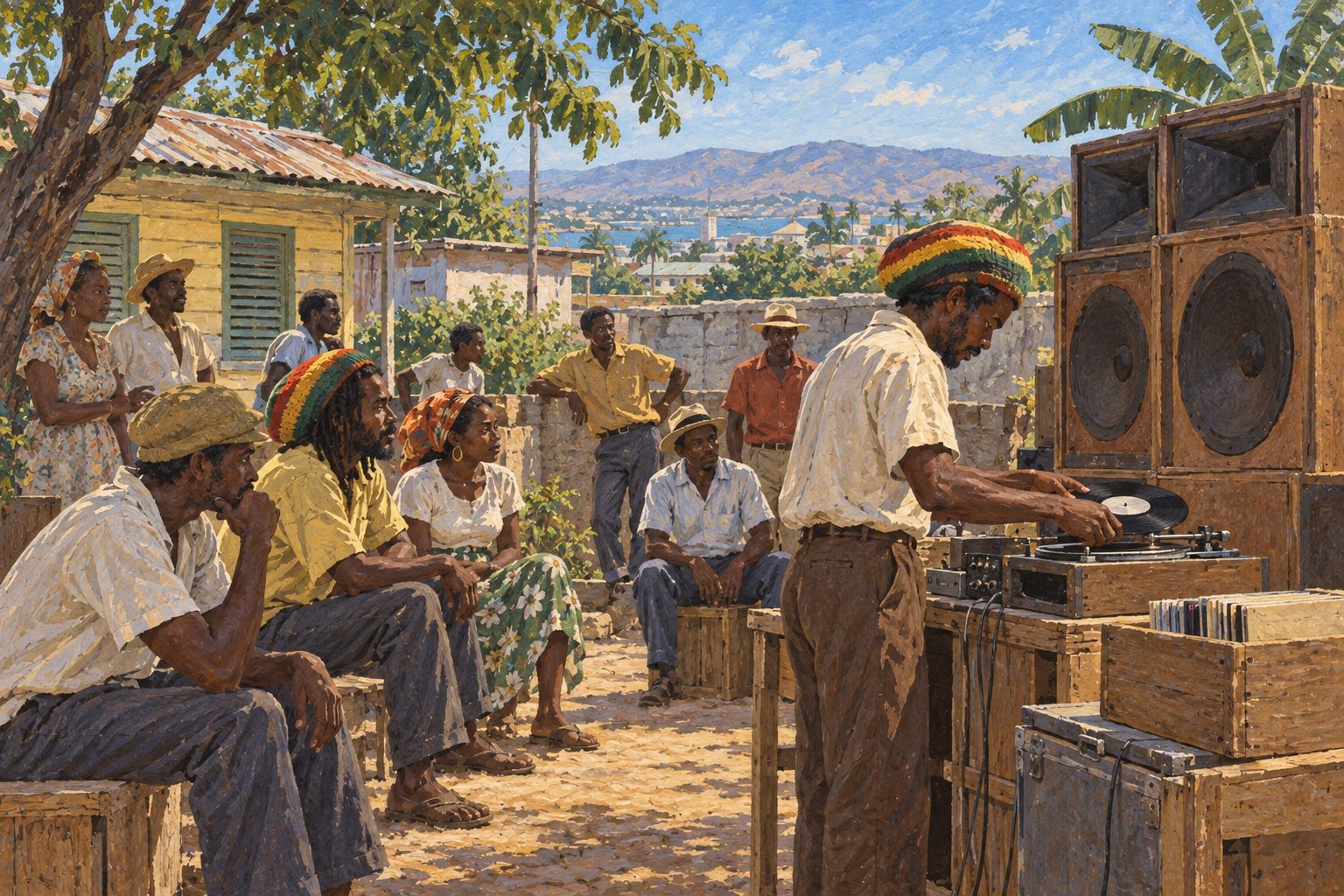
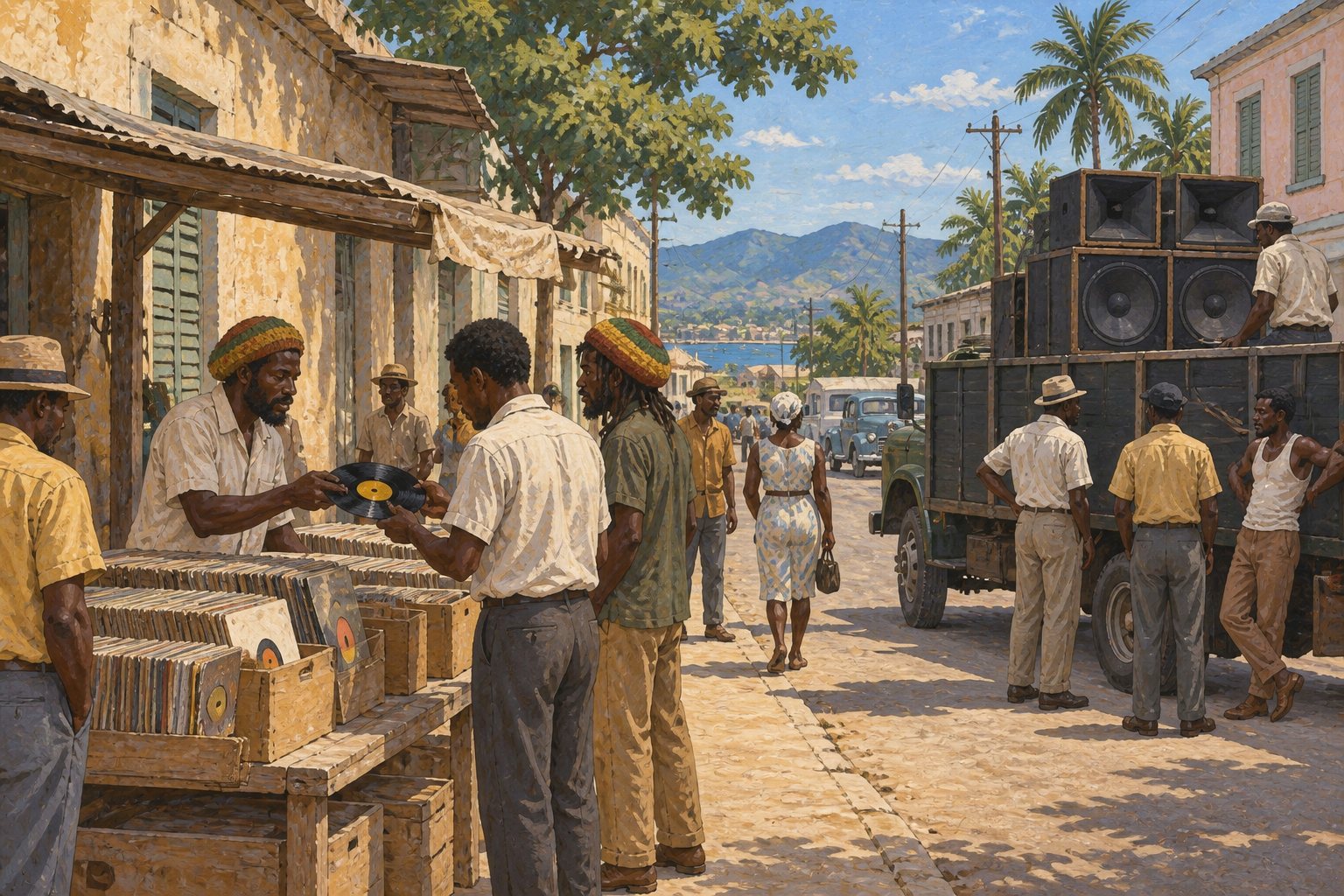
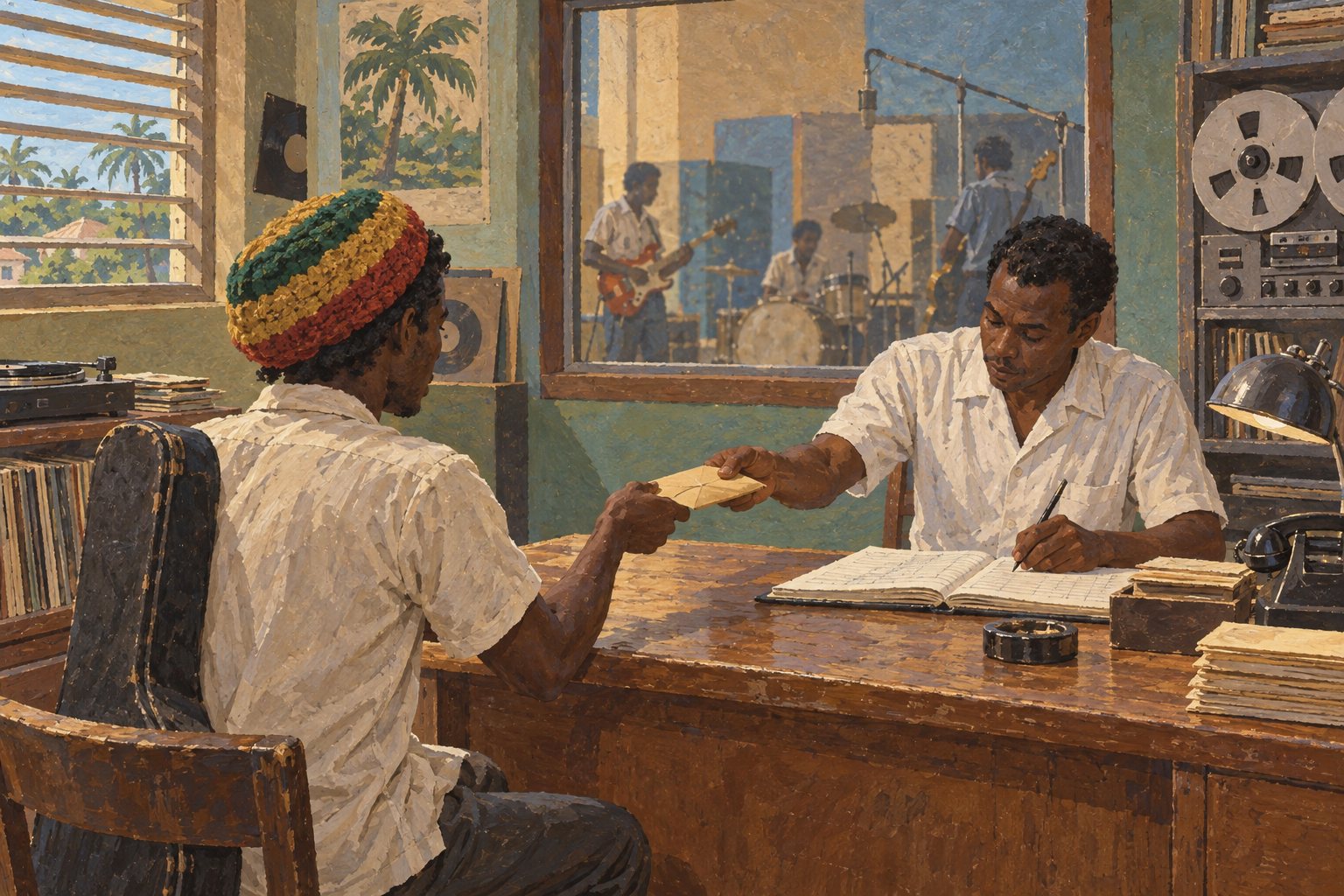
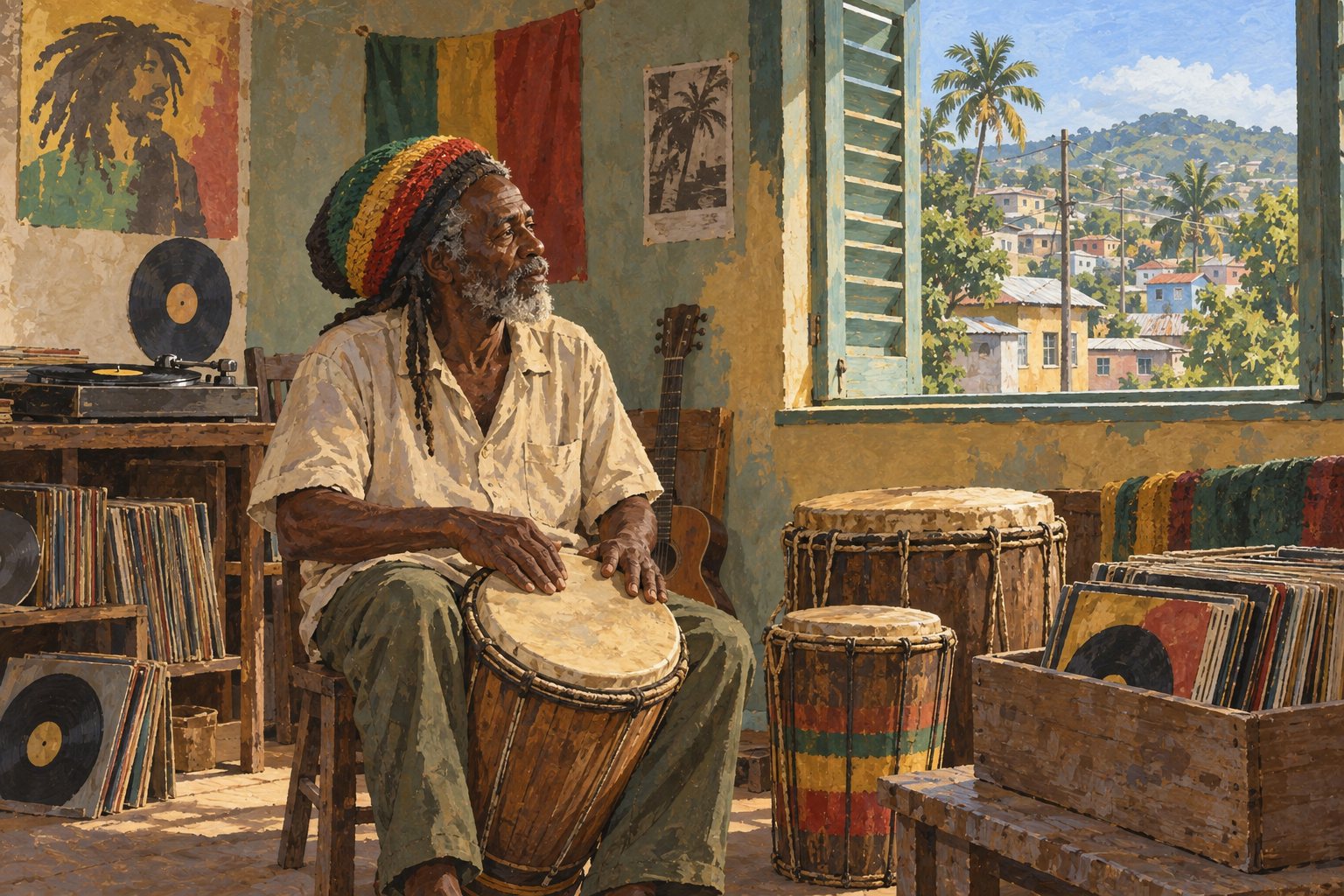
Drums Enter the Studio. The drums walked into the recording industry: Count Ossie’s camp above East Kingston taught the burru-derived Rasta hand-drumming, and when his drummers backed the Folkes Brothers’ “Oh Carolina” — produced by Prince Buster around 1960 — Rastafari sound entered the Jamaican hit parade; the sound systems, and then Clement Dodd’s Studio One on Brentford Road and Duke Reid’s Treasure Isle, industrialised the channel, and by the mid-sixties the island’s popular music was carrying the movement’s drums, themes and men — including three Trench Town singers called the Wailers — while radio largely would not.
Texts and authority
The Canon That Never Closed
Rastafari has no creed, no catechism, no ordination, no membership roll and no body empowered to issue one — doctrine is made in reasoning and held by elders, which means the authority question every canon chapter in this series asks is answered here in the negative; the cost is genuine doctrinal range on first-order questions (who Selassie is, what repatriation means), the benefit is that no institution exists for a state to capture or a schism to fight over, and the chapter opens with that argument, not with a text.
The Stolen Book
The movement’s one text is the King James Bible, and it is read through an unusual hermeneutic that deserves this full chapter: the book is held to be the true history of the black race and a translation altered in transmission by the very powers the movement opposes — authoritative and suspect in the same breath — so reading is recovery: citing chapter and verse aloud, correcting “corruption” against the reader’s own inspiration, finding the black Messiah in the texture of the English text itself; the proof texts are quoted, in the King James rendering, because that rendering is itself the subject.
Institutions and resources
The Missing Treasury
Every other volume in this series found an economy — temple estates, tithes, a waqf, a printing concession; Rastafari has no tithe, no collection plate, no central fund and no body that could hold one, and this chapter argues that the absence is the same fact as the absent canon: no centre, so no treasury — what exists instead is small and personal, the trades of men outside Babylon’s payroll (fishing, farming, craft, later the broom-making of one mansion), and the earliest recorded transaction in the movement’s history is Howell selling pictures of the Emperor at about a shilling, a figure that comes from his prosecutors and is labelled so.
Pinnacle
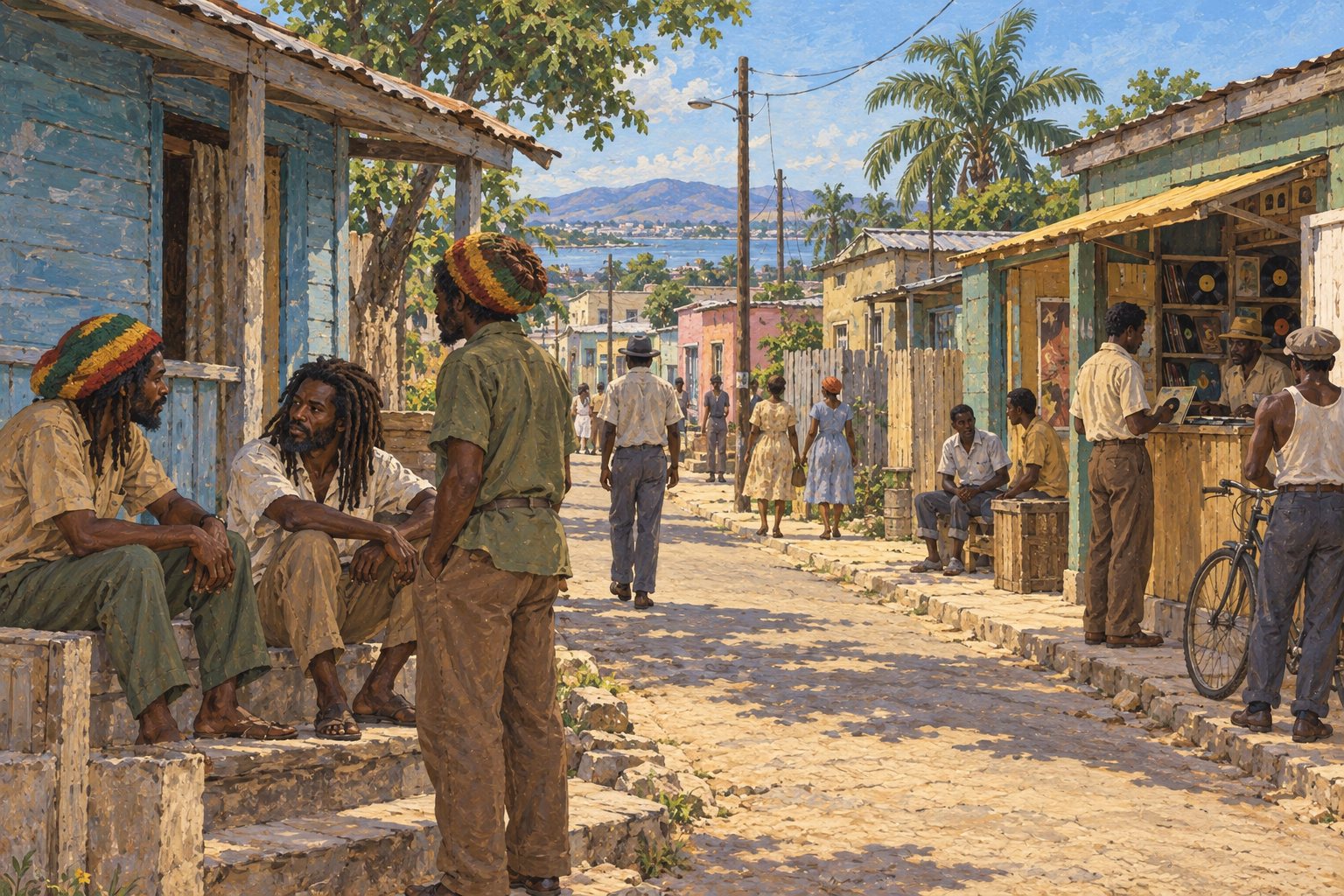
In 1940 Howell established Pinnacle, a commune in the hills of St Catherine — the movement’s one attempt at a landed economy: subsistence crops and, per the prosecution at his trials, ganja as the cash crop — and the state destroyed it in instalments: raided in 1941, broken up in 1954, finally cleared in 1958, its people scattering into West Kingston with their locks and their doctrine, which is one reason the movement’s next stronghold was a slum within walking distance of the recording studios; the dates are in the court and press record, the acreage and revenue are not, and where the figures should stand the text says UNVERIFIED.
Explore the illustrations7 scenes · The Recorded Catalogue
The Recorded Catalogue. The largest and most awkward fact in the movement’s economics: the value its culture generated went overwhelmingly to record companies and estates rather than to the movement — session men paid flat fees while catalogues compounded abroad, the Marley estate litigated for a decade after an intestate death and the catalogue’s subsequent sales involved sums the movement never saw — and the modern cannabis industry has commercialised the sacrament while practitioners still carry convictions under the laws that criminalised it, a fact Jamaica’s 2015 statute, which decriminalised possession and recognised sacramental use, acknowledges without undoing; enormous value, almost none captured, and the chapter says exactly that.
Changes and divisions
Many Mansions
The movement’s own word for its divisions is taken from the King James rendering of John — “In my Father’s house are many mansions” — and it is doing real work: the Mansions are not denominations, because there is no communion to be out of; they differ along three axes — organisation, the status of Selassie, and separatism — and the differences were prefigured in the late 1940s by the House of Youth Black Faith, whose young “Dreadfuls” argued the older “combsomes” down and made the matted locks a covenant; the origin of dreadlocks itself is contested — camp discipline, Kenyan newspaper photographs, the Nazirite vow — and the volume names the positions rather than picking one.
The Order of the Nyabinghi
The eldest house is barely an organisation at all: the Nyabinghi Order — its name arriving in Jamaica through a 1935 newspaper article about a supposed African order sworn against the colonisers, a text now traced to Italian propaganda, which the young movement adopted and made its own — keeps the drums, the groundation calendar of imperial anniversaries, and the strictest Selassie-centred doctrine, and holds that organisation itself is Babylon’s habit; it is the movement’s liturgical spine, and it owns the assemblies at which the other houses must still drum.
Limits of the evidence
These limits are stated in the book before its argument.
- Whether Marcus Garvey ever said “Look to Africa, where a black king shall be crowned.” The line is attributed to him everywhere and attested nowhere contemporary; the earliest attributions postdate the coronation, and the sentence is also attributed to the preacher James Morris Webb. It is reported in this volume as an attributed and disputed saying, never as a quotation — and what the record does show is printed beside it: Garvey’s own paper published sharply critical editorials about Haile Selassie in 1937.
- How many Rastafari there are, now or at any date The movement keeps no rolls, and much of it regards being counted as Babylon’s business. The 2011 Jamaican census figure is printed as the census’s own number; the circulating global figure of “about a million” is an estimate with no defensible method behind it, and the volume says so each time it appears. The volume’s own framing — a movement of perhaps a million — is UNVERIFIED at its core, and that is stated on the first page it is used.
- Pinnacle’s extent, population and revenue The founding (1940), the first raid (1941), the destruction (1954) and the final clearance (1958) are in the court and press record. The acreage and income figures that circulate are unsourced and are not printed. UNVERIFIED stands where a number would otherwise go, until a title deed or survey is found.
Sources and reading
This article brings together the series’ existing overview and chapter summaries. The linked book page provides the full outline and bibliography.
- Daily Gleaner coronation coverageNovember 1930. the crowning as foreign news in Kingston
- Robert A. Hill, “Leonard P. Howell and Millenarian Visions in Early Rastafari,” Jamaica Journal1983. four preachers dated from late interviews; Howell’s millenarian sources
- Barry Chevannes, Rastafari: Roots and Ideology1994. Revival parentage; the four careers; Youth Black Faith; Bobo rule
- King James Bible1611. the movement’s own text: Revelation 5:5 and 19:16 against the imperial style
- Amy Jacques Garvey ed., The Philosophy and Opinions of Marcus Garvey1923–25. “the God of Ethiopia” read through Ethiopian spectacles
- UNIA, Declaration of the Rights of the Negro Peoples of the WorldAugust 1920. Africa for the Africans; red, black and green
- Marcus Garvey, The Black Man editorials1937. contempt for Selassie after the exile; paraphrased, issues not obtained
- Horace Campbell, Rasta and Resistance1985. Ethiopianism as anti-colonial politics; Mau Mau photographs and the locks
Illustrations are newly generated interpretations of themes in the book. They are not surviving artifacts, historical photographs or evidence for the events described.