20 illustrations · 2:27
Watch & listen.
Follow the images with a narrated journey through the book.



Overview
- Coverage
- c.700 BCE onward
- Earliest secure evidence
- c.700 BCE
- Transmission
- the temple manuscript library
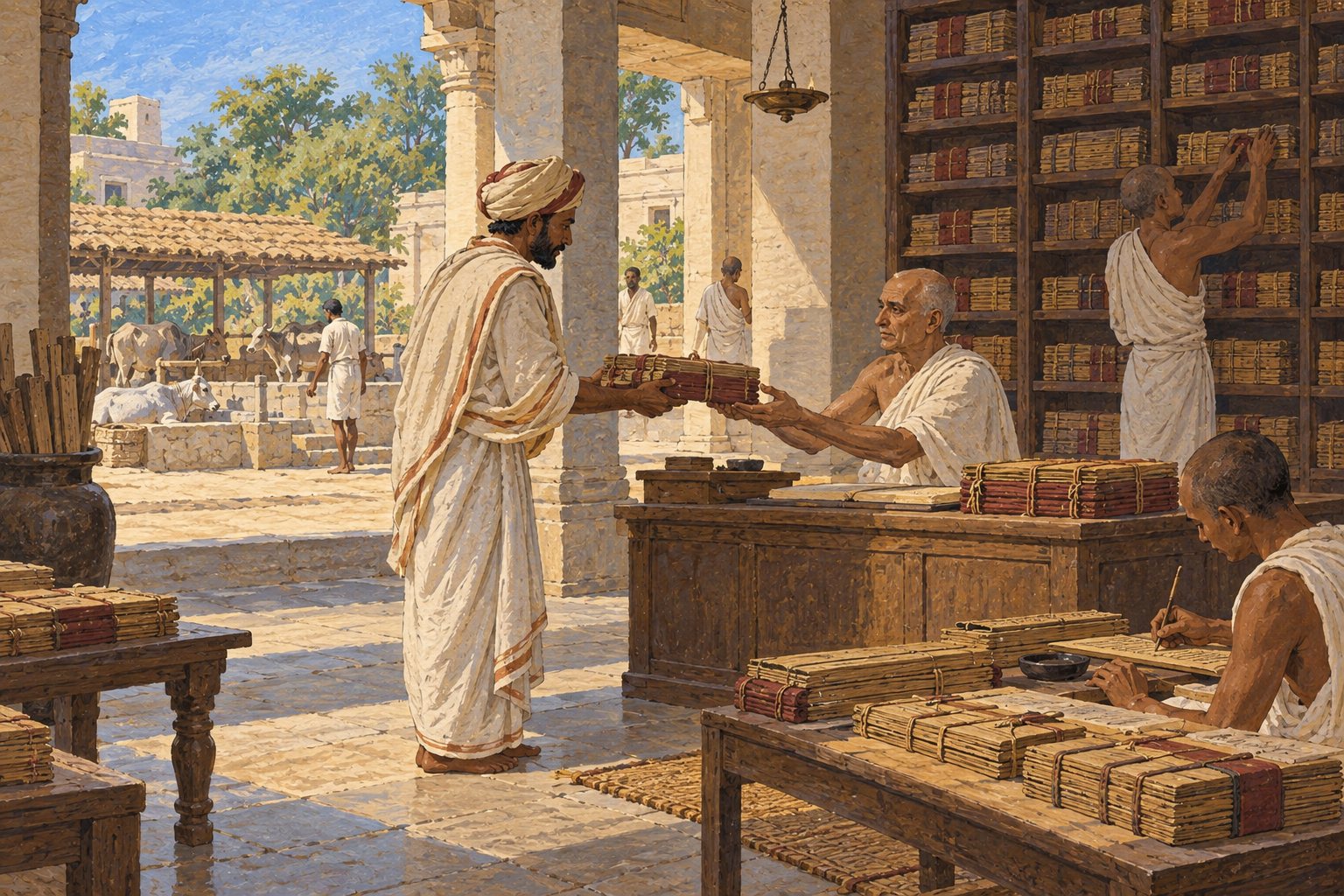
Ahimsa, taken seriously, closes off occupations. It pushed the Jain laity away from agriculture and toward trade, finance and the professions, and that made a small community disproportionately wealthy. The wealth went into the bhandara — the temple manuscript library — and made copying a religious act with a budget behind it. The Jain libraries at Jaisalmer, Patan and Cambay preserved not only Jain texts but a substantial part of what survives of Indian manuscript culture generally. Jainism is over-represented in the manuscript record because it funded the archive.
The coverage period and the earliest secure evidence are different dates. A tradition’s own account of its beginnings may differ from both.
Historical setting
The Renouncers’ Country
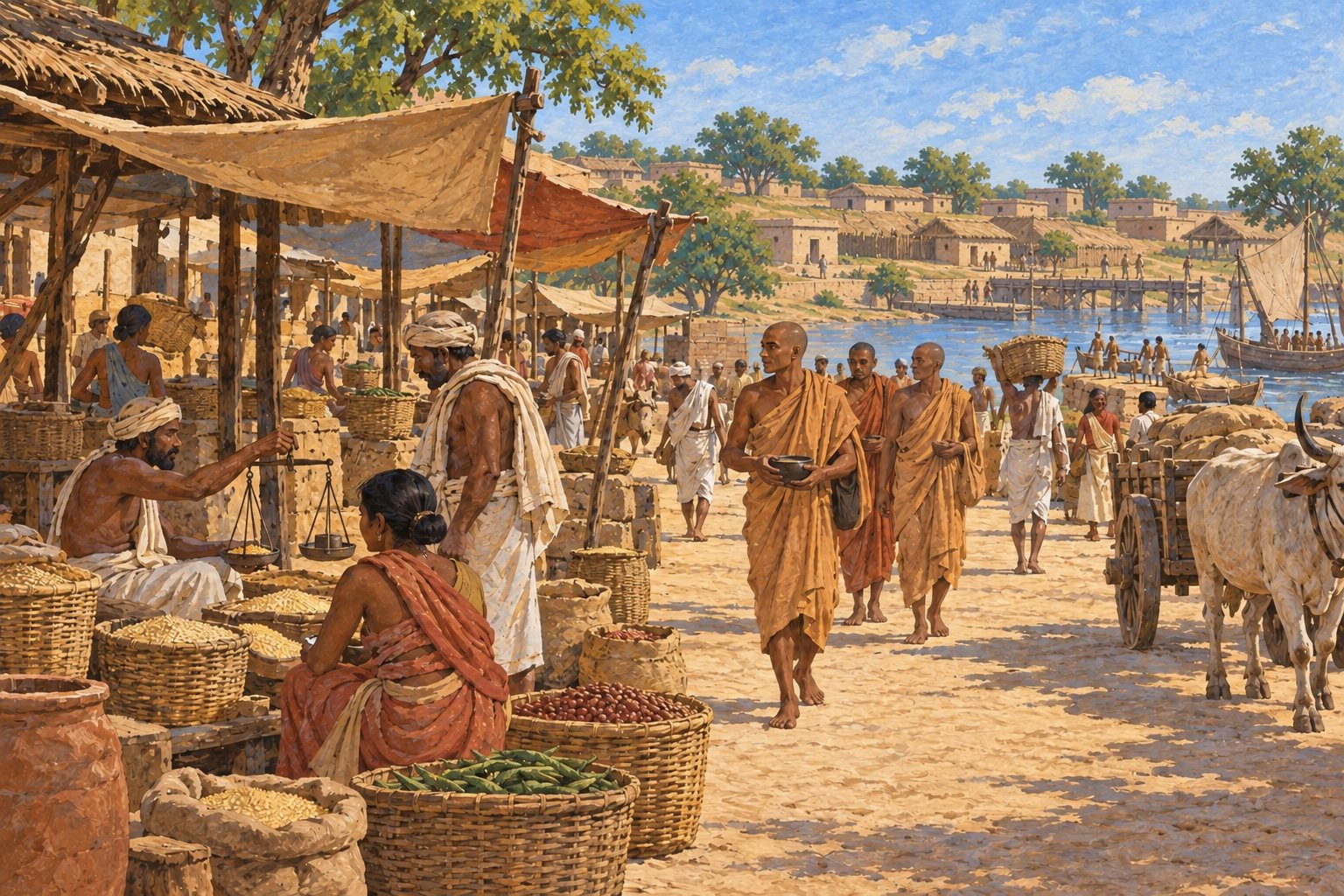
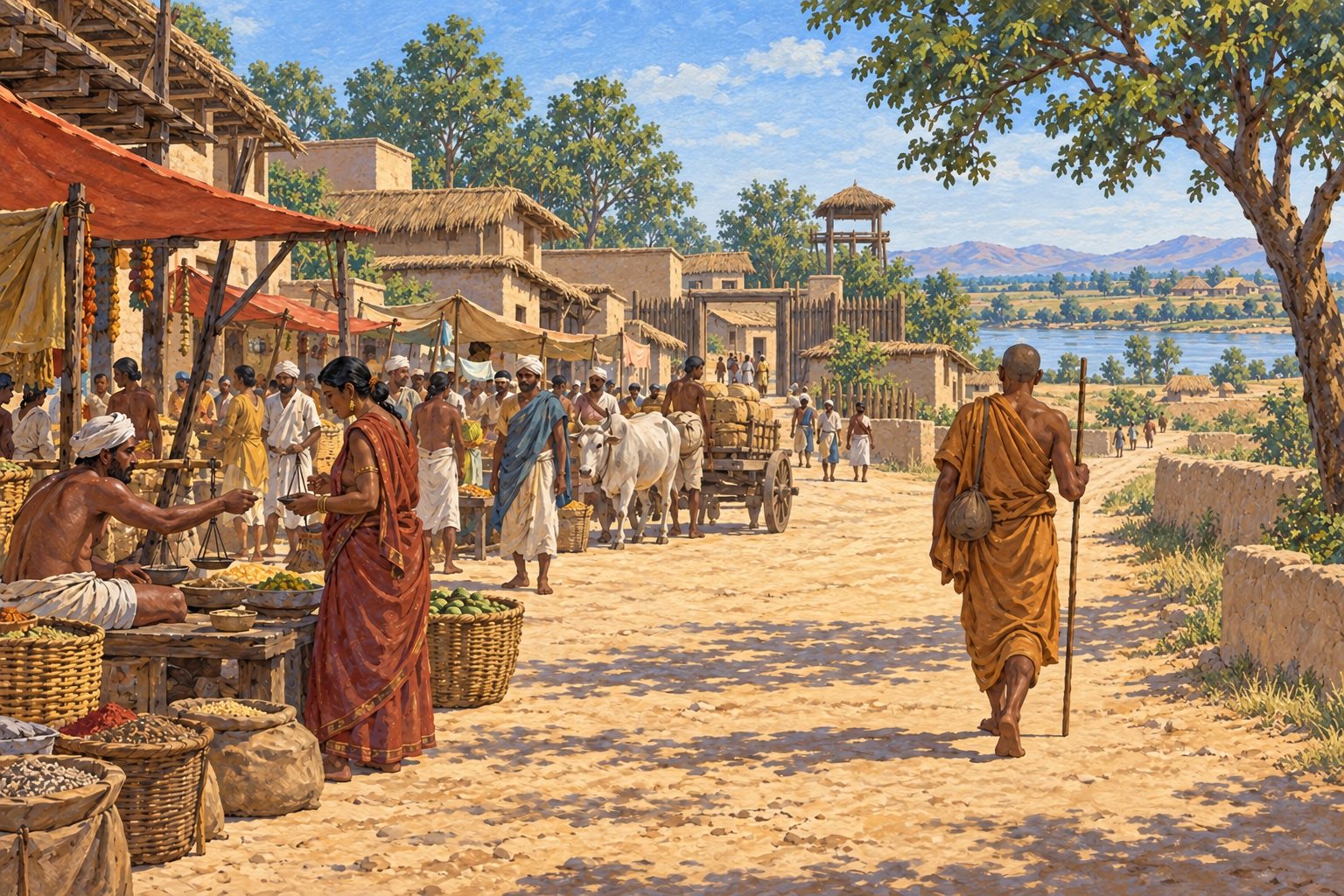
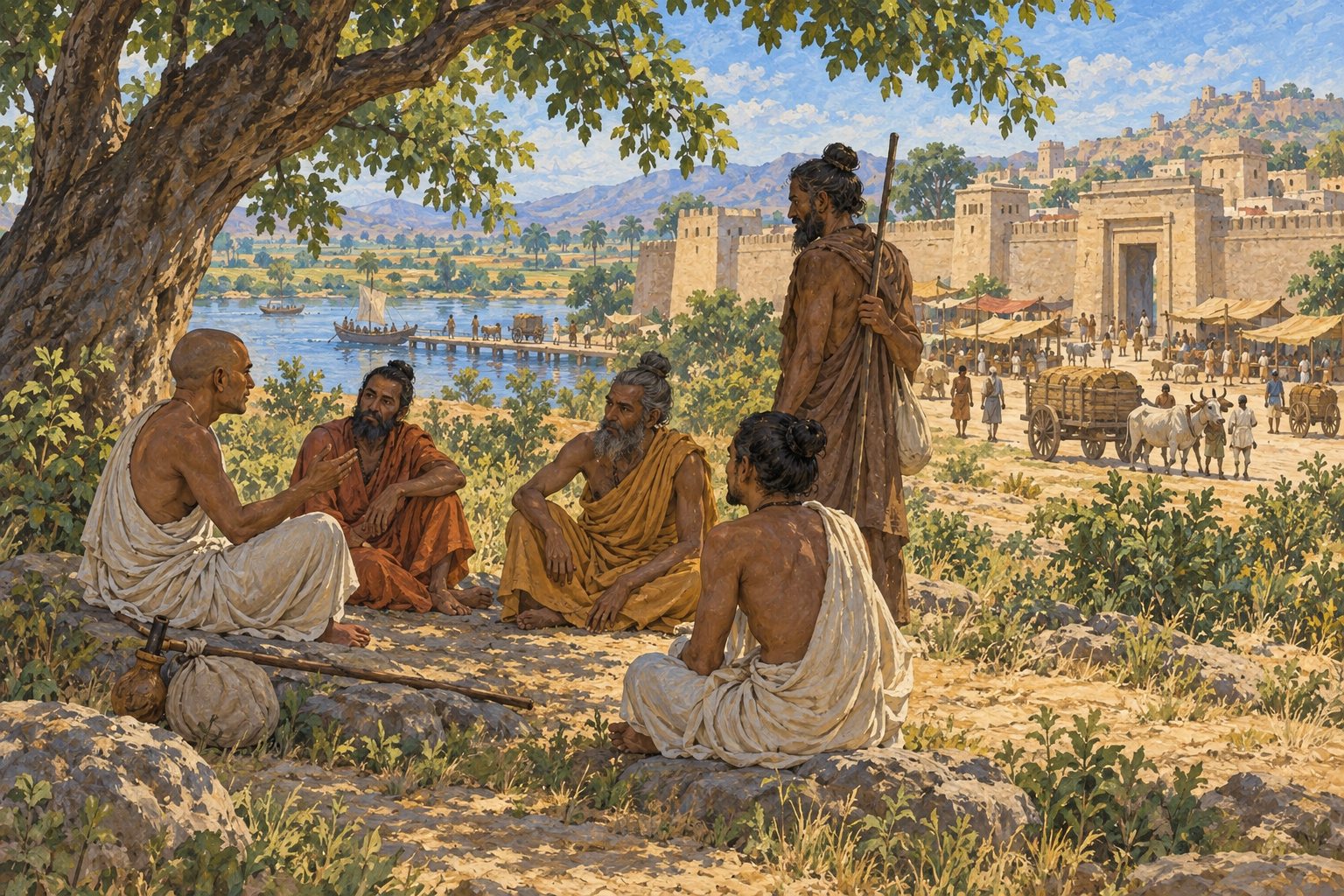
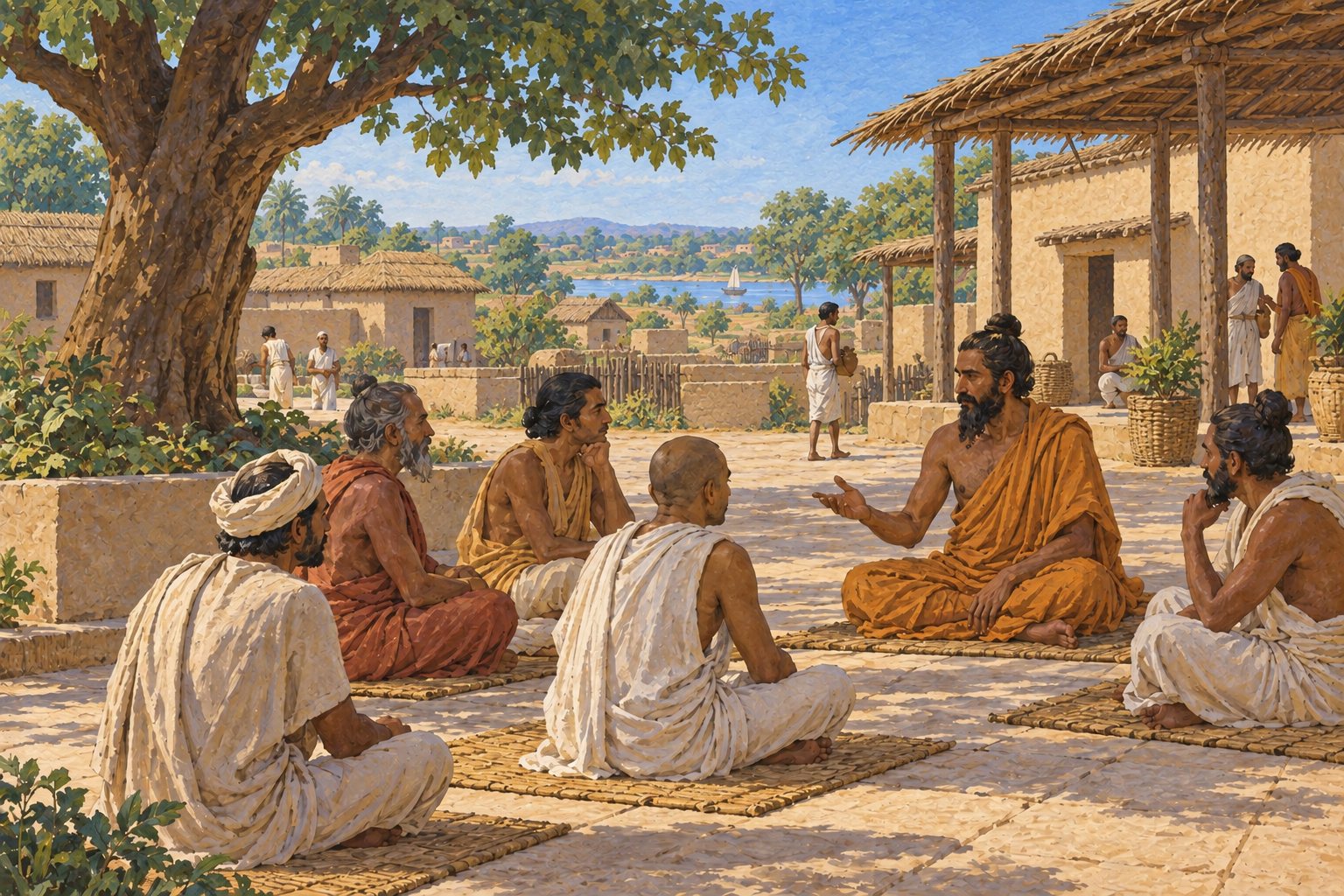
The second urbanisation of the Gangetic plain — new kingdoms, coined money, cities, surplus — produced a recognised social role: the sramana, the man who walks out of the economy, and a shared question all the renouncer schools answered: how does action bind a soul, and how is the binding stopped? The sacrificial religion described in the Vedic World volume priced its answers per rite; the renouncers’ answer was to stop the meter entirely. Kings collected these teachers the way they collected poets, and the scene that proves it survives in a rival’s scripture.
The Teacher Before the Teacher
The tradition holds that Mahavira was not a founder but the twenty-fourth in a line of Jinas, and for his immediate predecessor Parshva the claim has real, if circumstantial, support: both the Jain and the Buddhist canons describe an older “fourfold restraint” that Mahavira’s fivefold rule replaced, and the Jain canon stages communities of Parshva’s followers — clothed, under the older law — negotiating terms with Mahavira’s. The traditional dates put Parshva’s death 250 years before Mahavira’s, in the eighth century BCE by the tradition’s own arithmetic; what scholarship can say is that an older teacher’s community is plausibly real and absolutely undatable.
Explore the illustrations5 scenes · The renouncer’s road
The renouncer’s road. The second urbanisation of the Gangetic plain — new kingdoms, coined money, cities, surplus — produced a recognised social role: the sramana, the man who walks out of the economy, and a shared question all the renouncer schools answered: how does action bind a soul, and how is the binding stopped? The sacrificial religion described in the Vedic World volume priced its answers per rite; the renouncers’ answer was to stop the meter entirely. Kings collected these teachers the way they collected poets, and the scene that proves it survives in a rival’s scripture.
How it was transmitted
A Ledger of Forgetting
The first machine was organised memory, and the Jain version has a feature no other tradition in this series shows: it kept an inventory of its own decay. The tradition counts fourteen purvas — “prior” texts, the deepest layer of the teaching — and then records, teacher by named teacher, how many each generation still carried, down to zero. Bhadrabahu is remembered as the last man who knew them all; the knowledge thins in the succession lists like a decay curve; and both branches, who agree on almost nothing else, agree the purvas are gone. A tradition that would later fund the subcontinent’s best archives begins its transmission history with a data-loss report on itself.
Copying as Worship
At some point — visible by the eleventh century in surviving dated objects — the community converted the copying of scripture into a formal act of merit. Jnana, scripture-knowledge, is one of the seven canonical fields in which a pious layman sows wealth; colophons record who paid for a manuscript, in what year, for whose benefit; and the festival calendar contains a day, Jnana Panchami, on which the books themselves receive worship. The result is a copying economy: not a scriptorium of monks but a market of lay donors commissioning texts at scale, because the commissioning itself was the religious act. The machine of this volume is a funding model.
Explore the illustrations7 scenes · The locked manuscript room
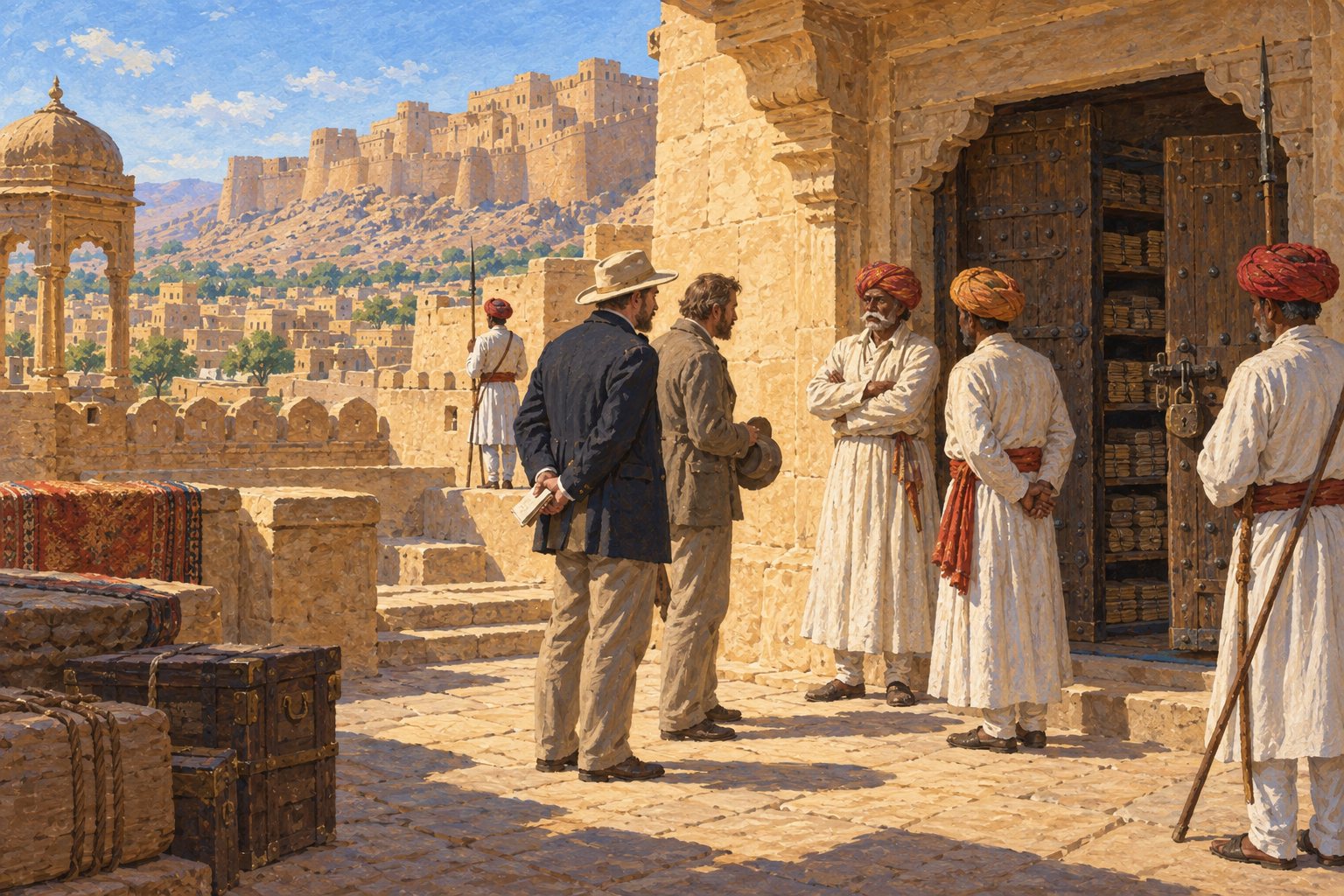
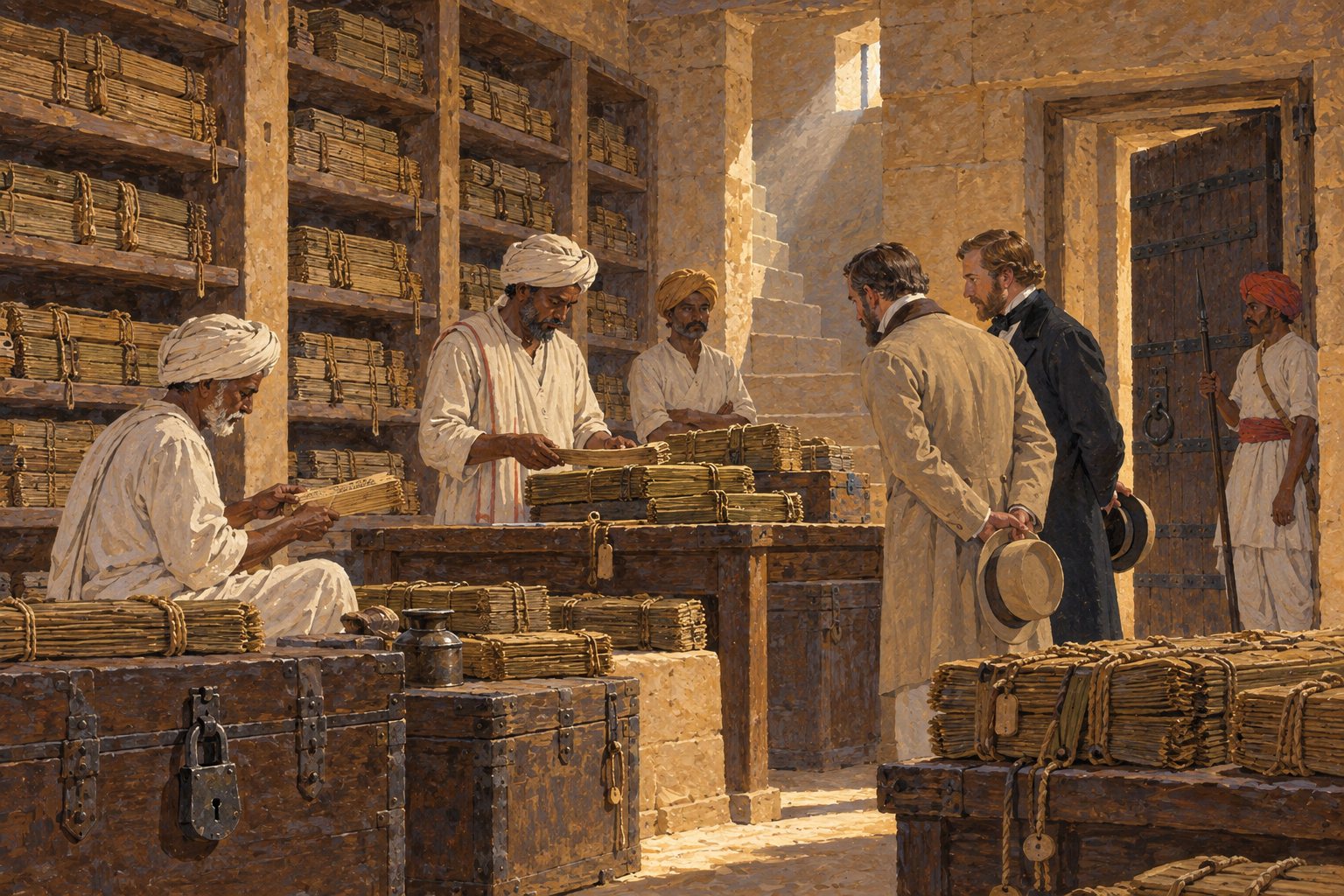
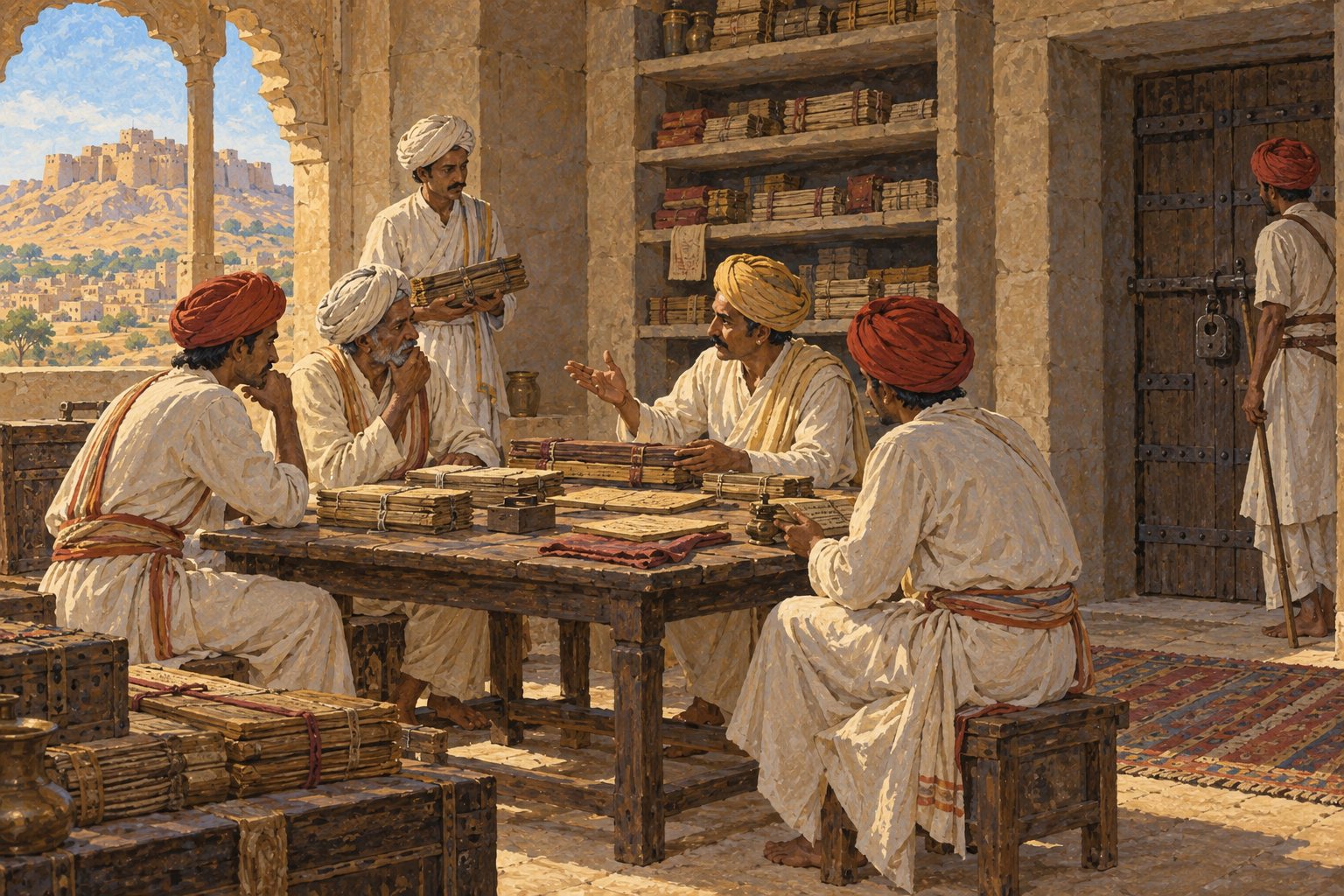
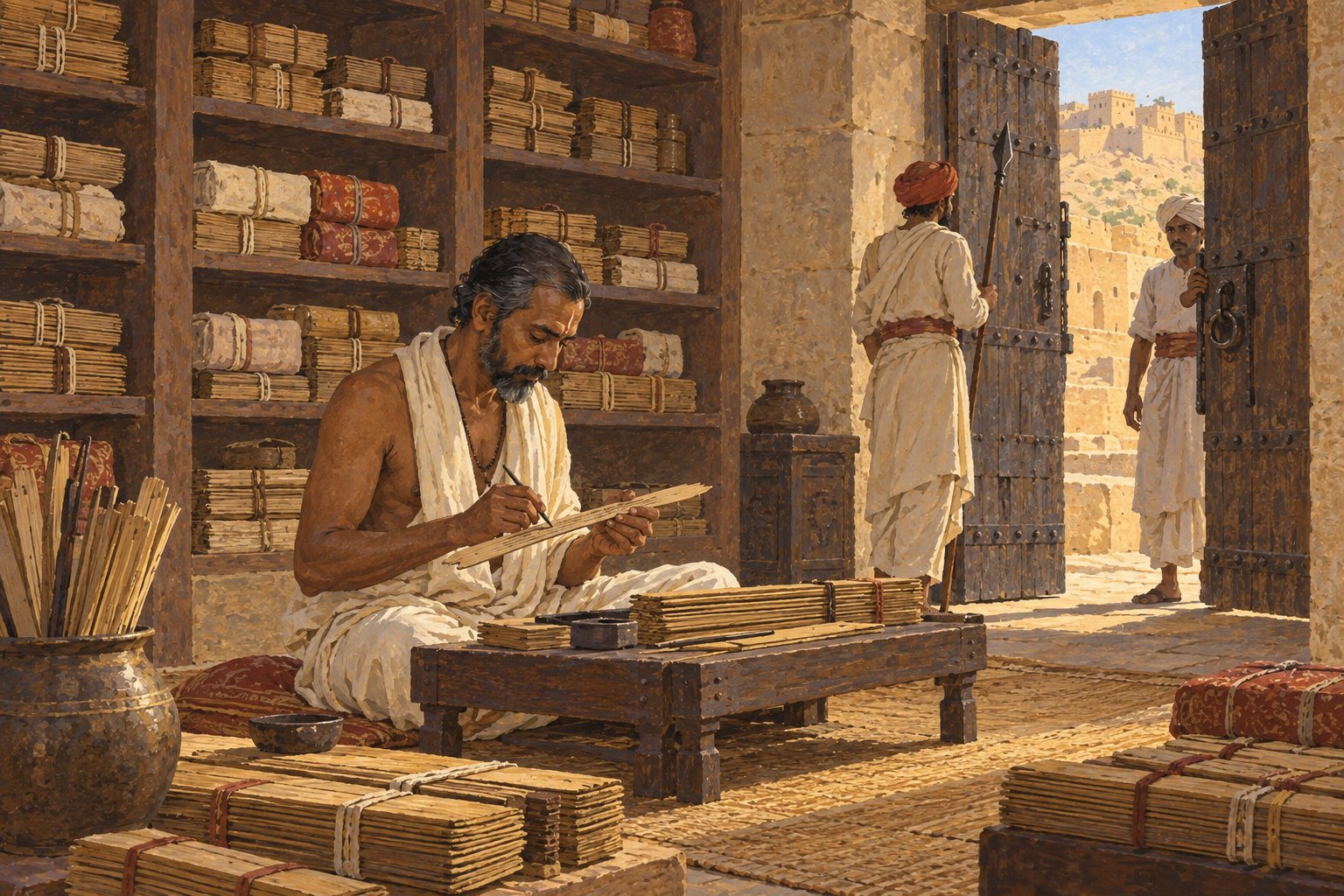
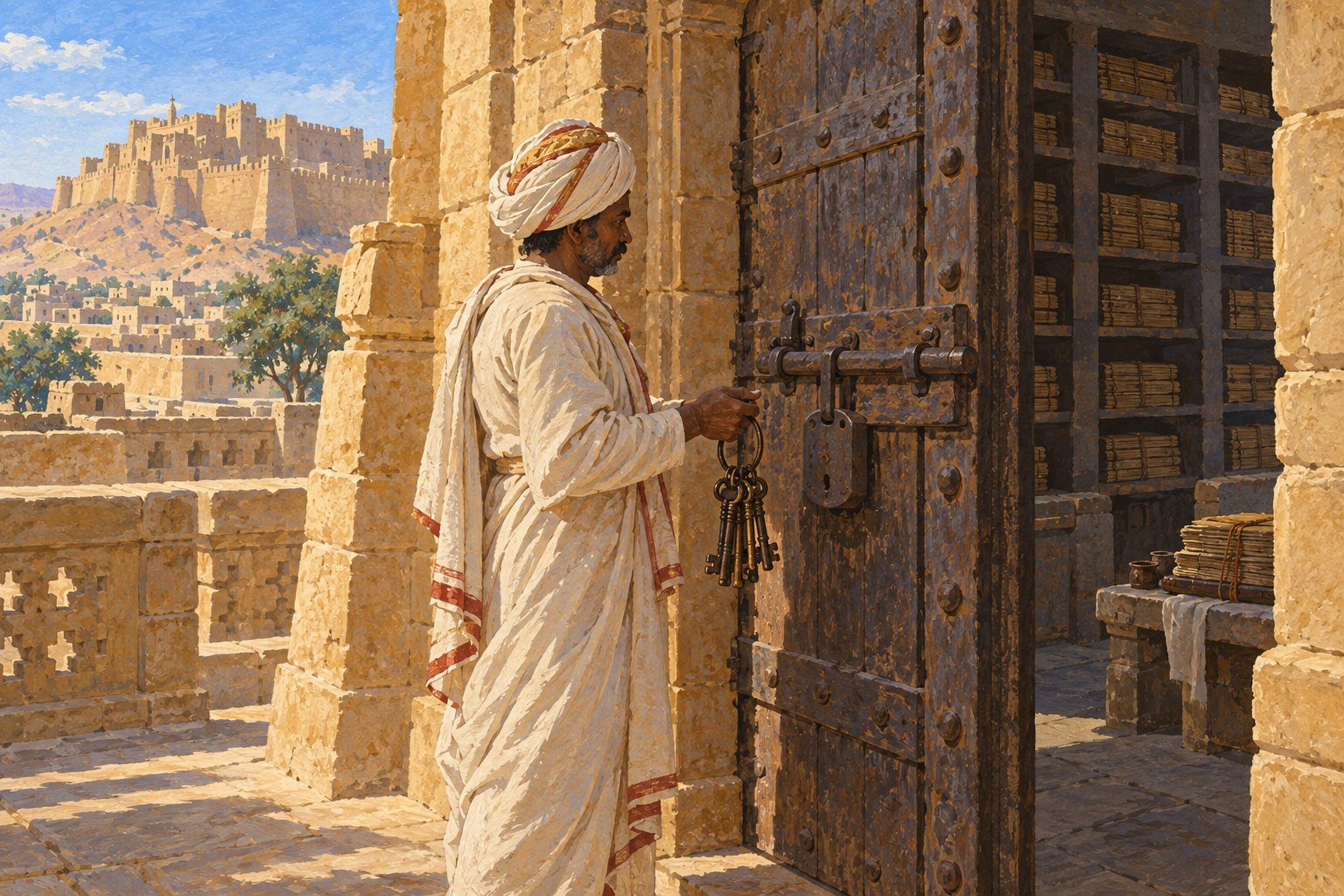
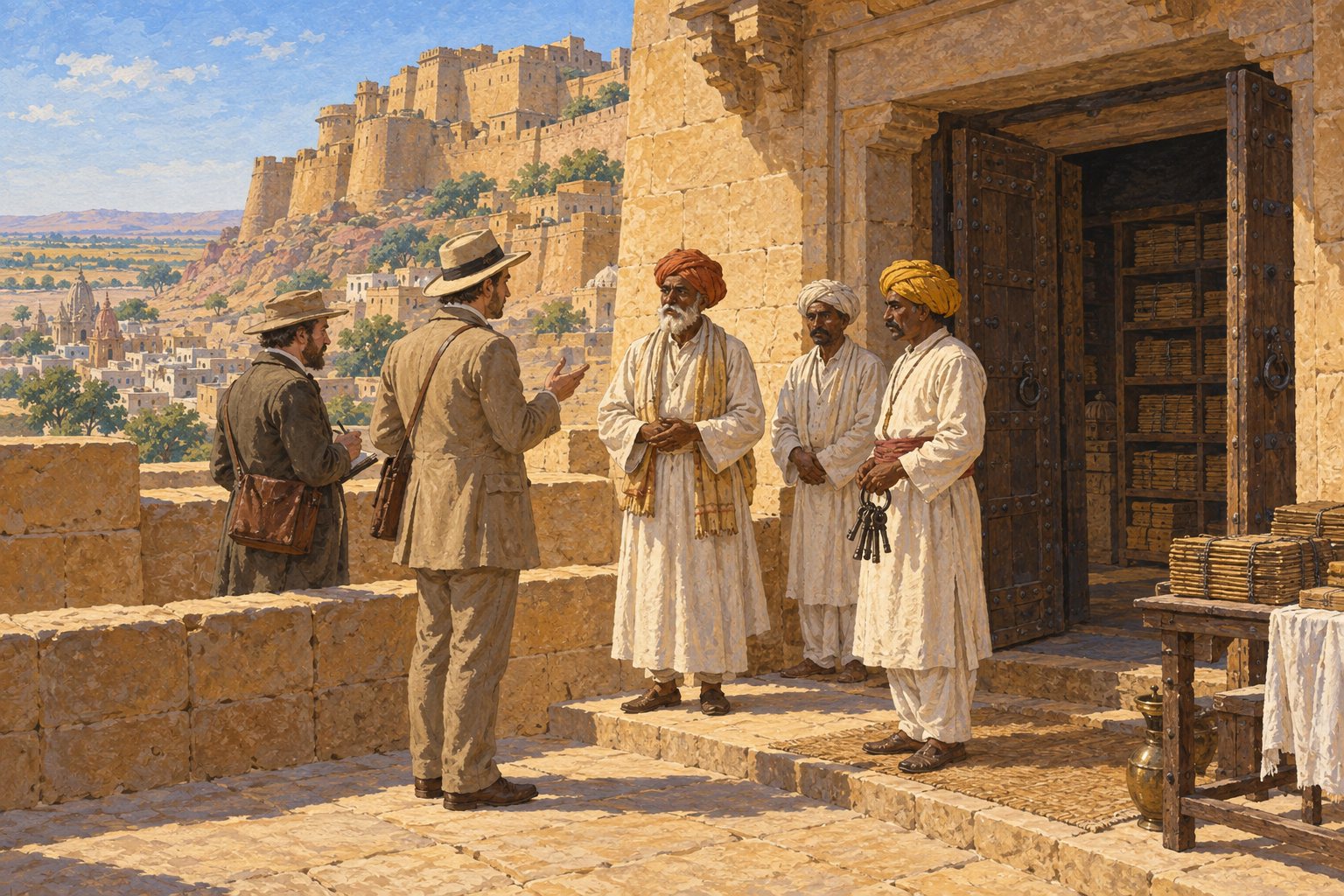
The locked manuscript room. The temple manuscript library — lay-owned, committee-governed, often literally underground — is the tradition’s great machine. Jaisalmer’s collection sits inside a desert fort, where dry air, locked rooms and a governing committee of laymen kept palm-leaf manuscripts alive from the eleventh and twelfth centuries onward; Patan and Cambay hold the sister collections in Gujarat. The survival is not luck: doctrine made the book an object of worship, wealth made copies plentiful, and administration made loss rare — three systems pointing the same way. The nineteenth-century European searchers who finally got inside reported collections whose age and condition had no parallel in the subcontinent, and their negotiation to be admitted is part of the story: this machine had owners, and the owners kept the door.
Texts and authority
Whether There Is Anything to Close
Every canon chapter in this series asks who had the authority to close the book. Jainism is the series’ limit case, because the two halves of the tradition disagree not about the book’s contents but about its existence. The Svetambaras hold that a canon — grown, damaged, partially lost, but real — was assembled and written down at Vallabhi. The Digambaras hold that the canon died with the men who memorised it, and that nothing on any shelf is the word of Mahavira in the authoritative sense: their position is not a rival list but a null result. And beneath both positions sits the one agreed fact — the purvas are gone. The sharpest canon dispute available to this series is not over what is in and what is out; it is over whether there is an “in”.
Three Recitations
The tradition holds that the Svetambara canon passed through three collective rescues before it was ever a book. At Pataliputra, after the famine (conventionally early third century BCE), the community reassembled the eleven angas from surviving memories, and the purvas already needed a specialist who was elsewhere. Six centuries later — conventionally the fourth century CE — parallel recitations at Mathura under Skandila and at Vallabhi under Nagarjuna produced rival recensions, and the final text still records readings tagged to “the Nagarjunians”: the canon carries the fingerprints of its own rescue attempts. None of the three councils is minuted; everything known about them arrives through the tradition’s later frame-stories, and the chapter says so at every step. Each rescue was triggered by catastrophe, famine above all — and that pattern is this volume’s bridge to the Buddhism volume, where a famine forced a canon onto palm leaf in the same centuries.
Institutions and resources
The Occupational Funnel
Take the physics of the chapter called Harmlessness as a Full-Time Job and apply it to a career. Farming wounds the earth-bodied and the creatures in the soil; soldiering, butchery, tanning, brewing are out by their materials; what remains open, in the tradition’s own occupational reasoning, is commerce — cloth, grain, gems, banking, brokerage — trades in which nothing visible dies. Lay Jainism concentrated there, documentably and over centuries, and then the vow-structure closed the loop: aparigraha, possession-limitation, converts surplus into religious spending rather than open-ended accumulation. The result is the pattern this movement documents — a small community, commercially over-represented, that continuously drains its own wealth into temples, animals and books. The chapter also files the historiography where it belongs: Weber compared the Jains to the Puritans a century ago, and the comparison is reported as his, not adopted.
Receipts in Stone
Medieval Jain money is unusually auditable, because its instruments survive in two forms that can be laid side by side. The stone: the Dilwara temples on Mount Abu carry dated dedication inscriptions — Vimala’s shrine conventionally dated 1032, and the Luna vasahi of 1230, whose prasasti names the minister-brothers Vastupala and Tejahpala, their family tree, and the endowment arrangements for the temple’s upkeep. The story: the prabandha chronicles award the same men spending totals that are transparently devotional arithmetic — tens of millions on a single mountain — figures that inflate with each retelling. The chapter prints both, labelled: the inscription is a receipt; the chronicle is a eulogy; and the difference between them is the difference this series exists to teach. A royal coda: the twelfth-century Chaulukya king Kumarapala, under the Jain teacher Hemachandra, is recorded proclaiming amari — bans on slaughter — the one period when the discipline of harmlessness briefly held state power.
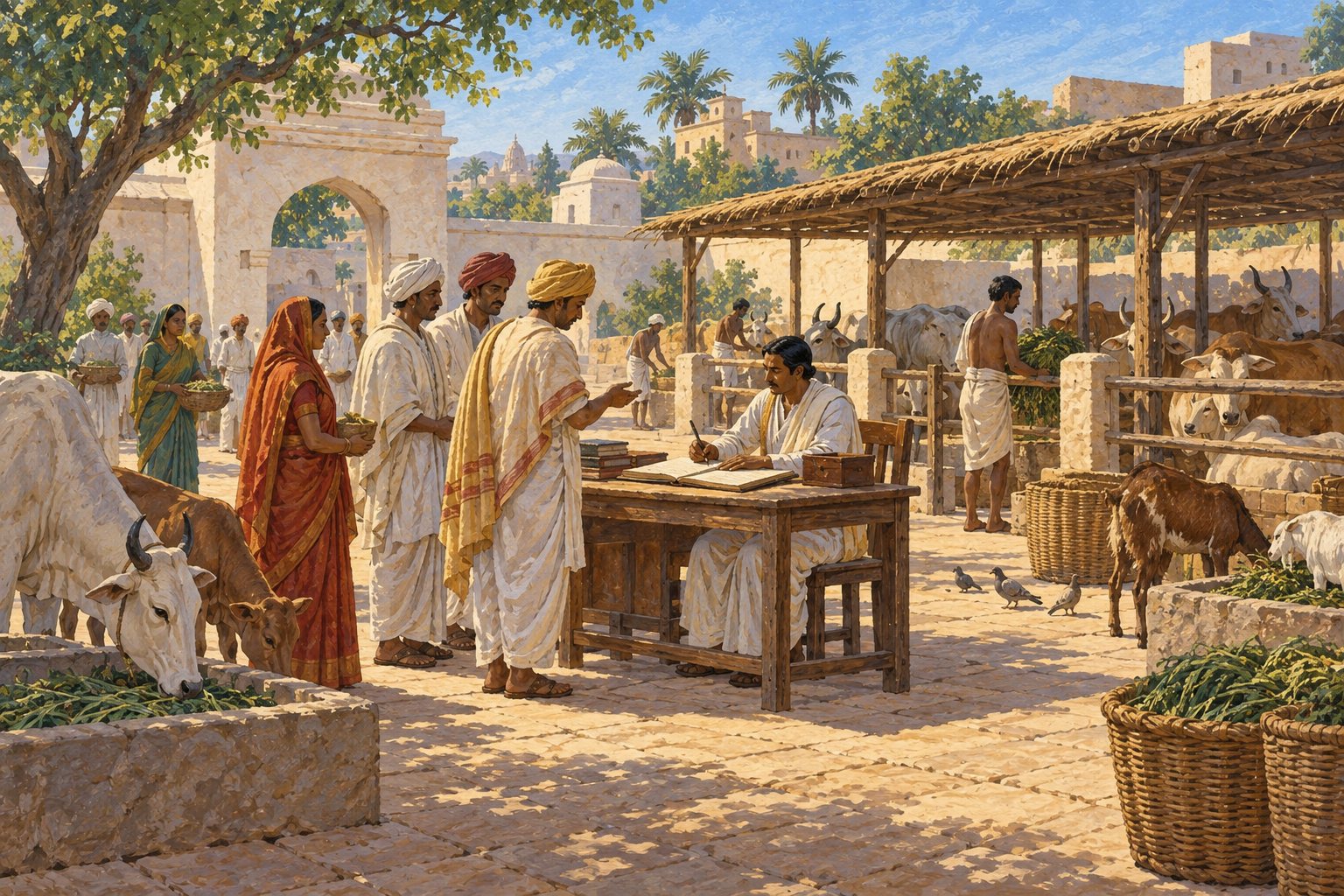
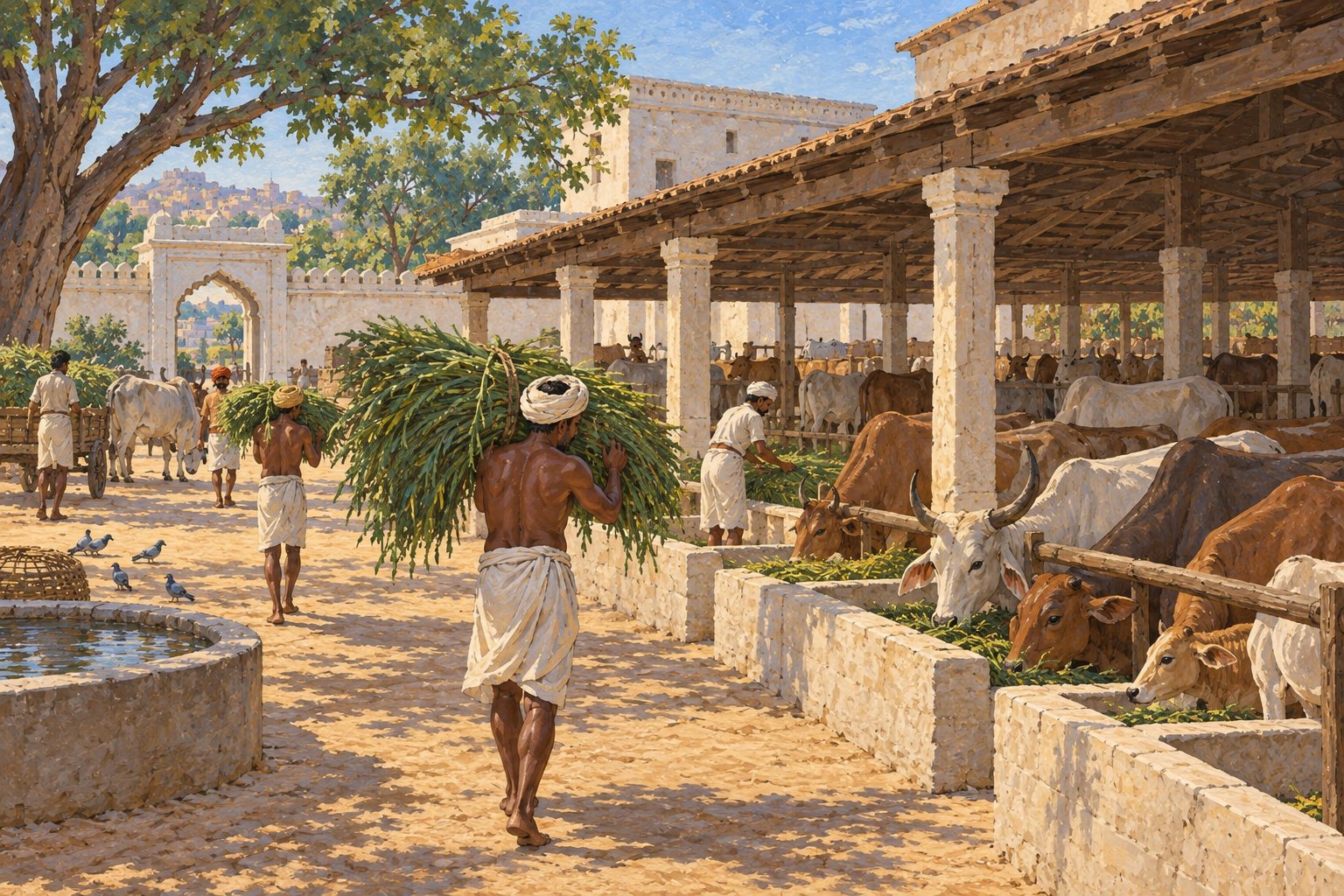
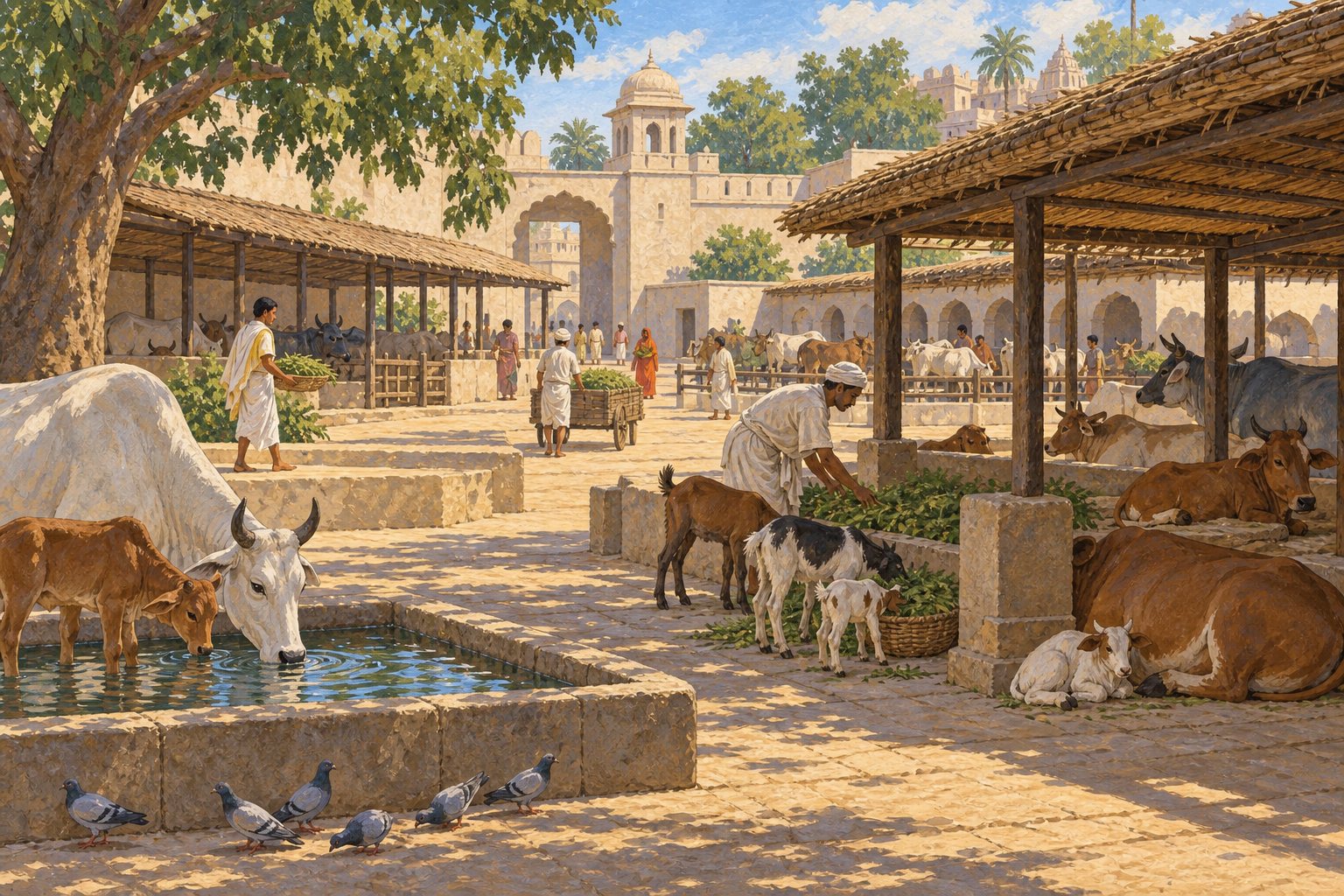
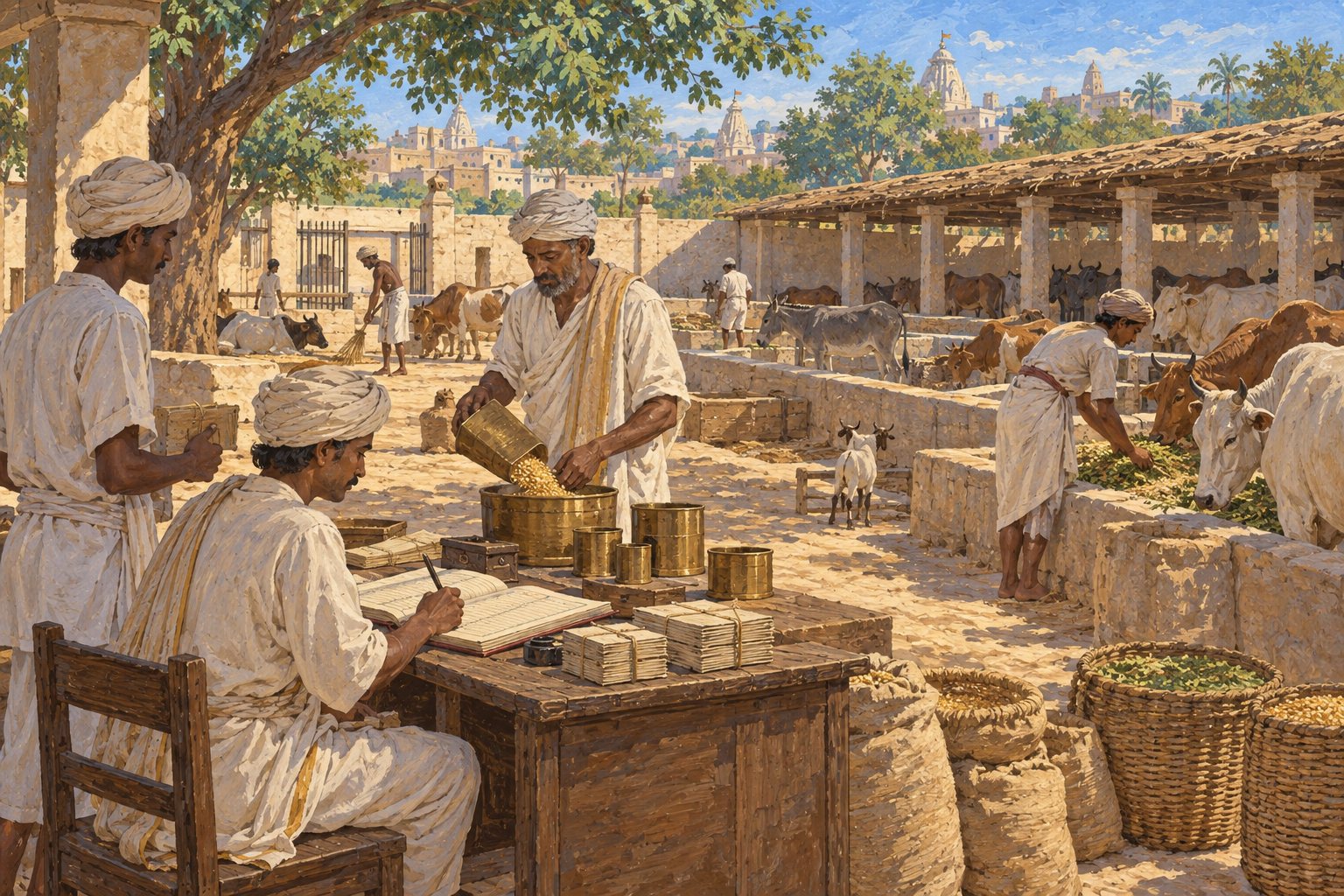
Explore the illustrations8 scenes · Care at the animal refuge
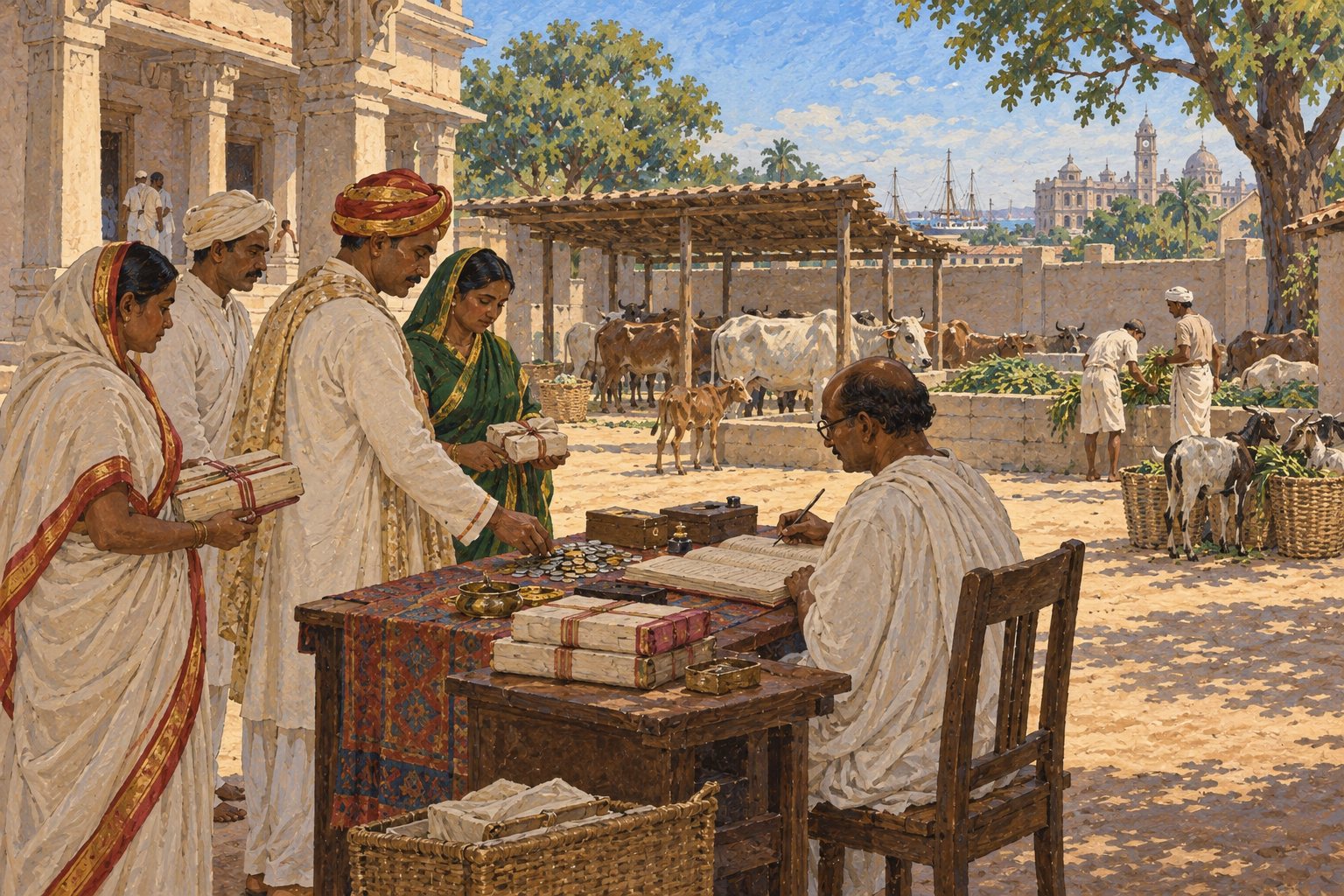
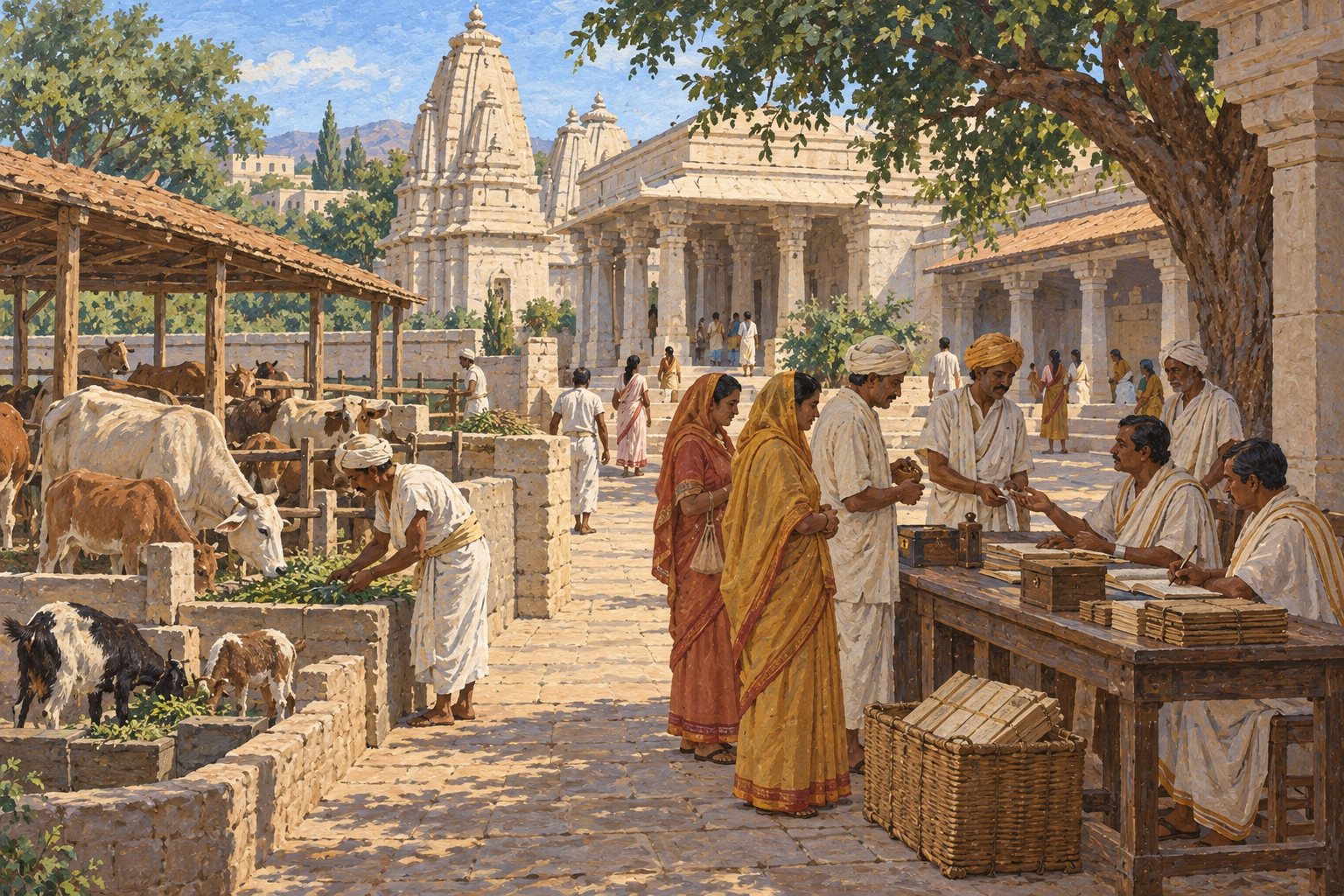
Care at the animal refuge. Jain religious giving is not an impulse; it is an institution with categories, calendars, auction procedures and account books. The classical lay literature ranks seven fields of merit for wealth — images, temples, scripture, monks, nuns, laymen, laywomen. The temple economy monetises devotion in public: the boli auction, in which the right to perform a ritual act is bid for aloud and the winning sum goes to the temple fund, turns a puja into recorded revenue. Ahimsa itself has a balance sheet: the panjrapole, the animal refuge maintained by merchant communities — colonial Bombay knew them as established charities, and the network operates today. And one of the seven fields is the machine of this volume: the scripture-copying of the chapter called Copying as Worship is the same institution seen from the donor’s side. The movement closes its loop with the archive.
Changes and divisions
The Famine Story
The tradition’s origin-story for its great division starts with weather. A twelve-year famine in Magadha — conventionally placed around the turn of the third century BCE, in the reign the tradition assigns to Chandragupta Maurya — sends part of the community south under Bhadrabahu; in the southern telling the emperor himself walks behind the teacher as a monk and dies by the fast at Shravanabelagola. When the migrants’ heirs and the northerners’ heirs meet again, one side’s monks are naked and the other side’s are clothed, and each regards the other as the deviation. Whether any of this is history is contested, and the evidence gap is stated with the story: the earliest inscription at Shravanabelagola naming Bhadrabahu is conventionally dated around 600 CE, the sectarian origin narratives are later still — the Svetambara version has the Digambaras begin with one monk’s vanity six centuries after the nirvana; the Digambara version has the Svetambaras descend from lax, half-clothed northerners — and a body of scholarship reads the split as slow regional divergence with the stories written afterward to give it a villain. The account is reported, the contest is reported, and the volume holds neither.
Cloth
The presenting question is property at its limit: may a man who has renounced everything retain a piece of cloth? The canon’s own layers show the question is older than the schism — the Acaranga regulates one garment, two, or none as graded options for different constitutions, and the Uttaradhyayana’s Kesi–Gautama dialogue exists precisely to smooth the difference between Parshva’s clothed rule and Mahavira’s — but the branches hardened the options into identities: Digambara, “sky-clad”, for whom nudity is constitutive of the full vow, possession zero, the body’s needs met by the cupped hand and the feather-whisk; Svetambara, “white-clad”, for whom the cloth is an instrument that binds nothing. The art historians add a quiet witness: the early Jina images at Mathura are unclothed, and images with lower garments appear only centuries later — the iconography records the fork. From this garment the movement’s other two disputes follow, and the chapter ends by handing each to its own chapter by name.
Limits of the evidence
These limits are stated in the book before its argument.
- Whether Parshva existed The tradition’s arithmetic places him in the ninth-to-eighth century BCE, 250 years before Mahavira’s death. The scholarly case for a historical Parshva is an inference — an older “fourfold restraint” attested in both the Jain and the Buddhist canons, and canonical scenes of “followers of Parshva” negotiating with Mahavira’s — and an inference is where it stays. His dates cannot be established from any external evidence at all.
- Mahavira’s dates The tradition holds 599–527 BCE and runs a living era from the death date. The scholarly range sits roughly a century later, because it is chained to the redating of the Buddha, which is itself contested. Nothing contemporary names him: the earliest notices are a rival tradition’s canon (written down centuries after both founders) and an imperial edict that names the community, not the man.
- Whether the famine and the southern migration happened The earliest inscription linking Bhadrabahu to Shravanabelagola is conventionally dated around 600 CE — eight centuries or more after the events it commemorates. The two branches’ origin stories for the split are later still, partisan in opposite directions, and scholars contest whether the division had a founding event at all rather than a slow regional divergence. This volume reports the account and reports the contest; it does not pick.
Sources and reading
This article brings together the series’ existing overview and chapter summaries. The linked book page provides the full outline and bibliography.
- F. R. Allchin, The Archaeology of Early Historic South Asia1995. NBPW, punch-marked coinage and the Gangetic towns that can feed renouncers
- Samannaphala Sutta, Bhikkhu Sujato trans.Pali canon, written down centuries later. a Magadhan king polling six teachers, including Nigantha Nataputta’s fourfold restraint
- Johannes Bronkhorst, Greater Magadha2007. the sramana east as a distinct culture; named as contested
- Uttaradhyayana 23, Hermann Jacobi, Jaina Sutras, SBE 451895. Kesi and Gautama reconciling four vows with five, and clothes with none
- Acaranga, Jacobi, SBE 221884. Mahavira’s parents as followers of Parshva; the six classes of lives; clothing cubits; sallekhana
- Jacobi, introduction to SBE 221884. Jainism independent of Buddhism; Parsva as an older order
- Kalpa Sutra, Jacobi, SBE 221884. the 250-year gap; Mahavira’s balanced life; elder lists; Vallabhi year-count; community totals
- Sutrakritanga, Jacobi, SBE 451895. the Jain counter-polemic on unintentional harm; an opponent denying the twelve angas
Illustrations are newly generated interpretations of themes in the book. They are not surviving artifacts, historical photographs or evidence for the events described.