18 illustrations · 2:13
Watch & listen.
Follow the images with a narrated journey through the book.



Overview
- Coverage
- c.1200 BCE onward
- Earliest secure evidence
- c.1200 BCE
- Transmission
- an alphabet invented to freeze a dead language
The Avestan alphabet is a recording device. It was cut out of existing Pahlavi hands in the Sasanian period, given roughly fifty characters and a phonetic precision no ordinary script needed, and used for one job: to freeze the sound of a liturgy that priests had carried in memory for over a thousand years in a language that had died. Set it beside the Vedic reciters and the Masoretic pointing and you have three traditions solving the same problem three different ways. This is the only one that built a new alphabet to do it.
The coverage period and the earliest secure evidence are different dates. A tradition’s own account of its beginnings may differ from both.
Historical setting
The Cousin Languages
Open with the object: two hymn corpora, the Gathas and the Rig Veda, so close in grammar, metre and formula that a line of one can nearly be transposed into the other word by word — haoma and soma, ahura and asura, daeva and deva — and the kinship is not a curiosity, it is the volume’s dating instrument: the Gathas are composed in a language of the same age as the oldest Vedic hymns, which is the strongest single argument for putting their composer in the second millennium BCE, centuries before anything that could check him.
The Complaint of the Cow
What the Gathas contain, described before anyone’s theory of them: seventeen hymns in five metres; a named poet, Zarathushtra Spitama, who names a royal patron (Kavi Vishtaspa), two allies at court (Frashaoshtra, Jamaspa) and a daughter (Pouruchista, in the wedding hymn); and a herding world of cattle and cattle-raiders in which the soul of the cow cries out against violence and is answered with a herdsman-prophet — the question the new teaching answered is audible in the complaint, and its vocabulary is the tradition’s permanent axis: asha, right order, against druj, the lie.
Explore the illustrations6 scenes · An eastern Iranian landscape
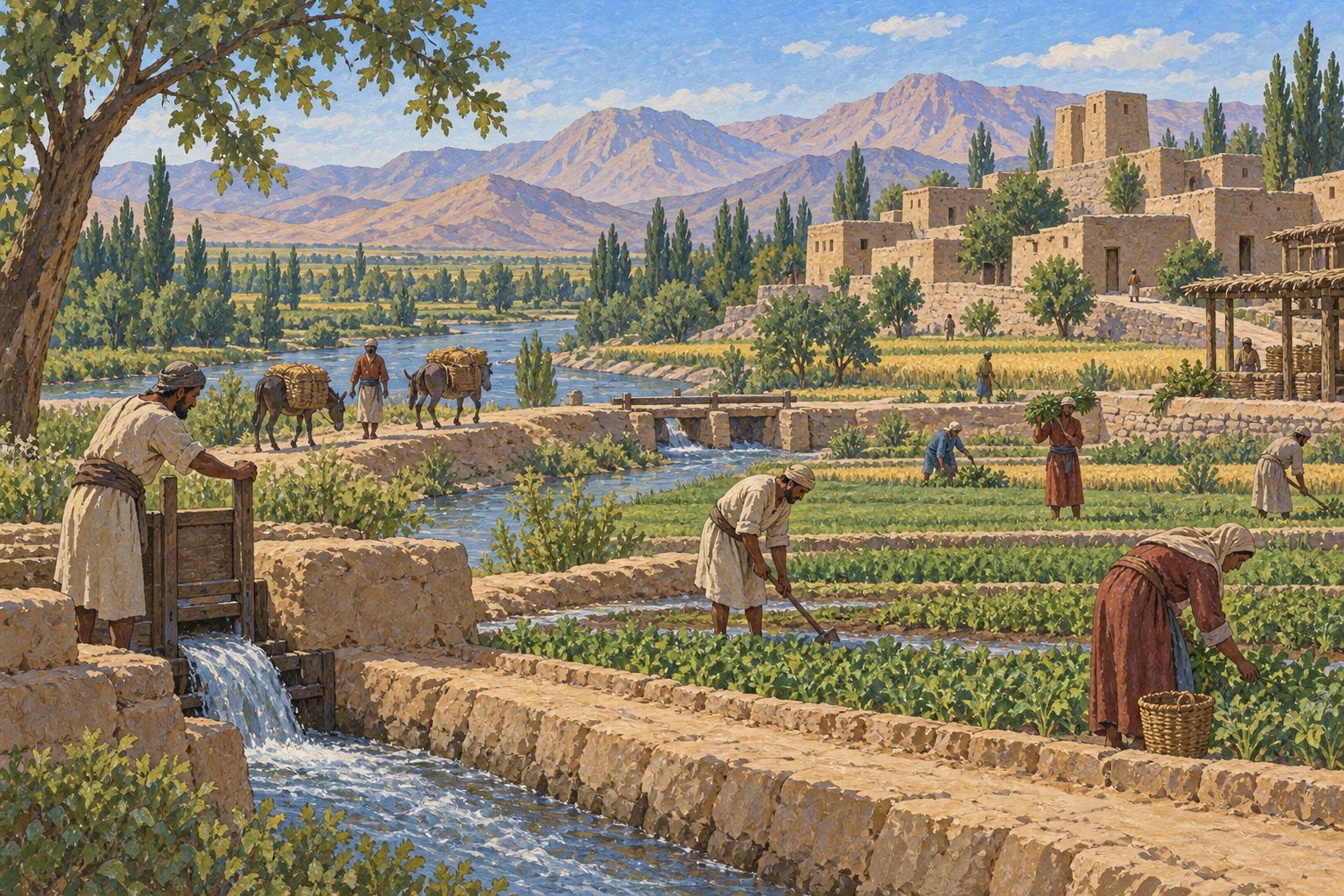
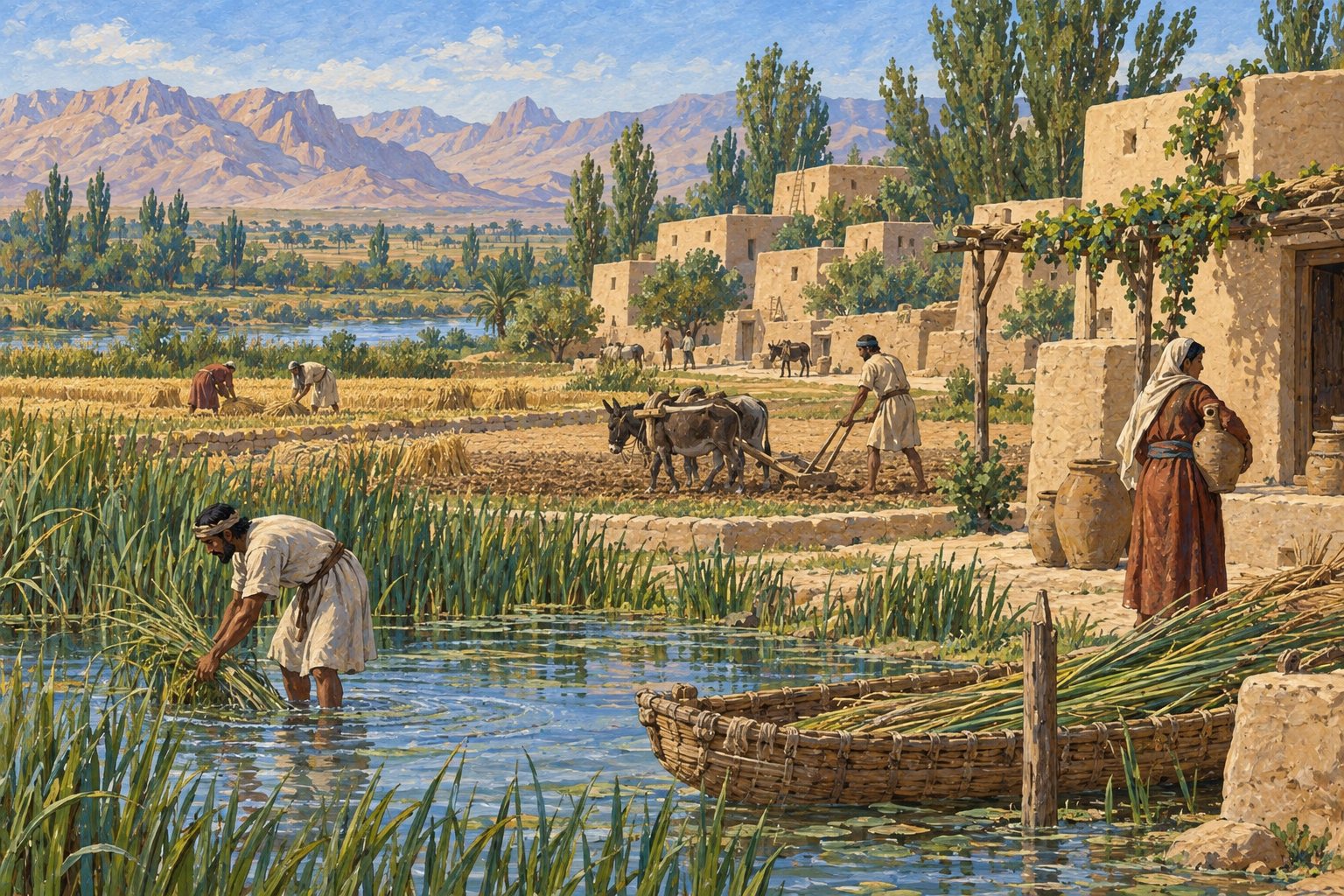
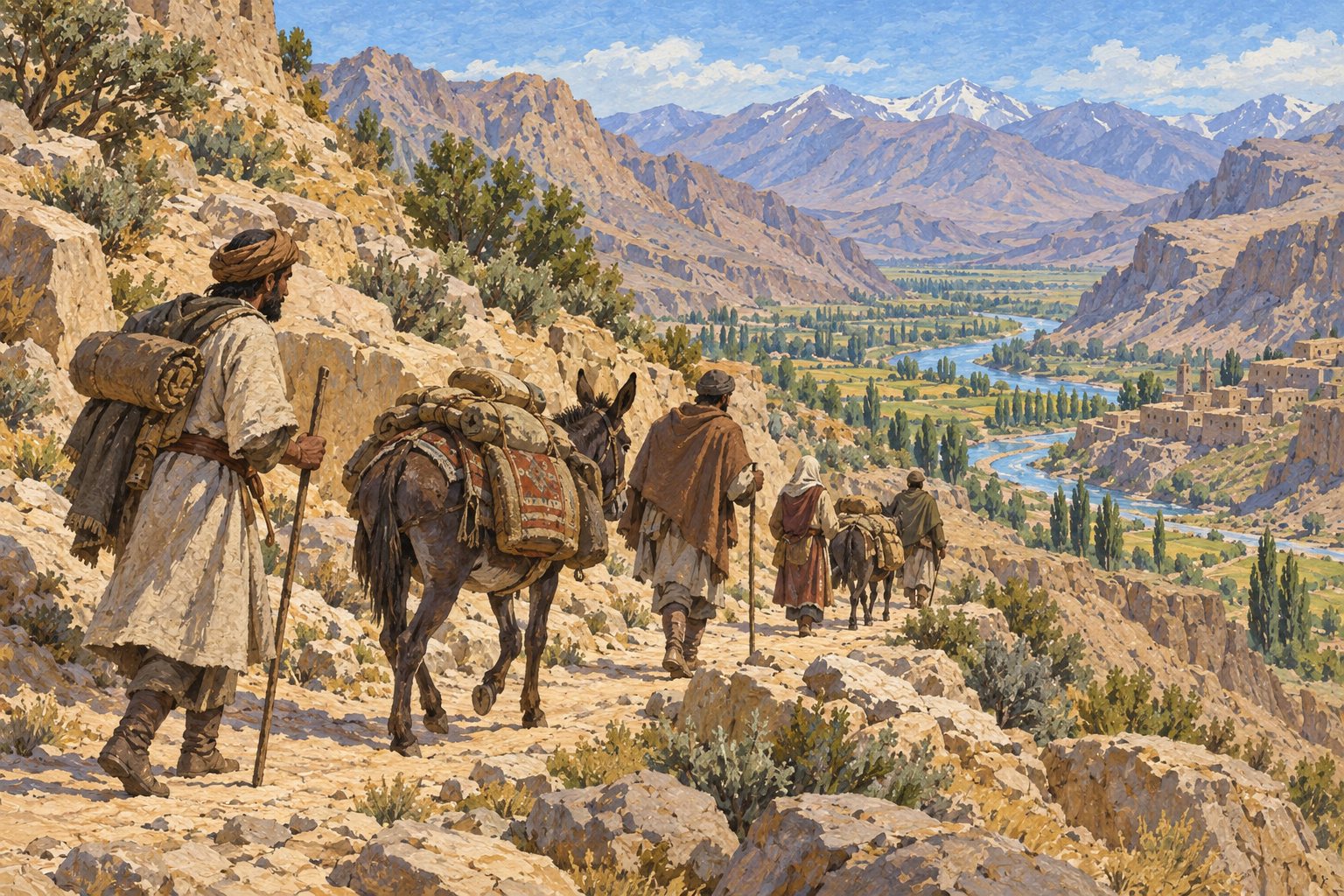
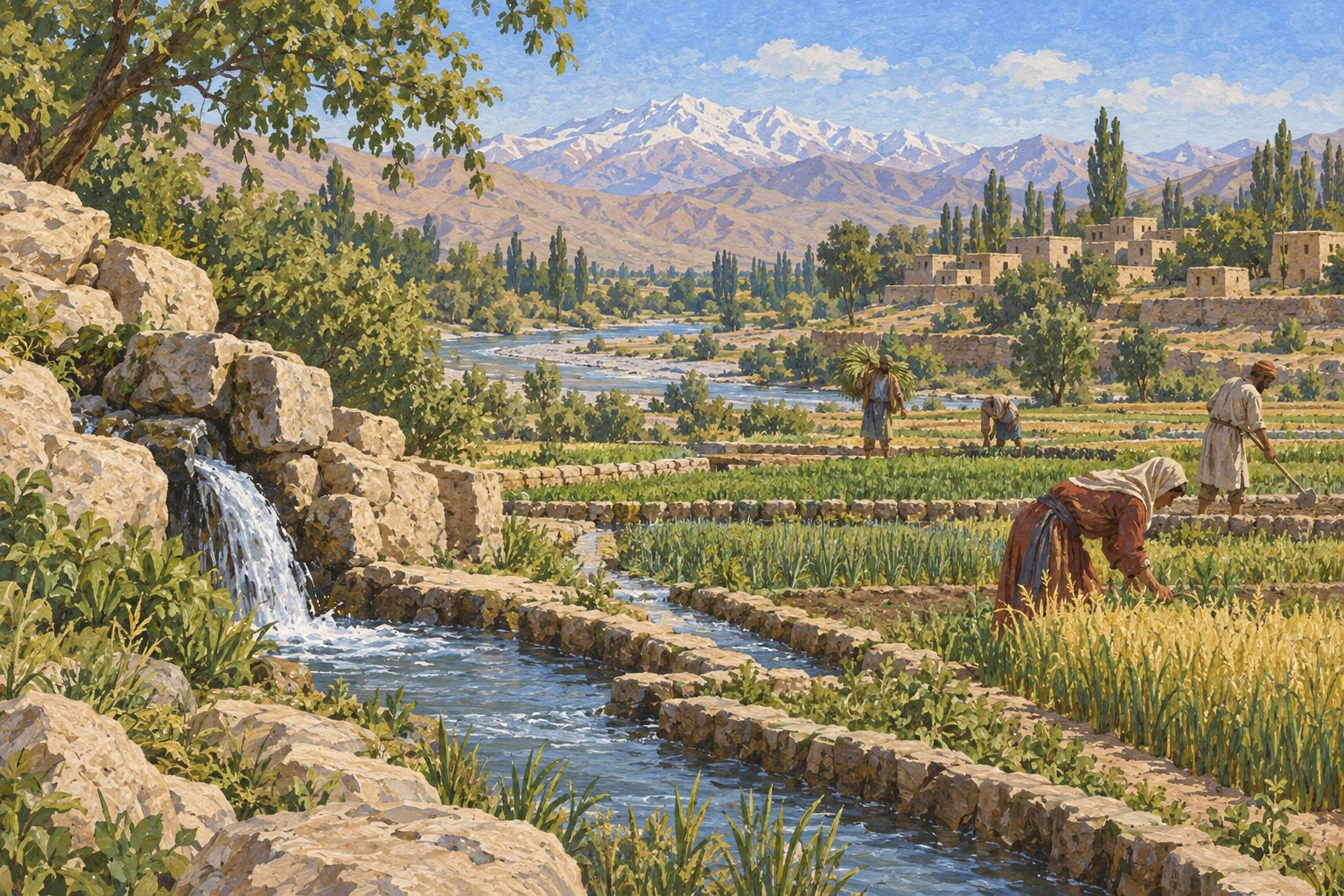
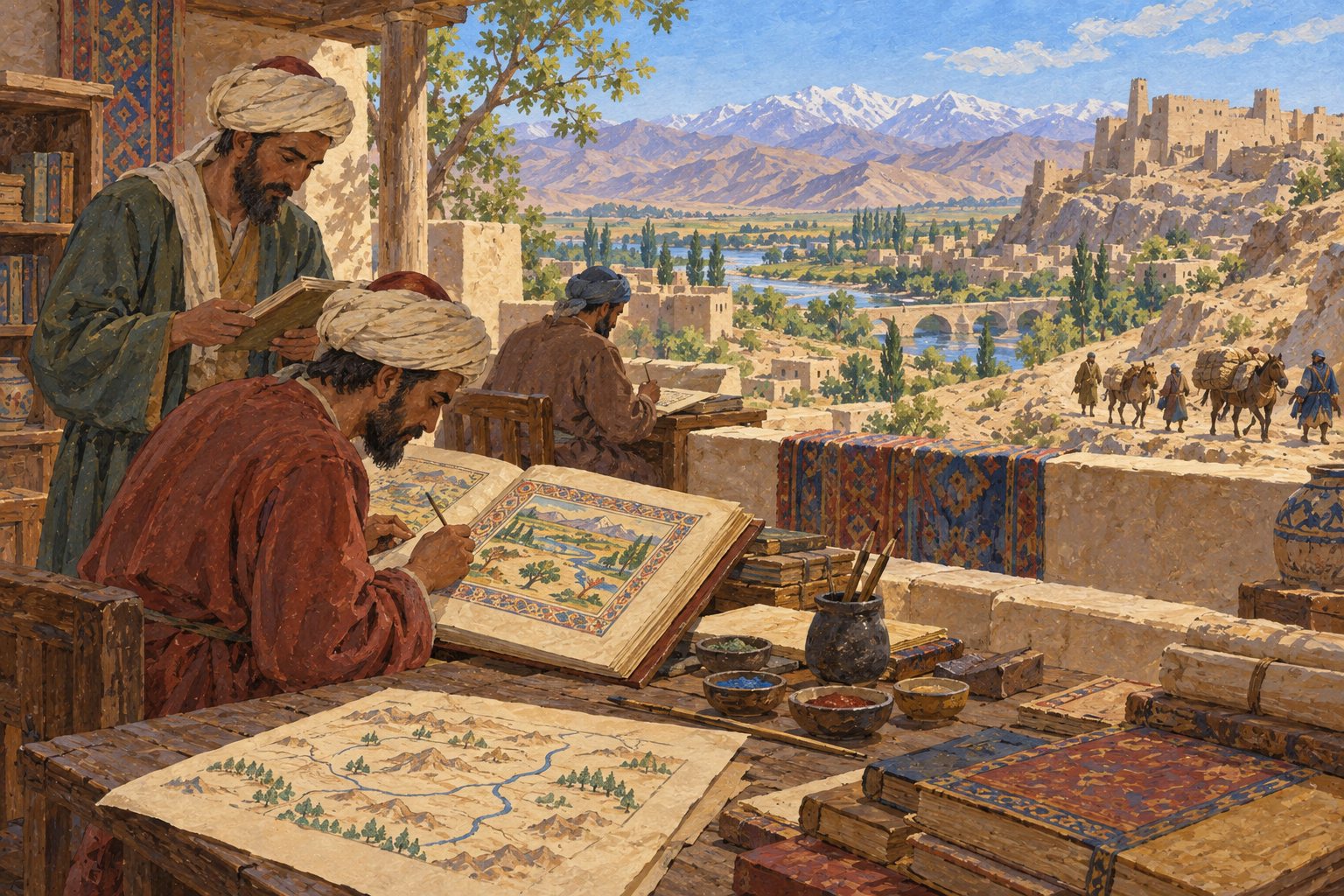
An eastern Iranian landscape. The Younger Avesta carries its own map, and Persia is not on it: the Videvdad opens with a catalogue of sixteen good lands — Sogdiana, Margiana, Bactria, Arachosia, the Land of the Seven Rivers — an eastern-Iranian world with no Persepolis, no Media, no western Iran at all, which is the geographic argument that the tradition grew up far from the empire that later spoke for it; and the Yashts show the tradition re-absorbing gods the Gathas never name — Mithra of the covenants, Anahita of the waters — the old Indo-Iranian pantheon returning under licence while daeva, the cousin-word for the Vedic gods, hardens into the word for demon.
How it was transmitted
A Liturgy Nobody Understood
By the middle of the first millennium BCE Avestan was nobody’s mother tongue, and the liturgy was carried for something on the order of a thousand years as memorised sound by priests who could recite it exactly and understand it imperfectly or not at all — the proof is in the corpus itself, where late compositions in imitation Avestan break the grammar their models keep, which shows the transmitters preserving sound they could no longer generate; the unit of preservation was never the book but the performed ceremony, and the profession is not a relic: priests memorise the Yasna today, and the chapter describes the training in the present tense.
Fifty Letters for a Dead Language
The Avestan alphabet, invented in the Sasanian period — conventionally dated to about the sixth century CE — is a script engineered for exactly one job: roughly fifty characters (the count varies with how ligatures are reckoned, and the printed number is one named authority’s), built out of the Pahlavi book hand and the Psalter script, fully vowelled, and phonetically fine-grained enough to record differences of sound that no difference of meaning depends on; nobody designs an alphabet like that to write a living language — it is a recording device, built to freeze the pronunciation of a liturgy in a language then dead for over a thousand years, and it is the single most striking transmission artefact in this series.
Explore the illustrations5 scenes · The manuscript copy
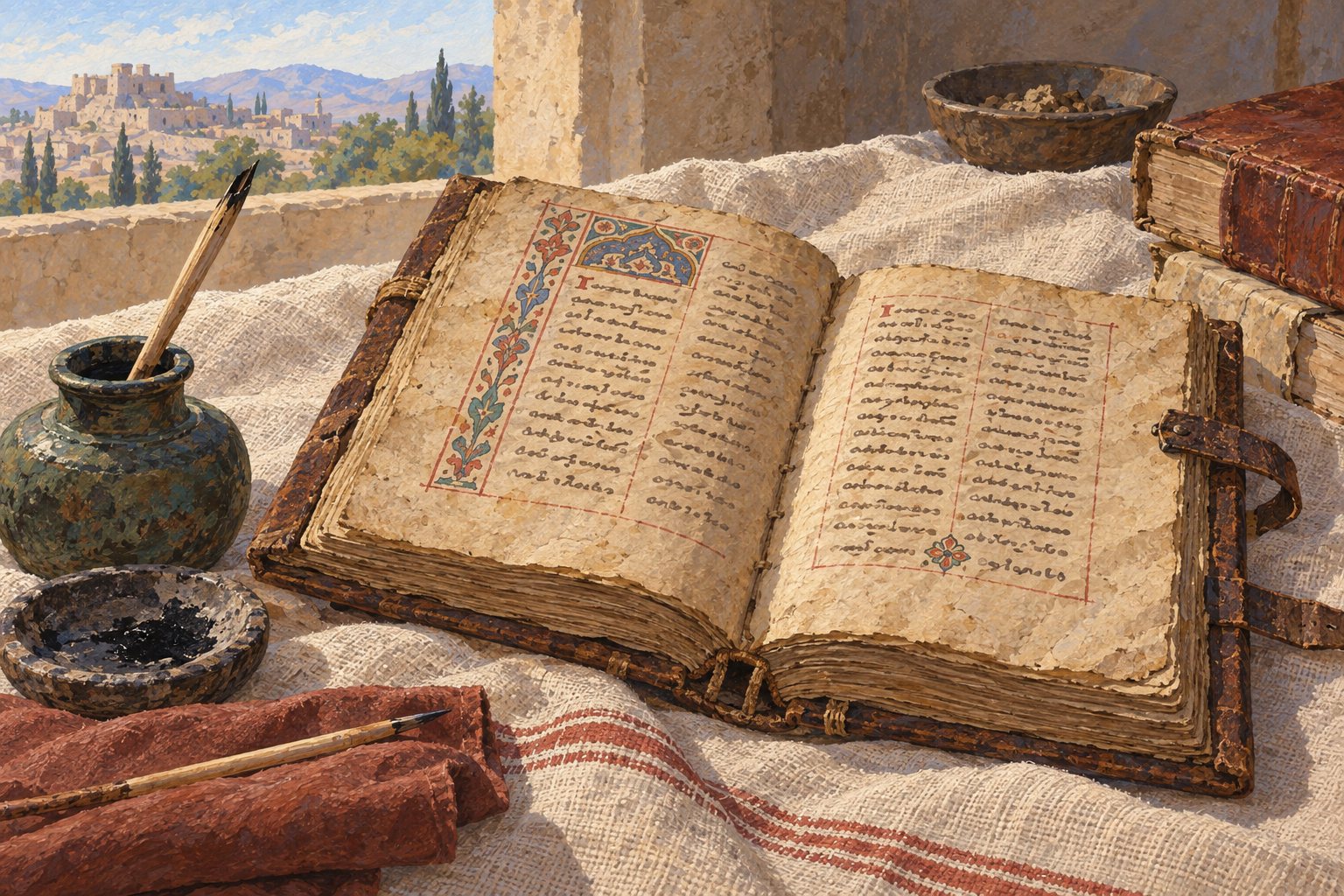
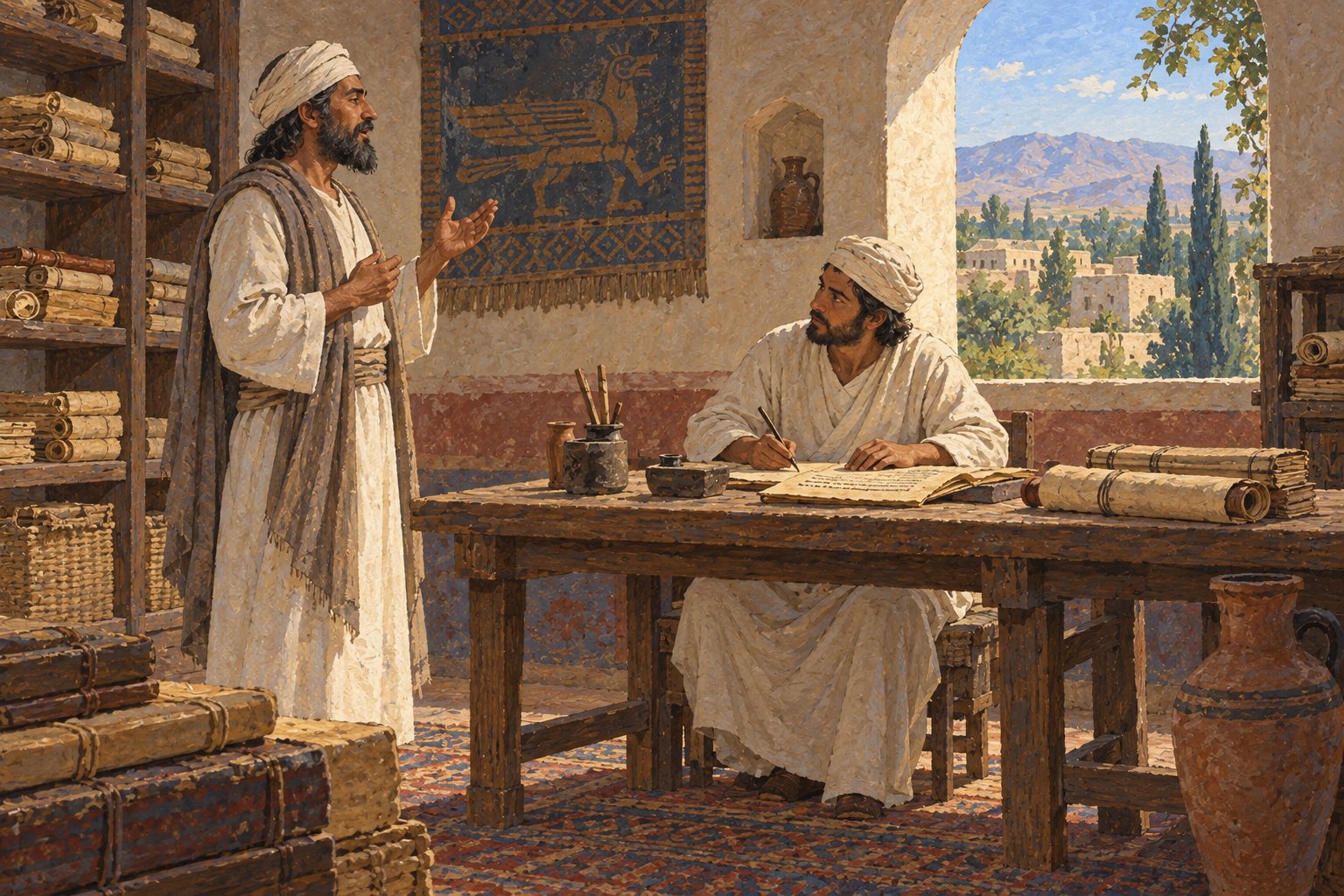
The manuscript copy. The oldest surviving Avestan manuscript is conventionally dated to about 1288 CE — younger than the alphabet it is written in by some seven centuries, younger than the Gathas by well over two thousand years, the widest such gap in this series — and the whole textual base of the religion is a handful of late-medieval manuscript families whose colophons name their scribes and their towns; the reason the gap matters less than it should is the machine: every copy descends from the Sasanian archetype, and the alphabet was built to carry sound across exactly this kind of distance — the recording device worked, and the manuscripts are the proof it was needed.
Texts and authority
What Alexander Is Said to Have Burned
The movement’s argument up front: loss is this canon’s story, and the tradition tells the loss as an event — the whole Avesta and its commentary, written in gold ink on prepared ox-hides and deposited in the royal archive, burned by “the accursed Alexander”; whether any such written Achaemenid Avesta existed cannot be established, and a strong philological tradition doubts it — but the account itself is load-bearing either way, because a religion that explains its own gaps with an arson has told you what it believes a canon is: property of the crown, held in an archive, and mortal.
Kings Collecting Fragments
The tradition’s own transmission history is a chronicle of royal salvage: an Arsacid king, Valakhsh, orders whatever survives “in writing or in oral tradition” gathered; Ardashir, founder of the Sasanian house, commissions the priest Tansar to assemble an authorised religion; Shapur I adds medicine and astronomy hunted out of India and Rome; Adurbad son of Mahrspand proves the settled text by ordeal, molten metal poured on his chest; Khosrow closes the sequence — five reigns of canon-making in which the authority to decide is the crown’s, exercised through a priest, and the account of it survives only as a Sasanian church document making a Sasanian church claim, which the chapter labels every time it leans on it.
Institutions and resources
The Fire That Owns Property
A consecrated fire in Sasanian law could be the beneficiary of an endowment — land, herds and slaves settled on it, foundations established “for the soul” of the founder and administered by priests — which made the great fires economic institutions and the priesthood their management; Kerdir’s inscriptions boast in stone of fires founded and priestly colleges endowed across the empire, the excavated sanctuary at Takht-e Soleyman shows the scale a royal fire could reach, and the scholarship argues these foundations as an ancestor of the Islamic waqf — reported as the argument it is, and handed by name to the Sufism volume, whose money movement runs on the waqf; what cannot be established is any total: the Sasanian church’s books do not survive, and the chapter says so in the sentence that wants them.
The Price of Staying
After the conquest the fiscal machine inverted: the jizya made remaining Zoroastrian a taxable status — money as a standing conversion pressure with a price printed on it — and the community’s own ninth-century books document the squeeze from inside, a high priest answering his postbag’s questions about what happens to inheritance when a brother converts; the conversion of Iran was nonetheless slow, generations not years, which is itself a finding about how the pressure worked.
Explore the illustrations7 scenes · Work at the dockyard
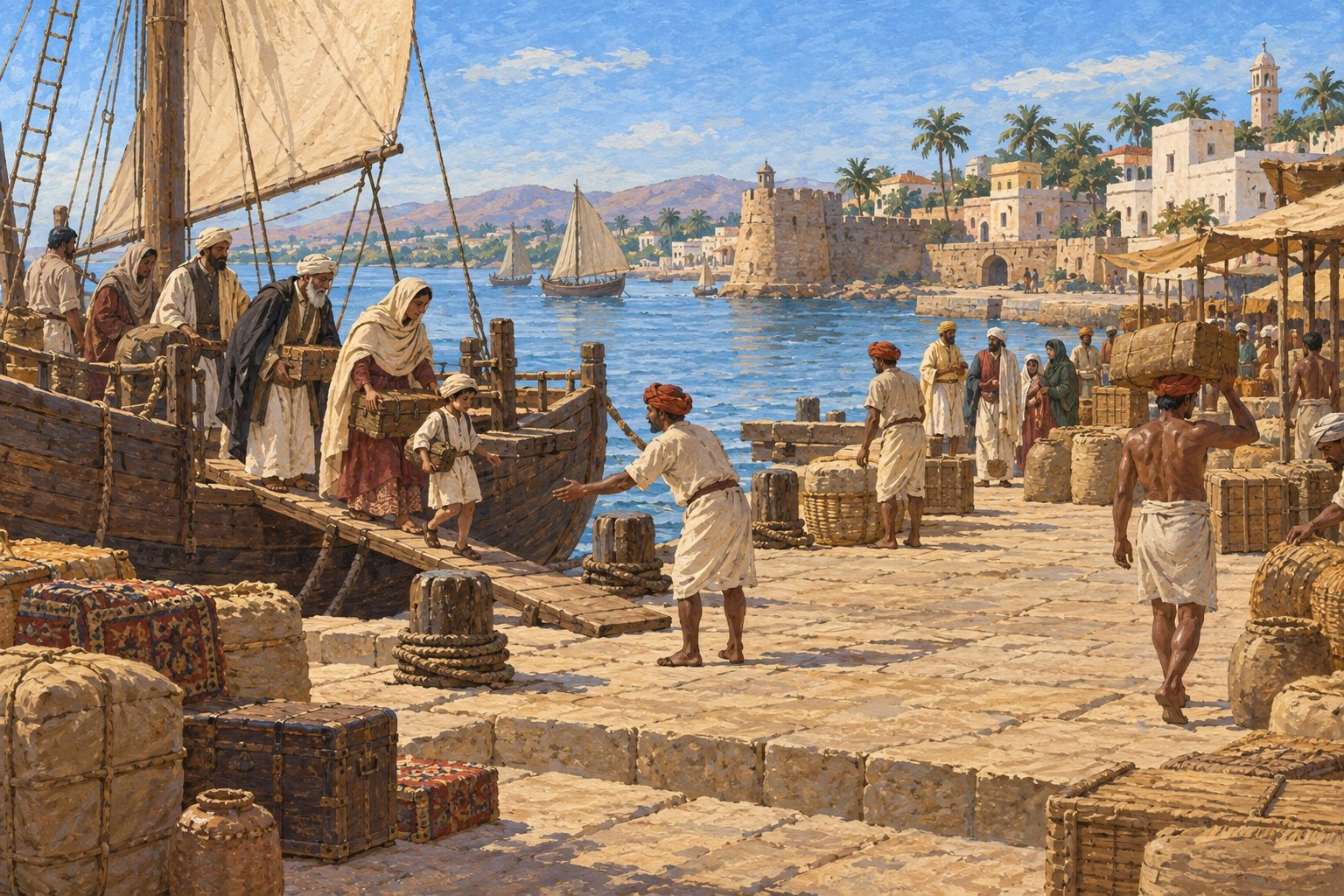
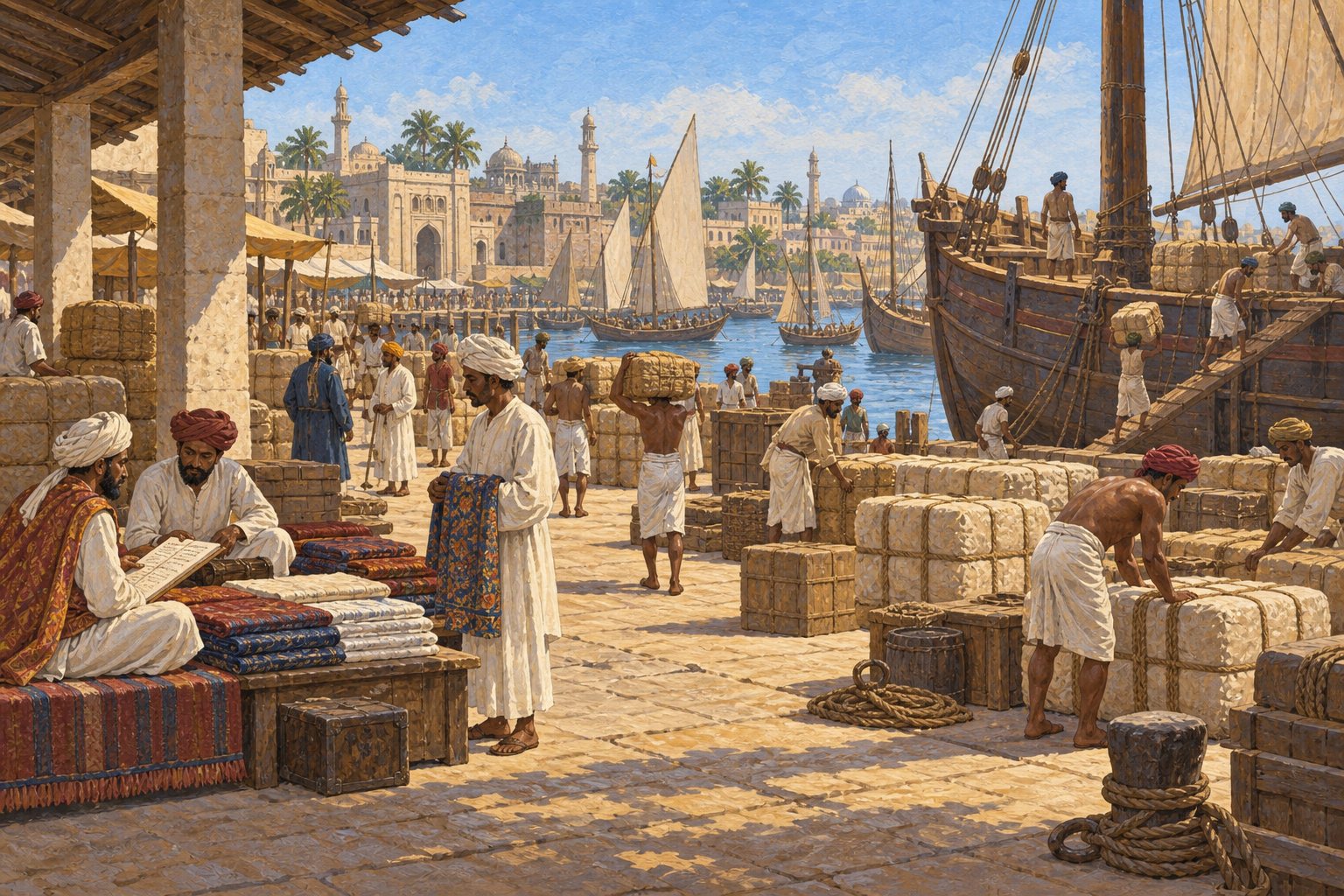
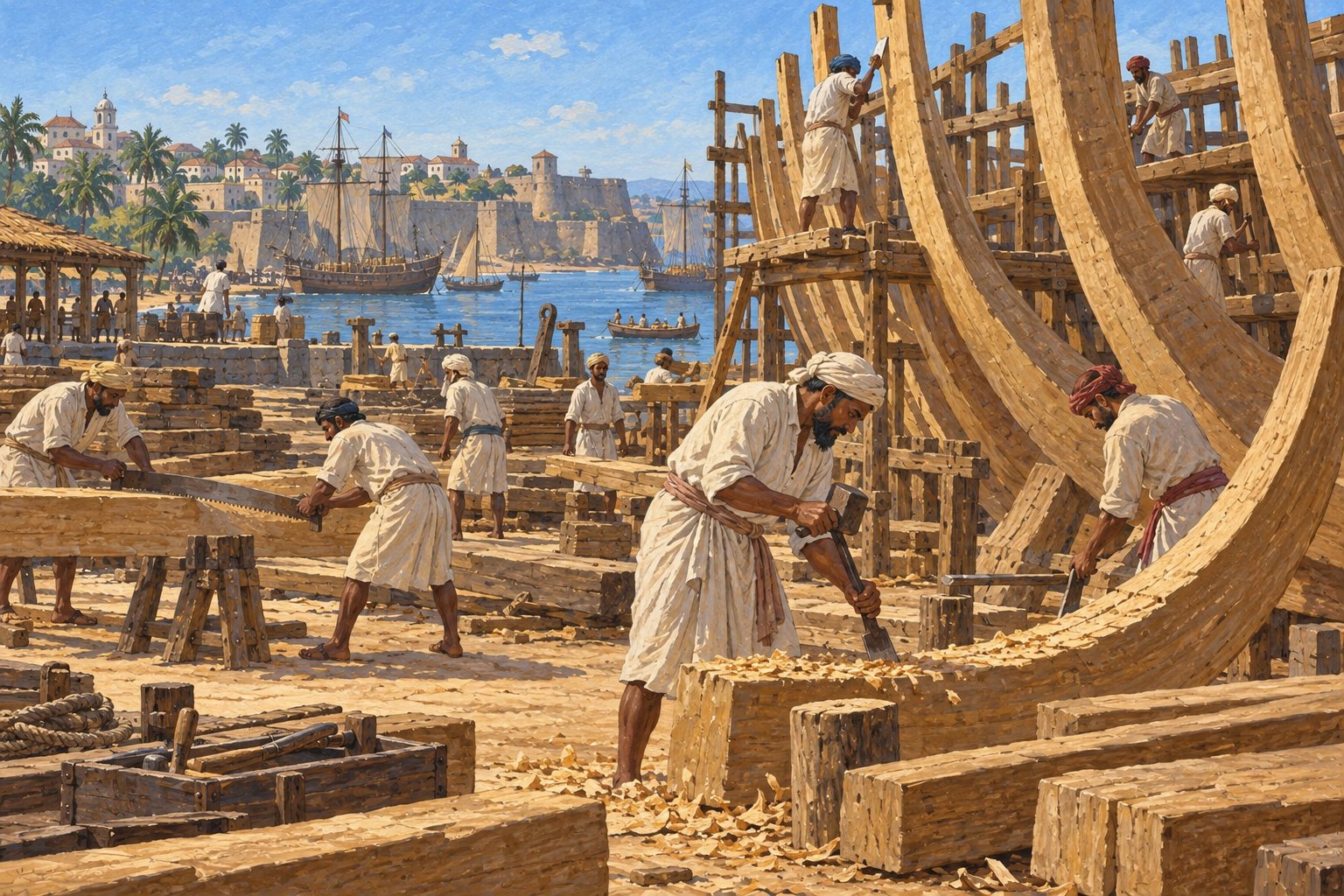
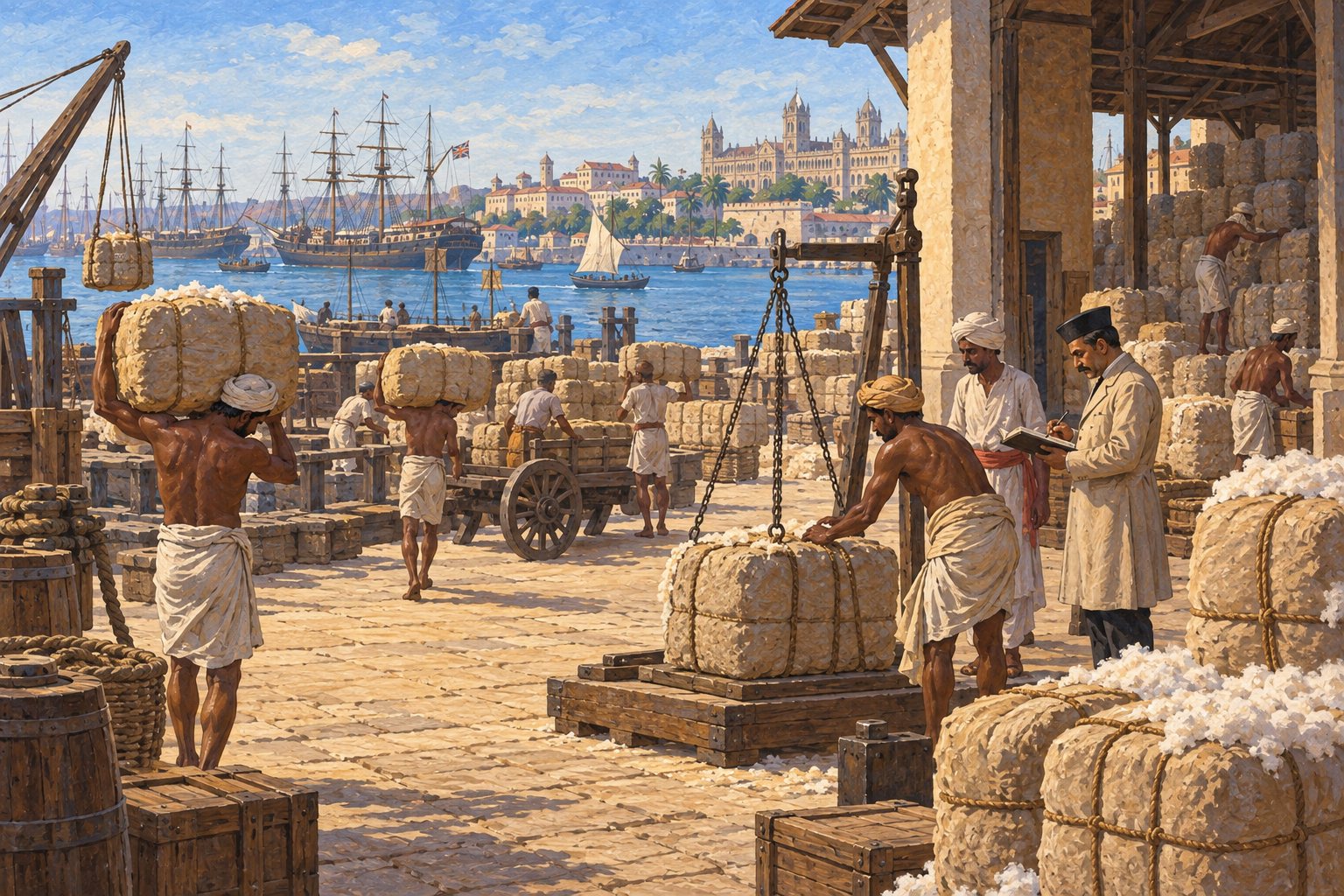
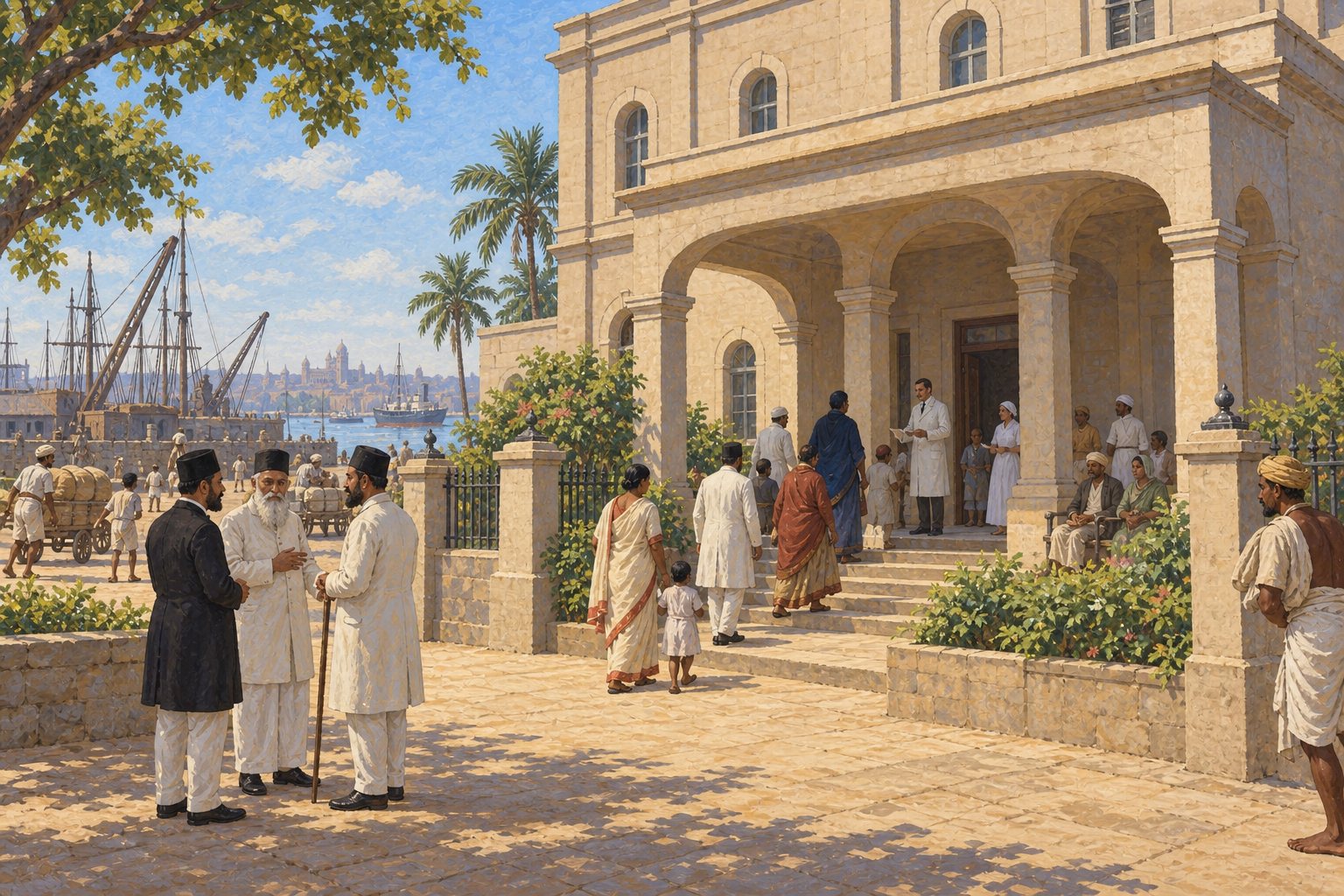
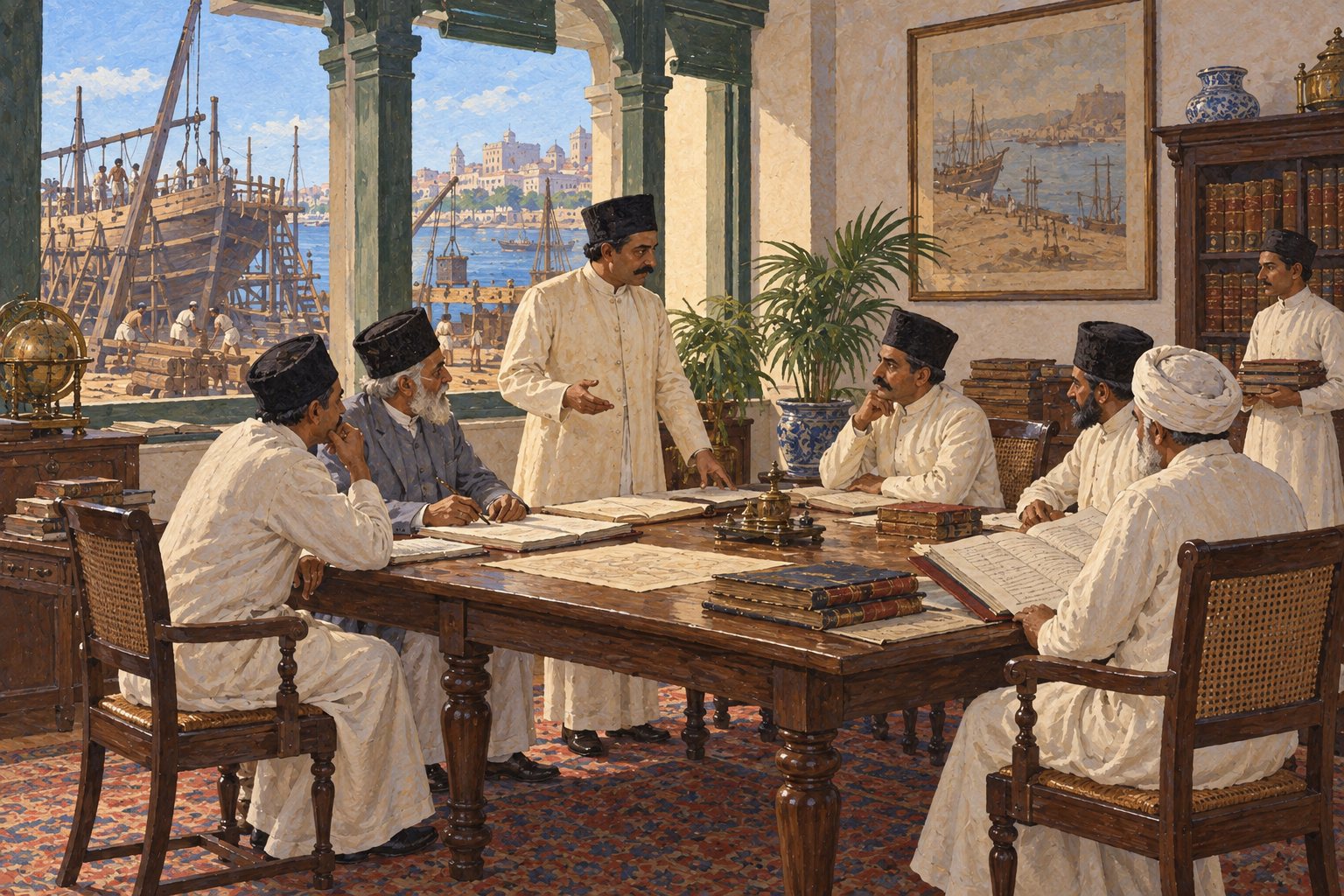
Work at the dockyard. The community that would become the world’s most conspicuous religious philanthropy arrived in India as refugees on a story: the Qissa-ye Sanjan — a Persian verse account composed in 1599 about events some six centuries earlier, and the chapter’s confidence is priced accordingly — lands the migrants in Gujarat, plants the Iranshah fire, and carries it through sack and jungle to safety; the ledger years follow — Parsi brokers to the East India Company at Surat, the Wadia master-shipwrights running Bombay’s dockyard from 1736, and Jamsetjee Jejeebhoy’s cotton-and-opium fortune converted, spectacularly, into hospitals and a baronetcy — so that by the mid-nineteenth century “Parsi charity” was a Bombay institution and the community reached the Punchayet chapter rich, urban and organised.
Changes and divisions
From Carthage to the China Coast
Mani died in the Sasanian king’s prison — 274 or 277, the accounts disagree — and within a century his church ran further than any single religion had yet run: Augustine spent nine years as a Manichaean hearer in Roman Africa and left the movement’s best hostile description; Coptic psalm-books were being copied in Egypt; Sogdian merchants carried the faith up the silk roads; it reached the Tang court in 694; and in 762/3 the khagan of the Uyghurs converted, giving Mani’s church the only state it would ever hold — the machine chapter’s design brief executed in full, translation all the way down, Mani preached as the Buddha of Light in Chinese; this is the series’ high-water mark for pure transmission engineering, and the next chapter is what happened to it.
The Religion That Died
Everyone persecuted it, everywhere, for the same structural reason: Mani’s church presented itself as the completion of whichever faith held power, so each power read it as heresy rather than as a foreign religion — Diocletian ordered its leaders burned with their scriptures, Kerdir’s church struck it as zandik, the Abbasids made zindiq a capital inquisition, and the Tang banned it in 843 within years of its Uyghur protector’s fall — while the elect-and-hearer structure made every congregation clergy-heavy and dependent; by the Ming proscriptions the last communities in Fujian fade from the record, and at Cao’an, near Quanzhou, the one surviving Manichaean shrine keeps a carved image of Mani that local worshippers have long venerated as a Buddha; the series’ clearest case of a religion with a superb machine, no lasting state, and no second act — it never split, because it never got the chance: it ended.
Limits of the evidence
These limits are stated in the book before its argument.
- When Zarathustra lived, to within nearly a millennium The language of the Gathas argues the second millennium BCE; the “258 years before Alexander” reckoning of the later tradition argues the sixth century; the Greek figures are fantastic; and some specialists argue the poems should not be read as one man’s work at all. Movement One prints the range, names who argues what, and resolves nothing — this is the series’ widest dating band and the front matter says so.
- Whether the Achaemenid kings were Zoroastrian in any sense a Sasanian priest would have recognised They name Ahura Mazda constantly; no royal inscription names Zarathustra; their archive tablets pay priests of other gods; their tombs hold bodies.
- Whether a written Achaemenid Avesta ever existed for Alexander to burn The destruction of the archive is the tradition’s account of its own loss, and the philologists’ doubt is part of the chapter that reports it.
Sources and reading
This article brings together the series’ existing overview and chapter summaries. The linked book page provides the full outline and bibliography.
- Ralph T. H. Griffith, The Hymns of the Rigveda1896. the ninth book’s soma hymns set beside the Yasna’s haoma opening
- L. H. Mills, Yasna and Gathas, Sacred Books of the East 311887. haoma = soma; the cow’s lament; the wedding hymn; the Chinvat line
- Christian Bartholomae, Altiranisches Wörterbuch1904. the public-domain monument of Old Iranian–Vedic comparison
- James Darmesteter, Videvdad, Sacred Books of the East 41880. the sixteen lands; corpse-exposure rules; the anti-daeva law
- J. J. Modi, Religious Ceremonies and Customs of the Parsees1922. navar versus maratab grades; the seventy-two-ha Yasna
- Kerman Daruwalla, Multimedia Yasna priestly-training studyfieldwork 2017–2020. lesson-ledgers and seven-year memorisation at Dadar
- Karl Hoffmann, “Avestan language” / script, Encyclopaedia Iranica1987. fifty-odd letters; a recording device built from Pahlavi and Psalter hands
- Unicode Standard, Avestan block (U+10B00–U+10B3F), version 5.22009. fifty-four named letters; no block for Book Pahlavi
Illustrations are newly generated interpretations of themes in the book. They are not surviving artifacts, historical photographs or evidence for the events described.