14 illustrations · 1:42
Watch & listen.
Follow the images with a narrated journey through the book.




Overview
- Coverage
- 551 BCE–1905 CE
- Earliest secure evidence
- 551 BCE
- Transmission
- the canon carved in stone, then the exam
The machinery came in two stages. The Xiping Stone Classics, carved from 175, put an authorised text in public in stone so that copies could be collated against it — and rubbings taken from those slabs are reproduction from a master, centuries before printing. Then the examination system, which did something no other tradition here managed: it made a canon the entry qualification for the state’s own hiring, so that studying it was a career decision before it was a religious one.
The coverage period and the earliest secure evidence are different dates. A tradition’s own account of its beginnings may differ from both.
Historical setting
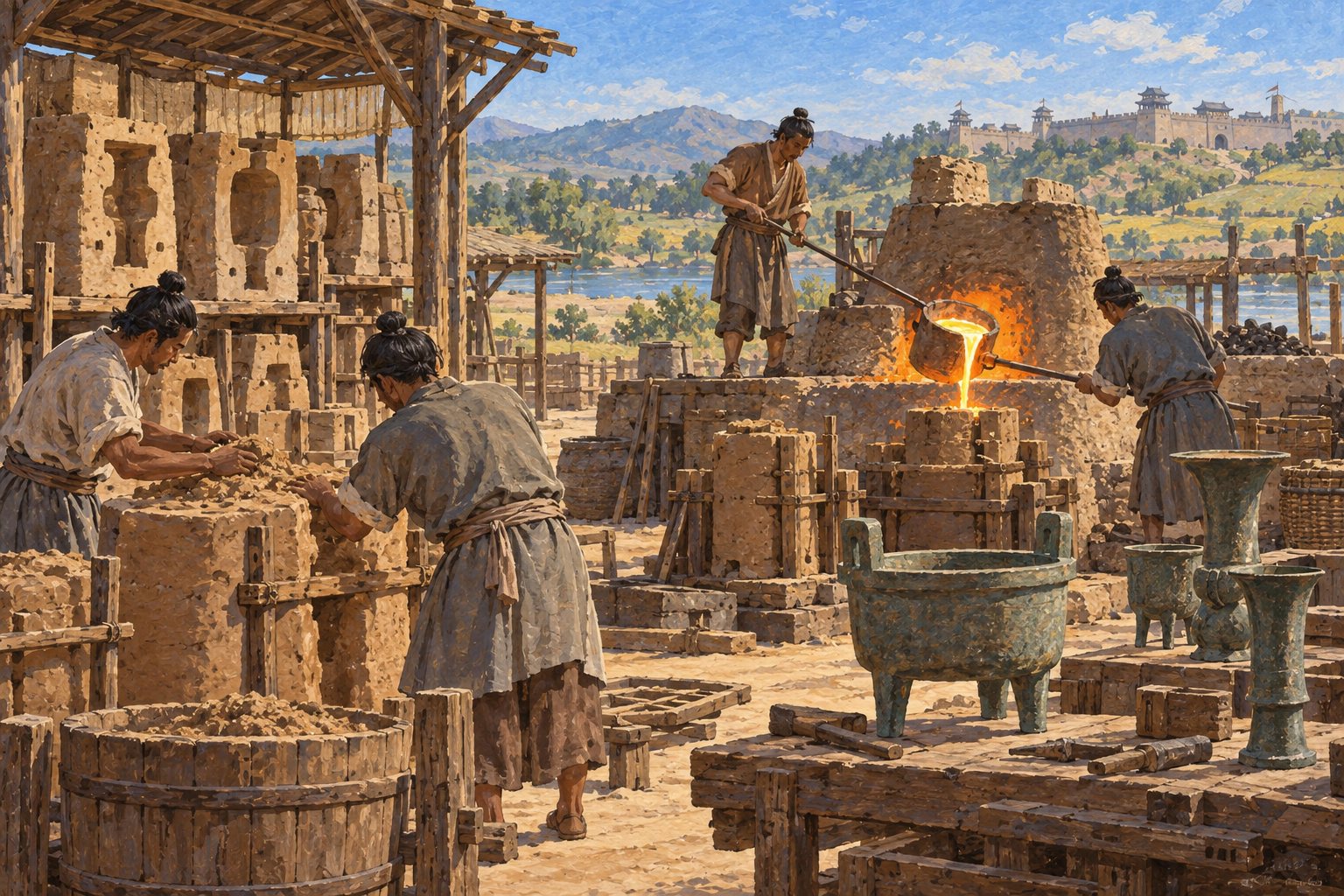
Cast in Bronze
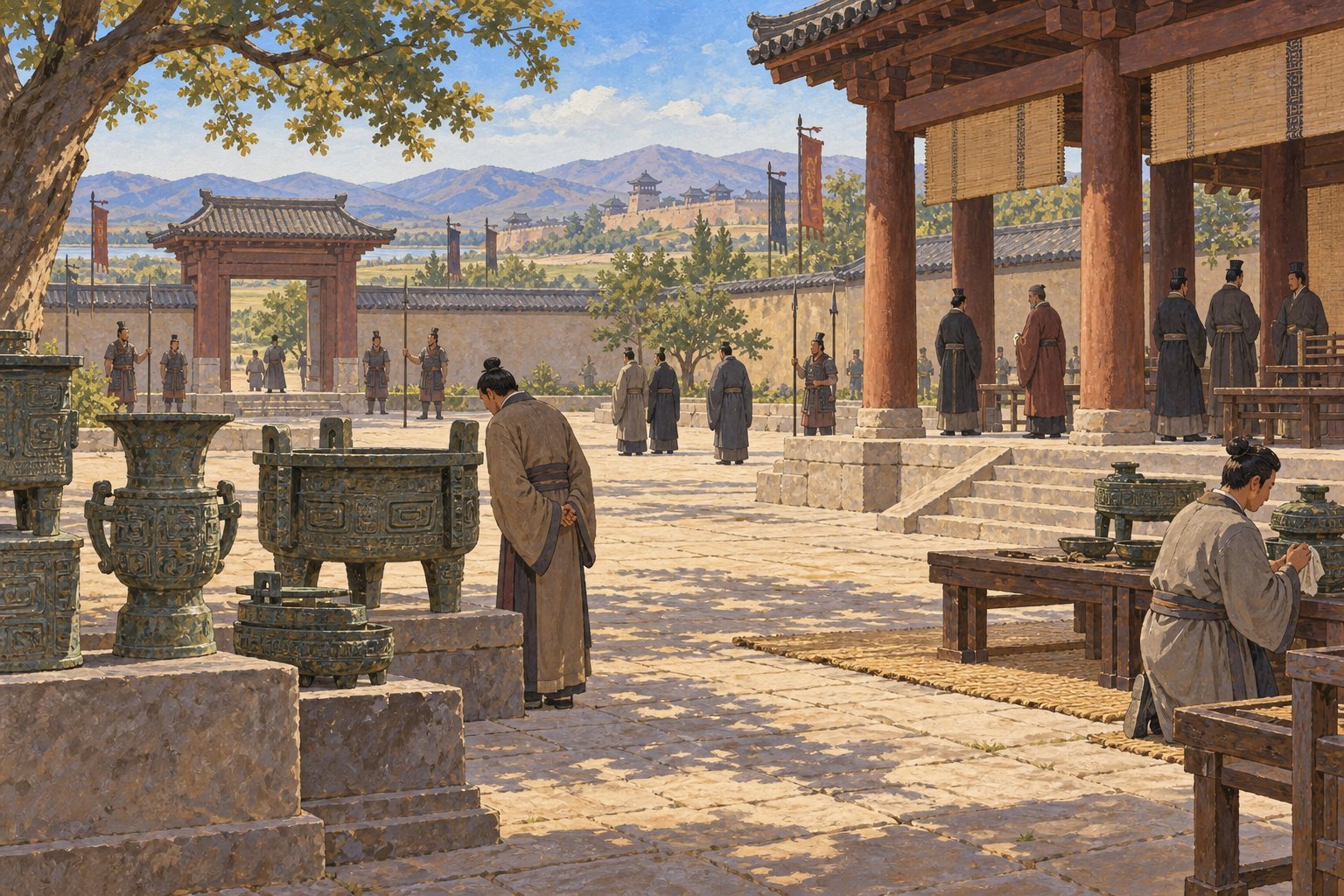
The Western Zhou order ran on ritual and kept its paperwork in bronze — vessels cast to record investitures, gifts and land settlements — and by Kongzi’s birth in the mid-sixth century the machinery had outlived the power it recorded: the king a figurehead in the east since 770, states swallowing states, and the chronicle of Kongzi’s own Lu logging ritual violated by the men most obliged to it, which made the question of the age what holds a world together when its forms still stand and its substance has gone.
A Profession of Mourners
The ru were a trade before they were a school — ritual specialists for hire at funerals, sacrifices and court occasions in a world where getting the rite wrong had legal force — and the earliest outside description of them is an attack: Mozi’s “Against the Ru” caricatures elaborate funerals that beggar households, which is hostile testimony, and hostile testimony is still testimony that the profession existed and charged.
Explore the illustrations5 scenes · Bronze and ritual memory
Bronze and ritual memory. The Western Zhou order ran on ritual and kept its paperwork in bronze — vessels cast to record investitures, gifts and land settlements — and by Kongzi’s birth in the mid-sixth century the machinery had outlived the power it recorded: the king a figurehead in the east since 770, states swallowing states, and the chronicle of Kongzi’s own Lu logging ritual violated by the men most obliged to it, which made the question of the age what holds a world together when its forms still stand and its substance has gone.
How it was transmitted
Warp Threads
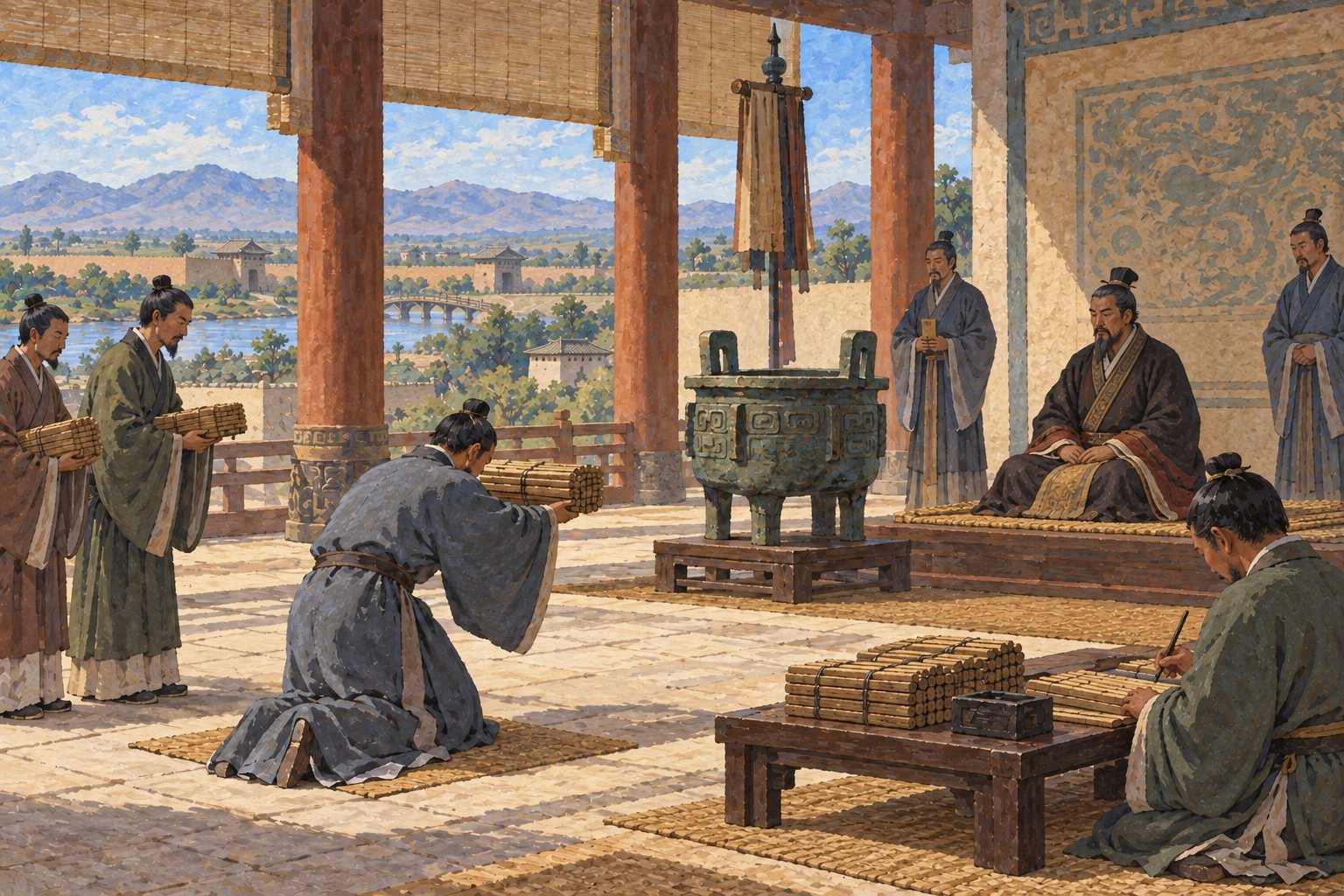
The word for a classic, jing, is the word for the warp thread of a loom, and the object it named was physical: a bundle of inscribed bamboo strips bound with cords, heavy, bulky, easily disordered and easily partial — which is why early “books” behave like collections of chapters rather than fixed wholes, and why the machine problems of the next eight centuries are all versions of how do you keep ten thousand strips identical across an empire.
Thirty Thousand Students
In 124 BCE the Han founded an imperial academy with fifty official students and chairs in the classics; the transmitted figures have enrolment at three thousand within a century and thirty thousand under the Later Han — the tradition’s numbers, printed as such — and the pedagogy was replication by lineage: each classic taught in authorised master-successions, examined by recitation, so that the academy functioned as a copying machine whose output was men.
Explore the illustrations5 scenes · Papers for the examiners
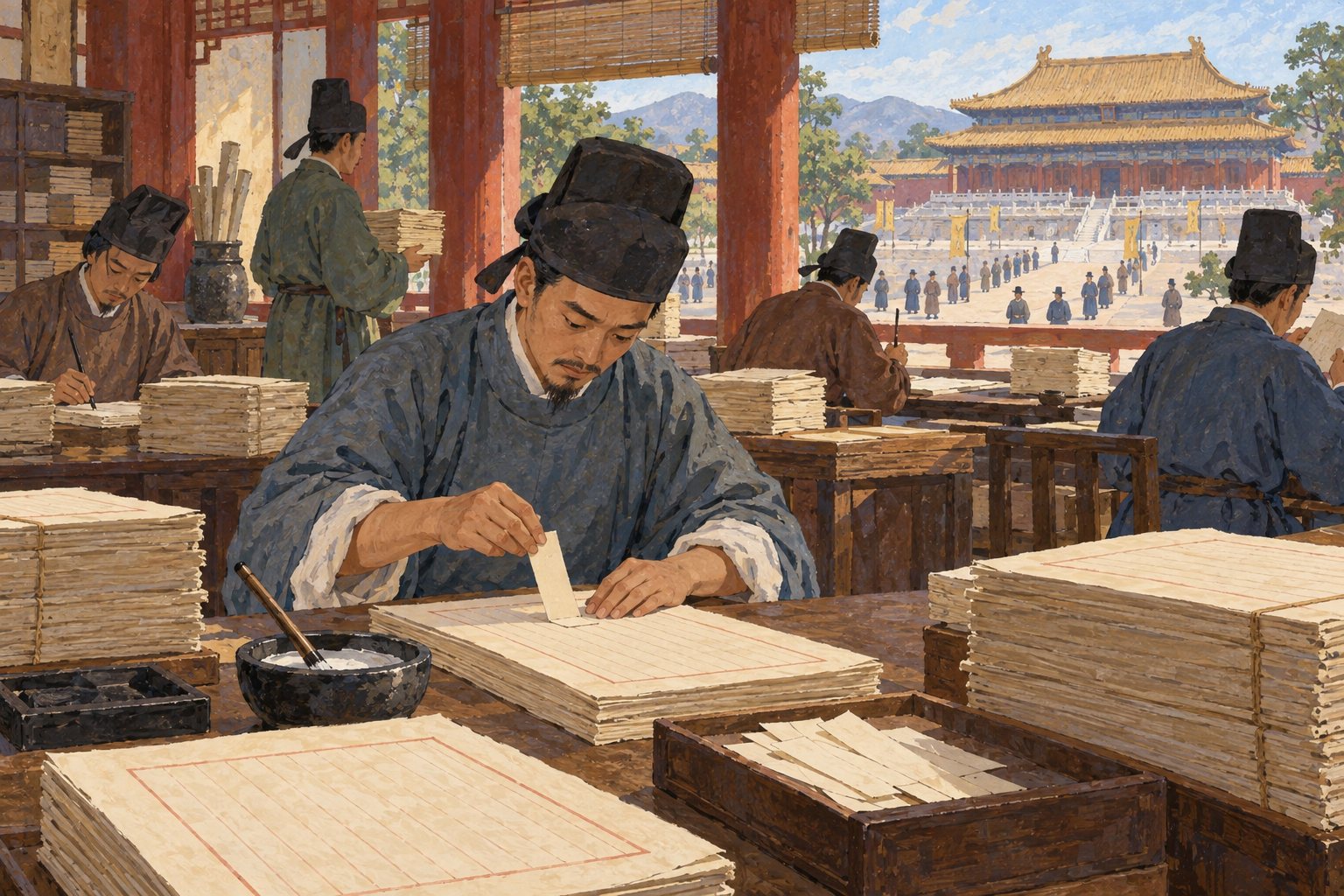
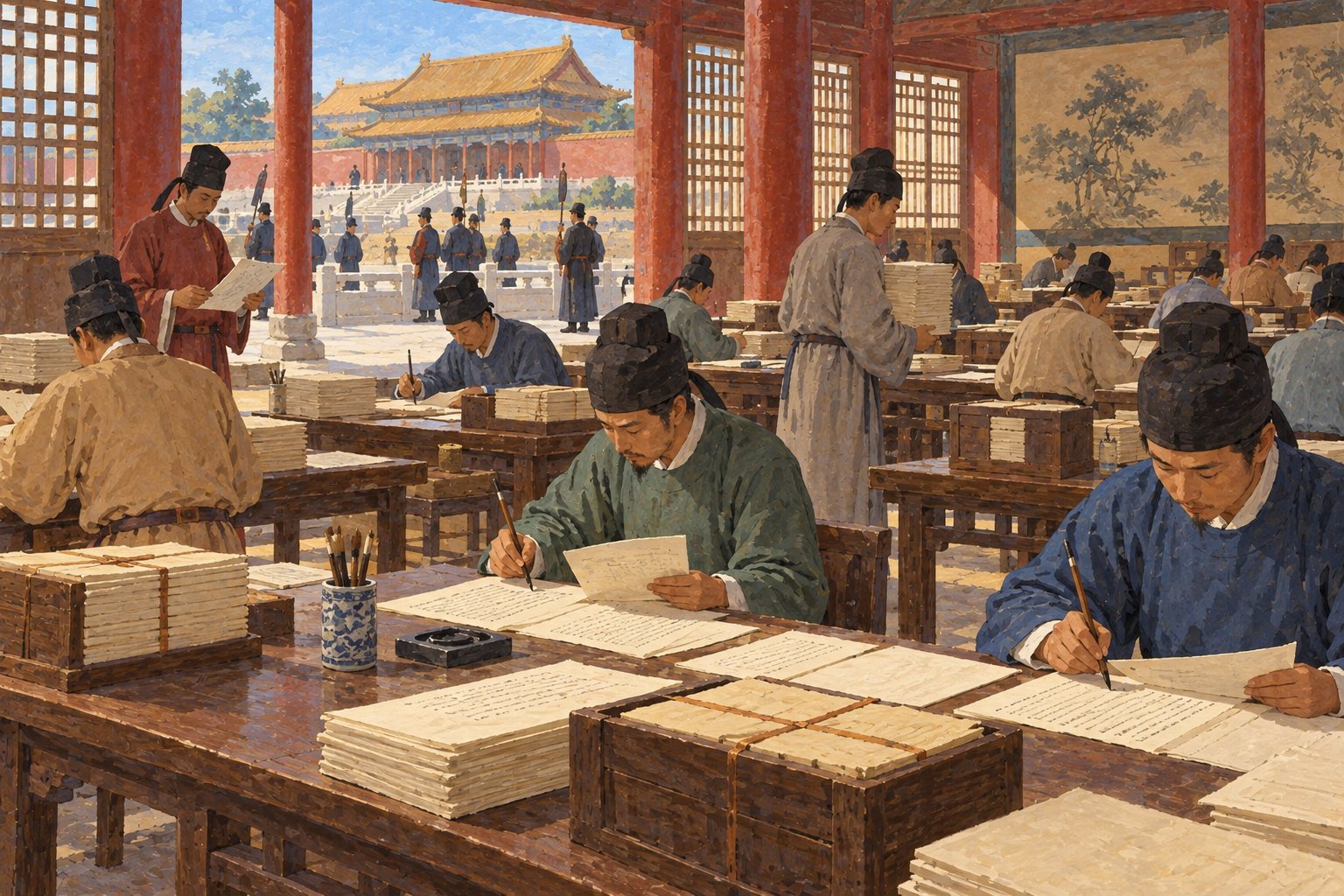
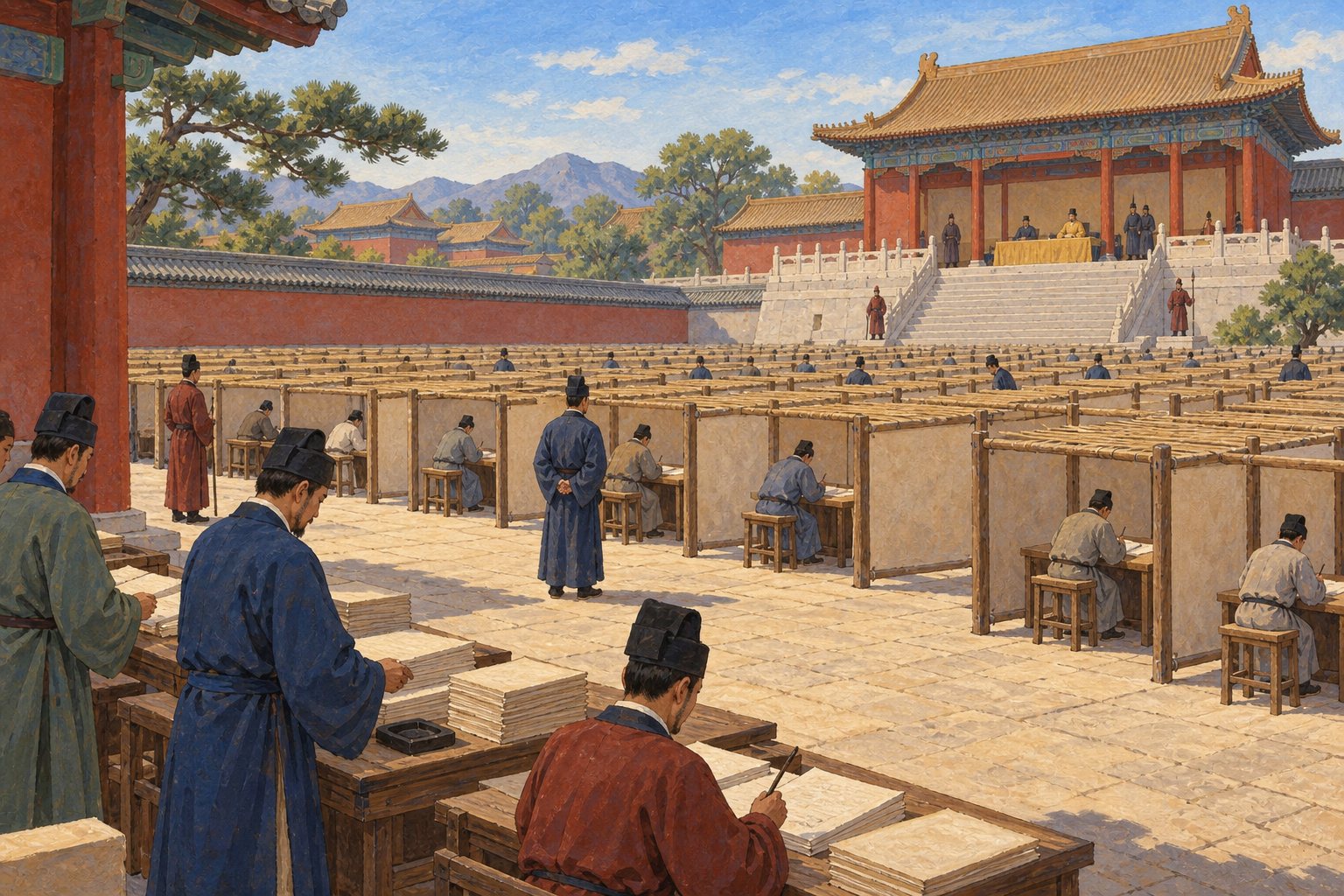
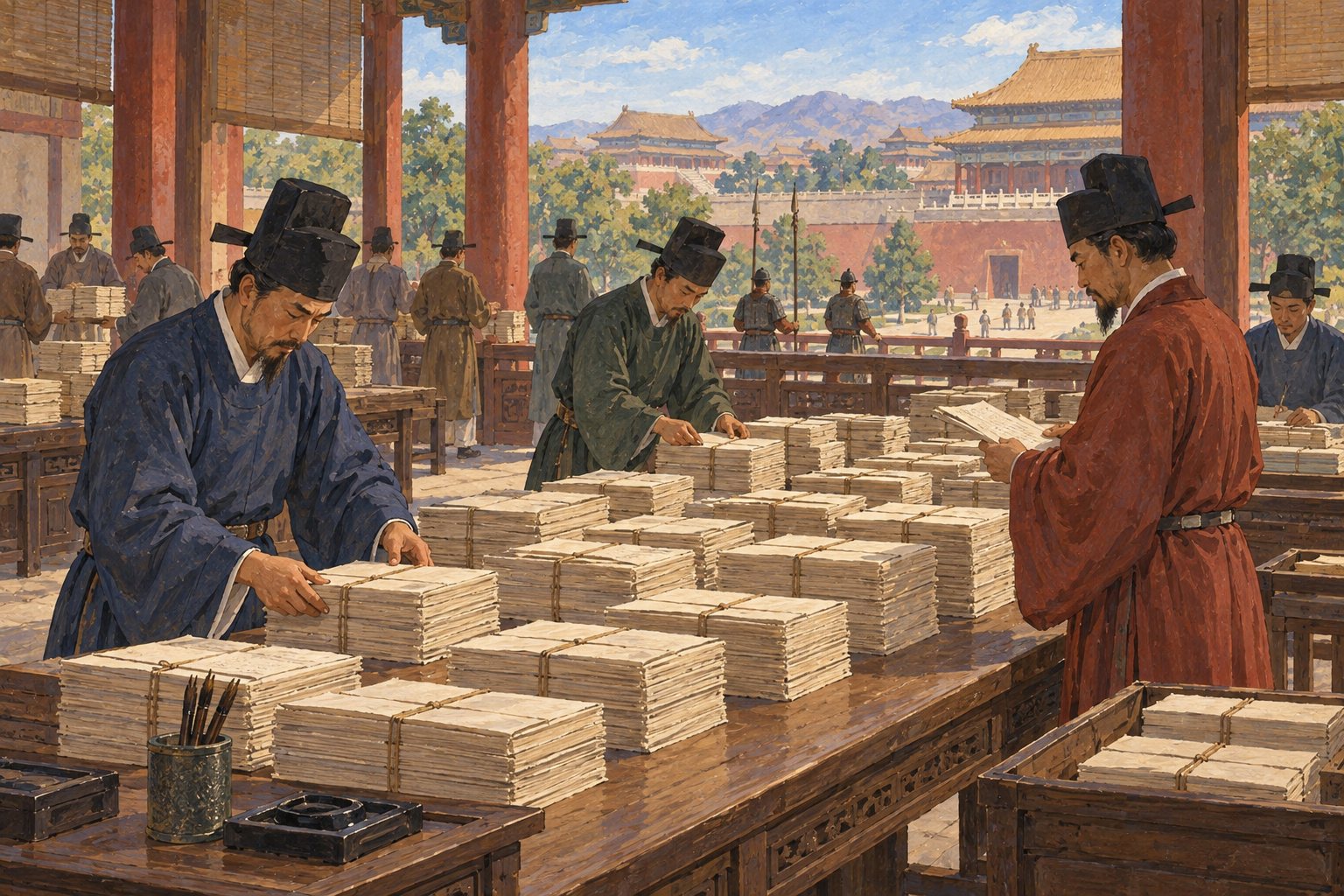
Papers for the examiners. The examination — conventionally dated from 605, mature under the Song — became a machine tooled against its own graders: candidates’ names pasted over, papers recopied by clerks so no examiner could recognise a hand, a palace stage with the emperor as final examiner, regional quotas after the list of 1397 seated southerners only and the graders paid for it — and by the 1250s, on the transmitted figures, a hundred thousand men a year were sitting it.
Texts and authority
Six Classics, One Missing
The canon claimed to be six — Changes, Documents, Odes, Rites, Music, Annals — and its first fact is a gap: no Classic of Music survives, if a text ever existed, so the tradition’s own count advertises a loss; the tradition holds Confucius edited all of them, scholarship contests every case, and the founder’s recorded sayings were not among the classics at all for the canon’s first millennium — a canon is what an authority says it is, and for a thousand years no authority said the Analects was one.
The Burning
In 213 BCE the First Emperor’s chancellor memorialised that private ownership of the Odes, Documents and the sayings of the hundred schools be ended by fire, with the court’s own erudites exempt — the decree targeted circulation, not existence — and what was actually lost cannot be established: the palace copies survived the decree and then burned with Xianyang in 206, so the tradition’s founding catastrophe and the scholars’ minimisation of it are both on the table, and the chapter reports the fight rather than settling it.
Institutions and resources
The State Cult
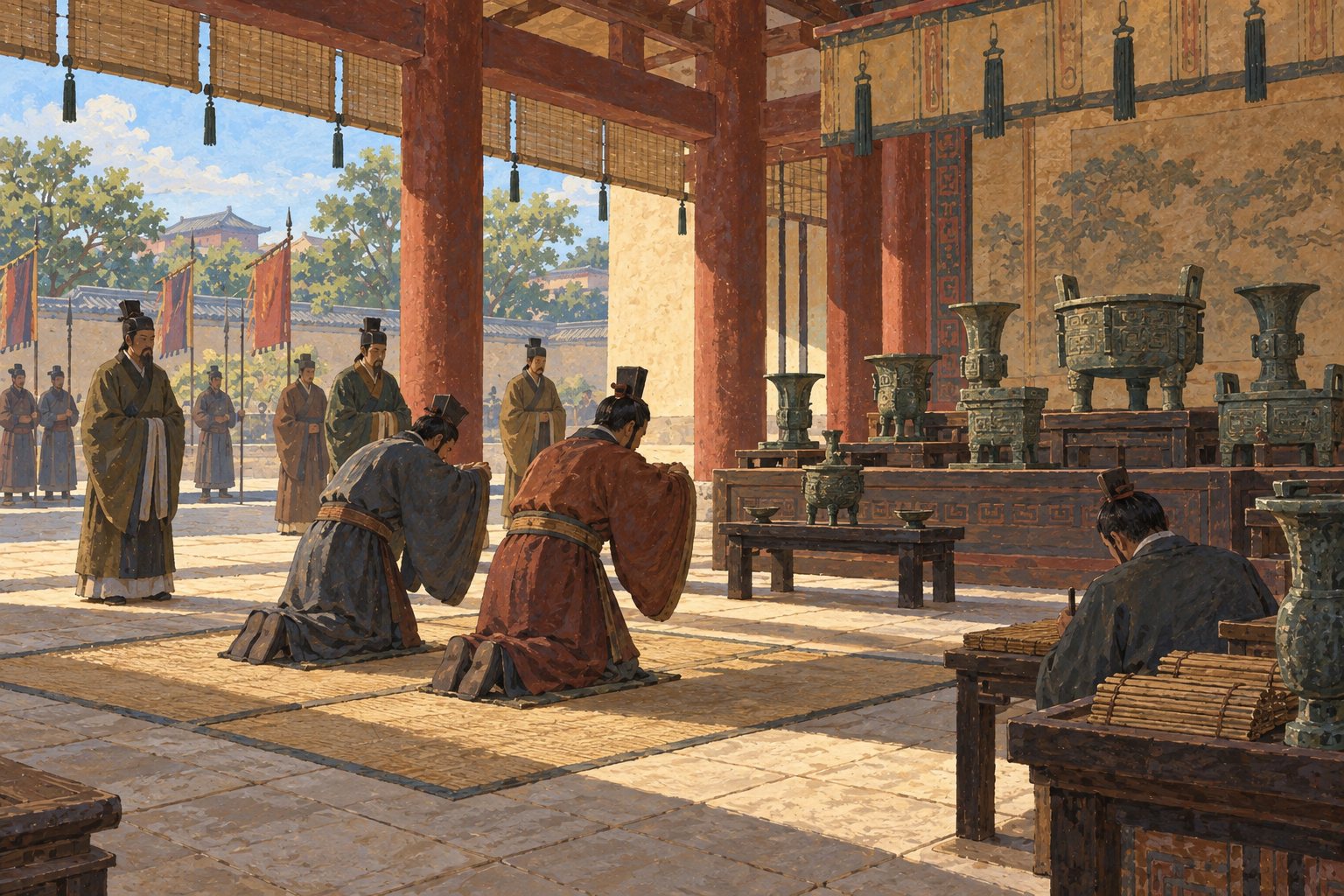
The tradition holds that the founding emperor of the Han stopped at Qufu in 195 BCE and offered Confucius the great sacrifice of ox, sheep and pig — the first imperial payment into what became a two-thousand-year cult account — and the ledger only ever ratcheted: ducal title by 1 CE, kingly title in 739, augmentations under the Song, until 1530, when a reforming Ming court stripped the kingly title, removed the images and installed a plain tablet — the state deciding, sixteen hundred years in, whether it was worshipping a god or honouring a teacher, which is the oldest evidence the chapter on the category question will call.
Receipts in Stone
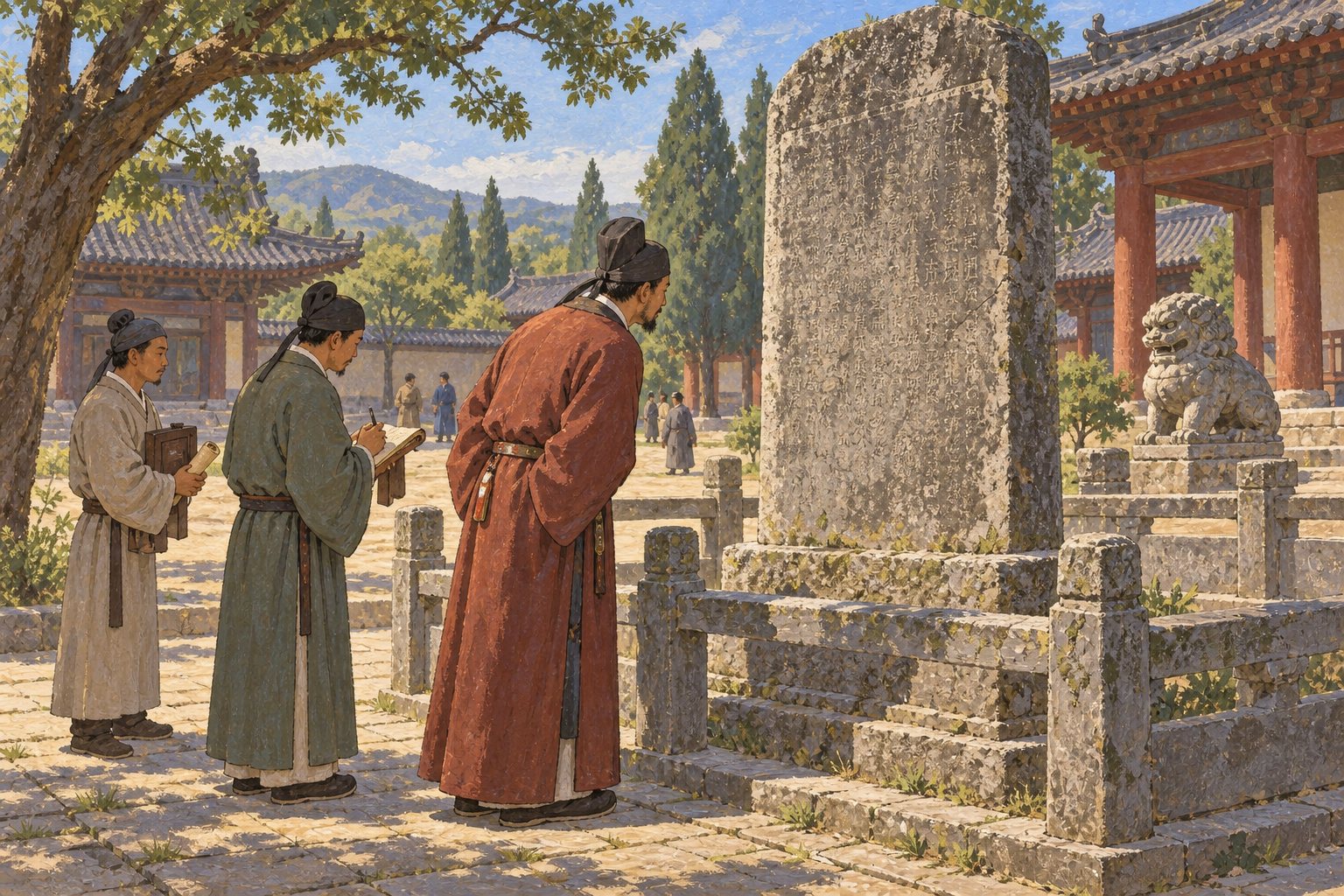
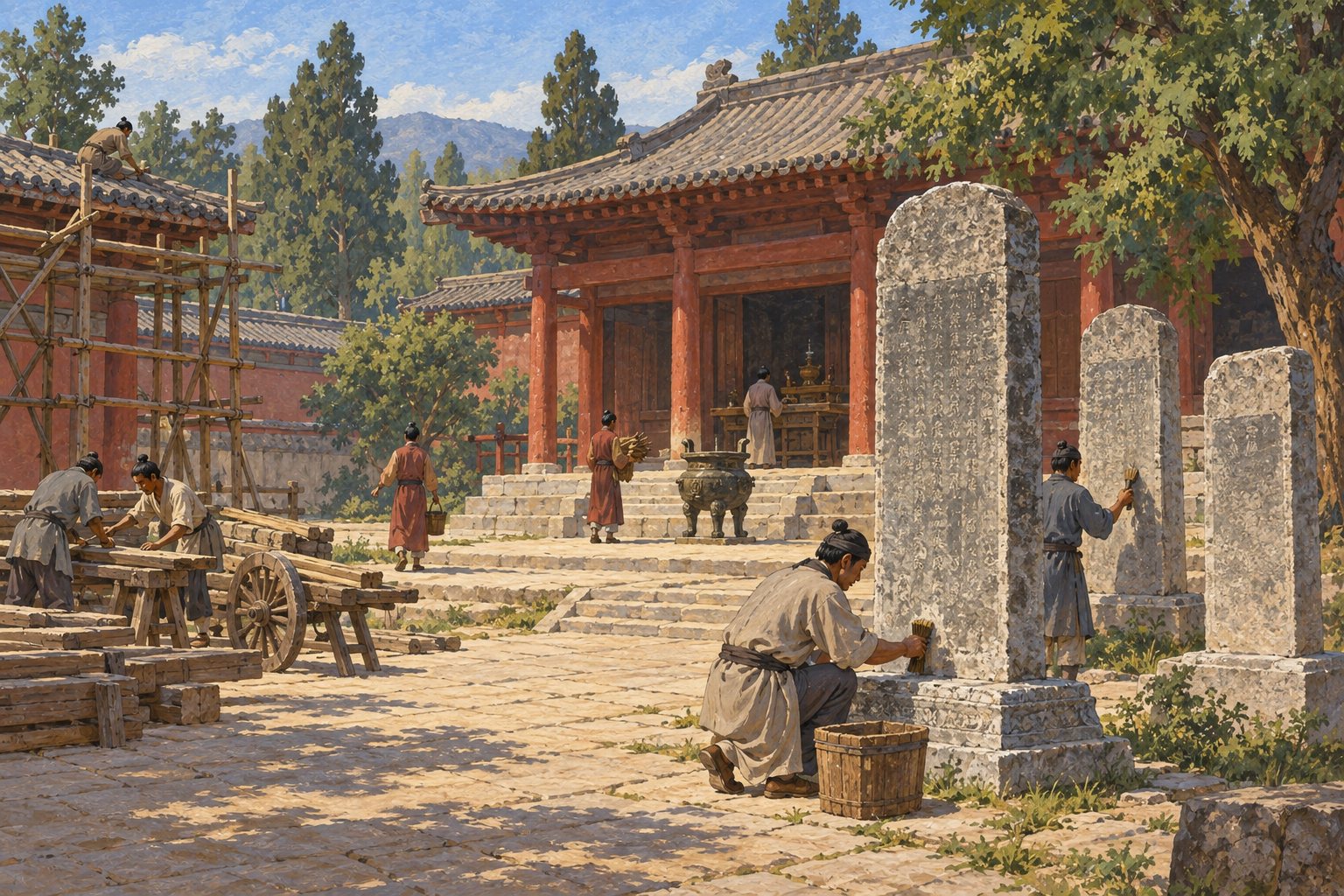
The temple’s Han-era finance survives on its own stelae, in situ: one of 153 CE records the memorial and approval appointing a temple officer, one of 156 carries on its reverse a donor roll with names and cash amounts, one of 169 records a prefect’s sacrifice and works — contemporaneous administrative stone, which is why this money chapter can say the record shows where most volumes in this series must say the tradition holds.
Explore the illustrations4 scenes · The temple’s stone record
The temple’s stone record. The temple’s Han-era finance survives on its own stelae, in situ: one of 153 CE records the memorial and approval appointing a temple officer, one of 156 carries on its reverse a donor roll with names and cash amounts, one of 169 records a prefect’s sacrifice and works — contemporaneous administrative stone, which is why this money chapter can say the record shows where most volumes in this series must say the tradition holds.
Changes and divisions
Goose Lake
In 1175 the two live wings of the revived learning met at Goose Lake and failed to agree — Zhu Xi’s programme of inquiry and study against Lu Jiuyuan’s appeal to the mind itself, the division later hardened as Cheng-Zhu against Lu-Wang — and the state settled it the way this tradition settles things, by syllabus: Zhu Xi’s school was first proscribed as “false learning” (a blacklist of fifty-nine names survives; he died under the ban in 1200), then canonised into the temple in 1241 and installed as the examination standard, so that Wang Yangming’s sixteenth-century revival of the other wing flourished everywhere except on the graded page.
The Rites Controversy
When the Jesuits decided a missionary should dress as a ru scholar, they also had to decide what the rites to ancestors and to Confucius were — civil custom or worship — and what to call God in Chinese; the argument escalated from Ricci’s accommodation to a papal prohibition (1704, confirmed 1715, hardened with an oath in 1742), against which the Kangxi emperor, who had certified the rites as civil in 1700, banned the missions in 1721 — and Rome held its answer for 235 years before reversing it in 1939; the category question, round one, fought entirely in law and licence.
Limits of the evidence
These limits are stated in the book before its argument.
- The historical Kongzi beyond a hard minimum His dates, conventionally 551–479 BCE, are among the best anchored in the ancient world — the chronicle tradition of his own state notices his death — but the connected biography is Sima Qian’s, from about 100 BCE, four centuries later and carrying legend, and the Analects is a compilation by students and later hands whose layers cannot be dated with confidence. Which sayings are the man’s cannot be established. (The compilation is a transmission fact, not a slight, and the volume treats it as its first piece of machine evidence.)
- Whether Confucius compiled or edited any of the Five Classics The tradition holds he did, in every case; scholarship contests every case; the volume prints both states and leans on neither.
- What the Qin decree of 213 BCE actually destroyed The loss cannot be separated from the burning of the Qin palace archives in 206 BCE or from ordinary transmission failure, and specialists disagree about the scale by name. The catastrophe narrative and its minimisation are both reported.
Sources and reading
This article brings together the series’ existing overview and chapter summaries. The linked book page provides the full outline and bibliography.
- Yu ding, National Museum of ChinaWestern Zhou; found early 19th c.. an investiture and a transfer of 1,700-odd dependents cast inside a sacrificial vessel
- Chunqiu of Lu, with Zuo commentary, James Legge, Chinese Classics Vannals 722–481 BCE; Legge 1872. ritual violations; odes as interstate code; Kong Qiu’s death notice
- Hsu Cho-yun, Ancient China in Transition1965. Zuozhuan prosopography of houses displaced by ministers
- Mozi, Fei ru5th–4th c. BCE compilation. an enemy’s job description of the ru as funeral specialists who charge
- Hu Shih, “Shuo ru”1934. Shang-descended ritualists; reported as a famous conjecture
- Analects, Legge, Chinese Classics Icompiled Han; Legge 1861. dried-flesh tuition; the age-ladder; duplicate sayings as merged notebooks
- Sima Qian, Shijic. 100 BCE. Kongzi’s life; Jixia salaries; Gongsun Hong’s memorial; Li Si’s burning decree; the 195 BCE tailao
- Han shulate 1st / early 2nd c. CE. three Analects recensions; no Music Classic; the wall find as sixteen chapters; Five-Classic chairs in 136 BCE
Illustrations are newly generated interpretations of themes in the book. They are not surviving artifacts, historical photographs or evidence for the events described.