19 illustrations · 2:27
Watch & listen.
Follow the images with a narrated journey through the book.





Overview
- Coverage
- 4th c. BCE–present
- Earliest secure evidence
- 4th c. BCE
- Transmission
- the parish register
What the refusal buys is the machinery. A household roll. A petition in the form of a government memorial. A talisman that is half of a tally whose other half, on the church’s account, is filed in heaven. Lu Xiujing complaining that the registers have gone slack. Parish counts from the dynastic histories, printed as the historian’s figures, never as counts.
The coverage period and the earliest secure evidence are different dates. A tradition’s own account of its beginnings may differ from both.
Historical setting
Two Beginnings
This volume covers one tradition with two separate ignitions — a body of Warring States texts whose authors cannot be established, and a church founded (the tradition holds) in 142 CE in Sichuan with members, officers and a subscription rate — and the chapter’s whole job is to say that neither is the other’s origin story: the church adopted the book four centuries after the book, and the book knows nothing of the church. Western shelves have long sold the first ignition without the second; this volume describes the second at full length, which is the correction — made by describing institutions, never by mocking the aesthetic.
The Archivist Who May Not Have Existed
The tradition holds that Laozi was an archivist of the Zhou court who instructed Confucius, wrote five thousand characters at a border pass at the gatekeeper’s request, and vanished into the west; the earliest biography, written four to five centuries after the era it describes, already offers three candidates for who he was and closes with the admission that no one can know — so the volume’s founding figure enters history as a source problem, and is treated as one throughout. Around the legend, the world that produced the texts: interstate war, wandering persuaders selling statecraft, and the Jixia patronage academy in Qi.
Explore the illustrations7 scenes · Bamboo and silk
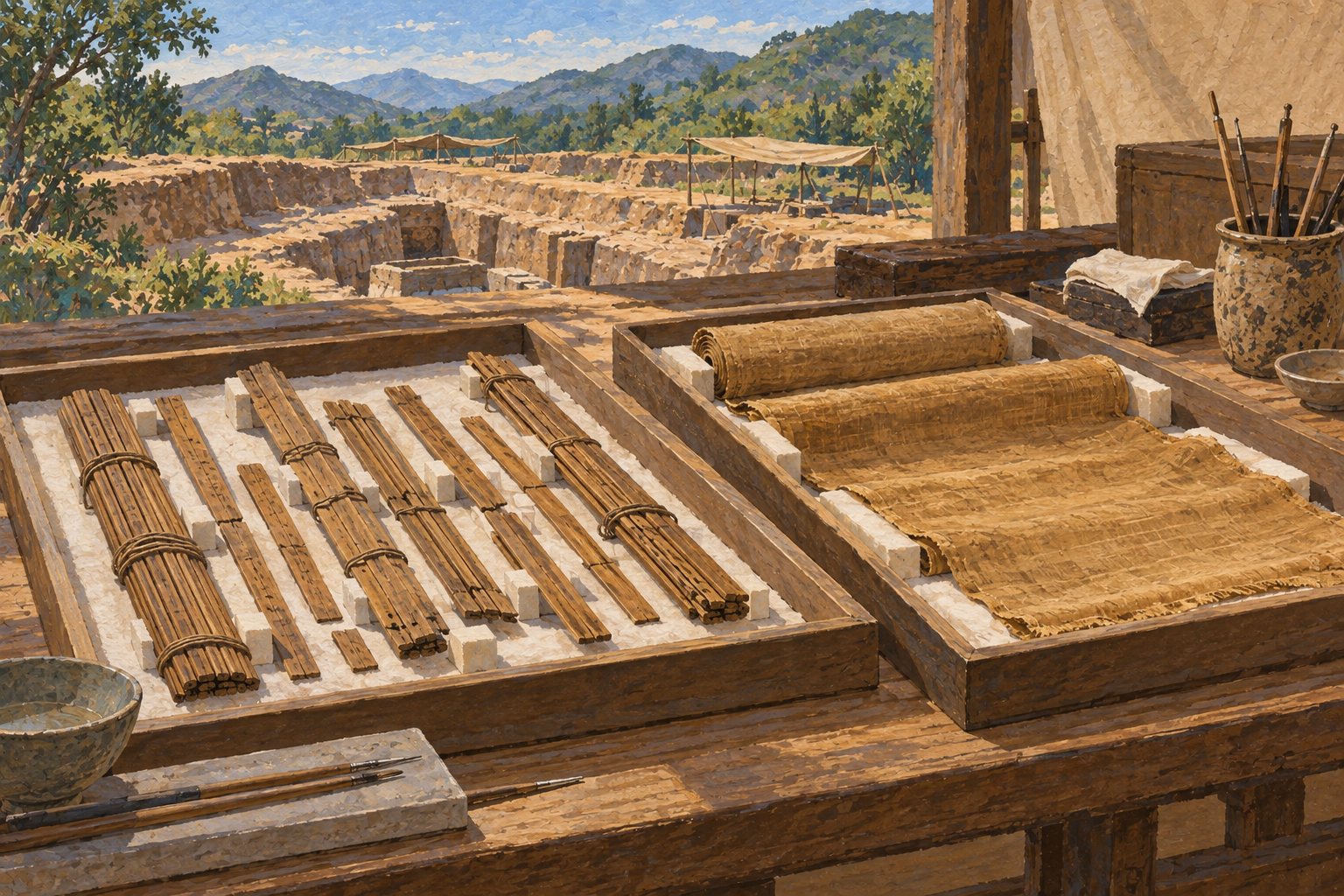
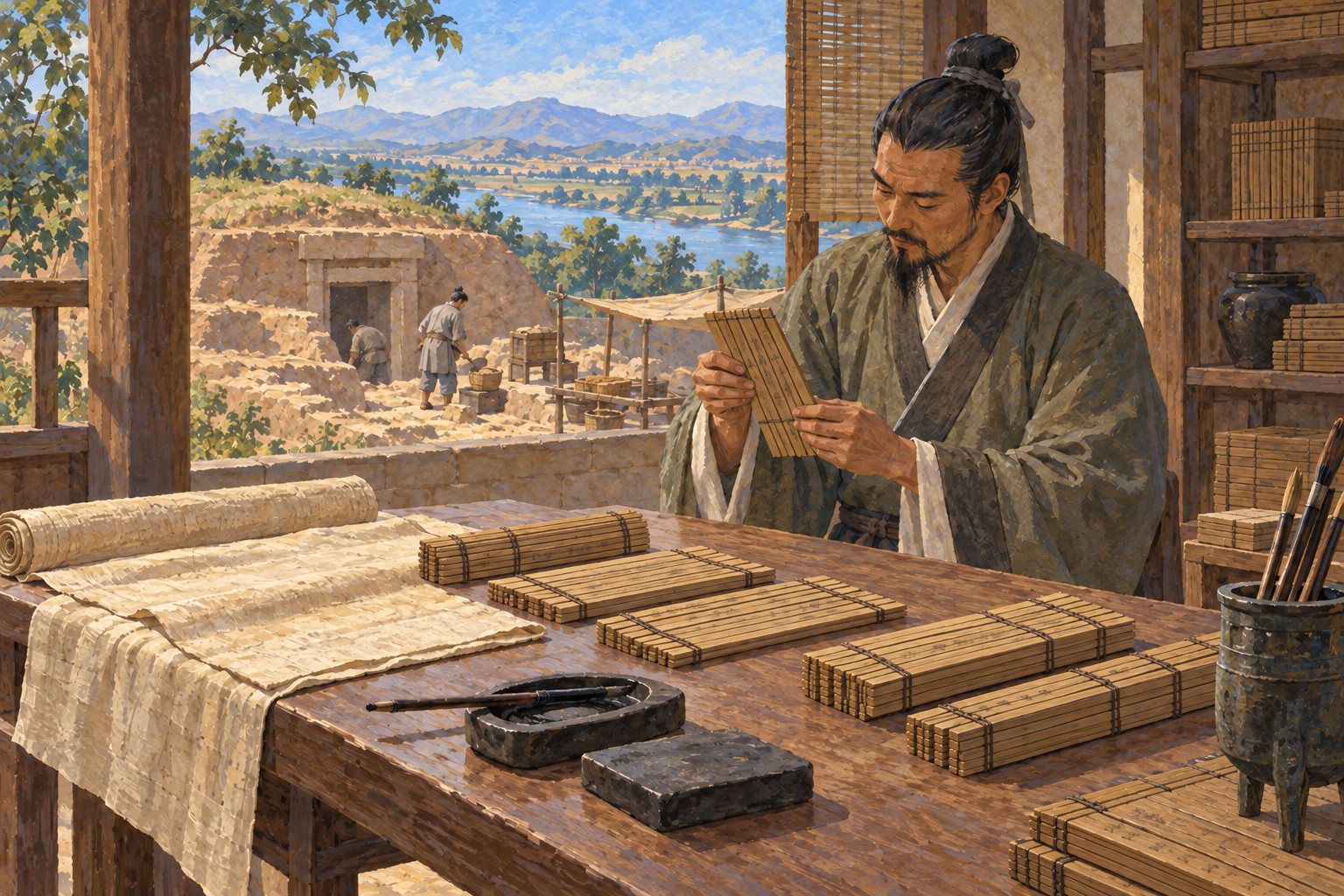
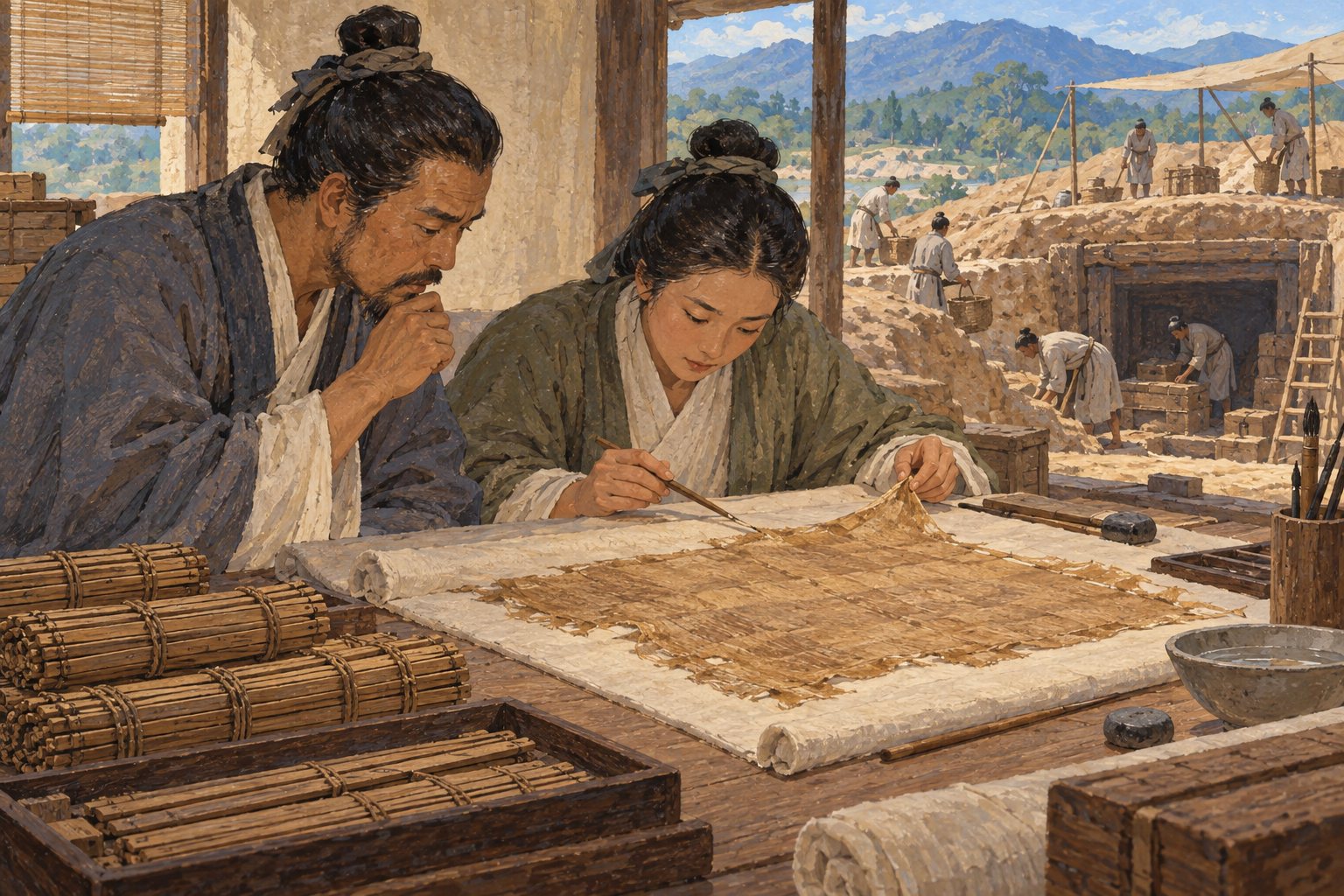
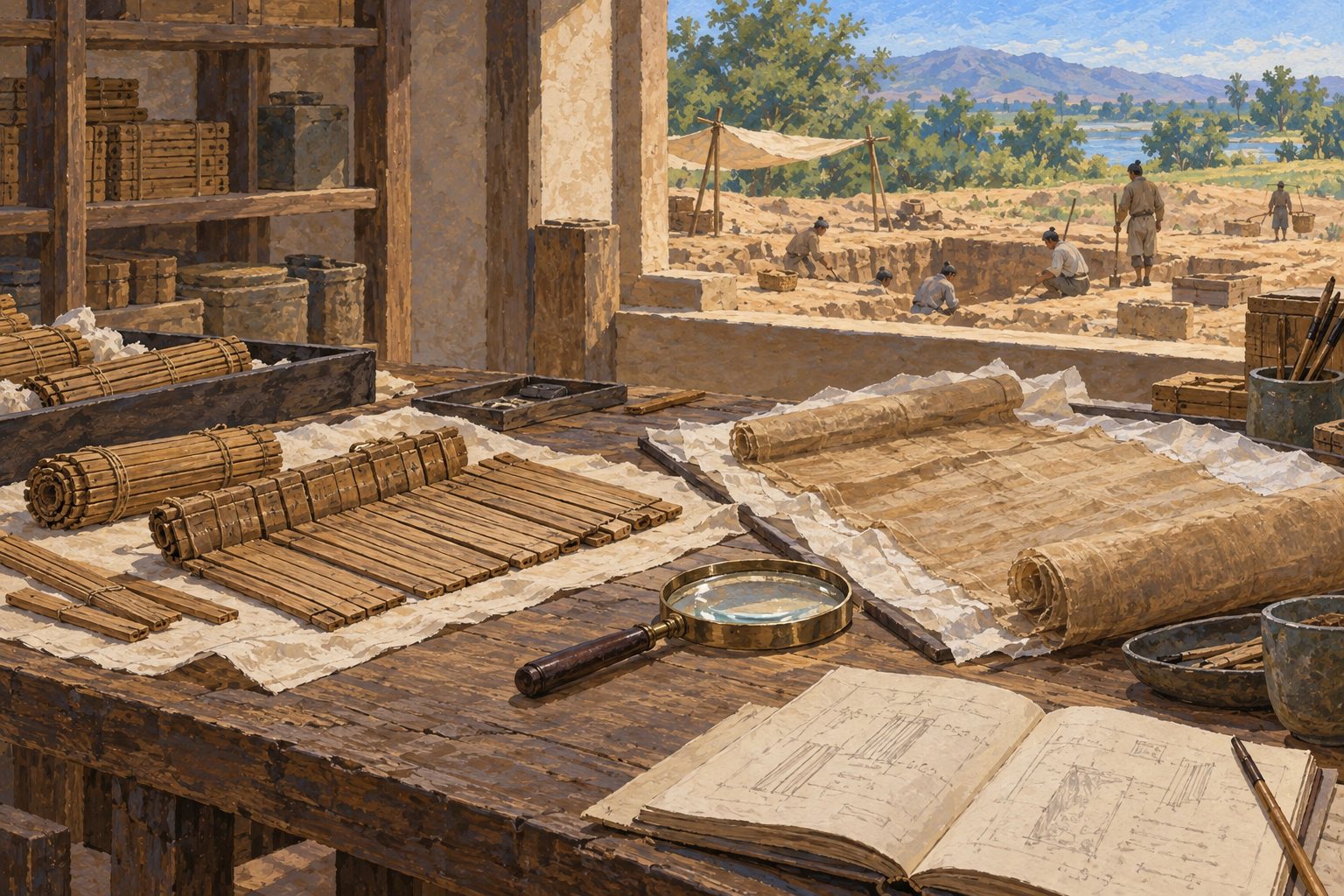
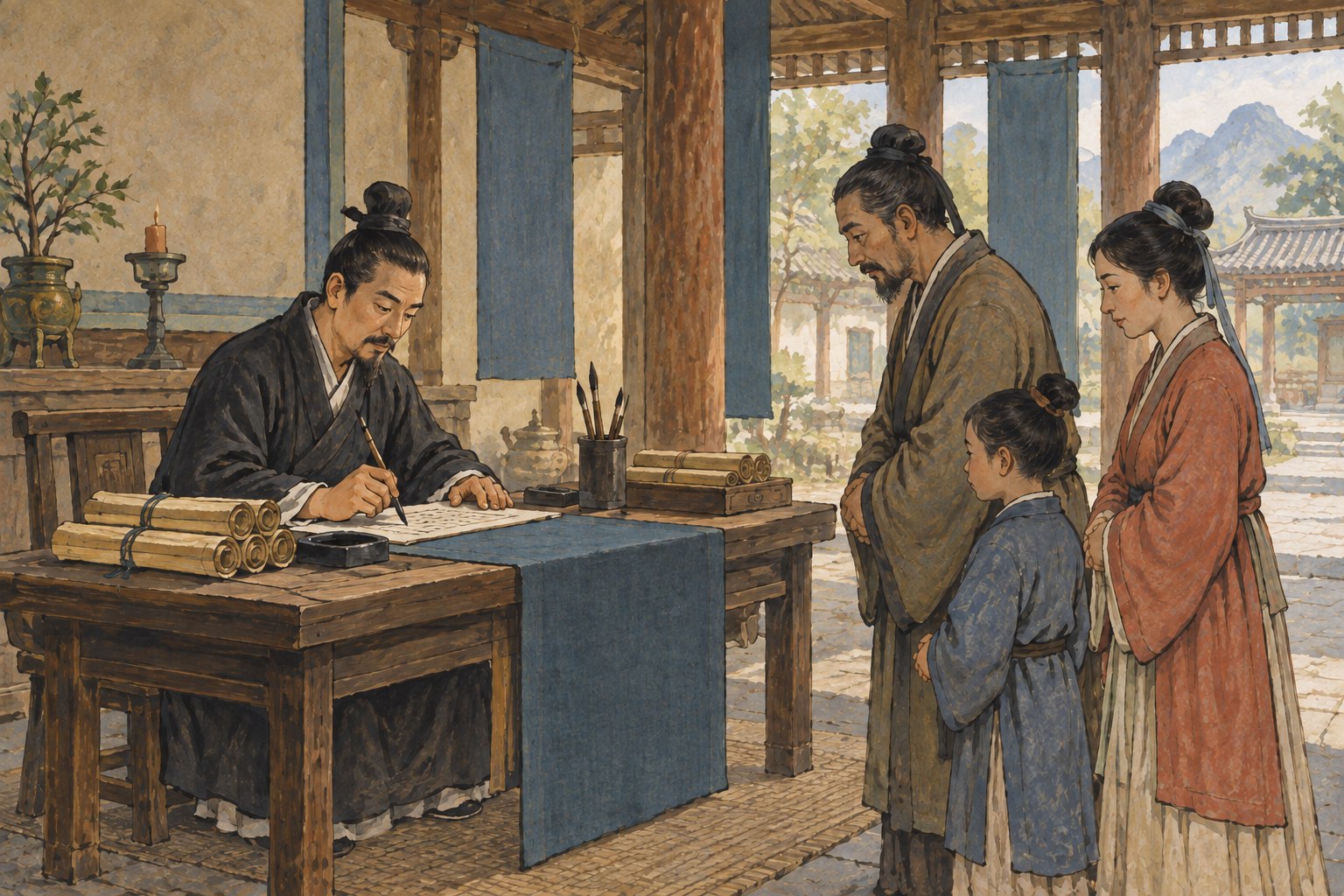
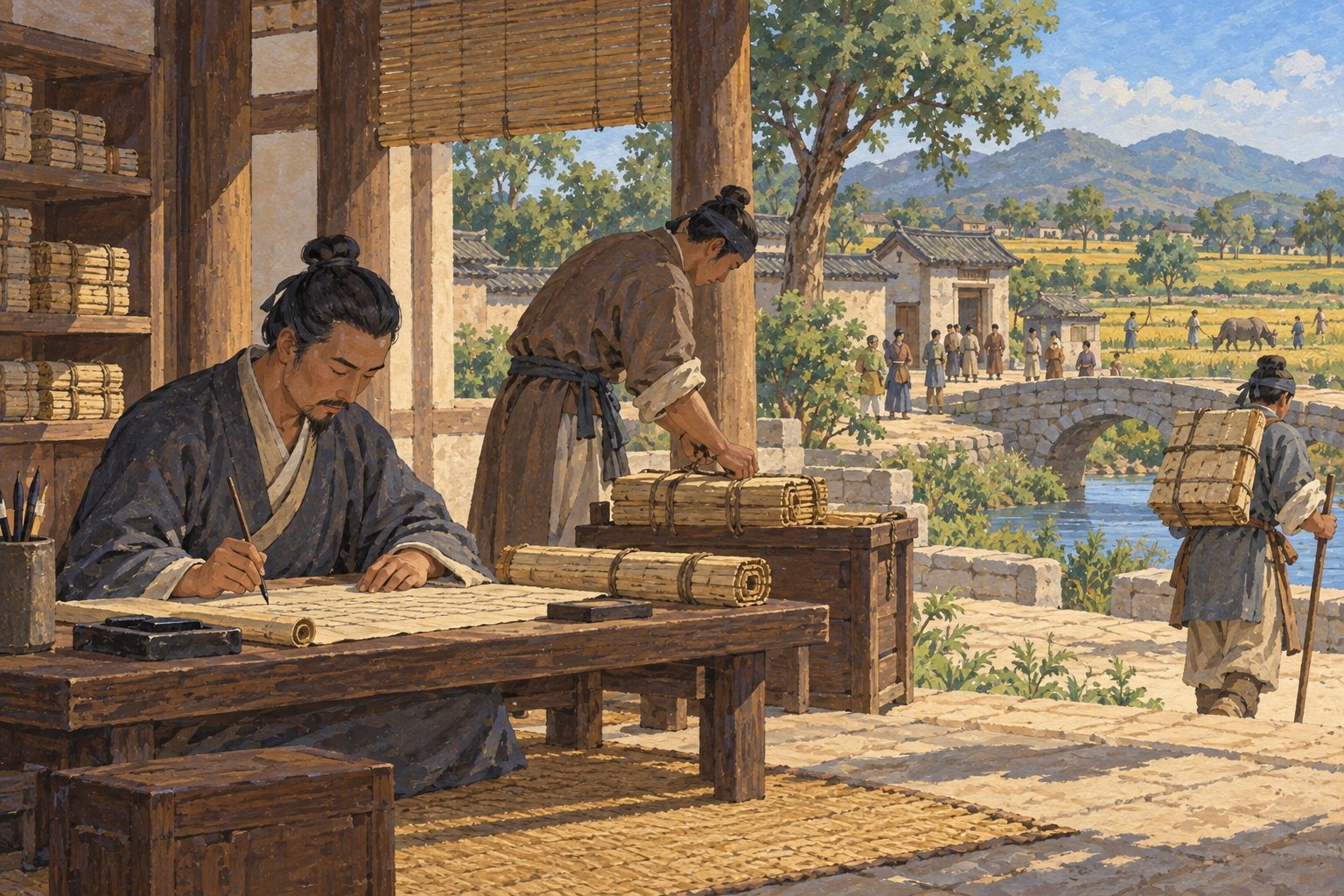
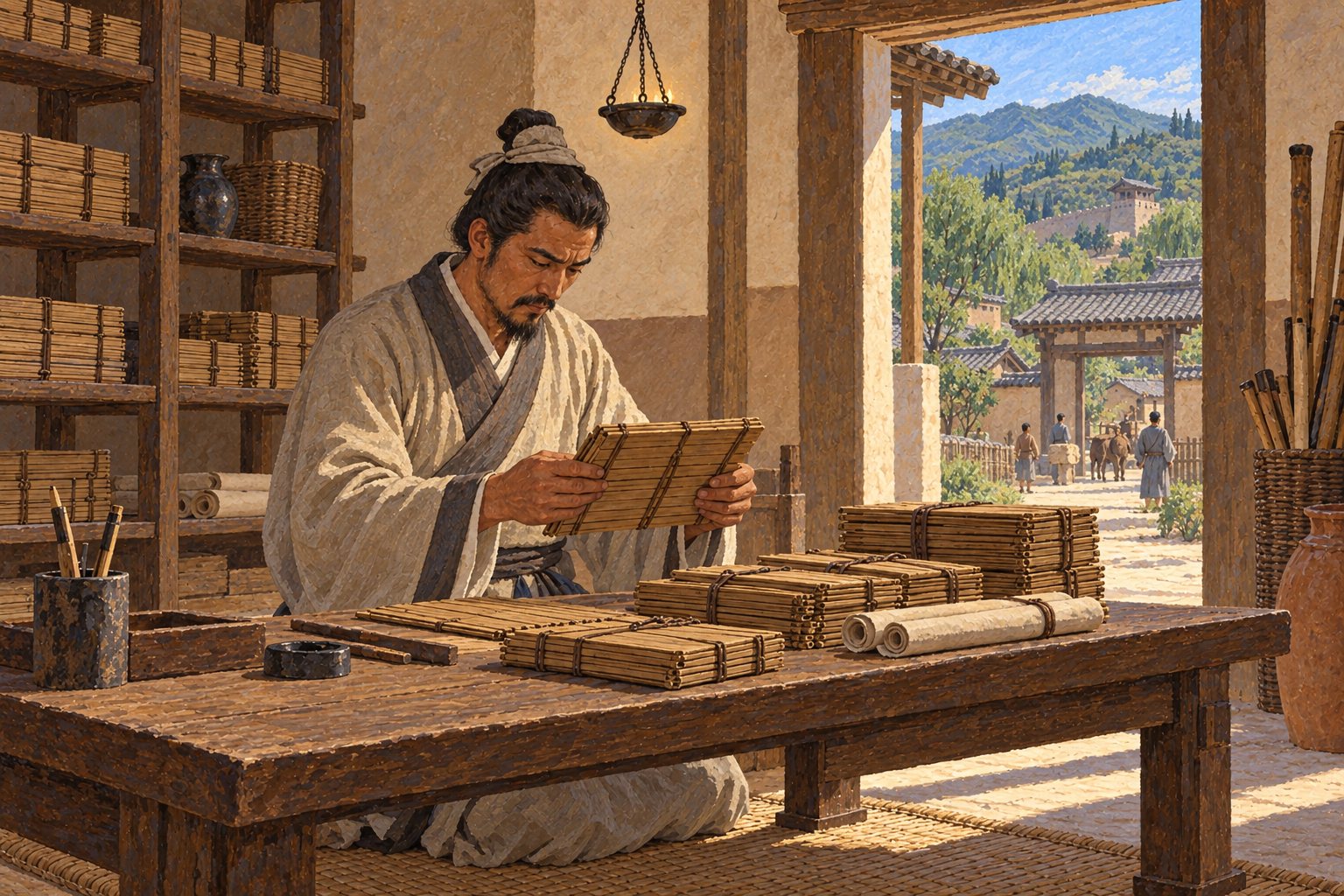
Bamboo and silk. Two excavations moved the text from legend into archaeology. At Guodian (found 1993), bamboo bundles sealed in a tomb around 300 BCE carry roughly a third of the received text, in different order and sometimes different wording — at the point where the received text renounces benevolence and righteousness, the bamboo reads otherwise, so the anti-Confucian edge may be a later sharpening — and the same tomb held a cosmogony nobody knew existed. At Mawangdui (found 1973, tomb sealed 168 BCE), two complete silk copies put the De half before the Dao half and lie beside Yellow Emperor texts: the library of the Huang-Lao statecraft current that the record shows dominating the early Han court. What the tombs establish is a floor, not an author.
How it was transmitted
The Parish Register
The machine is a database. Twenty-four parishes, each keeping a roster of member households — births, deaths, marriages, standing — updated at three fixed assemblies a year, with the levy due at assembly and the roster copied upward; the codes add the theological half, that the heavens keep a matching register of fates, which makes the paperwork itself the sacrament: a mis-kept roster is a soul unaccounted for. Membership as a written, auditable record, seventeen centuries before the parish registers of Europe — and the honest limit printed with it: what survives is codes prescribing the system and a fifth-century reformer complaining it had lapsed, not one original roster.
The Register at the Belt
The member’s personal copy of the database was the lu, the ordination register worn at the belt: a child entered the church with a register of one spirit-general and advanced through graded registers — the codes prescribe a sequence rising to seventy-five generals, merged at marriage into a joint one hundred and fifty — so rank was a document, promotion was a re-issue, and the priesthood itself was defined not by a building or a living but by which texts and registers one had been licensed to receive. Transmission of scripture in this church is not publication; it is conveyancing.
Explore the illustrations6 scenes · Keeping the household register
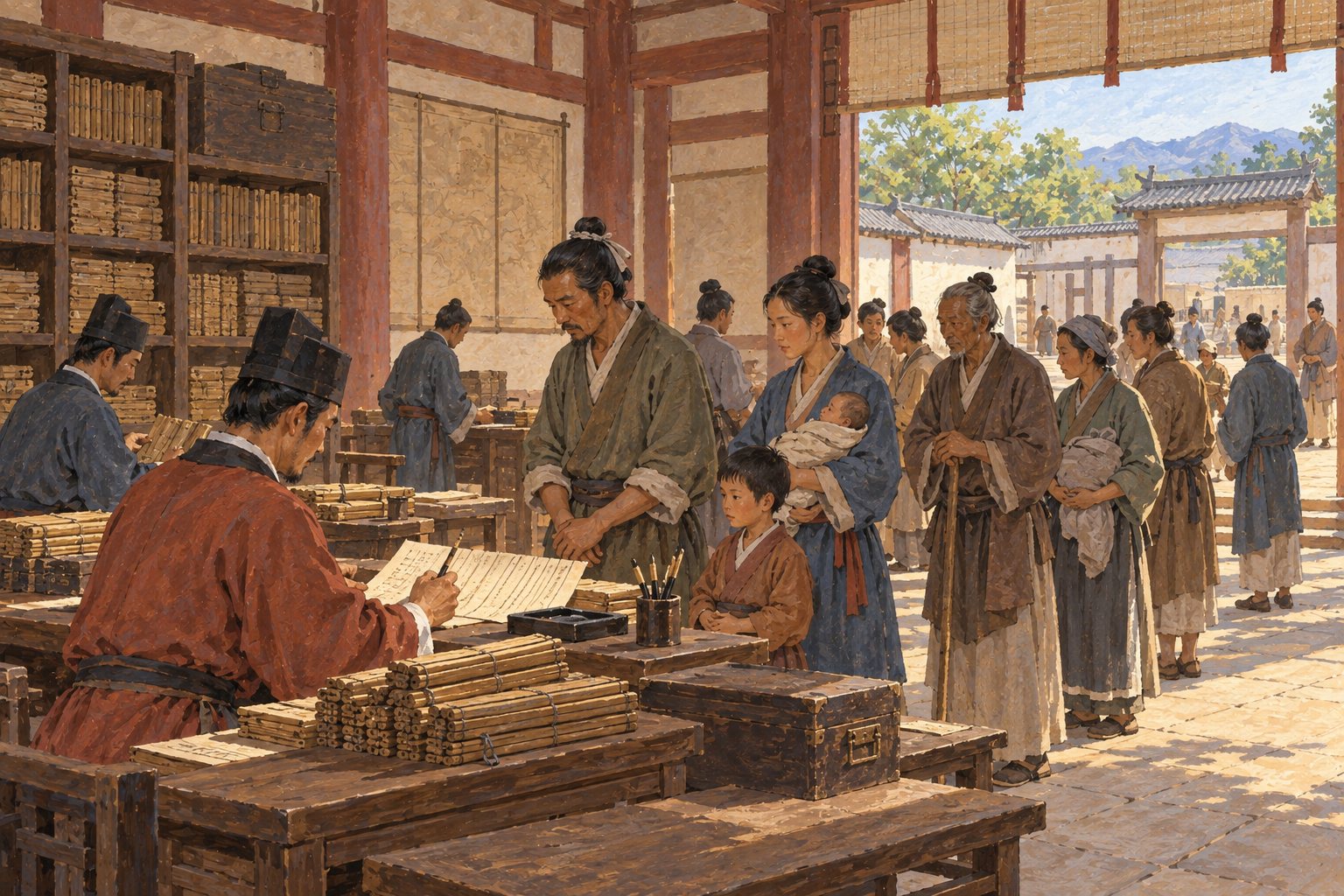
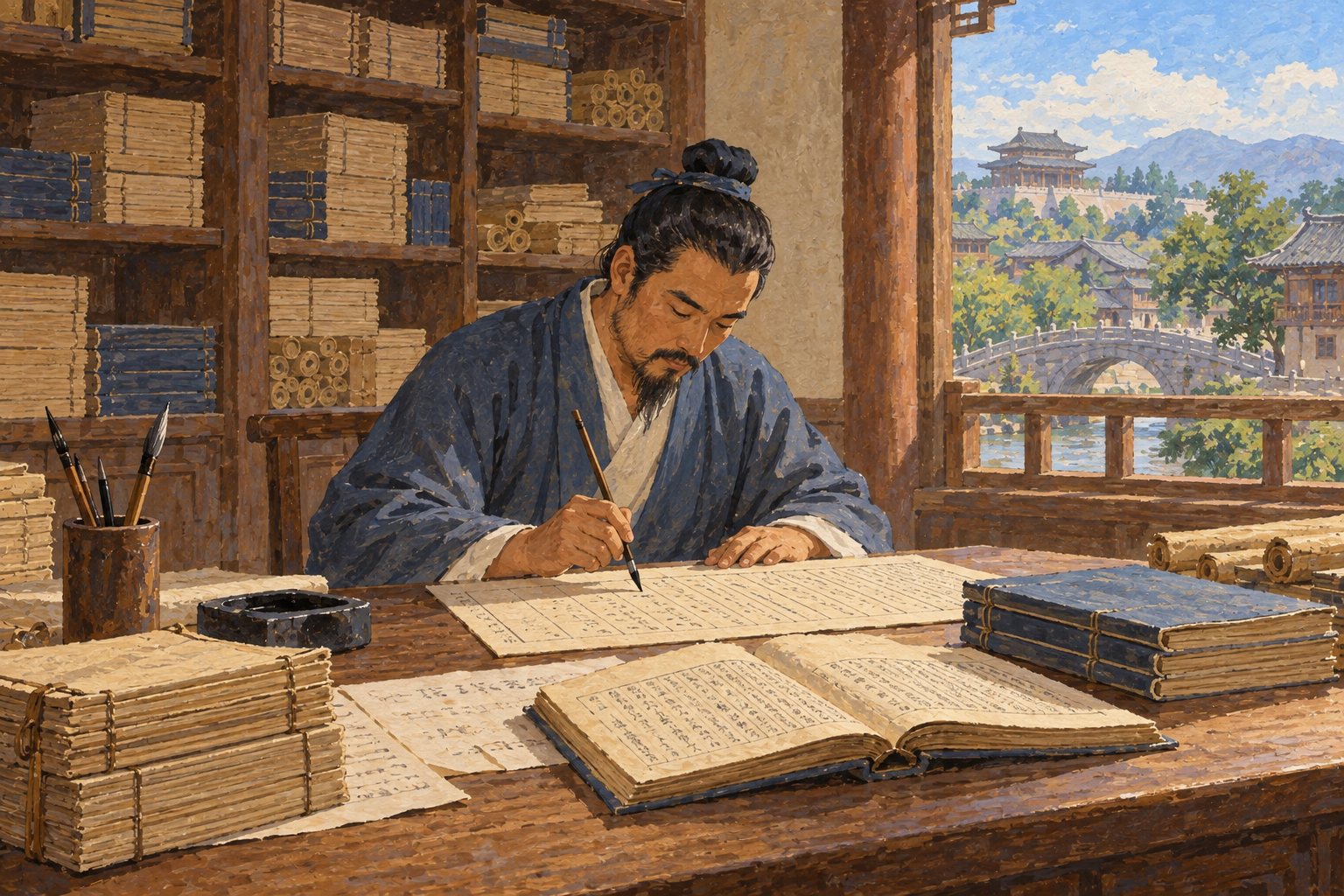
Keeping the household register. The machine is a database. Twenty-four parishes, each keeping a roster of member households — births, deaths, marriages, standing — updated at three fixed assemblies a year, with the levy due at assembly and the roster copied upward; the codes add the theological half, that the heavens keep a matching register of fates, which makes the paperwork itself the sacrament: a mis-kept roster is a soul unaccounted for. Membership as a written, auditable record, seventeen centuries before the parish registers of Europe — and the honest limit printed with it: what survives is codes prescribing the system and a fifth-century reformer complaining it had lapsed, not one original roster.
Texts and authority
A Category Invented by Librarians
The movement’s opening argument, before any scripture is named: “Daoism” as a category is the work of Han bibliographers. Sima Tan’s essay on the six schools coined daojia as the label for a shelf, not a membership; the imperial catalogue made it a bibliographic class; and no Warring States author called himself a Daoist. The pattern set in the palace library holds for fourteen centuries: definition, compilation, closure and destruction of the canon were all acts of the throne — and the four chapters that follow are that thesis, tested.
Scriptures That Kept Arriving
The corpus never closed because revelation never stopped. A Scripture of Great Peace was already being presented to Han emperors in the second century; the Supreme Clarity texts arrived through Yang Xi’s visions in the 360s; around 400 the Numinous Treasure corpus appeared and openly absorbed Buddhist material — rebirth, world-ages, translated formulae — a documented case of one canon ingesting another in real time. Each wave claimed higher heavens than the last, so the library came pre-sorted into an argument about altitude, and a church with mediums could always be handed a new shelf.
Institutions and resources
Five Pecks of Rice
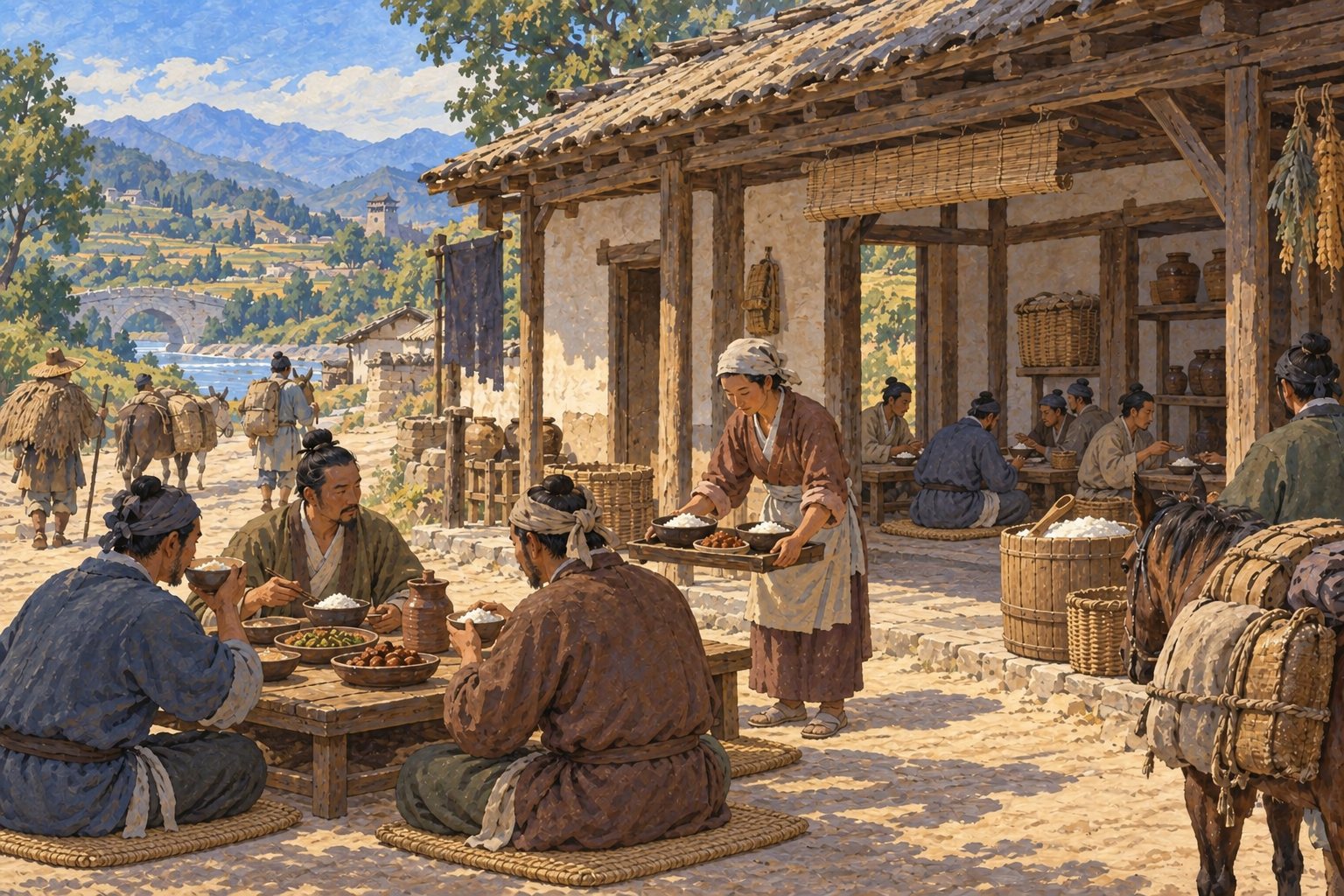
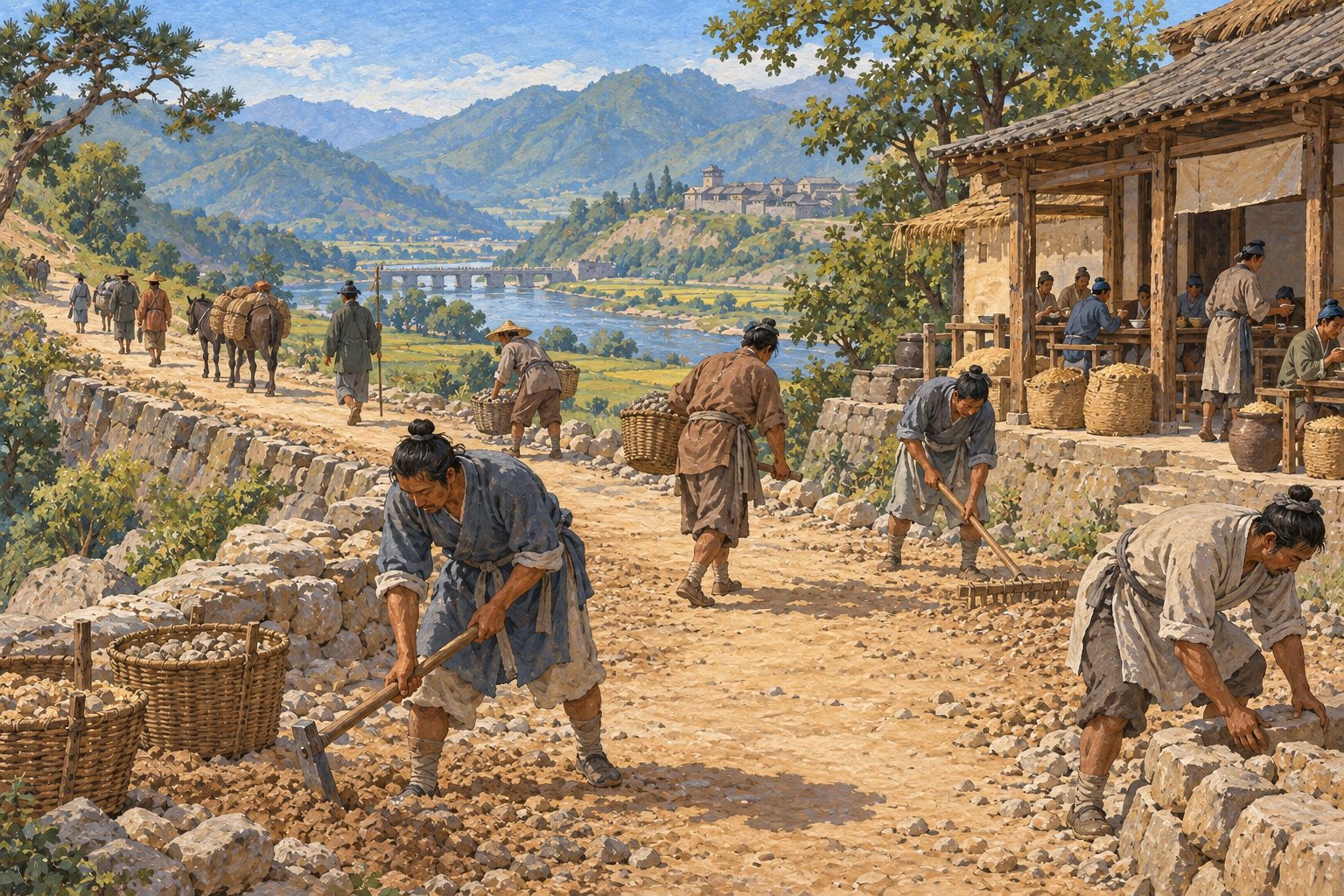
The founding levy is one of the earliest documented religious subscription rates anywhere: five pecks of rice per member household, from (the tradition holds) 142 CE — so distinctive that outsiders named the movement after its price. The dynastic histories call it the Way of the Five Pecks of Rice; its enemies shortened that to “rice thieves.” In Hanzhong under Zhang Lu the histories describe what the rice bought: charity lodges stocked with free grain and meat for travellers, officers called libationers instead of magistrates, three pardons before punishment, minor offences worked off in road repair — a functioning welfare polity, described entirely by the historians of the dynasty that absorbed it, which is both the source and the caveat.
The Pure Covenant
The church’s economic identity was a double refusal stated as theology: the gods of the covenant neither eat nor drink — so no blood sacrifice, which unplugged members from the animal-offering economy of the common religion and its “stale gods” — and the priest takes no payment for healing, which separated the libationer from the market in spirit-healers. What replaced both was an internal, regulated circuit: the rice levy; pledge-goods of rice, silk, paper and brushes owed at each transmission of texts and registers; communal kitchen-feasts whose guest-counts were set by rank. A complete alternative economy with the market designed out — on paper. The codes are rules, not receipts, and each sentence will say which one it is quoting.
Explore the illustrations6 scenes · Grain for the traveler
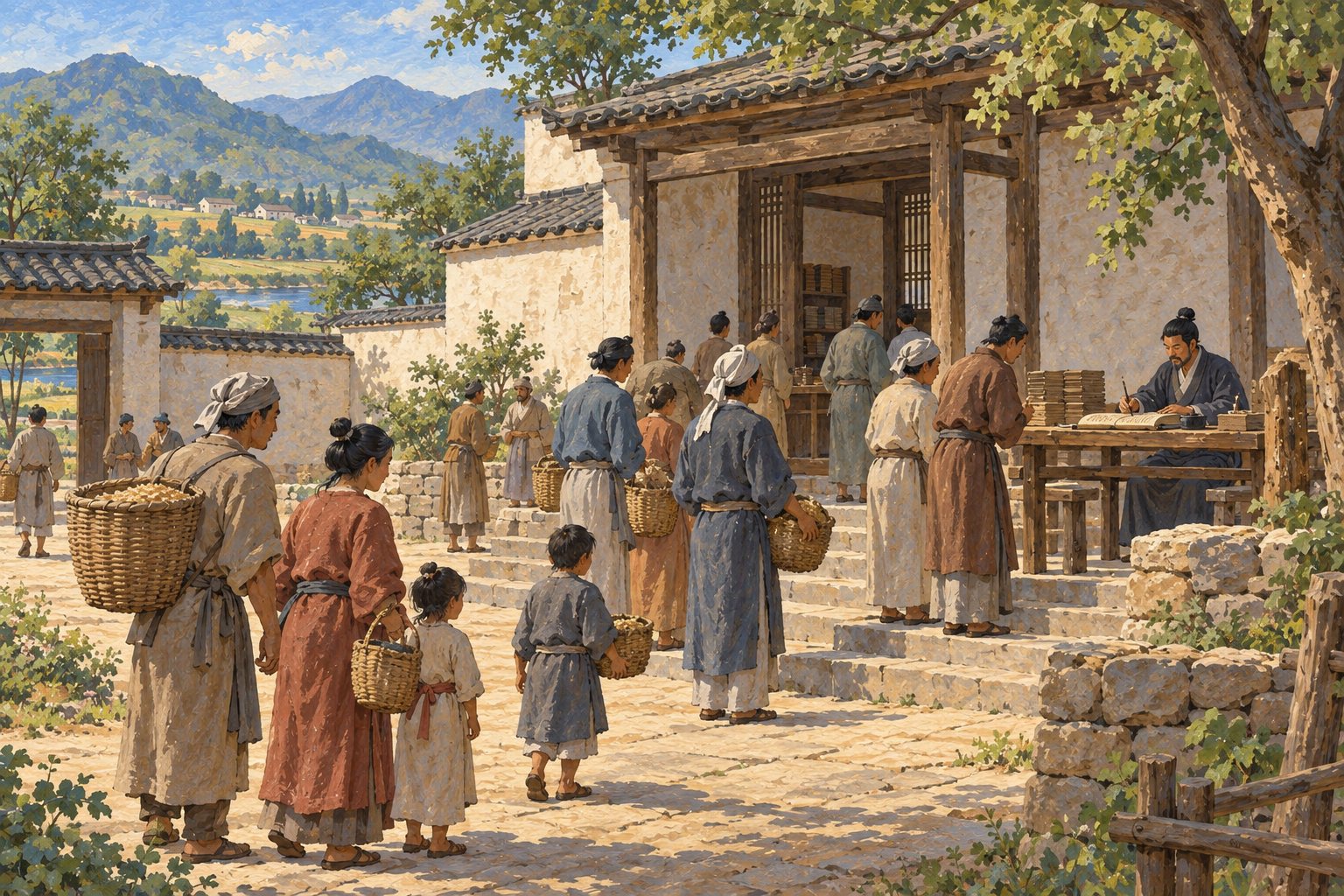
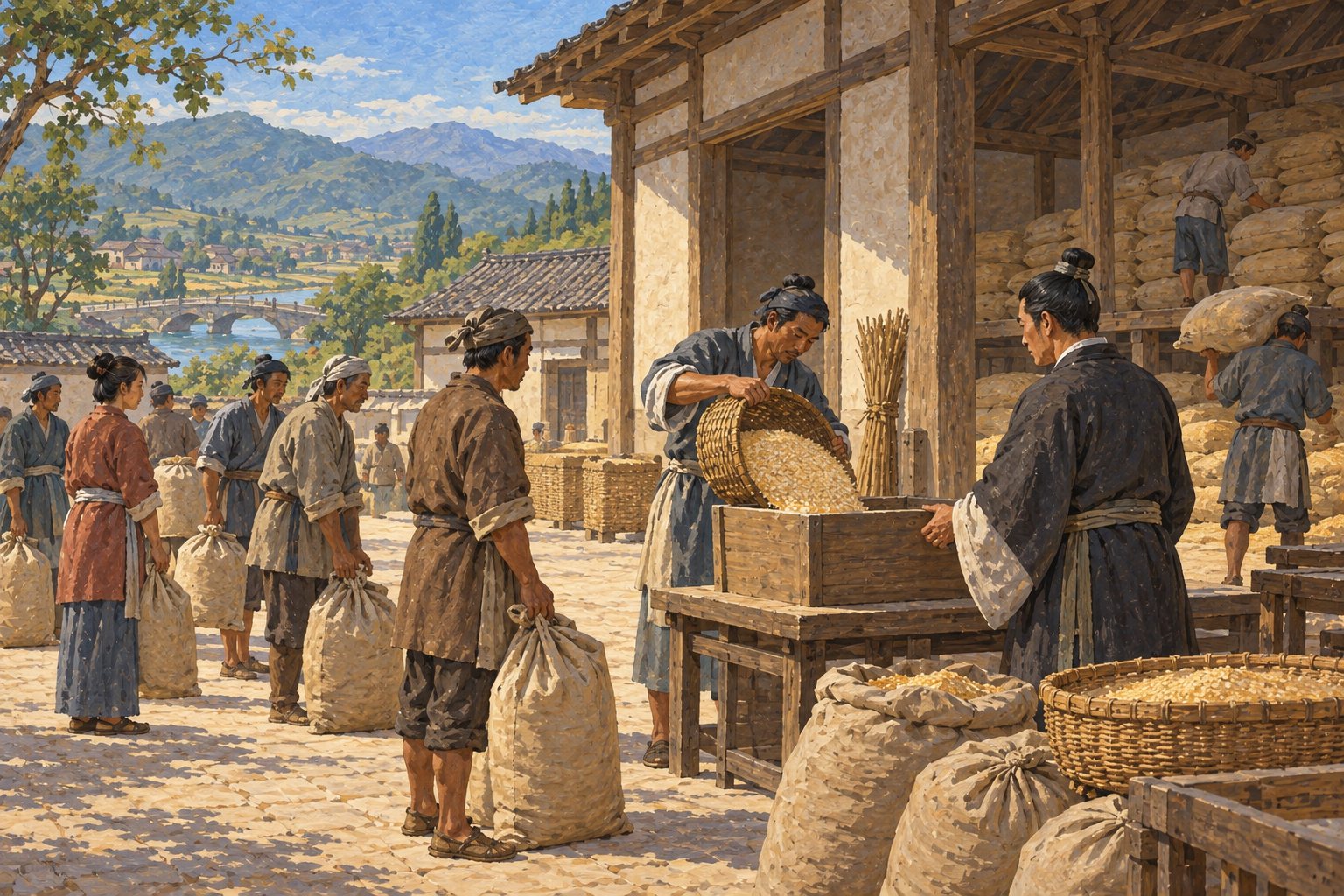
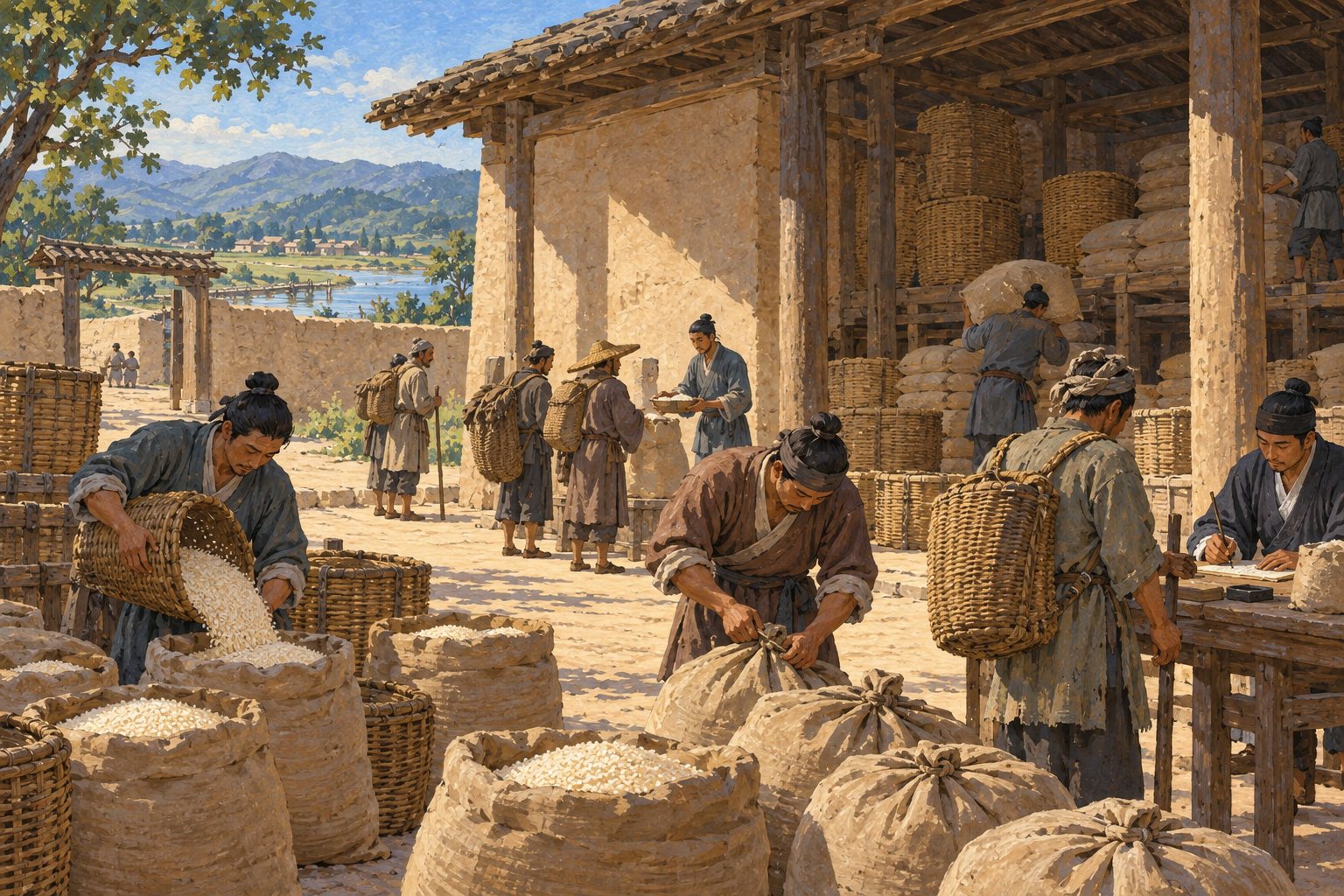
Grain for the traveler. The founding levy is one of the earliest documented religious subscription rates anywhere: five pecks of rice per member household, from (the tradition holds) 142 CE — so distinctive that outsiders named the movement after its price. The dynastic histories call it the Way of the Five Pecks of Rice; its enemies shortened that to “rice thieves.” In Hanzhong under Zhang Lu the histories describe what the rice bought: charity lodges stocked with free grain and meat for travellers, officers called libationers instead of magistrates, three pardons before punishment, minor offences worked off in road repair — a functioning welfare polity, described entirely by the historians of the dynasty that absorbed it, which is both the source and the caveat.
Changes and divisions
The Yellow Sky
The other second-century ignition became a rebellion. Zhang Jue’s Way of Great Peace healed by confession like the Sichuan church, organised the east into thirty-six commands, and in 184 — the first year of a new sexagenary cycle — rose under a slogan the histories preserve: the Azure Heaven is dead, the Yellow Heaven shall stand. The Han survived the rising but not the warlords raised to suppress it; and the equation the state drew — mass religious organisation equals rebellion in waiting — outlived every dynasty that drew it. The two movements were distinct; the sources conflate them; and the conflation, stated as such, is itself part of what the state learned to see.
Dispersal, and Two Reforms
The church lost its territory and won the empire. Zhang Lu surrendered Hanzhong to Cao Cao in 215, was ennobled, and his tens of thousands of member households were deported north — a forced migration that seeded Celestial Master communities across China. Two centuries on, each half of the divided empire produced a reformer: in the north, Kou Qianzhi’s revelations won the Northern Wei court, put a Daoist era-name on an emperor and abolished (the sources say) the rice levy and the rites he called abuses; in the south, Lu Xiujing’s codes tried to restore the lapsed registers. The institution’s survival mechanism was, twice, being adopted and rewritten by a throne — and the price of adoption was reform on the throne’s terms.
Limits of the evidence
These limits are stated in the book before its argument.
- Whether Laozi existed The earliest biography (Sima Qian, c. 94 BCE) already offers three candidates and closes by saying the world has no way of knowing. His historicity is contested and every mention of him as a person in this volume carries that label. (Stated in Movement One and never quietly dropped.)
- Who wrote the Daodejing or the Zhuangzi, or when The Guodian and Mawangdui finds give floors — a Laozi text existed in some form by about 300 BCE — not authors; and the received Zhuangzi is Guo Xiang’s fourth-century-CE redaction of a longer book the imperial catalogue lists at fifty-two chapters. An editor stands between the reader and both ignitions.
- What happened at Heming shan in 142 CE The covenant is the tradition’s account. The earliest surviving internal document (the Commands and Admonitions, conventionally dated 255 CE) is a century later; the earliest outside description of the church (the Dianlüe, preserved in a 429 CE commentary) is hostile.
Sources and reading
This article brings together the series’ existing overview and chapter summaries. The linked book page provides the full outline and bibliography.
- Sima Qian, Shiji 63c. 94 BCE. three Laozi candidates; “the world has no way of knowing”
- Commands and Admonitions for the Families of the Great Daoconventionally 255 CE. earliest surviving document from inside the church
- Yu Huan, Dianlüe, in Pei Songzhi’s commentary to the Sanguozhi3rd c.; commentary 429. hostile outside description; triplicate confession; five pecks as a standing rule
- A. C. Graham, “The Origins of the Legend of Lao Tan”1986. how the archivist, the long-lived sage and Grand Historian Dan became one person
- Shiji on the Jixia academyc. 94 BCE. seventy-six salaried debaters under King Xuan — the historian’s figures
- Han shu “Yiwenzhi”1st c. CE. Zhuangzi at fifty-two pian; classified Laozi commentaries
- Lu Xiujing, Abridged Codes for the Daoist Community5th c.. parish register as “people’s duplicate”; lapse complaint; pure covenant
- Franciscus Verellen on the twenty-four dioceses2003. the Sichuan parish map as a system
Illustrations are newly generated interpretations of themes in the book. They are not surviving artifacts, historical photographs or evidence for the events described.