9 illustrations · 0:58
Watch & listen.
Follow the images with a narrated journey through the book.



Overview
- Coverage
- c.480 BCE onward
- Earliest secure evidence
- c.480 BCE
- Transmission
- reciter guilds, and group chant as error-correction
The teaching is given as the collections give it, dated to when those collections were written down. Sujato’s complete sutta translations, dedicated CC0, are the series’ licence copy and are named in the visible text every time they are used. The Theravada reckoning, the corrected long chronology and the post-Göttingen figure near 400 BCE are printed together and none of them as settled history.
The coverage period and the earliest secure evidence are different dates. A tradition’s own account of its beginnings may differ from both.
Historical setting
Sixteen Kingdoms and a Coin
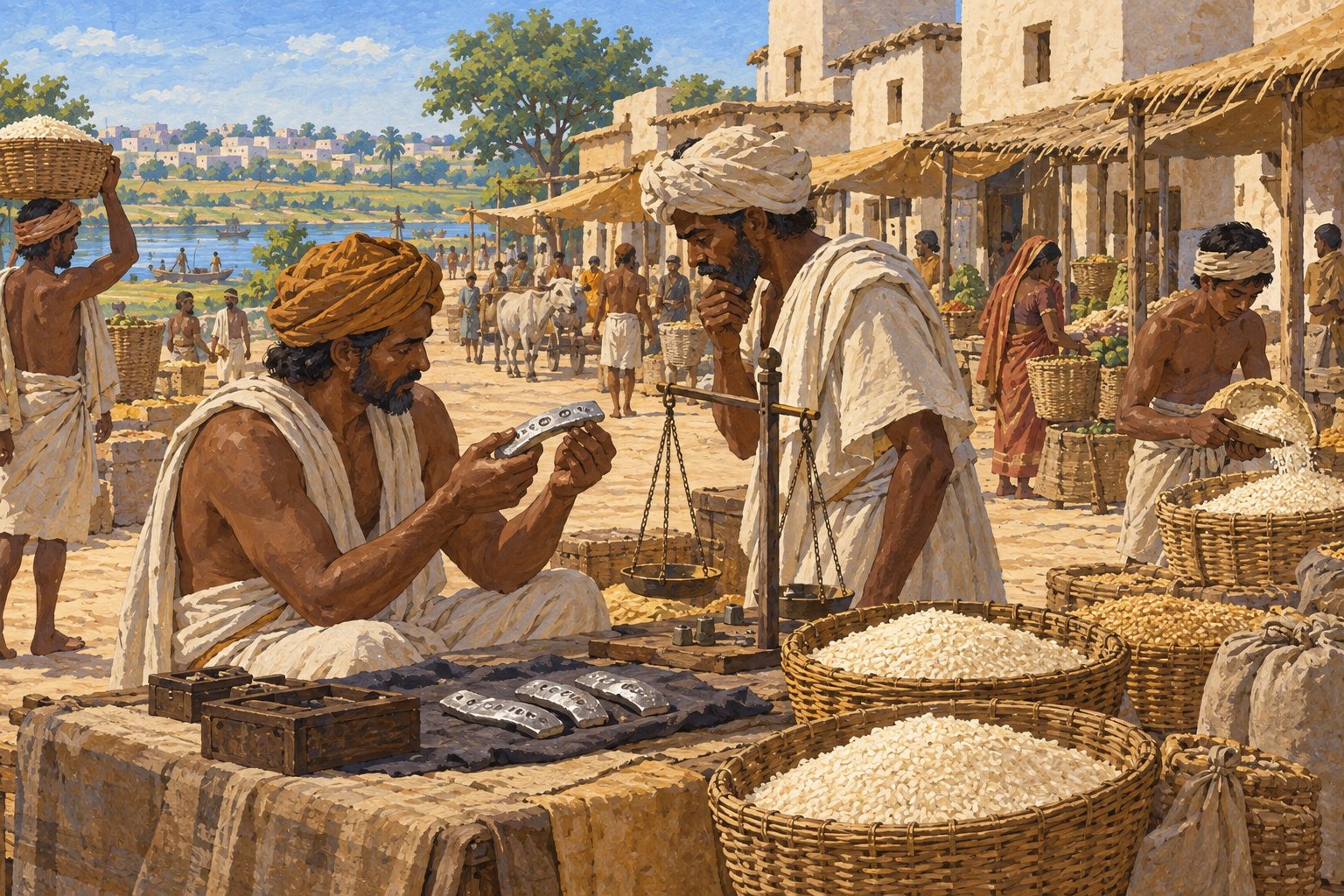
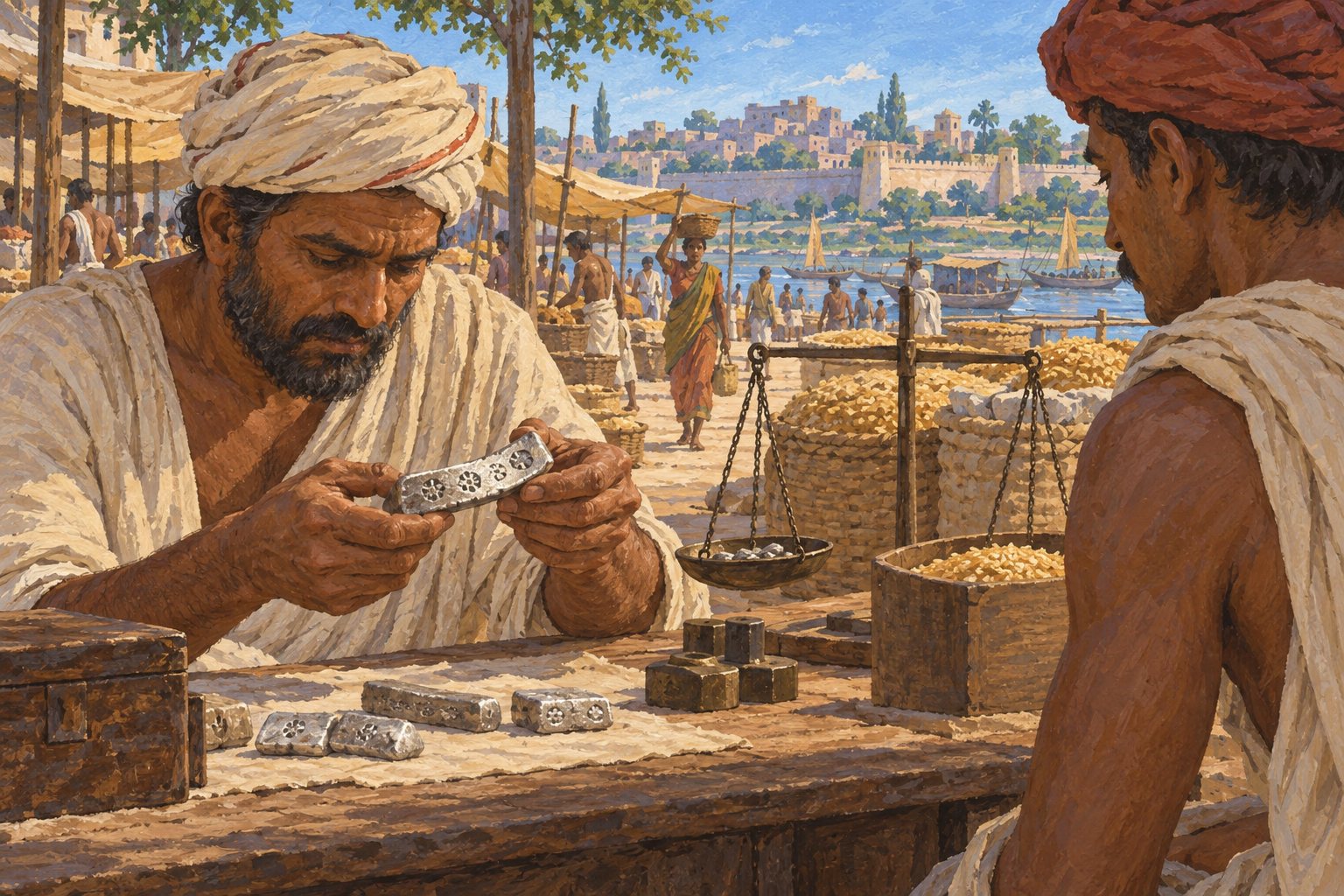
Open on the object — a bent bar of punch-marked silver: the teaching appears exactly where and when north India urbanises, with new cities, rice surplus, and money the old ritual order had no category for.
The Man With Money and No Standing
The Vedic sacrificial economy had nothing to sell the new commercial class, and the renouncer movements did — the gahapati householder-donor is the figure the whole economy of this volume stands on.
Explore the illustrations3 scenes · Silver at the market
Silver at the market. Open on the object — a bent bar of punch-marked silver: the teaching appears exactly where and when north India urbanises, with new cities, rice surplus, and money the old ritual order had no category for.
How it was transmitted
A Teaching With No Writing
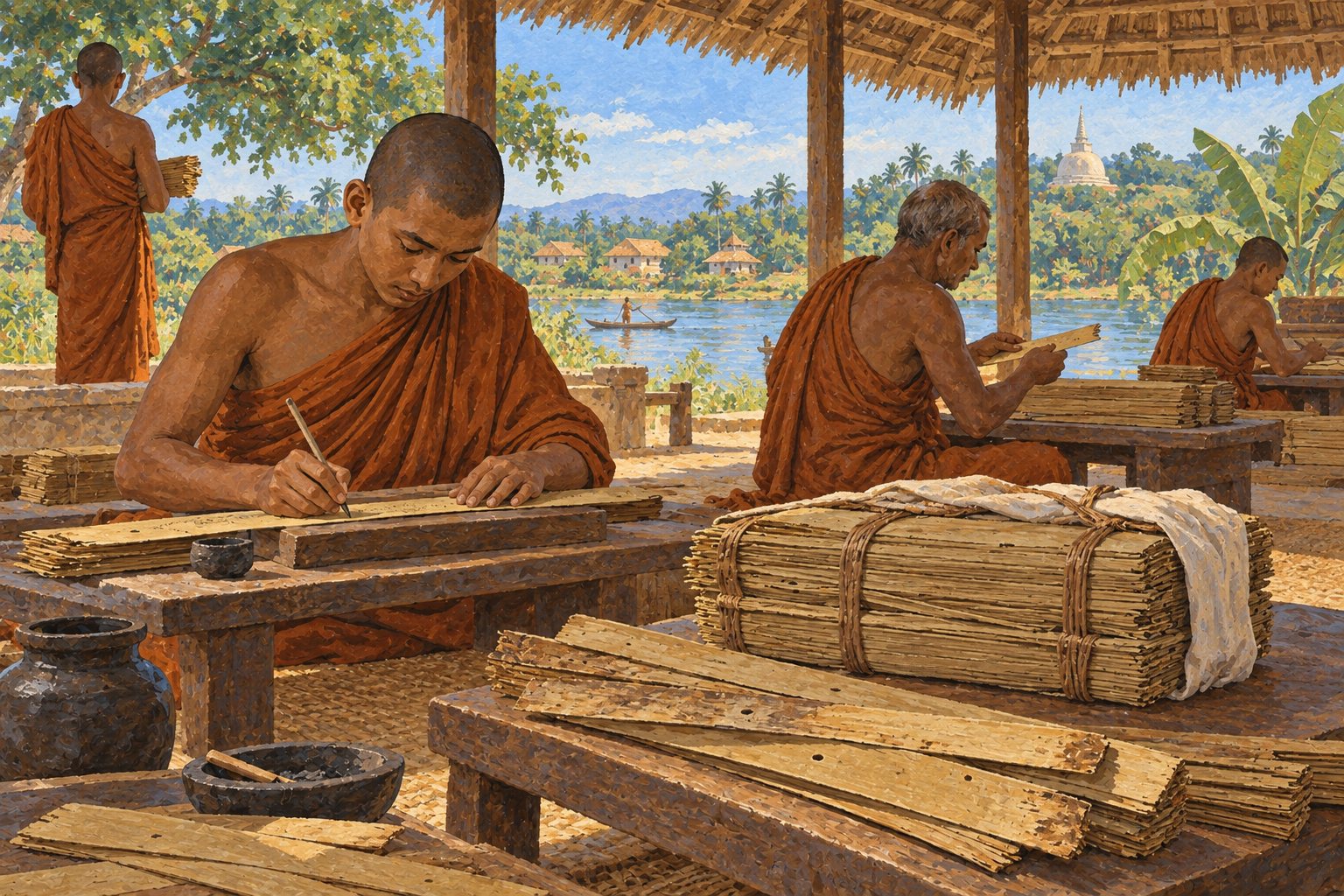
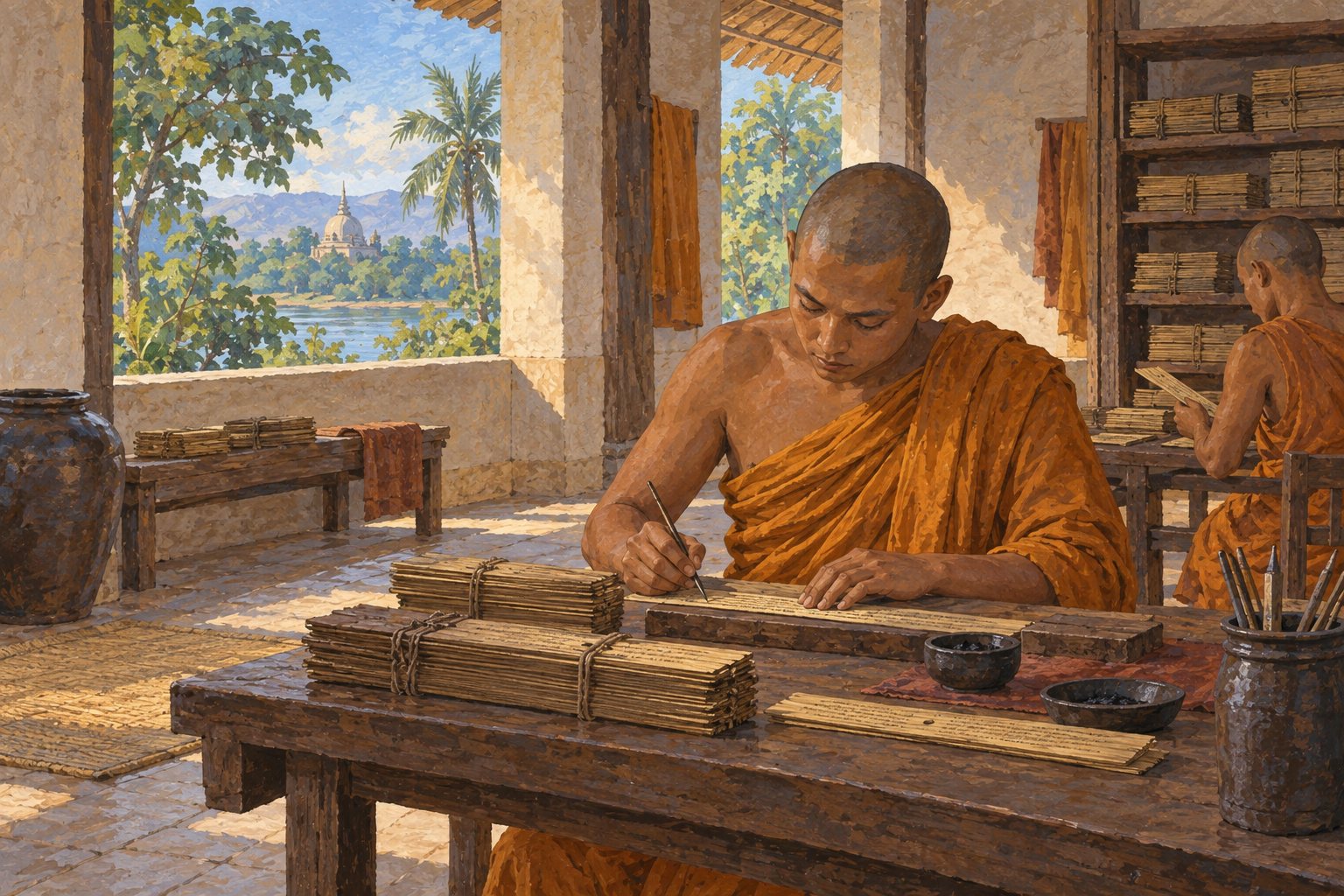
For its first two centuries the teaching existed in a country with, as far as any evidence goes, no writing used for texts — so the community’s founding technical act was to convert forty-five years of a dead teacher’s talk into an institution of organised memory.
The Reciter Guilds
The canon was divided among specialist lineages — Digha-bhanakas carrying the long discourses, Majjhima-bhanakas the middle-length, and so on, each lineage assigned one collection — a division of labour that turned an impossible individual memory problem into an ordinary institutional one.
Explore the illustrations3 scenes · Recopying the palm leaves
Recopying the palm leaves. Prepared palm leaf rots in a tropical climate within a few centuries, so writing did not end transmission — it converted a chanting machine into a recopying machine, and every surviving Pali book is the far end of an unbroken chain of copies, with the standardisations and losses that a chain of copies imposes.
Texts and authority
Three Baskets, Unevenly Old
The canon sorts into discipline, discourse and systematics, and the third basket is visibly the youngest: the schools share versions of the first two and each built its own third — and the Pali third basket contains a book its own tradition dates two centuries after the Buddha.
Who Had the Authority to Close It
No decree ever closed the Pali canon; closure happened operationally — councils fixed agreed recitations, and in the fifth century the commentaries fixed the boundary by what they chose to comment on — so “closed” describes a practice, not an event, and the practice has been re-performed into living memory.
Institutions and resources
Eight Possessions and a Steward
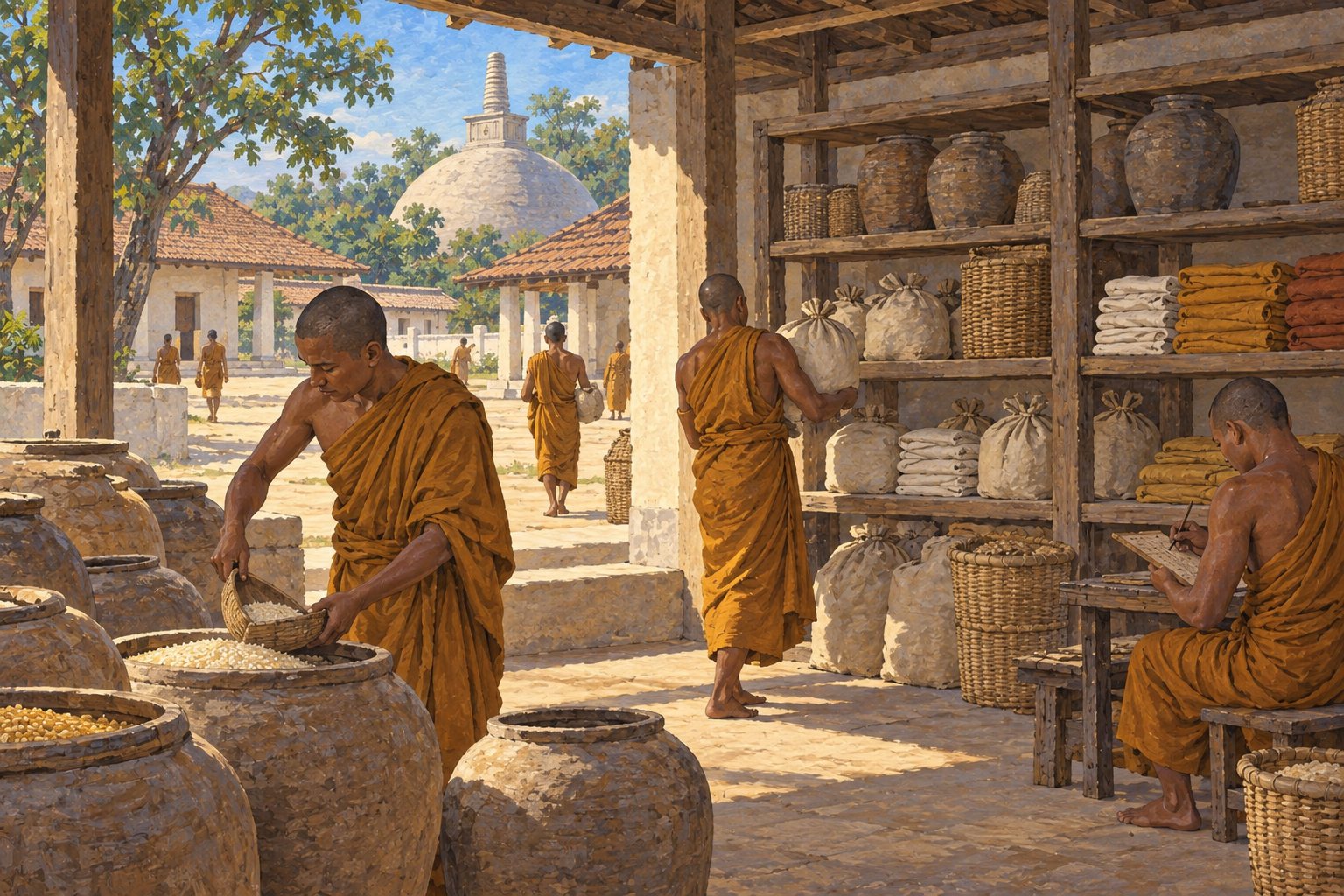
The rule of personal poverty is precise — three robes, a bowl, a razor, a needle, a belt, a water-strainer — and the same vinaya that forbids a monk to touch gold documents the lay-steward mechanism by which wealth moved anyway; the gap between the rule and the workaround is this movement’s subject.
Ten Practices, and the One That Mattered
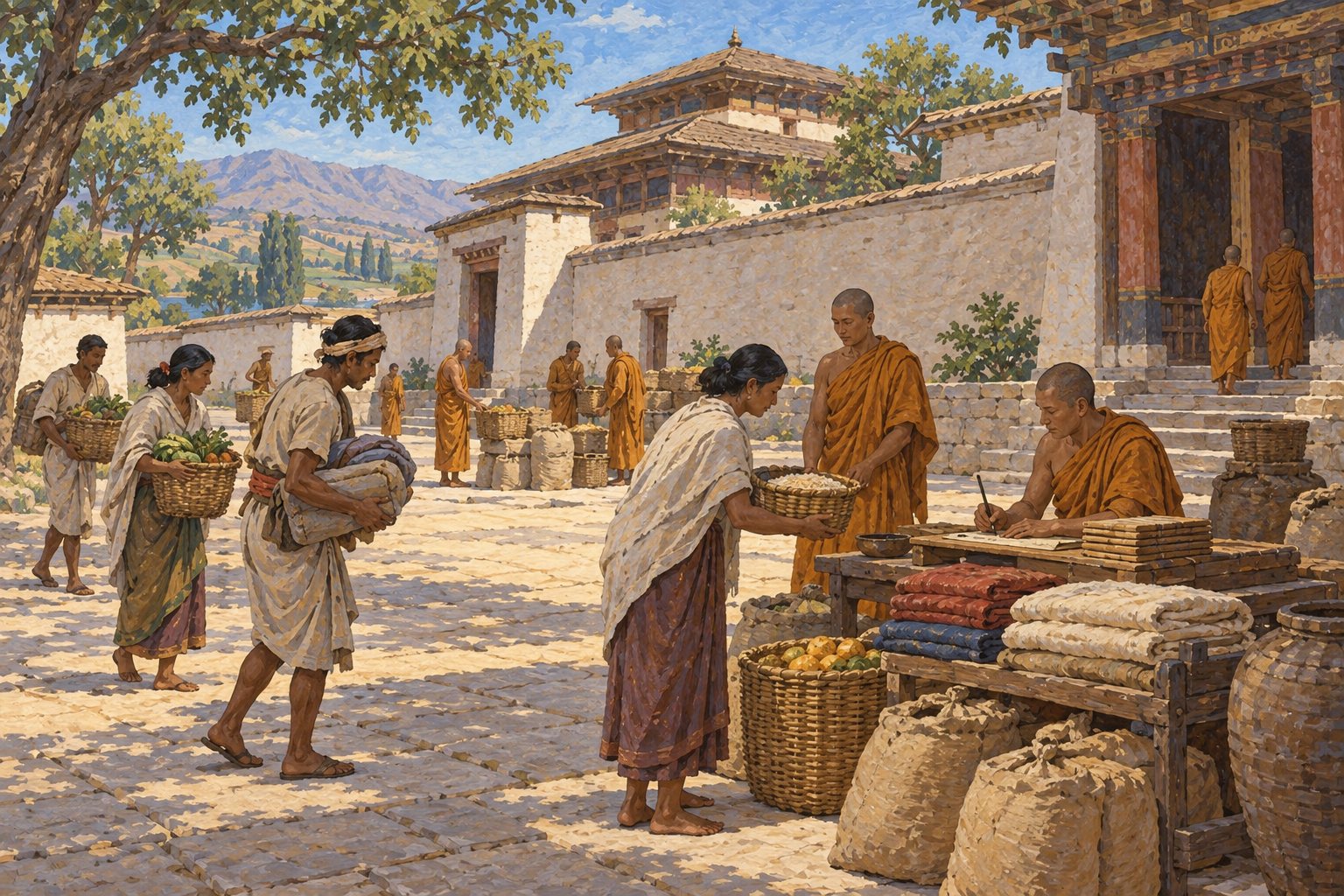
About a century after the founder’s death, the tradition’s first constitutional crisis was a finance dispute: ten condemned practices with the acceptance of gold and silver at their centre, provoked — on the tradition’s account — by monks collecting money from the laity at the fortnightly assembly.
Explore the illustrations3 scenes · Within the monastery court
Within the monastery court. Individual poverty and corporate wealth are a legal design, not a contradiction: property vests in “the sangha of the four quarters, present and absent” — a corporation that cannot die — and the earliest surviving picture of Buddhist money is literally a picture of money.
Changes and divisions
The Separate Recitation
In a memorised religion, holding your own council is the schism: the first enduring division was expressed as a rival recitation — but whether it happened at the Second Council or generations later is contested, the losers’ own books tell a different story, and the losers’ monastic code is not the lax one.
The Emperor’s Missionaries
The chronicle’s nine missions read as legend until the evidence splits cleanly: Ashoka’s own edicts prove envoys to five named Greek kings, and excavated relic caskets carry the names of the chronicle’s Himalayan missionaries — while for the mission this book most needs, Mahinda’s to Lanka, the hard evidence stays indirect.
Limits of the evidence
These limits are stated in the book before its argument.
- The founder’s dates, closer than about eighty years. The Theravada reckoning puts the death in 544/543 BCE; the corrected long chronology puts it about 486; since the Göttingen symposium of 1988 most specialists put it around 400. The volume gives all three, labels each, and never prints one as history.
- Any fact about the founder from contemporary evidence. Nothing physical survives from within roughly two centuries of his conventional lifetime; the earliest hard evidence is Ashokan, and the connected biography is a literary product centuries later again.
- What the Buddha actually said. The earliest surviving wording is in a western literary dialect he would not have spoken, first written down some four centuries after his death — and no manuscript survives from within roughly a thousand years of that writing-down.
Sources and reading
This article brings together the series’ existing overview and chapter summaries. The linked book page provides the full outline and bibliography.
- F. R. Allchin, The Archaeology of Early Historic South Asia1995. Northern Black Polished Ware and the second urbanisation — surplus, not religion
- D. D. Kosambi on the Magadhan karsha weightmid-20th century. fifty-four grains of silver for the royal punch-marked issue
- Osmund Bopearachchi on punch-marked chronologylate 20th–early 21st c.. earliest issues possibly minted by sixth-century mahajanapadas
- Joe Cribb on punch-marked chronologylate 20th–early 21st c.. a wholly independent Indian coinage from c. 1000 BCE no longer credited
- Numbered Discourses, sixteen-country list, Bhikkhu Sujato trans.SuttaCentral, CC0. the soḷasa mahājanapada political map
- Jain Bhagavatī Sūtra (Vyākhyāprajñapti)compiled long after the events. a rival sixteen-kingdom list that omits Gandhara and Kamboja
- Linked and Numbered Discourses on the gahapati / seṭṭhi, SujatoSuttaCentral, CC0. householder-financier as the donor class the discourses address
- Sigālaka Sutta, SujatoSuttaCentral, CC0. the household income split — enjoy, invest, reserve
Illustrations are newly generated interpretations of themes in the book. They are not surviving artifacts, historical photographs or evidence for the events described.