12 illustrations · 1:23
Watch & listen.
Follow the images with a narrated journey through the book.



Overview
- Coverage
- c.400 BCE–1500 CE
- Earliest secure evidence
- c.400 BCE
- Transmission
- the deed engraved in copper
Two figures a reader might expect are absent: the interest rate usually quoted for Chola temple lending, which did not verify against a named inscription in the form the popular literature repeats, and any date closer than a century for almost any teacher.
The coverage period and the earliest secure evidence are different dates. A tradition’s own account of its beginnings may differ from both.
Historical setting
A Name from a River
“Hindu” began as Persian geography — the people beyond the Sindhu — and “Hinduism” as an English noun is a nineteenth-century convenience; the chapter’s job is to say what it is a convenience for, which is not the same as calling it a fiction: a family of streams that shared an epic reference frame, a ritual profession, a pilgrimage map and a habit of recognising each other, without ever sharing a founder, a council or a list.
The Sacrifice Loses Its Monopoly
Around 400 BCE the Vedic sacrificial system was one option in a crowded market — renouncer movements were winning royal patronage, and the response of the ritualists’ world was not a counter-church but a literature: dharma codified on paper, an ordered society of four varṇas that the inscriptions’ messier world of jātis, guilds and mobile fortunes never quite matches — and the gap between śāstra and deed is this volume’s standing method.
Explore the illustrations3 scenes · A temple household
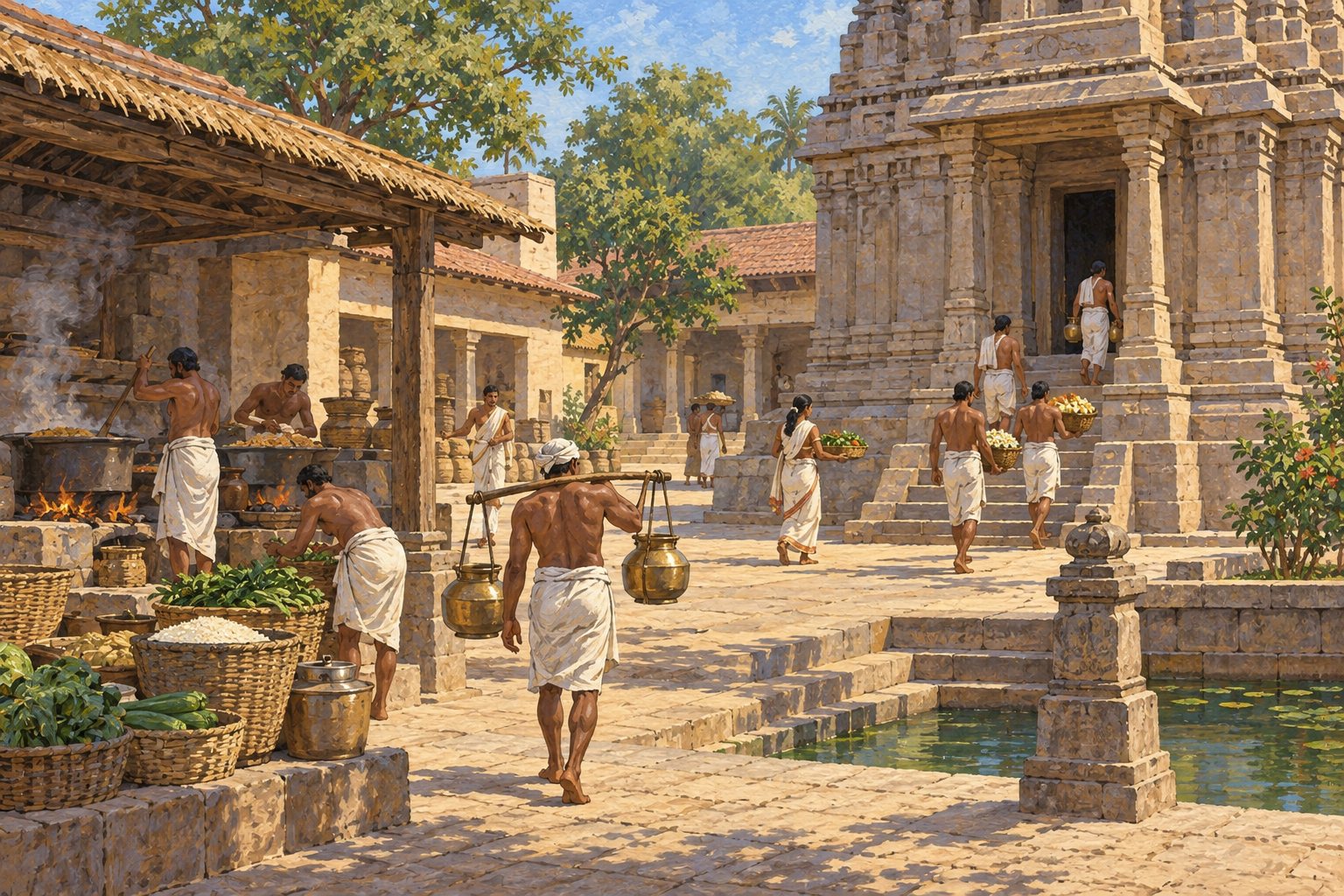
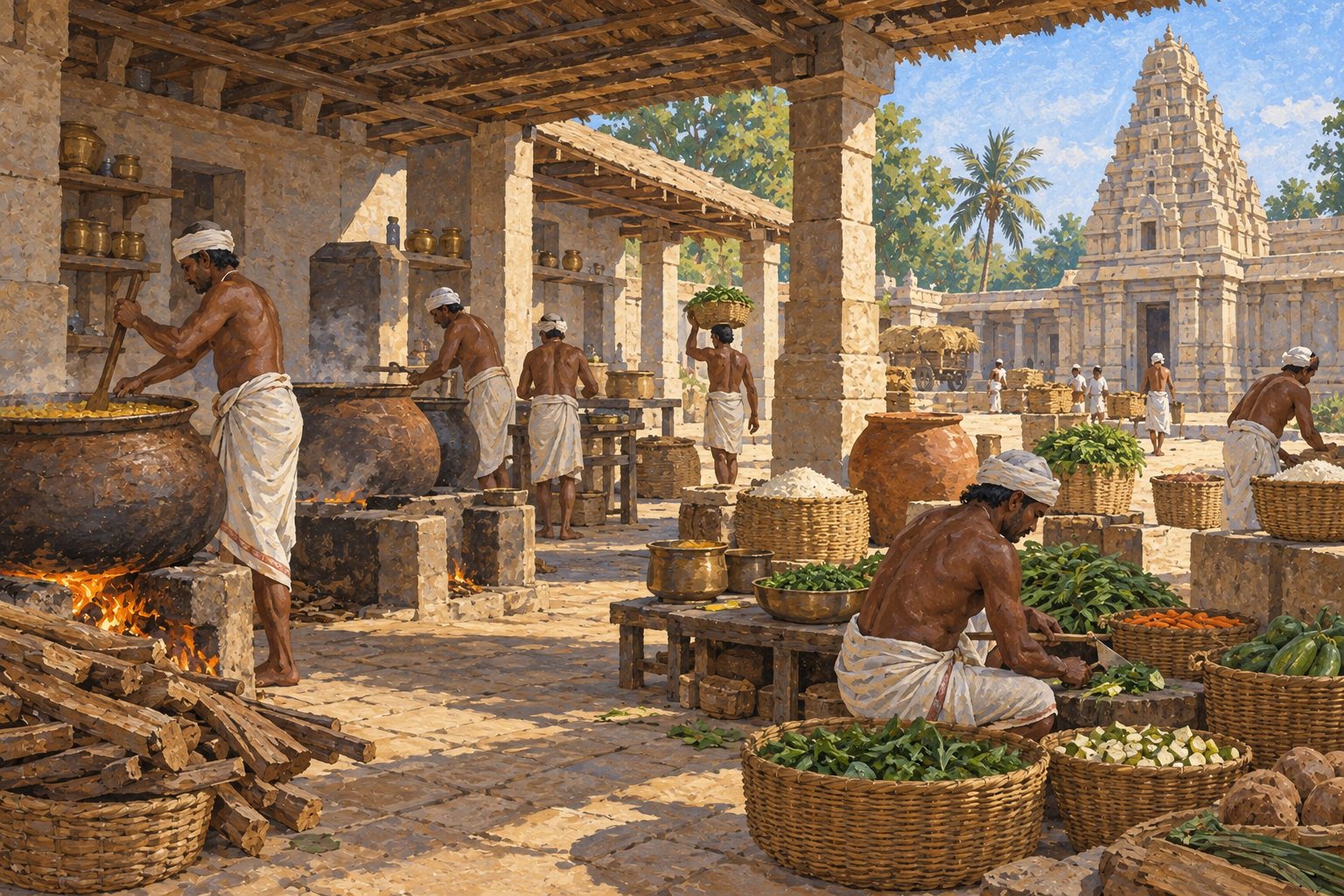
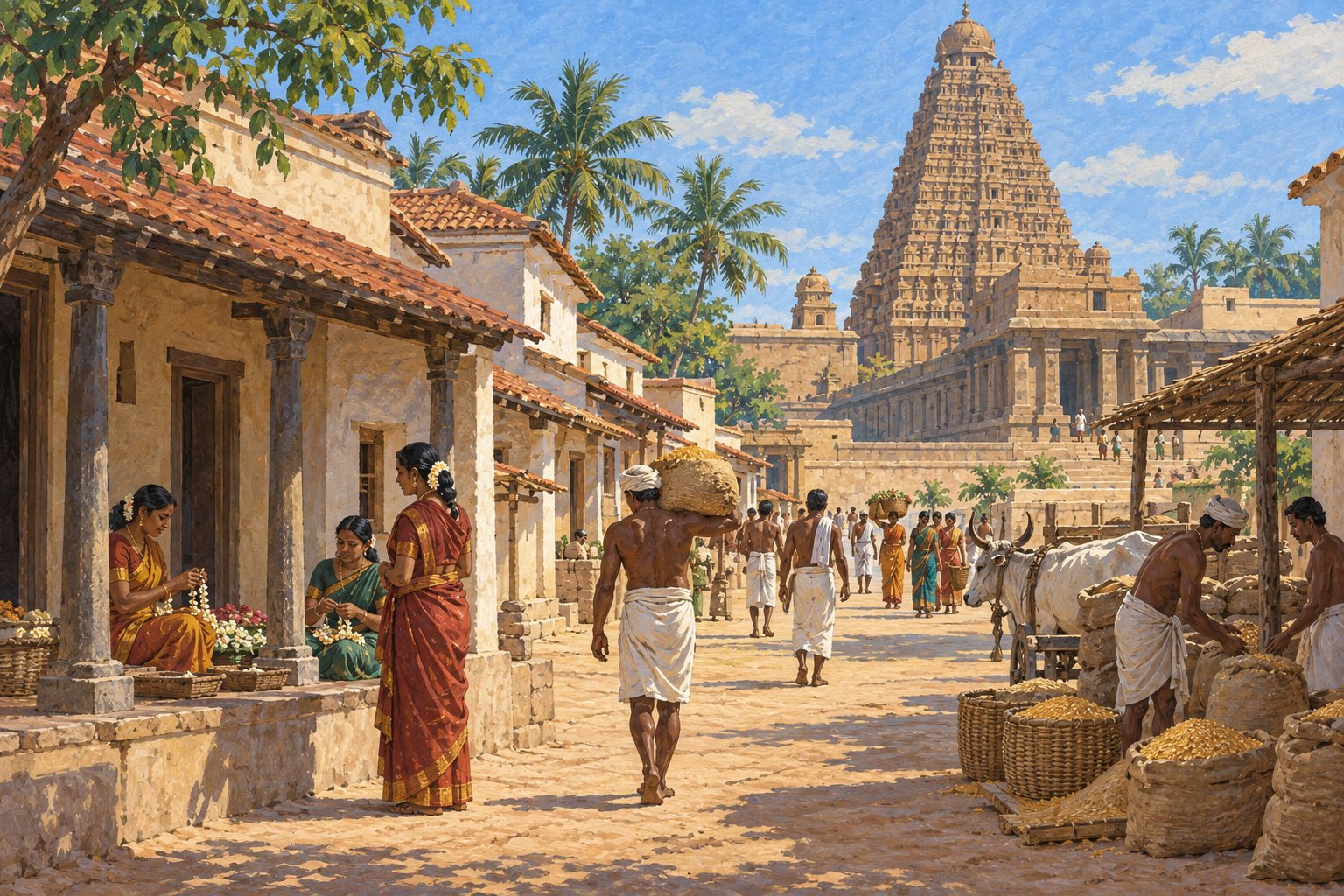
A temple household. The span’s structural event: the deity acquires an address. Sacrifice was a service performed by a specialist and consumed by fire; pūjā is hospitality offered to a resident — and a resident god needs a building, a staff, a kitchen and an income, which is how a form of worship became a form of institution.
How it was transmitted
The Deed on Copper
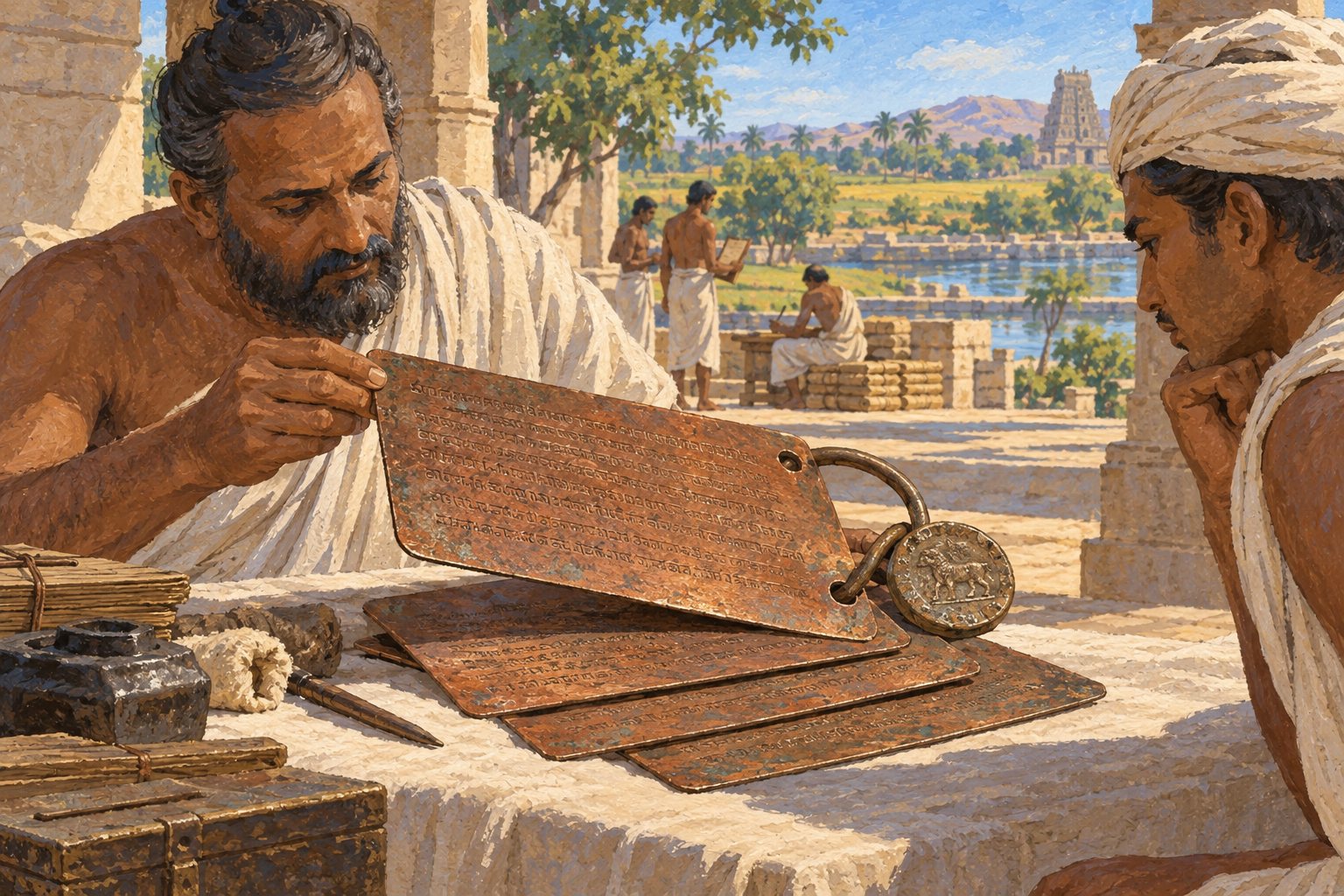
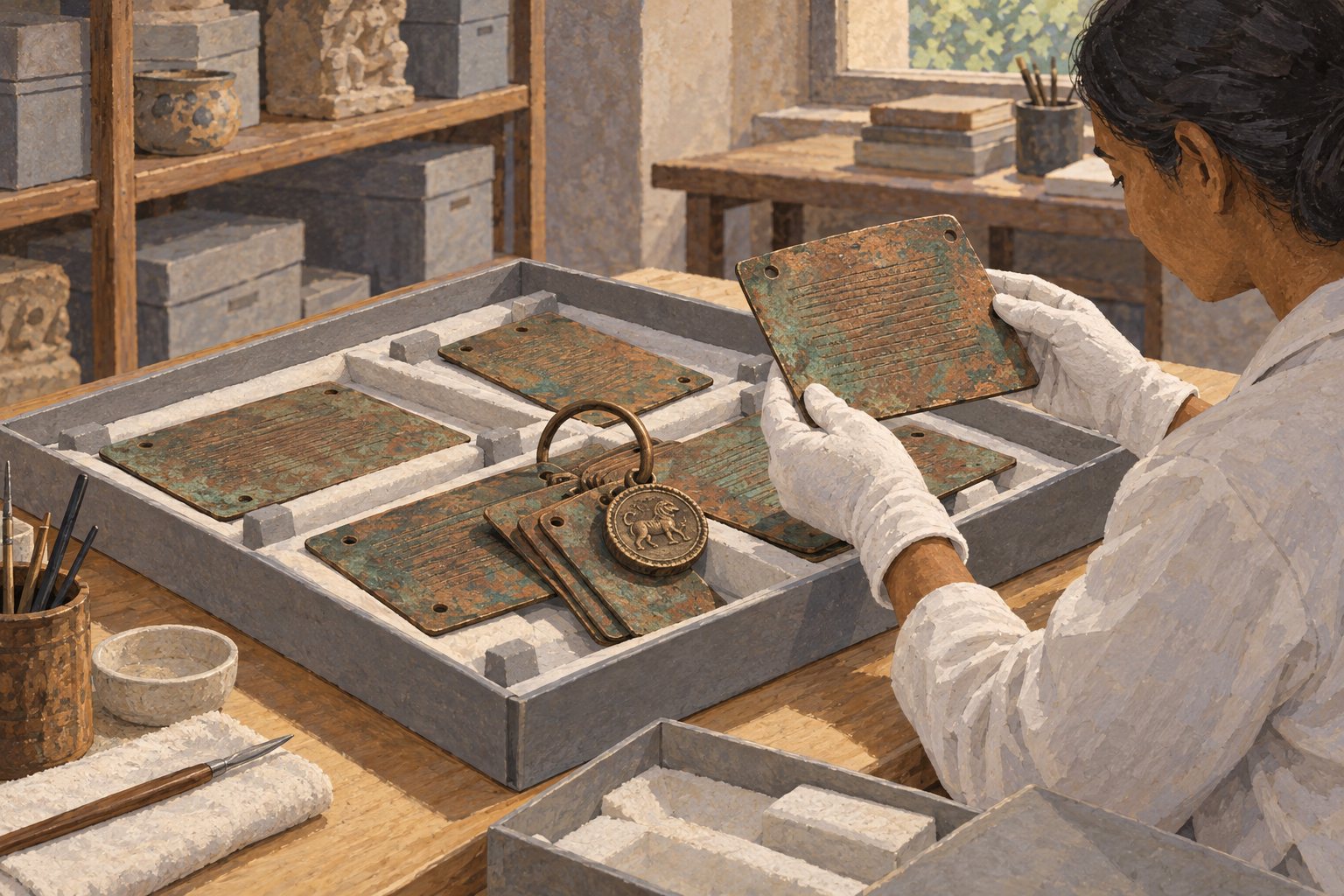
The tāmraśāsana — a land grant engraved on copper plates, strung on a ring closed with the royal seal — is the subcontinent’s registry office: fireproof, portable, forgeable only with difficulty, and treated by the law books themselves as evidence; the genre runs for over a millennium and survives in the thousands, which makes it the single richest documentary corpus this volume has.
The Wall That Keeps the Books
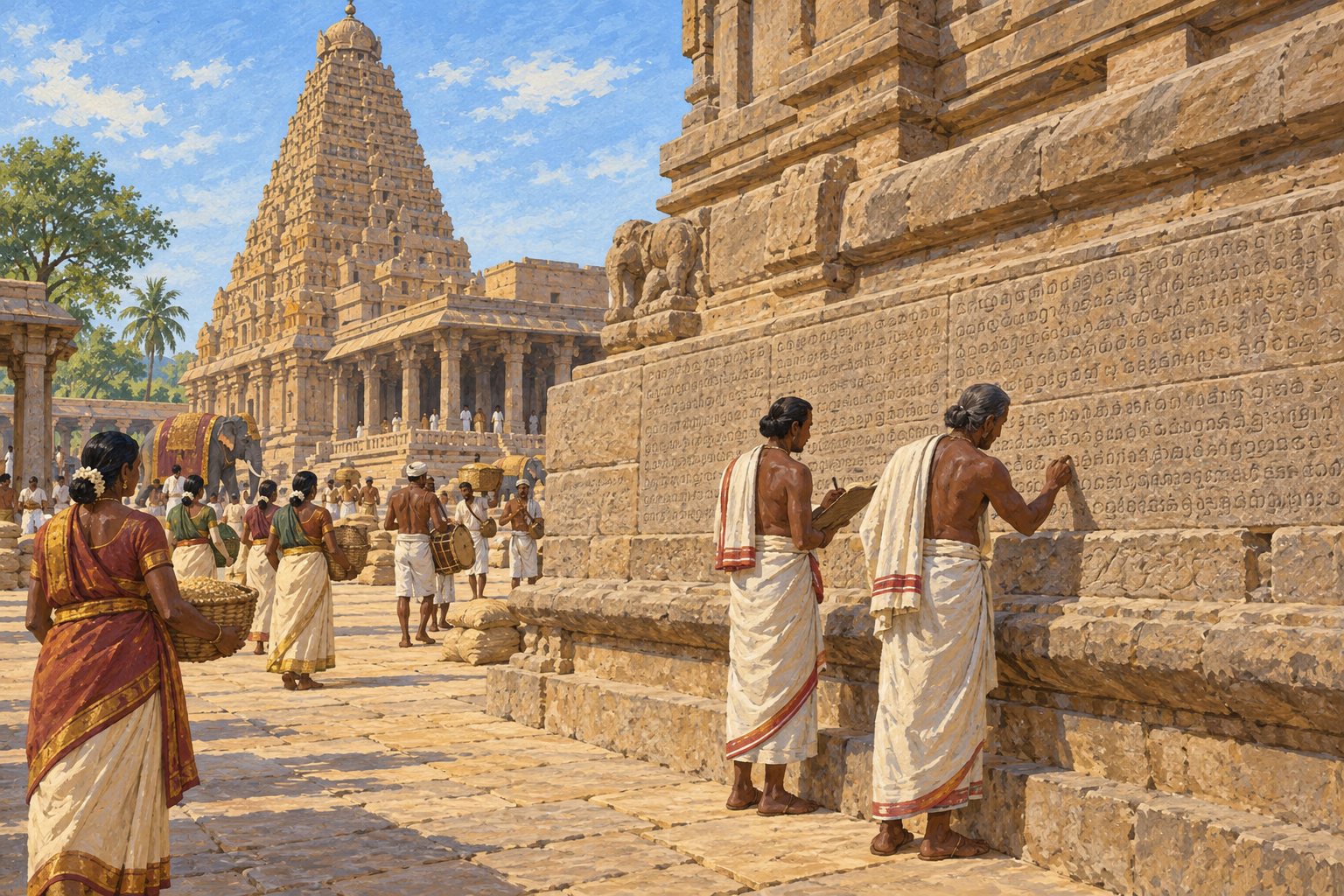
The temple wall is a public ledger: donations, staff, salaries and interest rates carved into the fabric of the building itself, in a form no clerk could quietly amend and any literate visitor could audit, permanently — and when a shrine was rebuilt, the old records were re-engraved onto the new walls, because the building understood itself as the archive.
Explore the illustrations4 scenes · The copper deed
The copper deed. The tāmraśāsana — a land grant engraved on copper plates, strung on a ring closed with the royal seal — is the subcontinent’s registry office: fireproof, portable, forgeable only with difficulty, and treated by the law books themselves as evidence; the genre runs for over a millennium and survives in the thousands, which makes it the single richest documentary corpus this volume has.
Texts and authority
The Canon That Never Closed
The argument chapter: śruti was fixed — the Veda, frozen by the recitation machine of the Vedic World volume — and everything after it accretes: epic, Purāṇa, Āgama, Tantra, commentary. Three traditions in this series solved the authority problem by closing a list — the councils of the Buddhism volume, the Vallabhī recension of the Jainism volume, the canon lists of the Early Christianity volume — and this one solved it by not having one: authority here is established by lineage and by use, and the boundary that was policed was allegiance to the Veda’s authority, not the contents of a shelf.
The Epic That Ate the Library
The Mahābhārata canonised itself: it calls itself the fifth Veda, boasts that what it omits does not exist, and — the claim that matters for this volume — presents itself as scripture for those the Vedic schools excluded; and its growth is not an embarrassment to the tradition but the mechanism, visible today because a critical edition spent half a century reconstructing the shorter text the manuscripts descend from.
Institutions and resources
The Village Given Away
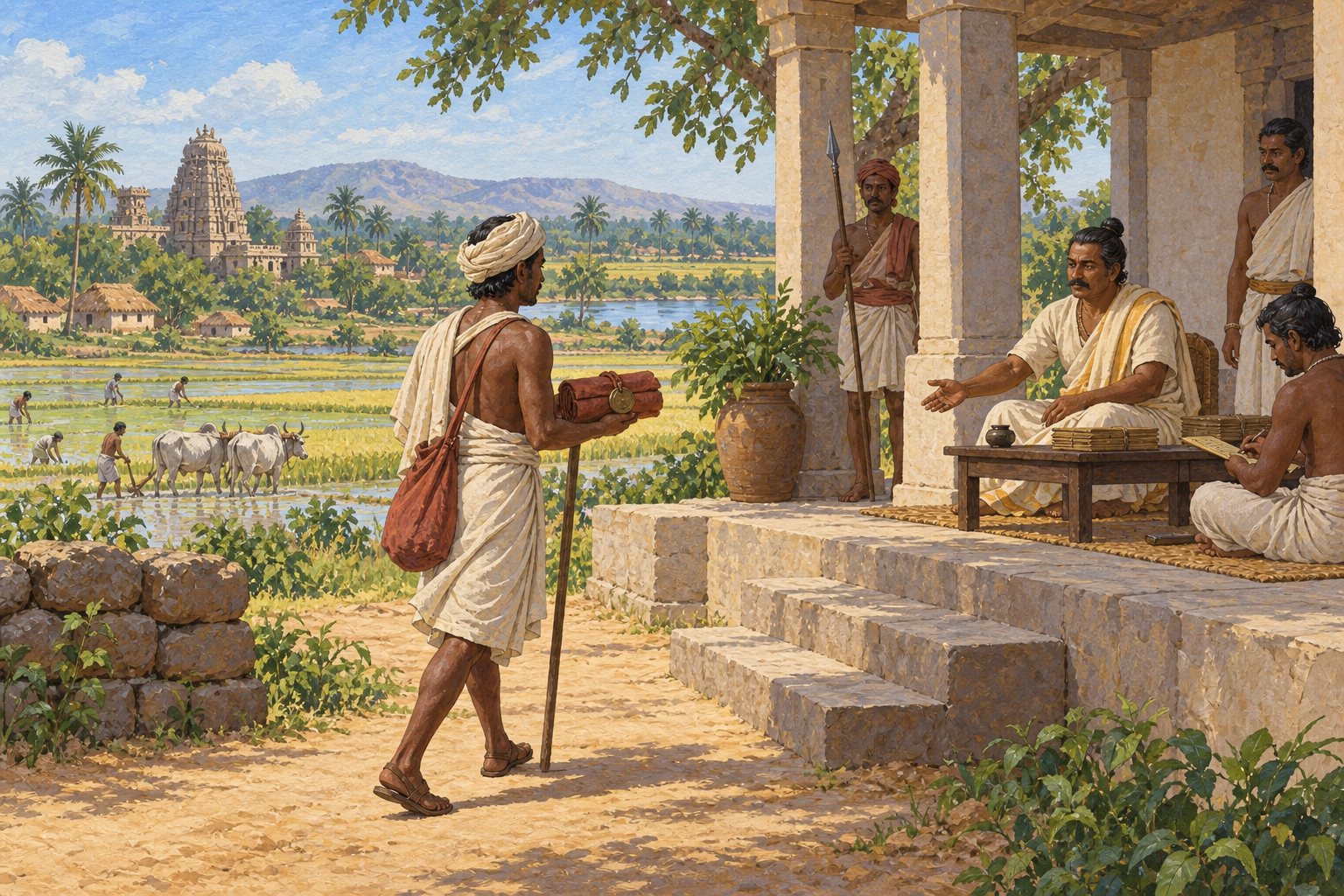
The standard instrument of religious finance is the tax-free village: the brahmadeya granted to brahmins, the devadāna to a temple — land, water rights, house sites and exemptions itemised on copper — and the grant creates a governing assembly whose own election rules, carved on a temple wall, include the pre-modern world’s most explicit audit clause.
Four Hundred Dancers on the Payroll
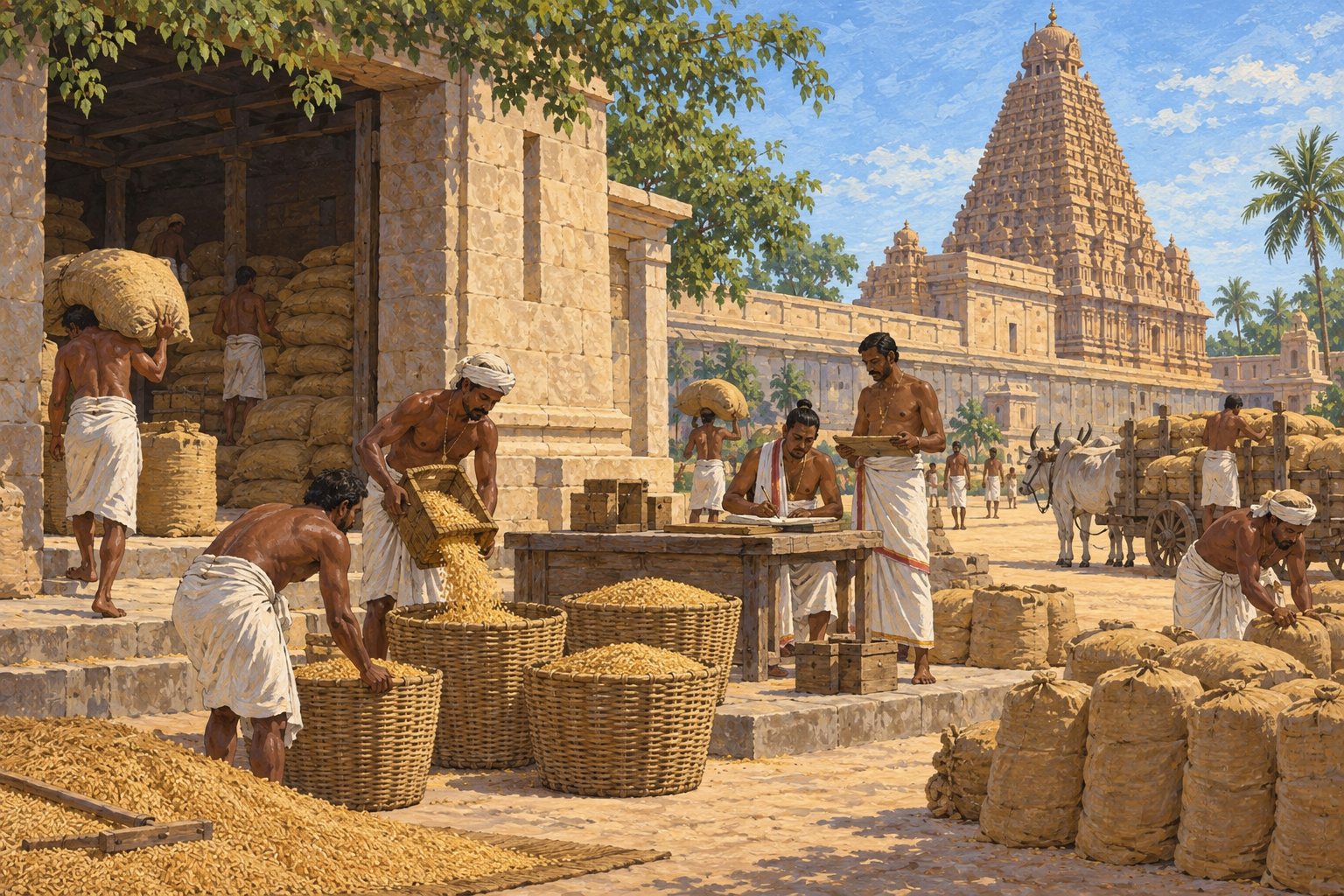
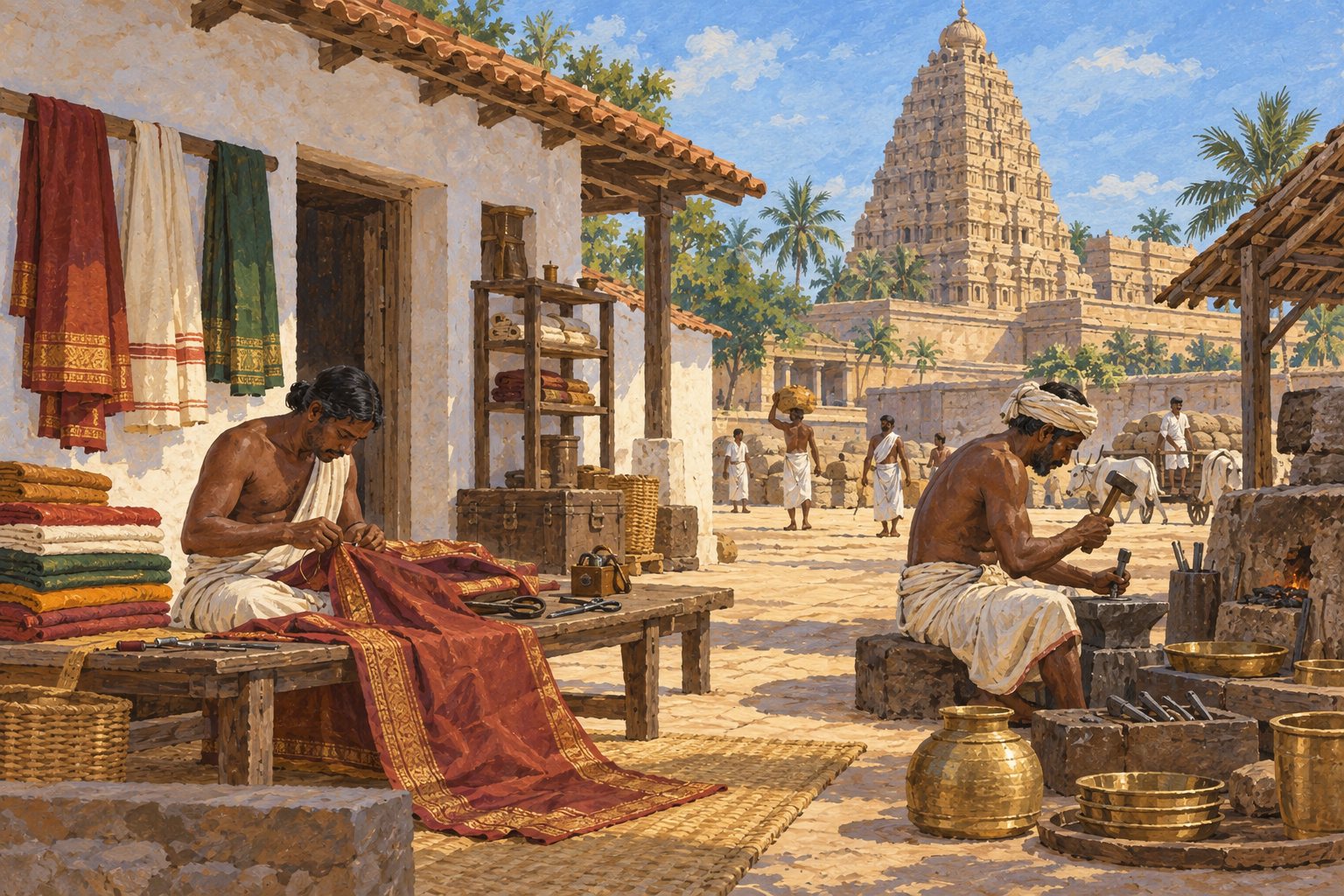
Rājarāja I’s Rājarājeśvaram at Thanjavur (consecrated conventionally 1010) carries its own endowment ledger cut into the plinth: the transfer of four hundred temple women from other temples, each named, each assigned a house in a named street and an allowance in paddy — plus singers, drummers, accountants, goldsmiths, tailors and watchmen at stated rates, and treasury lists itemising gifted jewels down to pearl counts. That is an audit trail as architecture, and it is this volume’s reason for existing.
Explore the illustrations5 scenes · Grain and temple wages
Grain and temple wages. Rājarāja I’s Rājarājeśvaram at Thanjavur (consecrated conventionally 1010) carries its own endowment ledger cut into the plinth: the transfer of four hundred temple women from other temples, each named, each assigned a house in a named street and an allowance in paddy — plus singers, drummers, accountants, goldsmiths, tailors and watchmen at stated rates, and treasury lists itemising gifted jewels down to pearl counts. That is an audit trail as architecture, and it is this volume’s reason for existing.
Changes and divisions
Three Readings of One Sentence
Advaita, Viśiṣṭādvaita, Dvaita — non-dualism, qualified non-dualism, dualism — are rival readings of the same three texts, and the split they made was conducted without a council, an expulsion or a war: it ran on commentaries, monasteries and patronage, which is what schism looks like in a tradition whose canon never closed.
The Competition for the King
The Śaiva–Vaiṣṇava division was also economic — two institutional worlds bidding for the same royal patronage — and its memory is double-layered: hagiographies of persecution and triumph written generations later, over an inscriptional record that shows something less dramatic and better documented: patronage shifting, and dynasties endowing across sectarian lines even while court religion tilted.
Limits of the evidence
These limits are stated in the book before its argument.
- A founding date, a founder, or a founding text There are none to establish, and the volume’s opening chapter states why the noun “Hinduism” — a nineteenth-century English convenience — is nonetheless a convenience for something demonstrable: a shared epic reference frame, a shared pilgrimage map, interlocking canon claims and mutual recognition among the streams. What cannot be established is that any practitioner in this span would have used one noun for all of it.
- The date of almost any text or teacher, closer than a century The epics’ composition is conventionally spread across centuries; Manu’s code is conventionally dated within a four-century window; Śaṅkara’s own monasteries date him to 509 BCE while scholars conventionally put him around 700–750 CE, and the volume prints both without repair. Rāmānuja’s traditional dates span a 120-year life and are labelled as the tradition’s.
- Any aggregate number Adherents, temple wealth totals, land shares: the inscriptions record particular endowments with named donors and stated rates, never totals, and there is no census. Where a figure is printed it is one record’s figure with its inscription named; where a widely repeated figure did not verify, the text writes UNVERIFIED rather than approximating.
Sources and reading
This article brings together the series’ existing overview and chapter summaries. The linked book page provides the full outline and bibliography.
- al-Bīrūnī, Edward Sachau trans.c. 1030; trans. 1888. India organised as a country, not a church
- Wilfred Cantwell Smith, The Meaning and End of Religion1962. the reification case against the English noun
- David Lorenzen, “Who Invented Hinduism?”, Comparative Studies in Society and History1999. a self-conscious Hindu identity before any British administrator
- Phillip B. Wagoner, “Sultan among Hindu Kings,” Journal of Asian Studies1996. Hindurāya-suratrāṇa as a political label, not a doctrine
- Aśoka, Girnar rock edict 3, Eugen Hultzsch3rd c. BCE. śramaṇa and brāhmaṇa as twin categories of the worthy
- Megasthenes via Arrian, J. W. McCrindle trans.c. 300 BCE; trans. 1877. Sourasenoi, Methora, a god a Greek called Herakles
- Patañjali, Mahābhāṣyaconventionally c. 150 BCE. images of Śiva and Skanda shown for money
- Manu, Georg Bühler, Sacred Books of the East 25code c. 200 BCE–200 CE; trans. 1886. four varṇas on paper; sources of dharma; the nāstika
Illustrations are newly generated interpretations of themes in the book. They are not surviving artifacts, historical photographs or evidence for the events described.