13 illustrations · 1:36
Watch & listen.
Follow the images with a narrated journey through the book.



Overview
- Coverage
- 312–1453
- Earliest secure evidence
- 312 CE
- Transmission
- the imperial post
The jacket and the chronology table both run 312–1453: legalisation to the fall of the city whose church this volume follows. 1054 is a beat on that line, not the stop. The Reformation volume takes the print ignition. The Early Christianity volume takes the illegal centuries.
The coverage period and the earliest secure evidence are different dates. A tradition’s own account of its beginnings may differ from both.
Historical setting
The Letter Posted at Nicomedia
The document everyone calls the Edict of Milan is neither an edict nor from Milan — it is a letter of Licinius posted at Nicomedia on 13 June 313, and what it actually orders is a property settlement: confiscated churches and assets returned to “the corporate body of the Christians”, with buyers compensated from the treasury — so the span opens not with toleration as a feeling but with restitution as an administrative act, addressed to a church the law could already see as an owner.
The Emperor’s God
What Constantine did is among the best-documented things in ancient history — laws, letters over his name, coins, buildings — and what he believed is not: the coinage kept Sol Invictus for over a decade after the bridge, he kept the title pontifex maximus all his life, and he was baptised on his deathbed in 337 by Eusebius of Nicomedia, a patron of the party his own council had condemned — a record that supports a dozen readings, and the chapter reports the strongest two or three without electing one.
Explore the illustrations4 scenes · The basilica form
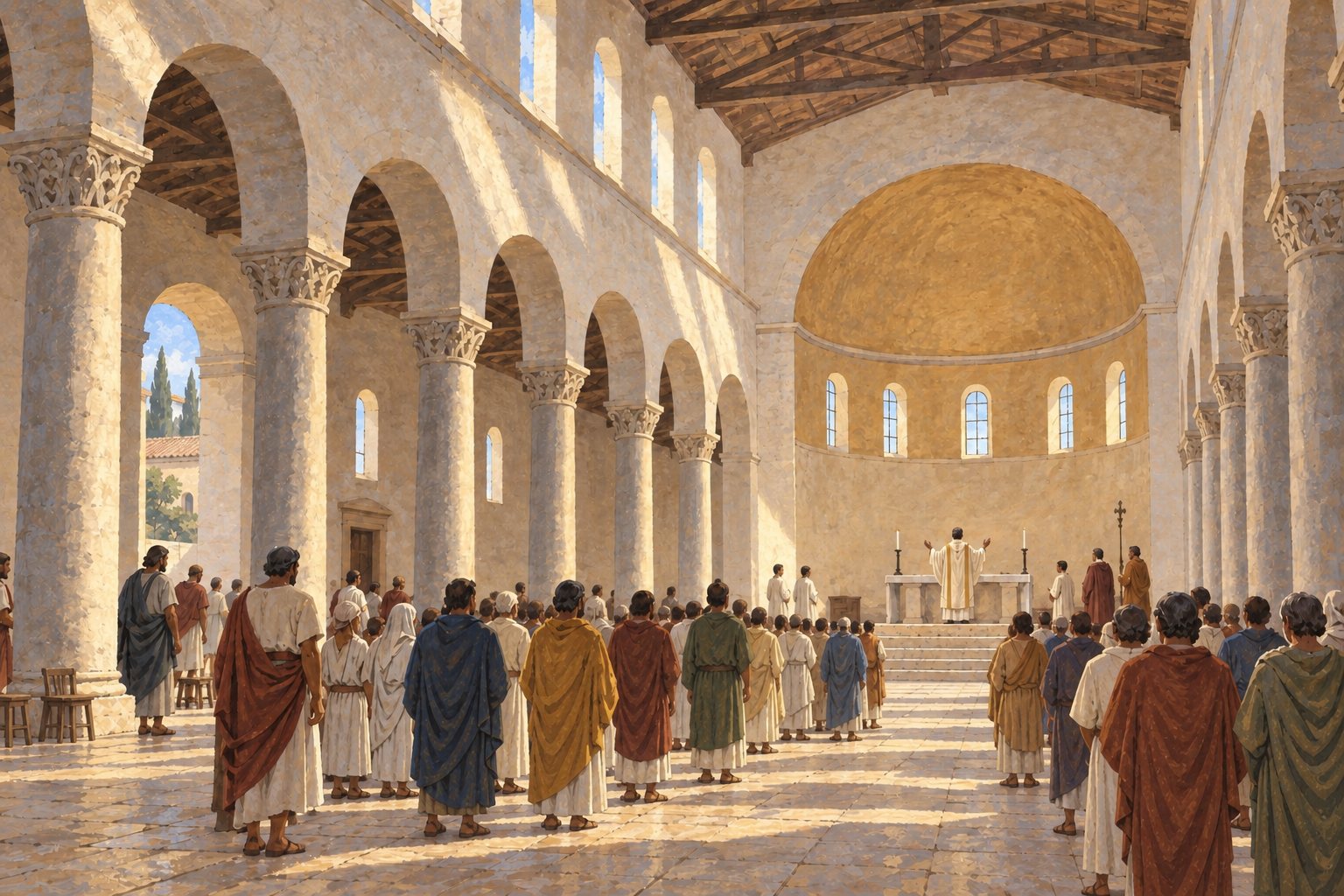
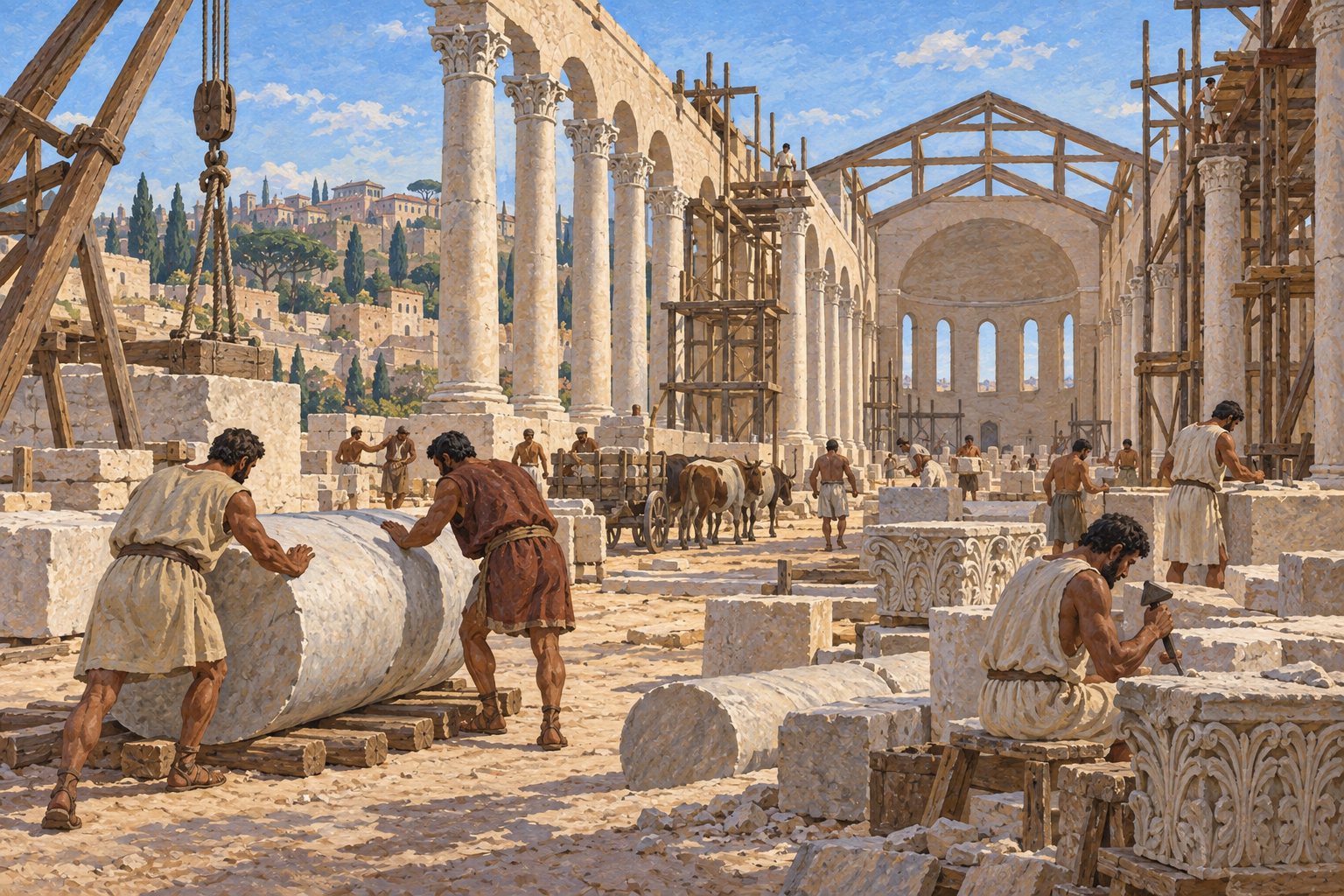
The basilica form. The empire built the church’s first monumental spaces, and it chose the form of its own law-courts — the basilica, an audience hall, not a temple — on imperial property: the Lateran on the site of a cavalry barracks, St Peter’s over a necropolis on the Vatican hill, the Holy Sepulchre by demolition of a temple in Jerusalem, and a new capital on the Bosporus where the founder’s tomb was arranged among cenotaphs of the twelve apostles, with himself as the thirteenth.
How it was transmitted
The Bishops Ride the Post
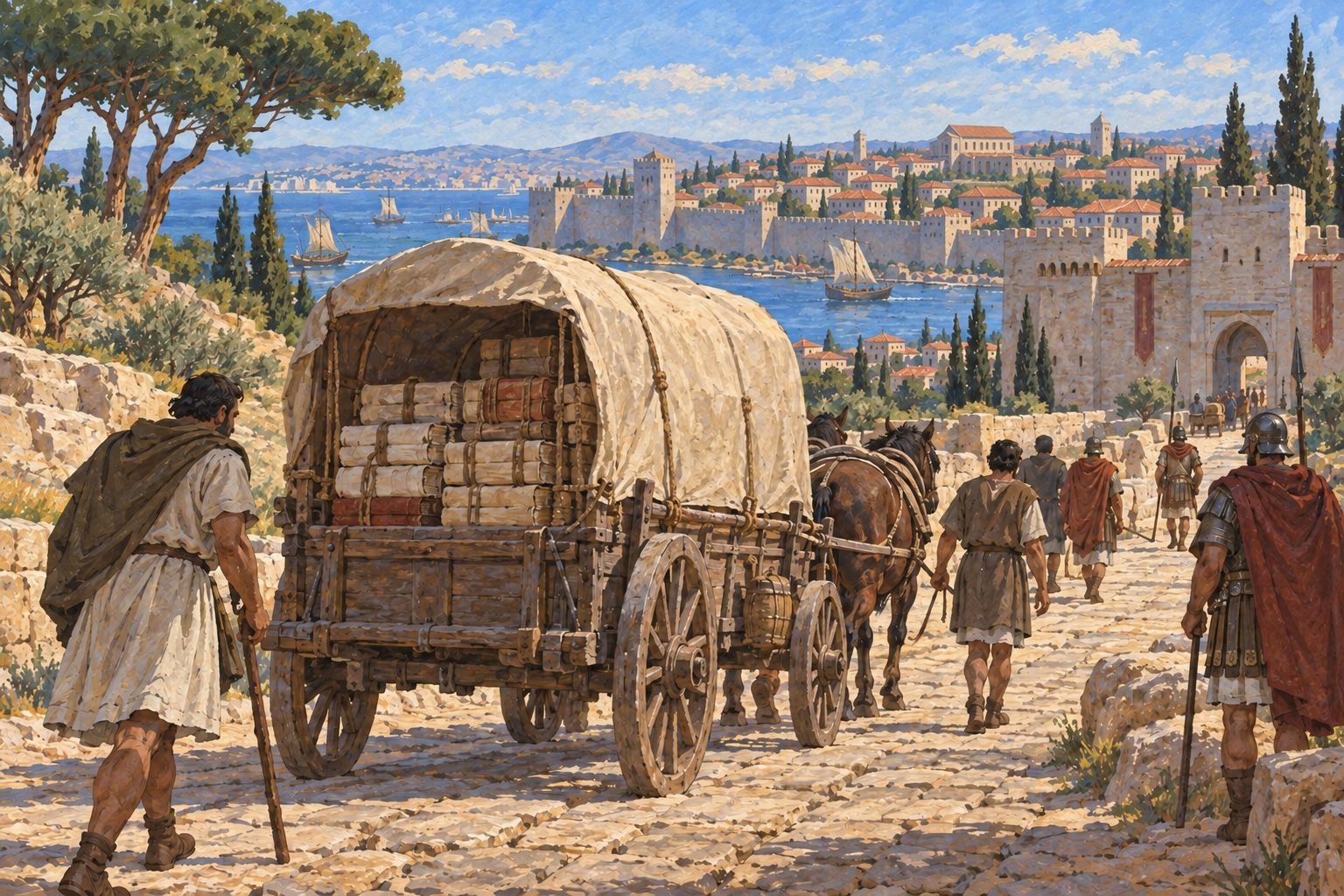
The cursus publicus — the relay post that moved the empire’s officials, orders and taxes — was opened to bishops travelling to councils at state expense, which is the concrete meaning of an “ecumenical” council: the emperor’s invitation was in effect a travel warrant, and a pagan historian complained that throngs of bishops galloping to synod after synod had hamstrung the service; the church’s deliberative machinery ran, literally, on the state’s wheels.
The Law Learns Theology
Imperial law became the enforcement layer for church decisions, and the first defendants were fellow Christians: the Donatist schism gave Constantine his first arbitration (Rome 313, Arles 314), his first coercion and his first retreat, and by 411 the state was minuting a compulsory debate at Carthage and ruling on the loser; meanwhile the code grew a whole title of heresy law — book-burning orders, meeting bans, property confiscations — until “wrong belief” was a category of Roman crime with a tariff.
Explore the illustrations5 scenes · Books by commission
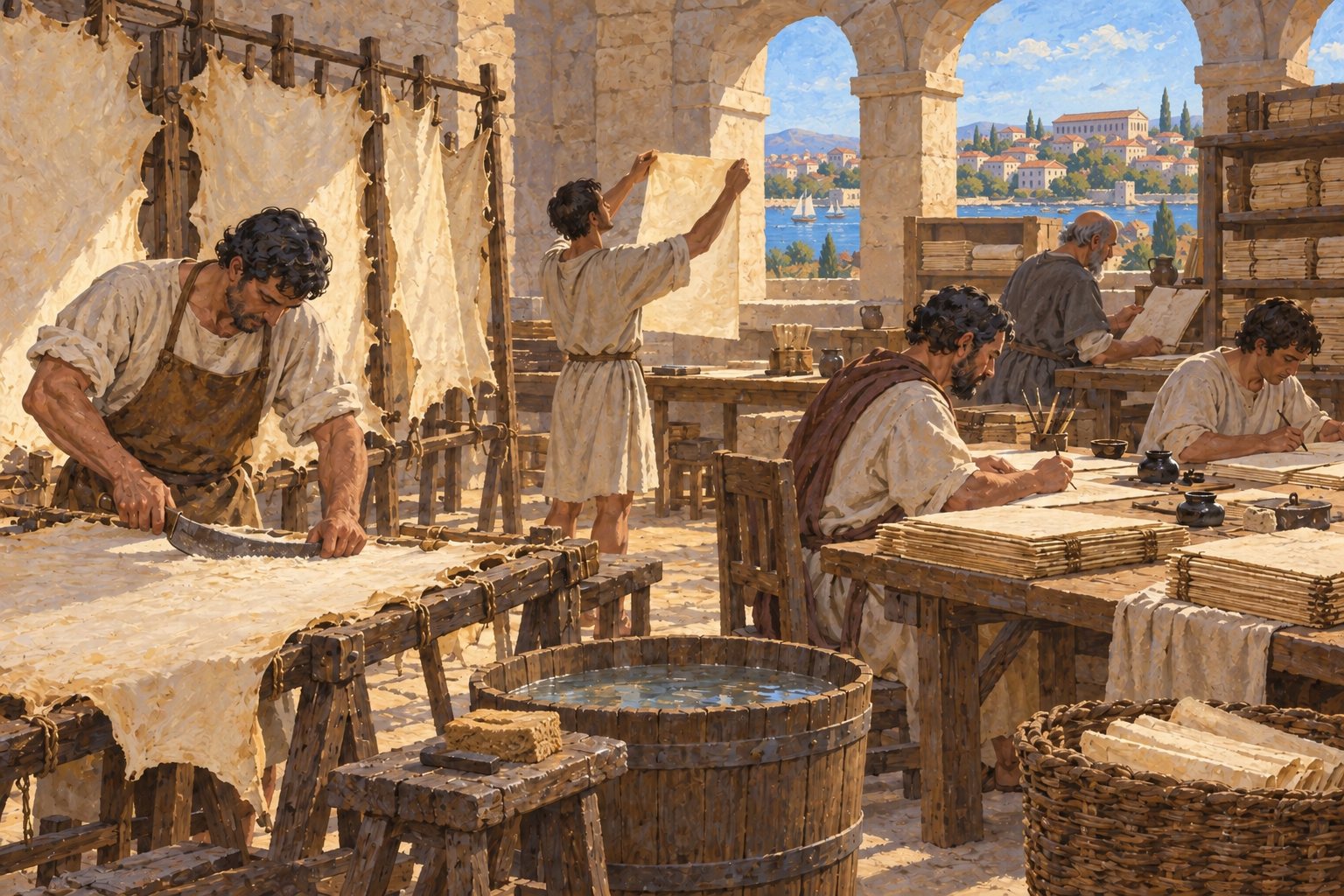
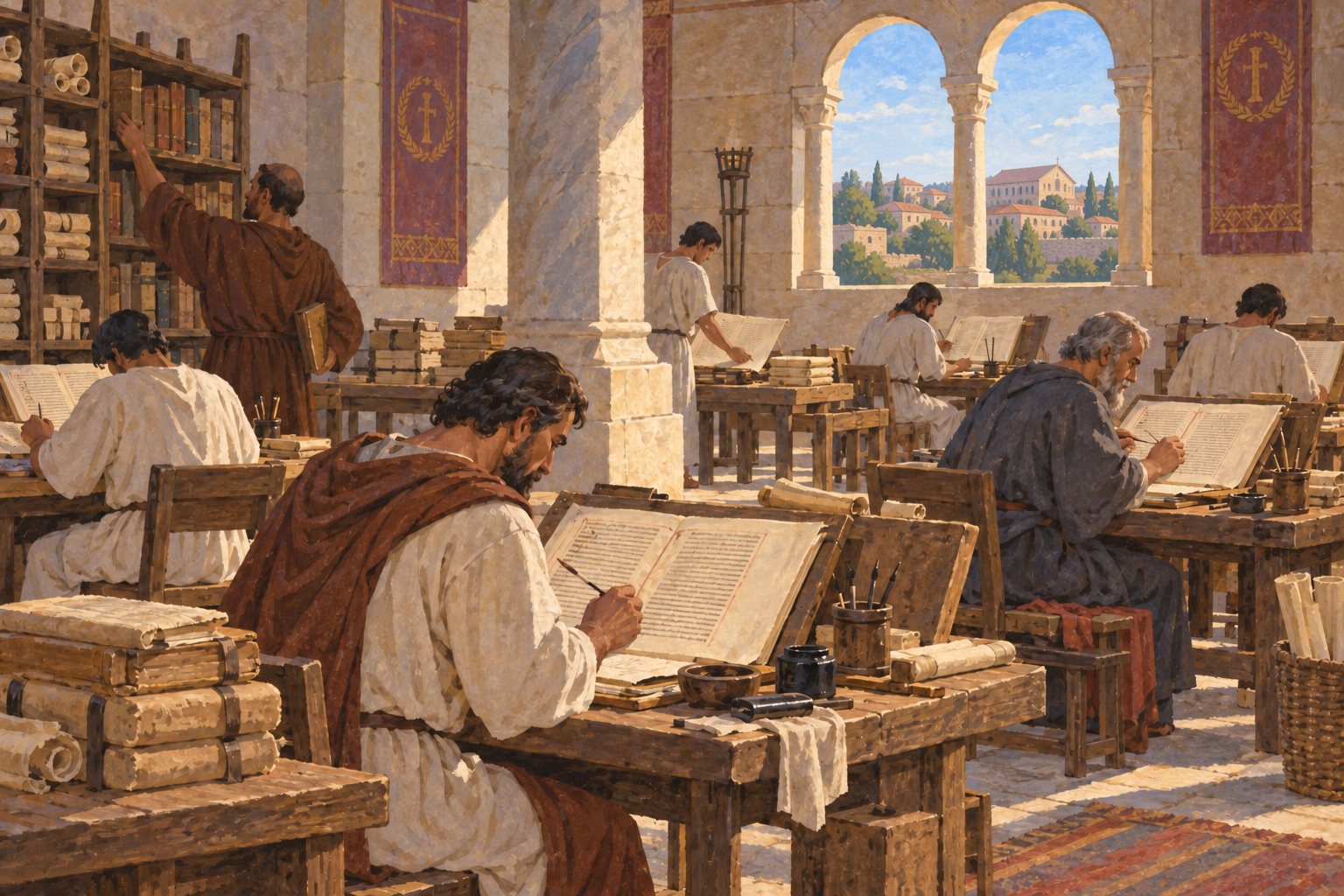
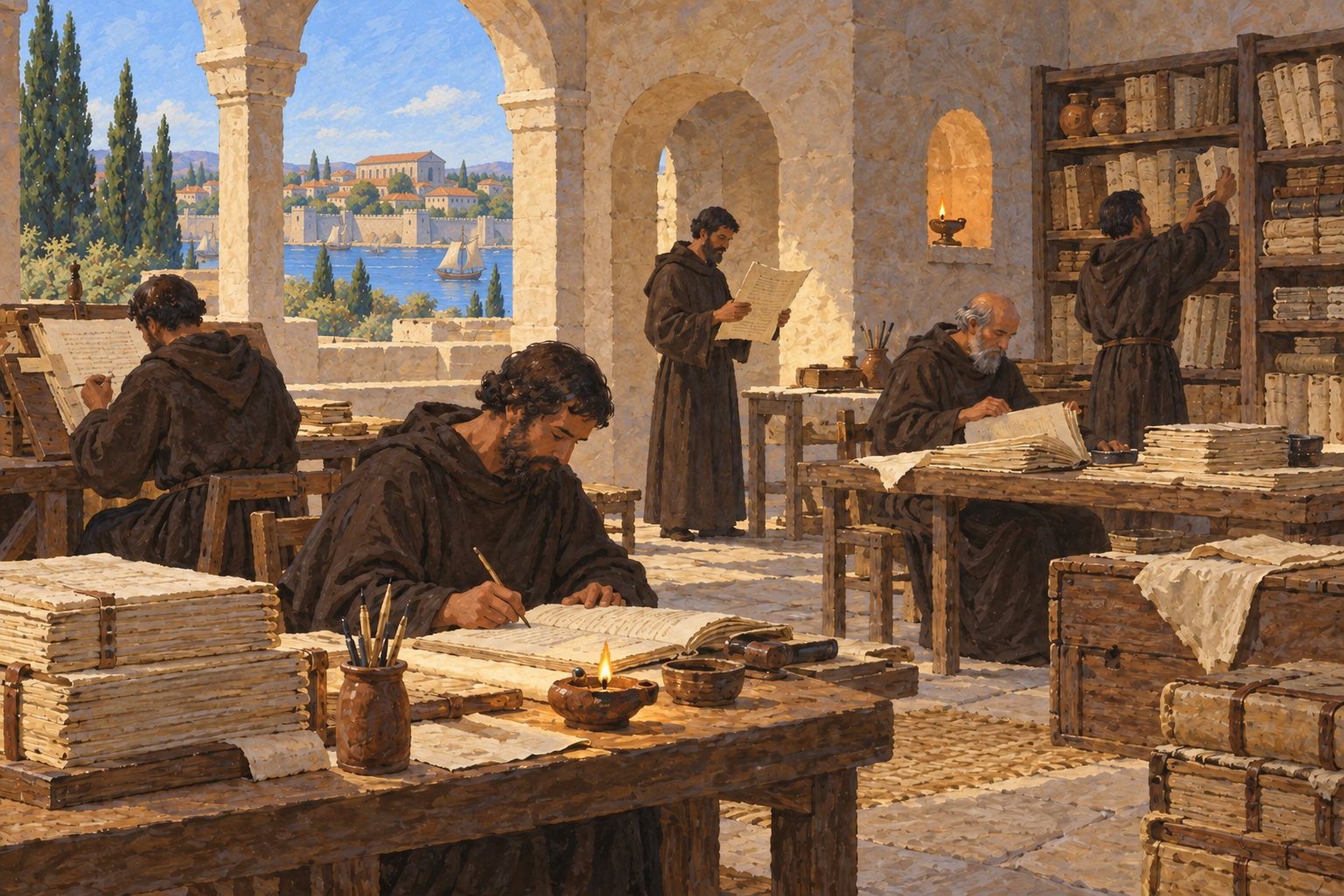
Books by commission. Constantine’s order to Eusebius for fifty parchment Bibles for the churches of Constantinople — professionally copied, in official carriages of the very post of two chapters ago — is the moment book production becomes state procurement; the order’s scale, and the survival of two great fourth-century pandect codices, shows the codex (inherited from the Early Christianity volume, whose machine it was) now backed by imperial money, and the workshop that would carry it after the money stopped was already forming: the monastic scriptorium.
Texts and authority
Minutes of the Meeting
A council was a meeting — travel warrants, an attendance list, a chair, procedure, shouted acclamations, published minutes — convened by the emperor and often steered by his commissioners; and even the list of which meetings count is itself a canon that closed differently in different churches: two for the Church of the East, three for the Oriental Orthodox, seven for the Chalcedonian East and West — so this movement treats the four great councils as what the record shows them to be, contested assemblies whose outcomes were not inevitable, rather than as milestones on a road that was always going to be walked.
The List Arrives in the Mail
The question the Early Christianity volume handed on — who had the authority to close the book-list — got its answer almost as an aside: the first list matching the modern 27-book New Testament arrives inside a bishop’s Easter circular of 367, regional councils at Hippo (393) and Carthage (397) ratify it for Africa, and no ecumenical council of this span ruled on the list at all; with an empire attached, the fight had moved from the bookshelf to the creedal formula — and the edges never fully hardened, because Revelation entered Eastern liturgical use slowly and the Ethiopian church keeps a broader canon to this day.
Institutions and resources
The Rent-Roll in the Popes’ Book
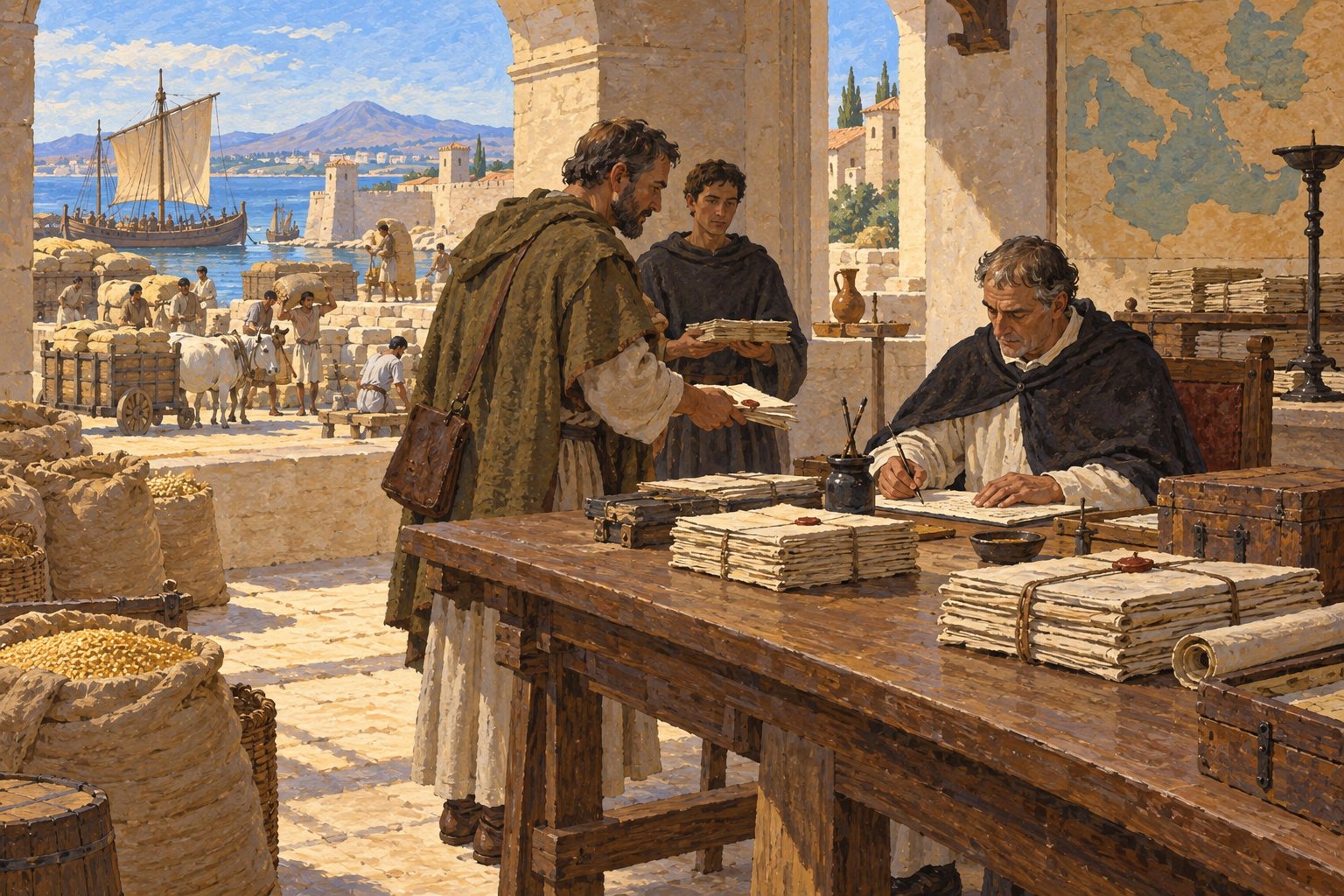
The Liber Pontificalis records the endowments of the Roman churches as itemised rent-rolls — estate by estate, with its location and its annual yield in solidi — one of the best-documented religious income statements to survive from the ancient world; the compilation is sixth-century and the fidelity of any given entry is contested, and read with that label it still shows what no narrative source does: a church whose income was land rent — denominated, recorded, and expected to continue for ever.
The Loophole in the Exemption
Clergy exemption from the ruinous obligations of town-council service made ordination financially attractive within a decade of legalisation — and the proof is not a moralist’s complaint but the legislation that tried to restrict it: laws barring the wealthy from taking orders, laws confining recruitment to men of slender fortune, and in 370 a law against clergy legacy-hunting, addressed to the bishop of Rome and ordered read aloud in the churches; the honest witness is Jerome, who wrote that he did not complain of the law but grieved that it had been deserved.
Explore the illustrations4 scenes · Grain for Rome
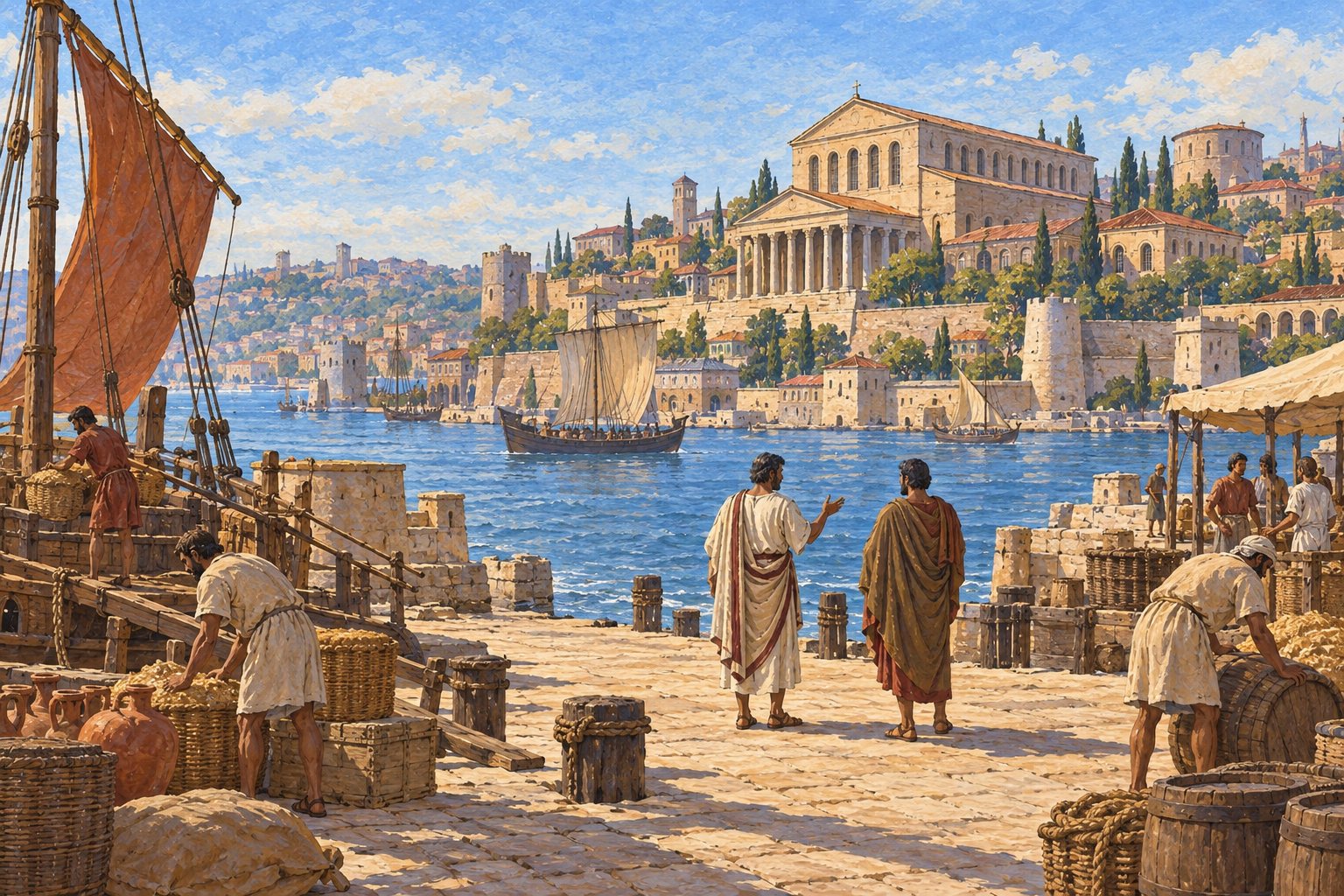
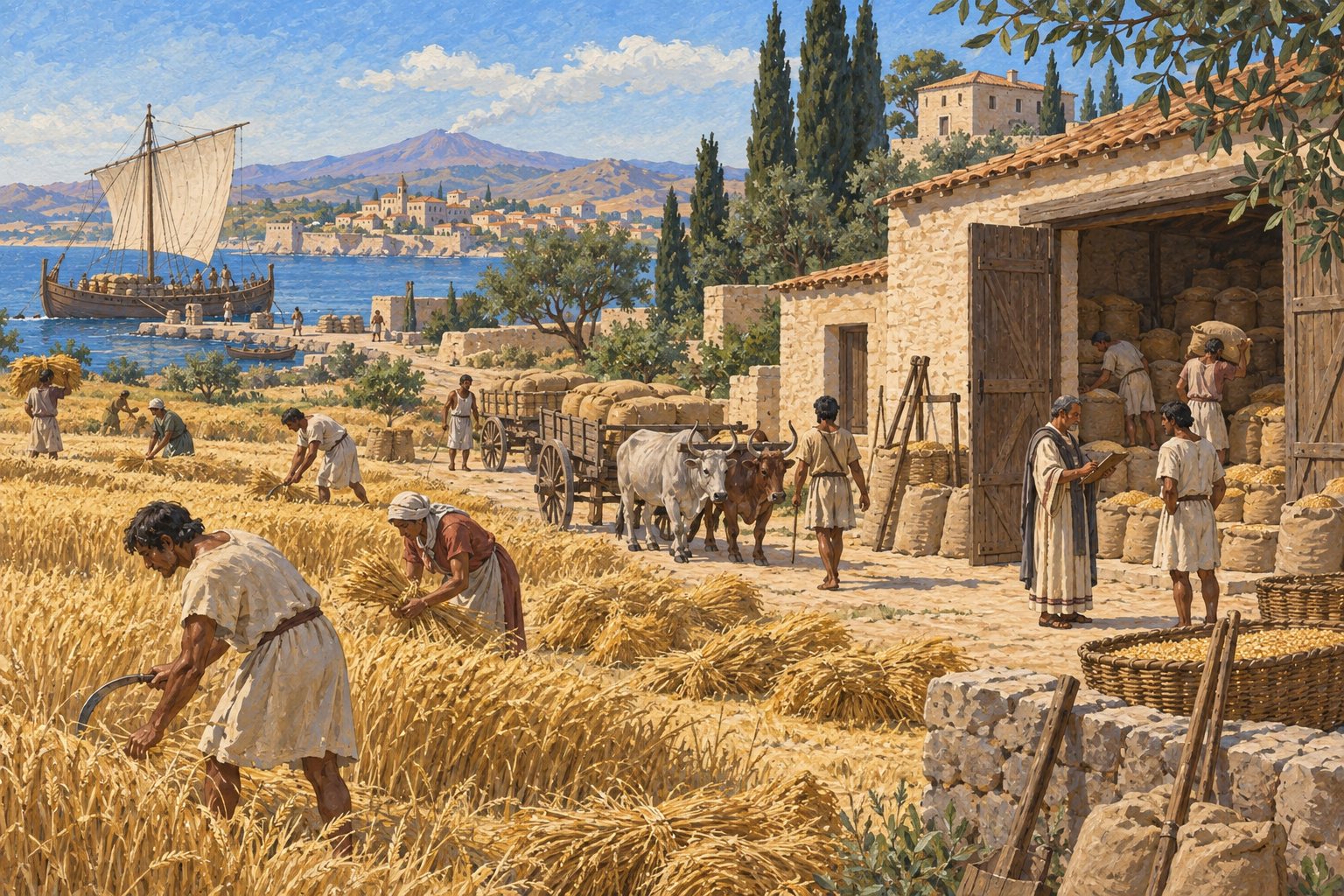
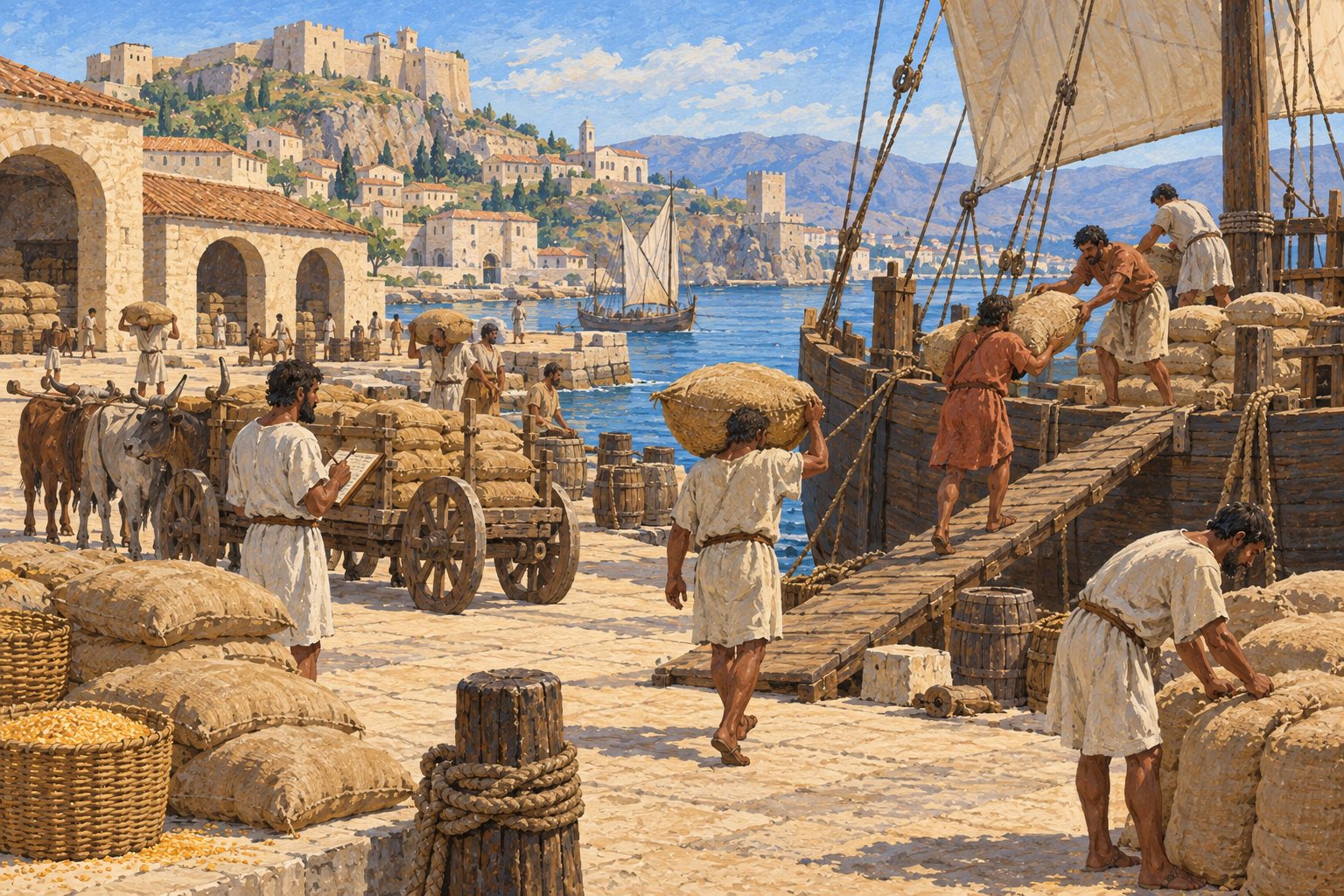
Grain for Rome. When the Western state failed, the church’s estates became the government’s successor: Gregory the Great’s letter-book shows the papal patrimony run as a working administration — rectors appointed over the Sicilian estates, grain shipped to a hungry city, rents audited, tenant farmers protected from unjust exactions by written instruction — the machine of this volume no longer borrowed but owned, and doing the state’s old job because no one else could.
Changes and divisions
The Churches That Said No
The split that lasted is Chalcedon’s: Egypt’s church refused the Definition and never accepted it — a break now six centuries older than the Roman–Byzantine schism and still unhealed — and the refusing communities are not a footnote but the living Coptic, Syriac, Armenian and Ethiopian churches, whose position this chapter states as they state it: the mia physis confession held as Cyril’s own orthodoxy, one incarnate nature of the Word, not a denial of Christ’s humanity — “Monophysite” is the opponents’ label, and the volume does not use an exonym as a name; the sequence from lynching to parallel hierarchy also contains the period’s most instructive smaller schism, Rome and Constantinople excommunicating each other for thirty-five years over a compromise document — and healing it, which is the control reading for 1054.
The Church Beyond the Border
The volume’s control case: the Church of the East ran the same religion on a different state’s machine — organised under the shah at Seleucia-Ctesiphon in 410 in a synod whose minutes survive, formally independent of “the Western fathers” from 424, doctrinally committed after 431 to the strict two-nature teaching its refugees carried east to the school of Nisibis — and it expanded along the trade routes to India, Central Asia and Tang China with no empire enforcing anything, which makes it the standing refutation of the assumption that this volume’s story is the only shape imperial-era Christianity could take.
Limits of the evidence
These limits are stated in the book before its argument.
- What Constantine believed His laws, letters, coins and buildings survive; his convictions are contested and stay that way in every chapter that touches them. The two accounts of the sign before the Milvian Bridge belong to the Early Christianity volume, which closes on them; this volume opens after the battle, with the paperwork.
- Whether any christological formula is true The series has no instrument for the question. Every position — Arius’s, Nestorius’s, Dioscorus’s, Leo’s — is stated as its holders stated it, and the losing side’s own words are used wherever they survive; where they survive only in hostile transmission, the sentence says so. The volume never implies an outcome was correct because it was the outcome.
- What conversion meant at street level once the law rewarded it The laws can be read; the motives of the millions who complied cannot. Sincerity is not a quantity this volume measures for anybody.
Sources and reading
This article brings together the series’ existing overview and chapter summaries. The linked book page provides the full outline and bibliography.
- Lactantius, On the Deaths of the Persecutors 48, William Fletcher, Ante-Nicene Fathersc. 314–315. the letter posted at Nicomedia on 13 June 313
- Eusebius, Church History 10.5–7, A. C. McGiffert, NPNFlast edition c. 324. Greek of the same letter; African restitution, the 3,000 folles, and the clergy exemption
- Sol Invictus bronze of Constantine (SOLI INVICTO COMITI)later 310s into the mid-320s. the sun still on the money after the bridge; last year contested
- Eusebius, Life of Constantine, E. C. Richardson, NPNFc. 337–339. deathbed baptism; Jerusalem building letter; Holy Apostles tomb; fifty-Bible order; “more than 250” at Nicaea
- Optatus of Milevis, appendix of imperial lettersmid-fourth century. the Donatist file as chancery paper
- Jerome, Chroniclec. 380. names Eusebius of Nicomedia as the baptiser
- Liber Pontificalis, life of Sylvester, Duchesne’s Latinsixth-century compilation; ed. 1886. Roman foundations; itemised rent-rolls, not audited accounts
- Constantine to Chrestus of Syracuse, in Eusebius, Church History 10.5.21–24314. the surviving travel warrant: bishop, two priests, three servants
Illustrations are newly generated interpretations of themes in the book. They are not surviving artifacts, historical photographs or evidence for the events described.