12 illustrations · 1:14
Watch & listen.
Follow the images with a narrated journey through the book.


Overview
- Coverage
- 610–661
- Earliest secure evidence
- 610 CE
- Transmission
- the standardised codex, and the memoriser
Between 610 and 661 a movement with no state, no treasury and no written scripture became an empire with all three. Most accounts of that half-century are biographies. This one is not. It asks the questions the series asks of every tradition in it: what carried this, who paid for it, what got written down, who had the authority to decide, and what finally divided it.
The coverage period and the earliest secure evidence are different dates. A tradition’s own account of its beginnings may differ from both.
Historical setting
The Sanctuary
Mecca’s economy was a truce with a market inside it — a haram where the sacred months suspended the feud so pilgrimage and trade could happen in the same place at the same time, and the family that administered the shrine ran the town.
The Caravan Question
Everyone agrees Quraysh ran caravans; what they carried, how far, and how rich it made them is contested — the incense-route picture and the leather-and-coarse-cloth picture are both on the table, and the chapter reports the fight rather than settling it.
Explore the illustrations4 scenes · The agricultural oasis
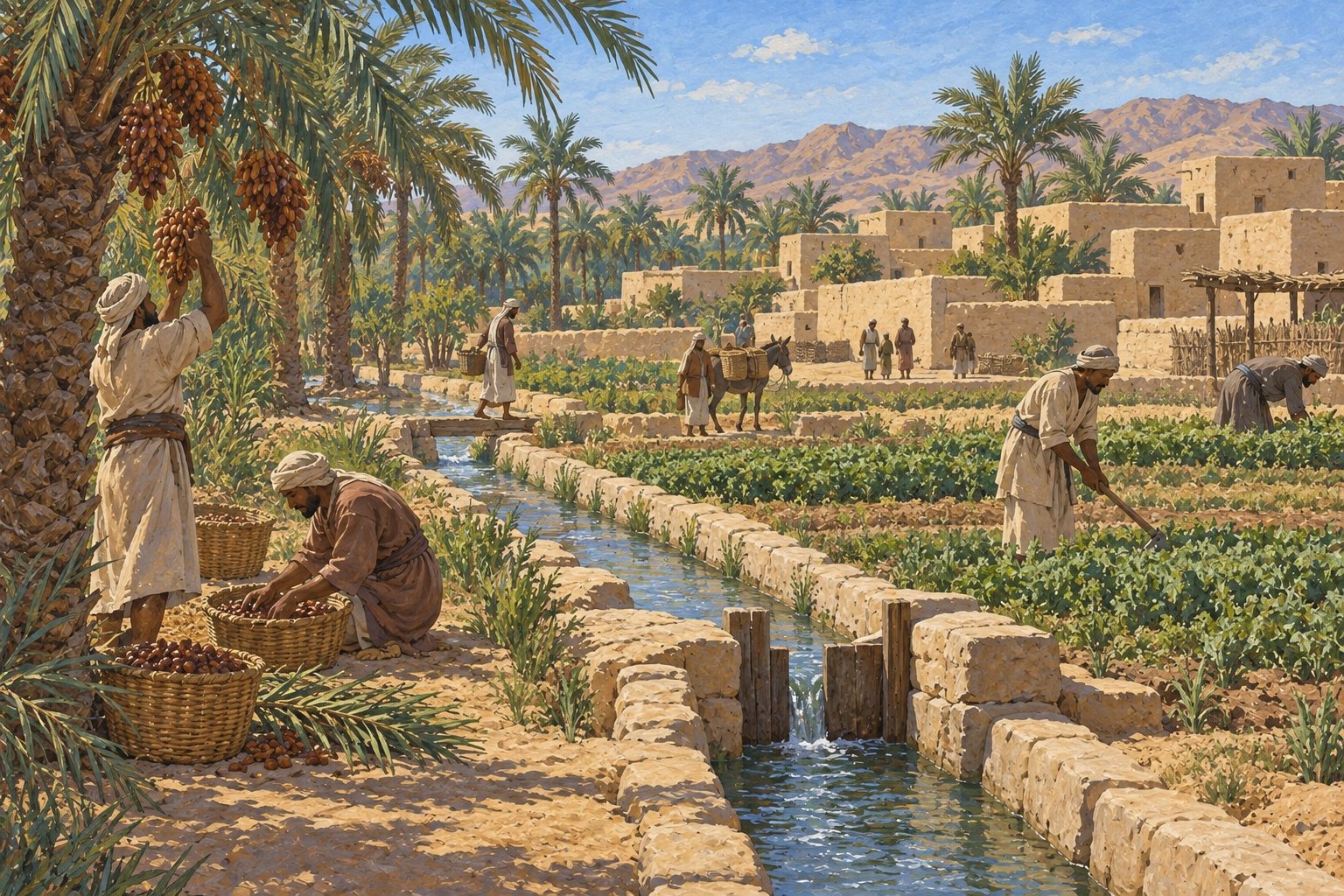
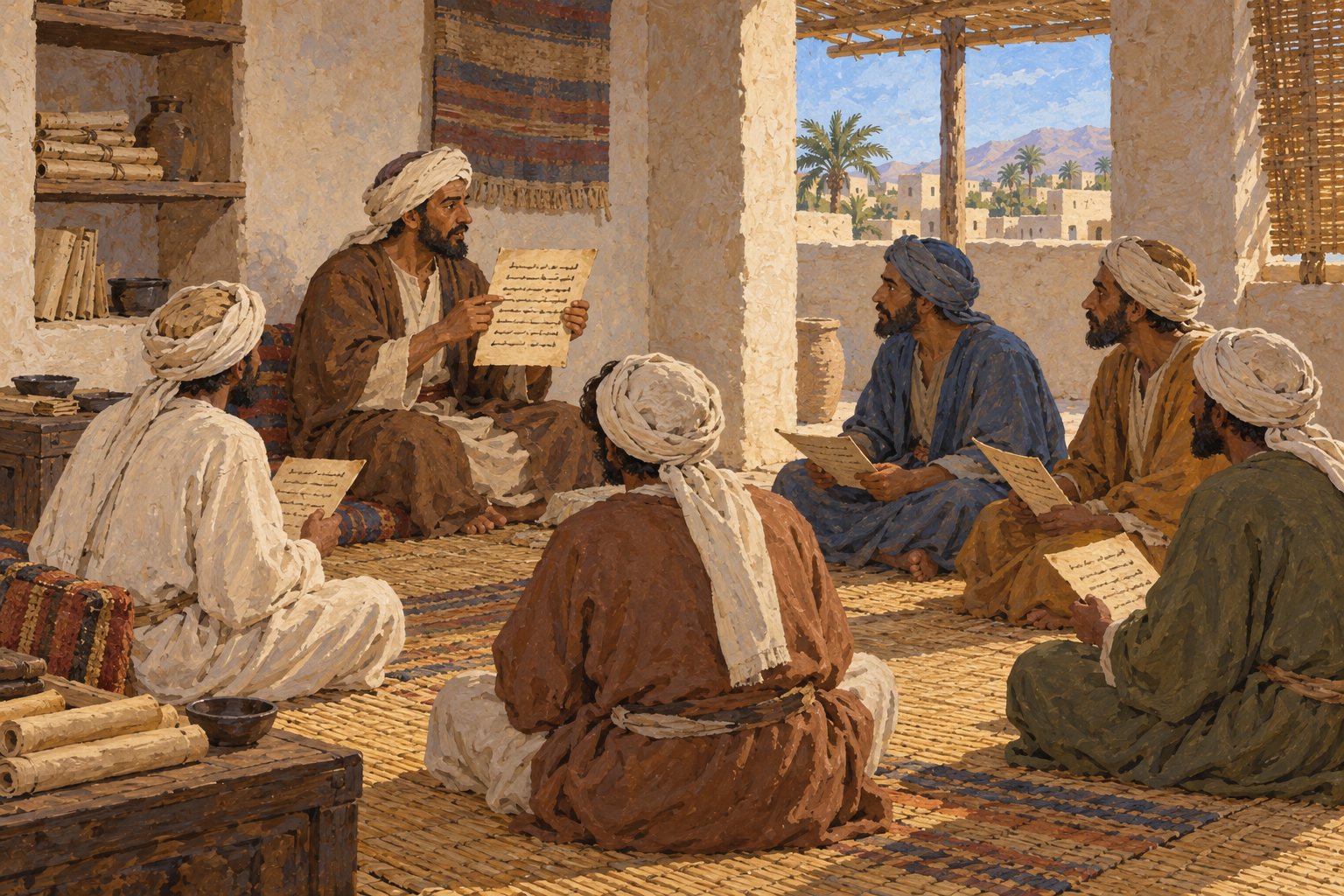
The agricultural oasis. Tribal law worked — blood-money, retaliation and sworn alliance instead of a state — but its unit was the kin group, and Medina in the 610s, an agricultural oasis whose clans had fought each other to a standstill (the tradition dates the last battle, Bu’ath, to about 617), shows what the system could not produce: a verdict both sides had to accept.
How it was transmitted
The Memoriser
The first storage medium was the trained human memory, organised — the huffaz carried the text as a licensed skill, the tradition’s own trigger-story for writing it down is the death of reciters in one battle (Yamama, 633), and the profession is no relic: the memorisation economy runs today, on chains of certification, and it is the reason the written page could afford to be incomplete.
A Skeleton of Consonants
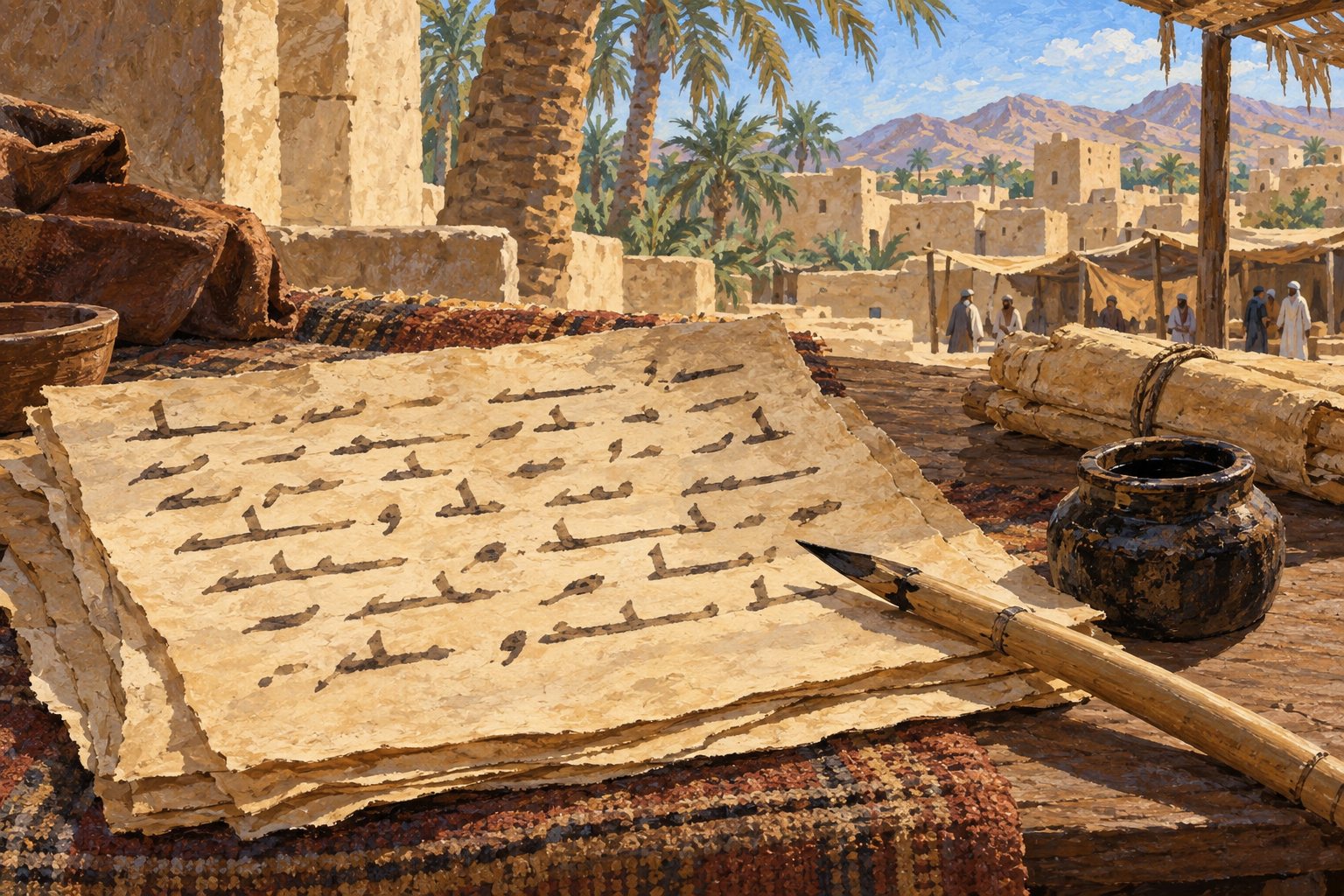
The earliest copies record consonants only — no vowels, few or no distinguishing dots, long vowels often unwritten — so the page could not tell a stranger how to read it and was never meant to: it was a support for a memorised recitation, not a replacement for one, and the script’s deficiencies are the system’s design.
Explore the illustrations4 scenes · Parchment and recitation
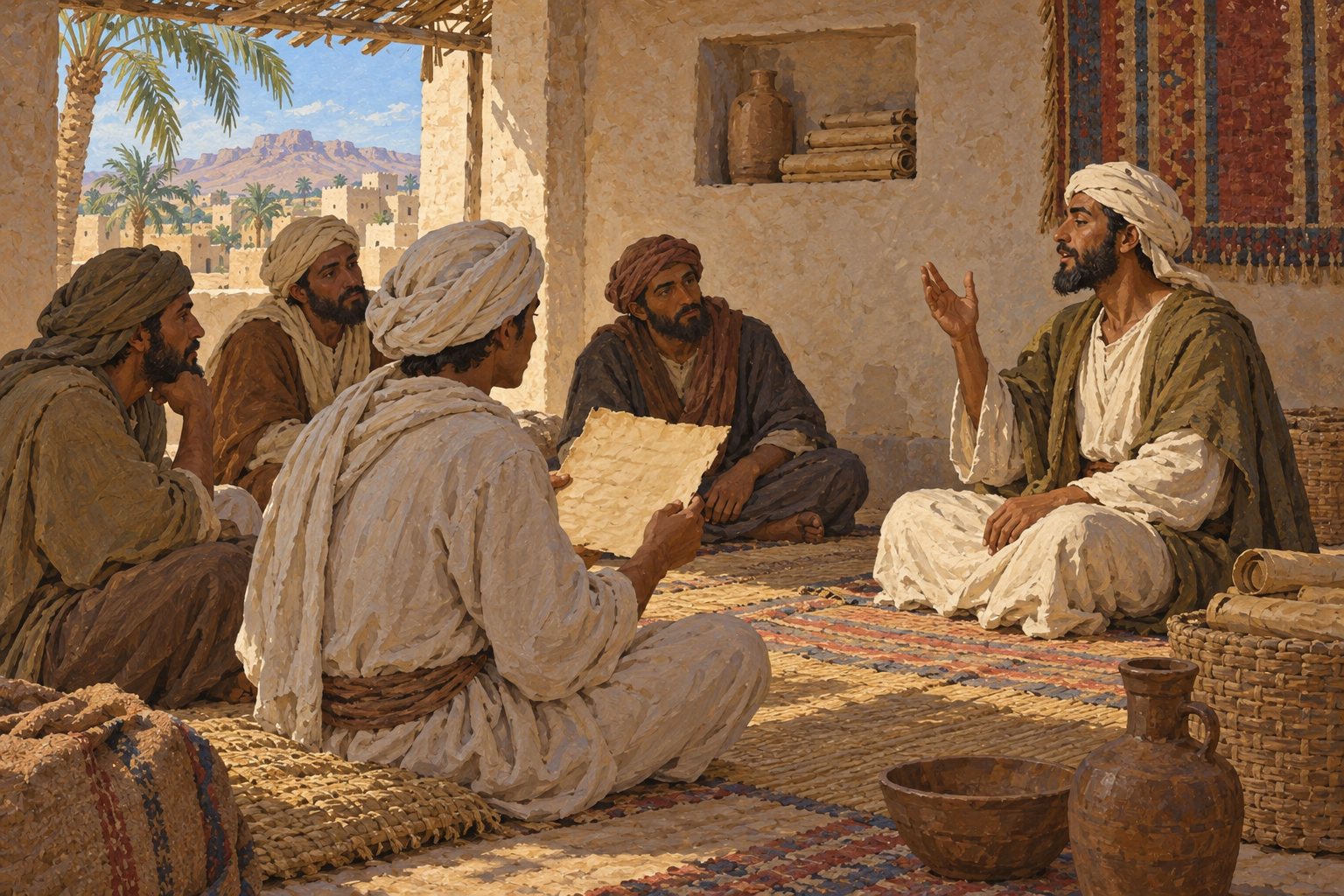
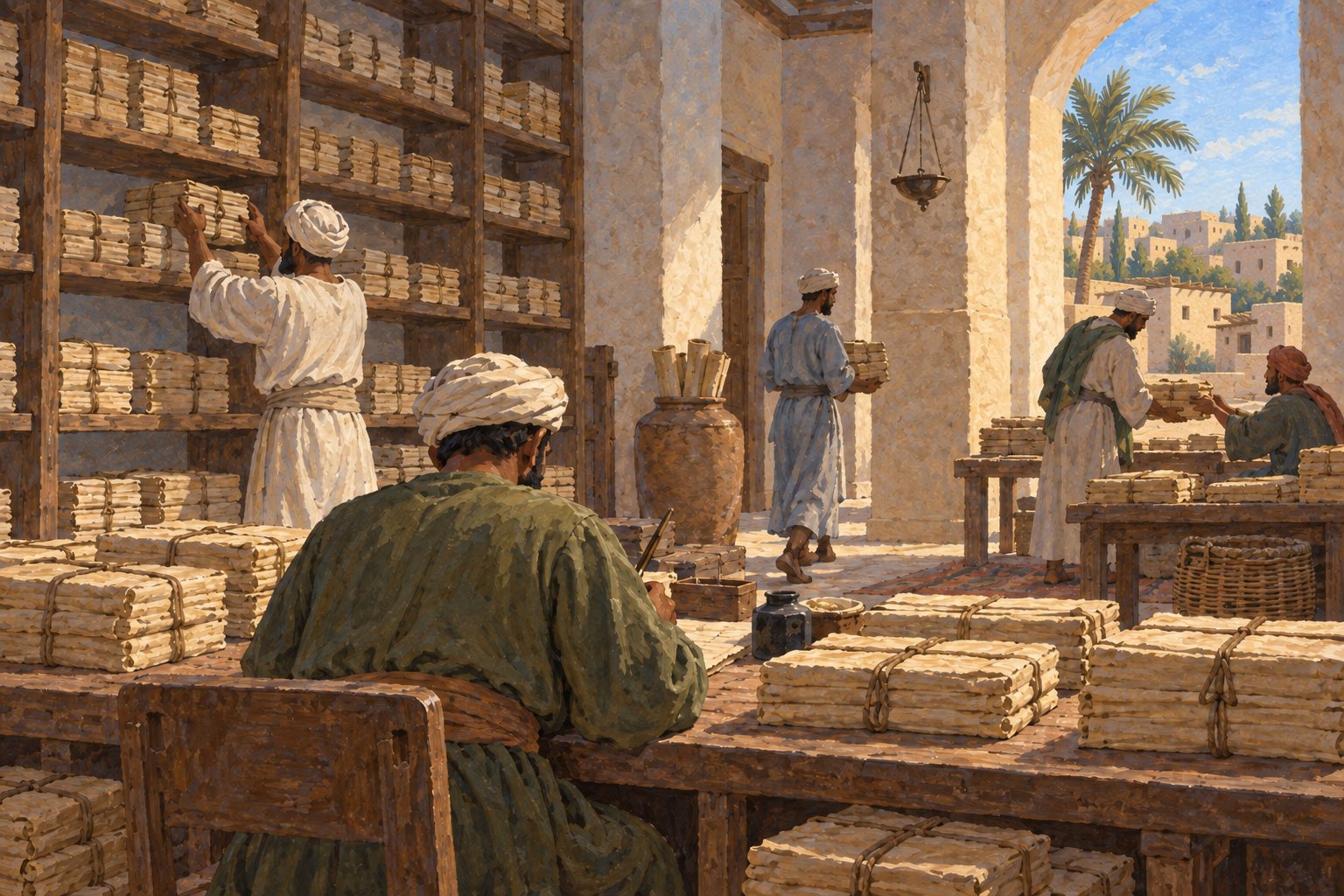
Parchment and recitation. The earliest copies record consonants only — no vowels, few or no distinguishing dots, long vowels often unwritten — so the page could not tell a stranger how to read it and was never meant to: it was a support for a memorised recitation, not a replacement for one, and the script’s deficiencies are the system’s design.
Texts and authority
What There Was to Close
At Muhammad’s death (conventionally dated 632) there was no book — the tradition’s own accounts inventory the text on palm-stalks, shoulder-blades and in the memories of men, and companions kept private codices that differed in order and, the reports say, in contents: Ibn Mas’ud’s lacked three suras of the now-standard text, Ubayy’s carried two extra.
The Caliph’s File Copy
The tradition holds that the first collection was made under Abu Bakr as sheets kept privately — passing to Umar and then to Umar’s daughter Hafsa, not to the treasury or the mosque — which is to say the community’s first complete text was an archival object, and no authority had yet been asserted over what people recited.
Institutions and resources
The Alms That Became a Tax
Zakat is paired with prayer throughout the Qur’an as the double mark of membership, but the text sets no rates — the familiar percentages are later jurists’ work, and the chapter says so — and under Muhammad, the tradition holds, it became something no Arabian shrine had had before: a levy collected by named agents, on behalf of a centre, from tribes that had submitted.
The Refusal
Within months of Muhammad’s death, tribes across the peninsula announced they would keep the prayer and stop the payment; the tradition calls what followed the apostasy wars, and its own operational detail says taxation — Abu Bakr is reported saying he would fight any who withheld so much as a hobbling-cord of what they had paid — so the community’s first war was, on the tradition’s own telling, a tax enforcement action.
Explore the illustrations4 scenes · The stipend register
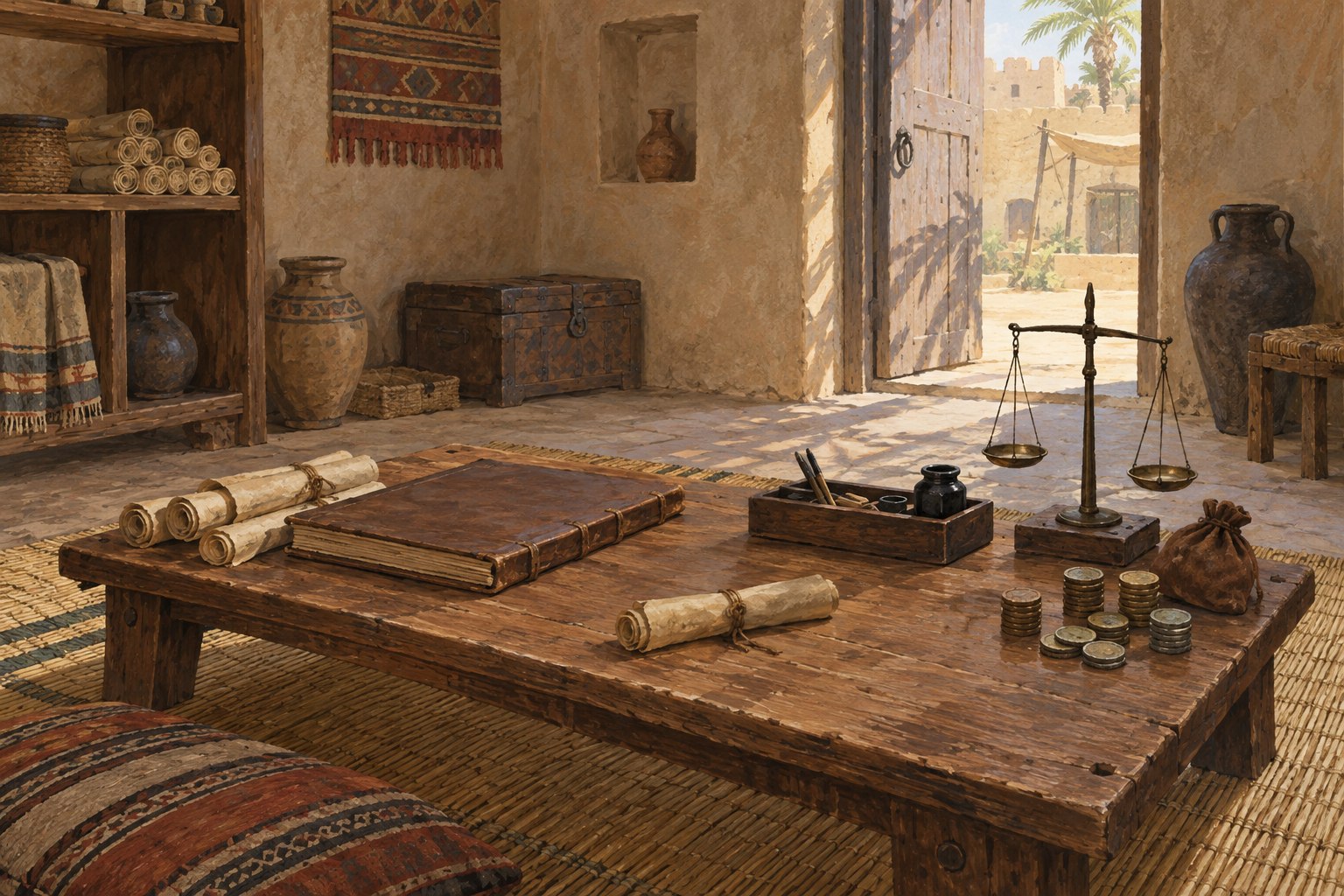
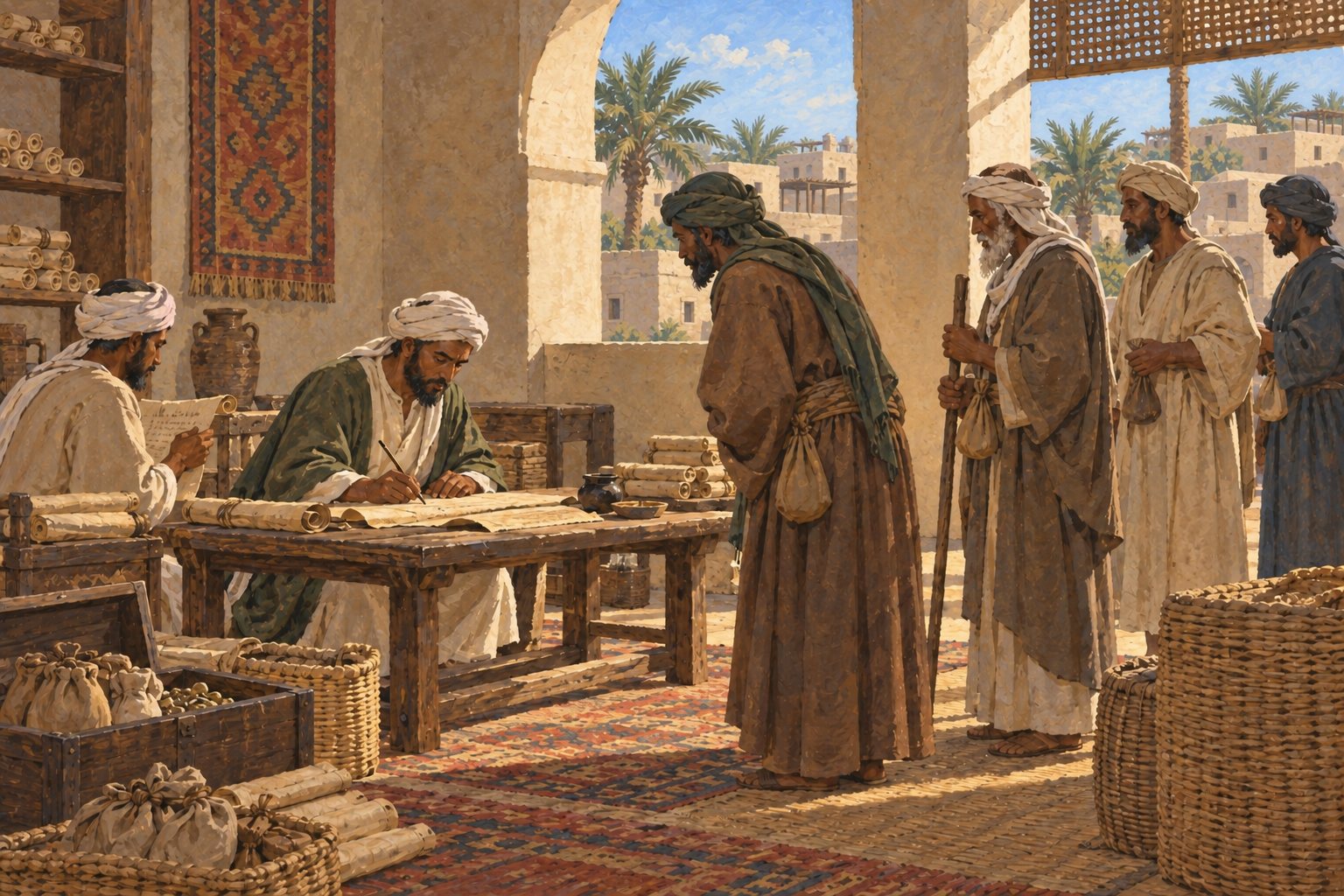
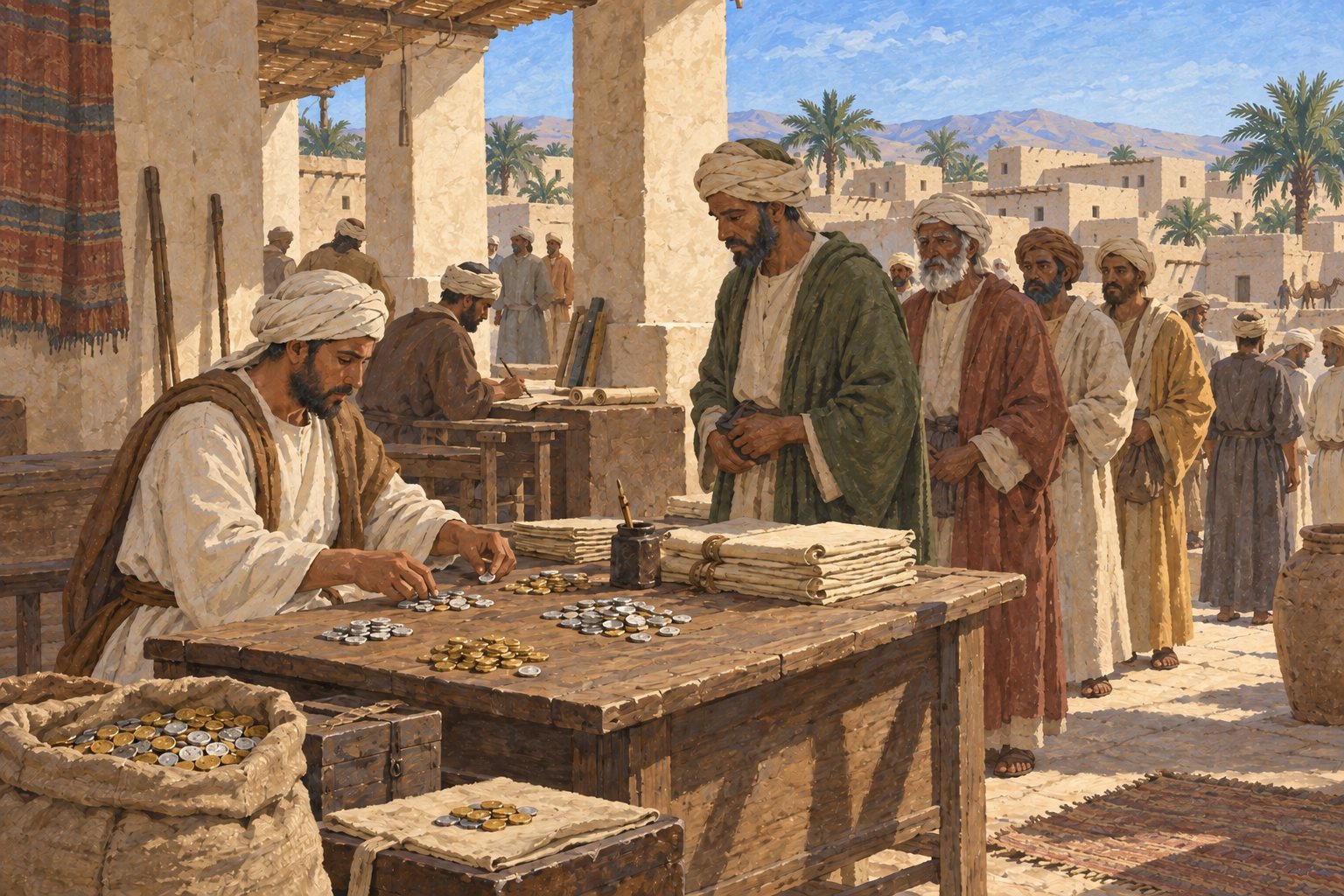
The stipend register. Conquest pay was systematised, the tradition holds, under Umar in about 641 as the diwan — a register of stipends ranked not by tribe or wealth but by precedence in the faith, with Muhammad’s widows at the head of the scale — so that within a decade of the founder’s death, piety had a payroll and seniority in belief was a class system with a cash value.
Changes and divisions
The Meeting in the Portico
Muhammad left no surviving written designation of a successor; the choice was made at an unminuted gathering in a Medinan portico on, the tradition holds, the day of his death — and the contradictory reports of it, plus the Ghadir Khumm addresses months earlier, which all parties transmit and each side reads as settling the matter its own way, became the texts over which the community would divide.
Blood on the Codex
In June 656 the caliph who had standardised the scripture was besieged in his own house by Muslims and killed — the tradition says while reading his codex — and the grievance lists against him (kinsmen appointed, revenue steered, codices burned) survive only in words written down under regimes and sects that were parties to the quarrel that followed.
Limits of the evidence
These limits are stated in the book before its argument.
- What was recited in Mecca in 610, or what stood in anyone’s memory in 632 The manuscripts show that a stable consonantal text existed extremely early; they cannot reach behind their own parchment. (This is the volume’s signature limit and it is stated inside Movement Two, not saved for a coda.)
- Pre-Islamic Mecca from contemporary evidence No datable pre-Islamic text names the city — the equation with Ptolemy’s “Macoraba” is contested — and the earliest surviving description of its sanctuary economy is al-Azraqi’s, from the mid-ninth century.
- The life of Muhammad beyond a hard minimum Near-contemporary outsiders establish that by 634 an Arab movement with a prophet existed, and Greek and Syriac writers knew his name within a decade; the connected biography is Ibn Ishaq’s, more than a century after the events, surviving only in a recension whose editor states he cut material.
Sources and reading
This article brings together the series’ existing overview and chapter summaries. The linked book page provides the full outline and bibliography.
- al-Azraqi, Akhbar Makkamid-ninth century. earliest surviving description of Mecca’s sanctuary economy
- Ian D. Morris, “Mecca and Macoraba,” al-'Usur al-Wusta2018. the contested equation of Mecca with Ptolemy’s Macoraba
- Qur’an, Sura 2:198, Marmaduke Pickthall, The Meaning of the Glorious Koran1930. permission to trade during the pilgrimage
- W. Montgomery Watt, Muhammad at Mecca1953. the standard trade-republic picture of Quraysh
- Patricia Crone, Meccan Trade and the Rise of Islam1987. demolition of the incense-route picture
- Qur’an, sura of Quraysh, Pickthall1930. the two named winter and summer caravan journeys
- Ibn Ishaq, Sirat Rasul Allah, in Ibn Hisham’s recensionIbn Ishaq d. 767; Ibn Hisham d. 833. the connected biography; the editor’s preface that he omitted material
- al-Bukhari, chapters on the collection of the Qur’ancompiled 9th c.. Yamama deaths and Zayd ibn Thabit’s commission
Illustrations are newly generated interpretations of themes in the book. They are not surviving artifacts, historical photographs or evidence for the events described.