17 illustrations · 1:57
Watch & listen.
Follow the images with a narrated journey through the book.



Overview
- Coverage
- 692 CE–present
- Earliest secure evidence
- 692 CE
- Transmission
- transmission by demolition
Kuroda Toshio argued in 1981 that kami worship lived inside a combined kami-buddha system for over a thousand years, and that “Shinto” as an independent religion is a medieval construction at the earliest and substantially a Meiji one. His critics answer that shrines, rites and myths form a continuous braid worth the name even without a self-conscious -ism. This book reports the thesis, reports the critics, and settles nothing.
The coverage period and the earliest secure evidence are different dates. A tradition’s own account of its beginnings may differ from both.
Historical setting
The Island of Offerings
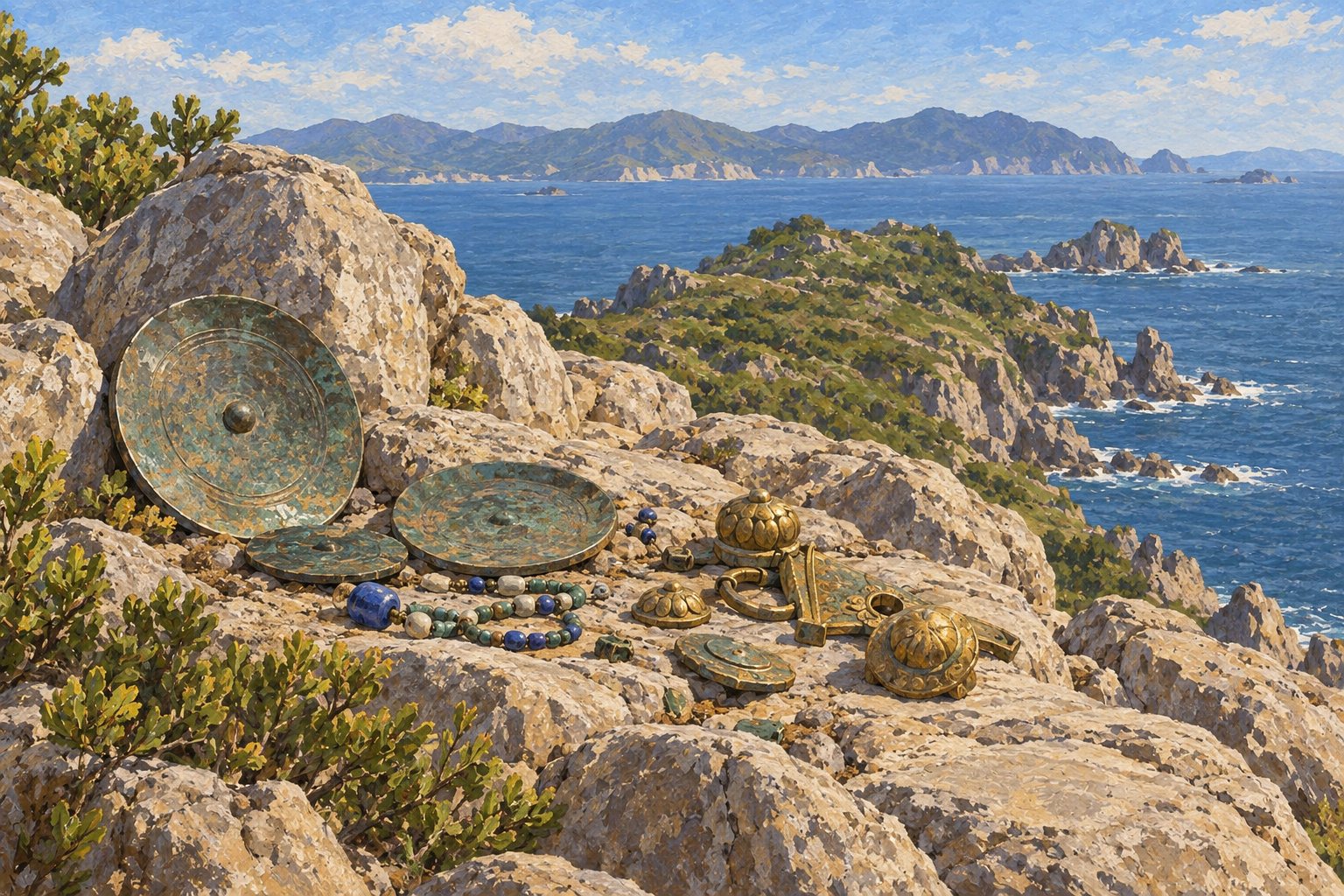
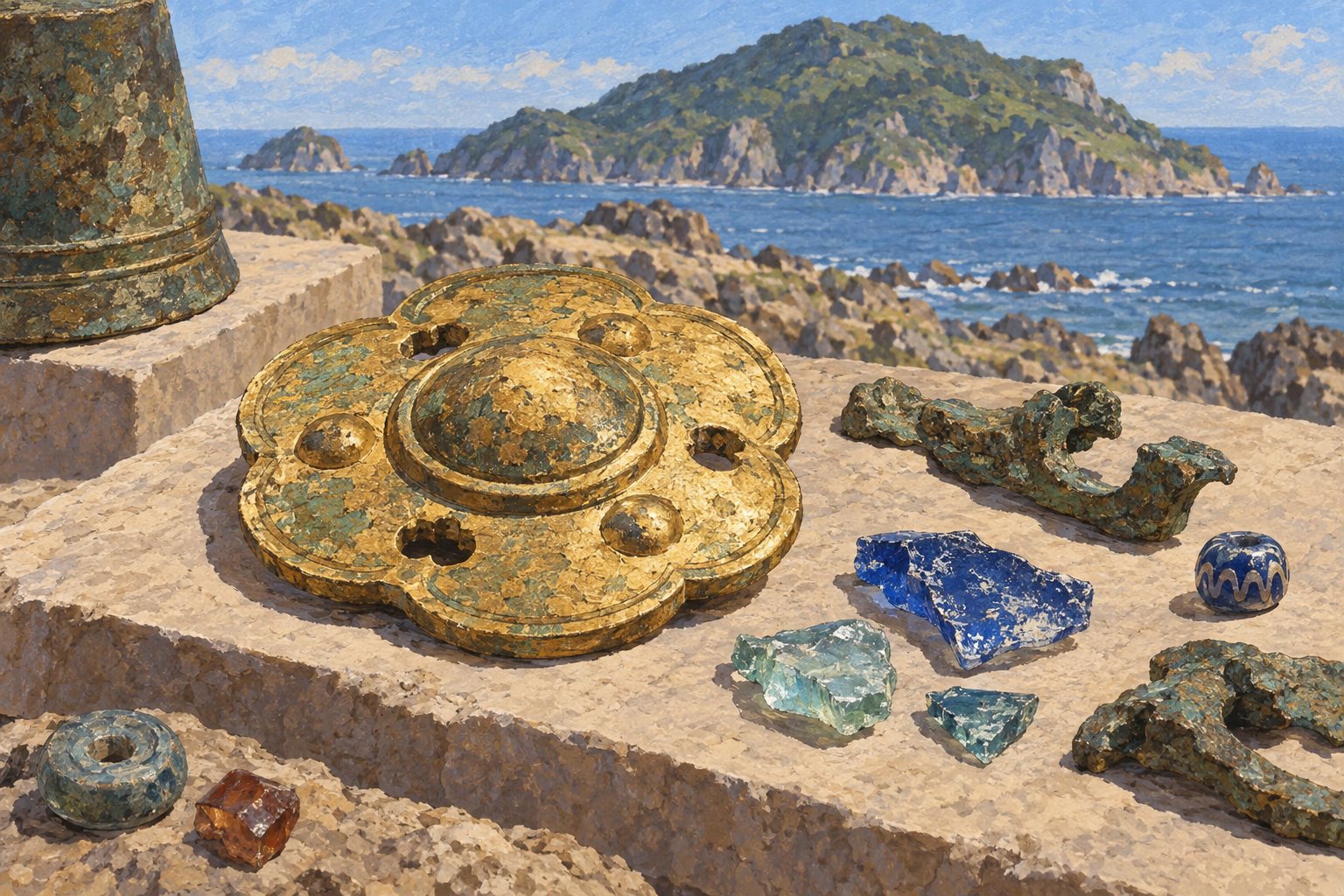
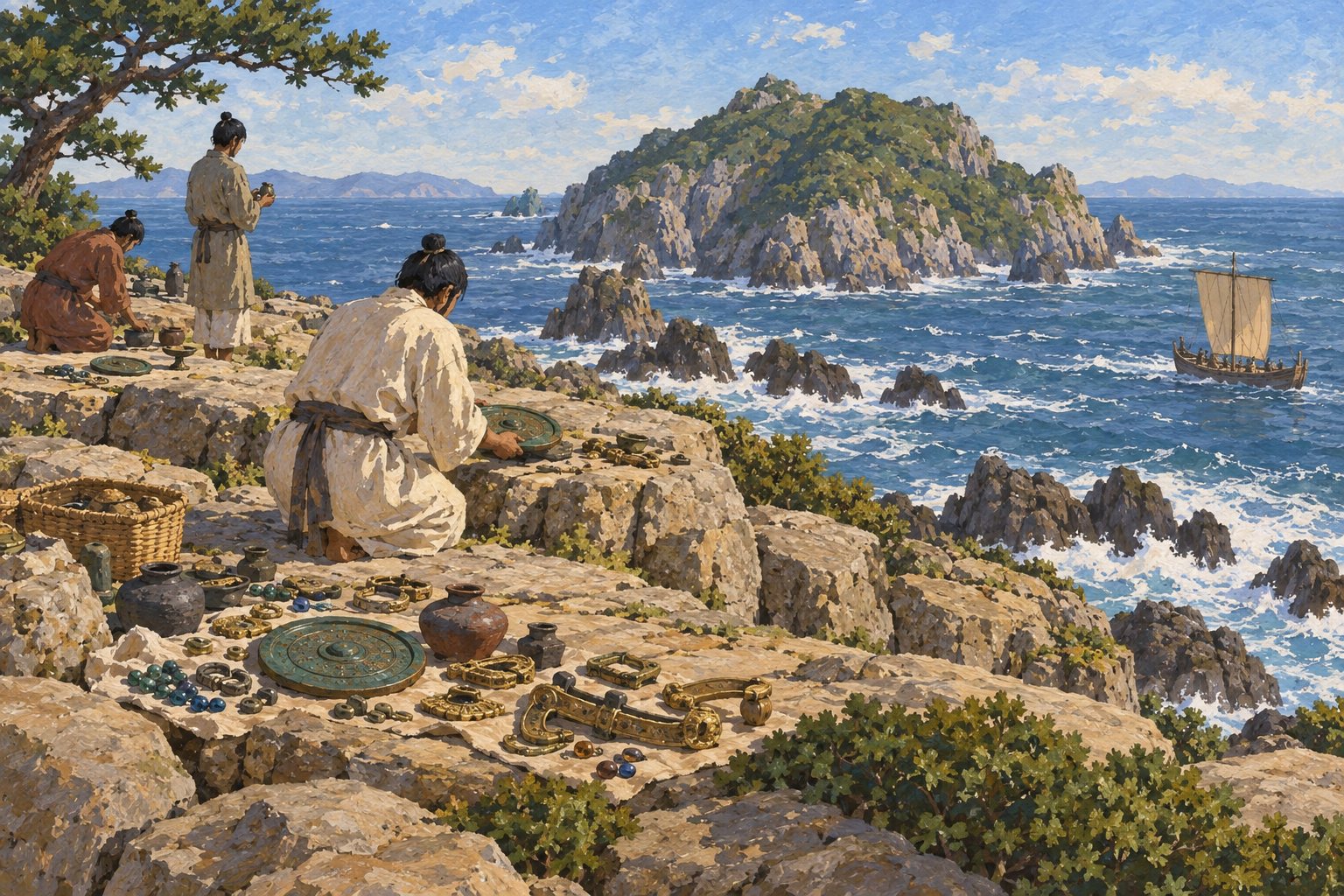
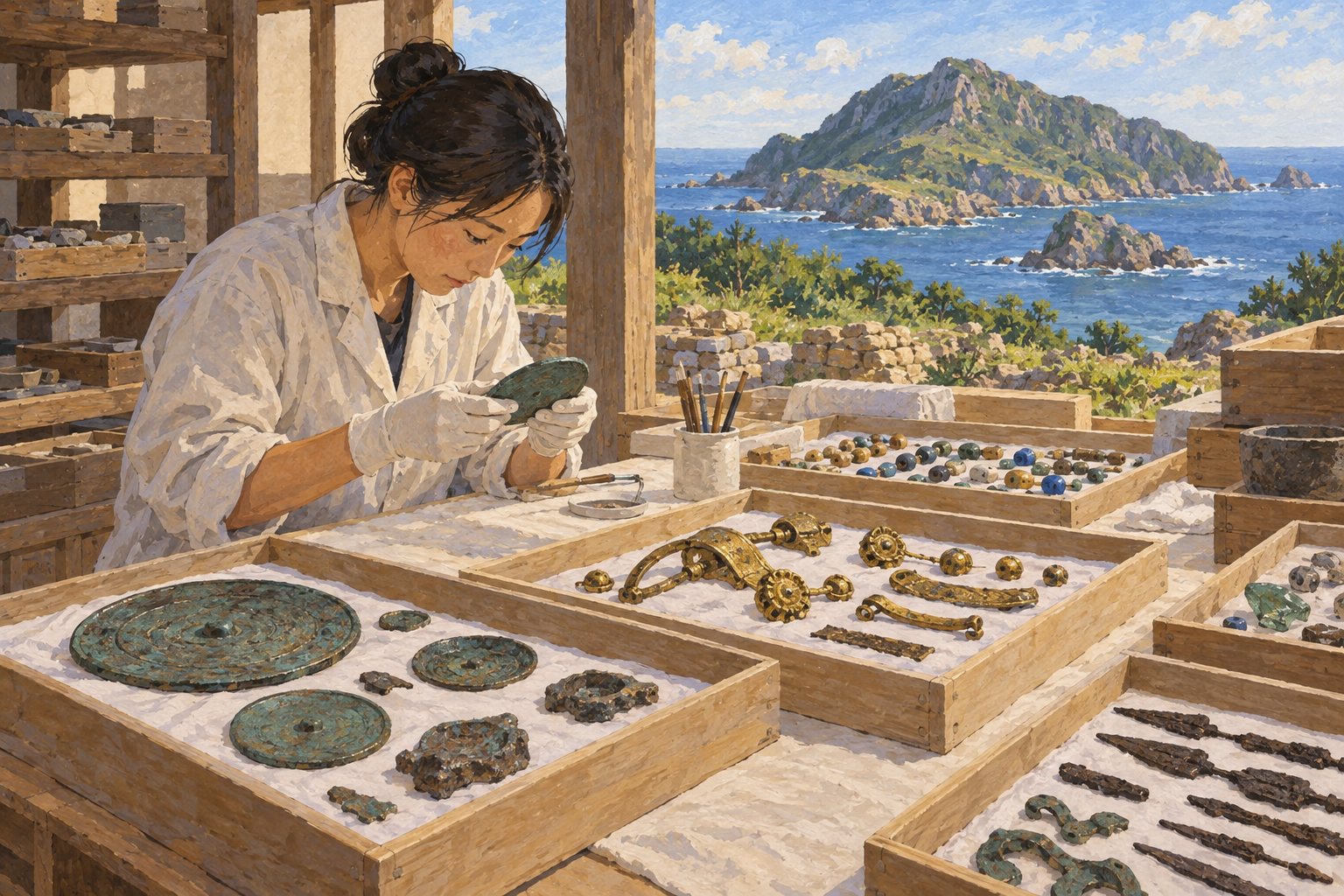
The record starts as objects on the ground: on Okinoshima, an uninhabited island in the Korea Strait, roughly 80,000 artefacts — mirrors, gilt-bronze horse trappings, glass from as far west as Persia — were deposited at open-air ritual sites over some five centuries, from about the fourth century to the ninth, with no text anywhere; this is what kami veneration looks like before anyone writes it down, and the volume’s span line is where the record starts, not where the practice does.
The Queen in the Chinese Record
The earliest written witness to ritual in the archipelago is foreign: a Chinese dynastic history compiled before 297 CE describes the country of Wa, its unmarried queen Himiko who — in the chronicle’s words — occupied herself with spirit-arts, and her seclusion, attendants and great mounded tomb; what the archipelago’s own soil adds is mute and rich — bronze bells buried in hillsides by the hundred for no recorded reason, Chinese mirrors in tombs, and the giant keyhole mounds — and where Yamatai itself stood is contested, and has been for three hundred years.
Explore the illustrations5 scenes · Island offerings
Island offerings. The record starts as objects on the ground: on Okinoshima, an uninhabited island in the Korea Strait, roughly 80,000 artefacts — mirrors, gilt-bronze horse trappings, glass from as far west as Persia — were deposited at open-air ritual sites over some five centuries, from about the fourth century to the ninth, with no text anywhere; this is what kami veneration looks like before anyone writes it down, and the volume’s span line is where the record starts, not where the practice does.
How it was transmitted
The Twenty-Year Clock
Ise Jingu is demolished and rebuilt on an adjacent, identical plot every twenty years — the empty twin site always visible beside the standing shrine — a practice conventionally dated to 690 for the Inner Shrine and 692 for the Outer, performed for the sixty-second time in 2013 and next due in 2033; and the arithmetic is itself the history, because sixty-two cycles by 2013 do not fit twenty-year spacing from 690: the record shows lapses of more than a century during the civil wars, and the shrine’s claim of unbroken rhythm is the institution’s own framing, printed here beside the gaps.
The Carpenter Is the Archive
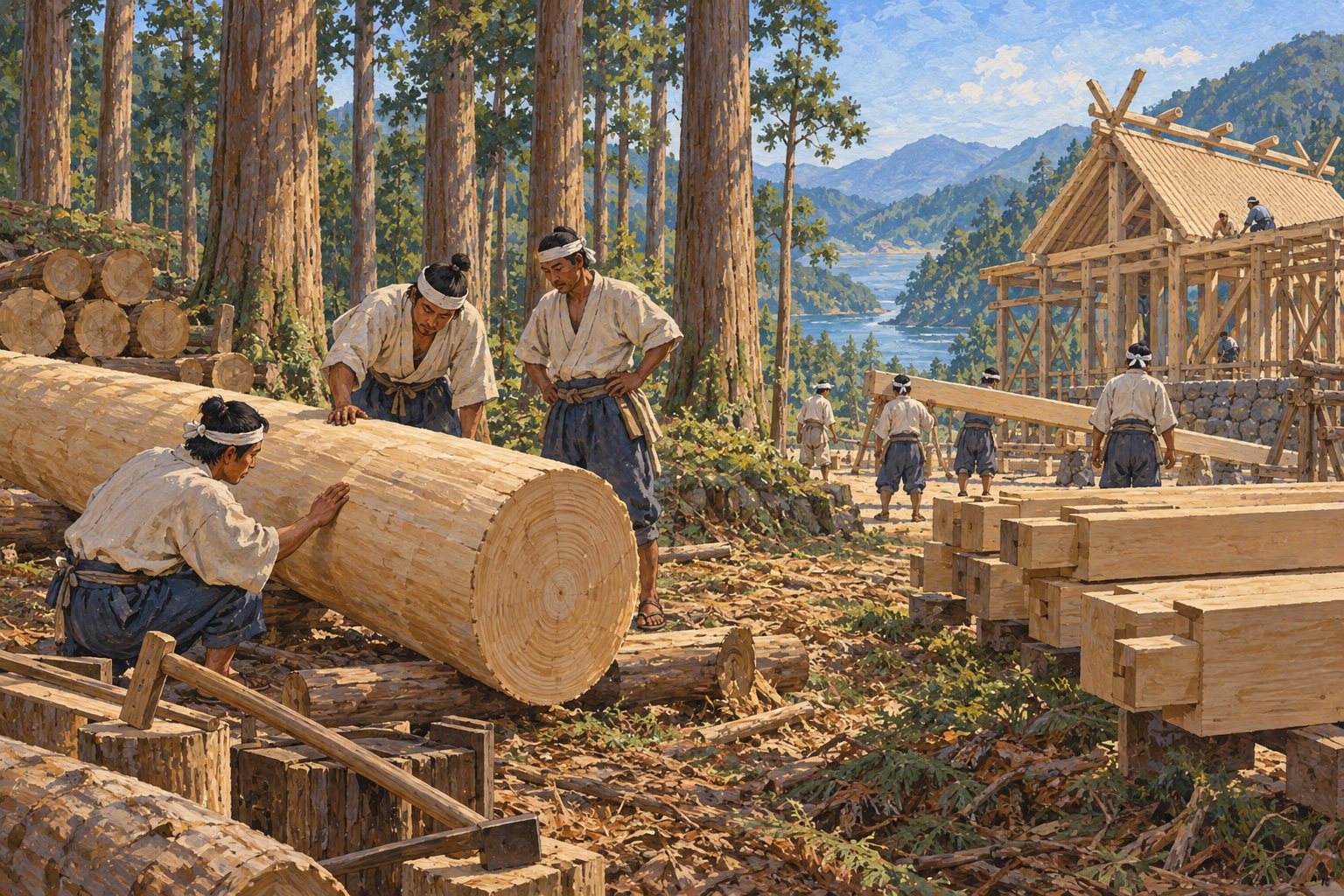
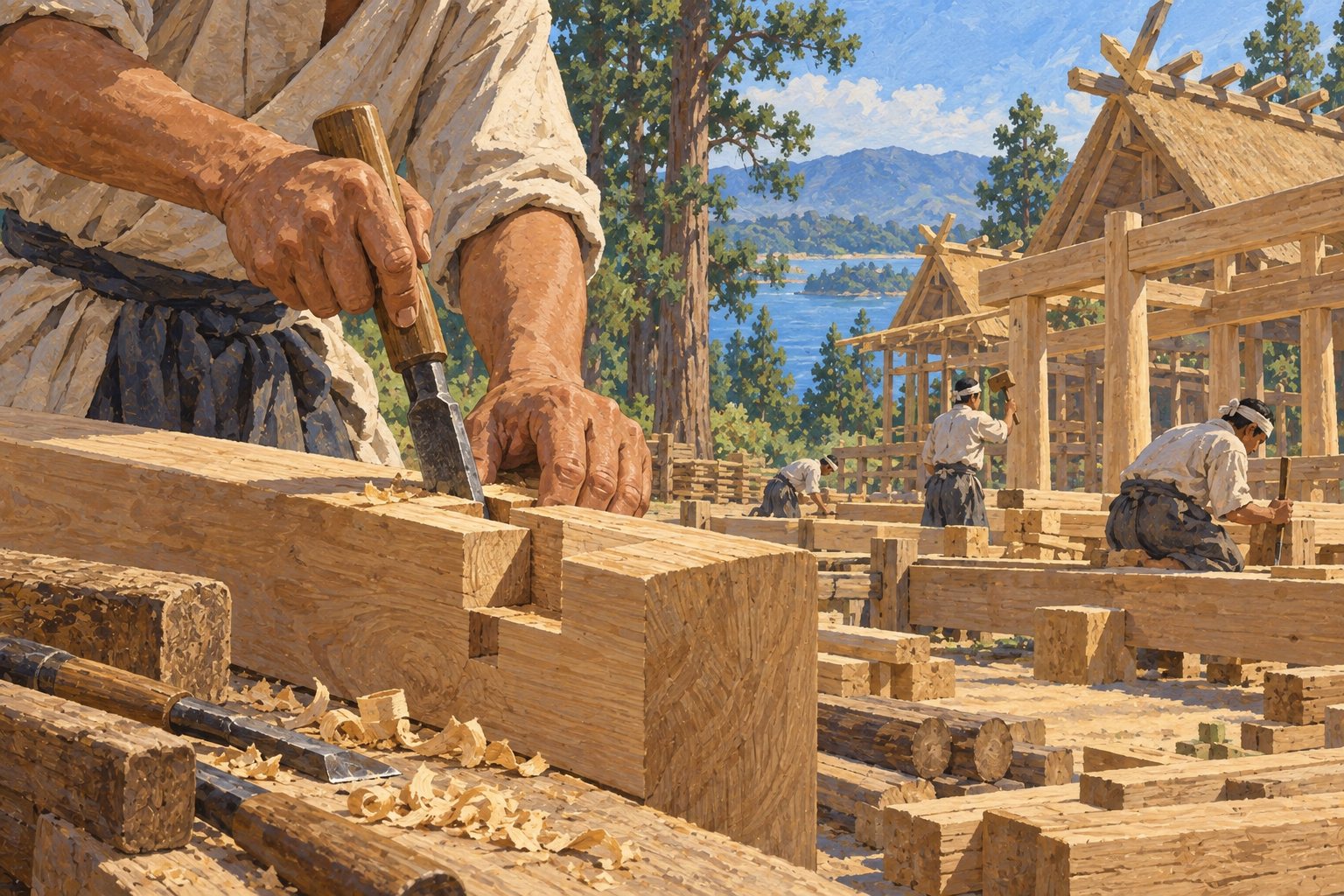
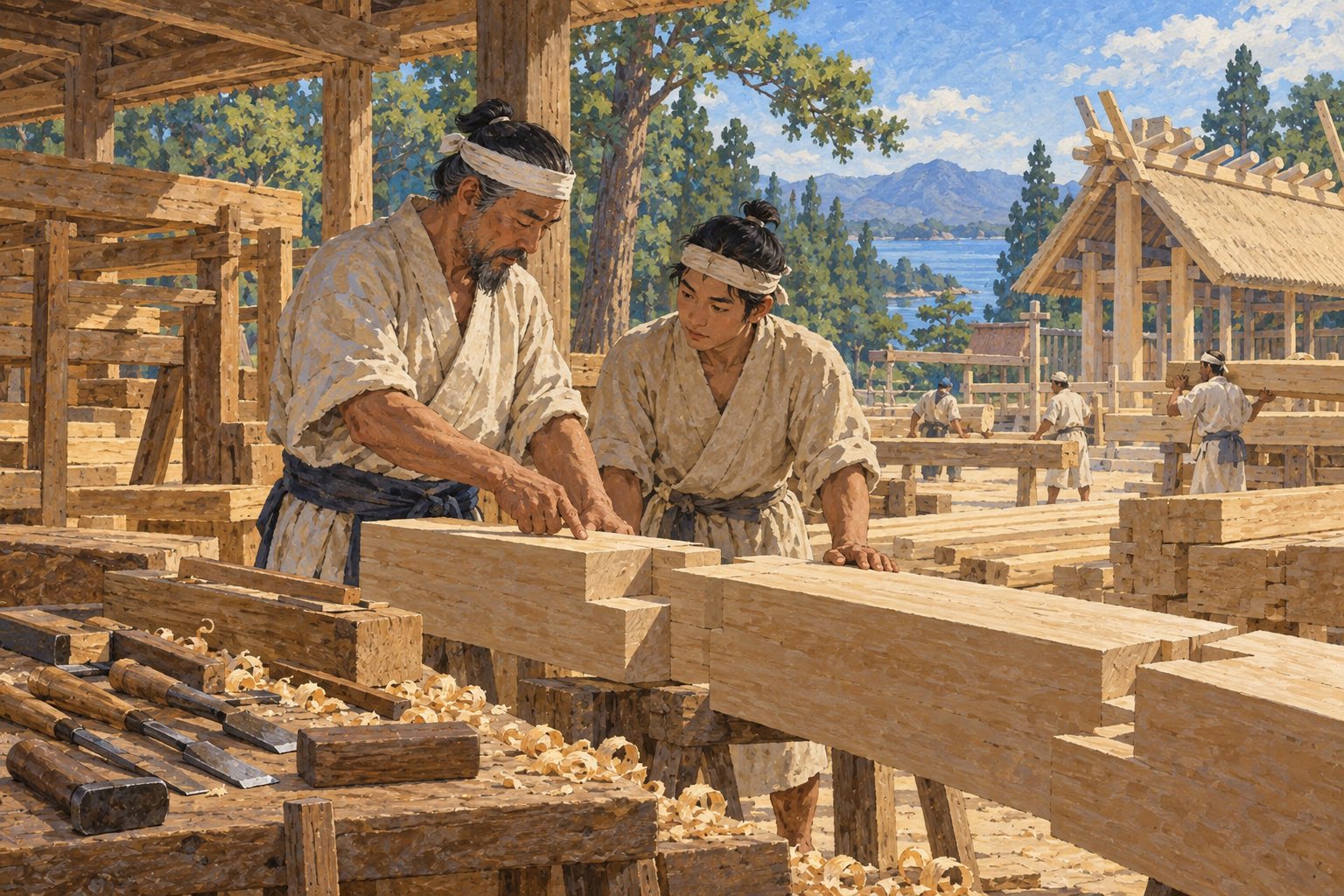
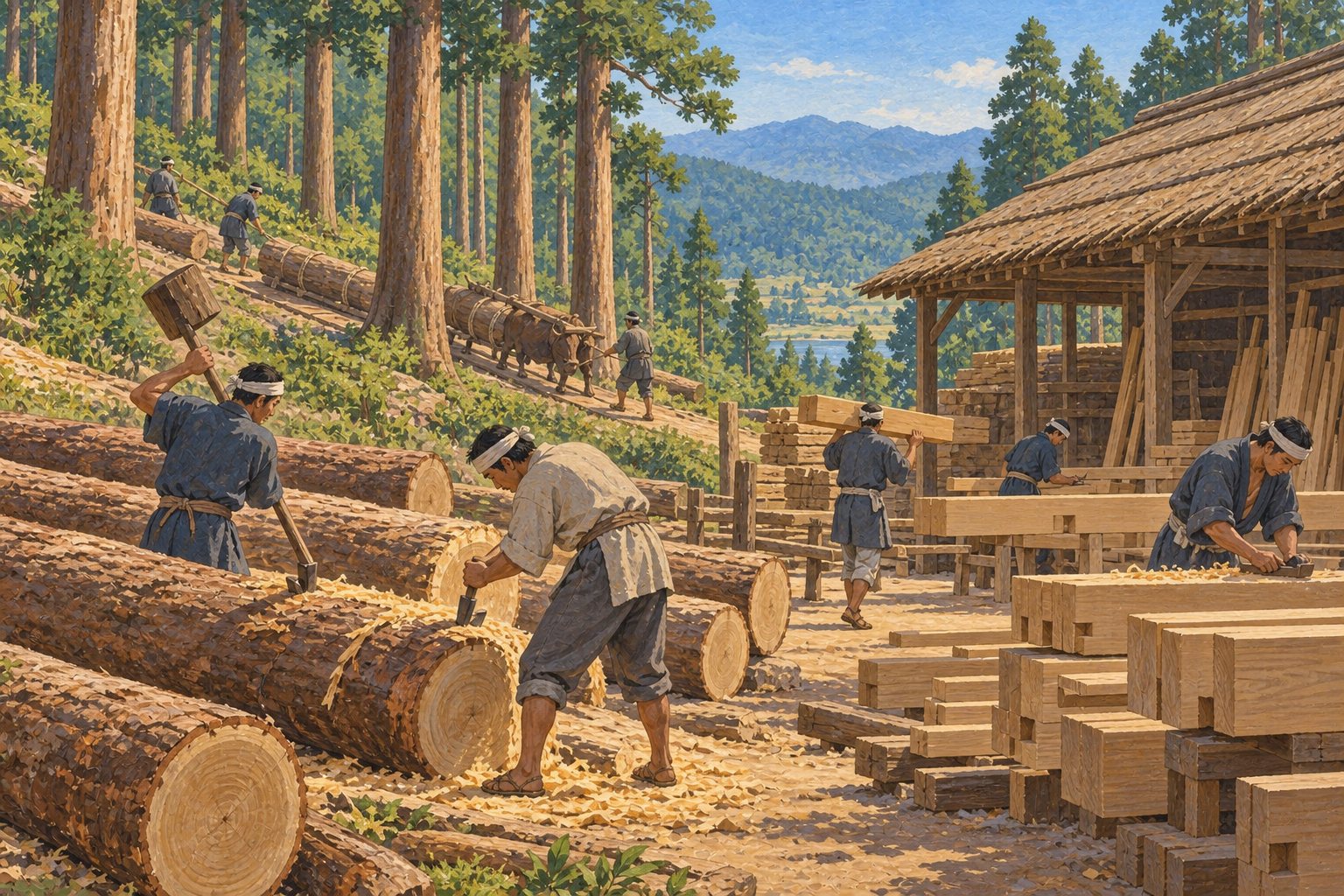
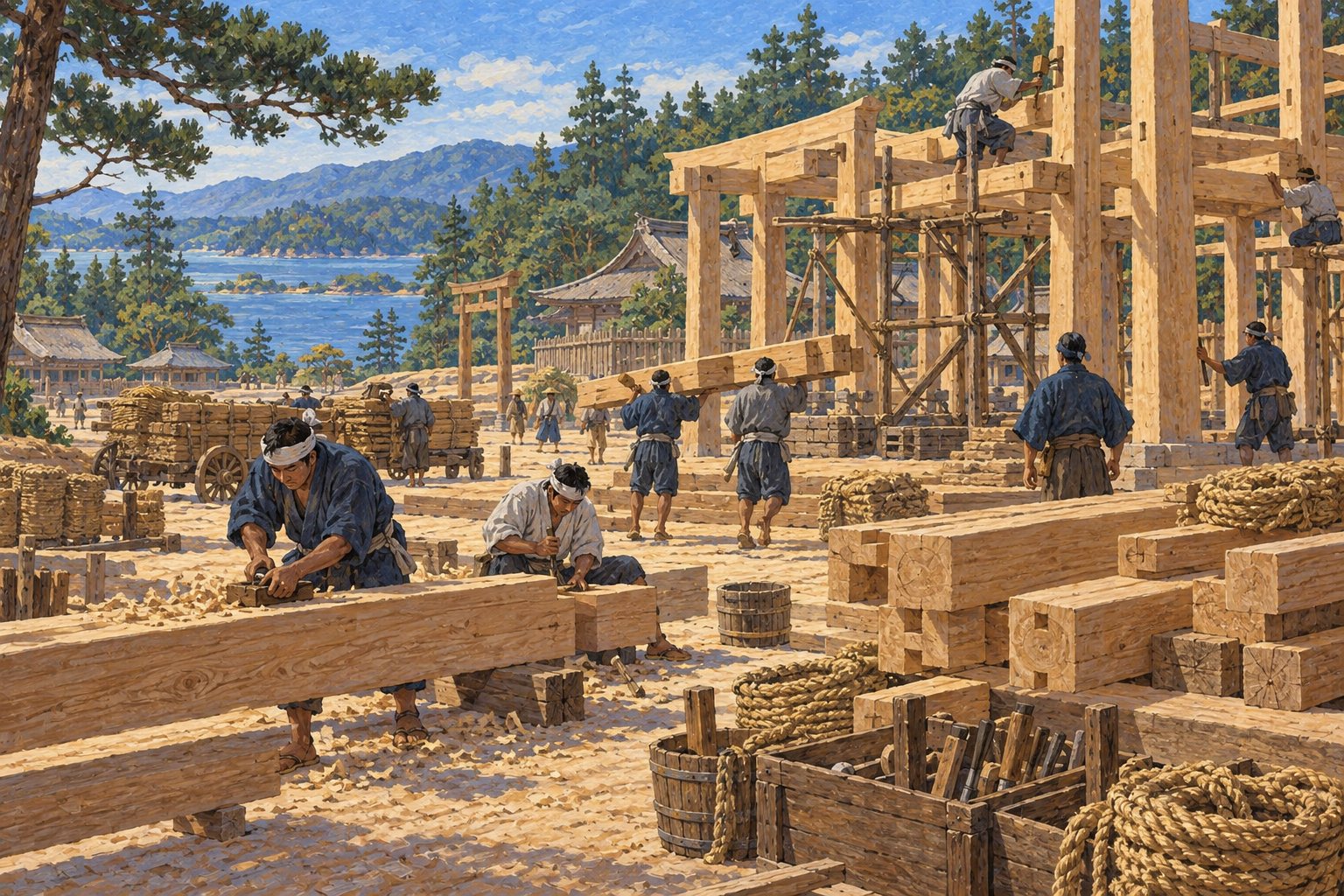
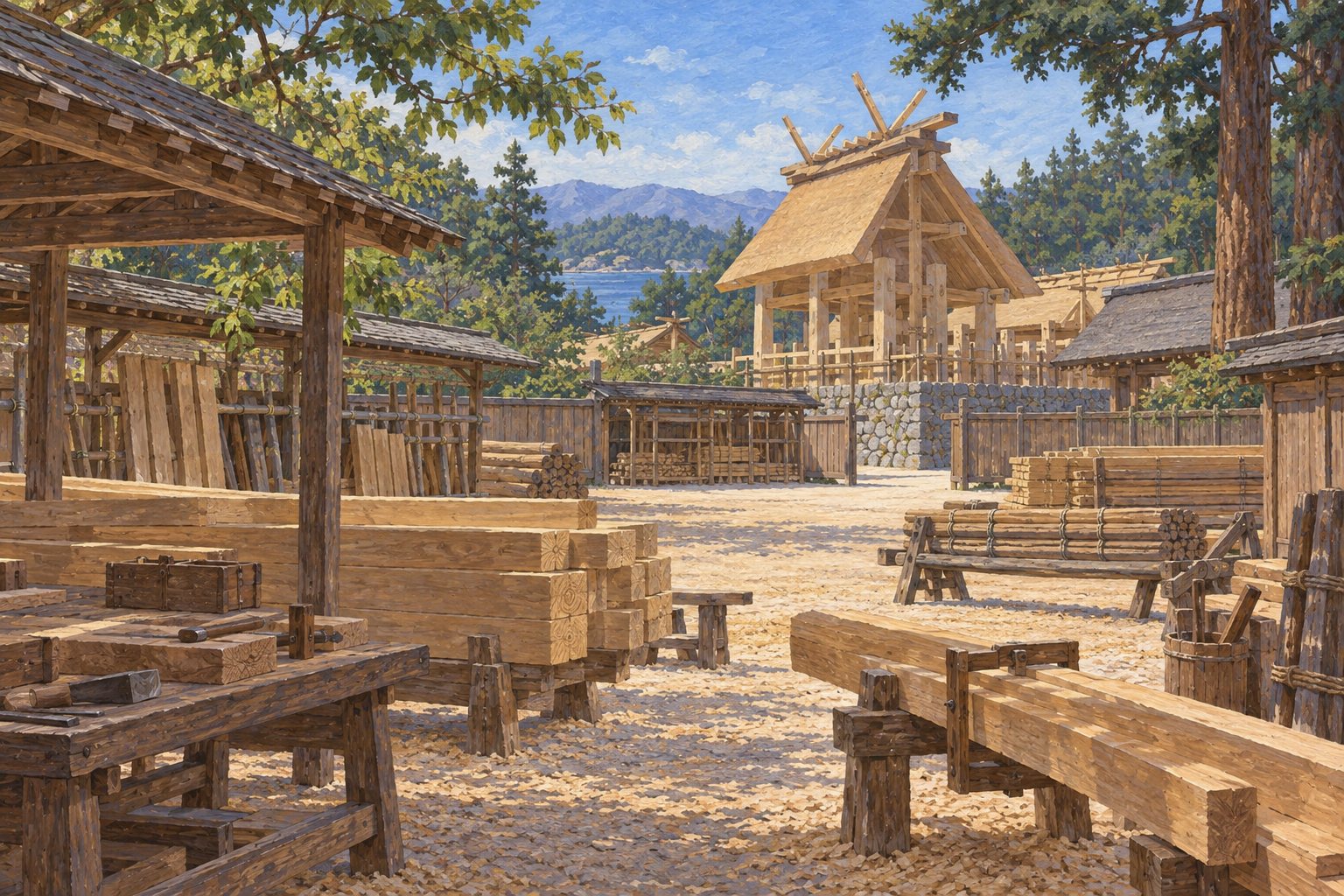
What the rebuilding transmits is not a text but a set of hands: the twenty-year interval is a human career, short enough that a carpenter who assisted at one rebuild can supervise the next, so the craft — joinery, tools, timber selection, the remaking of every treasure and vestment — passes from body to body on schedule; the artefact is deliberately impermanent so that the skill has to be permanent, and the institution maintains its own construction office and its own forests to guarantee the machine its inputs.
Explore the illustrations5 scenes · The joiner’s knowledge
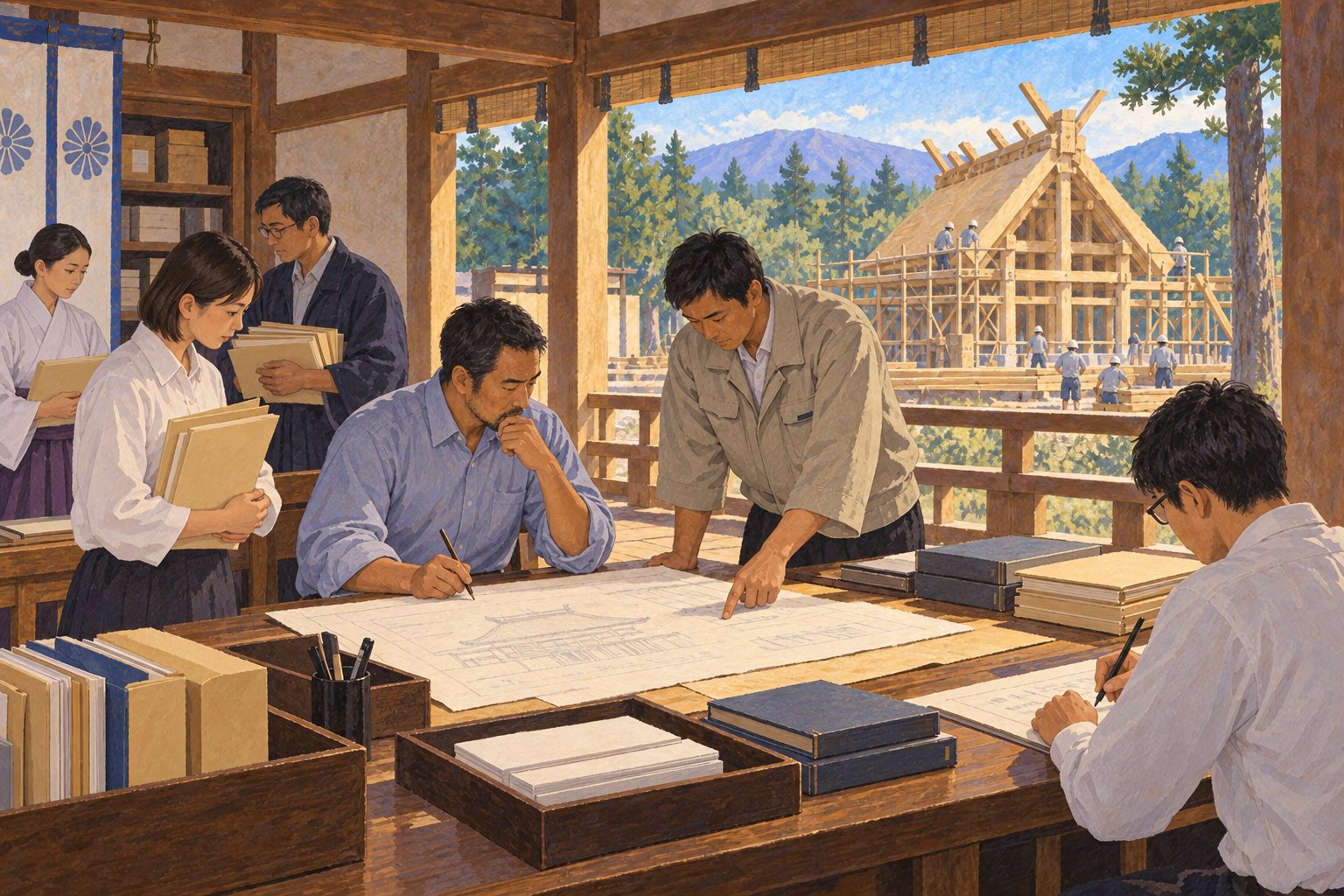
The joiner’s knowledge. What the rebuilding transmits is not a text but a set of hands: the twenty-year interval is a human career, short enough that a carpenter who assisted at one rebuild can supervise the next, so the craft — joinery, tools, timber selection, the remaking of every treasure and vestment — passes from body to body on schedule; the artefact is deliberately impermanent so that the skill has to be permanent, and the institution maintains its own construction office and its own forests to guarantee the machine its inputs.
Texts and authority
A Canon Nobody Needed
Every canon movement in this series has watched an authority close a text and pay for it — the Islam volume watched a caliph do it inside twenty years — but this tradition has no creed, no equivalent of a sermon, and no scripture in the devotional sense: nothing needed closing because nothing was propositional; what the eighth-century court actually closed, in two state-commissioned books, was a genealogy — the descent of the ruling house from the sun kami — and the nearest things to scripture this tradition possesses are a book of liturgies and a book of procedures, which is exactly what a tradition of practice rather than belief would be expected to canonise.
An Emperor Orders a Past
The Kojiki of 712 announces its own politics in its preface: Emperor Tenmu — who had just taken the throne in a civil war — is quoted ordering the correction of the “errors” in the clans’ competing records, a reciter named Hieda no Are is set to memorise the true version, and a generation later O no Yasumaro writes it down; the result runs from the world’s beginning to a seventh-century court, spine-first through the genealogy that makes the rulers descendants of Amaterasu — a political document about origins, not scripture in a devotional sense, and for most of the next thousand years almost nobody read it.
Institutions and resources
The Divine Districts
The early funding was state assignment: the court gave Ise whole districts whose taxes fed the shrine, and the Engishiki’s offering tables are fiscal documents — so many lengths of cloth, so many jars of sake, itemised per shrine per rite — which makes them the best evidence in the volume for who paid and what it cost; and when court finance failed in the medieval centuries, Ise did what every institution in this series does when its patron fails: it built a private economy, accumulating estates across the provinces, and the movement’s thesis is set here — each funding regime makes a different Shinto.
The Amulet Network
By the Edo period Ise ran the largest religious distribution network in the country without owning a single doctrine: hereditary agents — the onshi — held parish registers of confraternities across Japan, distributed the shrine’s amulets, collected first-fruits payments, and lodged their parishioners on pilgrimage in agent-towns at the shrine gates; the system produced the okage mairi, spasms of mass pilgrimage in which contemporary counts — transmitted as estimates and printed only as such — put millions of people on the Ise roads within months; and in 1871 the new Meiji state abolished the entire network by decree, overnight.
Explore the illustrations7 scenes · Financing the rebuild
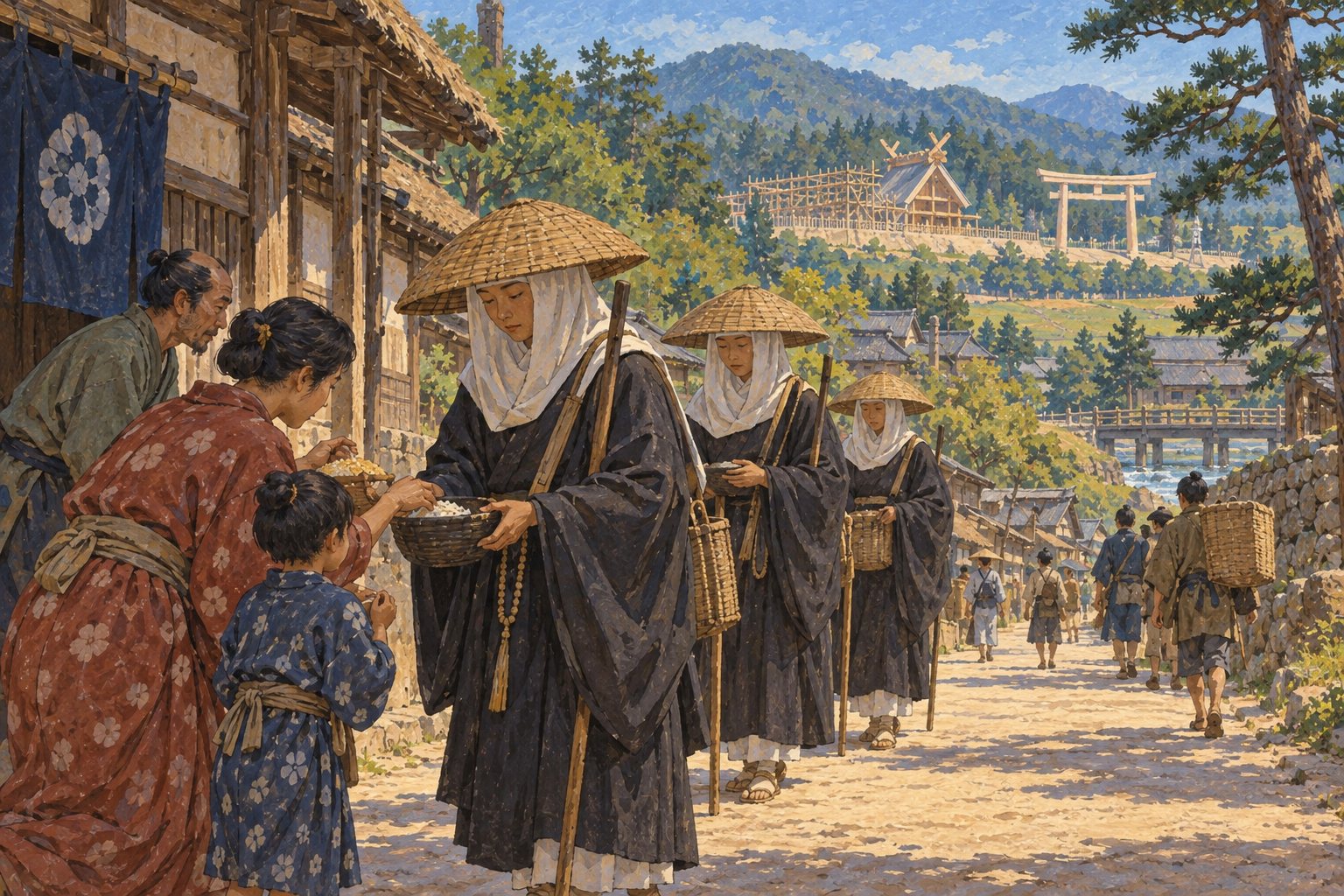
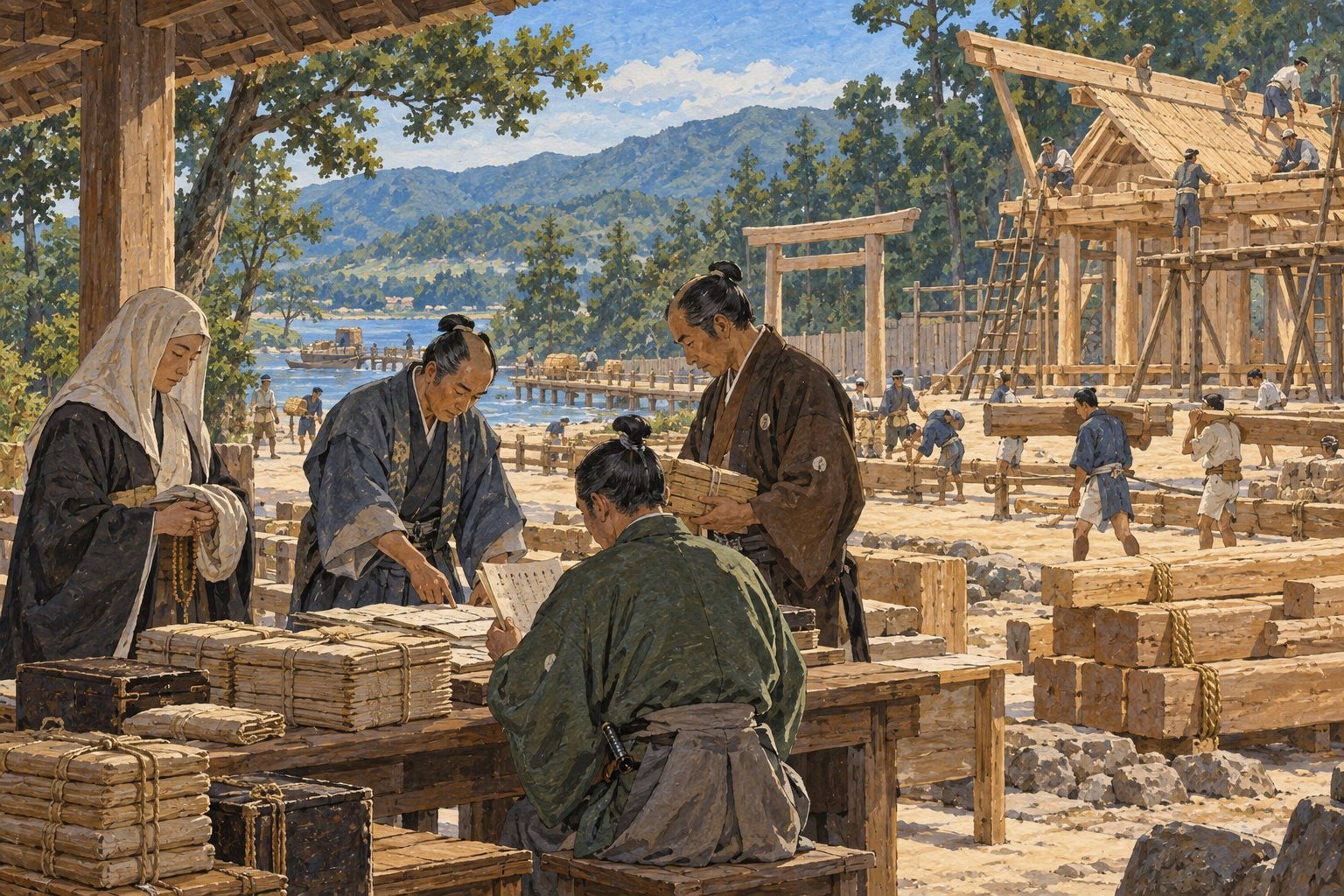
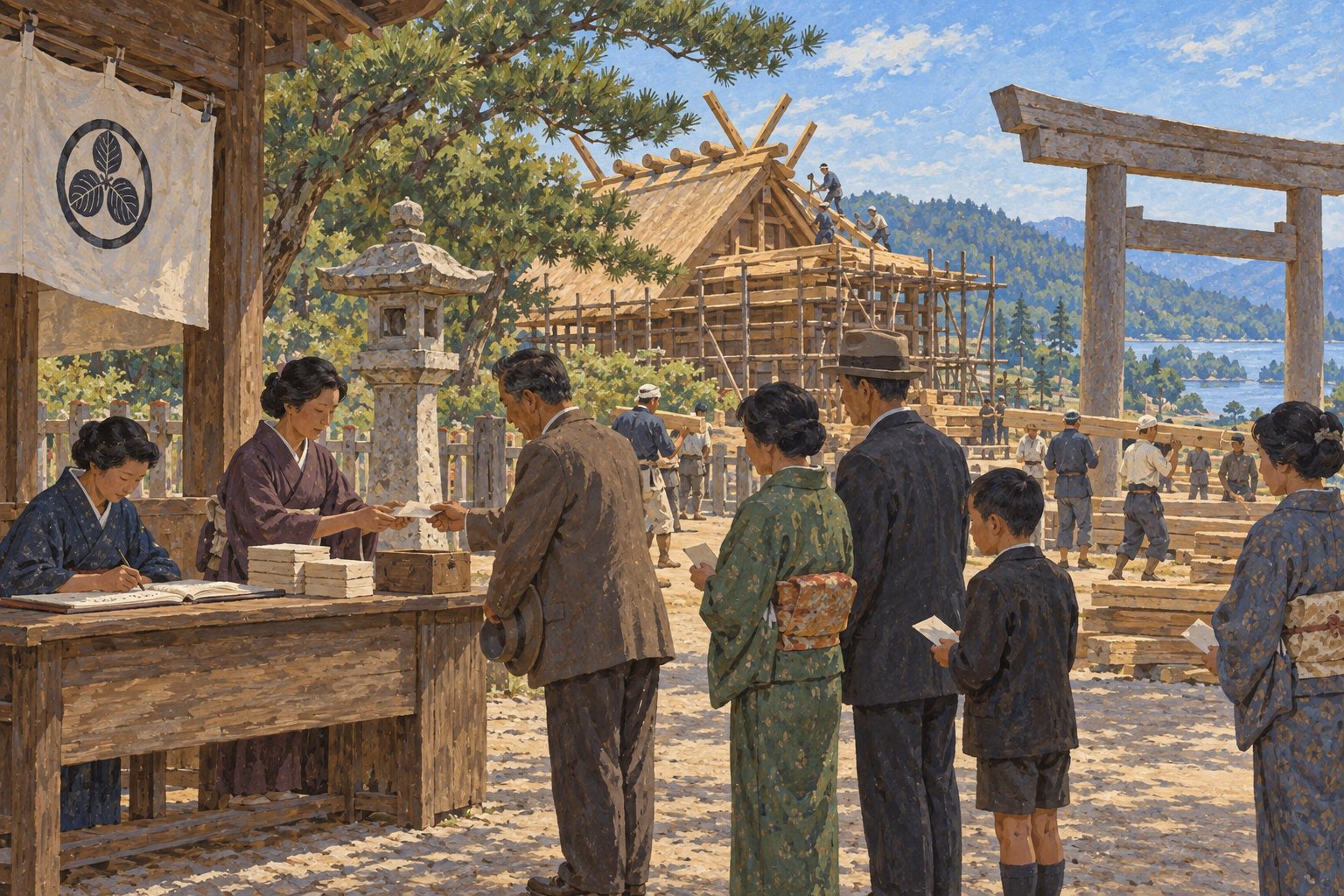
Financing the rebuild. A shrine that must be rebuilt every twenty years is a shrine that must be paid for every twenty years, and the funding history is the machine’s history: court-funded while the court could pay; stopped for over a century when it could not — and restarted in the sixteenth century substantially by Buddhist nuns whose alms campaigns rescued the rebuilding of Shinto’s central shrine, in the centuries when the two were one system; then warlord patronage, then shogunal obligation, then the modern state budget until 1945; the 1949 rebuild was postponed to 1953 and funded privately for the first time in the modern era, and the 2013 cycle is reported at about ¥57 billion, privately donated — the headline figure verified, the internal split not.
Changes and divisions
Separating the Gods
In the spring of 1868 the new government issued a run of administrative orders separating kami from buddhas: Buddhist clergy serving at shrines were ordered to laicise or leave, kami stripped of their Buddhist titles, Buddhist images and apparatus removed from shrine precincts — an administrative order, not a doctrine — and what followed in some domains went far beyond the order’s text: the wave of destruction remembered as haibutsu kishaku closed every temple in Satsuma and levelled thousands elsewhere, while the government issued follow-up proclamations disclaiming any intent to destroy; the volume reports documented policy and documented consequence, and prosecutes nobody.
The Religion That Officially Was Not One
Over the next four decades the state assembled what was later named State Shinto: priests of the ranked shrines barred in 1882 from doctrinal teaching and funerals — the administrative sentence that made shrines officially not a religion — while thirteen “Sect Shinto” bodies were licensed as religions to quarantine the believing kind; the constitution of 1889 granted religious freedom “within limits not prejudicial to peace and order and not antagonistic to their duties as subjects”; the 1890 Rescript on Education became a school liturgy; from 1906 the state consolidated roughly a third of the country’s shrines out of existence; and shrine reverence was exported and enforced in the colonies — documented policy, documented consequence, adjudicated nowhere in this book.
Limits of the evidence
These limits are stated in the book before its argument.
- Anything before the eighth century except through objects and foreign chronicles The span line on this volume’s own cover — 692/712 onward — is an attestation date, not a founding date: the practice is plainly older than the record, but its content before the chronicles is archaeology plus inference, and the volume says so every time. What was said or believed at any rite before 712 cannot be established. (The front matter prints the attestation-versus-tradition distinction, per the series chronology’s standing flag on this volume.)
- Whether “Shinto” existed as a self-standing religion before the medieval period at the earliest The Kuroda thesis holds that it did not — that kami worship lived inside a combined kami-buddha system for over a thousand years and that “Shinto” as an independent religion is a medieval construction at the earliest and substantially a Meiji one. The thesis is reported, its critics are reported by name, and the volume settles nothing; it is structured so the reader can watch the evidence assemble on both sides. (Stated inside Movement One, not saved for a coda.)
- When the rebuilding began The twenty-year cycle at Ise is conventionally dated to 690 for the Inner Shrine and 692 for the Outer, on the strength of court-chronicle entries; continuous contemporaneous documentation of the cycles is later, the count of sixty-two by 2013 includes recorded interruptions of more than a century, and “every twenty years since 690” is the institution’s own framing. The record shows the gaps, and the volume prints them.
Sources and reading
This article brings together the series’ existing overview and chapter summaries. The linked book page provides the full outline and bibliography.
- UNESCO nomination file, Sacred Island of Okinoshima and Associated Sites in the Munakata Regioninscribed July 2017. roughly 80,000 open-air deposits, fourth–ninth centuries — the nomination’s figures
- Wei zhi account of Wacompiled before 297. Himiko and guidao, in this book’s Chinese; Tsunoda–Goodrich not used
- Motoori Norinaga, Kojiki-dencompleted 1798. the late definition of kami; the unread chronicle made into scripture
- Shoku Nihongieighth century. Hachiman’s progress to Nara, 749; the 720 presentation notice
- Engishikicompiled 927; in force 967. rite calendar; shrine register; twenty-seven norito; offering tables
- John Breen and Mark Teeuwen, A Social History of the Ise Shrines2017. the twenty-year clock; mikuriya estates; the onshi; the Keikoin nuns
- Ise Jingu published sengu inventory2013 cycle. sixty-five buildings, treasures and apparel remade — the shrine’s own figures
- Helen Hardacre, Shinto and the State, 1868–19881989. 1871 ranking and land seizure; 1871 abolition of houses and onshi; the 1882 bar
Illustrations are newly generated interpretations of themes in the book. They are not surviving artifacts, historical photographs or evidence for the events described.