18 illustrations · 2:06
Watch & listen.
Follow the images with a narrated journey through the book.



Overview
- Coverage
- c.1000–1400 onward
- Earliest secure evidence
- c.1000 CE
- Transmission
- a binary-indexed oral database
The clergymen wrote first. Two snapshots, named. Who speaks for Ifá is a live argument and is left as one. The carver’s bill and the grove are what can be priced; the initiation is described as a public fact about cost and not as a transcribed rite.
The coverage period and the earliest secure evidence are different dates. A tradition’s own account of its beginnings may differ from both.
Historical setting
The Heads
In 1938 workmen digging house foundations at Wunmonije Compound, near the palace of the Ooni of Ife, struck a cache of brass heads cast with a naturalism Europe then believed Africa incapable of — Leo Frobenius had seen one such head in 1910 and announced he had found Atlantis, a claim worth quoting because the mistake is the evidence: the heads establish a court and a workshop tradition, conventionally dated between the twelfth and fifteenth centuries, and they establish nothing about what anyone at that court believed.
The City That Made Its Own Glass
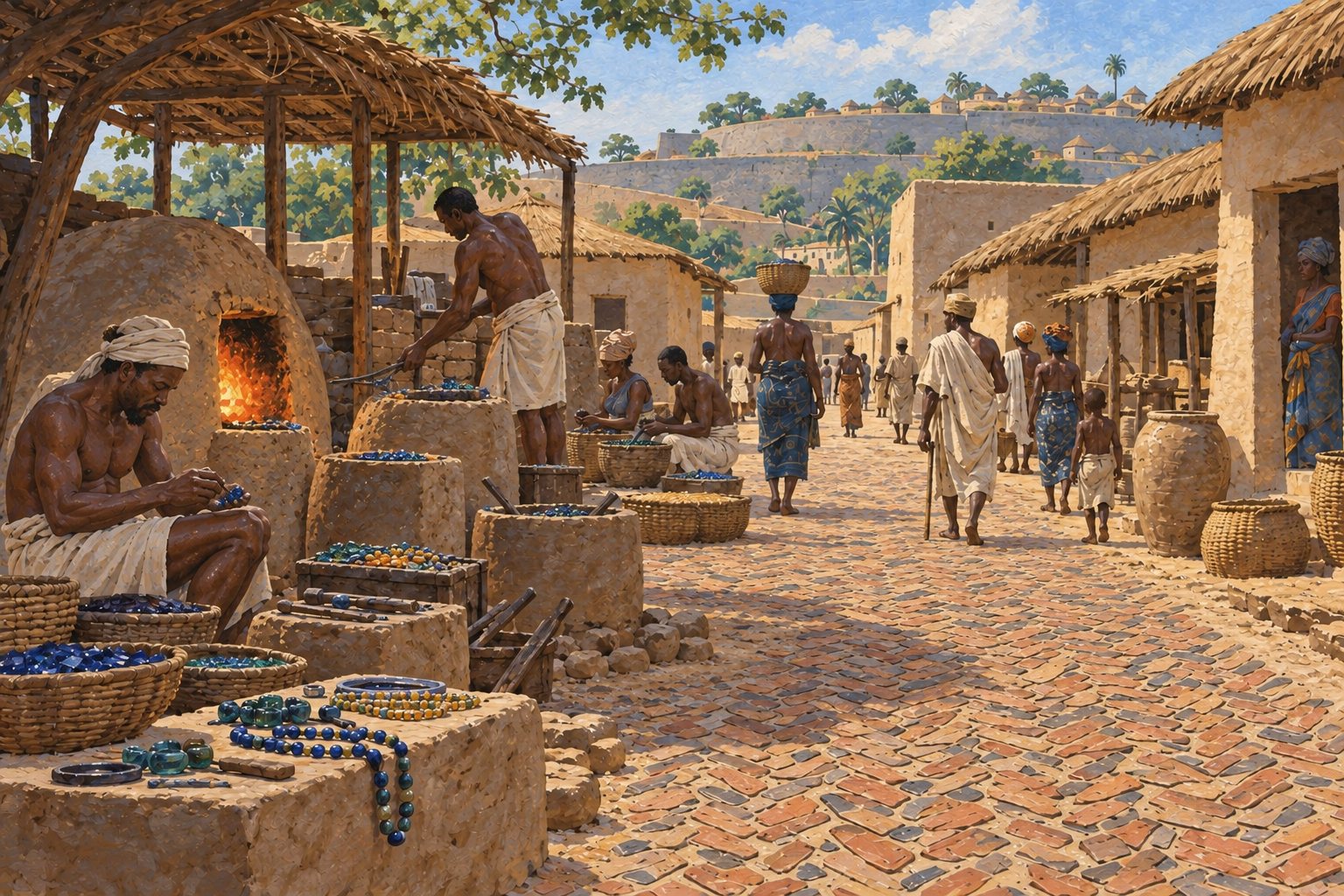
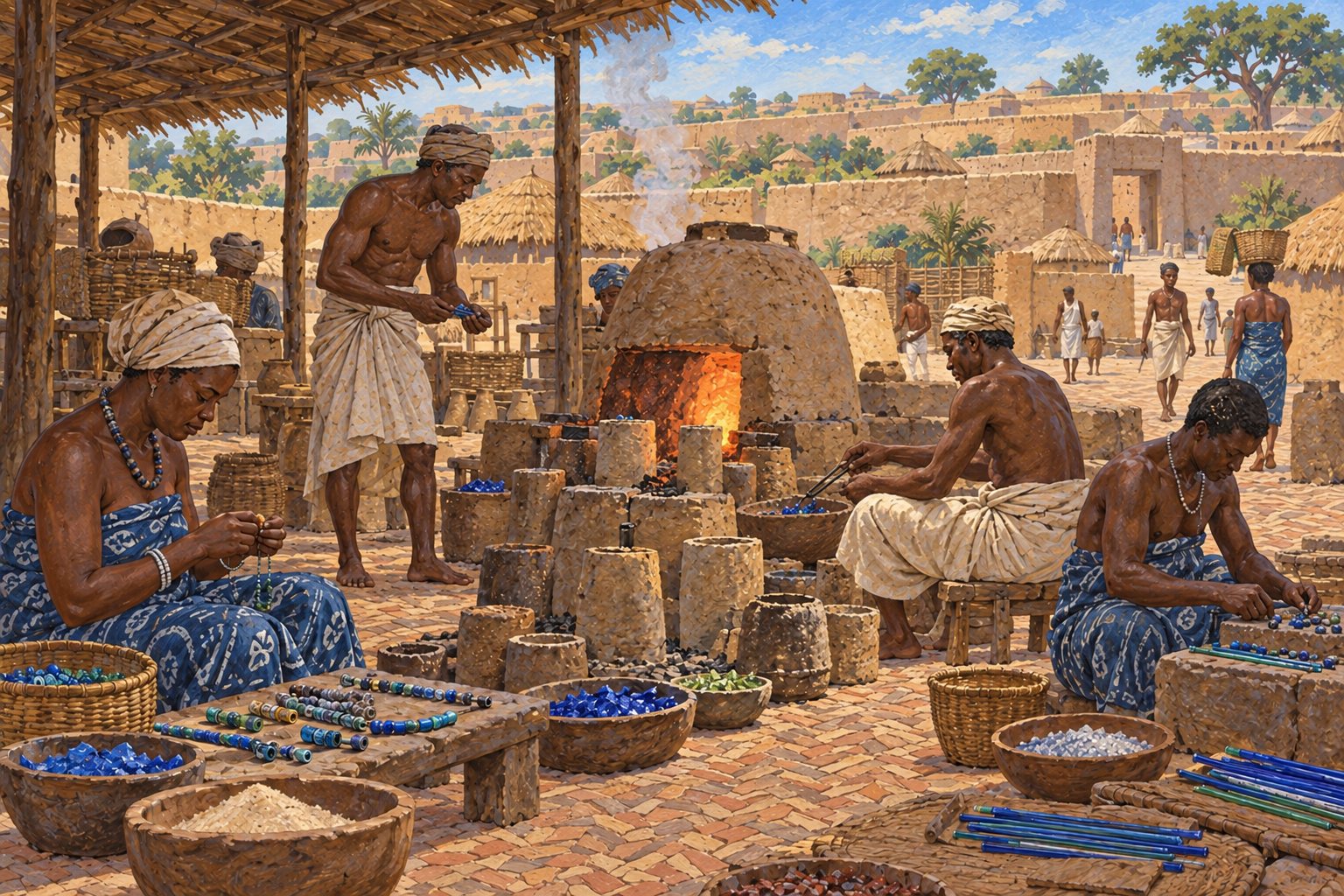
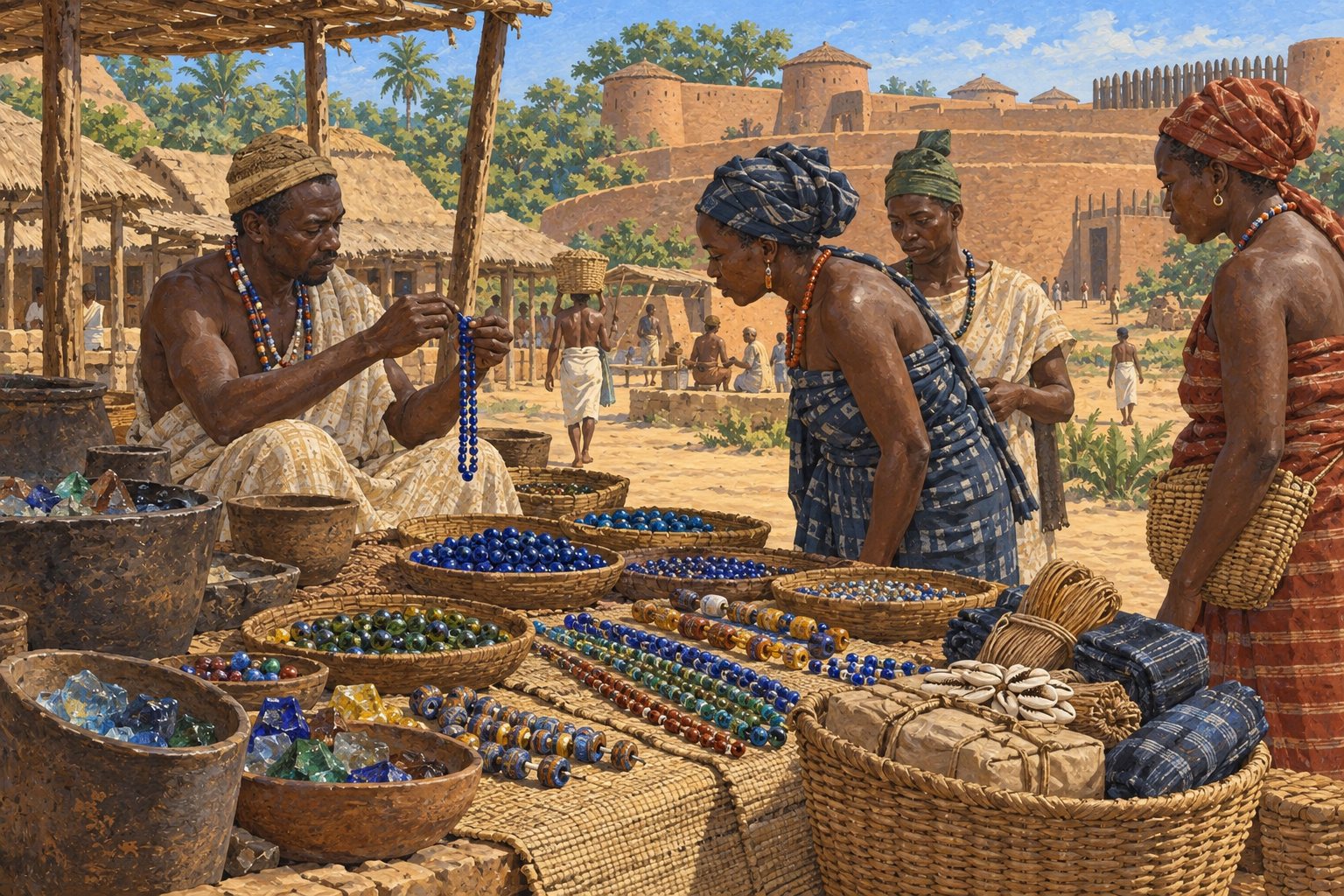
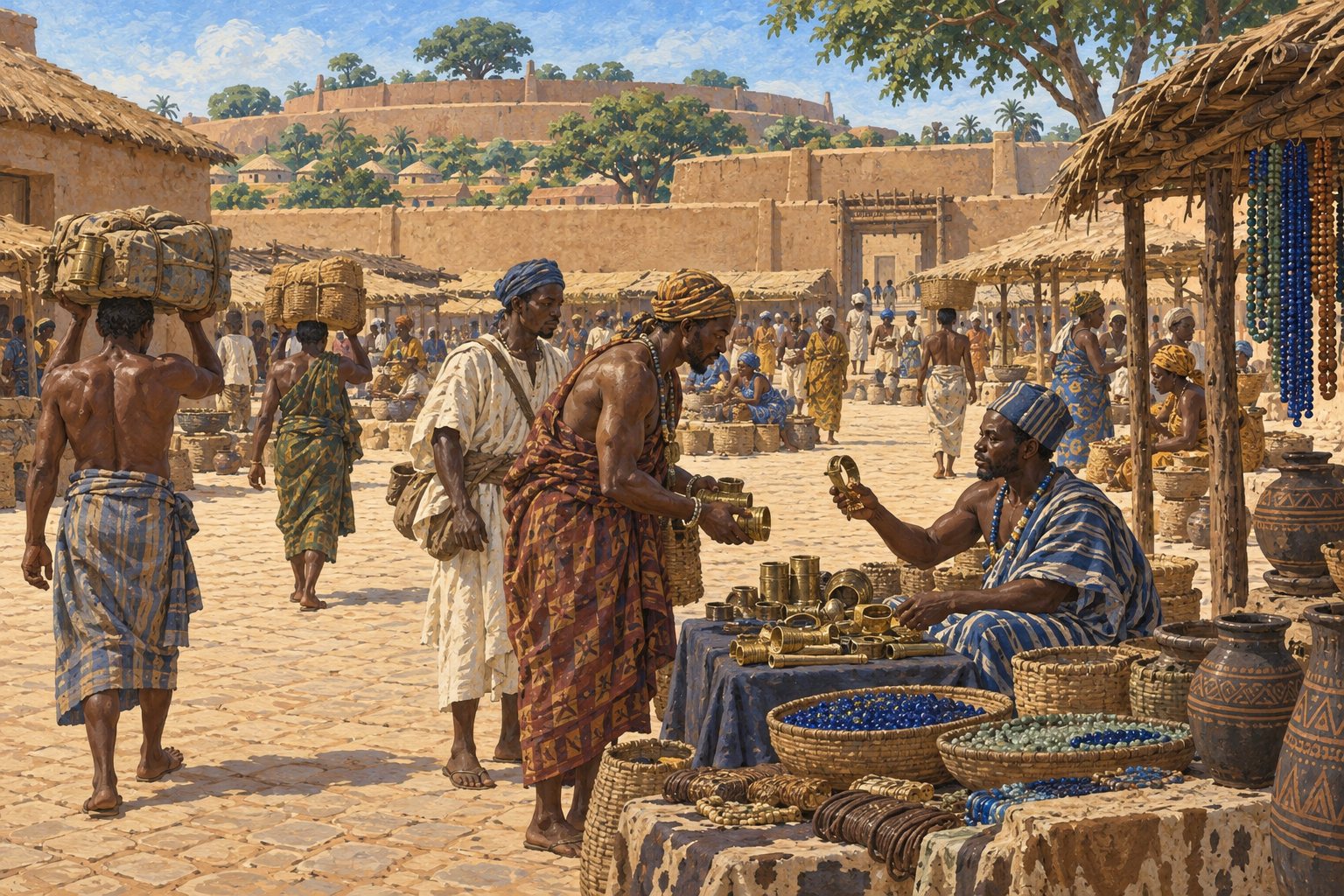
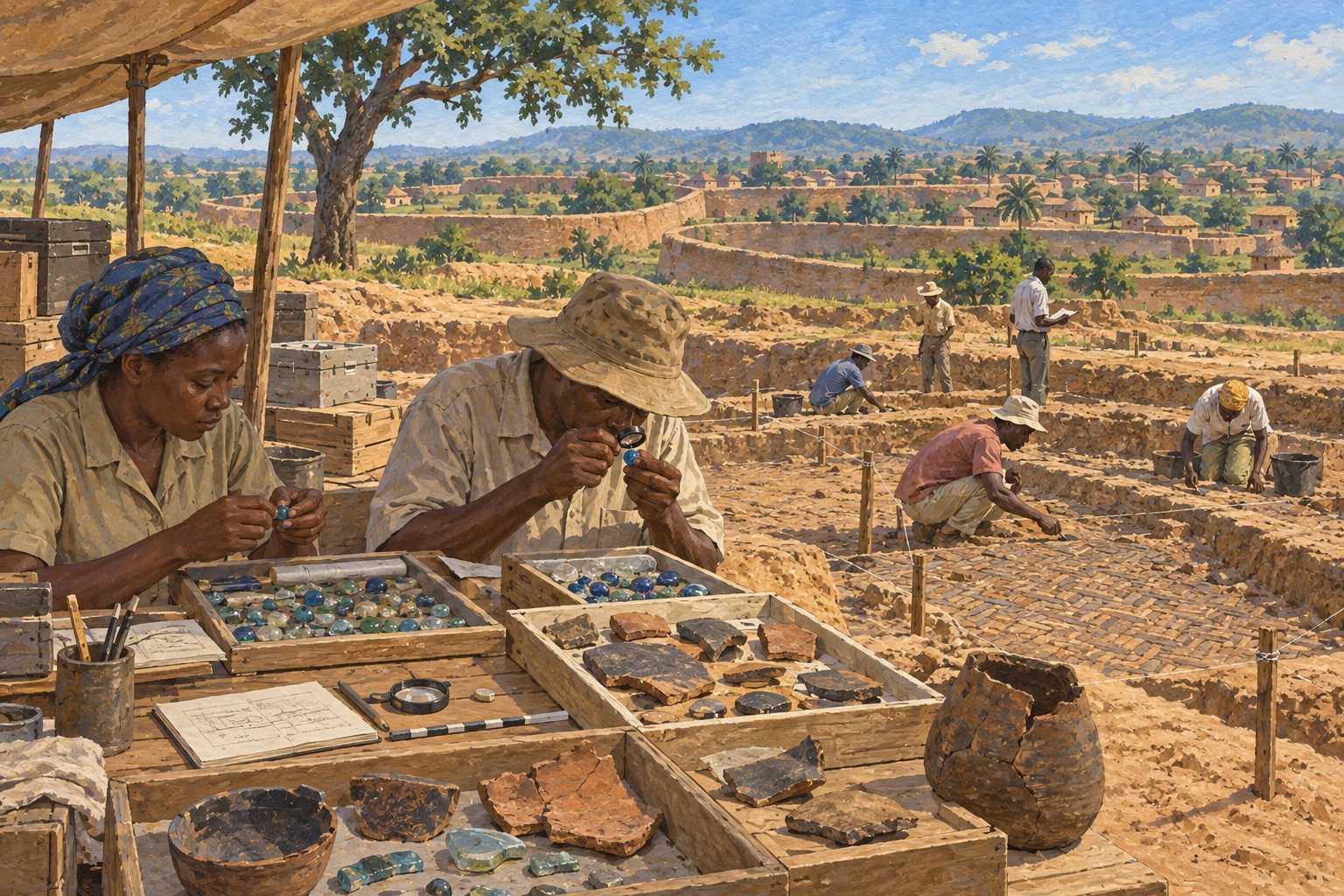
Ife was a working city before it was anyone’s holy one: potsherd pavements laid in herringbone, city walls in concentric rings, and at Igbo Olokun a glass industry melting its own distinctive glass into beads — excavated, radiocarbon-dated to roughly the eleventh to fifteenth centuries, and traded — while the copper for the famous heads is not local at all, so the metal had to travel; against this stands the tradition, which holds that the world itself was created at Ife, in more than one version — Oduduwa descending on a chain, or arriving at the head of migrants — and the chapter prints both versions and the dig, in separate sentences.
Explore the illustrations6 scenes · Glassmaking at Ife
Glassmaking at Ife. Ife was a working city before it was anyone’s holy one: potsherd pavements laid in herringbone, city walls in concentric rings, and at Igbo Olokun a glass industry melting its own distinctive glass into beads — excavated, radiocarbon-dated to roughly the eleventh to fifteenth centuries, and traded — while the copper for the famous heads is not local at all, so the metal had to travel; against this stands the tradition, which holds that the world itself was created at Ife, in more than one version — Oduduwa descending on a chain, or arriving at the head of migrants — and the chapter prints both versions and the dig, in separate sentences.
How it was transmitted
Sixteen Times Sixteen
The address space first: a cast produces one of sixteen figures — four vertical positions, each holding a single or a double mark, two to the fourth power — and a full divination produces two figures side by side, sixteen times sixteen, two hundred and fifty-six odu, each a named chapter heading over its own body of verses; the sixteen principal doubles have names and a seniority order, and the order itself varies by town and by continent, which Bascom tabulated — Ife against Oyo against Meko against Cuba — a variance the canon movement will need.
The Chain and the Nuts
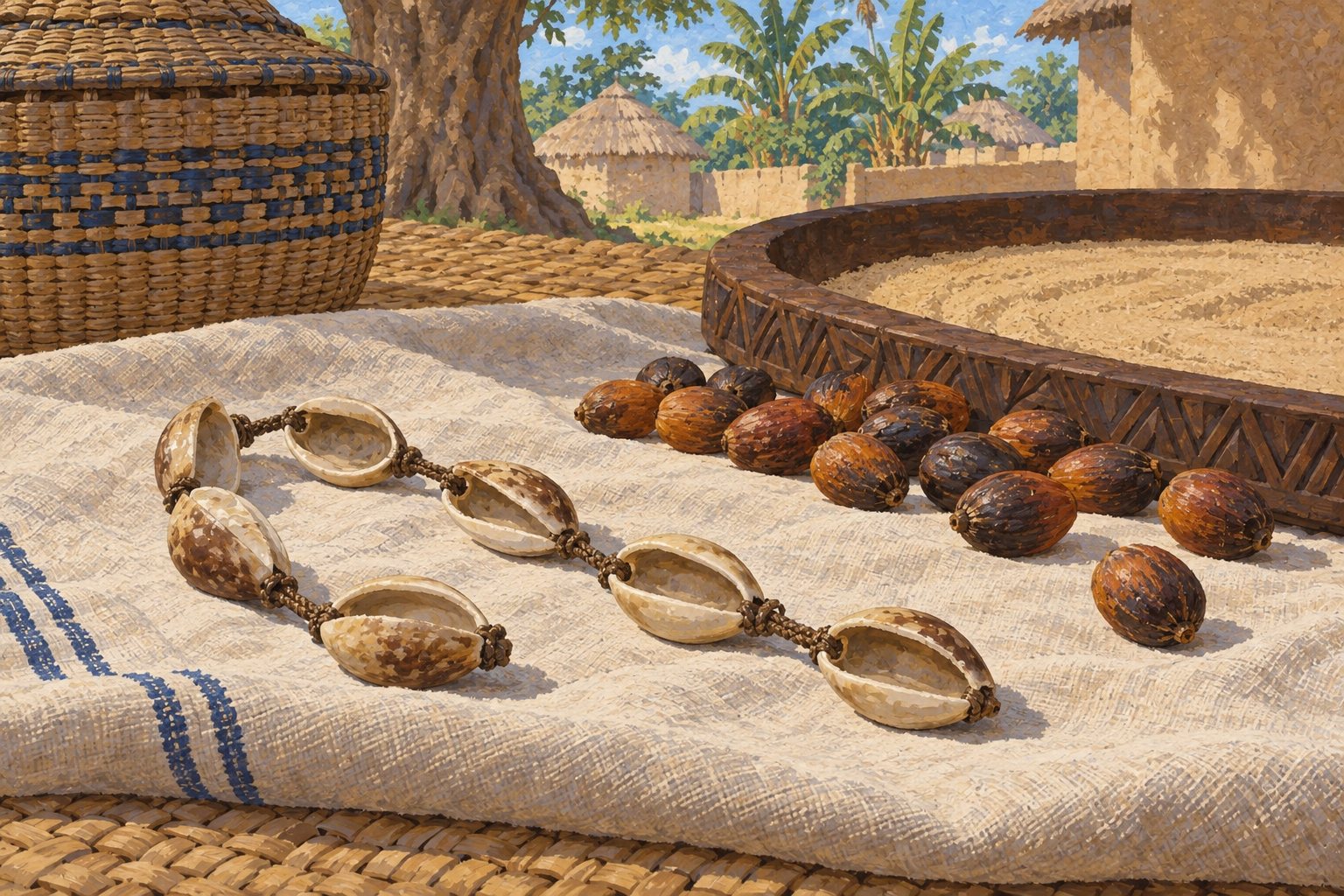
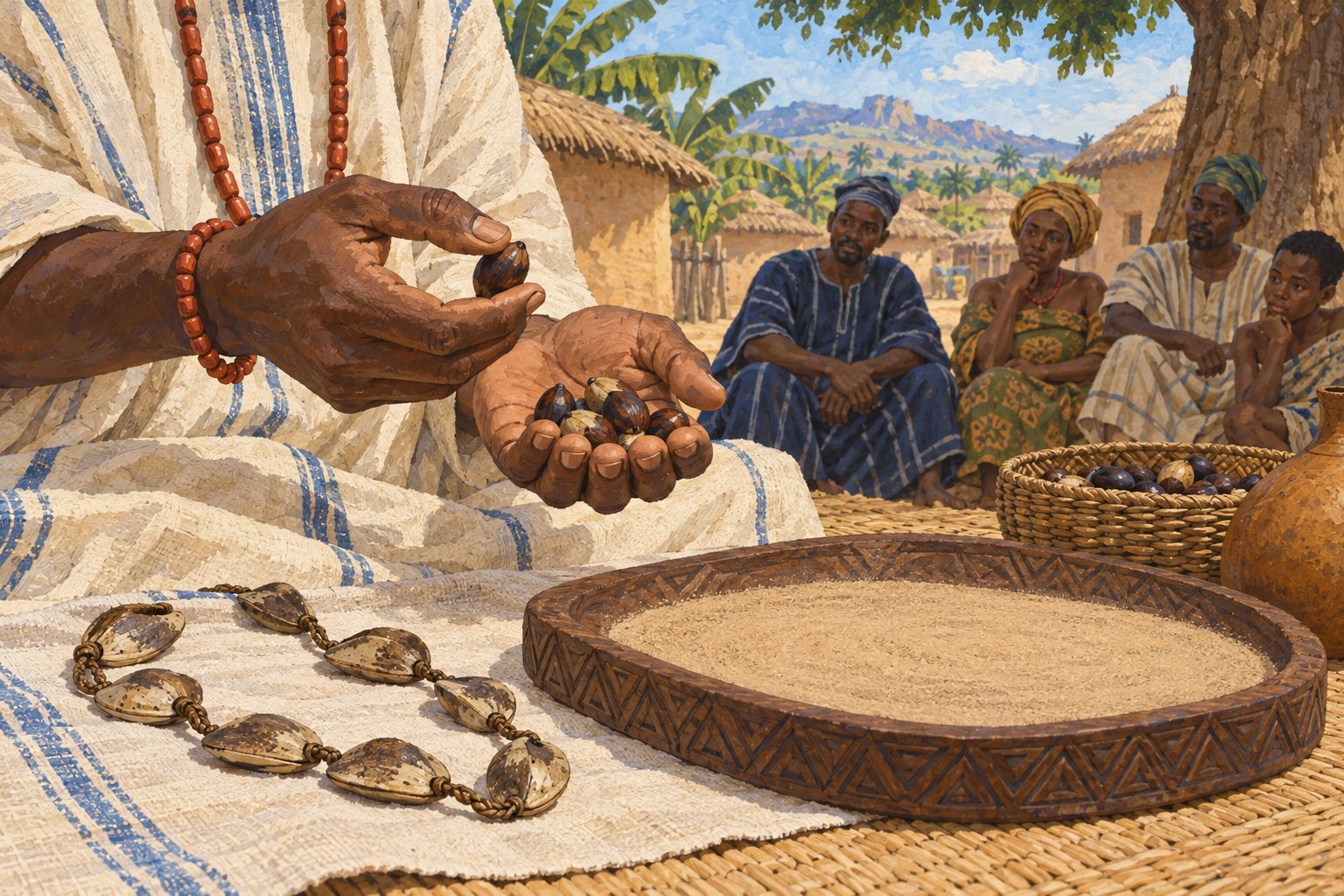
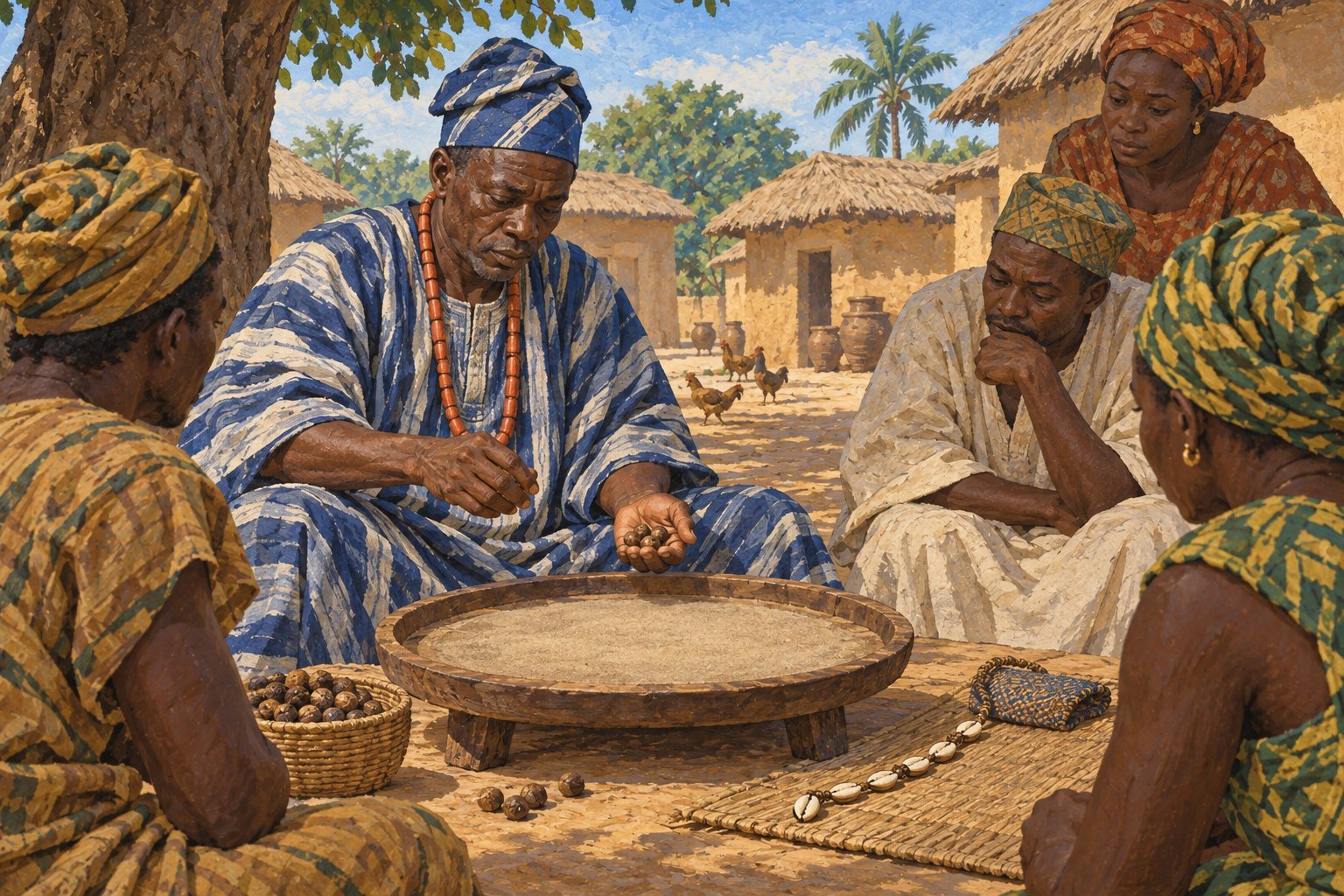
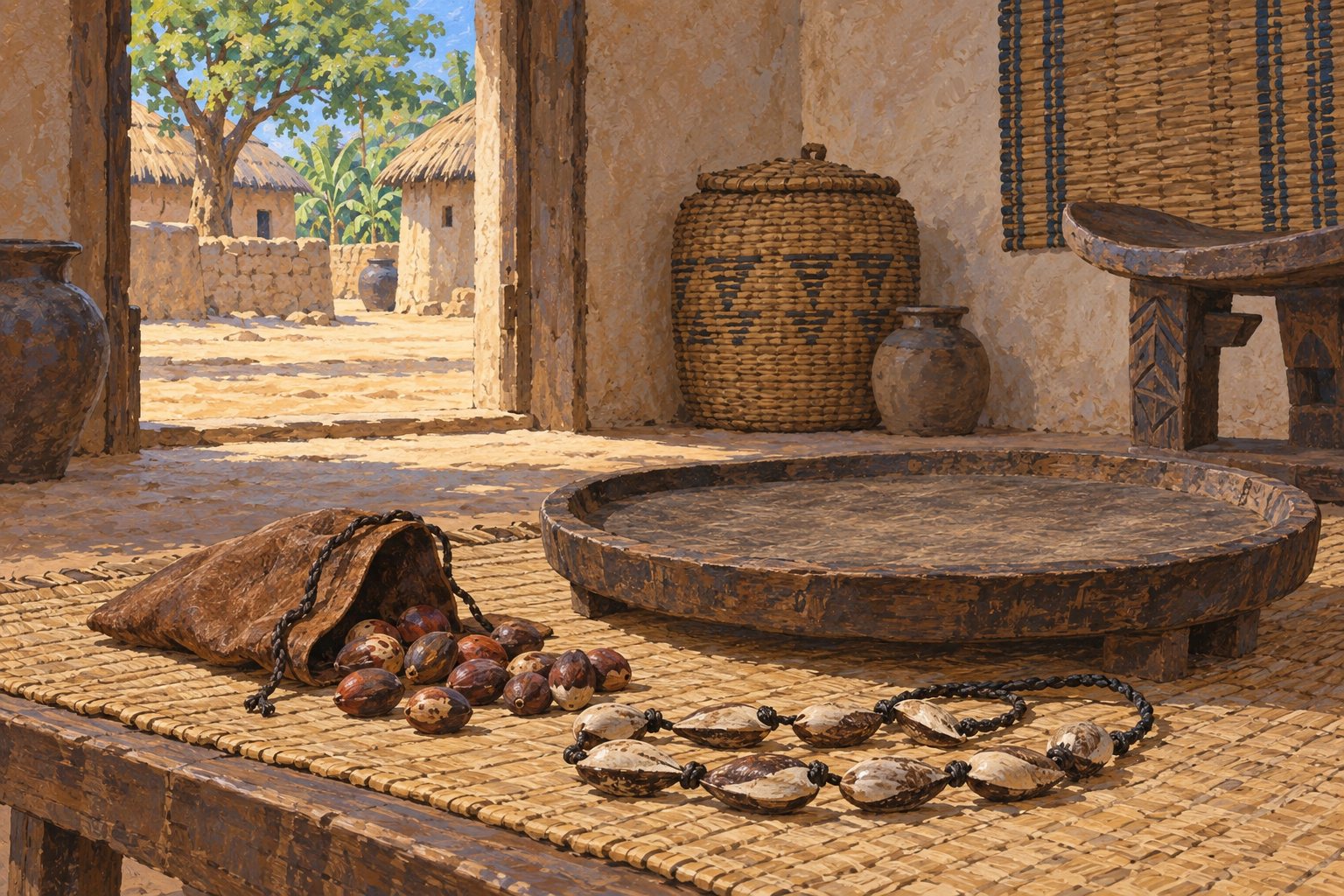
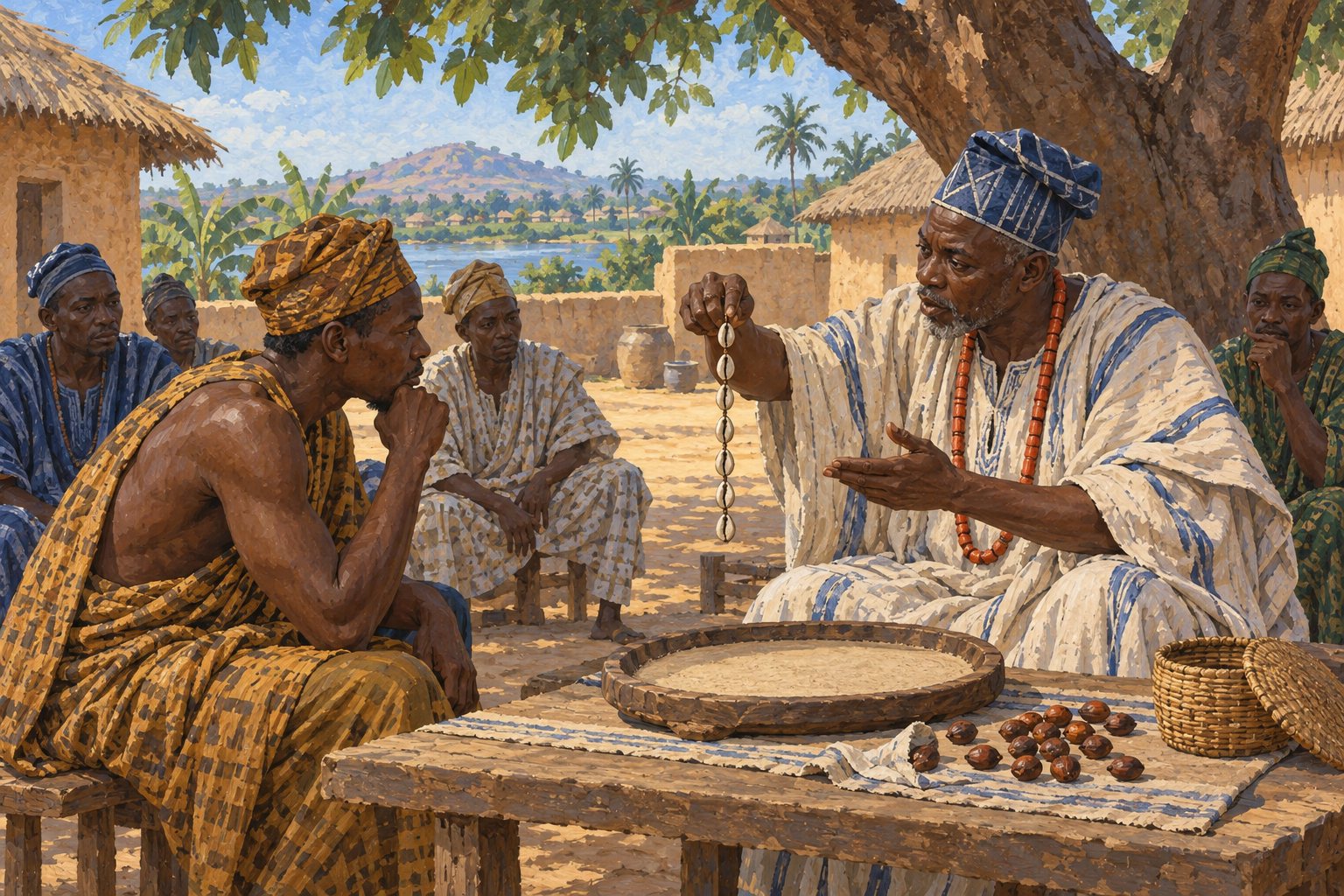
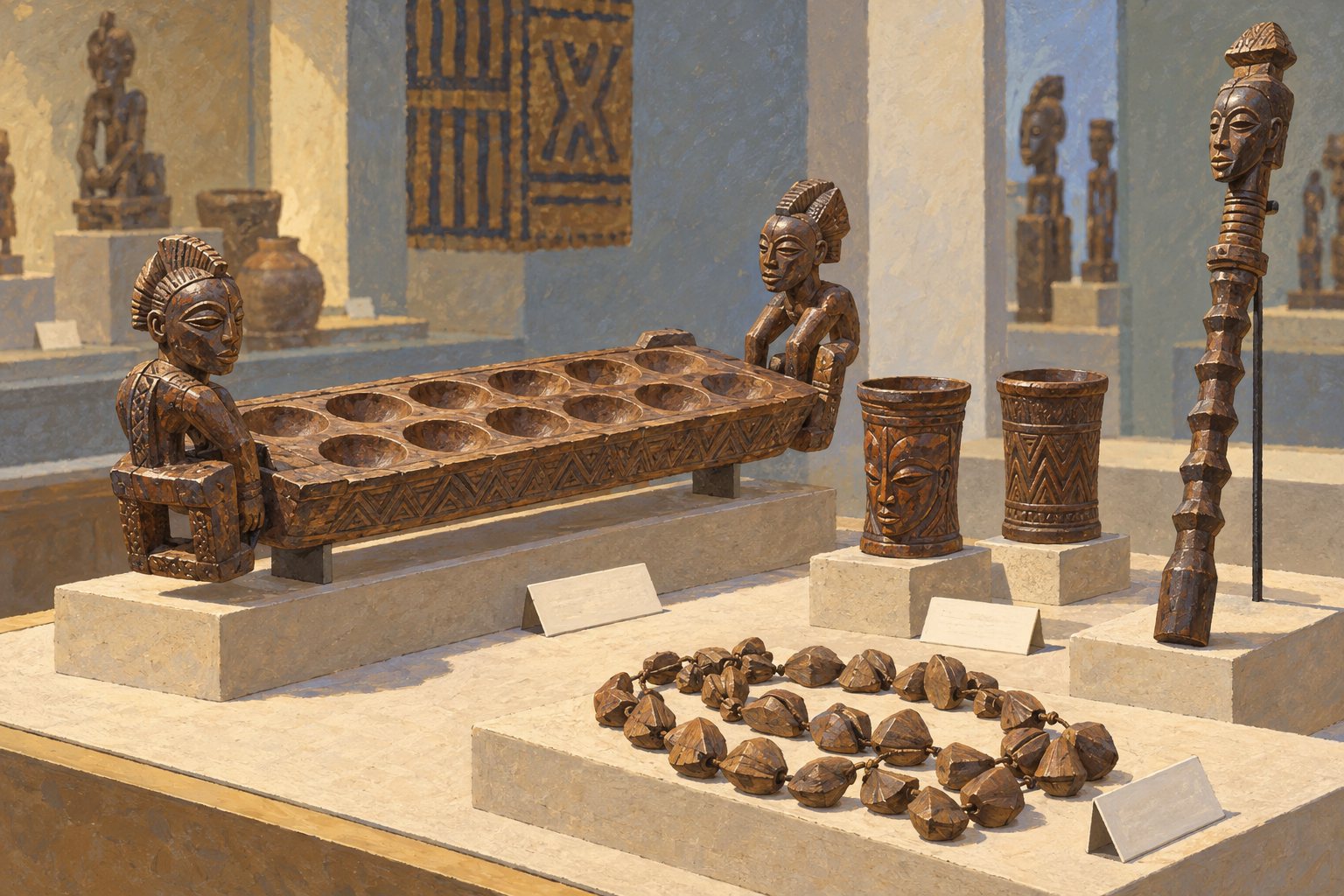
The hardware is two instruments at two speeds: the opele, a chain of eight half-shells that falls in one throw as a complete odu — fast, portable, the working diviner’s everyday tool — and the sixteen ikin, sacred palm nuts beaten from palm to palm, where the remainder left in the hand writes one mark at a time into iyerosun dust on the opon tray, eight operations to an odu, slow and ceremonial; the code is inverted — one nut remaining marks double, two nuts remaining mark single — and the chapter walks one full cast of each instrument as a worked example, the way the Islam volume walked a consonantal skeleton.
Explore the illustrations6 scenes · Chain, Nuts and Tray
Chain, Nuts and Tray. The hardware is two instruments at two speeds: the opele, a chain of eight half-shells that falls in one throw as a complete odu — fast, portable, the working diviner’s everyday tool — and the sixteen ikin, sacred palm nuts beaten from palm to palm, where the remainder left in the hand writes one mark at a time into iyerosun dust on the opon tray, eight operations to an odu, slow and ceremonial; the code is inverted — one nut remaining marks double, two nuts remaining mark single — and the chapter walks one full cast of each instrument as a worked example, the way the Islam volume walked a consonantal skeleton.
Texts and authority
An Index, Not a List
Every canon in this series is a list — books in, books out — and this one is an index: 256 addresses are fixed, closed and universal, while the verses filed under them are open, unnumbered and nowhere the same twice, so the question “is this verse canonical” translates to “is it recited under its odu by a trained diviner,” and no further; there is no synod, no Uthman — the standardising caliph of the Islam volume has no counterpart here and structurally cannot, because closure would require simultaneous authority over every trained memory alive — and the proof is empirical: Bascom’s recorded verses for an odu at Ife differ from Abimbola’s for the same odu at Oyo, and both are the canon working, not the canon failing.
The Anatomy of a Verse
An ese is a case, and it is built like one: a stereotyped opening names the diviner — often a praise-name, “so-and-so cast Ifa for such-a-client” — then the precedent client’s predicament, the advice, the sacrifice prescribed, whether the client complied, the outcome, and often a closing song; Abimbola’s structural anatomy of the form carries the chapter, one brief published verse is quoted whole as the worked example, and the form explains the canon’s openness — a verse is a precedent narrative, and a corpus of precedents can absorb new cases forever, which is why twentieth-century recordings contain verses naming courts, cocoa and letters, a modernity the collections themselves document.
Institutions and resources
The Missing Ledger
The Sufism volume can read a waqf deed and the Classical Hinduism volume can read a temple wall, and this volume can read neither, because there is nothing to read: Ifá’s economy is a consultation fee passing from client to diviner and a sacrifice purchased in the market, transaction by transaction, with no central treasury and no written account — a structural fact about a distributed priesthood, stated in the text as this movement’s finding rather than papered over; what exists instead is ethnography with dates, above all Bascom’s recorded fees and income figures from Ife diviners, in pence and shillings of their day, and the ese themselves, whose stock endings prescribe the sacrifice and its components — the price list is inside the literature, and it is the only place it was ever written down.
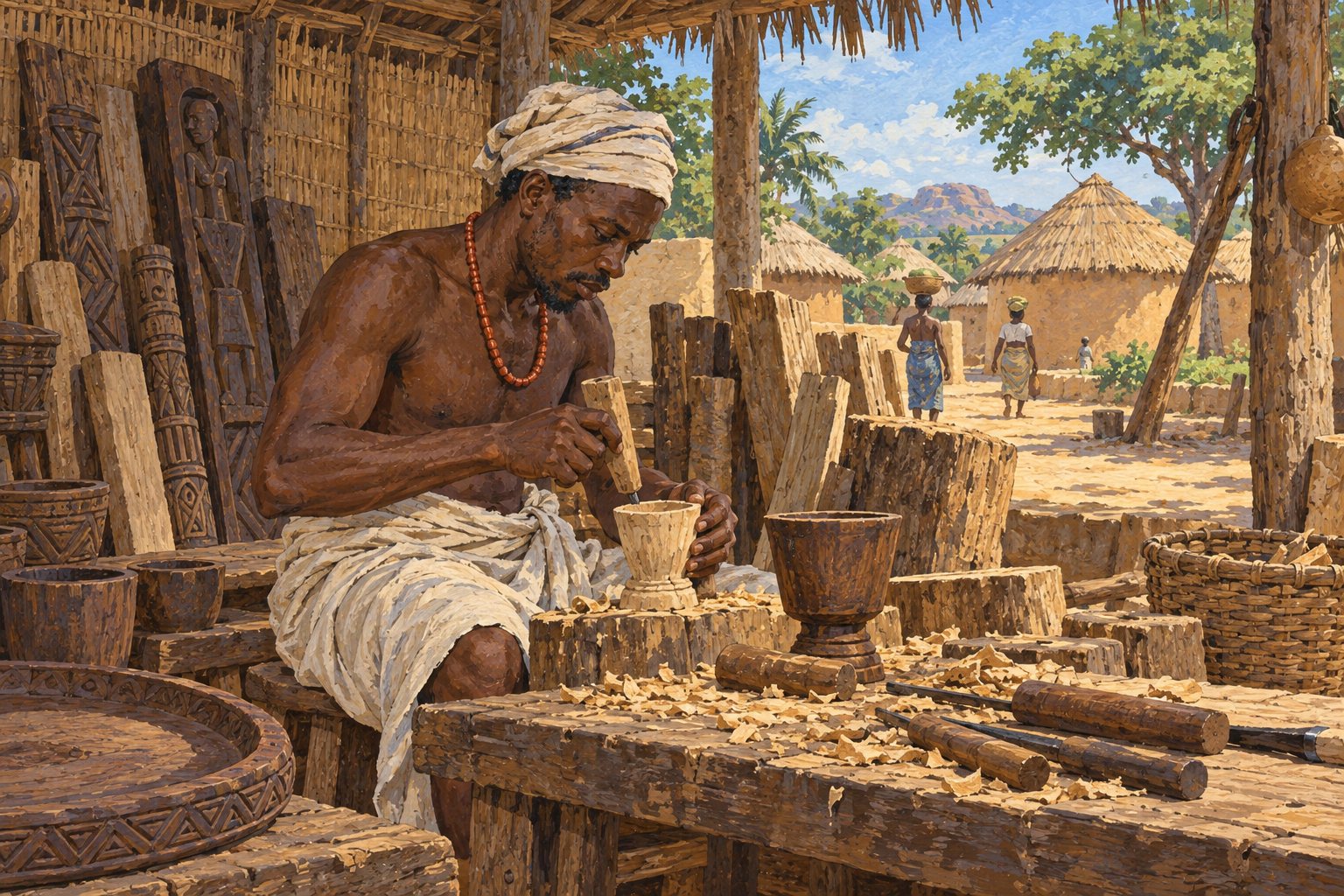
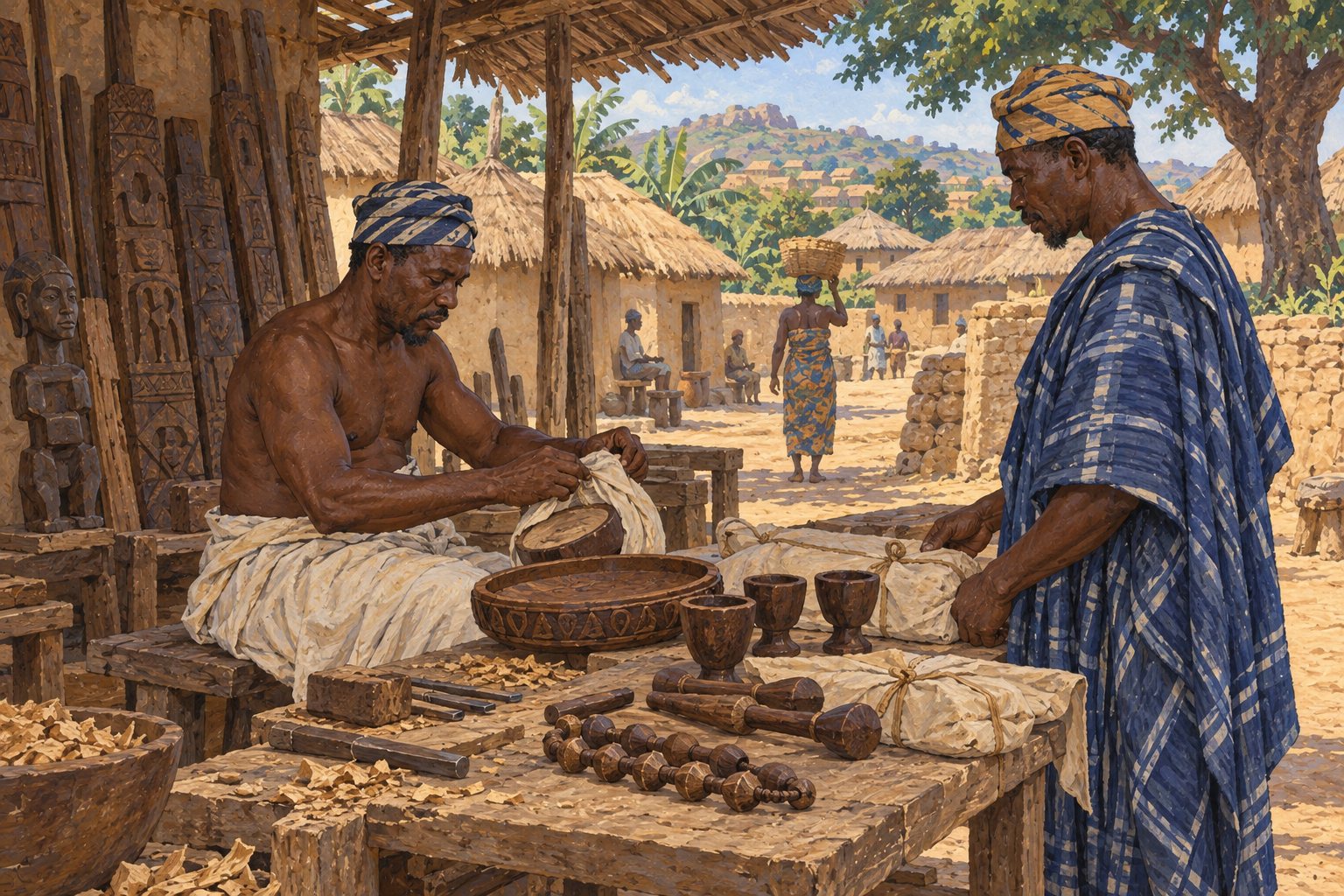
The Carver’s Bill
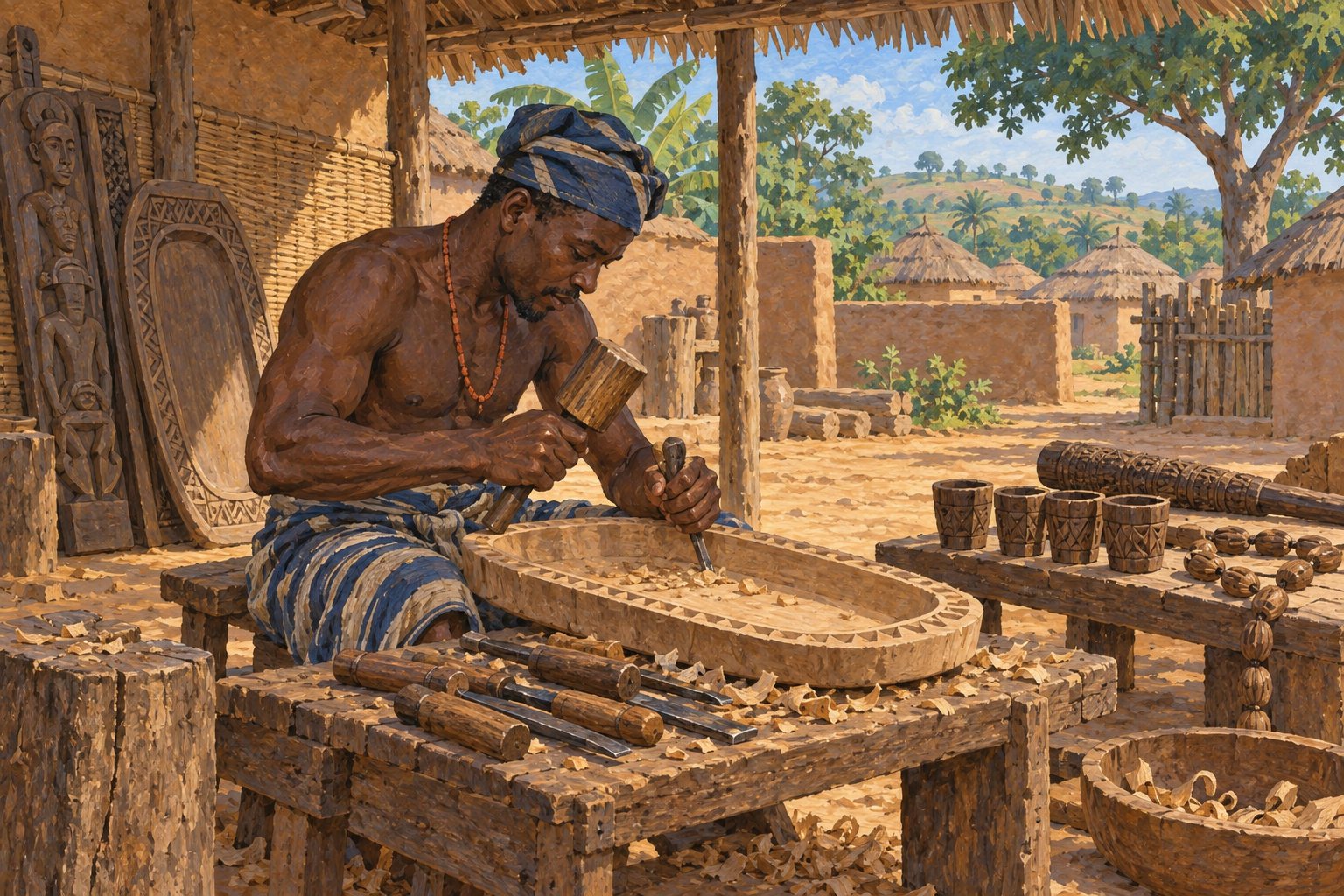
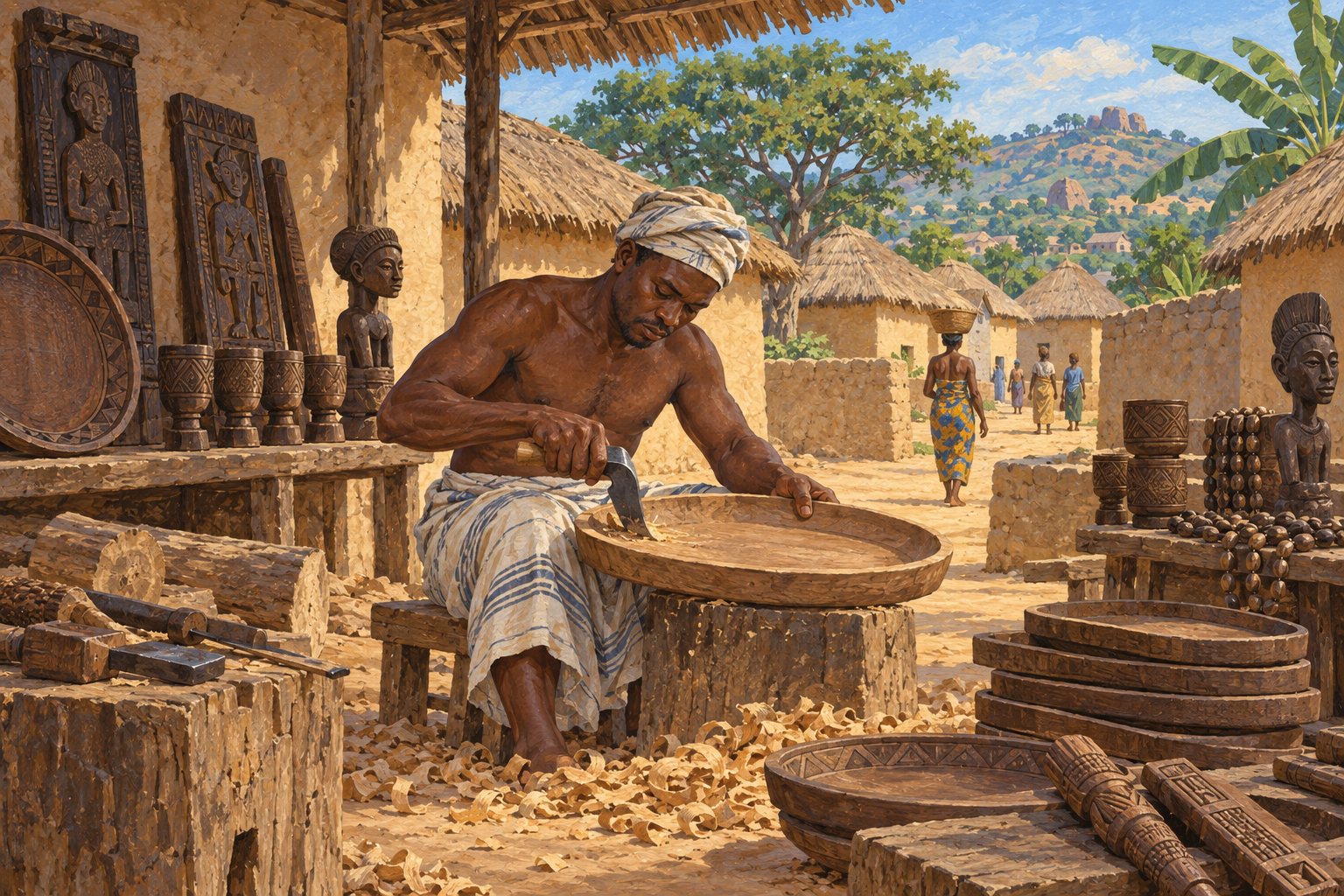
The system’s hardware was a paid trade: opon trays, agere cups, iroke tappers and opele chains came from professional carvers whose names and workshops the art history preserves — Areogun of Osi-Ilorin, Olowe of Ise, whose own praise-poetry records his royal commissions — and the trade is old, because the Ulm tray was valuable enough to cross the Atlantic into a merchant’s cabinet by 1659; today the same objects sit in museum catalogues and at auction, and the chapter prints only documented prices with their dates and sources, or prints UNVERIFIED.
Explore the illustrations6 scenes · The Carver’s Workshop
The Carver’s Workshop. The system’s hardware was a paid trade: opon trays, agere cups, iroke tappers and opele chains came from professional carvers whose names and workshops the art history preserves — Areogun of Osi-Ilorin, Olowe of Ise, whose own praise-poetry records his royal commissions — and the trade is old, because the Ulm tray was valuable enough to cross the Atlantic into a merchant’s cabinet by 1659; today the same objects sit in museum catalogues and at auction, and the chapter prints only documented prices with their dates and sources, or prints UNVERIFIED.
Changes and divisions
The Fall of Oyo, and the Ships
In the early nineteenth century the Oyo empire came apart — Ilorin revolted under Afonja, passed to a Fulani emirate, and Oyo-Ile itself was abandoned, conventionally dated to the mid-1830s — and the wars that followed fed the last great wave of the Atlantic trade, which carried enslaved Yoruba in their tens of thousands to Cuba and Brazil precisely in the decades when the trade elsewhere was dying; the numbers come from the shipping database and are estimates built from ports and ethnonyms — Lucumí in Cuba, Nagô in Brazil — and are labelled as such; among the transported were trained diviners, which is the single most consequential fact in this volume: the machine’s storage medium is a person, and the ships were loading it.
The Mission and the Mosque
The homeland divided confessionally without ever quite dividing in practice: over the twentieth century most Yoruba became Christians or Muslims — the mission working through returned recaptives like Crowther, whose Yoruba Bible made the language a literary one, Islam growing from older northern roots — yet consultation of Ifá persisted across both memberships, documented from the mission journals onward, so the split here is not schism but layering: exclusive confessional identity above, a shared diagnostic practice below, and the volume reports that arrangement in the present tense because it continues; Peel’s argument that the encounter itself helped make “the Yoruba” a self-conscious people is printed as his, with his name on it.
Limits of the evidence
These limits are stated in the book before its argument.
- The age of Ifá Archaeology establishes a court and a workshop tradition at Ile-Ife, conventionally dated between the eleventh/twelfth and fifteenth centuries; nothing establishes when the 256-odu system took its present form. The earliest datable piece of the apparatus is a carved divination tray in a German cabinet of curiosities, catalogued in 1659; the earliest descriptions of the system at work are later still. Between the tradition’s claim that Orunmila taught divination at Ife and the first dated object stands more than half a millennium, and the volume keeps the two in separate sentences every time.
- Whether the sixteen-figure system is indigenous or arrived with Islamic geomancy The family resemblance to 'ilm al-raml — sixteen binary tetragrams, from the Sahel to Madagascar — is real and is contested in both directions by named scholars. The volume reports the argument and settles nothing.
- The extent of the corpus No total count of ese is possible even in principle: verses vary by lineage, region and diviner, and every recorded collection is a snapshot of one diviner’s holdings at one date. The tradition’s own totals are large, round and vary between tellers; they are printed only as the tradition’s numbers.
Sources and reading
This article brings together the series’ existing overview and chapter summaries. The linked book page provides the full outline and bibliography.
- British Museum later account of the Wunmonije cache; object Af1939,34.1find January 1938; accession 1939. five copper heads, twelve brass, one half-figure; one brass head in London
- Leo Frobenius, The Voice of Africa1913 English. the Olokun head as Poseidon; the Atlantis claim quoted because the mistake is the evidence
- Frank Willett, Ife in the History of West African Sculpture1967. the finds, the dispersal, the twelfth-to-fifteenth-century dating; pavements and walls
- Suzanne Preston Blier, Art and Risk in Ancient Yoruba2015. current dating; the unresolved argument about what the heads were for
- Abidemi Babatunde Babalola, Susan Keech McIntosh, Laure Dussubieux and Thilo Rehren, Igbo Olokun report, Antiquity 912017. locally made high-lime high-alumina glass; radiocarbon 1058–1264 and 1304–1423
- Samuel Johnson, The History of the Yorubaswritten 1897; published 1921. Ife creation and migration versions; Oyo constitution and Sango; the wars’ end — an Oyo-partisan clergyman, named as such
- E. Bolaji Idowu, Olodumare: God in Yoruba Belief1962. formulaic counts (“many, and one more”); ori; the chain-and-cockerel creation
- William Bascom, Ifa Divinationfieldwork 1937–38; book 1969. Orunmila’s office; dated Ife client list; figure names and rank orders; chain and nuts; whispered-question protocol; training spans; fees in pence and shillings; verses as a snapshot
Illustrations are newly generated interpretations of themes in the book. They are not surviving artifacts, historical photographs or evidence for the events described.