17 illustrations · 2:09
Watch & listen.
Follow the images with a narrated journey through the book.



Overview
- Coverage
- 8th c.–present
- Earliest secure evidence
- 8th c. CE
- Transmission
- the order as a franchise
Hallaj is split into chronicle versus compilation. Hujwiri will not ban him and will not approve him. Rumi domesticates the scaffold by putting it in verse. Later jurists quote the charge. Later demolitions quote the charge again, with bulldozers.
The coverage period and the earliest secure evidence are different dates. A tradition’s own account of its beginnings may differ from both.
Historical setting
Three Memberships
The most venerated Sufi in the world was a Hanbali jurist — Abd al-Qadir al-Jilani preached law in Baghdad — and that is the framing fact the whole volume hangs on: a Muslim holds a school of law, a sect, and an order as three separate memberships, so Sufism is not a denomination beside Sunni and Shia Islam but a set of methods and institutions inside both; the popular Western picture — a poetry-and-tolerance package with the institutions removed — is named on page one as the thing this book corrects, by describing the institutions.
The Preacher of Basra
Basra in Hasan al-Basri’s lifetime (conventionally d. 728) was a garrison boomtown swollen with conquest revenue, and the renunciant style he came to stand for — coarse dress, weeping, contempt for the new wealth — answers that room; but the sentence carries the caveat: his sermons and sayings reach us in compilations assembled generations later, later movements from the Mutazila to the Sufi orders all claimed him as a founder, and the scholarship contests how much of the corpus is his.
Explore the illustrations6 scenes · Rooms of the Lodge
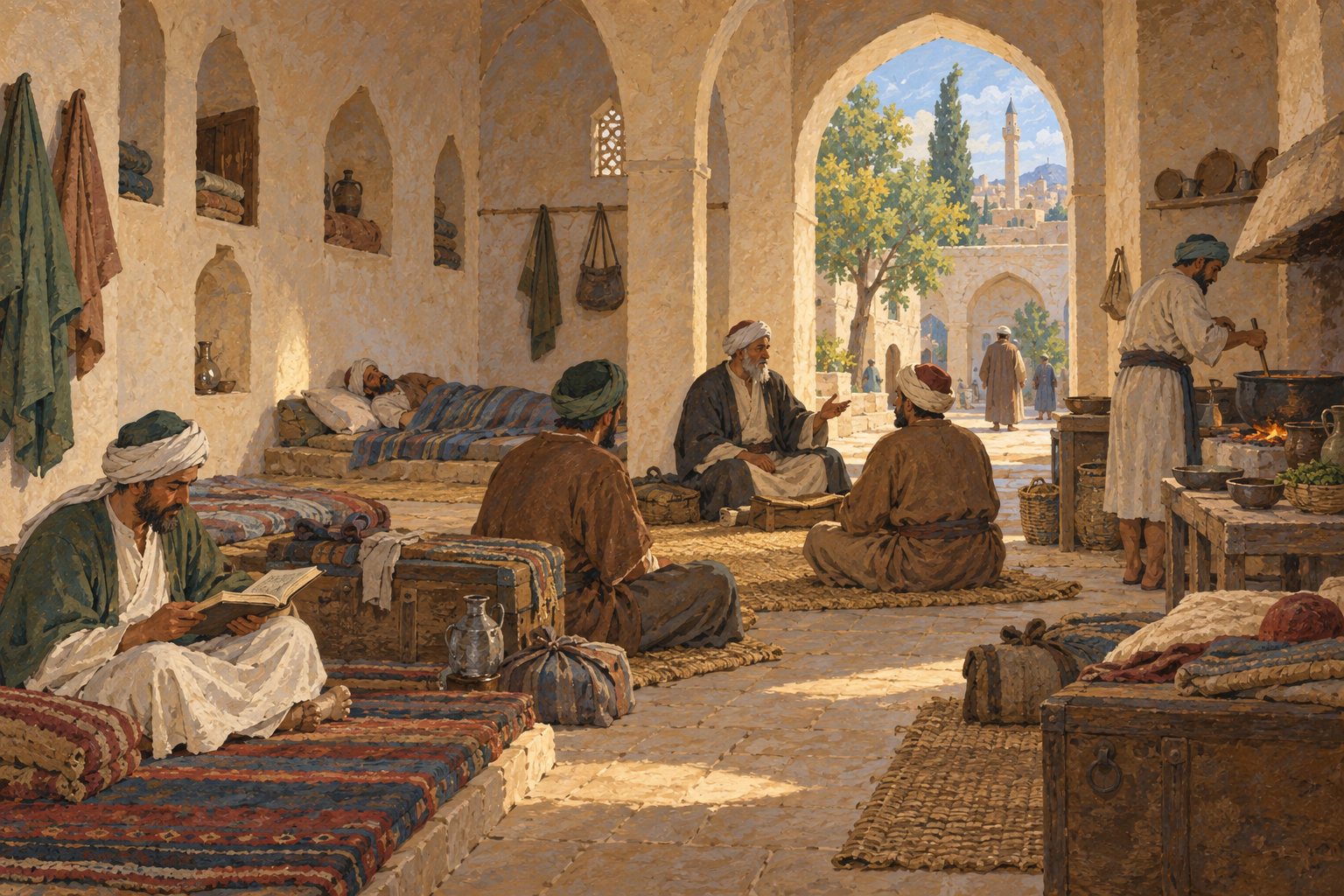
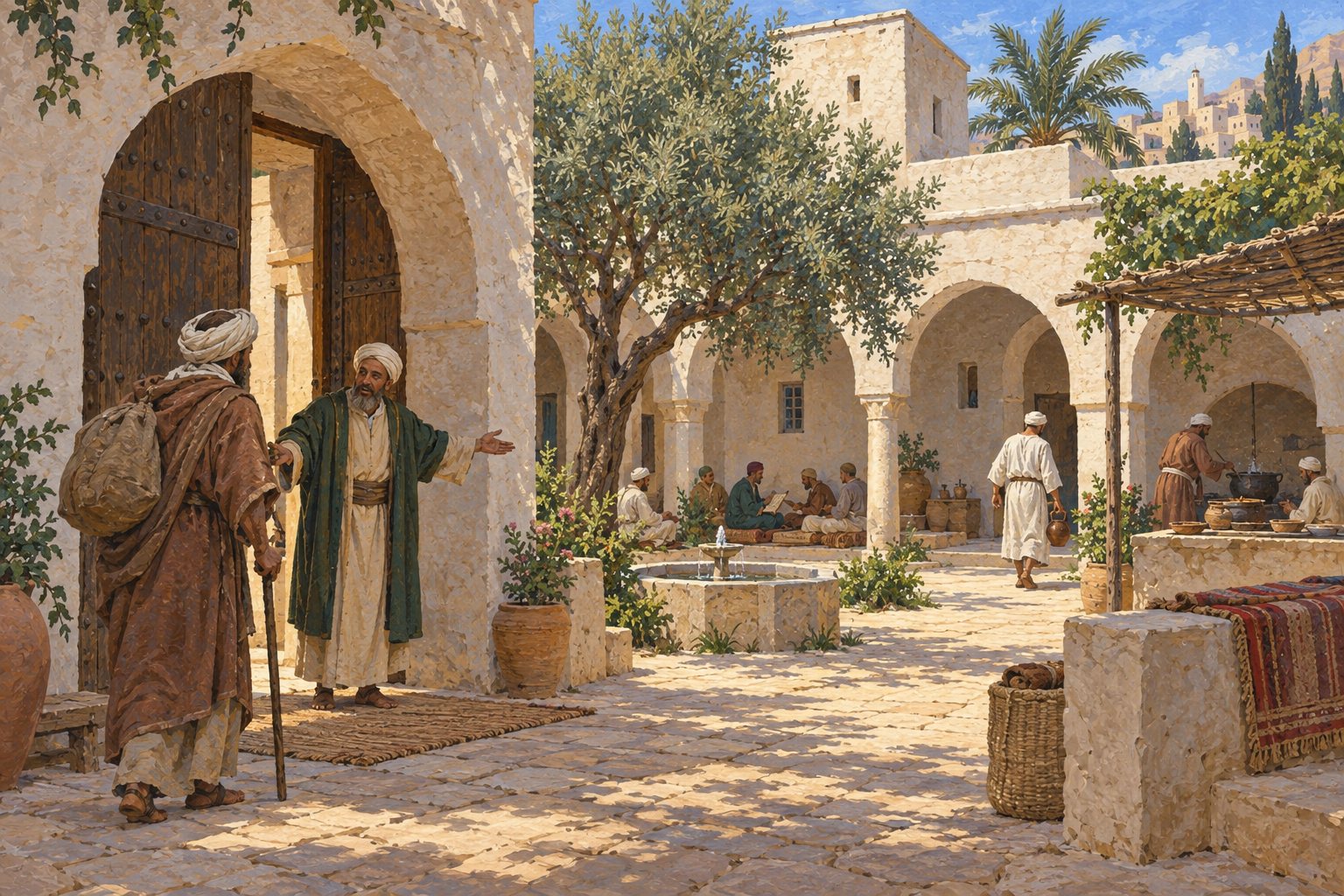
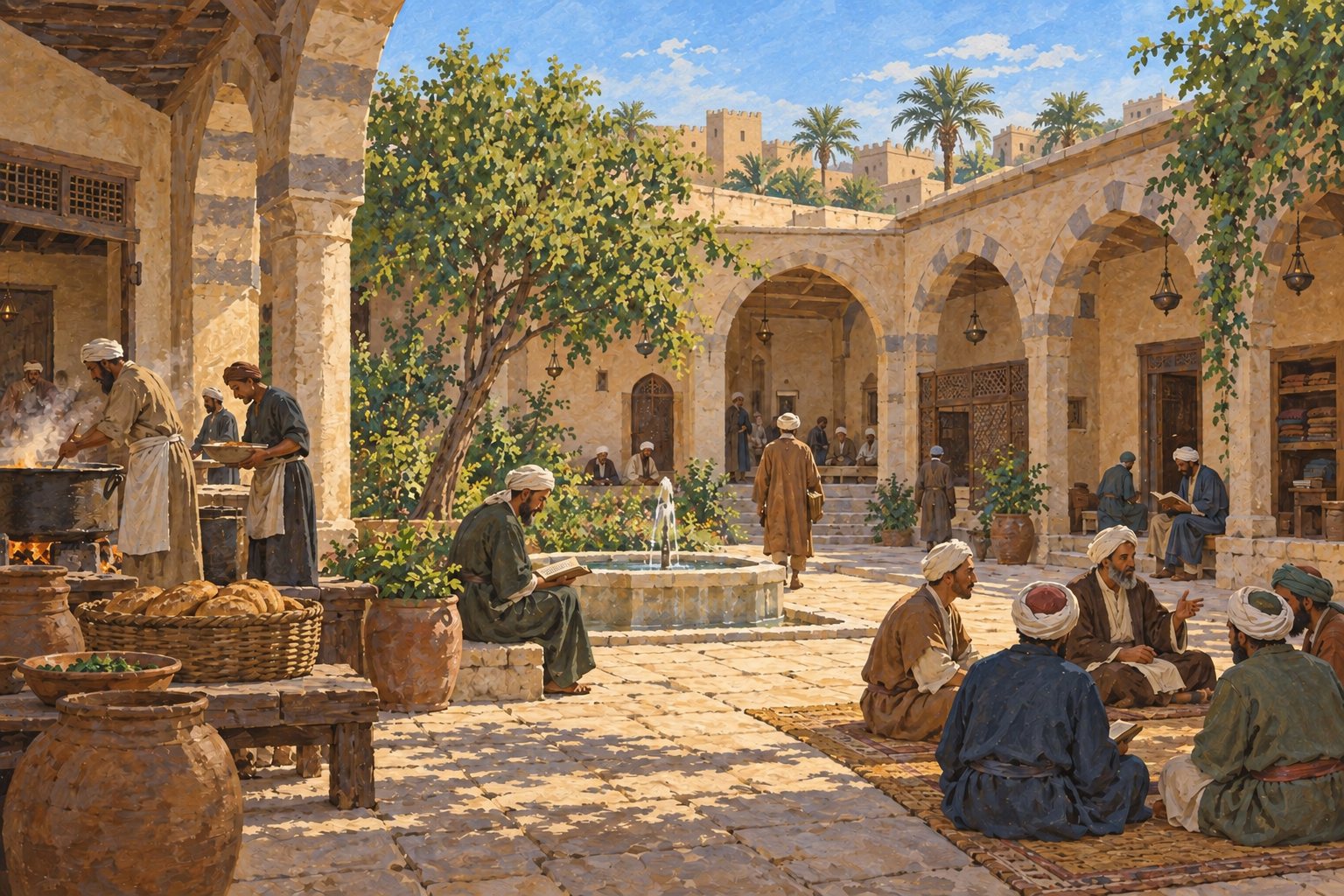
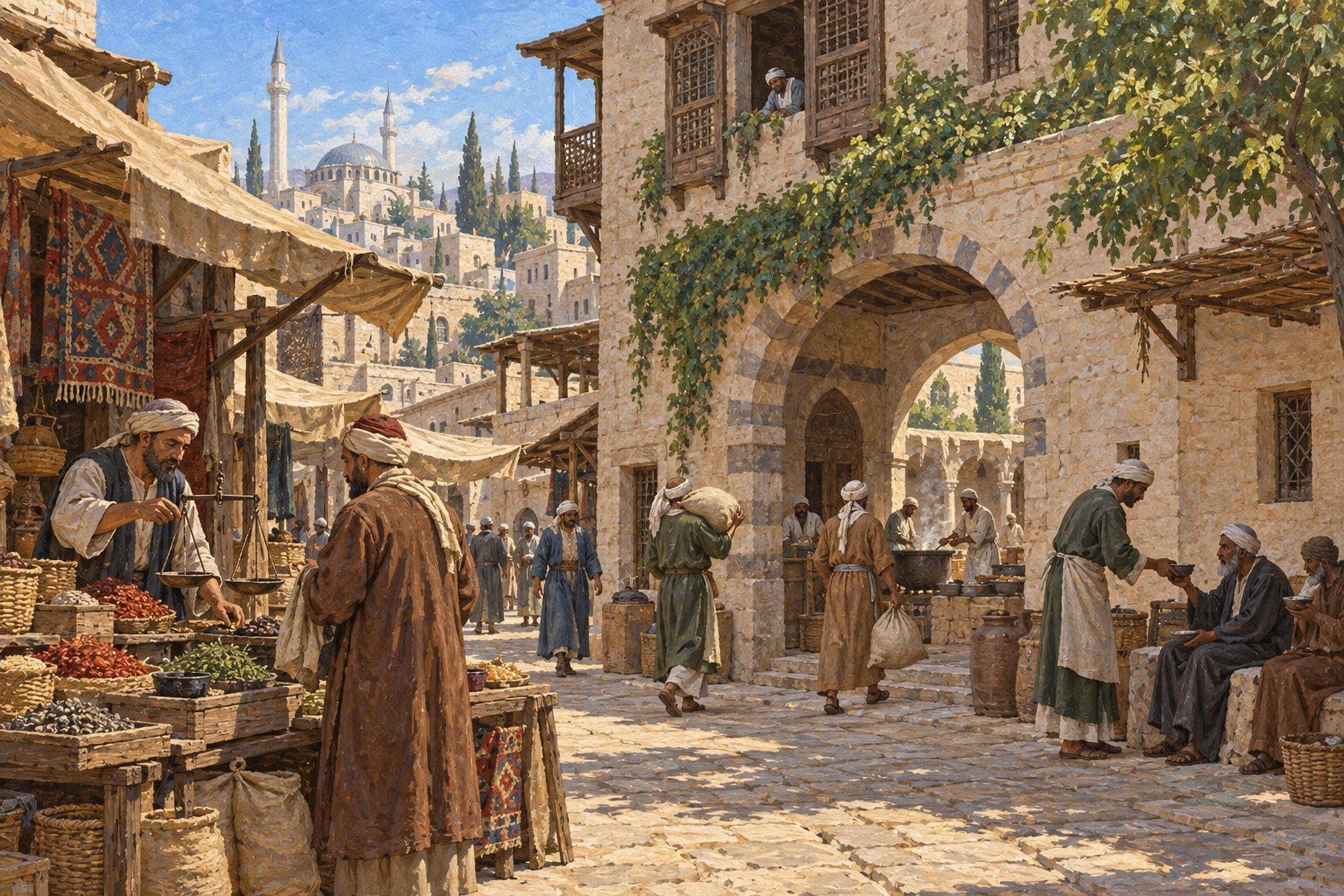
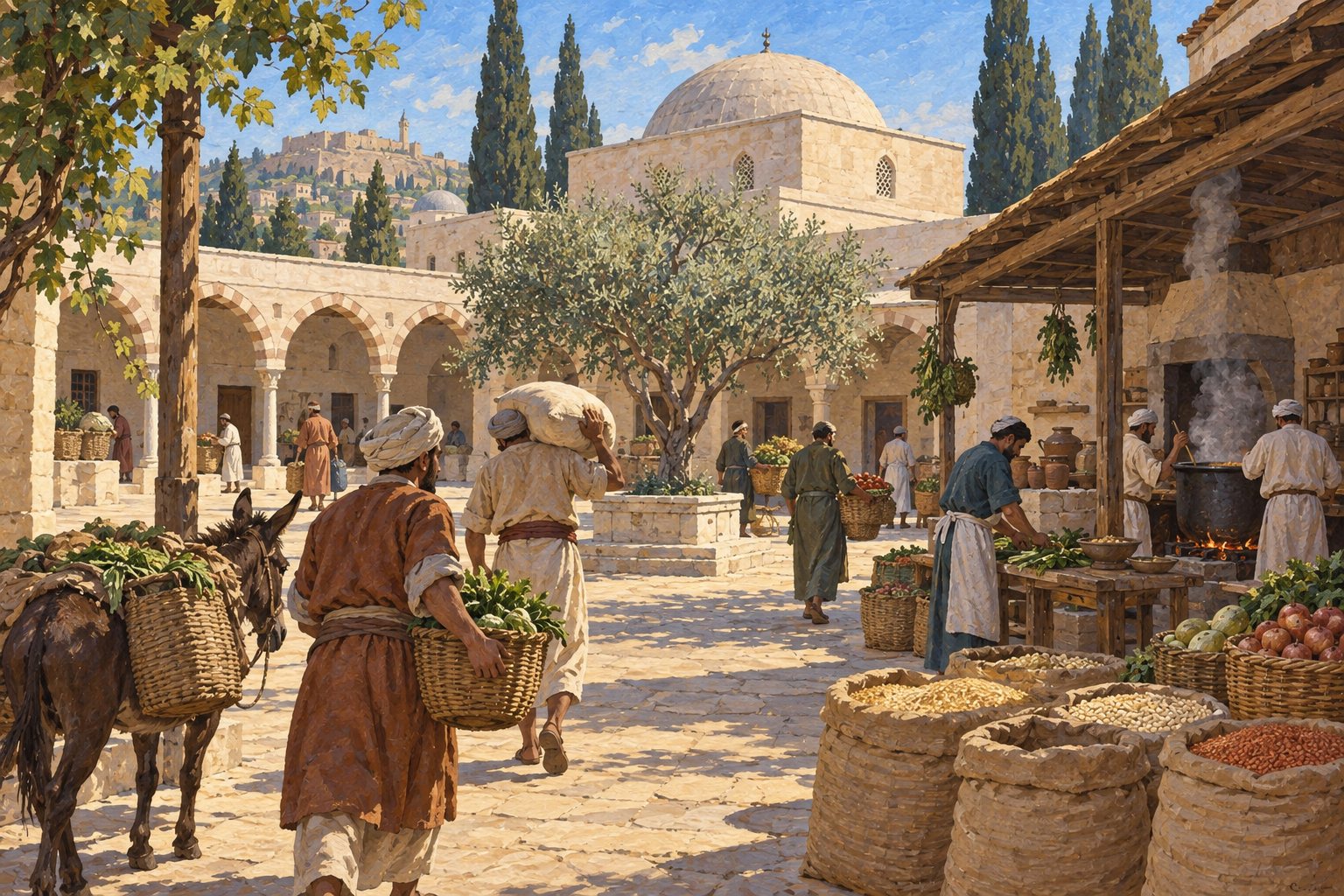
Rooms of the Lodge. The package lands in a building, and the building’s name changes with the language while the institution does not — khanqah in the Persian east, ribat and zawiya in the Arab lands and the Maghreb, tekke in Turkish, dargah where a tomb anchors it in South Asia — which is the distribution map written into vocabulary; the lodge is residence, kitchen, school, hospice and stage in one endowed plant, it had a written rulebook, and a Cairo example shows the state building the plant deliberately: Saladin founded the Sa’id al-Su’ada in 1173 with stipends for resident Sufis, the tradition’s figure of three hundred printed as the tradition’s.
How it was transmitted
The Chain
Every order’s authority is a recited list of names — the silsila, running from the living shaykh back through the eponym, through Junayd, to a companion of the Prophet and so to the Prophet himself — and it is structurally the same idea as the isnad, which the Sunni and Shia volume owns, with one decisive difference: it authenticates persons and practices rather than reports, so what travels down it is not a text but a licence to transform people; the links back to the mid-ninth century join men who demonstrably lived, the earlier links cannot be established and scholars treat them as retrospective, and the chapter uses the chain the way this volume always will — as evidence of what an order claimed.
The Method
What a chain licenses is a method — a defined dhikr, the repetition of divine names counted, timed and breathed in the order’s own way — and the method is the product that differentiates one franchise from another: the Naqshbandi silent dhikr with its enumerated principles (“solitude in the crowd”, khalwat dar anjuman, in the order’s own Persian), the Mevlevi turning ceremony codified generations after Rumi, the Rifai loud dhikr that travellers reported with amazement, the Shadhili litanies a member could carry through a working urban life; the warrant every order cites is the same Qur’anic instruction, and the differentiation on top of it is where the machinery lives.
Explore the illustrations5 scenes · Cloak and Licence
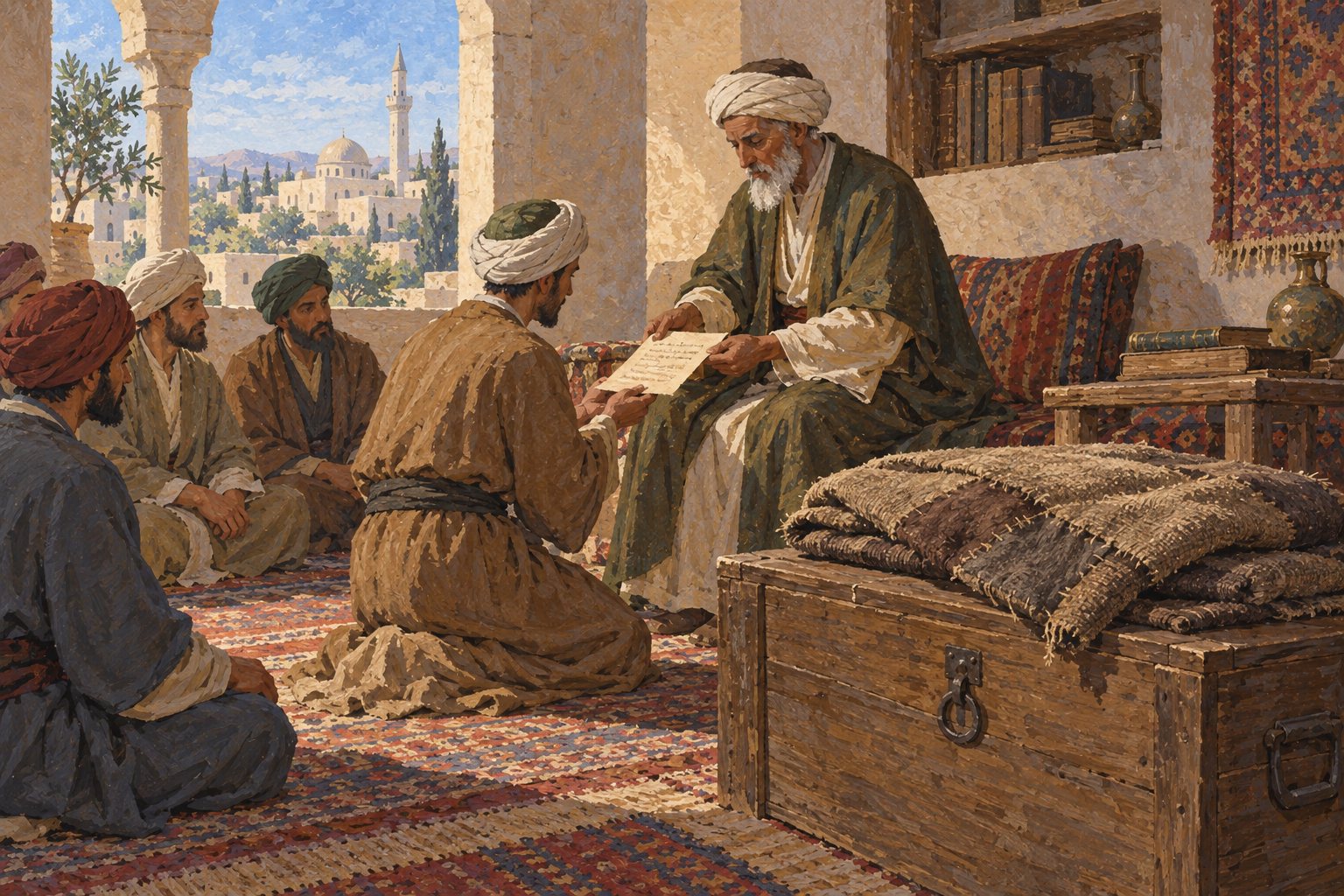
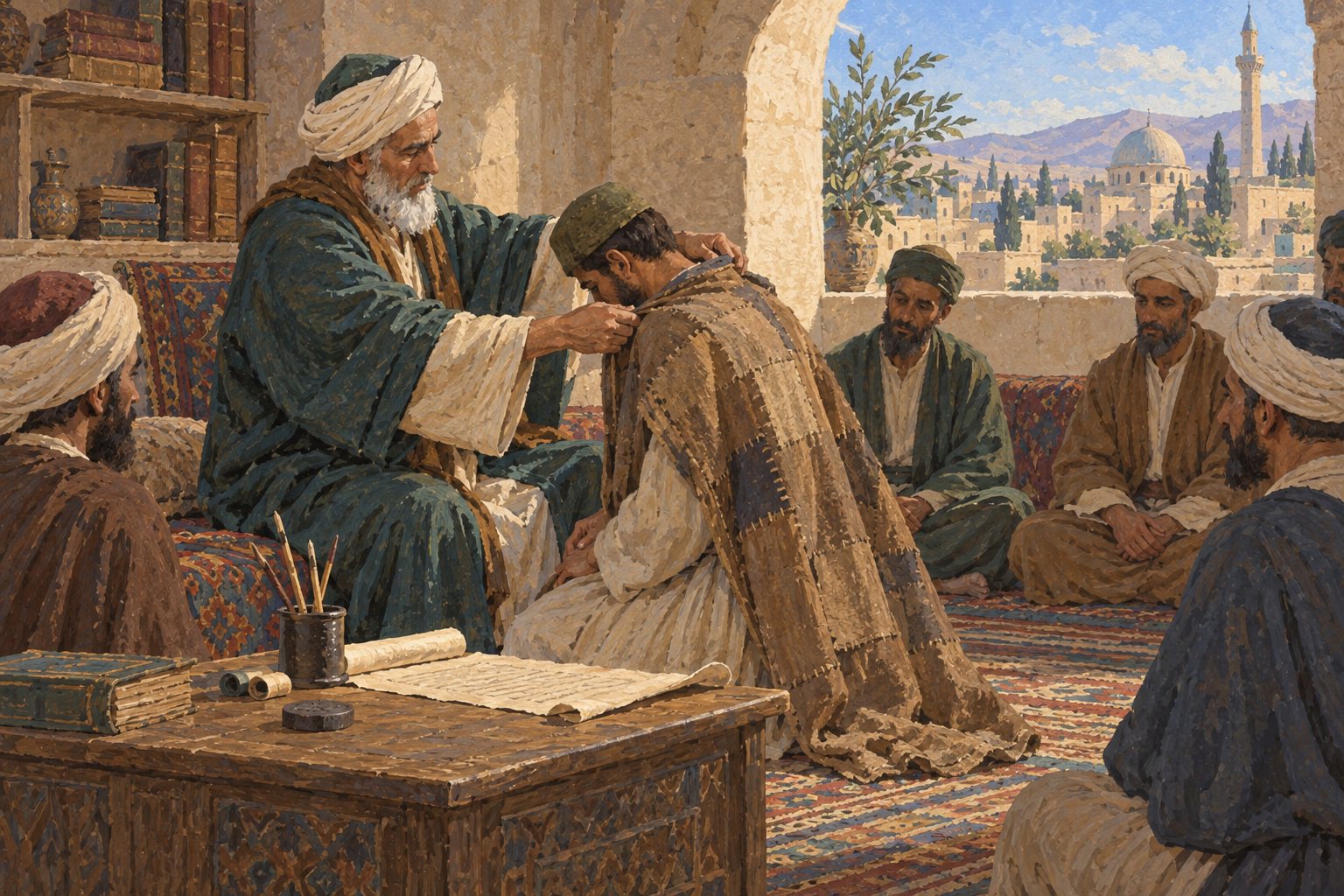
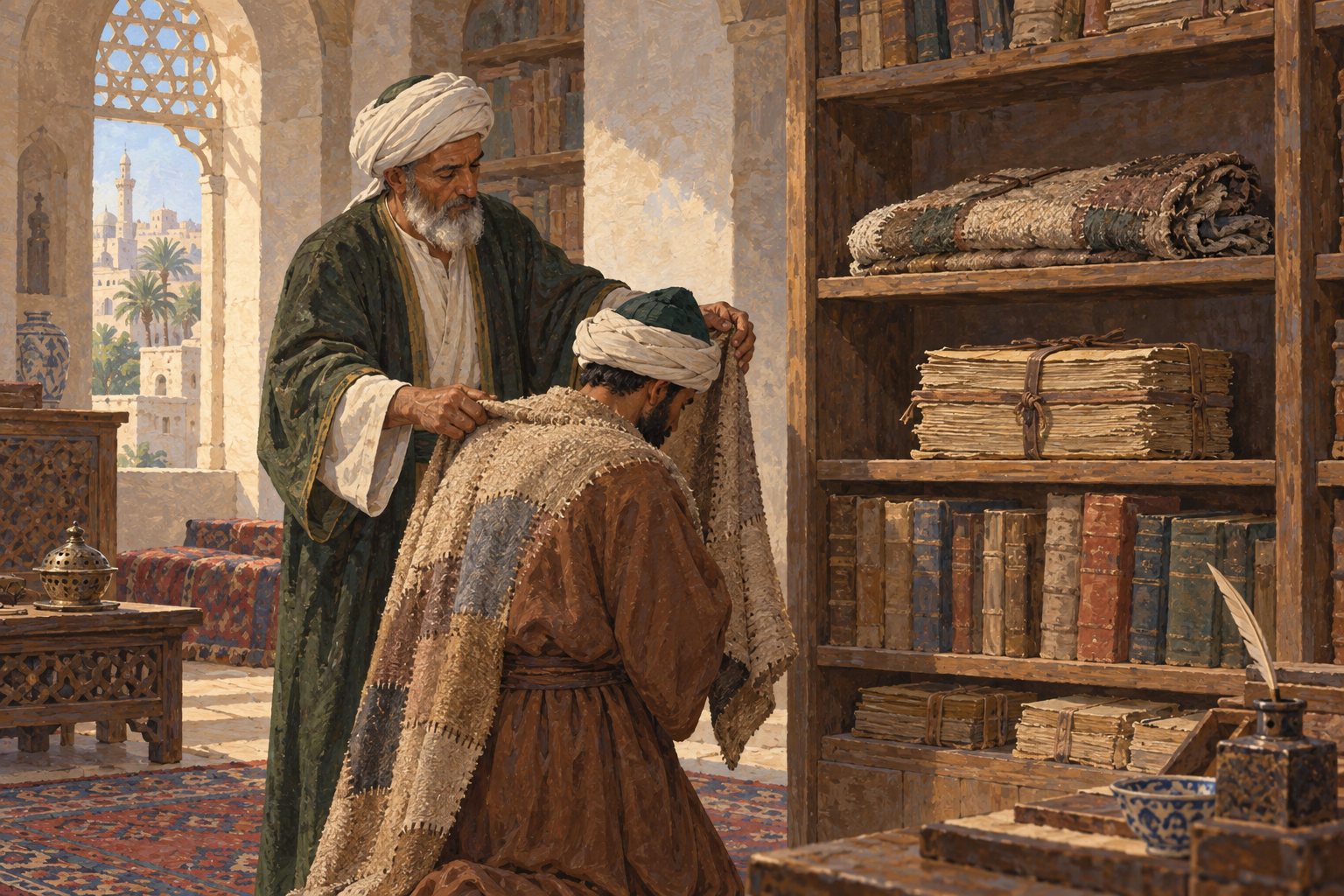
Cloak and Licence. The franchise replicates by investiture — the patched cloak (khirqa) laid on a disciple, the written ijaza or khilafat-nama that licenses him to initiate others, granted by an existing shaykh and by no one else — and this is the machine’s genius and its whole governance: there is no headquarters to consult and none to rebel against, a khalifa dispatched to a new city is a complete, self-certifying copy of the order, and the same mechanism that made expansion effortless made schism painless, because a disputed succession simply produces two lineages, both documented, both valid by their own chains.
Texts and authority
A Canon With No Closer
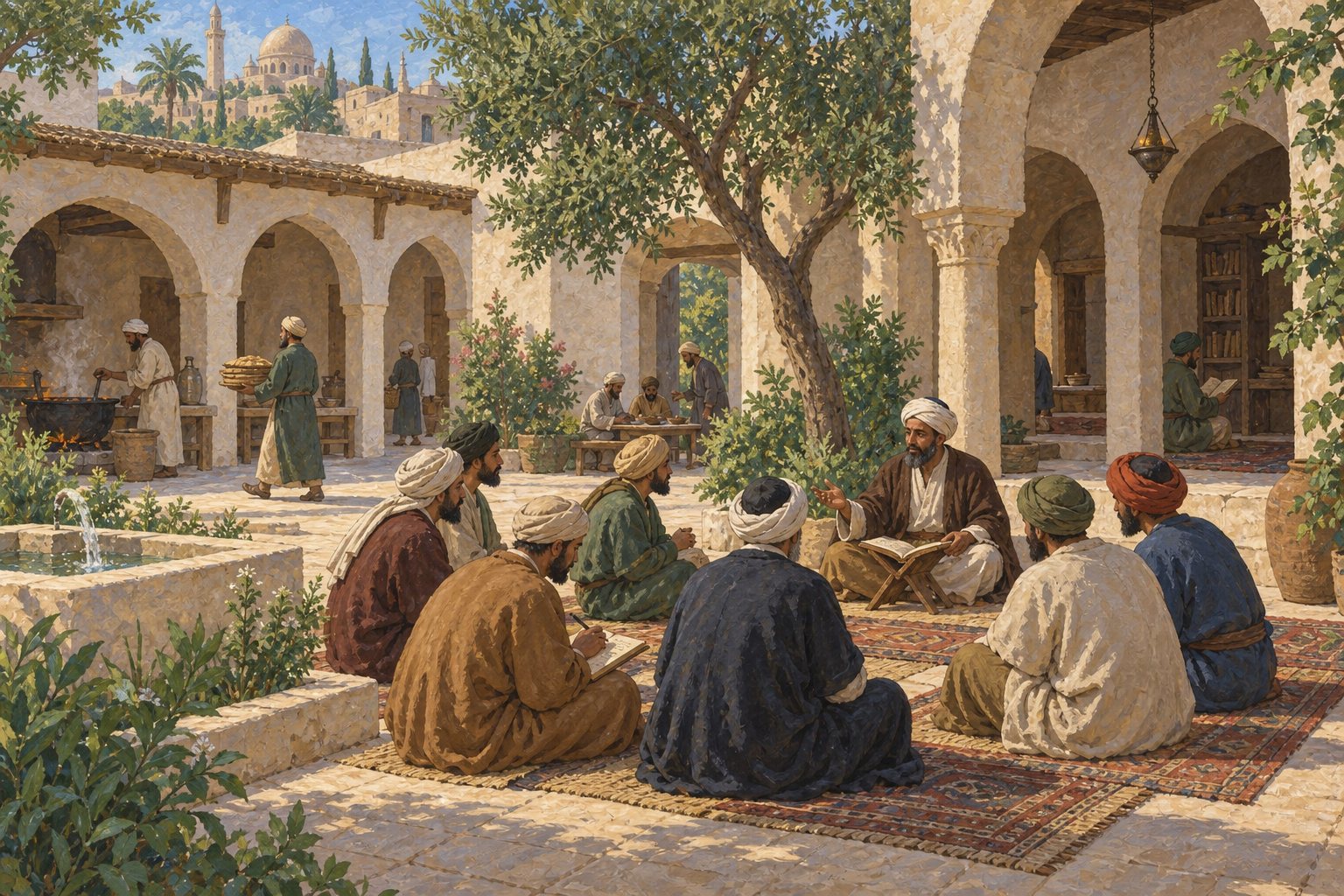
Sufism never produced a scripture, a creed or a council, and could not have — its warrant was the Qur’an, which the Islam volume owns, and its authority structure was ten thousand independent chains with no synod above them — so the canonical function was performed by three substitute genres, each solving a different problem: manuals to prove respectability, poetry to carry the teaching across languages, and saints’ lives to underwrite the shrines; the chapter states the argument and the cost, which is that a canon nobody can close is also a canon nobody can defend a border of, and every later fight in Movement Five is downstream of that.
The Manuals
Between the late tenth and mid-eleventh centuries the discipline wrote itself a defensive literature — al-Sarraj’s Kitab al-Luma' (author d. 988), al-Kalabadhi’s Ta’arruf, al-Qushayri’s Risala (which dates itself; verify the year before print), and Hujwiri’s Persian Kashf al-Mahjub — codifying the path as a ladder of stations earned and states bestowed, precisely so the jurists could inspect it; the codification is the institutional event: a discipline that writes its own syllabus and its own limits is applying for a place inside orthodoxy, and the application, though never formally granted, was never formally refused.
Institutions and resources
The Deed That Outlives Everyone
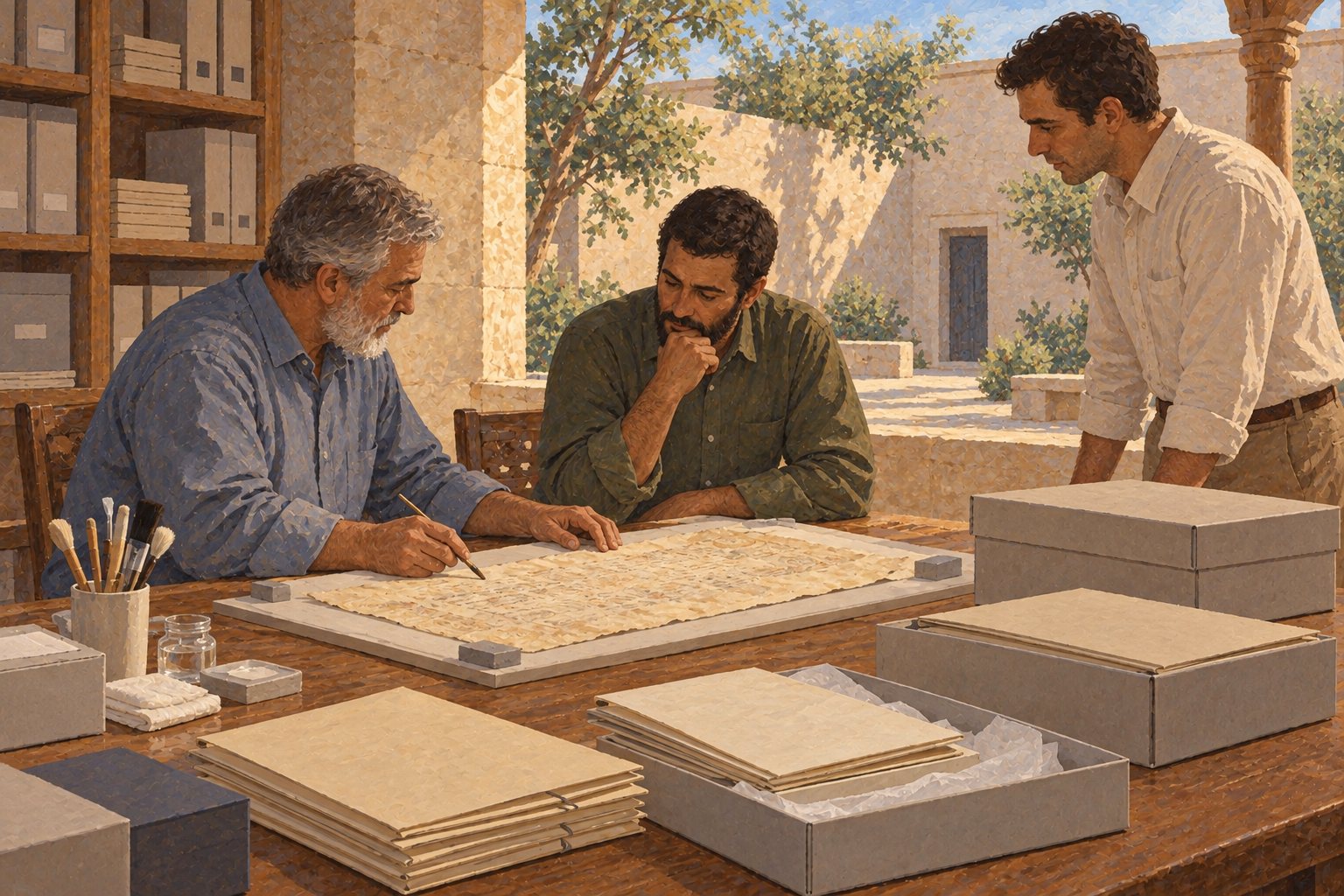
The waqf is a legal machine for making charity immortal — property deeded before a judge, its revenue assigned to named purposes in perpetuity, inalienable and, in principle, beyond confiscation — and it is what turned the Sufi package from a teaching into an estate: a lodge with a waqf can feed disciples, pay a shaykh and survive its founder indefinitely; the chapter anatomises one surviving deed clause by clause, and then states the limit of the record plainly — a deed is a donor’s promise, not an institution’s accounts, the famous claims about what share of Ottoman land was waqf are contested and head this series’ verification backlog, and the sentence prints the contest, or UNVERIFIED, never a round number.
The Traveller Checks In
The best surviving audit of the lodge network is a user’s — Ibn Battuta crossed the Islamic world in the fourteenth century sleeping and eating in Sufi hospices from the Maghreb to India, and his Rihla records what the endowments actually bought: lodging assigned by home region in Cairo, stipends, food, sweets money and clothing for resident Sufis, a functioning long-distance hospitality system that made the network self-provisioning for any traveller who could recite the right affiliations; the caveat travels with the witness — the Rihla was dictated years later, borrows from earlier travellers in places, and is one man’s memory of a continent — and the chapter uses it as what it is, the period’s only network-wide receipt.
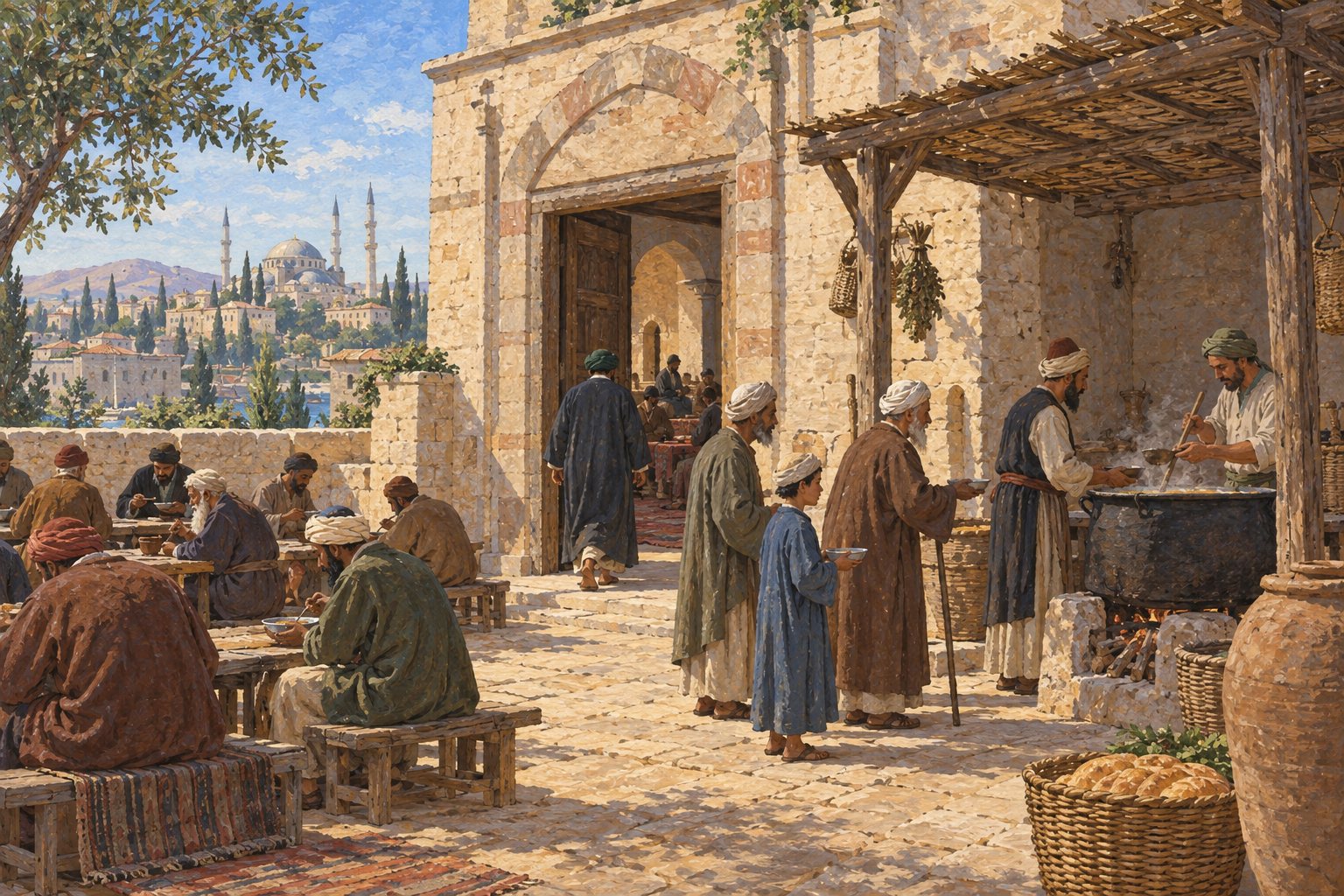
Explore the illustrations6 scenes · A Deed and a Kitchen
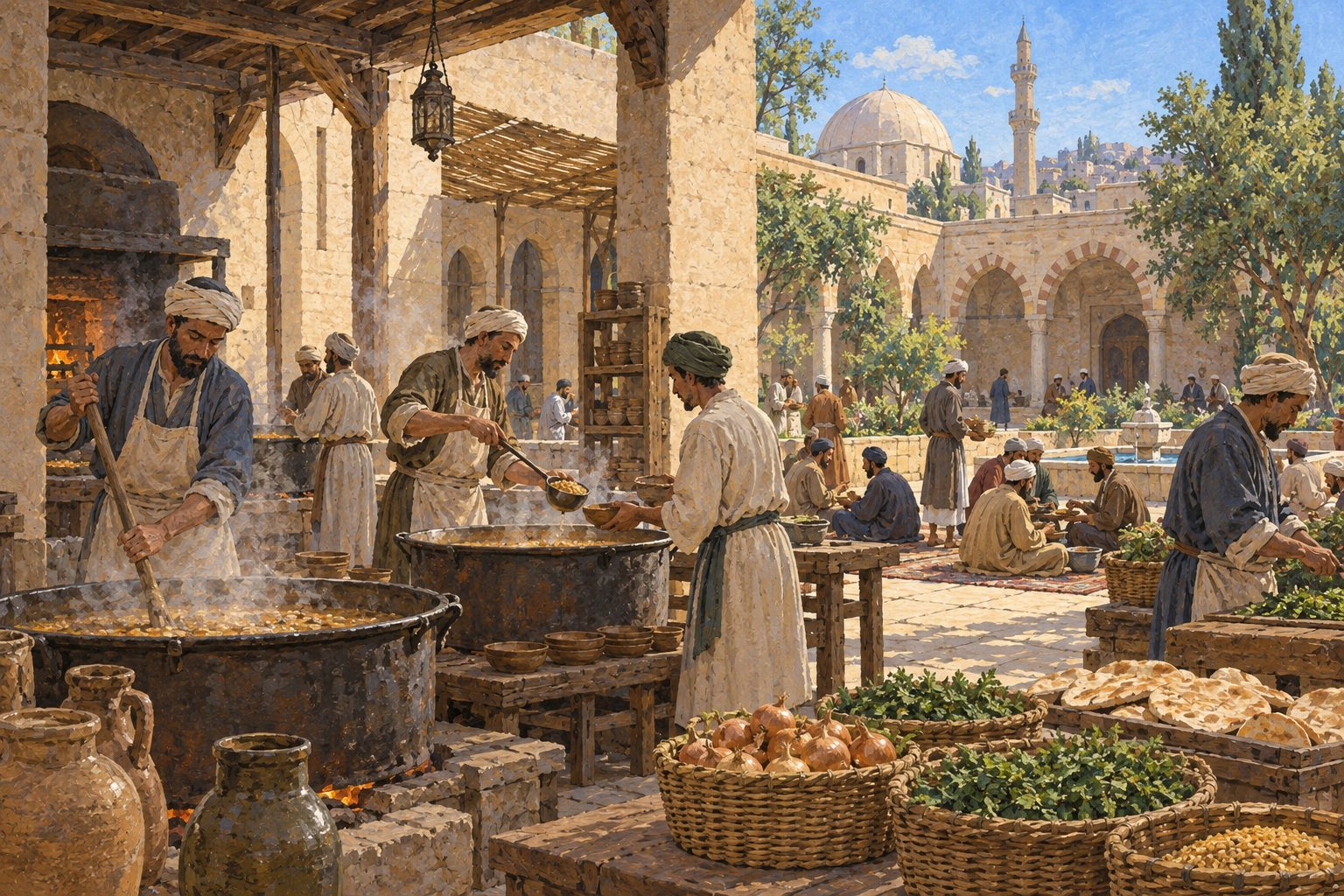
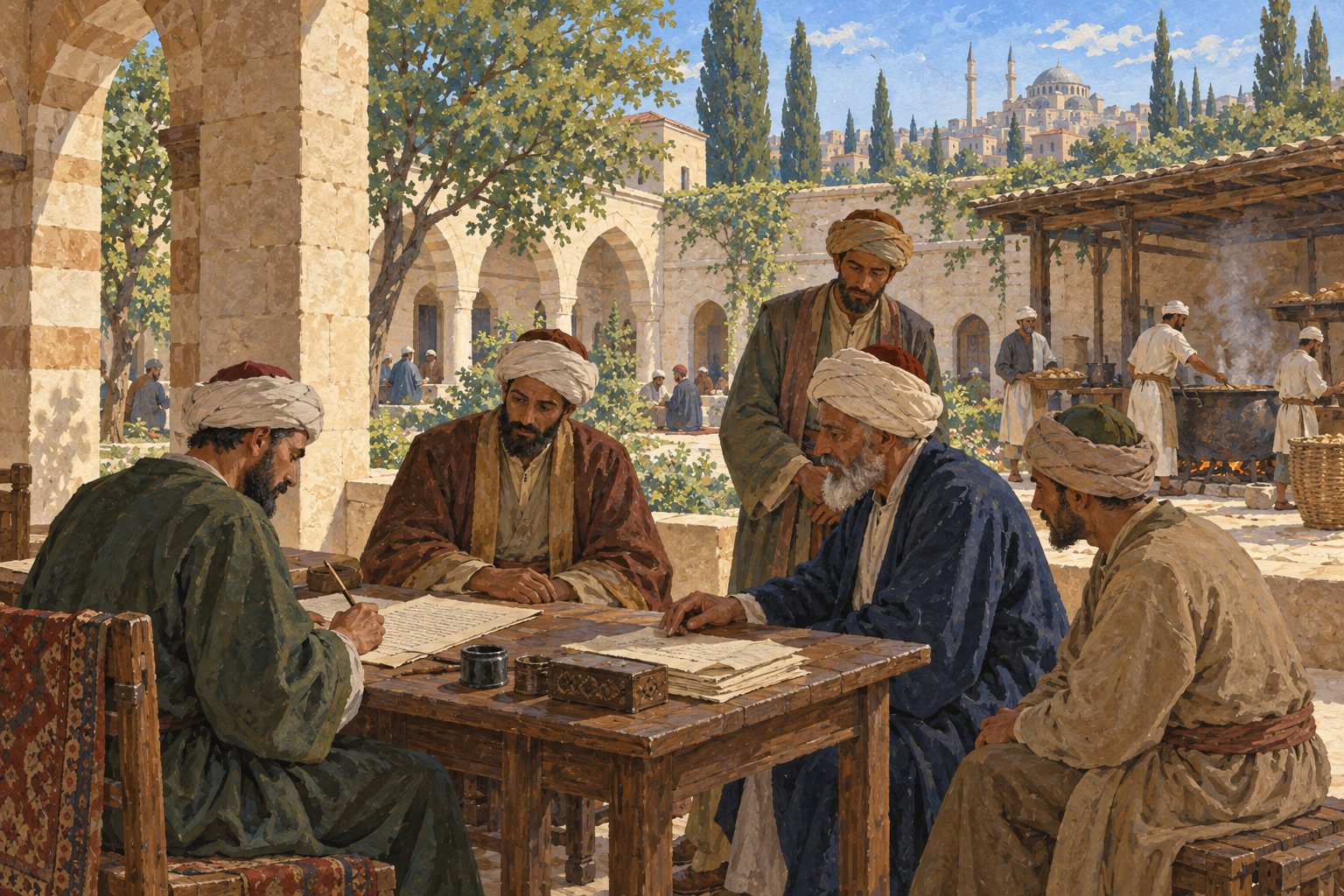
A Deed and a Kitchen. The waqf is a legal machine for making charity immortal — property deeded before a judge, its revenue assigned to named purposes in perpetuity, inalienable and, in principle, beyond confiscation — and it is what turned the Sufi package from a teaching into an estate: a lodge with a waqf can feed disciples, pay a shaykh and survive its founder indefinitely; the chapter anatomises one surviving deed clause by clause, and then states the limit of the record plainly — a deed is a donor’s promise, not an institution’s accounts, the famous claims about what share of Ottoman land was waqf are contested and head this series’ verification backlog, and the sentence prints the contest, or UNVERIFIED, never a round number.
Changes and divisions
The Scaffold at Baghdad
In March 922 the Abbasid state executed the Sufi al-Hallaj after years of imprisonment and a trial the sources describe differently — the chronicles are closest to the event, the charge they report turns on his writings about substituting devotions for the hajj, while the Sufi tradition remembers the ecstatic utterance ana al-haqq, “I am the Truth”, transmitted in its own compilations rather than the trial record — and the execution crystallised the question the tradition never afterwards escaped: whether words spoken from inside the mystical state are testimony, blasphemy, or a category the law cannot reach; the chapter reports the event, the spread of the charges, and the fact that his tomb became a shrine.
The Drunk and the Sober
The argument that followed ran inside the tradition before it ever ran against it — the manuals framed it as sobriety against intoxication, Junayd’s school against Bistami’s sayings and al-Hallaj’s fate, and Hujwiri says plainly which side he judges sounder; the ecstatic utterances were not suppressed but curated: collected, glossed and defended in Ruzbihan Baqli’s commentary, domesticated into poetry where Rumi could invoke al-Hallaj safely, and fenced with the manuals’ doctrine that a state is bestowed, not claimed — so the tradition’s own answer to its hardest case was editorial rather than judicial, which is what a community without a magisterium has instead of a verdict.
Limits of the evidence
These limits are stated in the book before its argument.
- A founding date This is one of the traditions with no defensible single ignition, and the front matter prints the double date: the orders’ own genealogies reach back to the Prophet’s companions; the earliest secure attestation is of eighth-century renunciants and a ninth-century name, and the institutions this volume is about are twelfth-century. Even the name’s origin cannot be established — the classical manuals themselves survey the etymologies of sufi and reject most of them, and that disagreement is printed as what it is: the tradition’s own admission that its beginning was already out of reach a thousand years ago.
- The first two centuries of named figures, beyond a hard minimum Hasan al-Basri’s sayings reach us in compilations assembled generations later, and modern scholarship contests how much of the corpus is his; Rabia al-Adawiyya’s connected biography is essentially Attar’s, written about four centuries after her conventional death date, and what earlier notices establish is very small. Both chapters say so in the sentence, not in a note.
- Any silsila’s early links, as history The chains that carry every order’s authority run from twelfth-century founders back through Junayd to the Prophet’s companions. The links from the mid-ninth century forward connect people who demonstrably lived and in some cases demonstrably met; the earlier links are the orders’ own genealogies, and scholars treat them as retrospective. This volume uses a chain as evidence of what an order claimed — which is the use that matters institutionally — and never as a verified pedigree.
Sources and reading
This article brings together the series’ existing overview and chapter summaries. The linked book page provides the full outline and bibliography.
- Hujwiri, Kashf al-Mahjub, Nicholson’s rendering11th c.; Nicholson 1911. etymologies that fail; Sufism not a sect; sama; Hallaj treated with sympathy and anxiety
- Pew Research Center, The World’s Muslims: Unity and Diversity2012. self-identification with a Sufi order, by country — not counted initiations
- Carl Ernst, The Shambhala Guide to Sufism1997. nineteenth-century European coinage of “Sufism” as an -ism detached from Islam
- Tradition’s biographies of Abd al-Qadir al-Jilanideath conventionally 1166. a Hanbali chair at Baghdad; the Qadiriyya organised by sons
- Suleiman Mourad, Early Islam between Myth and History2006. Hasan al-Basri as a substantially retrospective construction
- Ahmet Karamustafa, Sufism: The Formative Period2007. the zuhd-to-tasawwuf arc; map of ninth-century schools
- Christopher Melchert, articles on early renunciantsnamed. Basran zuhd as a style, not yet an order
- J. Spencer Trimingham, The Sufi Orders in Islam1971. khanqah–tariqa–ta’ifa stages; retrospective character of early silsila links
Illustrations are newly generated interpretations of themes in the book. They are not surviving artifacts, historical photographs or evidence for the events described.