126 pages, 5.5 × 8.5 in. Three or more volumes in one order and every copy drops to $11.99.
United States, 8 to 11 days. All destinations
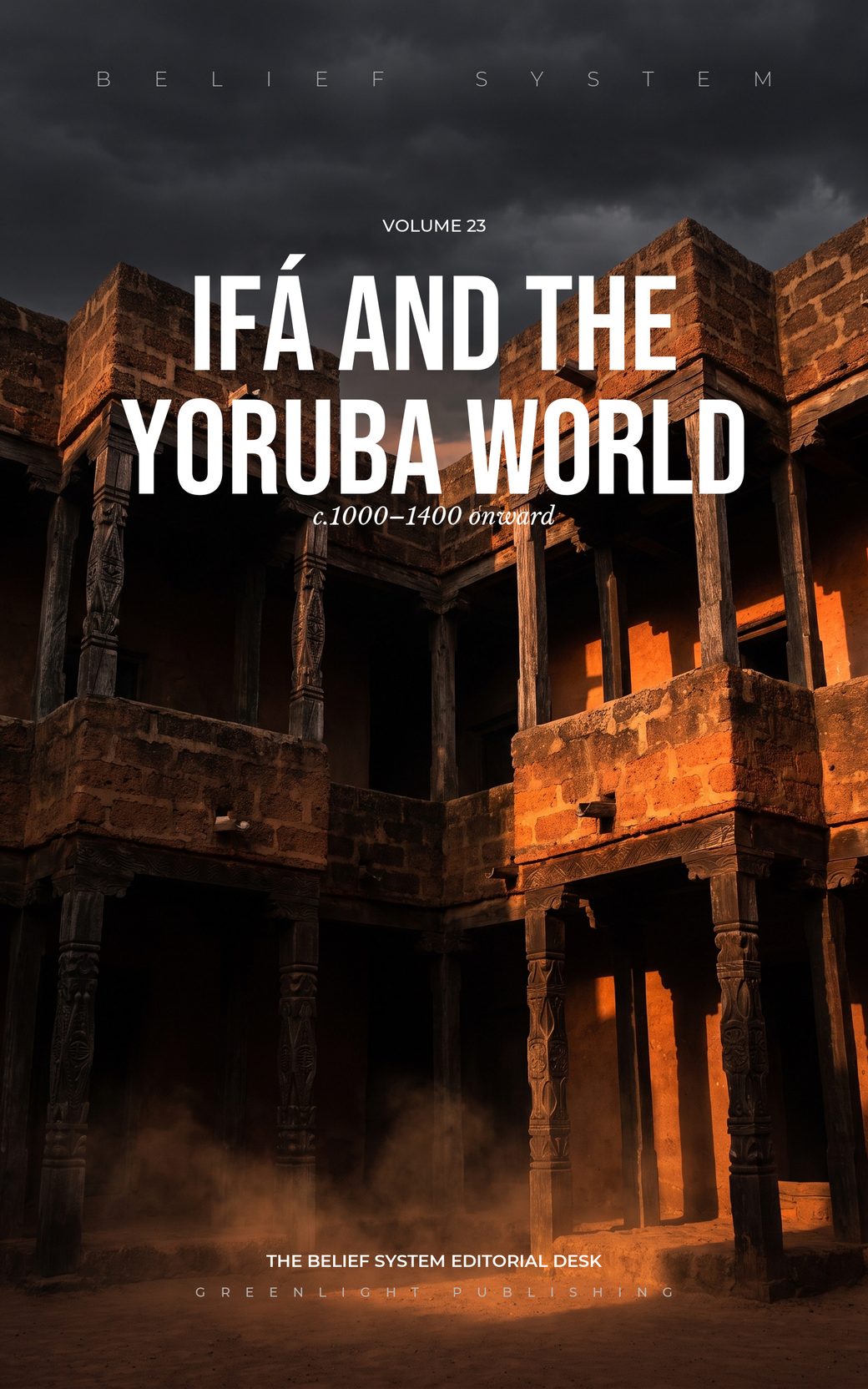
Volume 23 Belief System c.1000–1400 onward
Ifá and the Yoruba World
The machinea binary-indexed oral database
- Attested from
- c.1000 CE
- Narrates
- c.1000–1400 onward
The earliest secure evidence, and the key this volume is filed under. All thirty-one
The period the book actually covers. It is rarely the same figure.
The argument in one sentence
Around the time Ife’s court was casting bronze portraits, the Yoruba were carrying a religion on the most formally elegant transmission system in this series — a binary cast addressing two hundred and fifty-six chapters of memorised verse — and because the store lived distributed across every trained diviner rather than in any book, treasury or synod, no authority could ever close its canon and no ledger ever recorded its money, so the splits it faces now are about the storage medium itself: who may be initiated to carry it, and whose initiation counts.
256 chapters of verse, carried entirely in the trained memory of babalawo diviners, indexed by a binary cast: a retrieval system with no written index, proclaimed by UNESCO in 2005.The commissioning line
What it is
Two hundred and fifty-six chapters of verse, carried entirely in the trained memory of babalawo diviners, indexed by a binary cast: a retrieval system with no written index, proclaimed by UNESCO in 2005.
This is a history of that machine, and of how we know.
Restricted material is declined in the text and said so. Nigeria’s Copyright Act 2022 allows brief illustration in an original work, with community attribution mandatory. Published collections only. Nothing obtained from a living babaláwo outside the initiation boundary.
Five movements: the world of the heads, the machine of the sixteen times sixteen, the canon that is a person, the missing ledger, and the religion that cannot be counted.
The book never adjudicates. Money is ethnographic. No ledger is invented.
Belief System, Volume 23.
In full
Ifá is a binary-indexed oral database. Sixteen times sixteen. The library is a person. The whispered question is the retrieval. UNESCO’s file estimate of verses per odu is printed as the file’s figure, not as a census of anyone’s mouth.
The clergymen wrote first. Two snapshots, named. Who speaks for Ifá is a live argument and is left as one. The carver’s bill and the grove are what can be priced; the initiation is described as a public fact about cost and not as a transcribed rite.
The fall of Oyo and the ships hand the next volume its cargo. The mission and the mosque are dated arrivals. Women at the door, whose lineage counts, the religion that cannot be counted: the present tense is required because the machine is still running.
The volume uses five fixed phrases, and no sixth. It reports no orisha as fact and denies none. It never tells you what a cast revealed.
Belief System is a history of world religion, one tradition at a time. Thirty-one volumes, ordered by earliest secure attestation.
The contents
26 chapters in five movements. Every volume in the series has the same five, in the same order, and each chapter below is printed with the idea it carries.
Movement OneThe World
Ile-Ife and Oyo as the evidence actually gives them: bronze and terracotta, pavements and glass, then oral tradition written down centuries later — and the question a cast answers. What archaeology establishes and what the tradition holds are kept apart in every sentence.
- 1The HeadsIn 1938 workmen digging house foundations at Wunmonije Compound, near the palace of the Ooni of Ife, struck a cache of brass heads cast with a naturalism Europe then believed Africa incapable of — Leo Frobenius had seen one such head in 1910 and announced he had found Atlantis, a claim worth quoting because the mistake is the evidence: the heads establish a court and a workshop tradition, conventionally dated between the twelfth and fifteenth centuries, and they establish nothing about what anyone at that court believed.
- 2The City That Made Its Own GlassIfe was a working city before it was anyone’s holy one: potsherd pavements laid in herringbone, city walls in concentric rings, and at Igbo Olokun a glass industry melting its own distinctive glass into beads — excavated, radiocarbon-dated to roughly the eleventh to fifteenth centuries, and traded — while the copper for the famous heads is not local at all, so the metal had to travel; against this stands the tradition, which holds that the world itself was created at Ife, in more than one version — Oduduwa descending on a chain, or arriving at the head of migrants — and the chapter prints both versions and the dig, in separate sentences.
- 3Four Hundred and OneThe orisa are not a fixed pantheon but a distributed one — each town its patron, each lineage its inheritance, Sango royal at Oyo, Osun at Osogbo, Ogun wherever iron is worked — and the recorded counts are formulaic, two hundred and one, four hundred and one, numbers whose grammar means “many, and one more”; among them Orunmila is the orisa who witnesses destiny, because the tradition holds that each person chose an ori, a destiny, before birth and forgot it — which is the question this religion answers, and the reason its central institution is not a congregation but a consultation.
- 4Oyo and the HorseNorth of the forest, Oyo built the region’s great cavalry empire — an Alaafin checked by the Oyo Mesi council, which could reject a king by sending him an empty calabash and the expectation of suicide, on Johnson’s telling — and it ran a state cult: Sango, the tradition’s deified fourth Alaafin, whose priests travelled with the empire’s administration, so that at Oyo the question of who controls the orisa had an imperial answer; the empire’s dates, its tribute from Dahomey and its cavalry logistics come from coastal records and court tradition, and the two are labelled every time they disagree.
- 5The Questions People BroughtWhat people actually asked was concrete — illness, barrenness, a journey, a marriage, a chieftaincy dispute, later whether to take a mission-school place — and Bascom’s Ife fieldnotes preserve the client list of a working diviner with dates attached, which makes this religion legible as a diagnostic service with ritual obligations assigned per verdict, no weekly liturgy and no membership roll; consultation crossed confessional lines then and crosses them now, and the mission journals record Muslims and Christians at the diviner’s mat, to the missionaries’ fury.
- 6When Description BeginsEverything so far has an evidence horizon, and this chapter draws it in the open: the earliest datable object of Ifá practice anywhere is a carved divination tray collected on the Slave Coast and catalogued in the Weickmann cabinet at Ulm in 1659; the earliest inland European accounts of Oyo are Clapperton and the Landers in the 1820s; the first Yoruba vocabulary is Crowther’s in 1843; the first published odu are a Yoruba clergyman’s in 1898 — so the written description of this religion begins some six centuries after the bronze heads, almost all of it by missionaries, converts or their pupils, and the volume reads every source with that fact attached.
Movement TwoThe Machine
The transmission technology, named as a concrete object or institution — not an abstraction. Here: a 256-slot binary index addressing a memorised verse corpus, with the diviner as the storage medium and the cast as the lookup. The one machine in the series that is a formal system rather than an institution, and the movement treats it as engineering: the cast, the marking, the recitation, and the client’s role in selecting the verse.
- 7Sixteen Times SixteenThe address space first: a cast produces one of sixteen figures — four vertical positions, each holding a single or a double mark, two to the fourth power — and a full divination produces two figures side by side, sixteen times sixteen, two hundred and fifty-six odu, each a named chapter heading over its own body of verses; the sixteen principal doubles have names and a seniority order, and the order itself varies by town and by continent, which Bascom tabulated — Ife against Oyo against Meko against Cuba — a variance the canon movement will need.
- 8The Chain and the NutsThe hardware is two instruments at two speeds: the opele, a chain of eight half-shells that falls in one throw as a complete odu — fast, portable, the working diviner’s everyday tool — and the sixteen ikin, sacred palm nuts beaten from palm to palm, where the remainder left in the hand writes one mark at a time into iyerosun dust on the opon tray, eight operations to an odu, slow and ceremonial; the code is inverted — one nut remaining marks double, two nuts remaining mark single — and the chapter walks one full cast of each instrument as a worked example, the way the Islam volume walked a consonantal skeleton.
- 9The Library Is a PersonThe store the cast addresses is a trained human memory: apprenticeship begins in childhood and runs for years — the spans Bascom’s Ife informants gave him, with their dates, carry the paragraph — memorising verses odu by odu, and the profession is organised, with ranked titles up to the Araba, the chief of Ifa at Ife; there is also a boundary, stated in the text: some knowledge is initiation-bound by the tradition’s own designation, this volume does not print it and says so, and what a reader can know about the training is what initiates have themselves published — which, from Abimbola, a trained initiate who became a professor of Yoruba oral literature, is a great deal.
- 10The Whispered QuestionThe consultation is an information protocol and the chapter traces the data flow: the client does not state the problem aloud — in the protocol Bascom recorded at Ife the problem is confided silently to the fee or the instruments — the diviner casts, marks the odu, and recites its verses in order; the client, who alone knows the question, stops him at the verse that fits, and paired lots called ibo — cowrie for yes, bone for no — narrow specifics through further casts; the design distributes trust, because the diviner cannot steer an answer toward a question he was never told, and the verse ends by prescribing the sacrifice, which is where the money movement will pick up.
- 11Where the Machine Came FromSixteen-figure binary divination is a family that spans a hemisphere — 'ilm al-raml in the Islamic world, sikidy in Madagascar, Fa at the Fon court of Dahomey, Afa among the Ewe — and where Ifá sits in the family is contested: Maupoil argued derivation from Arabic geomancy moving south, later comparativists have argued both directions, and the tradition holds the system was Orunmila’s teaching at Ife; the chapter lays out the shared formal skeleton, names the positions and their holders, prints the tradition’s own account beside them, and settles nothing — because what can be established is the resemblance, and what cannot is the arrow.
- 12The Sister System and the World ListIfá is the largest machine in a Yoruba divination ecology, not the only one: sixteen cowries — erindinlogun — is the orisa priests’ system, one throw, sixteen outcomes, no paired figures, learned faster and held by women as much as men, and it is the system that would become dominant in Cuba, a hand-off the African Diaspora Religions volume takes by name; and in 2005 the machine acquired a modern certificate, when UNESCO proclaimed the Ifa divination system a Masterpiece of the Oral and Intangible Heritage of Humanity — a formal description of an oral system entering a world list, which raises exactly the question the next movement answers: what, precisely, is the thing being safeguarded?
Movement ThreeThe Canon
What is in, what is out, who decided, when, and what the decision cost. The real subject is who had the authority to close it — and here the answer is structural: nobody, ever, because the corpus is defined by an index rather than a list and held distributively in living memory. The movement opens with that argument, never with a collection.
- 13An Index, Not a ListEvery canon in this series is a list — books in, books out — and this one is an index: 256 addresses are fixed, closed and universal, while the verses filed under them are open, unnumbered and nowhere the same twice, so the question “is this verse canonical” translates to “is it recited under its odu by a trained diviner,” and no further; there is no synod, no Uthman — the standardising caliph of the Islam volume has no counterpart here and structurally cannot, because closure would require simultaneous authority over every trained memory alive — and the proof is empirical: Bascom’s recorded verses for an odu at Ife differ from Abimbola’s for the same odu at Oyo, and both are the canon working, not the canon failing.
- 14The Anatomy of a VerseAn ese is a case, and it is built like one: a stereotyped opening names the diviner — often a praise-name, “so-and-so cast Ifa for such-a-client” — then the precedent client’s predicament, the advice, the sacrifice prescribed, whether the client complied, the outcome, and often a closing song; Abimbola’s structural anatomy of the form carries the chapter, one brief published verse is quoted whole as the worked example, and the form explains the canon’s openness — a verse is a precedent narrative, and a corpus of precedents can absorb new cases forever, which is why twentieth-century recordings contain verses naming courts, cocoa and letters, a modernity the collections themselves document.
- 15The Clergymen Wrote FirstThe first people to publish odu were not colonial ethnographers but Yoruba Christian clergy: E. M. Lijadu, an Anglican evangelist, printed Ifa in 1898 and Orunmila in 1908 to prove to his fellow missionaries that the religion they were fighting had a theology worth engaging; Bishop James Johnson wrote its practices down to refute them, Samuel Johnson embedded court religion in his history — so the written record of this canon begins as an argument among Yoruba Christians about the worth of their fathers’ religion, and every early transcription carries that purpose in its selection, which the chapter states rather than laments.
- 16Two SnapshotsThe scholarly record of the corpus is essentially two great photographs taken a generation apart: Bascom’s — an American anthropologist transcribing verses from named Ife diviners from 1937–38 onward, published 1969 with the Yoruba on the page — and Abimbola’s — a Yoruba initiate-professor recording his own tradition’s verses at Oyo and beyond, published in Yoruba from 1968 and in English from 1975 — and each is explicitly a snapshot of particular diviners’ holdings at particular dates, which both men state in their prefaces; what fraction of the living corpus was ever recorded cannot be established, and the chapter prints that sentence rather than an estimate.
- 17Who Speaks for IfaAn open canon still has offices: the Araba of Ife heads the Ife priesthood, and in 1981 the Ooni of Ife installed Wande Abimbola in a newly prominent office, Awise Awo ni Agbaye — spokesman for Ifa in the world — a title about representation, not closure; the nearest thing to a synodal pronouncement is the annual festival at Oke-Itase, Ife, where the Araba casts the odu of the coming year, and Havana’s diviners cast their own Letter of the Year, and the two need not agree — a divergence the African Diaspora Religions volume owns; meanwhile print and the internet now circulate odu compilations among initiates worldwide, so the index travels while the holdings diverge further, which hands the split movement its subject: when everyone can read the verses, who has the authority to carry them?
Movement FourThe Money
Who paid, who was paid, and how we know. The honest answer, stated in the text: this is the thinnest money movement in the series, because divination was and is fee-for-service between individuals and leaves no ledger — no temple estate, no tithe, no waqf, no treasury. The movement runs four chapters instead of five because the evidence does, and it opens by saying so. What can be established: recorded fees with dates, the material culture and its makers, the shrine and festival economy, and the modern initiation economy. Where a figure cannot be verified, the text prints UNVERIFIED.
- 18The Missing LedgerThe Sufism volume can read a waqf deed and the Classical Hinduism volume can read a temple wall, and this volume can read neither, because there is nothing to read: Ifá’s economy is a consultation fee passing from client to diviner and a sacrifice purchased in the market, transaction by transaction, with no central treasury and no written account — a structural fact about a distributed priesthood, stated in the text as this movement’s finding rather than papered over; what exists instead is ethnography with dates, above all Bascom’s recorded fees and income figures from Ife diviners, in pence and shillings of their day, and the ese themselves, whose stock endings prescribe the sacrifice and its components — the price list is inside the literature, and it is the only place it was ever written down.
- 19The Carver’s BillThe system’s hardware was a paid trade: opon trays, agere cups, iroke tappers and opele chains came from professional carvers whose names and workshops the art history preserves — Areogun of Osi-Ilorin, Olowe of Ise, whose own praise-poetry records his royal commissions — and the trade is old, because the Ulm tray was valuable enough to cross the Atlantic into a merchant’s cabinet by 1659; today the same objects sit in museum catalogues and at auction, and the chapter prints only documented prices with their dates and sources, or prints UNVERIFIED.
- 20The Grove and the FestivalThe shrine economy is visible once a year at scale: the Osun grove at Osogbo — rebuilt over decades under the Austrian-born artist-priestess Susanne Wenger, inscribed a UNESCO World Heritage Site in 2005 — draws an annual festival whose crowd figures are the organisers’ and the state’s, printed here as claims with owners rather than as counts; around the festival moves real money — offerings, sacrifices, vendors, state tourism budgets — and almost none of it is auditable, so the chapter reports the one documented layer, the heritage economy: the inscription file, the conservation grants, the state’s involvement, each with a date and a source, and marks the rest UNVERIFIED.
- 21The Price of BecomingThe one part of this economy with advertised prices is initiation: itefa in Yorubaland costs what the ethnographies record — animals, cloth, fees to officiating elders, days of feeding a compound — and the diaspora has made it a market, with roots-pilgrimage packages to Ile-Ife and Ode Remo carrying dollar figures that Clarke documented in the early 2000s and that initiation websites advertise openly today; the fees are themselves a fight inside the tradition — commercialisation is the accusation, access the defence, and the chapter reports both positions with named holders — and the existence of an advertised price for initiation is the bridge to the split movement, because the splits are about exactly this: who may be initiated, by whom, for what.
Movement FiveThe Split
What divided it, what it became, what it handed on. Two live splits, both about custody of the machine — iyanifa, and homeland versus diaspora — reported with named holders of each position and settled nowhere. The hand-off is to the African Diaspora Religions volume, which owns Santeria, Candomble and Vodou.
- 22The Fall of Oyo, and the ShipsIn the early nineteenth century the Oyo empire came apart — Ilorin revolted under Afonja, passed to a Fulani emirate, and Oyo-Ile itself was abandoned, conventionally dated to the mid-1830s — and the wars that followed fed the last great wave of the Atlantic trade, which carried enslaved Yoruba in their tens of thousands to Cuba and Brazil precisely in the decades when the trade elsewhere was dying; the numbers come from the shipping database and are estimates built from ports and ethnonyms — Lucumí in Cuba, Nagô in Brazil — and are labelled as such; among the transported were trained diviners, which is the single most consequential fact in this volume: the machine’s storage medium is a person, and the ships were loading it.
- 23The Mission and the MosqueThe homeland divided confessionally without ever quite dividing in practice: over the twentieth century most Yoruba became Christians or Muslims — the mission working through returned recaptives like Crowther, whose Yoruba Bible made the language a literary one, Islam growing from older northern roots — yet consultation of Ifá persisted across both memberships, documented from the mission journals onward, so the split here is not schism but layering: exclusive confessional identity above, a shared diagnostic practice below, and the volume reports that arrangement in the present tense because it continues; Peel’s argument that the encounter itself helped make “the Yoruba” a self-conscious people is printed as his, with his name on it.
- 24The Women at the DoorWhether a woman may be initiated as a diviner of Ifá — iyanifa — is answered differently in different places, and the volume maps the answers without grading them: lineages in Yorubaland initiate women and are on record about it, with the widely reported restriction that women do not receive or behold the closed calabash of Odu — a designation this volume reports and does not probe, saying so in the text; Abimbola has stated positions on the question in published interviews; Cuban Ifá holds the priesthood male by definition, with women serving as apetebi, and when women were initiated in Havana in the early 2000s the major Cuban commissions issued public condemnations — the letters, names and dates to be fetched from the documented record before print; the chapter names who holds each position, quotes only published statements, and settles nothing.
- 25Whose Lineage CountsThe second live split is jurisdictional — who can initiate, whose lineage confers legitimacy, and what the homeland owes the diaspora and vice versa: Cuban lineages hold an unbroken transmission from named nineteenth-century founders and some regard Nigerian re-initiation of Cuban-line priests as an insult; Ife holds the authority of the source, and Nigerian babalawo have initiated Americans by the hundred; African Americans built their own return — Oyotunji Village in South Carolina, founded 1970 by Efuntola Oseijeman Adefunmi, who had been initiated in Cuba in 1959 and was later received at Ife — and since 1981 the International Congresses of Orisa Tradition and Culture have put all parties in one room without merging them; the chapter reports the map of claims, each with its holder, and hands the Cuban and Brazilian interiors of this argument to the African Diaspora Religions volume by name.
- 26The Religion That Cannot Be CountedThe volume ends on its honest number, which is that there is none: Nigeria has published no religion census data since 1963, circulating counts of orisa practitioners run from one million to over one hundred million, and the spread is the finding — a practice consulted across confessional lines resists the census category itself; what can be dated instead is recognition — UNESCO’s 2005 proclamation, the heritage grove, an Isese Day now marked in Osun State (its holiday status verified before print) — and transmission: the 256 addresses are today cast in Ile-Ife, Havana, Salvador da Bahia, and a suburb of Atlanta, because the machine crossed the Atlantic inside the people who carried it; what it became there — Santeria, Candomble, and the different, Fon-rooted stream of Vodou — is the African Diaspora Religions volume, which begins where this sentence stops.
What this volume cannot establish
Printed in the book before the argument is, and printed here for the same reason. A history of a tradition that will not say where its evidence runs out is not a history.
- The age of Ifá. Archaeology establishes a court and a workshop tradition at Ile-Ife, conventionally dated between the eleventh/twelfth and fifteenth centuries; nothing establishes when the 256-odu system took its present form. The earliest datable piece of the apparatus is a carved divination tray in a German cabinet of curiosities, catalogued in 1659; the earliest descriptions of the system at work are later still. Between the tradition’s claim that Orunmila taught divination at Ife and the first dated object stands more than half a millennium, and the volume keeps the two in separate sentences every time.
- Whether the sixteen-figure system is indigenous or arrived with Islamic geomancy. The family resemblance to 'ilm al-raml — sixteen binary tetragrams, from the Sahel to Madagascar — is real and is contested in both directions by named scholars. The volume reports the argument and settles nothing.
- The extent of the corpus. No total count of ese is possible even in principle: verses vary by lineage, region and diviner, and every recorded collection is a snapshot of one diviner’s holdings at one date. The tradition’s own totals are large, round and vary between tellers; they are printed only as the tradition’s numbers.
- Pre-nineteenth-century Yoruba religion from contemporaneous internal texts. There are none. Everything before the mission-era journals rests on archaeology, objects in European collections, coastal trade records, and oral tradition written down from 1843 onward — each labelled as what it is, and the archaeology and the oral tradition kept apart in the reader’s hands.
- The historicity of Oduduwa, Orunmila or Sango as persons. The tradition holds; it cannot be established, and the volume prints the tradition’s own multiple versions rather than choosing one.
- Any adherent count. Nigeria has published no religion census data since 1963; circulating figures for orisa practice run from one million to over one hundred million and none is defensible. The volume prints the range, the census silence, and the word UNVERIFIED.
- The money beyond ethnography. Divination was and is fee-for-service between individuals and leaves no ledger. Recorded fees exist only where a fieldworker wrote them down with a date, and the money movement says so in the text rather than manufacturing a substitute.
- Anyone’s interior state.
Sources
46 works, dated, and specific enough that a reader can go and look at the thing. Nothing is on this list that the desk did not consult.
| # | Document or work | Date | Evidence for |
|---|---|---|---|
| 1 | British Museum later account of the Wunmonije cache; object Af1939,34.1 | find January 1938; accession 1939 | five copper heads, twelve brass, one half-figure; one brass head in London |
| 2 | Leo Frobenius, The Voice of Africa | 1913 English | the Olokun head as Poseidon; the Atlantis claim quoted because the mistake is the evidence |
| 3 | Frank Willett, Ife in the History of West African Sculpture | 1967 | the finds, the dispersal, the twelfth-to-fifteenth-century dating; pavements and walls |
| 4 | Suzanne Preston Blier, Art and Risk in Ancient Yoruba | 2015 | current dating; the unresolved argument about what the heads were for |
| 5 | Abidemi Babatunde Babalola, Susan Keech McIntosh, Laure Dussubieux and Thilo Rehren, Igbo Olokun report, Antiquity 91 | 2017 | locally made high-lime high-alumina glass; radiocarbon 1058–1264 and 1304–1423 |
| 6 | Samuel Johnson, The History of the Yorubas | written 1897; published 1921 | Ife creation and migration versions; Oyo constitution and Sango; the wars’ end — an Oyo-partisan clergyman, named as such |
| 7 | E. Bolaji Idowu, Olodumare: God in Yoruba Belief | 1962 | formulaic counts (“many, and one more”); ori; the chain-and-cockerel creation |
| 8 | Karin Barber, “How Man Makes God in West Africa,” Africa | 1981 | the attention economy in which an orisa’s standing rises and falls with its devotees |
| 9 | William Bascom, Ifa Divination | fieldwork 1937–38; book 1969 | Orunmila’s office; dated Ife client list; figure names and rank orders; chain and nuts; whispered-question protocol; training spans; fees in pence and shillings; verses as a snapshot |
| 10 | Robin Law, The Oyo Empire c.1600–c.1836 | 1977 | reconstruction from European coastal records; the collapse |
| 11 | J. Lorand Matory, Sex and the Empire That Is No More | 1994 | Sango’s cult as imperial infrastructure — reported as his |
| 12 | J. D. Y. Peel, Religious Encounter and the Making of the Yoruba | 2000 | the CMS archive as an archive; Muslims and Christians at the mat; the thesis that the encounter helped make “the Yoruba” |
| 13 | Samuel Ajayi Crowther, CMS journals | mid-nineteenth century | a recaptive agent on the coast and up the river, arguing with babalawo |
| 14 | James Johnson, Yoruba Heathenism | 1899 | practices written down in order to refute them |
| 15 | E. M. Lijadu, Ifa | 1898 | the first published odu, selected to prove a theology |
| 16 | Christoph Weickmann, Ulm cabinet catalogue | 1659 | the earliest datable Ifá object: a carved opon collected on the Slave Coast |
| 17 | Hugh Clapperton, journals of the inland journey | 1825–26 | Oyo as a cavalry state, seen from the road |
| 18 | Richard and John Lander, Journal of an Expedition to Explore the Course and Termination of the Niger | 1832 | the same court after Clapperton’s death; religion noticed and left |
| 19 | Samuel Ajayi Crowther, A Vocabulary of the Yoruba Language | 1843 | the first Yoruba vocabulary in print; the hinge between travellers and clergymen |
| 20 | Wande Abimbola, Ifá: An Exposition of Ifá Literary Corpus | 1976 | the system as its custodians teach it; recitation discipline; anatomy of an ese |
| 21 | Henry John Drewal, John Pemberton III and Rowland Abiodun, Yoruba: Nine Centuries of African Art and Thought | 1989 | opon, opele, iroke and agere as objects from paid workshops |
| 22 | Wande Abimbola, Ifá Divination Poetry | 1977 | initiate-scholar’s published verses; the comparative holdings against Bascom |
| 23 | Nigeria Copyright Act 2022, Part IX, sections 74(2), 74(3) and 76 | 2022 | folklore protection; the illustration exception; mandatory community attribution; commercial-use offence |
| 24 | Bernard Maupoil, La géomancie à l’ancienne Côte des Esclaves | 1943 | derivation from Arabic geomancy, argued from the Fon-court Fa material |
| 25 | Louis Brenner, chapter on Muslim divination, in John Pemberton III (ed.), Insight and Artistry in African Divination | 2000 | 'ilm al-raml as a going West African practice, not a rumour |
| 26 | Wim van Binsbergen, comparative geomancy papers | late twentieth and early twenty-first centuries | the sixteen-figure family argued in both directions |
| 27 | William Bascom, Sixteen Cowries: Yoruba Divination from Africa to the New World | 1980 | erindinlogun as the sister system; the Cuba hand-off |
| 28 | UNESCO proclamation of the Ifa divination system as a Masterpiece of the Oral and Intangible Heritage of Humanity | 25 November 2005 | official description of an oral system; the parenthetical “around 800 ese per odu” |
| 29 | UNESCO Representative List inscription, “Ifa divination system” | 2008 | automatic carry-over under the 2003 Convention’s transitional rule |
| 30 | E. M. Lijadu, Orunmila | 1908 | the evangelist’s second printed odu booklet |
| 31 | Wande Abimbola, Ijinle Ohun Enu Ifa | 1968–69 | the Yoruba-first snapshot of holdings at Oyo and beyond |
| 32 | Wande Abimbola, Sixteen Great Poems of Ifá (UNESCO) | 1975 | sixteen selected poems presented as world-list literature |
| 33 | Wande Abimbola, Ifa Will Mend Our Broken World | 1997 | the Awise Awo ni Agbaye as its holder described it (installed 1981 by Ooni Okunade Sijuwade); published positions on initiation and women |
| 34 | Comisión Organizadora, published Letter of the Year recording the Havana sitting | sitting 31 December 2004; letter 2006 | 992 priests at Avenida 10 de Octubre under Guillermo Diago; a year-verse that need not match Ife’s |
| 35 | Jacob K. Olupona and Terry Rey (eds.), Òrìṣà Devotion as World Religion | 2008 | the globalised canon; the congresses from 1981; the initiation market |
| 36 | Roslyn Adele Walker, Olowe of Ise: A Yoruba Sculptor to Kings | 1998 | a named carver’s royal commissions; his oriki quoted from the Yoruba, not her English |
| 37 | Peter Probst, Osogbo and the Art of Heritage | 2011 | Susanne Wenger, the grove, and the heritage economy |
| 38 | UNESCO World Heritage inscription, Osun-Osogbo Sacred Grove | 2005 | the dated official layer of the shrine economy |
| 39 | Kamari Maxine Clarke, Mapping Yorùbá Networks | 2004 | dollar figures on roots-pilgrimage packages; American women initiated in Nigeria; Oyotunji chronology (Adefunmi 1959; founding 1970) |
| 40 | Trans-Atlantic Slave Trade Database, slavevoyages.org | ongoing compilation | Bight of Benin embarkations as estimates built from ports and ethnonyms (Lucumí, Nagô) |
| 41 | Samuel Ajayi Crowther, letter to William Jowett, Fourah Bay | 22 February 1837 | the 1821 fall of Osogun; capture on the Lagos river, 7 April 1822 |
| 42 | T. G. O. Gbadamosi, The Growth of Islam Among the Yoruba, 1841–1908 | 1978 | Islam growing from older northern roots in the century of the missions |
| 43 | Nigeria, last published religion-census data | 1963 | the silence that makes every later adherent total UNVERIFIED |
| 44 | Oyeronke Olajubu, Women in the Yoruba Religious Sphere | 2003 | the scholarly frame for a map of answers on iyanifa, not a verdict |
| 45 | J. Lorand Matory, Black Atlantic Religion | 2005 | lineage-authority claims across homeland and diaspora |
| 46 | Osun State Isese Day declarations, under the Public Holidays Act, section 2(2) | first declared 2014; 20 August | official recognition without a headcount |
Common questions
When is Ifá and the Yoruba World first securely attested?
c.1000 CE. That is the earliest date the surviving evidence supports, and it is the key this volume is filed under. It is not the same claim as when the tradition began: the tradition’s own account of its beginning is printed beside it in the book’s front matter, never instead of it.
What period does the book cover?
c.1000–1400 onward. The coverage span and the attestation date are two different facts, and the gap between them is often the most interesting thing about a volume.
What carried Ifá and the Yoruba World?
A binary-indexed oral database. Movement Two of every volume is about the transmission technology — the concrete object or institution that made copying possible, and would not have existed a century earlier.
How long is it?
About 29,000 words, roughly 120 minutes’ reading, 126 pages in the paperback. The audiobook runs 3h 15m, measured from the finished masters.
What does this volume not claim to establish?
The age of Ifá. Archaeology establishes a court and a workshop tradition at Ile-Ife, conventionally dated between the eleventh/twelfth and fifteenth centuries; nothing establishes when the 256-odu system took its present form. The earliest datable piece of the apparatus is a carved divination tray in a German cabinet of curiosities, catalogued in 1659; the earliest descriptions of the system at work are later still. Between the tradition’s claim that Orunmila taught divination at Ife and the first dated object stands more than half a millennium, and the volume keeps the two in separate sentences every time. Every volume prints its own limits before it prints its argument; there are 8 on this one’s list.
Does the book say which tradition is true?
No. Belief System does not adjudicate. Where the tradition’s account and the earliest evidence disagree, both are given, in their own vocabulary, attributed, and neither is given the last word. No miracle is reported as fact and none is denied.
Can I buy Ifá and the Yoruba World in print?
Yes. It is a 5.5 × 8.5 in paperback, 126 pages, $12.99 a copy, bought direct rather than through a retailer. All thirty-one together are $199.00, with the ebook and the audiobook of every volume included.
The edition
| Trim | 5.5 × 8.5 in / 140 × 216 mm |
|---|---|
| Binding | Perfect-bound paperback, matte laminate |
| Paper | 60# uncoated cream, black ink |
| Extent | 126 pages |
| Edition | Extent | ISBN |
|---|---|---|
| Paperback | 126 pages, 5.5 × 8.5 in | ISBN not yet issued |
| Ebook | EPUB | 979-8-90623-857-3 |
| Audiobook | 3h 15m | 979-8-90623-858-0 |
| BISAC 1 | `REL017000` RELIGION / Comparative Religion |
|---|---|
| BISAC 2 | `REL029000` RELIGION / Folk & Tribal |
| BISAC 3 | `REL033000` RELIGION / History |