14 illustrations · 1:42
Watch & listen.
Follow the images with a narrated journey through the book.





Overview
- Coverage
- 1517–1648
- Earliest secure evidence
- 1517
- Transmission
- the pamphlet
Print existed for sixty years before 1517 and had mostly produced long, expensive books. The Reformation’s innovation was the cheap short vernacular quarto, printed fast, sold cheap, and reprinted by any press that got hold of one. A printer’s own letter, written in 1519, records six hundred copies into France and Spain, a bookseller carrying a good part into Italy, three hundred copies only of one reply, and the sentence a printer writes when a thing is selling.
The coverage period and the earliest secure evidence are different dates. A tradition’s own account of its beginnings may differ from both.
Historical setting
An Empire of Small Sovereigns
The Holy Roman Empire in 1517 was a legal landscape rather than a state — seven electors made its emperor, several hundred princes, prince-bishops and free cities held the day-to-day sovereignty, and no authority could execute a uniform policy across it. The volume states this first because everything that follows depends on it: the same fragmentation that had made reform edicts unenforceable for a century made a condemned friar physically survivable.
The Recovery of Greek
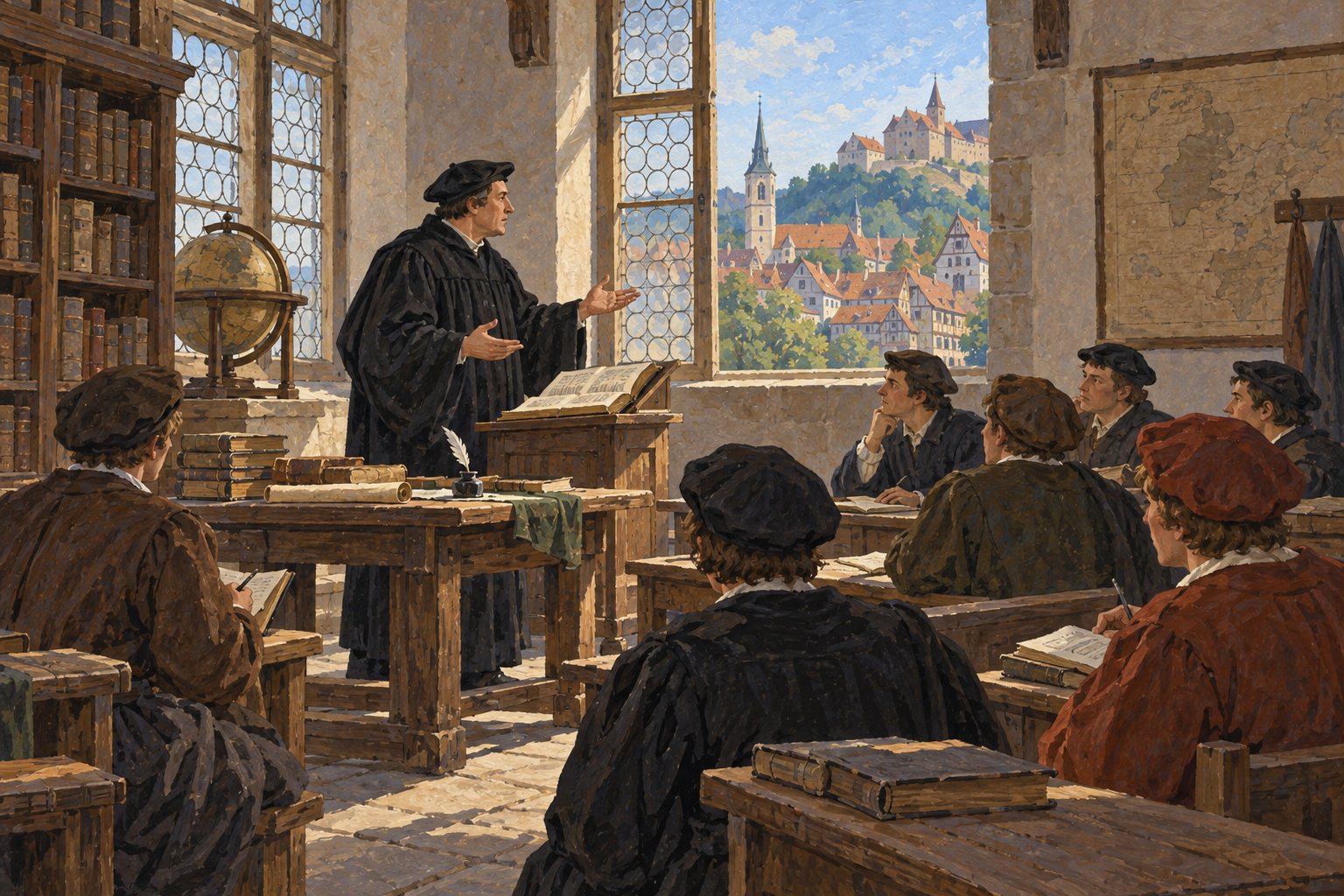
Humanist philology was the century’s solvent: Valla proved the Donation of Constantine a forgery from its Latin alone (1440, and in print by 1517), and Erasmus set the Greek New Testament beside a fresh Latin in 1516 — one annotation carrying a charge nobody had yet measured: behind the Vulgate’s poenitentiam agite, “do penance”, a sacrament, stood the Greek imperative metanoeite, a turning of the mind. The first of the ninety-five theses stands on that gap. It is the volume’s founding example of a translation dispute that is itself the historical event.
Explore the illustrations5 scenes · A Landscape of Small Powers
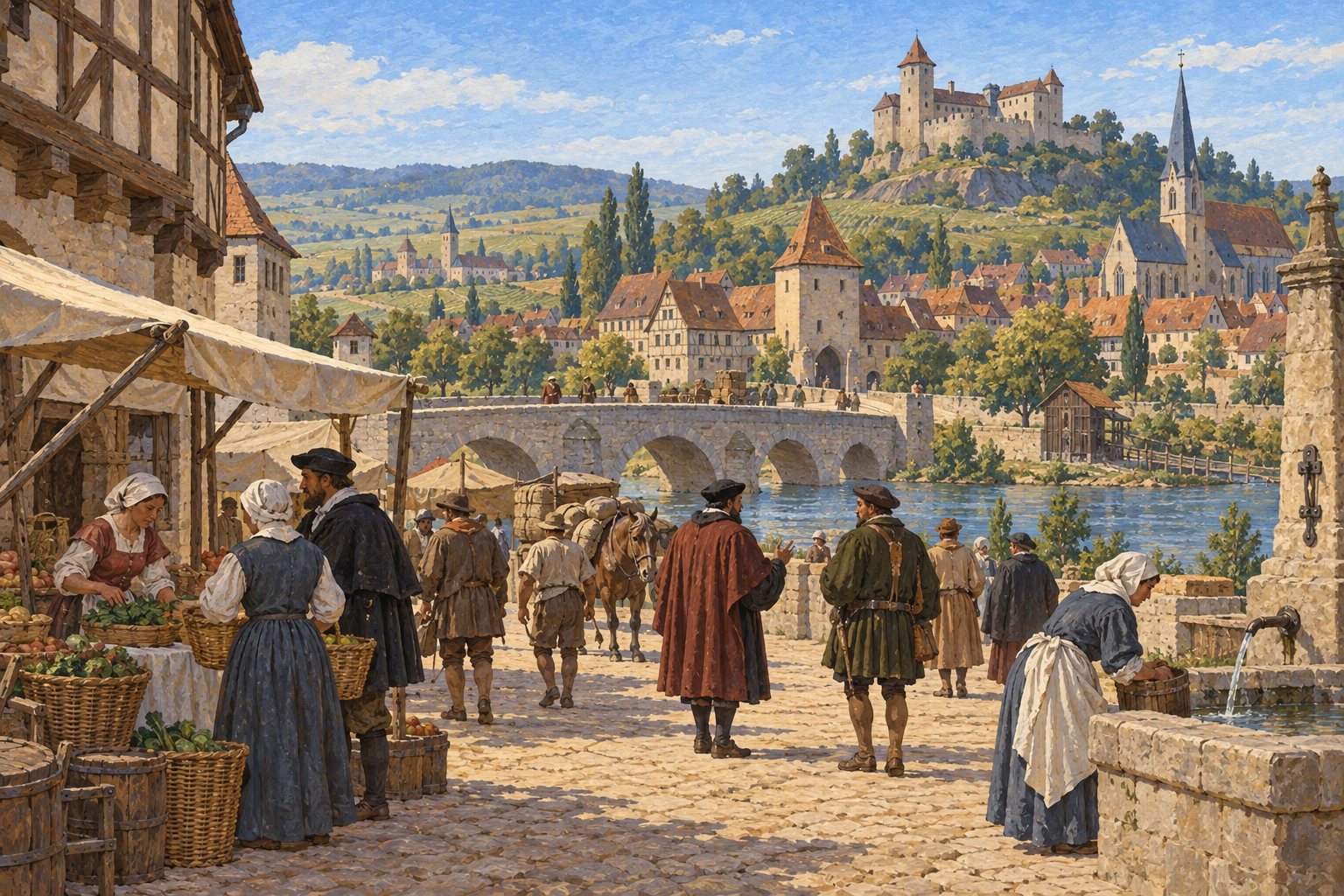
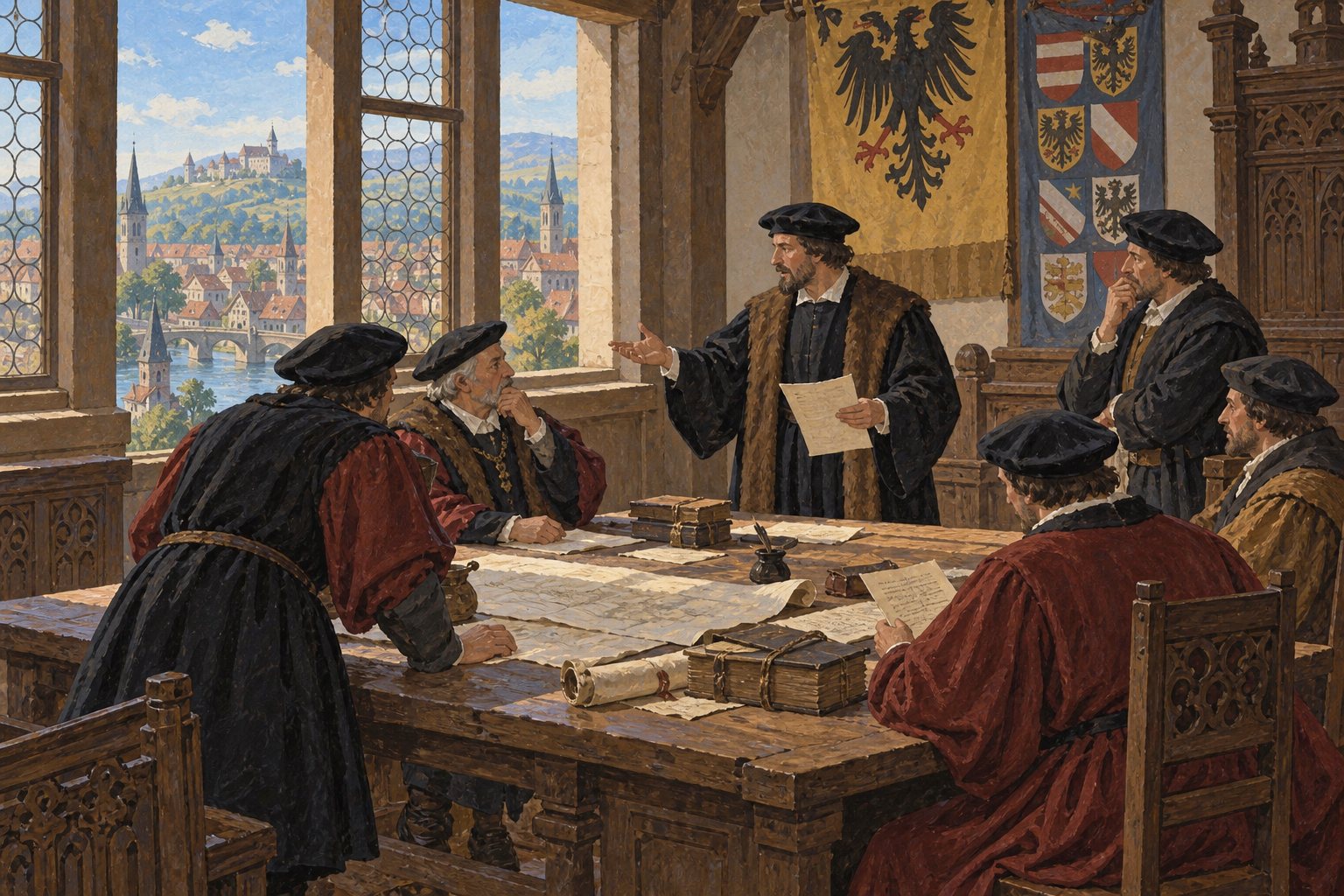
A Landscape of Small Powers. The Holy Roman Empire in 1517 was a legal landscape rather than a state — seven electors made its emperor, several hundred princes, prince-bishops and free cities held the day-to-day sovereignty, and no authority could execute a uniform policy across it. The volume states this first because everything that follows depends on it: the same fragmentation that had made reform edicts unenforceable for a century made a condemned friar physically survivable.
How it was transmitted
Sixty Years of Expensive Books
The press was not born reformist. For its first sixty years it mostly made what its capital structure required: big Latin folios for institutional buyers — Bibles, missals, law, scholastic theology — plus the church’s own paperwork, indulgence blanks above all. Printing was capital-hungry, overproduction bankrupted printers, and the industry’s anchor client was the institution the pamphlet would shortly attack. The machine existed for two generations before 1517; the format that changed everything did not.
The Quarto
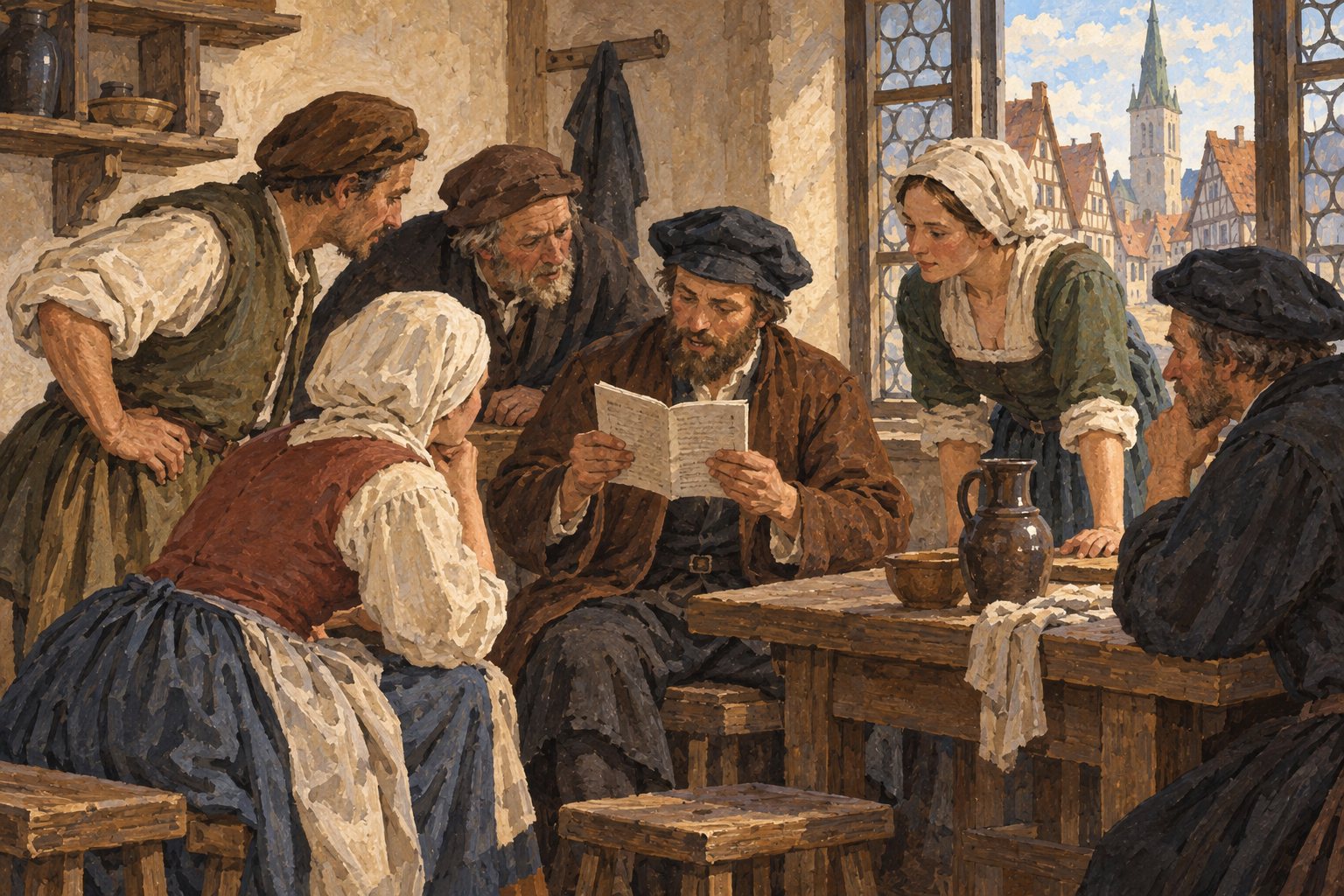
The Reformation’s innovation was a format: the Flugschrift — a German quarto of eight to thirty-two pages, printable in a day or two, cheap, portable under a coat, sold by pedlars — and its prototype was Luther’s Sermon on Indulgence and Grace of early 1518, a plain-German tract that went through printing after printing within months. Short vernacular print turned a Latin faculty dispute into a public one, and the hostile witnesses noticed first.
Explore the illustrations4 scenes · The Portable Quarto
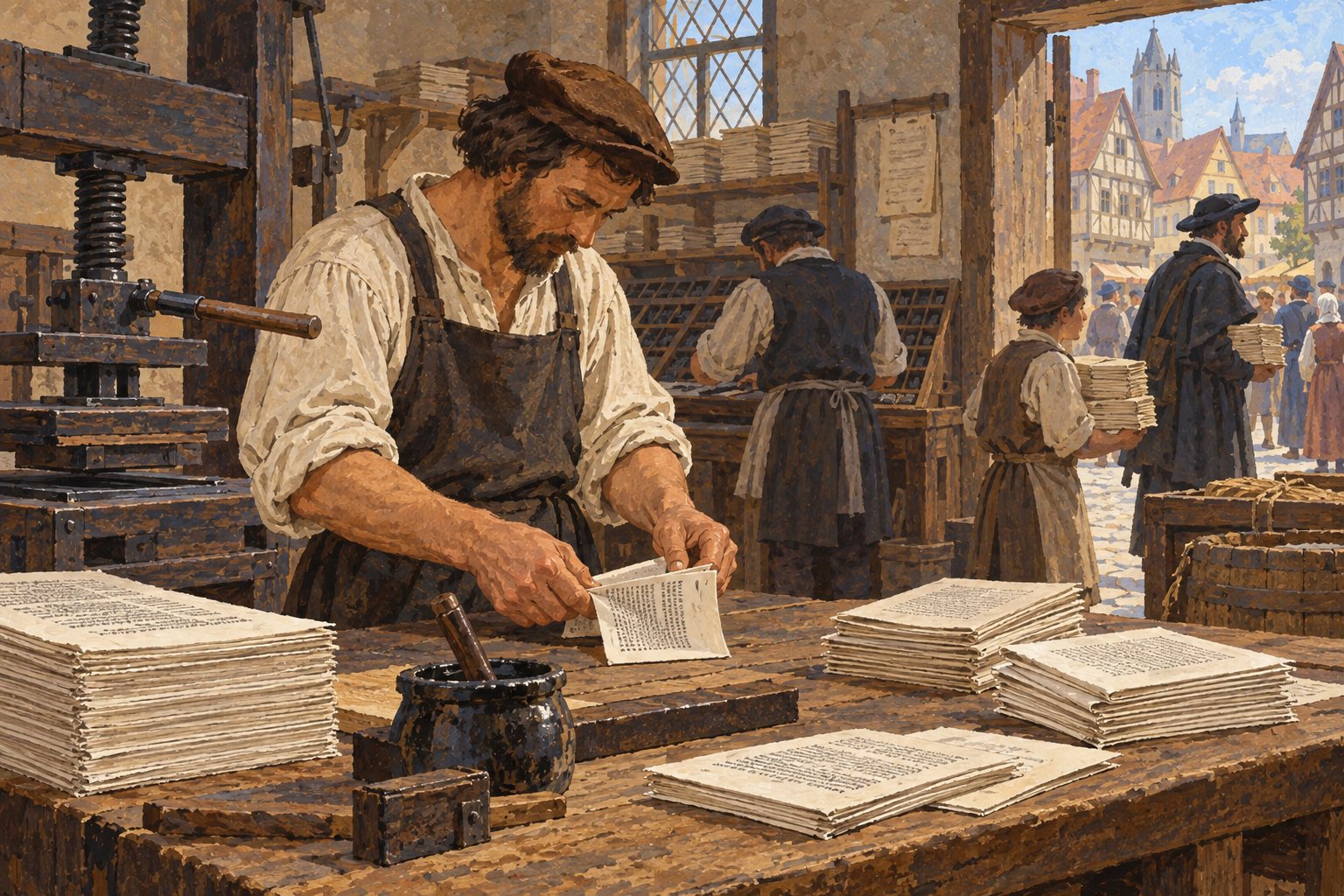
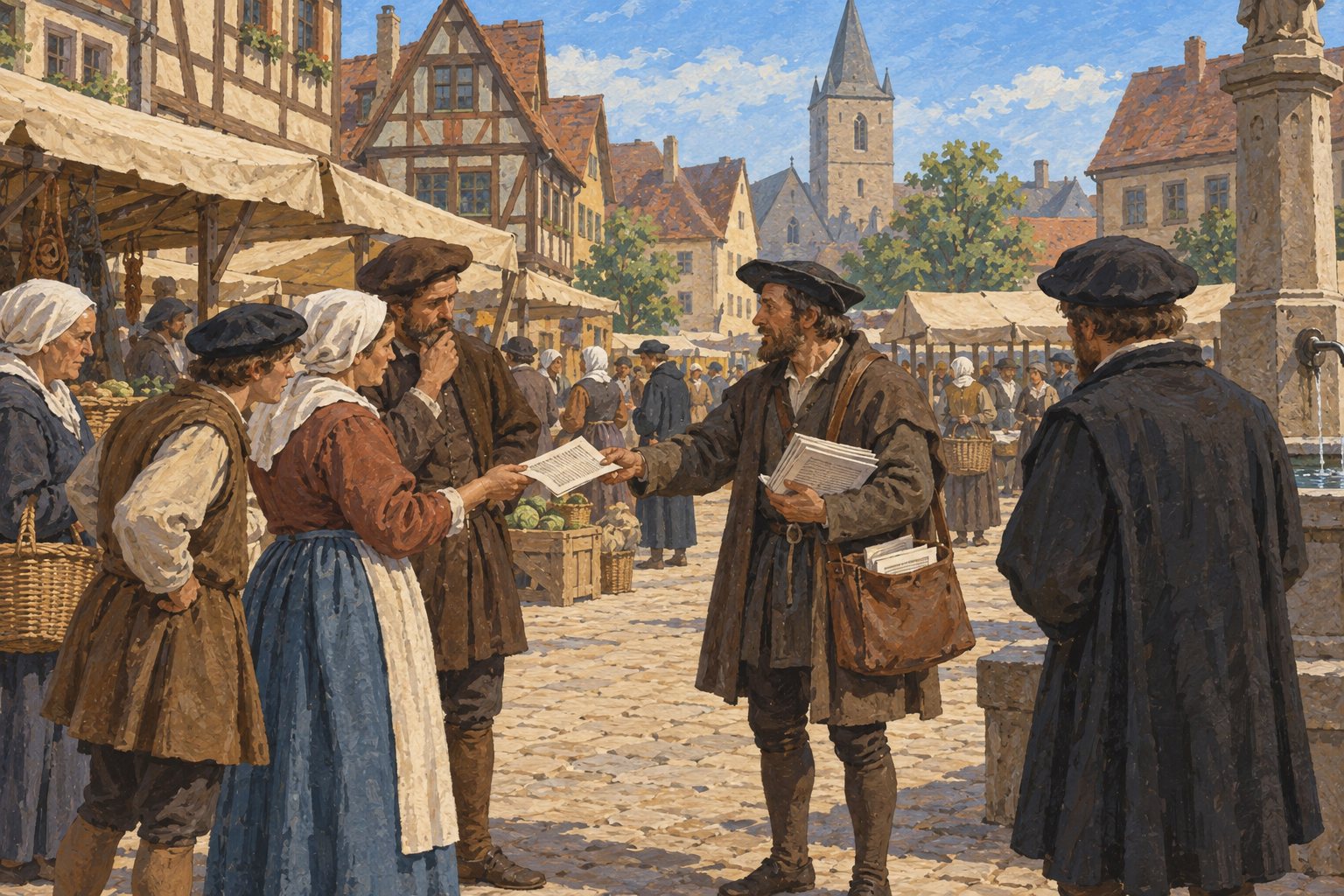
The Portable Quarto. The Reformation’s innovation was a format: the Flugschrift — a German quarto of eight to thirty-two pages, printable in a day or two, cheap, portable under a coat, sold by pedlars — and its prototype was Luther’s Sermon on Indulgence and Grace of early 1518, a plain-German tract that went through printing after printing within months. Short vernacular print turned a Latin faculty dispute into a public one, and the hostile witnesses noticed first.
Texts and authority
Scripture Alone Reopens Everything
The appeal to scripture alone did not simplify authority; it reopened every question a settled hierarchy had closed. At Leipzig in 1519, pressed by Eck, Luther conceded that councils can err — which left the text as the sole court of appeal and immediately raised the four questions the rest of this movement follows: which books, whose Greek and Hebrew, whose translation, and who says. A millennium of practice had made the answers feel settled. It took three years of print to reopen all four at once.
The Epistle of Straw
Luther edited the canon in public: his 1522 New Testament preface graded the books by whether they preach Christ and called James “a right strawy epistle” beside them — a judgement later editions dropped, and the drop is itself checkable against surviving printings; his table of contents numbered twenty-three books and then set Hebrews, James, Jude and Revelation apart, unnumbered, at the end; and in 1534 the whole Apocrypha went between the Testaments under a header saying these books are not held equal to holy scripture and yet are useful and good to read. Not an accident and not a secret: the reopened canon was being re-sorted by one theologian’s criterion, in print, in German.
Institutions and resources
The Mainz Arrangement
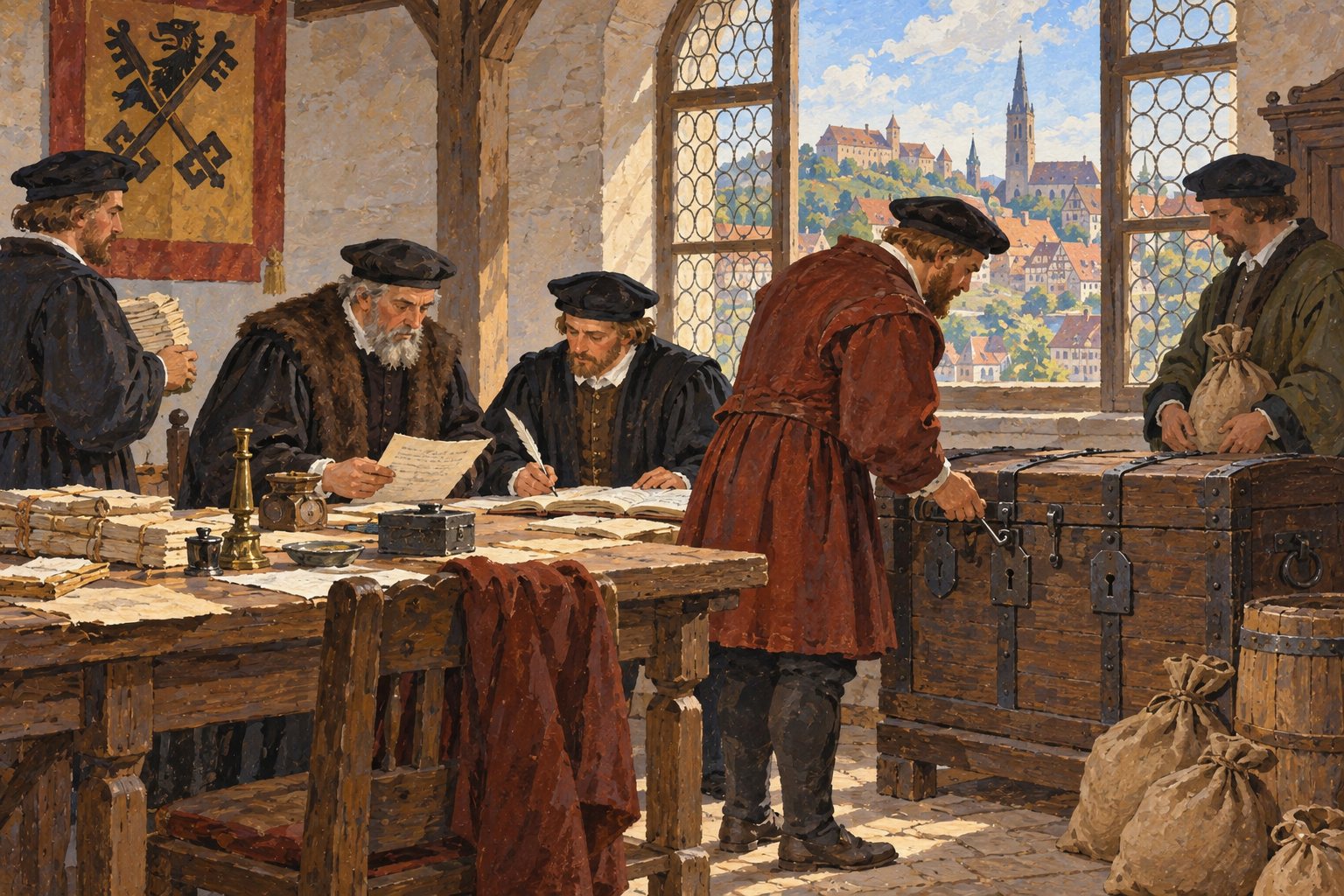
The indulgence Luther attacked was collateral. Albrecht of Brandenburg, holding one archbishopric already, bought papal confirmation of Mainz in 1514 with fees he financed by borrowing 20,000 gulden from the Fugger house, and the St Peter’s indulgence preached in his provinces from 1517 was structured to service the debt — half the take to Rome for the basilica, half to the Fuggers. A documented financing arrangement in curial and banking records, not a polemical claim. The same house was about to finance the election of the emperor before whom Luther would stand at Worms.
The Man From the Bank
The campaign was run as the financial operation it was: Albrecht’s printed Instructio Summaria gave his sub-commissioners a graduated price schedule — so much for kings and archbishops, down the ranks to the clause letting the penniless contribute prayer and fasting; Tetzel preached; and a Fugger agent travelled with the operation, keeping a key to the chest and the count. The one piece everyone remembers — the couplet about the coin and the soul — survives as the opponents’ report, and Luther’s twenty-seventh thesis paraphrases it as what “they preach”.
Explore the illustrations5 scenes · The Common Chest
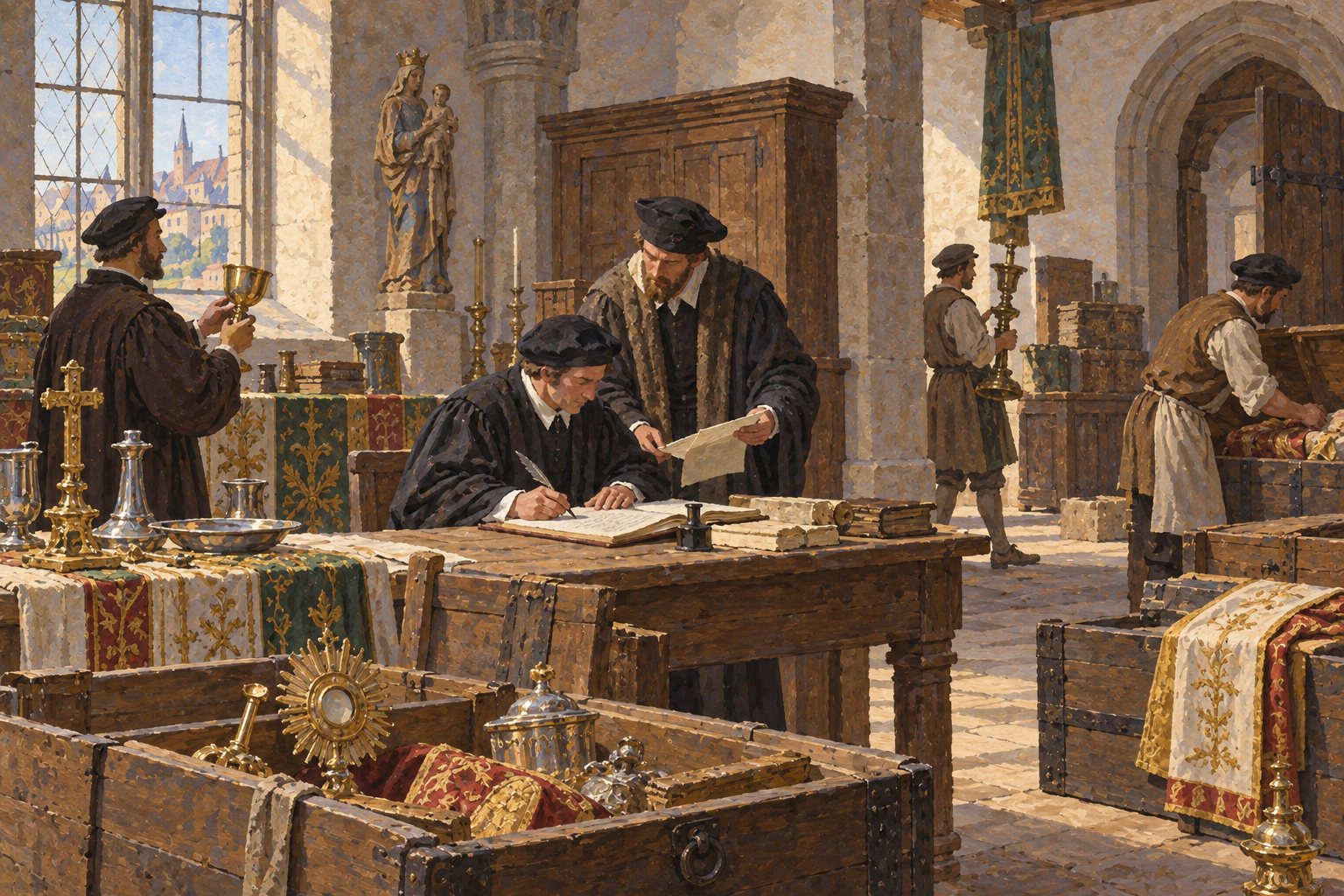
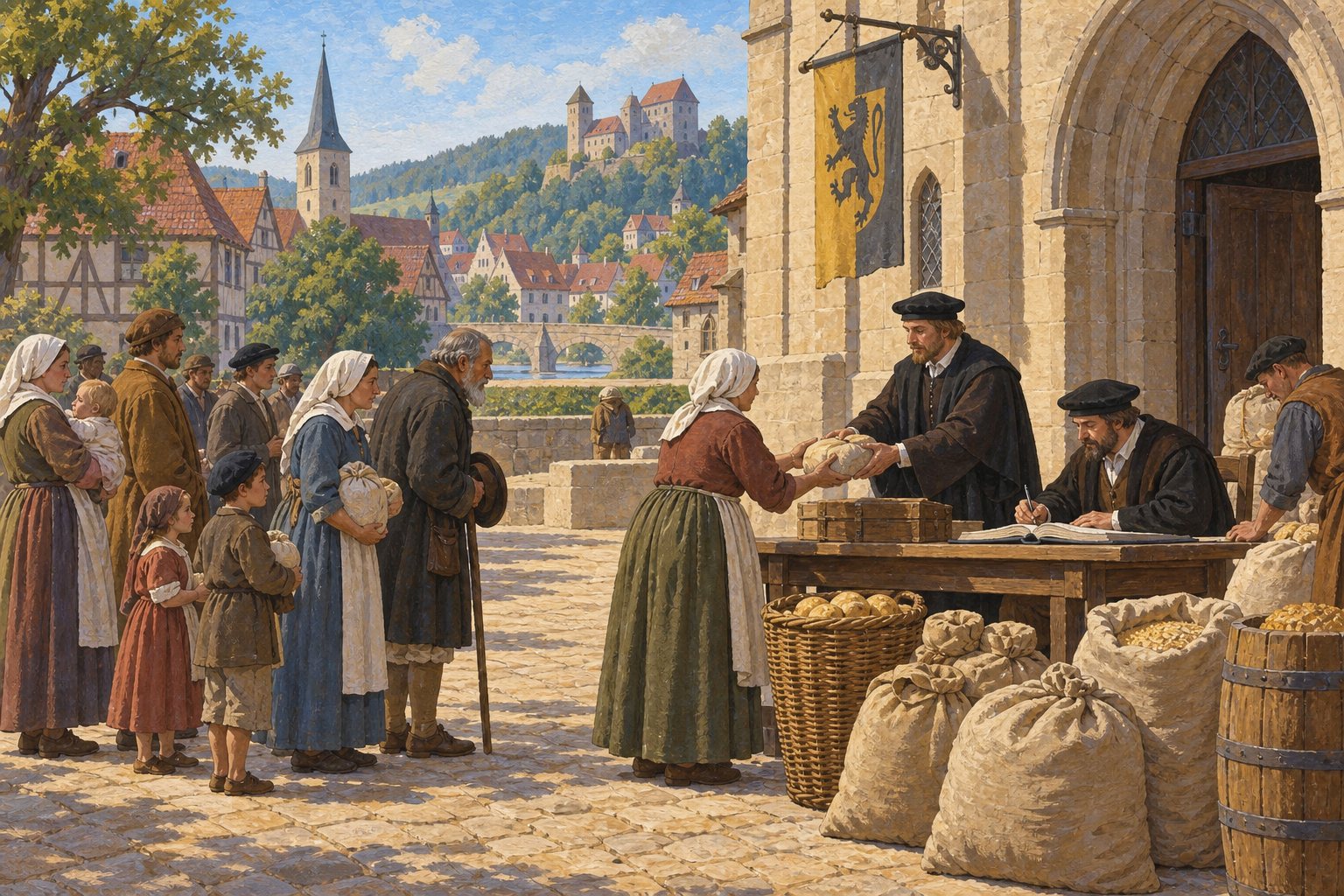
The Common Chest. Where the movement won, church wealth was not abolished but re-plumbed: the town of Leisnig’s common chest ordinance of 1523, carrying Luther’s preface, pooled the parish’s endowments, mass-foundations and fees into one municipal chest for pastors’ pay and poor relief — and the pattern generalised, councils and princes inventorying, absorbing and reassigning ecclesiastical property, Philip of Hesse funding a new university at Marburg from dissolved houses. The machine’s assets changed hands wherever the doctrine did, which gave every converting ruler a fiscal stake in never converting back.
Changes and divisions
Fourteen of Fifteen
At Marburg in October 1529 the movement’s two halves met to merge and instead measured the crack: Luther and Zwingli agreed fourteen articles and failed on the fifteenth, the eucharist — the signed articles themselves record the failure, pledging mutual charity while stating that agreement on the bodily presence had not been reached — and the reported table scene, Luther chalking Hoc est corpus meum beneath the cloth, is printed as the participants’ report, not as a camera’s. The colloquy is the split’s emblem because it was the best case: one language, one decade, one patron pressing for union, and no way to close the gap.
The Reformation of the Reformation
The movement’s radical edge ran ahead of it on the movement’s own logic: Zwickau prophets in Wittenberg by late 1521 while Luther sat in the Wartburg; Karlstadt reforming faster than his absent colleague; then Müntzer preaching judgement, and the peasants of 1525 printing the Twelve Articles — grievances footnoted with scripture, chapter and verse, the pamphlet apparatus turned to social demands with the tithe at their head. Luther answered the peasants in a pamphlet whose title alone did permanent work; the princes answered at Frankenhausen; and the death figures are early-modern estimates, printed as such. Private judgement had no natural edge on that side either — this chapter is the movement discovering it.
Limits of the evidence
These limits are stated in the book before its argument.
- Whether the theses were posted on the church door on 31 October 1517 The record shows a letter from Luther to Archbishop Albrecht dated that day, enclosing the theses. The posting itself is first attested by Melanchthon in 1546, after Luther’s death, by a colleague who did not arrive in Wittenberg until 1518; a secretary’s marginal note (Rörer) also asserts it, likewise secondhand; and Iserloh argued in 1961 that it never happened. The chapter on the door prints all three states — the letter, the late attestations, the contest — and never the scene.
- Luther’s inner conversion — the “tower experience” — from anywhere but Luther’s own late telling The source is his autobiographical preface of 1545, written roughly three decades after whatever it describes, and specialists disagree about the described event’s date by several years. It is reported, attributed and dated. It is never narrated from inside.
- Whether Tetzel spoke the couplet about the coin and the soul It survives in his opponents’ reports, and in Luther’s paraphrase of what “they preach” (thesis 27). Printed only as the opponents’ account of the preaching.
Sources and reading
This article brings together the series’ existing overview and chapter summaries. The linked book page provides the full outline and bibliography.
- Golden Bull of Charles IV, in O. J. Thatcher and E. H. McNeal1356; English 1905. the seven electors and the election protocol
- Peter H. Wilson, Heart of Europe2016. the Empire as a legal landscape; later, the war-loss reconstruction
- Franz Herre, Die Fugger in ihrer Zeit2000. Jakob Fugger’s letter to Charles V on the 1519 election
- H. J. Cohn, article in German History2001. the contested totals of the 1519 election loans
- Lorenzo Valla, Discourse on the Forgery of the Alleged Donation of Constantine, in Christopher B. Coleman1440; English 1922. a donation dated by its Latin alone
- Erasmus, Novum Instrumentum (Froben, Basel)1 March 1516. Greek New Testament beside a fresh Latin; the metanoeite annotation
- World English Bible, Matthew 4:17 and Romans 3:282000. the working English against which the Vulgate and Luther’s allein are set
- Luther to Johann Staupitz, with the Resolutiones, in the Philadelphia Works of Martin Luther, vol. 1letter 1518; English 1915. poenitentia learned as Greek metanoia
Illustrations are newly generated interpretations of themes in the book. They are not surviving artifacts, historical photographs or evidence for the events described.