Belief System
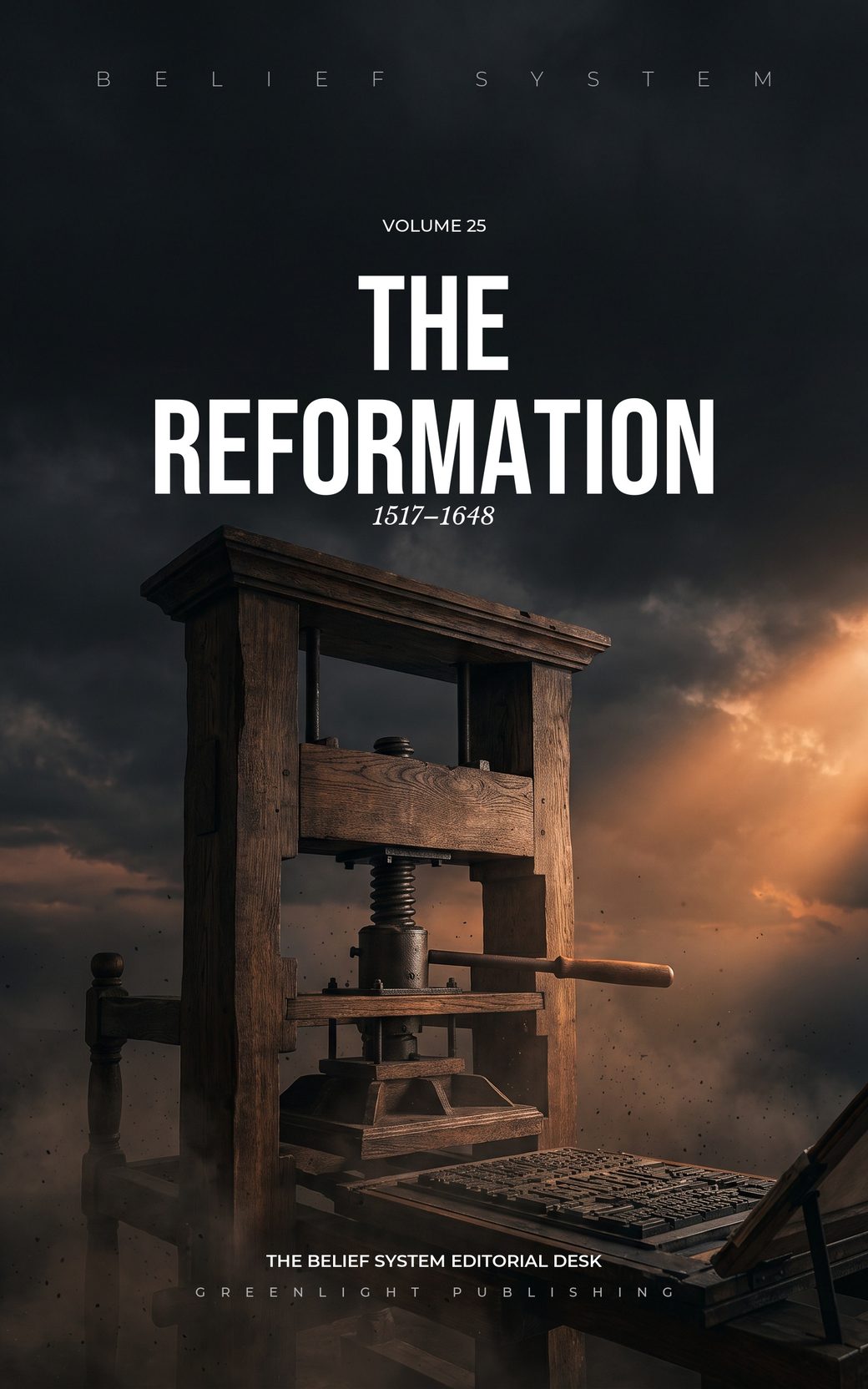
Jacket of Belief System volume 25, The Reformation
$12.99paperback

134 pages, 5.5 × 8.5 in. Three or more volumes in one order and every copy drops to $11.99.

copies

United States, 8 to 11 days. All destinations

Volume 25 Belief System 1517–1648

The Reformation

The machinethe pamphlet

Attested from
1517

The earliest secure evidence, and the key this volume is filed under. All thirty-one

Narrates
1517–1648

The period the book actually covers. It is rarely the same figure.

The argument in one sentence

A leveraged purchase of an archbishopric, structured for repayment through a franchised indulgence campaign, collided with a sixty-year-old printing industry that had just learned to make books short, cheap and German — and the collision reopened a canon that had sat settled for a millennium, transferred a national church’s landed wealth to buyers with a permanent interest in keeping it, and left the winning movement with no mechanism for settling its own disagreements, so it split at Marburg on one article of fifteen and kept splitting until a peace treaty in 1648 did the work no council could.

it ignited over a leveraged buyout: Albrecht of Brandenburg borrowed 20,000 gulden from Jacob Fugger to buy papal confirmation of Mainz, and the indulgence Luther attacked was split half to Rome and half to the Fugger debt.The commissioning line

What it is

The indulgence certificates were printed with a blank where the buyer’s name went.

That is where this book starts, because it is the fact most accounts leave out: the thing Luther attacked was a financial product, with agents, quotas, a marketing operation and a bank behind it.

The archbishopric of Mainz was bought with a Fugger loan, and the indulgence campaign was structured to repay it, with the bank’s agent travelling alongside the preacher. Within two years a movement had discovered the cheap vernacular quarto, and nobody, Luther included, controlled who reprinted it. A settled canon had to be stated aloud because somebody had disputed it. An enormous share of England’s landed wealth changed hands and created a class of buyers with a permanent interest in the settlement holding.

Five movements: the world it began in, the machine that carried it, the canon reopened, the money, and the split that could not be stopped.

The book never adjudicates. No story of corruption cleansed, no story of unity broken by pride. The indulgence trade is reported as documented finance and Trent as documented deliberation. The tower experience is reported, attributed and dated, never narrated from inside. And no motive, for anybody.

Belief System, Volume 25.

In full

A movement built on the right of private judgement against a central authority cannot then constitute a central authority. So it splits, and keeps splitting. This volume is about how that happened, and about the machinery that made it possible, which is better recorded than the scenes everybody knows and mostly missing from accounts of them.

Print existed for sixty years before 1517 and had mostly produced long, expensive books. The Reformation’s innovation was the cheap short vernacular quarto, printed fast, sold cheap, and reprinted by any press that got hold of one. A printer’s own letter, written in 1519, records six hundred copies into France and Spain, a bookseller carrying a good part into Italy, three hundred copies only of one reply, and the sentence a printer writes when a thing is selling.

The money is the movement’s spine. The Mainz arrangement is a documented financing structure, not a polemical claim. The English dissolution is evidenced by statutes, surveys and account books, which record what was done rather than why, and this book prints the survey’s own decomposition of its totals instead of the headline proportion that circulates without one.

The canon movement is about a list that had been settled for a millennium and had to be stated because it was challenged, and about a translation dispute, metanoia against poenitentiam agere, that is the founding argument of the whole period. The split movement ends at Marburg, where fourteen articles were agreed and the fifteenth was not, and a movement discovered it had no mechanism for settling a disagreement.

Three scenes this book will not narrate: the door at Wittenberg, attested only by Melanchthon after Luther’s death; the tower experience, from a preface written three decades later; and the couplet about the coin in the box, which reaches us only through its target’s opponents. Each is reported, attributed and dated. None is dramatised.

Belief System is a history of world religion, one tradition at a time. Thirty-one volumes, ordered by earliest secure attestation.

The contents

26 chapters in five movements. Every volume in the series has the same five, in the same order, and each chapter below is printed with the idea it carries.

Movement OneThe World

The Empire, the universities and the indulgence trade as they stood in 1517 — the conditions that made a protected heretic possible, before any door is mentioned.

  1. 1An Empire of Small SovereignsThe Holy Roman Empire in 1517 was a legal landscape rather than a state — seven electors made its emperor, several hundred princes, prince-bishops and free cities held the day-to-day sovereignty, and no authority could execute a uniform policy across it. The volume states this first because everything that follows depends on it: the same fragmentation that had made reform edicts unenforceable for a century made a condemned friar physically survivable.
  2. 2The Recovery of GreekHumanist philology was the century’s solvent: Valla proved the Donation of Constantine a forgery from its Latin alone (1440, and in print by 1517), and Erasmus set the Greek New Testament beside a fresh Latin in 1516 — one annotation carrying a charge nobody had yet measured: behind the Vulgate’s poenitentiam agite, “do penance”, a sacrament, stood the Greek imperative metanoeite, a turning of the mind. The first of the ninety-five theses stands on that gap. It is the volume’s founding example of a translation dispute that is itself the historical event.
  3. 3A Financial ProductBy 1517 the indulgence was a mature instrument with a theology, a paper form and a sales force: the treasury-of-merits doctrine (stated by papal bull in 1343) supplied the asset; the printed certificate with a blank for the buyer’s name supplied the product — the earliest precisely datable pieces of European printing are indulgence blanks from the mid-1450s; commissioners, sub-agents, preaching tours and graduated price schedules supplied the distribution. Reported as documented finance, because that is what the documents show it was.
  4. 4The Elector’s Own CollectionFrederick of Saxony — the ruler whose protection would keep Luther alive — was himself a major indulgence proprietor: his Wittenberg relic collection, catalogued in a printed, Cranach-illustrated Heiltumsbuch in 1509, anchored an annual indulgence market, and he barred the St Peter’s campaign from his territory as competition; Wittenbergers crossed the border to buy from Tetzel at Jüterbog. The Reformation’s shelter was not built of sympathy for reform. It was built of electoral politics and a rival product.
  5. 5The Door, Reported AccuratelyWhat the record shows for 31 October 1517 is a letter — Luther to Archbishop Albrecht, dated that day, enclosing ninety-five Latin theses framed for academic disputation and objecting to the campaign preached in Albrecht’s name. The famous posting is attested by Melanchthon in a preface of 1546, after Luther’s death, by a man who arrived in 1518; a marginal note by Luther’s secretary Rörer also asserts it; Iserloh argued in 1961 that it never happened, and the question is contested still. What is not contested: within weeks the theses were reprinted in Basel, Leipzig and Nuremberg — the fact this volume runs on, and the machine movement’s subject.

Movement TwoThe Machine

The transmission technology, named as a concrete object: the cheap short vernacular quarto — the pamphlet — plus the woodcut that reached the illiterate, and the reprint nobody controlled.

  1. 6Sixty Years of Expensive BooksThe press was not born reformist. For its first sixty years it mostly made what its capital structure required: big Latin folios for institutional buyers — Bibles, missals, law, scholastic theology — plus the church’s own paperwork, indulgence blanks above all. Printing was capital-hungry, overproduction bankrupted printers, and the industry’s anchor client was the institution the pamphlet would shortly attack. The machine existed for two generations before 1517; the format that changed everything did not.
  2. 7The QuartoThe Reformation’s innovation was a format: the Flugschrift — a German quarto of eight to thirty-two pages, printable in a day or two, cheap, portable under a coat, sold by pedlars — and its prototype was Luther’s Sermon on Indulgence and Grace of early 1518, a plain-German tract that went through printing after printing within months. Short vernacular print turned a Latin faculty dispute into a public one, and the hostile witnesses noticed first.
  3. 8A Fifth of EverythingOne man became a measurable share of an industry: Luther’s output, counted in editions, has been put at about a fifth of all German pamphlet printing in the early Reformation decades — the most striking figure in this series, printed only after verification. His name on a title page became a selling device in a trade that had mostly issued theology anonymously; Wittenberg went from a one-shop backwater whose printing Luther complained about to a major print centre; and the printers who built it — Lotter, the Cranach–Döring partnership, later Lufft — were entrepreneurs following demand, not converts donating capital.
  4. 9The WoodcutFor the majority who could not read, the movement shipped pictures: Cranach’s Passional Christi und Antichristi (1521) ran thirteen paired woodcuts — Christ washing feet set opposite the pope having his kissed — with captions beneath; the broadsheet monsters of 1523, the Papal Ass and the Monk Calf, turned prodigy-literature into polemic. How many people the images reached cannot be established, because literacy in the Empire is an estimate with a wide spread — and the chapter says so instead of choosing a number.
  5. 10Nobody Owned the ReprintThere was no copyright: printing privileges ran to a territory’s border and no further, so any press could reprint anything it could get, and did, within days. Luther’s texts spread at reprint speed and degraded at reprint speed — his own printed complaints about garbling reprinters survive — and the Edict of Worms banned his books across an Empire whose structure guaranteed non-enforcement. Even the words everyone knows from Worms are a print artefact: “Here I stand” appears in the earliest printed account and not in the transcripts, and is reported here as exactly that. The consequence the volume keeps: Karlstadt, Müntzer and Zwingli ran on the same uncontrolled channel, so the movement fragmented at the speed of its own distribution.

Movement ThreeThe Canon

What is in, what is out, who decided, when, and what the decision cost. The real subject is who had the authority to close the list — and this movement’s argument is that sola scriptura, which sounds like a simplification, functioned as a reopening. The movement opens with that argument, never with an entry.

  1. 11Scripture Alone Reopens EverythingThe appeal to scripture alone did not simplify authority; it reopened every question a settled hierarchy had closed. At Leipzig in 1519, pressed by Eck, Luther conceded that councils can err — which left the text as the sole court of appeal and immediately raised the four questions the rest of this movement follows: which books, whose Greek and Hebrew, whose translation, and who says. A millennium of practice had made the answers feel settled. It took three years of print to reopen all four at once.
  2. 12The Epistle of StrawLuther edited the canon in public: his 1522 New Testament preface graded the books by whether they preach Christ and called James “a right strawy epistle” beside them — a judgement later editions dropped, and the drop is itself checkable against surviving printings; his table of contents numbered twenty-three books and then set Hebrews, James, Jude and Revelation apart, unnumbered, at the end; and in 1534 the whole Apocrypha went between the Testaments under a header saying these books are not held equal to holy scripture and yet are useful and good to read. Not an accident and not a secret: the reopened canon was being re-sorted by one theologian’s criterion, in print, in German.
  3. 13Trent States the ListOn 8 April 1546 the Council of Trent defined the canon by decree — the disputed books included, an anathema attached, and the Latin Vulgate declared the authentic edition. The structural point carries the chapter: a tradition that had lived with a settled list for a millennium had to state it, because someone had disputed it — a canon’s closing becomes visible only under challenge, as readers of the Early Christianity volume have seen with Marcion. The session was a deliberation, not a reflex — the acta record real argument over whether to grade the books or vote the list whole — and it is reported here as documented deliberation.
  4. 14Eleven Weeks at the WartburgThe vernacular Bible became an industrial product: hidden in the Wartburg after Worms, Luther drafted the entire New Testament in about eleven weeks; the September Testament of 1522 appeared without his name on it and, the estimates hold, sold out within months, a December printing following; and his 1530 open letter on translating turned method into manifesto — look at the mouth of the common man — while defending the most disputed word he ever printed: the “alone” his Romans added to “faith”. One German adverb, argued in public for a decade, because the translation choice is the historical event.
  5. 15The Contraband BibleIn English the industrial Bible was a smuggled one: Tyndale’s New Testament, printed abroad in 1526, entered in cloth bales; the bishop of London burned it at Paul’s Cross and — a chronicle says — unwittingly financed the next edition by buying up stock to destroy; Tyndale’s word-choices (congregation for church, elder for priest, love for charity) were the real battlefield, argued in print with Thomas More; he was strangled and burned in 1536, and Foxe reports last words about the king of England’s eyes. Then the product line: the Geneva Bible of 1560, with roman type, verse numbers and margin notes whose politics a king could read; the Douay–Rheims counter-translation; and at Hampton Court in 1604 a king commissioned a Bible whose distinguishing feature was margins with no doctrine in them. The King James Version is quoted in this volume because here it is the subject.

Movement FourThe Money

The best-documented financing arrangement in the series, then the largest land transfer. Who paid, who was paid, and how we know — numbers with their provenance in the same sentence.

  1. 16The Mainz ArrangementThe indulgence Luther attacked was collateral. Albrecht of Brandenburg, holding one archbishopric already, bought papal confirmation of Mainz in 1514 with fees he financed by borrowing 20,000 gulden from the Fugger house, and the St Peter’s indulgence preached in his provinces from 1517 was structured to service the debt — half the take to Rome for the basilica, half to the Fuggers. A documented financing arrangement in curial and banking records, not a polemical claim. The same house was about to finance the election of the emperor before whom Luther would stand at Worms.
  2. 17The Man From the BankThe campaign was run as the financial operation it was: Albrecht’s printed Instructio Summaria gave his sub-commissioners a graduated price schedule — so much for kings and archbishops, down the ranks to the clause letting the penniless contribute prayer and fasting; Tetzel preached; and a Fugger agent travelled with the operation, keeping a key to the chest and the count. The one piece everyone remembers — the couplet about the coin and the soul — survives as the opponents’ report, and Luther’s twenty-seventh thesis paraphrases it as what “they preach”.
  3. 18The Common ChestWhere the movement won, church wealth was not abolished but re-plumbed: the town of Leisnig’s common chest ordinance of 1523, carrying Luther’s preface, pooled the parish’s endowments, mass-foundations and fees into one municipal chest for pastors’ pay and poor relief — and the pattern generalised, councils and princes inventorying, absorbing and reassigning ecclesiastical property, Philip of Hesse funding a new university at Marburg from dissolved houses. The machine’s assets changed hands wherever the doctrine did, which gave every converting ruler a fiscal stake in never converting back.
  4. 19The Survey Before the SeizureEngland’s Dissolution began as an audit: the Valor Ecclesiasticus of 1535 valued every religious house in the kingdom; statute then dissolved the smaller houses (1536) and the rest (1539); a purpose-built Court of Augmentations processed the property; and within a decade a monastic estate that the research file carries as roughly a quarter of the nation’s landed wealth — a proportion this volume re-verifies before printing it — had passed to the crown. The sequence survey → statute → land office is the chapter, because it shows a religious revolution executed as fiscal administration.
  5. 20A Class With an InterestThe Dissolution’s permanence was purchased, not decreed: the crown sold most of the land on, at broadly market terms, to gentry, lawyers and merchants — creating thousands of owners whose titles depended on the settlement. The proof of the mechanism came under Mary: Catholic restoration succeeded in doctrine and failed in property, the papal dispensation confirming purchasers in their former church lands being written into the very statute that reconciled England to Rome; Westminster’s brief monastic refoundation was the exception that measured the rule. A revolution that creates buyers cannot be reversed by decree. The money movement closes on that finding.

Movement FiveThe Split

A movement built on the right of private judgement against a central authority cannot then constitute a central authority. What divided it, what it became, what it handed on. Names the next volumes by NAME, never by number.

  1. 21Fourteen of FifteenAt Marburg in October 1529 the movement’s two halves met to merge and instead measured the crack: Luther and Zwingli agreed fourteen articles and failed on the fifteenth, the eucharist — the signed articles themselves record the failure, pledging mutual charity while stating that agreement on the bodily presence had not been reached — and the reported table scene, Luther chalking Hoc est corpus meum beneath the cloth, is printed as the participants’ report, not as a camera’s. The colloquy is the split’s emblem because it was the best case: one language, one decade, one patron pressing for union, and no way to close the gap.
  2. 22The Reformation of the ReformationThe movement’s radical edge ran ahead of it on the movement’s own logic: Zwickau prophets in Wittenberg by late 1521 while Luther sat in the Wartburg; Karlstadt reforming faster than his absent colleague; then Müntzer preaching judgement, and the peasants of 1525 printing the Twelve Articles — grievances footnoted with scripture, chapter and verse, the pamphlet apparatus turned to social demands with the tithe at their head. Luther answered the peasants in a pamphlet whose title alone did permanent work; the princes answered at Frankenhausen; and the death figures are early-modern estimates, printed as such. Private judgement had no natural edge on that side either — this chapter is the movement discovering it.
  3. 23Rebaptism, and the Kingdom at MünsterIn Zurich in January 1525 a handful of men rebaptised each other and founded, at a stroke, the era’s most persecuted movement: Zurich made rebaptism a drowning offence — Felix Manz went into the Limmat in 1527 — the Empire made it capital, and the Schleitheim articles of 1527 defined a church of the voluntarily separated. In 1534–35 the movement’s apocalyptic wing took the city of Münster and held it under siege through baptismal compulsion, polygamy and a proclaimed kingdom; it ended with the leaders’ bodies in three iron cages on St Lambert’s tower, where the cages hang today. The chapter reports both faces — including the pacifist regathering under Menno Simons — because together they are the demonstration: with no mechanism to adjudicate, the spectrum runs to every edge at once.
  4. 24No MechanismThe split kept splitting because nothing could stop it — and this is the volume’s closing argument, stated plainly. At Augsburg in 1530 the protesting estates could not file even one confession: the Lutherans submitted theirs, four cities another, Zwingli his own — three Protestant confessions at a single diet. The colloquies failed at the same article each time (Marburg 1529, Regensburg 1541); the Wittenberg Concord of 1536 patched less than it claimed; and the settlement that finally held, the Peace of Augsburg in 1555, was not a doctrinal resolution but a jurisdictional one — each prince chooses for his territory, dissenters may emigrate. The ruler had become the mechanism, which is to say the movement never built one of its own: a revolt founded on the right of private judgement against a central authority could not then erect a central authority.
  5. 25Trent, the Long AnswerThe Catholic answer was the thing Protestantism could not build — a working central mechanism. Trent sat in three periods across eighteen years (1545–63), thinly attended at its opening, and issued decrees that stated the canon (the chapter on Trent’s list, named), defined doctrine against the reformers point by point, and — the machine answer — ordered a seminary in every diocese, while the new Society of Jesus (1540) built schools and the Index of 1559 built a canon of exclusions. Reported as documented deliberation throughout: the acta’s attendance figures instead of adjectives, the drafts and the votes instead of a verdict on anyone’s sincerity.
  6. 26A Treaty Where a Council Should BeThe wars ended the argument without settling it: the Schmalkaldic War, the French wars, then thirty years that made the Empire the demonstration case — and the Peace of Westphalia in 1648 resolved a religious question by political instrument: confessional rights frozen to a normative year (1624), rulers’ powers over conscience bounded, emigration guaranteed, Calvinists admitted to the system, and the papal brief declaring the religious articles null ignored by every signatory — reported without comment, because it is the volume’s whole finding in one document. Then the hand-offs, by name: the Catholic half of the split carries its mass-produced saints into the Atlantic world of the African Diaspora Religions volume; and the machine this volume built — cheap print, no licence, every believer a reader — waits two and a half centuries and becomes a free newspaper in Los Angeles, where the Pentecostalism volume begins.

What this volume cannot establish

Printed in the book before the argument is, and printed here for the same reason. A history of a tradition that will not say where its evidence runs out is not a history.

  • Whether the theses were posted on the church door on 31 October 1517. The record shows a letter from Luther to Archbishop Albrecht dated that day, enclosing the theses. The posting itself is first attested by Melanchthon in 1546, after Luther’s death, by a colleague who did not arrive in Wittenberg until 1518; a secretary’s marginal note (Rörer) also asserts it, likewise secondhand; and Iserloh argued in 1961 that it never happened. The chapter on the door prints all three states — the letter, the late attestations, the contest — and never the scene.
  • Luther’s inner conversion — the “tower experience” — from anywhere but Luther’s own late telling. The source is his autobiographical preface of 1545, written roughly three decades after whatever it describes, and specialists disagree about the described event’s date by several years. It is reported, attributed and dated. It is never narrated from inside.
  • Whether Tetzel spoke the couplet about the coin and the soul. It survives in his opponents’ reports, and in Luther’s paraphrase of what “they preach” (thesis 27). Printed only as the opponents’ account of the preaching.
  • Copies. Editions can be counted — VD16 and the USTC index them — but sixteenth-century print runs are estimates almost without exception. Every copy figure in this volume is printed as an estimate with its provenance in the sentence, or not at all.
  • How many could read. Literacy estimates for the Empire diverge by a factor of several. The woodcut chapter says so instead of choosing a number.
  • Anyone’s motive. — Henry VIII’s above all. The evidence for the Dissolution is statutes, surveys and account books, which record what was done and not why.
  • What the people in the pews believed. The Saxon visitations measured answers given to official visitors, not belief; the volume quotes Luther’s own printed dismay at the results and stops there.
  • The human cost of the wars beyond a scholarly range. Contemporary casualty figures are propaganda on all sides; modern estimates for the Thirty Years’ War vary sharply by region. The closing chapter prints the named scholars’ ranges or nothing.

Christianity, three ignitions

This tradition ignites more than once in the chronology. The other slots are Early Christianity, Imperial Christianity. See the thread.

Sources

68 works, dated, and specific enough that a reader can go and look at the thing. Nothing is on this list that the desk did not consult.

The bibliography, as the volume prints it
# Document or work Date Evidence for
1Golden Bull of Charles IV, in O. J. Thatcher and E. H. McNeal1356; English 1905the seven electors and the election protocol
2Peter H. Wilson, Heart of Europe2016the Empire as a legal landscape; later, the war-loss reconstruction
3Franz Herre, Die Fugger in ihrer Zeit2000Jakob Fugger’s letter to Charles V on the 1519 election
4H. J. Cohn, article in German History2001the contested totals of the 1519 election loans
5Lorenzo Valla, Discourse on the Forgery of the Alleged Donation of Constantine, in Christopher B. Coleman1440; English 1922a donation dated by its Latin alone
6Erasmus, Novum Instrumentum (Froben, Basel)1 March 1516Greek New Testament beside a fresh Latin; the metanoeite annotation
7World English Bible, Matthew 4:17 and Romans 3:282000the working English against which the Vulgate and Luther’s allein are set
8Luther to Johann Staupitz, with the Resolutiones, in the Philadelphia Works of Martin Luther, vol. 1letter 1518; English 1915poenitentia learned as Greek metanoia
9Thirty-one-line Mainz indulgence; Scheide Library copy issued at Pfullendorf to Johannes Grosshansprinted 1454–55; issued 29 April 1455the press’s earliest datable product: a sales form with a blank for the name
10Clement VI, Unigenitus, in Emil Friedberg, Corpus iuris canonici27 January 1343; Friedberg 1881the treasury-of-merits doctrine as a store that cannot be drawn down
11R. N. Swanson, work on the late medieval indulgence tradeearly 2000show the money moved and who took a cut
12Frederick of Saxony’s printed relic catalogue, woodcuts by Lucas Cranach1509an elector’s own indulgence market, illustrated
13Ernst Borkowsky, Das Leben Friedrichs des Weisen; Martin Marty, life of Luther1929; 20081,902,202 years as the collection’s published arithmetic; a 1518 inventory at 17,443
14Luther to Archbishop Albrecht of Brandenburg, enclosing the ninety-five theses31 October 1517the same-day document; no door in it
15Georg Rörer, marginal note; Philip Melanchthon, preface to Luther’s Latin worksRörer after 1540; Melanchthon 1546–48late, secondhand notices of a posting; Melanchthon arrived in 1518
16Erwin Iserloh, challenge to the posting, answered by Heinrich Bornkamm1961; reply thereafterthe door as a constructed memory versus routine faculty practice
17Adam Petri (Basel), Jacob Thanner (Leipzig) and Hieronymus Höltzel (Nuremberg), reprints of the theses1517three shops, three formats, no permission asked
18Incunabula Short Title Cataloguecount as of August 201630,518 pre-1501 editions; folio-heavy, Latin-heavy profile
19Andrew Pettegree, The Book in the Renaissance2010print-shop economics; Sweynheym and Pannartz’s 1472 appeal
20Luther, Sermon von Ablass und Gnadeearly 1518the German quarto that turned a faculty dispute public; edition-count contested, copies uncountable
21VD16 and the Universal Short Title Cataloguecurrent union catalogueseditions as countable survivors; the Twelve Articles at G 3540–G 3563; Luther L 7499
22Tübingen Flugschriften corpus, under Hans-Joachim Köhlerlate twentieth centurythe measured shape of the early-sixteenth-century pamphlet
23Johannes Cochlaeus, Commentaria de actis et scriptis Martini Lutheri1549hostile contemporary complaint that Luther’s books were in everyone’s hands
24Andrew Pettegree, Brand Luther; Mark U. Edwards Jr., Printing, Propaganda, and Martin Luther2015; 1994Wittenberg’s rise; Luther’s counted share of German pamphlet output
25Johann Froben to Luther, in B. J. Kidd, Documents Illustrative of the Continental Reformation14 February 1519; Kidd 1911a Basel printer reporting demand
26Passional Christi unnd Antichristi, Matthes Maler, Erfurt; Boston Public Library copy1521thirteen paired woodcuts; Christ washing feet set opposite the pope having his kissed
27R. W. Scribner, For the Sake of Simple Folk1981the standard census of Reformation imagery
28Edict of Worms, book clauses, in KiddMay 1521a ban an Empire so structured could not enforce
29Preserved Smith, The Life and Letters of Martin Luther1911the Leipzig Disputation record of 1519
30Luther, Appeal to the Christian Nobility, in Wace and Buchheim, First Principles of the Reformation1520; English 1883the three walls around the interpretive monopoly
31September Testament copies at Stuttgart and Wolfenbüttel1522twenty-three numbered books; Hebrews, James, Jude and Revelation unnumbered at the end
32Luther, 1522 New Testament preface (“eine recht stroherne Epistel”), Weimarer Ausgabe Deutsche Bibel 61522; dropped by 1546James graded in public, then the grading page gone
33Luther’s 1534 Bible, Apocrypha header1534books “not held equal to holy scripture and yet useful and good to read”
34Andreas Karlstadt, De canonicis scripturis libellus1520the Hebrew canon’s boundary argued two years before the September Testament
35Council of Trent, Fourth Session decree, in J. Waterworth8 April 1546; English 1848the list stated, the Vulgate declared authentic, an anathema attached
36Council of Florence, canon list1442the precedent Trent took and then armed with a penalty
37Luther, Sendbrief vom Dolmetschen1530“look at the mouth of the common man”; the defence of allein in Romans 3:28
38Heinrich Dibbelt versus Heinrich Bornkamm on the Wartburg Greek1941; 1947whether eleven weeks could have been a Greek job
39Edward Hall, chronicle1548; reprinted 1809the Packington buy-up story, labelled a chronicle’s story
40William Tyndale, An Answer unto Sir Thomas More’s Dialogue, Parker Society1531; English 1850congregation, elder, love — the contested word-list from his own text
41John Foxe, Acts and Monuments, Cattley and Townsend, vol. 51838Tyndale’s last words, with no independent witness
42William Barlow, Hampton Court report, in Alfred W. Pollard, Records of the English Bibleconference 1604; Pollard 1911the king on the Geneva notes; Pollard’s warning that Barlow is prejudiced
43Rules issued to the 1611 translators, in Pollard1604–11margins with no doctrine in them
44Albrecht of Brandenburg’s bond to Jakob Fugger, in Aloys Schulte, Die Fugger in Rom15 May 1514; Schulte 190421,000 ducats for the Mainz pallium; the split that serviced the debt
45Instructio Summaria ad sub-commissarios, in Kidd1517graduated price schedule; the prayer-and-fasting clause for the penniless
46Elbing indulgence certificates, in Kidd26 November 1513the printed confessional letter as a form with a blank for the name
47Leisnig Kastenordnung, in Emil Sehling, Die evangelischen Kirchenordnungen des XVI. Jahrhunderts1523; Sehling 1902endowments pooled in one municipal chest; whether it became law, contested
48Philip of Hesse’s foundation of the University of Marburgdecreed 30 May 1527; opened 1 Julya new university funded from dissolved houses
49Alexander Savine, study of the Valor Ecclesiasticus1909553 monasteries in his list; income totals he would stand behind; no kingdom-share printed here
50Suppression statutes of 1536 and 1539, in Gee and Hardy1896 collectionthe 1536 preamble’s “manifest sin” as the crown’s own stated case
51Second Statute of Repeal, and Reginald Pole’s letters, in Gee and Hardy1554–55; collection 1896purchasers confirmed in former church lands in the statute that reconciled England to Rome
52Marburg Articles; Rudolf Collin’s colloquy account1–4 October 1529fourteen articles agreed; the fifteenth, on the eucharist, failed; Hoc est corpus meum on the table
53Dye Grundtlichen Vnd rechten haupt Artickel aller Baurschafft (Twelve Articles), Augsburg printing, in KiddMarch 1525scripture citations in the margin; pastor, tithe and serfdom as pamphlet demands
54Luther, Auch widder die reubischen vnd moerdisschen rotten der andern bawren1525the title that answered the peasants
55Zollikon depositions, in Kidd7 February 1525named men saying they were rebaptised in Rudolf Thomann’s house
56Zurich council mandates silencing Grebel and Manz18 and 21 January 1525infant baptism ordered; the first rebaptism as the tradition’s account
57Schleitheim Articles1527a church of the voluntarily separated
58Hermann von Kerssenbrock’s Latin history and Gresbeck’s eyewitness narrative of Münstermid-sixteenth centurythe kingdom under siege, each labelled for what it is
59Confession of Augsburg; Zwingli’s Fidei Ratio; Confessio Tetrapolitana; Recess of the DietJune–September 1530three Protestant confessions at one diet; a date in place of a decision
60Wittenberg Concord, in Kidd29 May 1536a eucharistic patch that concedes the signers cannot bind anyone
61Peace of Augsburg, in Kidd25 September 1555each estate’s religion; emigration; the Reformed excluded; cuius regio not in the text
62Catholic Encyclopedia1907–13named as a party: Old Testament canon, Trent attendance, Münster, Zelo domus Dei
63Council of Trent, opening session and seminary decree of the twenty-third session, in Waterworth13 December 1545; 15 July 1563a procedure that can vote; a training plant in every diocese
64Regimini Militantis Ecclesiae, in Kidd27 September 1540the Society of Jesus capped at sixty persons
65Roman Index of prohibited books1559the first Roman list intended for the whole world to carry that title
66Treaties of Münster and Osnabrück, eighteenth-century English in the Avalon Project24 October 1648normative year 1 January 1624; Calvinists admitted; emigration terms; protests declared empty
67Innocent X, Zelo domus Dei26 November 1648the religious articles declared null; ignored by every signatory
68Luther, Small Catechism preface, in the Triglot Concordiavisitations 1528–29; Triglot 1921“the common man knows nothing of Christian doctrine”

Common questions

When is The Reformation first securely attested?

1517. That is the earliest date the surviving evidence supports, and it is the key this volume is filed under. It is not the same claim as when the tradition began: the tradition’s own account of its beginning is printed beside it in the book’s front matter, never instead of it.

What period does the book cover?

1517–1648. The coverage span and the attestation date are two different facts, and the gap between them is often the most interesting thing about a volume.

What carried The Reformation?

The pamphlet. Movement Two of every volume is about the transmission technology — the concrete object or institution that made copying possible, and would not have existed a century earlier.

How long is it?

About 32,000 words, roughly 135 minutes’ reading, 134 pages in the paperback. The audiobook runs 3h 23m, measured from the finished masters.

What does this volume not claim to establish?

Whether the theses were posted on the church door on 31 October 1517. The record shows a letter from Luther to Archbishop Albrecht dated that day, enclosing the theses. The posting itself is first attested by Melanchthon in 1546, after Luther’s death, by a colleague who did not arrive in Wittenberg until 1518; a secretary’s marginal note (Rörer) also asserts it, likewise secondhand; and Iserloh argued in 1961 that it never happened. The chapter on the door prints all three states — the letter, the late attestations, the contest — and never the scene. Every volume prints its own limits before it prints its argument; there are 8 on this one’s list.

Does the book say which tradition is true?

No. Belief System does not adjudicate. Where the tradition’s account and the earliest evidence disagree, both are given, in their own vocabulary, attributed, and neither is given the last word. No miracle is reported as fact and none is denied.

Can I buy The Reformation in print?

Yes. It is a 5.5 × 8.5 in paperback, 134 pages, $12.99 a copy, bought direct rather than through a retailer. All thirty-one together are $199.00, with the ebook and the audiobook of every volume included.

The edition

The paperback
Trim5.5 × 8.5 in  /  140 × 216 mm
BindingPerfect-bound paperback, matte laminate
Paper60# uncoated cream, black ink
Extent134 pages
Editions and ISBNs
EditionExtentISBN
Paperback134 pages, 5.5 × 8.5 inISBN not yet issued
EbookEPUB979-8-90623-861-0
Audiobook3h 23m979-8-90623-862-7
Filed under
BISAC 1`REL017000` RELIGION / Comparative Religion
BISAC 2`REL015000` RELIGION / Christianity / History
BISAC 3`REL033000` RELIGION / History
  • Reformation
  • Martin Luther
  • indulgences
  • printing press
  • Council of Trent
  • Dissolution of the Monasteries
  • history of religion
  • Fugger
  • sola scriptura
  • church history