134 pages, 5.5 × 8.5 in. Three or more volumes in one order and every copy drops to $11.99.
United States, 8 to 11 days. All destinations
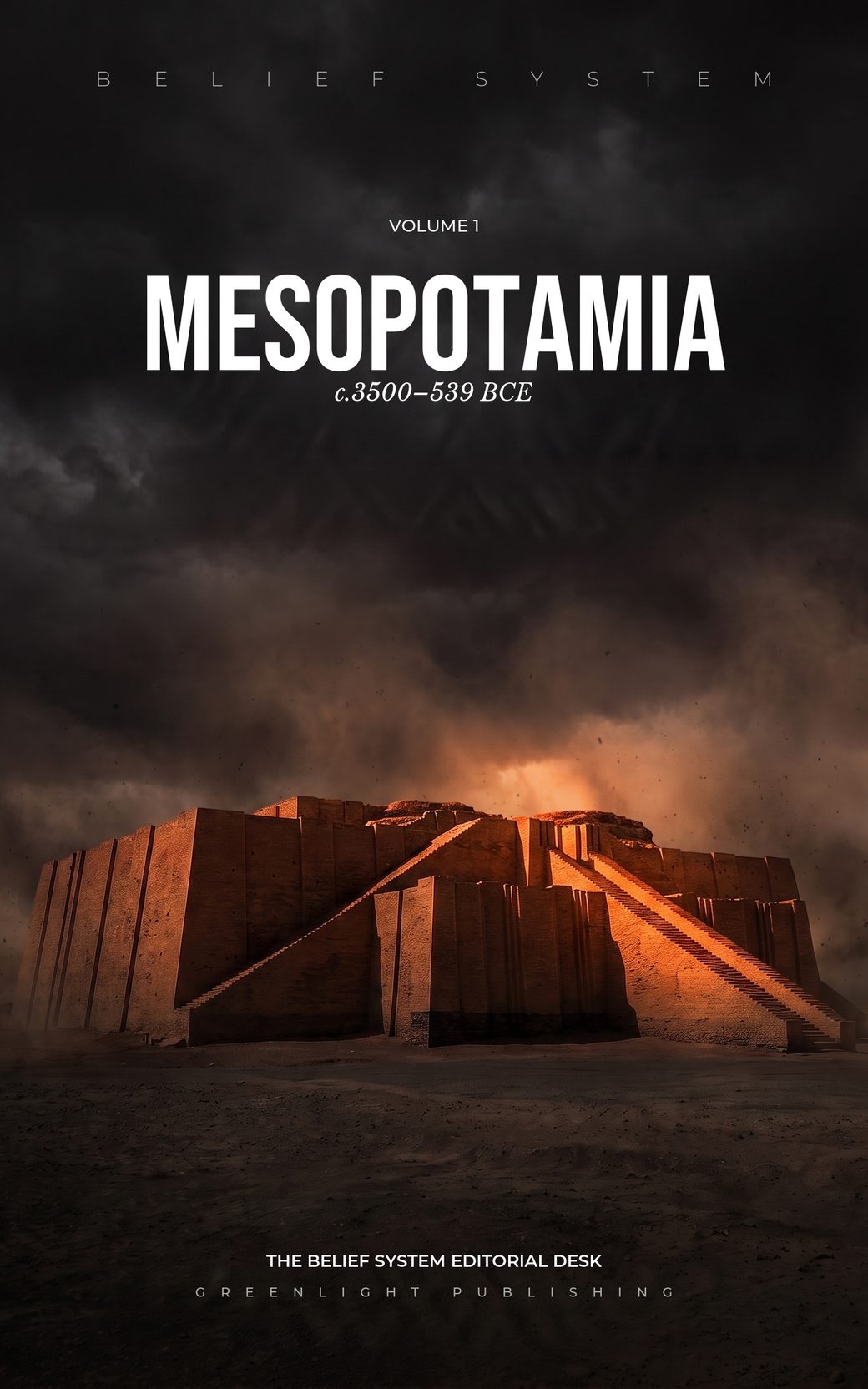
Volume 1 Belief System c.3500–539 BCE
Mesopotamia
The machinethe scribal school and the collated tablet
- Attested from
- c.3500 BCE
- Narrates
- c.3500–539 BCE
The earliest secure evidence, and the key this volume is filed under. All thirty-one
The period the book actually covers. It is rarely the same figure.
The argument in one sentence
The first religion in history that can be read ran as a household economy — gods with estates, payrolls and posted lending rates, staffed and copied by a scribal school that curated, collated and versioned its corpus for twenty-five centuries without ever closing it, because no institution in a land of rival cities held the authority to close anything — and a tradition that never produced a closed, portable book could not outlive its temples and its script, so its afterlife ran through other peoples’ scriptures until the decipherers gave it back its own words.
the first author in human history whose name we know was a priestess: Enheduanna, daughter of Sargon, signing temple hymns around 2300 BCE.The commissioning line
What it is
Excavators at Uruk recovered around five thousand clay tablets from the first centuries of writing. They are about barley, beer, sheep, textiles and land. There is no hymn among them, no prayer, no myth. For roughly five hundred years, writing kept accounts and did nothing else.
This is a history of the first religion we can read, and of how we know.
Twenty-five centuries, from the storehouse at Uruk to the last cuneiform tablet. A god with an address, a kitchen and a payroll. A school where a dozen boys copying in a private house held one curriculum steady across cities at war with each other. A temple office that could be sold, mortgaged, inherited and split into fractions of a day’s work. Loans at posted rates, and the women of the cloister who made them.
Five movements: the world it began in, the machine that carried it, the canon nobody had the authority to close, the money, and the ending.
The book never adjudicates. Every figure arrives with the archive it came out of, and where that archive is a sample, which is every time, the sentence says so. Where something cannot be established, the book says so and says why.
Belief System, Volume 1.
In full
The first religion whose documents we can read left almost no devotional writing for five hundred years. It left receipts.
That is the fact this volume is built on. Writing was invented in southern Iraq to run a storehouse, and for roughly its first five centuries it was spent on barley, beer, sheep and land. The gods of these cities were householders with estates, staff and posted lending rates, and the record they left is an economic one, which is why it can be checked.
Most books about Mesopotamian religion open with Gilgamesh. This one opens with the accounts, because the accounts are what survive in quantity and what nobody wrote to persuade anybody. It asks the questions this series asks of every tradition: what carried this, who paid for it, what got written down, who had the authority to decide, and what finally ended it.
The transmission machine is a school. Fixed lists copied in a fixed order, colophons recording line counts and stating that a copy had been collated against its original, and a scribe who wrote “broken” rather than invent a reading he could not see. The canon is the chapter that is not there: a corpus curated, versioned and reassembled for two and a half thousand years and never closed, because no institution in a land of rival cities ever had the standing to close it. The money is the best-documented religious economy in the ancient world. The ending is a tradition with no portable book, which could not outlive the temples that housed it or the script that carried it.
The volume uses five fixed phrases, and no sixth, so a reader always knows which kind of claim is being made. It quotes, and names the translation in the visible text every time. It reports no miracle as fact and denies none. It never tells you what anybody was thinking. And it does not write about a dead tradition in the knowing tone that dead traditions invite.
Belief System is a history of world religion, one tradition at a time: where it started, what carried it, who paid for it, and how it divided. Thirty-one volumes, ordered by earliest secure attestation.
The contents
26 chapters in five movements. Every volume in the series has the same five, in the same order, and each chapter below is printed with the idea it carries.
Movement OneThe World
Uruk, Eridu, and the question the religion answered. The city as a god’s household; writing invented for the storehouse; the evidence oldest and thinnest here, and the confidence falls with it, in the same sentence.
- 1The Disk of EnheduannaThe first author in human history whose name survives is a priestess — Enheduanna, daughter of Sargon, en-priestess of the moon god at Ur around 2300 BCE — and the two ways we know her teach the series’ whole method in one object: a carved disk from her own lifetime establishes that she existed and held the office, while the hymns that carry her name survive only in schoolroom copies five centuries younger, so her authorship is a tradition, and the chapter says which is which.
- 2The Stacked ShrinesTwo thousand years before any god’s name can be read, belief is attested at Eridu by architecture and ash — a sequence of shrines rebuilt on the same footprint from the sixth millennium into the fourth, their floors and altars littered with the fish bones of offerings — which makes the volume’s baseline point physically: attestation comes first, and everything the later tradition says about beginnings is a claim made afterwards, from a distance the chapter measures.
- 3The God’s HouseholdA Mesopotamian city was organised as the household — é, “house” — of its owner-god: a statue that was fed, dressed, perfumed and put to bed by a staff on rations, and the estate was not a metaphor, because the god’s meals were cooked in real kitchens from real herds and the leftovers moved down a human hierarchy by rule.
- 4The Accountants’ InventionWriting was invented in the temple precincts of Uruk around 3300 BCE as an accounting technology, and for roughly its first five centuries it recorded barley, beer, sheep and rations and not one prayer — the machine and the money are older than the canon, which is the deepest structural fact about this tradition and the reason this series’s movements run in the order they do.
- 5The First Readable PrayersWhen religious literature becomes readable, around 2600 BCE at Fara and Abu Salabikh, it arrives already organised — hymn collections, the earliest god lists, named scribes signing their work — and the copyists of the oldest Sumerian religious poetry include men with Akkadian names, so transmission across a language boundary is there on the first readable page.
- 6Why Humans Were MadeThe question this religion answered was the question of the silt — two violent, unpredictable rivers, salt creeping into the fields, flood and famine one administrative failure away — and its most explicit surviving answer is Atrahasis: the gods ran the world as an estate, tired of digging its canals, and manufactured humans from clay and a slain god’s blood to carry the workload, which makes service, storage and payroll the actual content of piety rather than its background.
Movement TwoThe Machine
The transmission technology, named as a concrete object or institution — not an abstraction. Here: the edubba, the fixed list curriculum, and the collated tablet, as one working system.
- 7The Tablet HouseThe replication machine of this tradition was the edubba, the “tablet house” — in the one excavated case a private home of a few small rooms, where a dozen boys at a time copied a fixed curriculum onto recycled clay — and the machine’s smallness is the finding: no ministry and no priesthood ran it, yet its output was standardised across cities.
- 8The List of EverythingThe curriculum was lists — sign drills, then thematic lists of trees, professions, gods, stones and fish, copied in a fixed sequence for centuries — so a student at Nippur and a student at Ur internalised the same textual canon without any authority ever decreeing one, and the measure of the machine’s fidelity is the Standard Professions List, transmitted essentially verbatim from the archaic period deep into the second millennium, long after many of its job titles had gone dead.
- 9Written and CollatedError-correction was physical and explicit: a finished tablet ends in a colophon that counts its lines, places it in its series, and states that it was written and collated against its original — and where the original was damaged, the copyist wrote ḫepi, “broken”, into the text rather than invent a reading, which is the oldest written refusal to replace a gap with a plausible guess.
- 10The First Dead LanguageSumerian died as a spoken language early in the second millennium — the date is contested by centuries, and the contest is reported — and then remained the liturgical language for nearly two thousand more years, kept alive by the school through interlinear bilingual tablets and by lamentation-priests chanting their Emesal-dialect laments into the Hellenistic period: the first dead sacred language in history, and a pattern later volumes of this series meet again and again.
- 11The King Who CollectedThe nearest the tradition came to a central archive was a royal security project: Ashurbanipal of Assyria assembled at Nineveh a reference library of some thirty thousand tablets and fragments — by inheritance, by commissioned copying, and by ordering tablets collected out of Babylonian temple and private libraries after his brother’s revolt — and even the most powerful collector in the tradition’s history closed nothing: he stocked the stream, he did not dam it.
Movement ThreeThe Canon
What is in, what is out, who decided, when, and what the decision cost. The real subject is who had the authority to close it — and here the finding is that nobody did. The movement opens with that argument, never with an entry.
- 12The Canon That Never ClosedMesopotamia had everything a canon needs — fixed series with numbered tablets, catalogues, attributed authors, collation, even a native catalogue assigning texts to gods, sages and men — everything except an institution with the authority to say “this and no more”; closing a canon is a political capability, not a literary one, and a land of rival cities, rival dynasties and family scribal firms never produced the politics, so the corpus stayed curated, versioned and open for twenty-five centuries.
- 13Theology by ListThe native genre of theology was the list: from the god lists of Fara around 2600 BCE to the great series An = Anum — seven tablets and roughly two thousand entries, the pantheon organised into households with spouses, children, viziers and staff — gods were catalogued, equated, merged and demoted the way ledgers are reconciled, which is theology done by the same craft that ran the storehouse, in a genre that can always take another entry and so can never close.
- 14The Fifty NamesEnuma Elish, the seven-tablet Babylonian creation poem, is the closest thing to a creed the tradition produced, and it is a promotion document — cosmology rewritten so that Babylon’s own Marduk earns kingship over the gods and a temple at the universe’s centre — so central that it was recited to the god’s statue every New Year, and so unclosed that Assyrian copyists could swap their own god into the title role.
- 15The Versions of GilgameshGilgamesh survives in visible layers — separate Sumerian poems, an integrated Old Babylonian epic opening “Surpassing all kings”, and an eleven-tablet Standard Babylonian edition opening “He who saw the Deep”, which a native catalogue attributes to one named editor, Sin-leqi-unninni — and no layer was ever suppressed in favour of another: here an edition was a prestige achievement carrying an editor’s name, never an act of exclusion, and what a caliph did to the Qur’an in a decade, as the Islam volume shows, no Mesopotamian institution attempted on Gilgamesh in fifteen centuries.
- 16The Gods Publish DailyNo closed scripture was needed because revelation never stopped: the gods were held to write continuously — in the stars, called “the writing of heaven”, and in the liver of every sacrificed sheep — so the largest genre in the libraries is omens, read by credentialed experts whose authority lay in their training rather than in any closed book; and when one scholar, Esagil-kin-apli, did impose an edition on the diagnostic series — the old versions, he says, were like tangled threads — it spread by prestige and bound nobody, the exception that measures the rule.
Movement FourThe Money
Who paid, who was paid, and how we know. Numbers get their provenance in the same sentence — and in this volume every total is a sample, because no archive is complete.
- 17The Estate of the GodThe earliest well-documented religious institution on earth is a payroll: the mid-third-millennium archive of the household of the goddess Bau at Girsu — on the conventional count some seventeen hundred tablets of fields, plough-teams, herds and boats, with ration lists that name weavers, orphans and widows — and the first great modern generalisation built on it, that the temple owned everything, turned out to be wrong, which this series treats as a finding about method: an archive is a sample, not an economy.
- 18The Posted RatesTemples were grain-stores and lenders, and the price of credit was so conventional it was legislated — 20 per cent on silver, 33⅓ per cent on barley, rates posted in the Laws of Eshnunna and repeated in Hammurabi’s code — and the differential is the sociology, on the standard reading, which the chapter reports rather than owns: silver moved between merchants, barley fed the hungry until harvest, and the loan likelier to fail carried the higher rate.
- 19The Cloister PortfolioThe best-documented women of the ancient world are financiers attached to a temple: the naditu of Shamash at Sippar, who entered a walled cloister young, never married, and managed capital for life — fields, houses, silver out at interest — while a run of paragraphs in Hammurabi’s code regulates their property; the standard scholarly reading of the institution is financial — a cloistered daughter kept her dowry under her own management and, childless, let it return to her father’s line — and the chapter attributes that reading to the scholars who made it, because no naditu ever tells us why she entered.
- 20The Clearinghouse of SacrificeFor about a century the sacrificial economy ran through a purpose-built clearinghouse with daily paperwork: Puzrish-Dagan, founded by King Shulgi of Ur to book livestock in and out for the gods of Nippur — part of a documentation regime that has left on the order of a hundred thousand published tablets from a single century, more administrative text than survives from any other century of antiquity — and the same king walked himself onto the divine side of the ledger, taking a god’s determinative, temples and offerings while alive.
- 21A Share of the God’s TableBy the first millennium a slice of a god’s dinner was a negotiable security: the prebend, a temple office measured in days of service per month — baker’s days, brewer’s days, butcher’s days — entitled its holder to a fixed cut of the offerings that came back off the god’s table, and the contracts show prebends sold, mortgaged, inherited by women, and subdivided into fractions of a single day; the sacred economy had financialised itself, on paper we still hold.
Movement FiveThe Split
What divided it, what ended it, and what it handed on. The sources for this movement are victors’ propaganda and the loser’s own monuments, and every chapter says so. Next volumes named by NAME, never by number.
- 22The King Who Loved the MoonThe last native king of Babylon, Nabonidus (556–539), moved the moon god Sin toward the summit of the pantheon — rebuilding Sin’s temple at Harran, crediting Sin with his kingship, and reviving at Ur, after centuries of lapse, the very priestess-office Enheduanna had held, installing his own daughter in it — a reordering that the tradition’s open canon could not forbid and only a rival king could stop; and nearly everything narrative we know about it comes from his enemies’ documents or his own, with no neutral text between them.
- 23Ten Years Without the FestivalThe state cult had a single point of failure — the New Year festival required the king’s own hand on Bel in Babylon on fixed days — and for about ten years Nabonidus was at the Arabian oasis of Tayma while the chronicle logged the outage in a repeating formula: the king did not come, Nabu did not come, Bel did not go out, the festival was omitted.
- 24The Hand of CyrusIn October 539 Babylon changed hands — the chronicle has Sippar and then the city taken without battle, and Cyrus entering to green branches spread before him — and virtually every narrative source for the transfer was produced under the victor: the Cyrus Cylinder has Marduk himself scan the lands, take Cyrus by the hand and walk him in; the Verse Account jeers at Nabonidus’s heresies; even the sober chronicle was compiled under Persian rule; so the famous smoothness of 539 is the claim of the parties that benefited, and the chapter says so in every paragraph that leans on them.
- 25The Long AfterlifeNothing fell in 539 that a worshipper could see: the temples ran on under Persian, Seleucid and Parthian rule for five more centuries — through a documented purge of the old temple families after the revolts of 484, through a Hellenistic Uruk that promoted Anu to the head of its local pantheon and rebuilt his precinct under officials carrying one Babylonian name and one Greek — until the tradition died not of conquest but of script-death: a religion that had never made a closed, portable, vernacular book could not leave its temples, and when the last cuneiform readers went, it went.
- 26The Flood Tablet in LondonThe tradition that never closed its canon was reopened one tablet at a time: in 1857 the Royal Asiatic Society sealed four independent translations of the same Assyrian inscription and opened them together to prove decipherment real — collation, performed on the decipherers themselves — and in December 1872 George Smith read a Nineveh tablet’s flood story to a London society, and a religion eighteen centuries dead abruptly had heirs to speak to, because what Mesopotamia handed on it had handed through other peoples’ books: a flood narrative into the scriptures of the exiles, the zodiac and the sexagesimal sky to the Greek astronomers, and to this series a method — count the lines, collate against the original, and where the tablet is broken, write “broken” rather than guess.
What this volume cannot establish
Printed in the book before the argument is, and printed here for the same reason. A history of a tradition that will not say where its evidence runs out is not a history.
- When any of it began, or from what. The oldest evidence is architecture and offering debris — a stack of shrines at Eridu with fish bones on the floors — with no readable name of any god. The c.3500 of the title page is where the material record thickens, not a founding; there is no founder, no founding event, and no founding date, and the volume’s front matter prints the attestation-versus-tradition distinction that fact forces (per the series chronology’s standing flag on this volume).
- What anyone believed. The corpus is the output of temple and school scribes. It documents what institutions wrote, paid for and copied — not what a farmer at Nippur held true. Private religion is glimpsed obliquely, in personal names and letters, and the volume says “glimpsed” when it means glimpsed.
- That Enheduanna composed the hymns that bear her name. A carved disk and household seals establish, from her own lifetime, that she existed and held the office. The hymns naming her as their compiler survive only in school copies five centuries younger, and the attribution is contested. The record shows the priestess; the tradition supplies the author.
- Ritual continuity across the gaps. The best surviving descriptions of the god’s daily meals and of the New Year festival are Seleucid- and Hellenistic-era tablets. Every backward projection from them is labelled as inference, chapter by chapter.
- Any economic total. The archives are accidental samples — one temple’s office, one family’s strongbox, one burnt room. Posted interest rates are conventions that real contracts diverge from; no temple’s holdings can be summed because no archive is complete; and the first great modern generalisation from this evidence (the “temple state”) was an overreach the money movement reports as a lesson in method.
- The inside of the final century. Every principal narrative source for Nabonidus and the fall of Babylon — chronicle, cylinder, verse polemic — was produced under or after the Persian victory, or by Nabonidus himself. There is no neutral text, and the split movement says so on every page that uses them.
- How any of it sounded. Performance, music and pronunciation are reconstructions; the volume does not stage a scene it cannot source.
- Anyone’s interior state.
Sources
69 works, dated, and specific enough that a reader can go and look at the thing. Nothing is on this list that the desk did not consult.
| # | Document or work | Date | Evidence for |
|---|---|---|---|
| 1 | Calcite disk of Enheduanna, Penn Museum, from Woolley’s giparu at Ur | conventionally c. 2300 BCE; found 1927 | her name, office and filiation on a lifetime object |
| 2 | Cylinder seals of Enheduanna’s household staff, Ur | Sargonic | contemporaneous administrative corroboration of her household |
| 3 | Sumerian Temple Hymns, Old Babylonian school copies, ETCSL composite | copies c. 1800–1600 BCE | the compiler line naming Enheduanna |
| 4 | nin-me-šara, Old Babylonian school copies; Hallo and van Dijk, The Exaltation of Inanna | copies Old Babylonian; ed. 1968 | the first-person signature; the live authorship debate |
| 5 | Safar, Mustafa and Lloyd, Eridu | excavations 1946–49; report 1981 | seventeen superimposed shrines and the fish-bone floors |
| 6 | Sumerian King List, Ashmolean WB 444 | Old Babylonian, year 11 of Sin-Magir | “kingship was at Eridu” as later tradition, not as a date |
| 7 | Walker and Dick, The Induction of the Cult Image in Ancient Mesopotamia | 2001 | the craftsmen’s sworn denial in the mouth-washing rite |
| 8 | Thureau-Dangin, Rituels accadiens | 1921 | Seleucid daily meals of Anu; the Akitu slap and confession |
| 9 | A. Leo Oppenheim, Ancient Mesopotamia | 1964 | care and feeding of the gods; the “stream of tradition” |
| 10 | Nissen, Damerow and Englund, Archaic Bookkeeping | 1993 | the Uruk administrative corpus and the contested Kushim sign-pair |
| 11 | Anton Deimel, Die Inschriften von Fara | 1922–24 | the earliest god lists from Shuruppak |
| 12 | Robert Biggs, Inscriptions from Tell Abū Ṣalābīkh, OIP 99 | 1974 | the za3-mi2 hymns and the earliest Kesh Temple Hymn |
| 13 | Biggs, “An Archaic Sumerian Version of the Kesh Temple Hymn from Tell Abū Ṣalābīkh” | 1971 | eight centuries of recognisable wording |
| 14 | Krebernik and Lisman, The Sumerian Zame Hymns from Tell Abū Ṣalābīḫ | 2020 | the re-edition of the Abu Salabikh praise sequence |
| 15 | Lambert and Millard, Atra-ḫasīs | 1969 | the creation-and-flood poem dated by Ammi-ṣaduqa colophons |
| 16 | Jacobsen and Adams, “Salt and Silt in Ancient Mesopotamian Agriculture,” Science | 1958 | salinisation visible in the administrative record |
| 17 | Eleanor Robson, “The tablet house: a scribal school in Old Babylonian Nippur,” Revue d’assyriologie 95 | 2001 | House F’s 1,407 school tablets recycled into the walls |
| 18 | Samuel Noah Kramer, “Schooldays,” JAOS 69 | 1949 | the school’s self-portrait of caning, dinner and a fee |
| 19 | Standard Professions List (ED Lu A) | archaic Uruk into Old Babylonian | job titles copied long after they went dead |
| 20 | Niek Veldhuis, Elementary Education at Nippur | 1997 | the curriculum reconstructed from tablet co-occurrence |
| 21 | Veldhuis, History of the Cuneiform Lexical Tradition | 2014 | the same syllabus extended across the lexical tradition |
| 22 | Hermann Hunger, Babylonische und assyrische Kolophone | 1968 | line counts, catch-lines and collation statements |
| 23 | Piotr Michalowski, “The Lives of the Sumerian Language,” in Margins of Writing, Origins of Cultures | 2006 | the contested death-date of spoken Sumerian |
| 24 | Kuyunjik tablets, British Museum, excavated by Layard and Rassam | recovered from 1850 | Ashurbanipal’s library as an order of thirty thousand pieces |
| 25 | Simo Parpola, “Assyrian Library Records,” JNES 42 | 647 BCE; pub. 1983 | tablets received from named Babylonian scholars |
| 26 | Ashurbanipal’s Borsippa collection letter | seventh century BCE | “let no one withhold a tablet”; addressee left unread |
| 27 | Grant Frame and A. R. George, “The Royal Libraries of Nineveh,” Iraq 67 | 2005 | how the library was stocked after the Babylonian revolt |
| 28 | W. G. Lambert, “Ancestors, Authors, and Canonicity,” JCS 11 | 1957 | authorship without an institution that could close the list |
| 29 | Lambert, “A Catalogue of Texts and Authors,” JCS 16 | 1962 | works ascribed to Ea, the sages and Sin-leqi-unninni |
| 30 | Francesca Rochberg, “Canonicity in Cuneiform Texts,” JCS 36 | 1984 | why Assyriology’s word “canonical” wears quotation marks |
| 31 | Richard Litke, A Reconstruction of the Assyro-Babylonian God-Lists | 1998 | An = Anum as household theology; 2,123 surviving entries |
| 32 | L. W. King, The Seven Tablets of Creation | 1902 | the Enuma Elish opening and the fifty names of Marduk |
| 33 | R. Campbell Thompson, The Epic of Gilgamish | 1928 | the Standard Babylonian prologue and the Tablet XII graft |
| 34 | Enuma Anu Enlil and Shumma Alu omen series | first-millennium library copies | revelation that never stopped, tablet after tablet |
| 35 | Hunger, Astrological Reports to Assyrian Kings, SAA 8 | 1992 | court omen reports that contradict one another |
| 36 | Parpola, court scholars’ letters, SAA 10 | 1993 | the wider correspondence of the ummânu |
| 37 | Irving Finkel, catalogue of Sakikku, Sachs memorial volume | 1988 | Esagil-kin-apli’s tangled-threads editorial statement |
| 38 | Ulla Koch-Westenholz, Mesopotamian Astrology | 1995 | the published scale of the celestial series |
| 39 | é-mí archive of the household of Bau, Girsu | c. 2400–2350 BCE | fields, herds and ration lists as the earliest temple payroll |
| 40 | Urukagina reform cones AO 3278 and AO 3149 | late Early Dynastic | estates declared the gods’ — royal self-praise, the name read three ways |
| 41 | Anton Deimel, Sumerische Tempelwirtschaft | 1931 | the temple-state hypothesis built on Girsu |
| 42 | Benjamin Foster, “A New Look at the Sumerian Temple State,” JESHO 24 | 1981 | temples beside palace and private holdings, not instead of them |
| 43 | I. J. Gelb, “The Ancient Mesopotamian Ration System,” JNES 24 | 1965 | the sex-and-age schedule behind the lists |
| 44 | Laws of Eshnunna tablets, Tell Abū Harmal, ed. Albrecht Goetze | found 1945–47; conventionally c. 1770 BCE | posted 20 per cent on silver, 33⅓ per cent on barley |
| 45 | Hammurabi stele from Susa; Robert Francis Harper, The Code of Hammurabi King of Babylon | stele carried off c. 1155 BCE; Harper 1904 | the erased interest columns; the nadītu property paragraphs |
| 46 | C. H. W. Johns, Babylonian law, eleventh Encyclopaedia Britannica | 1911 | working loans charged above and below the posted tariff |
| 47 | Rivkah Harris, Ancient Sippar | 1975 | the gagû and the nadītu contracts of Shamash |
| 48 | Drehem (Puzrish-Dagan) livestock tablets | Shulgi year 39; mid-21st c. BCE | animals booked in and out for the gods of Nippur |
| 49 | Tonia Sharlach, Provincial Taxation and the Ur-III State | 2004 | the bala rotation that funded the central cult |
| 50 | A. C. V. M. Bongenaar, The Neo-Babylonian Ebabbar Temple at Sippar | 1997 | prebends reconstructed person by person |
| 51 | Michael Jursa, Aspects of the Economic History of Babylonia in the First Millennium BC | 2010 | a first-millennium temple economy running in silver |
| 52 | Nabonidus Ur cylinders; Robert William Rogers, Cuneiform Parallels to the Old Testament | 556–539 BCE; Rogers 1912 | the prayer commending Belshazzar to Sin, not Marduk |
| 53 | Adad-guppi stele; C. J. Gadd, “The Harran Inscriptions of Nabonidus,” Anatolian Studies 8 | Pognon 1906; Rice paving find pub. 1958 | her stele’s own century of attendance on Sin |
| 54 | Paul-Alain Beaulieu, The Reign of Nabonidus, King of Babylon 556–539 B.C. | 1989 | priestly opposition as inference from hostile sources |
| 55 | Nabonidus Chronicle (ABC 7); Sidney Smith; A. K. Grayson, Assyrian and Babylonian Chronicles | Smith 1924; Grayson 1975 | the Akitu outage refrain; the contested Opis line |
| 56 | Verse Account of Nabonidus, Sidney Smith | 1924 | the jeer at Nabonidus’s wisdom and the temple officers |
| 57 | Cyrus Cylinder, BM 90920, Rogers trans. | found by Rassam, 1879; Rogers 1912 | Marduk taking Cyrus by the hand — a Babylonian foundation deposit |
| 58 | Amélie Kuhrt, “The Cyrus Cylinder and Achaemenid Imperial Policy,” JSOT 25 | 1983 | the cylinder as standard royal genre, not a rights charter |
| 59 | Isaiah 45, Jewish Publication Society | 1917 | the same conqueror written into a second god’s plan |
| 60 | Caroline Waerzeggers, “The Babylonian Revolts Against Xerxes and the End of Archives,” AfO 50 | 2003/2004 | the 484 BCE stop in the northern temple-family files |
| 61 | Seleucid Uruk building inscriptions of Anu-uballit Nikarchos and Anu-uballit Kephalon | Hellenistic | Anu promoted and housed by men with two names |
| 62 | Sachs and Hunger, Astronomical Diaries and Related Texts from Babylonia | diaries c. 652–61 BCE; ed. 1988–96 | night-by-night sky, river and market rates |
| 63 | M. J. Geller, “The Last Wedge,” ZA 87 | 1997 | the cuneiform record ending near 75 CE |
| 64 | Hunger and de Jong on Uruk almanac W22340a | 79/80 CE; pub. 2014 | the latest firmly datable tablet |
| 65 | Murashu archive, Nippur | Artaxerxes I–Darius II; found 1893 | Judean names in Achaemenid business documents |
| 66 | Royal Asiatic Society sealed translations of the Tiglath-Pileser I prisms | 1857 | decipherment tested by collation on the decipherers |
| 67 | George Smith, paper to the Society of Biblical Archaeology; The Chaldean Account of Genesis | 3 December 1872; book 1876 | the Nineveh flood tablet made public, in Smith’s own rendering |
| 68 | Smith, Assyrian Discoveries | 1875 | the Daily Telegraph's thousand guineas and the 1873 fragment |
| 69 | E. A. Wallis Budge, The Rise and Progress of Assyriology | 1925 | the 1857 referees’ verdict; the undressing anecdote as late tradition |
Common questions
When is Mesopotamia first securely attested?
c.3500 BCE. That is the earliest date the surviving evidence supports, and it is the key this volume is filed under. It is not the same claim as when the tradition began: the tradition’s own account of its beginning is printed beside it in the book’s front matter, never instead of it.
What period does the book cover?
c.3500–539 BCE. The coverage span and the attestation date are two different facts, and the gap between them is often the most interesting thing about a volume.
What carried Mesopotamia?
The scribal school and the collated tablet. Movement Two of every volume is about the transmission technology — the concrete object or institution that made copying possible, and would not have existed a century earlier.
How long is it?
About 31,500 words, roughly 130 minutes’ reading, 134 pages in the paperback. The audiobook runs 3h 13m, measured from the finished masters.
What does this volume not claim to establish?
When any of it began, or from what. The oldest evidence is architecture and offering debris — a stack of shrines at Eridu with fish bones on the floors — with no readable name of any god. The c.3500 of the title page is where the material record thickens, not a founding; there is no founder, no founding event, and no founding date, and the volume’s front matter prints the attestation-versus-tradition distinction that fact forces (per the series chronology’s standing flag on this volume). Every volume prints its own limits before it prints its argument; there are 8 on this one’s list.
Does the book say which tradition is true?
No. Belief System does not adjudicate. Where the tradition’s account and the earliest evidence disagree, both are given, in their own vocabulary, attributed, and neither is given the last word. No miracle is reported as fact and none is denied.
Can I buy Mesopotamia in print?
Yes. It is a 5.5 × 8.5 in paperback, 134 pages, $12.99 a copy, bought direct rather than through a retailer. All thirty-one together are $199.00, with the ebook and the audiobook of every volume included.
The edition
| Trim | 5.5 × 8.5 in / 140 × 216 mm |
|---|---|
| Binding | Perfect-bound paperback, matte laminate |
| Paper | 60# uncoated cream, black ink |
| Extent | 134 pages |
| Edition | Extent | ISBN |
|---|---|---|
| Paperback | 134 pages, 5.5 × 8.5 in | ISBN not yet issued |
| Ebook | EPUB | 979-8-90623-813-9 |
| Audiobook | 3h 13m | 979-8-90623-814-6 |
| BISAC 1 | `REL017000` RELIGION / Comparative Religion |
|---|---|
| BISAC 2 | `REL114000` RELIGION / Ancient |
| BISAC 3 | `REL033000` RELIGION / History |