130 pages, 5.5 × 8.5 in. Three or more volumes in one order and every copy drops to $11.99.
United States, 8 to 11 days. All destinations
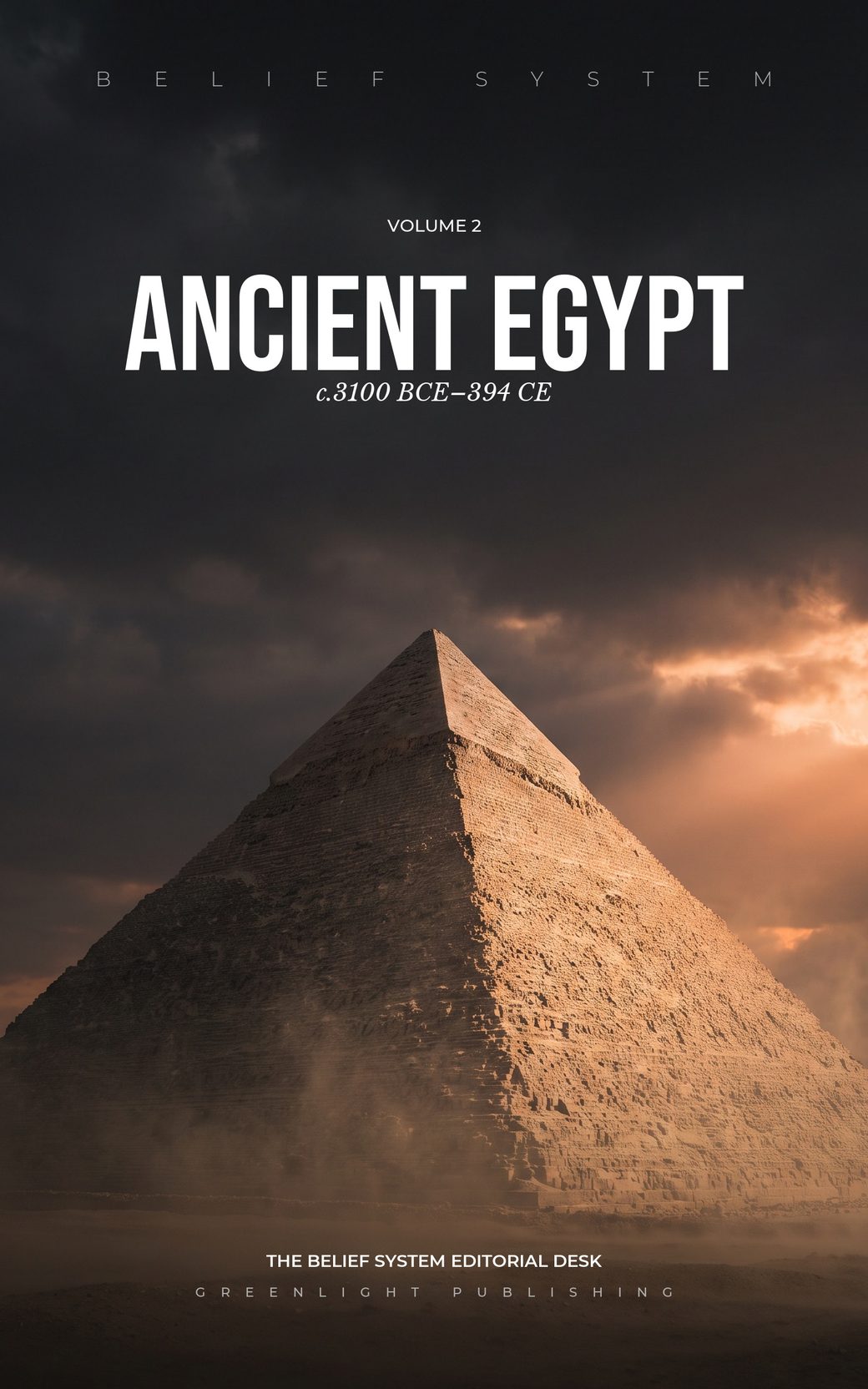
Volume 2 Belief System c.3100 BCE–394 CE
Ancient Egypt
The machinethe fill-in-the-blank funerary scroll
- Attested from
- c.3100 BCE
- Narrates
- c.3100 BCE–394 CE
The earliest secure evidence, and the key this volume is filed under. All thirty-one
The period the book actually covers. It is rarely the same figure.
The argument in one sentence
For three thousand years Egyptian religion ran as a physical economy — a river measured annually in cubits, a king who was in theory the only priest in the country, an afterlife sold retail with blanks left for the buyer’s name, and temple estates so large that the one king who attacked them was reversed and erased within a generation — and it ended the way an economy ends, not refuted but defunded, until the last man who could date a sentence in hieroglyphs carved it at Philae in 394 CE.
Books of the Dead were prefabricated with blanks for the buyer’s name; in the Papyrus of Ani, “Ani” is in a different hand from the body text and is sometimes misspelled.The commissioning line
What it is
The most famous religious book to survive from ancient Egypt is a stock item with the purchaser’s details filled in at the counter.
The Papyrus of Ani runs to about 23.6 metres. Its pictures were painted before its text was written, the columns of spells ruled around them, and where the space ran out a spell simply stops. The owner’s name is in a hand of its own, dropped into gaps the copyists had left for it, misspelled in places and in others left out.
That object is this book’s argument in miniature. For as long as Egyptian religion can be observed, it ran as a physical economy. The flood was measured and recorded, so the bargain the system offered carried a number every year. The afterlife was sold retail, in price tiers, from a menu. The temples held people, land, livestock and ships, itemised in documents that survive. And the one king who attacked the largest of those estates was reversed within a generation.
Five movements: the world it began in, the machine that carried it, the canon nobody ever closed, the money, and the ending.
Three thousand years is long enough that “the Egyptians believed” is a sentence about thirty centuries and therefore about nothing. This book does not write it. Every figure arrives with the document it came from, and where a total is disputed the dispute is printed instead of the total.
Belief System, Volume 2.
In full
Egyptian religion did not end because it was refuted. It ended because it was defunded.
That is the argument of this volume, and it is traceable in objects at every stage. Writing kept the accounts before it kept the hymns. The Nile flood was measured, so the promise the system made was auditable annually. The funerary literature was a manufactured product with workshop production, price tiers and blanks left for the buyer’s name. And when the state stopped paying, the last dated hieroglyphic inscription was cut at Philae in 394 CE.
Most accounts of this subject open with the gods. This one opens with the supply chain, because the supply chain is what survives in quantity and what nobody wrote to persuade anybody. It asks the questions this series asks of every tradition: what carried this, who paid for it, what got written down, who had the authority to decide, and what finally ended it.
The canon movement is about a canon that never existed. Pyramid Texts to Coffin Texts to the Book of the Dead is a two-thousand-year editorial tradition in which the same material migrates down the social scale, gets renumbered and gets rewritten, and no council ever closed anything. The numbering everybody now uses is a nineteenth-century scholar’s, imposed on a corpus that had none of its own.
The money movement refuses its own headline. The claim that the temples held some large fraction of Egypt is repeated everywhere; the surviving documents give holdings, not a national share, and this book prints what they give and says why it will not print the rest.
Two rules govern the writing. Egyptian chronology has real error bars, so nothing before the seventh century BCE gets a bare year: the conventional dating and the scientific dating are both printed and both labelled. And the volume never adjudicates. No miracle is asserted and none is denied, there is no devotional register and no debunking one, and no knowing tone toward a tradition that cannot answer back.
Belief System is a history of world religion, one tradition at a time: where it started, what carried it, who paid for it, and how it divided. Thirty-one volumes, ordered by earliest secure attestation.
The contents
26 chapters in five movements. Every volume in the series has the same five, in the same order, and each chapter below is printed with the idea it carries.
Movement OneThe World
The valley as it actually worked, and the question the system answered. The surviving evidence is stone and tomb — a bias the movement states at the door.
- 1The River That Could Be MeasuredThe flood was an annual, measurable, bankable event — the state recorded its height to fractions of a cubit from the first dynasties — so the religion’s basic bargain, order maintained against chaos, carried a number every year, and a bad number was a theological event with a famine attached.
- 2Two Crowns on One PaletteUnification, conventionally dated c.3100 BCE, is attested first on a religious object: a carved votive palette from a temple deposit at Hierakonpolis showing one king smiting under the falcon on one face and wearing the other land’s crown on the reverse — and whether it records a war, a rite, or a rite about a war is contested.
- 3Three Thousand Years, Give or Take a CenturyEvery date in this volume hangs on a spine that is disclosed once, early: dynasties from a priest whose book survives only in quotation, king lists that edit their own past, a papyrus that gives the gods reigns before any man, one Sothic star-rising doing immense work, and radiocarbon — which broadly confirms the conventional scheme while disagreeing with it by decades — so the volume prints both datings, labelled, every time they diverge.
- 4The Only PriestIn theory there was one priest in Egypt — the king — and every wall of every temple shows him alone making the offering; in practice the daily cult ran in his name in hundreds of sanctuaries at once, performed by deputies, which makes the kingship less a man than a legal fiction the whole system was written in: the hinge between the human and the divine orders, and the hinge is an office.
- 5The Nome and the NationEgypt was forty-odd districts, each with its own god, standard and feud, and national religion was a negotiated layer over them: a local god whose city backed a winning family went national — Amun of Thebes, merged with Ra as Amun-Ra, is the worked example — the nome count itself shifted with administration, and the local-versus-national tension never resolved: under Roman rule two neighbouring towns were still rioting over each other’s animal gods.
- 6The Business of DyingThe question this system answered was death, and the answer was an industry: the west bank was a built economy of embalmers, coffin-makers, tomb-builders and mortuary priests on contract — and Herodotus, shown the trade in the 440s BCE, reported what a customer saw: three qualities of mummification, chosen from wooden samples, by price.
Movement TwoThe Machine
The transmission technology, named as a concrete object or institution — not an abstraction. Here: the fill-in-the-blank funerary scroll, and the scribal system that fed it.
- 7The Words of the GodEgypt ran three scripts as one tiered technology — monumental hieroglyphs, “the god’s words,” for eternity; cursive hieratic for administration, letters and literature; demotic beneath that — one language stacked from temple wall down to tax receipt, so sacred text was never locked to a script: the same spell could be carved for ever or copied fast for a customer.
- 8Be a ScribeThe whole apparatus rested on a profession manufactured in schools, whose recruitment propaganda survives because schoolboys copied it — every other trade is misery, “be a scribe” — and whose working discipline is visible in what it left behind: exercise copies, master texts, and colophons certifying that the copy matches what was found.
- 9Blanks Left for the NameA Book of the Dead was often not commissioned but stocked: workshops produced scrolls in advance — vignettes painted, spells copied, spaces left where the buyer’s name would go, filled in at sale — and in the Papyrus of Ani the name “Ani” sits in those blanks in a different hand from the body text and is in places misspelled or omitted: personal salvation, held as inventory.
- 10The MenuWhat went into a scroll was a selection: no two Theban-period books carry the same spells in the same order, and length and finish graded from luxury scrolls tens of metres long to a few plain sheets — a menu priced by tier, fifteen hundred years before movable type, in which the buyer’s choices, not any church’s, decided the contents.
- 11The House of LifeBehind the retail front sat the temple scriptorium — the House of Life — where texts were copied, collated and stored; it is the institution that carried one corpus across two thousand years, its collation habits are the closest thing the tradition has to error-correction, and it is also the single point of failure: when the temple payroll stopped, every text in the stack went unreadable at once.
Movement ThreeThe Canon
What is in, what is out, who decided, when, and what the decision cost. The real subject is who had the authority to close it — and here the answer is nobody, which takes five chapters to earn. The movement opens with that argument, never with a manuscript.
- 12A Canon With No CouncilThere is no Egyptian canon — no list, no closing, no council, no trial over contents in three thousand years — and what exists instead is a two-thousand-year editorial tradition in which the same material is copied, re-selected, renumbered and re-sold down the social scale; the cleanest proof of the openness is that the religion’s central story survives nowhere as a connected Egyptian narrative — the only continuous account of the Osiris myth is Plutarch’s, a Greek priest of Delphi writing two millennia after the first allusions.
- 13The Spells in the PyramidThe corpus enters history at the top: in 1881 Maspero opened the pyramid of Unas (conventionally dated c.2350 BCE) and found the chambers walled with spells — the oldest substantial body of religious text surviving anywhere — written for exactly one man, the king, and including utterances in which he consumes the power of the gods; the “utterance” numbers scholars cite were assigned in Berlin in 1908.
- 14Down the Social ScaleWithin centuries the king’s spells were on officials’ coffins — edited, expanded to over a thousand spells, fitted to wooden panels — and the standard name for this, “the democratisation of the afterlife,” is itself contested: whether access widened, or evidence merely survives differently, is a live argument the chapter reports rather than settles.
- 15Going Forth by DayThe New Kingdom product every reader has heard of is not a book: “Book of the Dead” is a nineteenth-century trade name for a corpus Egyptians called “utterances of going forth by day,” assembled per customer with no fixed order — and its most famous scene, the weighing of the heart with its list of denials, is the closest thing the tradition offers to a moral code, delivered not as commandments but as the customer’s script for an examination.
- 16The Saite Recension, and the Prussian OneThe nearest Egypt came to canonisation was a product standardisation: under the 26th Dynasty the Book of the Dead acquired a fixed spell sequence — the Saite recension, an edition with an order at last, produced by the same archaising age that carved a claim to have restored a worm-eaten ancient original — and the chapter numbers everyone uses today were assigned by Lepsius in 1842 from a single Ptolemaic papyrus in Turin: the canon, such as it is, was versioned twice, once at Sais and once in Prussia.
Movement FourThe Money
Who paid, who was paid, and how we know. Numbers get their provenance in the same sentence. Here: the temple as employer, granary and landlord.
- 17The God’s EstateA temple was an economic unit — fields, herds, ships, workshops, granaries — staffed by rotating lay watches and paid through a circuit in which offerings presented to the god “reverted” to the staff as wages; and from the Old Kingdom on, kings granted temples immunity from levy and corvée: the untaxed sector is as old as the state.
- 18What Ramesses Gave AmunThe scale survives on one object: Papyrus Harris I, at about forty-one metres the longest papyrus known, compiled under Ramesses IV, itemises what Ramesses III conferred on the temples — on the order of a hundred thousand people, half a million cattle, seven hundred thousand acres, with Amun’s Thebes taking roughly four-fifths of it — and the same chapter prints the limits in the same breath: whether the lists record new gifts or confirmed totals is debated, and the leap from them to “the temples owned a third of Egypt” is a modern extrapolation resting mainly on one further document.
- 19Buying Eternity at AsyutThe mechanics of endowment survive whole in one provincial tomb: the nomarch Hepzefa carved ten contracts with his own mortuary priesthood — bread, beer and land against services on named festival days, with his official income and his private property distinguished inside the deals — a man buying cult for himself for ever, from an institution he could pay but not outlive.
- 20We Are HungryThe state’s best-documented workforce, the tomb-builders of Deir el-Medina, were paid in grain from temple stores — so in year 29 of Ramesses III, when rations ran weeks late, they downed tools and sat at the mortuary temples in the first recorded strike in history, saying, in the clerk’s transcript, that they were hungry; where the granary is the god’s, a payroll failure and a cult failure are the same event.
- 21Robbing the DeadThe funerary economy had stored centuries of metal underground, and when the state weakened in the late 20th Dynasty it was spent: trial papyri record royal commissions inspecting tombs, a robber’s confession of stripping a king and queen, and — a generation on — the priesthood itself salvaging, rewrapping and hiding the royal mummies, with dockets on the wrappings recording the work: the system liquidating its own past, with paperwork.
Movement FiveThe Split
What divided it, what it became, what it handed on. Names the next volume by NAME, never by number.
- 22The Horizon of the AtenWhatever Akhenaten’s theology was — and no source states his motive — his measurable acts were fiscal and administrative: the god with the largest estate in Egypt had his name hacked from monuments, his temples’ revenues redirected, and a rival capital for a rival cult raised on virgin ground; read as economics, Amarna is a crown striking the one institution rich enough to rival it — and that reading is printed as a reading, beside the theological one, with neither adjudicated.
- 23Overgrown with WeedsThe restoration is the measurement: within a few years of Akhenaten’s death the court had left his city, and a stela in Tutankhamun’s name describes the temples fallen into ruin, their shrines become mounds overgrown with weeds, and itemises re-endowment — then the machinery of erasure ran in reverse, the Aten temples quarried for fill under Horemheb and the whole episode omitted from Seti I’s king list at Abydos: the estate outlived the king, and it kept the books.
- 24A Cartouche for the High PriestThe split Akhenaten forced and lost happened later anyway, slowly and without a heresy: by the end of the New Kingdom the high priest of Amun, Herihor, was written inside a cartouche at Karnak while a king reigned elsewhere; and in the Late Period the office of God’s Wife of Amun — a celibate royal daughter who adopted her successor — made the Theban estate a prize dynasties competed to place a daughter into, with the endowment itemised on the stela recording Nitocris’s adoption in 656 BCE: the estate had become the throne’s counterparty, not its instrument.
- 25Pharaohs Who Spoke GreekForeign kings bought the priesthood rather than fight it: the Ptolemies and Rome built the largest Egyptian temples now standing — Edfu’s own walls date its construction to 237–57 BCE — priestly synods traded cult honours for tax privilege in trilingual decrees, of which the Rosetta Stone is one, and the pilgrim economy hit its industrial peak in the animal catacombs, ibis mummies by the estimated million, some of the wrapped bundles, when scanned, containing partial birds or nothing at all: the retail machine at full commercial speed under kings who could not read its script.
- 26The Last HieroglyphThe end was administrative and datable: Theodosius’s laws of 391–92 closed the temples and banned the cult; the Serapeum of Alexandria fell to a Christian crowd in 391; and with the temple payroll went the script itself — the last dated hieroglyphic inscription is a priest’s graffito at Philae from 24 August 394 CE, the last demotic there follows in 452, and Isis’s cult at Philae, kept open for the frontier tribes by treaty, ran on until Justinian’s officers closed it in the 530s: the gods of Egypt were never refuted; they were foreclosed.
What this volume cannot establish
Printed in the book before the argument is, and printed here for the same reason. A history of a tradition that will not say where its evidence runs out is not a history.
- What any Egyptian believed. The sources are overwhelmingly funerary and monumental, produced by and for the fraction who could write or pay — Baines and Eyre’s much-cited estimate puts literacy around one per cent, and it is printed as an estimate. The volume can establish what was written, copied, sold, endowed, erased and restored; inner assent, for thirty centuries of farmers, cannot be established. The phrase “the Egyptians believed” appears nowhere in this book: it is a sentence about thirty centuries and therefore about nothing.
- A founding. This is one of the eleven volumes with no defensible ignition date, and here even the tradition offers no founder and no founding story — the gods are simply present in the earliest records, and the Turin king list assigns them reigns before any human king. The span opens at the earliest secure attestation of the state cult — the Narmer Palette, conventionally dated c.3100 BCE — and the front matter prints that distinction, per the series rule.
- Absolute dates before 664 BCE. Chronology is fixed to the year only from Psamtik I (664 BCE) backwards, via Assyrian and Greek synchronisms; before that it is built from edited king lists, one heavily-worked Sothic observation, and radiocarbon — and the schemes disagree by decades, in the third millennium by a century or more. The traditional and the scientific datings are both given and labelled; “conventionally dated” carries more weight in this volume than in any other.
- Whether the Narmer Palette records an event. A conquest, a rite, or a rite about a conquest — is contested, and the specialists are named in the chapter.
- What a Book of the Dead cost, as a general fact. Price evidence is thin, late and period-specific. The chapter prints the tiers the manuscripts themselves show — lengths, hands, pigments, per-copy spell counts — and any priced document that survives verification, and no headline figure. A plausible price invented to fill the gap would be exactly the defect this series exists to avoid.
- The temples’ share of Egypt’s land. Papyrus Harris I and the Wilbour Papyrus give real numbers for named estates in named reigns; “the temples owned a third of Egypt” is a modern extrapolation from them, period-bound and measure-bound. The volume prints the documents’ figures with their limits and refuses the headline, and tells the reader why.
- Akhenaten’s motive. No source states it. Theological, political and fiscal readings all remain live; motive is an interior state; the volume reports his measurable acts instead.
- That it was one religion. Institutional and textual continuity across three millennia is demonstrable object by object; continuity of meaning is not. A sentence about “Egyptian religion” that does not name its century is treated as a defect of the writing.
- Anyone’s interior state.
Sources
68 works, dated, and specific enough that a reader can go and look at the thing. Nothing is on this list that the desk did not consult.
| # | Document or work | Date | Evidence for |
|---|---|---|---|
| 1 | Palermo Stone royal annals, in Breasted, Ancient Records of Egypt I | Fifth Dynasty compilation; Breasted 1906 | year-by-year Nile heights in cubits, palms and fingers |
| 2 | Strabo, Geography 17, Hamilton and Falconer | Roman; Hamilton and Falconer trans. | the Elephantine nilometer as a flood gauge and a tax base |
| 3 | Herodotus, book 2, G. C. Macaulay | 440s BCE; Macaulay trans. | the land as “a gift of the river”; three grades of embalming by price |
| 4 | Hymn to the Nile, in Erman, Blackman’s English | 19th Dynasty school copies; Blackman 1927 | praise to a flood no organised cult could compel |
| 5 | Narmer Palette, Cairo JE 32169 | conventionally c. 3100 BCE; found 1897–98 | unification first attested as a votive cosmetic palette |
| 6 | Quibell and Green, Hierakonpolis plates, with Petrie’s notes | 1900 | findspot, faces, crowns — and Petrie’s obsolete 4800 BCE dating |
| 7 | Nicholas Millet on the related macehead | 1990 | objects of this class as dated temple donations, not war monuments |
| 8 | Whitney Davis, Masking the Blow | 1992 | the smiting image as a scheme of representation |
| 9 | John Baines, paper on early Egyptian art and writing | 1989 | the scenes as tokens of royal achievement, not a campaign report |
| 10 | Manetho, Aegyptiaca, in Cory, Ancient Fragments | 3rd c. BCE; Cory 1832 | Menes; dynasties surviving only in later quotation |
| 11 | Turin Royal Canon, Museo Egizio Papyrus 1874 | reign of Ramesses II | gods given reigns before any man, on the back of a tax register |
| 12 | Abydos king list of Seti I | 19th Dynasty | the edited cartouche run that jumps Amarna and Hatshepsut |
| 13 | Bronk Ramsey and colleagues, “Radiocarbon-Based Chronology for Dynastic Egypt,” Science | 2010 | one Sothic sighting doing too much work; the radiocarbon check |
| 14 | P. Berlin 3055, published by Alexandre Moret | late Theban; Moret 1902 | the daily Amun ritual performed by a priest on rota |
| 15 | Daily-ritual chapters carved in Seti I’s temple at Abydos | 19th Dynasty | the same service on the wall, still showing only the king |
| 16 | White Chapel of Senusret I, Lacau and Chevrier | 12th Dynasty; reconstructed 1927–30; pub. 1956 | the nome list as sacred geography and land registry |
| 17 | Juvenal, Satire 15, G. G. Ramsay | after the consulship of 127 CE | neighbouring towns still quarrelling over animal gods |
| 18 | Rosetta Stone, in Budge’s 1913 volume | Memphis decree, 196 BCE | three script registers; honours traded for tax remissions |
| 19 | Clement of Alexandria, Stromata, Ante-Nicene Fathers | c. 200 CE | Egyptian script classes as a curriculum, hardest last |
| 20 | Baines and Eyre, literacy studies, Göttinger Miszellen; repr. Baines, Visual and Written Culture in Ancient Egypt | 1983; 2007 | literacy around one per cent — an estimate, and printed as one |
| 21 | Satire of the Trades, in Erman, Blackman’s English | Middle Kingdom; Blackman 1927 | every other trade as misery; “be a scribe” as school copy |
| 22 | D’Orbiney Papyrus colophon, F. Ll. Griffith in Petrie, Egyptian Tales | 1895 | a named copyist and a curse instead of “as found in writing” |
| 23 | Papyrus of Ani, BM EA 10470, Budge’s 1895 and 1913 volumes | conventionally c. 1250 BCE | the buyer’s name inserted in blanks, in another hand, and misspelled |
| 24 | Budge, narrative of the Ani acquisition | 1920 | the 1888 removal in tin boxes; “The Service of Antiquities Outwitted” |
| 25 | Budge’s measured Theban rolls — Nebseni, Nu, Hunefer, Qenna | New Kingdom | length and finish as the visible price ladder |
| 26 | Onomasticon of Amenemope, in Erman, Blackman’s English | New Kingdom; Blackman 1927 | a House of Life scribe’s word-list with cosmology on the cover |
| 27 | Alan Gardiner, survey of per-ankh attestations, JEA 24 | 1938 | the House of Life named often and described rarely |
| 28 | H. M. Tirard’s English of Erman | 1894 | the Wadi Hammamat “scribe of the house of life”; the magic-book trial |
| 29 | Turin judicial papyrus and the Lee and Rollin papyri | 20th Dynasty | a palace magic book stolen and treated as part of the offence |
| 30 | Plutarch, On Isis and Osiris, William W. Goodwin | c. 100 CE; Goodwin 1878 | the only continuous Osiris narrative, two millennia late |
| 31 | James Henry Breasted, Development of Religion and Thought in Ancient Egypt | 1912 | Osiris variants; the Cannibal Hymn; the Great Hymn to the Aten |
| 32 | Pyramid Texts of Unas, Saqqara; Kurt Sethe’s edition | opened 1881; Sethe 1908–10; conventionally c. 2350 BCE | the oldest substantial religious corpus, written for one king |
| 33 | Coffin of Amamu, BM 6654, and the coffins in Budge’s 1895 footnote | Middle Kingdom | Pyramid Text lines migrating onto officials’ boards |
| 34 | Adriaan de Buck, The Egyptian Coffin Texts | 1935–61 | the modern spell numbers, past eleven hundred |
| 35 | Amduat and the New Kingdom netherworld books | Valley of the Kings, then later priestly papyri | the second downward migration, a thousand years on |
| 36 | Book of the Dead spell 125, Budge 1895, from Naville’s composite | Theban period; Budge 1895 | the negative confession as a customer’s examination script |
| 37 | Richard Lepsius, Das Todtenbuch der Ägypter | 1842 | 165 chapters numbered from one Ptolemaic Turin papyrus |
| 38 | Shabaka Stone, British Museum | 25th Dynasty; claims an older original | the worm-eaten restoration rubric; later used as a millstone |
| 39 | Nekonekh duty table, Tehneh, Fraser; Breasted, Ancient Records I | Fifth Dynasty; Fraser 1902; Breasted 1906 | reversion of offerings as a rota and a payroll |
| 40 | Canopus Decree, Budge | 238 BCE; Budge 1904 | a fifth priestly phyle added to the four |
| 41 | Elephantine quay decree for the temples of Khnum, Breasted, Ancient Records IV | attributed to Ramesses III | inhabitants and ships exempted from levy and requisition |
| 42 | Papyrus Harris I, BM EA 9999, Breasted, Ancient Records IV | compiled at the death of Ramesses III | people, cattle and land listed as the temples’ estate |
| 43 | Wilbour Papyrus, Brooklyn Museum | year 4 of Ramesses V; bought 1893 | the land survey behind every share estimate — edition unused |
| 44 | Hepzefi contracts, Griffith, The Inscriptions of Siût and Dêr Rîfeh; Breasted I | 12th Dynasty; Griffith 1889 | ten carved deals buying bread, beer and procession for ever |
| 45 | Absence register O. BM EA 5634 | year 40 of Ramesses II | forty tomb-crew names and the reasons they were off |
| 46 | Strike journal P. Turin Cat. 1880 | year 29 of Ramesses III | the sit-down at the mortuary temples, in the clerk’s minute |
| 47 | William F. Edgerton, strikes of year 29, JNES | 1951 | the standard treatment of the strike file |
| 48 | Turin papyrus via Spiegelberg, in Breasted, Ancient Records IV | year 29 of Ramesses III | vizier Ta collecting southern gods for the Sed jubilee |
| 49 | Coffin BM 15659, restoration docket in Breasted IV | late New Kingdom | a burial renewed after “the children of the cemetery” opened it |
| 50 | Abbott Papyrus | year 16 of Ramesses IX; facsimile 1860 | the royal-tomb inspection and the one pyramid found tunnelled |
| 51 | Amherst papyrus confession, Breasted, Ancient Records IV | late 20th Dynasty | stripping Sebekemsaf and dividing the gold eight ways |
| 52 | Deir el-Bahri royal-cache dockets, in Breasted IV | cleared 1881; dockets 21st–22nd Dynasty | priests salvaging, rewrapping and hiding the kings |
| 53 | Soleb lions of Amenhotep III, Breasted, Ancient Records | 18th Dynasty; Breasted 1906 | “Amun” cut from a dead father’s cartouches — and put back wrong |
| 54 | Talatat from the Karnak Aten temples | Amarna period; recovered from later pylons | demolition preserved as fill, block by block |
| 55 | Great Hymn to the Aten, tomb of Ay, Breasted 1912 | Amarna period | the sun hymn set beside Psalm 104 |
| 56 | Psalm 104, Jewish Publication Society | 1917 | the resemblance discussed since Breasted, explanations contested |
| 57 | Restoration Stela, Cairo CG 34183, Budge, Tutankhamen volume | found 1905; Budge 1923 | temples overgrown with weeds; the re-endowment schedule |
| 58 | Khonsu temple reliefs at Karnak, Breasted, Ancient Records | end of the New Kingdom; Breasted 1906 | Herihor’s high-priest title written inside a cartouche |
| 59 | Nitocris Adoption Stela, found by Legrain | 656 BCE on the 664 anchor; Breasted printed 654 | land and daily rations of the God’s Wife of Amun |
| 60 | Edfu building inscriptions of the temple of Horus | 237–57 BCE | a Ptolemaic temple dating its own construction |
| 61 | Tacitus on the origin of Serapis | c. 100 CE | a god described as a Ptolemaic procurement |
| 62 | Wasef and colleagues, sacred ibis genomes, PLOS ONE | 2019 | about 1.75 million birds at Saqqara, taken seasonally |
| 63 | McKnight, Atherton-Woolham and Adams, RadioGraphics | 2015 | imaging what a votive bundle actually contains |
| 64 | Theodosian Code CTh 16.10.10, 16.10.11, and the constitution of 8 November 392 | 391–92 CE | temples closed, sacrifice banned, household incense fined |
| 65 | Socrates Scholasticus and Sozomen on the Serapeum, Nicene and Post-Nicene Fathers | fifth century | the Serapeum razed and converted — victors’ histories |
| 66 | Philae graffito 436 of Nesmeterakhem / Esmet-Akhom | 24 August 394 CE | the last dated hieroglyphic inscription |
| 67 | Procopius, Wars book 1, H. B. Dewing | sixth century; Dewing trans. | Diocletian’s shared temples; Narses closing Philae |
| 68 | Priscus, fragment on the treaty of Maximinus | 452 CE, at one remove | Blemmyes still granted access to the image of Isis |
Common questions
When is Ancient Egypt first securely attested?
c.3100 BCE. That is the earliest date the surviving evidence supports, and it is the key this volume is filed under. It is not the same claim as when the tradition began: the tradition’s own account of its beginning is printed beside it in the book’s front matter, never instead of it.
What period does the book cover?
c.3100 BCE–394 CE. The coverage span and the attestation date are two different facts, and the gap between them is often the most interesting thing about a volume.
What carried Ancient Egypt?
The fill-in-the-blank funerary scroll. Movement Two of every volume is about the transmission technology — the concrete object or institution that made copying possible, and would not have existed a century earlier.
How long is it?
About 30,500 words, roughly 125 minutes’ reading, 130 pages in the paperback. The audiobook runs 3h 05m, measured from the finished masters.
What does this volume not claim to establish?
What any Egyptian believed. The sources are overwhelmingly funerary and monumental, produced by and for the fraction who could write or pay — Baines and Eyre’s much-cited estimate puts literacy around one per cent, and it is printed as an estimate. The volume can establish what was written, copied, sold, endowed, erased and restored; inner assent, for thirty centuries of farmers, cannot be established. The phrase “the Egyptians believed” appears nowhere in this book: it is a sentence about thirty centuries and therefore about nothing. Every volume prints its own limits before it prints its argument; there are 9 on this one’s list.
Does the book say which tradition is true?
No. Belief System does not adjudicate. Where the tradition’s account and the earliest evidence disagree, both are given, in their own vocabulary, attributed, and neither is given the last word. No miracle is reported as fact and none is denied.
Can I buy Ancient Egypt in print?
Yes. It is a 5.5 × 8.5 in paperback, 130 pages, $12.99 a copy, bought direct rather than through a retailer. All thirty-one together are $199.00, with the ebook and the audiobook of every volume included.
The edition
| Trim | 5.5 × 8.5 in / 140 × 216 mm |
|---|---|
| Binding | Perfect-bound paperback, matte laminate |
| Paper | 60# uncoated cream, black ink |
| Extent | 130 pages |
| Edition | Extent | ISBN |
|---|---|---|
| Paperback | 130 pages, 5.5 × 8.5 in | ISBN not yet issued |
| Ebook | EPUB | 979-8-90623-815-3 |
| Audiobook | 3h 05m | 979-8-90623-816-0 |
| BISAC 1 | `REL017000` RELIGION / Comparative Religion |
|---|---|
| BISAC 2 | `REL114000` RELIGION / Ancient |
| BISAC 3 | `REL033000` RELIGION / History |