Belief System
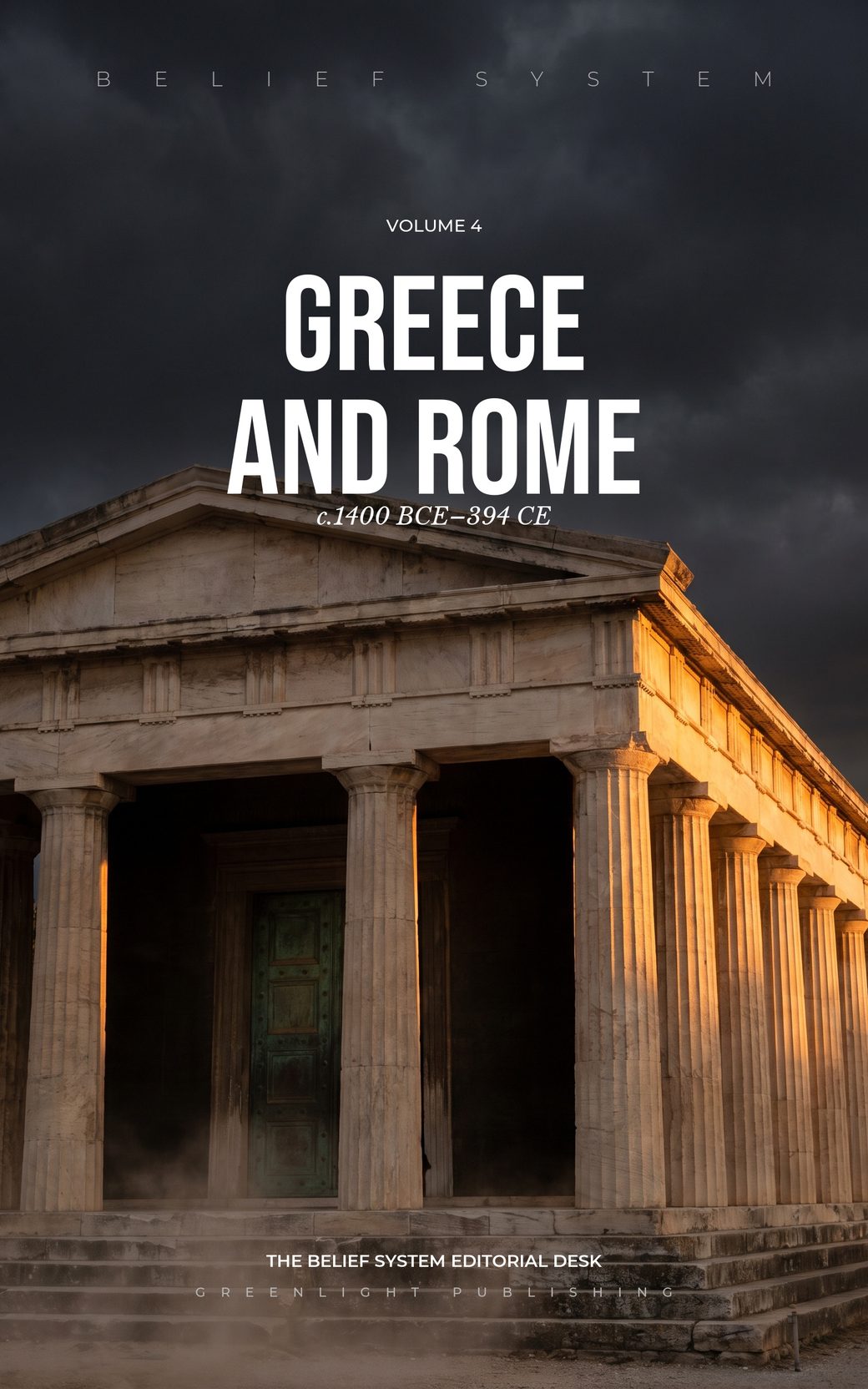
Jacket of Belief System volume 4, Greece and Rome
$12.99paperback

132 pages, 5.5 × 8.5 in. Three or more volumes in one order and every copy drops to $11.99.

copies

United States, 8 to 11 days. All destinations

Volume 4 Belief System c.1400 BCE–394 CE

Greece and Rome

The machinea state-owned oracle behind a locked door

Attested from
c.1400 BCE

The earliest secure evidence, and the key this volume is filed under. All thirty-one

Narrates
c.1400 BCE–394 CE

The period the book actually covers. It is rarely the same figure.

The argument in one sentence

The oldest continuously attested tradition in this series ran for some eighteen centuries with no transmission machine at all — no creed, no scripture, no trained corps, because nothing in it required word-perfect replication — carried instead by a civic timetable, a rulebook of procedure and a funded treasury; and when the Christian empire confiscated the funding — Constantine’s seizures, Gratian’s cancelled subsidies in 382, Theodosius’s bans of 391–392 — there was nothing self-copying left to survive on, a verdict Julian had already delivered by trying to build the missing machine by decree and failing inside two years.

Athens funded the Peloponnesian War partly by borrowing from Athena, at interest, repayable to her treasury. The Parthenon was a central bank.The commissioning line

What it is

The emperor Julian climbed to the festival of Apollo at Daphne expecting a civic procession. He found one priest, with one goose, brought from the man’s own household.

Julian wrote that down himself. He had spent his reign trying to give his religion a machine: provincial high priests, letters about clerical conduct, a charitable system copied from the church. He had under two years, and it did not take.

This is the control case of the series. Eighteen centuries of funded, public, civic religion with no creed, no scripture, no trained corps and no doctrine anyone was required to hold. Nothing needed word-perfect replication, so nothing was built to replicate it. When the fourth-century state confiscated the funding, there was nothing self-copying left.

Five movements: the world it began in, the machine it never built, the canon it never had, the money, and the ending.

Athena’s treasury lent to Athens at interest, computed to the day. Delphi was melted down to pay mercenaries. The Vestals’ revenues were stripped by statute, and Symmachus and Ambrose argued the case in documents that survive on both sides.

The book never adjudicates, and it does not smirk. Ancient polytheism is described in the register this series gives every tradition in it.

Belief System, Volume 4.

In full

Every other volume in this series describes a machine. This one describes an absence, and argues that the absence is why the tradition is gone.

Greek and Roman religion had no creed, no scripture, no trained transmission corps and no fixed teaching. Nobody was ever a heretic for disagreeing with Homer. What held it together was correctness of procedure and the ancestral custom, and both of those were carried by the state that paid for them. The Sibylline Books are the exception that proves the rule: a state archive, kept by appointed custodians, consulted on the Senate’s instruction, and periodically weeded.

That makes this the volume the rest of the series can be read against. Set the absence beside the Vedic reciters, who transmitted a text with a redundancy manuscripts cannot achieve, and beside the scribes who counted letters and logged their own errors. Three traditions, three answers to the same problem, and only one of them declined to answer.

The money is unusually good. The Parthenon accounts record the goddess lending to the state with interest computed to the day. Delphi functioned as an international deposit institution until the Phocians melted its dedications. Priesthoods were sold. And the ending is fiscal before it is theological: Constantine’s confiscations, Gratian removing the Altar of Victory and stripping the subsidies in 382, Theodosius in 391 and 392.

Julian’s attempt to build the machine by decree is the volume’s proof. He appointed a priestly hierarchy modelled on the church, wrote to it about conduct, and funded a charitable system in imitation. It collapsed in under two years, and his own pamphlet against Antioch is the best witness against him.

The volume quotes only public-domain translations and names each one in the visible text. Greek and Latin terms are given untranslated where the English would decide the question for the reader.

Belief System is a history of world religion, one tradition at a time. Thirty-one volumes, ordered by earliest secure attestation.

The contents

26 chapters in five movements. Every volume in the series has the same five, in the same order, and each chapter below is printed with the idea it carries.

Movement OneThe World

The place, the moment, and the question answered. Here the attestation starts in accounting documents, and the volume says so on its first page: the earliest evidence for these gods is ledger entries of offerings.

  1. 1The God in the LedgerThe earliest secure attestation of Greek religion is bookkeeping — clay tablets from the palace archives of Knossos and Pylos, baked hard by the fires that destroyed them, recording offerings of oil, honey and gold vessels to names a later reader knows: po-se-da-o who is Poseidon, di-we who is Zeus, e-ra who is Hera, and at Pylos di-wo-nu-so, Dionysos, a millennium before anyone thought him a latecomer — and the tablets are inventories, not theology, so the volume opens on exactly the evidence it will have all the way down: what was given, to whom, never why.
  2. 2Four Centuries of SilenceThe palaces burned around 1200 BCE and the script died with them — Linear B wrote inventories, and with no palace there was nothing to inventory — yet on the far side of roughly four hundred years without writing, Zeus, Poseidon, Hera and Athena are being worshipped by Greeks who cannot read; whatever carried religion across that gap, it was not a text, and the eighth century then shows the revival in objects: votive bronzes multiplying at Olympia, the first temple buildings, and games whose traditional date of 776 was compiled centuries later from no secure record.
  3. 3The Shared MeatThe central act was not belief but a procedure with food at the end — thysia, the animal led garlanded to the altar, the god’s portion burned, the meat divided among the participants — and Hesiod already tells it as a story about the division: Prometheus wrapping the bones in fat to trick Zeus, an origin-myth not of the world but of why the gods get smoke while the city eats; sacrifice was a civic act, its calendar public, its meat a distribution system, and eusebeia — the word usually translated “piety” — named the doing of it correctly, not the believing of anything.
  4. 4The Calendar Is the DoctrineThe nearest thing Athens had to an authoritative religious text was a timetable with prices — the state sacrificial calendar, revised and republished on stone between 410 and 399, and the deme calendars beneath it itemising which god, which day, which animal, at what cost in drachmas — and when the republication went wrong the remedy was not a heresy trial but a lawsuit: Lysias’s speech against Nikomachos, the clerk accused of inscribing more sacrifices than the funds could bear, is the tradition’s version of a doctrinal controversy, and it is an argument about a budget.
  5. 5Priests Without a SeminaryA Greek priesthood was an office, not a vocation and not a profession — allotted, elected, inherited in families like the Eumolpidai at Eleusis, or in Ionia openly sold — held by ordinary citizens with no training, no ordination, no doctrinal examination and no preaching duty, because there was no doctrine to examine anyone on; the Pythia at Delphi herself was, the tradition holds, an ordinary local woman, and when a city needed religious expertise it hired it by the job — exegetes, seers, and at Rome the Etruscan haruspices, consultants summoned and paid.
  6. 6Religio Means Doing It RightRome’s version makes the principle legible because Rome wrote its rules down: religio was correct procedure in the state’s dealings with its gods — Cicero defines it flatly as cultus deorum, the tending of the gods — administered by colleges of part-time priest-magistrates, the pontifices, whose chief was an elected politician; the system’s tell is instauratio, the rule that a flawed ritual is not sinful but void, and must be repeated — if the dancer halted or the flute fell silent, the games were done again — an error-handling protocol, which is what you build when the sacred thing is the performance and not a text.

Movement TwoThe Machine

The transmission technology, named as a concrete object or institution. Here the finding is an absence, and the absence is argued, not asserted: this is the series’ control case — the tradition that had no machine, and did not survive. The one true text-machine it built, a state archive behind a locked door, stored an oracle and no teaching at all.

  1. 7The Missing MachineThere was no machine, and this chapter does the arguing: no creed, no catechism, no fixed teaching, no text that had to survive word for word — therefore no memorisation discipline like the Vedic World volume’s pāṭha checksums and no counting scribes like the Judaism volume’s, because replication technology exists to protect a payload and here there was no payload; what transmitted the tradition was the festival cycle, the sanctuary, and apprenticeship in practice — and the negative proof is Eleusis, whose initiates kept their secret for about a millennium with no written backup, so that when the practice stopped, the content ceased to exist.
  2. 8The Locked BooksRome did build one genuine sacred-text technology, and what it chose to protect proves the rule: the Sibylline Books — a state-owned oracle collection kept in a stone chest under the Capitoline temple, consultable only on the Senate’s instruction, by an appointed college, with capital penalties for leaking — had all the apparatus of a scripture, archive, custodians, authentication, and contained no teaching whatsoever; burned with the temple in 83 BCE, recollected by embassy from Erythrae and elsewhere, vetted verse by verse, weeded of forgeries by Augustus along with two thousand other prophetic books, and finally burned for good around 408 — a canon managed like a state secret, because the state was the church.
  3. 9The Question MachinesThe closest this tradition came to revelation was an answering service: oracles processed queries one at a time and stored nothing — at Dodona the questions survive physically, thousands of inscribed lead strips asking whether to marry, whether to sail, whether the child is his; at Delphi the procedure was an institution with a calendar, a fee and a staff — and Herodotus’s Croesus story is already a test protocol, a king benchmarking seven oracles with a question only he could verify; a query system, unlike a teaching system, replicates nothing, and when the questions stopped coming, nothing remained.
  4. 10Homer Without a GuardianThe poems closest to scripture travelled with no priestly custodian at all — performed by competing professional rhapsodes (Athens’ one rule was a relay order at the Panathenaia), copied so freely that the early Ptolemaic papyri carry extra verses the received text lacks, and finally stabilised not by a religious institution but by literary critics in a royal library, Zenodotus and Aristarchus, who marked lines for deletion on grounds of taste and consistency; set against the Judaism volume’s scribes — who preserve even their errors, and log them — the Alexandrians’ editorial confidence is the difference between a canon and a classic, in one image.
  5. 11Synchronised by FestivalWhat actually coordinated a religion spread across a thousand independent cities was a scheduling protocol: the four-yearly circuit of the great games, the sacred truce carried city to city by heralds, the theoroi and their published host-lists, asylia grants inscribed at the sanctuaries — and the system had teeth, since Thucydides records Sparta fined and barred from Olympia in 420 in a dispute conducted entirely in the register of sanctions and payments; Rome’s equivalent was the fasti, the calendar itself posted in stone, which Ovid could versify book by book because the timetable was the content — a machine for synchronising bodies and dates, never beliefs.

Movement ThreeThe Canon

What is in, what is out, who decided. The real subject is who had the authority to close it — and here nobody did, because there was nothing to close. The movement opens with that argument, never with a text.

  1. 12A Religion Without a BookThe modern reader’s package — a scripture, a creed, a clergy trained on both, membership by assent — maps onto nothing in this volume, and the chapter says so in the open: there was no scripture, no office empowered to define one, and no word in the language for “religion” in the modern sense — the working vocabulary was eusebeia (right reverence, a practice), ta patria (the ancestral things) and at Rome mos maiorum (the custom of the elders); what did the normative work everywhere was ritual correctness and inherited usage, and Herodotus states the nearest thing to a canon-history in one sentence: Homer and Hesiod gave the Greeks their gods’ genealogies and titles — poets, credited with a taxonomy, holding no office at all.
  2. 13Disagreeing with HomerNobody was ever heretical for contradicting Homer: Xenophanes wrote that Homer and Hesiod ascribed to the gods everything shameful among men — and founded no schism and stood no trial; Plato expelled Homeric theology from his ideal city in a book that circulated freely; Epicurus taught that the gods concern themselves with nothing, and his school met unmolested for centuries; and Cicero could serve as augur while writing a treatise dismantling augury, without a flicker of contradiction — because Homer was a shared reference, not an authority, and correctness lived in the rite, not in the reading.
  3. 14What Impiety WasAsebeia was an offence of act and civic injury, not of opinion — the indictment of Socrates charges failure to acknowledge the city’s gods and the introduction of new ones, not false belief; the panic of 415 was about deeds, mutilated statues and a parodied initiation, and its paper trail is financial, the Attic Stelai auctioning the convicted men’s property line by line; and Rome ran the same grammar — the Vestals buried alive after Cannae were punished for ritual failure contaminating the city’s standing with its gods, an enforcement regime aimed always at performance and pollution, never at doctrine.
  4. 15The Books Rome Kept InsteadRome’s priestly colleges did keep books — and every one of them was procedure: the pontifical commentaries of formulas and precedents, the augurs’ rules of sky-reading, the chief priest’s whitened board of annual events that grew into the annales maximi — records, not revelation, never taught to the laity and never carrying a doctrine; and when a fixed wording did survive centuries, it survived as sound without sense — Quintilian records that the Salian priests’ hymn was barely intelligible to the priests still singing it, and the Arval brethren inscribed their archaic chant into their minutes in 218 CE — the exact inversion of the Vedic World volume’s pāṭha, where sound is preserved by design with checksums; here it fossilised by accident, in minutes.
  5. 16Gods by DecreeThe pantheon itself stayed open, and admission was an administrative act: Athens received Asclepius in 420/19 and a private citizen’s monument records the arrival; Rome imported the Great Mother in 204 on the Sibylline Books’ instruction, fetched the black stone from Asia Minor and vetted the welcome committee; Rome also called gods out of enemy cities by formal invitation, evocatio, as at Veii; and when the state said no — the Bacchanalia in 186 — the suppression decree survives on bronze, and its clauses regulate assembly, oath, priesthood and, tellingly, the common fund: the state licensed cult and policed association and money, and never once ruled on whether a god was real.

Movement FourThe Money

Who paid, who was paid, and how we know. This tradition kept the best religious accounts in the ancient world — on stone, in public — and the volume’s richest evidence is here. Numbers get their provenance in the same sentence, and every ancient total is the source’s figure, not an audit.

  1. 17The Goddess Who Lent at InterestAthena was Athens’ biggest creditor: the city borrowed from her treasury on the Acropolis to fight the Peloponnesian War and the accounts were published on stone — the logistai inscription totals the loans of 426–423 with the interest computed to the day — while Pericles, in Thucydides, inventories the sacred reserves like a chancellor, down to the forty talents of removable gold on the statue itself; the treasurers were an annual board of citizens who published handover inventories like any magistracy, because the goddess’s property was the state’s strategic reserve and piety kept double books — the series’ standing question, who owned this and how do we know, answered here by the stones themselves.
  2. 18The Deposit Bank at DelphiDelphi functioned as an international deposit institution — states built named treasury-houses on its terrace, kings banked prestige there in bullion, and Herodotus itemises Croesus’s deposits piece by piece, a hundred and seventeen half-bricks of precious metal, a lion of gold, great mixing bowls — until the Phocians seized the sanctuary in 356 and spent the next decade melting dedications into mercenary pay; Diodorus’s total for what the Sacred War consumed is ten thousand talents, an ancient figure and not an audit, and the aftermath is bookkeeping again: the Amphictyony fined Phocis and the repayment instalments were inscribed at Delphi, where they survive.
  3. 19The God as LandlordGods held property the way institutions do, and their estates were managed on the record: on Delos the hieropoioi inscribed annual accounts of Apollo’s farms and houses — rents, arrears, named defaulters, loans at interest — a divine landlord with a rent-roll; Athens tried a man for uprooting the stump of a sacred olive, because the trees belonged to the goddess and were audited; and the Eleusis first-fruits decree ordered a proportional grain levy for the Two Goddesses from Athens and her allies and invited all Greece to join — a tithe, fixed by decree, at stated fractions of the harvest — while Roman temple property ran under the censors’ maintenance contracts like any public works.
  4. 20Meat, Skins and the Price of OfficeThe sacrificial economy ran down to street level and left receipts: Athens’ dermatikon accounts record, festival by festival, the money raised auctioning the hides of publicly sacrificed animals; priesthoods carried itemised perquisites — the skin, the thigh, the table-portion — and in the cities of Ionia the offices were sold outright, the prices inscribed, a priesthood bought as a revenue stream with its yields listed in the deed; much of the meat an ordinary Greek city ate moved through sacrifice, so the festival calendar was also a food-distribution schedule — and a clergy that was a marketplace of offices rather than a salaried order would have, when the end came, no institution to defend and no institution to defend it.
  5. 21What Rome Paid ForRoman state religion was a budget line from the beginning of the record — the tradition holds that Numa assigned the Vestals a public stipend, and the historical books show the machinery: censors letting temple-maintenance contracts, generals vowing temples in battle and building them from spoils, victory converted into sacred architecture as a matter of accounting — until Augustus absorbed the whole apparatus into the imperial purse and then published the invoice: eighty-two temples restored in a single year, and offerings from war-booty he prices himself at about a hundred million sesterces, figures that are his own accounting, in his own monument, and read here as such; an infrastructure this centralised has exactly one point of failure.

Movement FiveThe Split

What ended it, and what it handed on. The ending is fiscal before it is theological: a confiscation, a cancelled subsidy, a budget appeal refused — and only then a ban. Movement Five reports what ended it, which is this movement doing its normal job.

  1. 22The ConfiscationsThe fourth century’s first blows against the old religion were asset operations: Eusebius describes Constantine’s agents stripping temple doors and roofs and melting cult statues for their metal, a fourth-century military treatise says his seizures of temple wealth flooded gold into circulation, and Firmicus Maternus urges the emperors on in the language of the mint — take the ornaments, coin the gods; Constantius banned sacrifice in 341 in a two-line law, yet the priesthoods, the Vestals and the subsidies ran on for another generation — the defunding preceded the prohibition, enforcement was uneven, and a religion that was a funded practice rather than a believed doctrine had nothing else to stand on.
  2. 23Julian Builds the Machine Too LateThe best evidence that the missing machine was fatal is the emperor who tried to install one: Julian, restoring the cults in 361, set about building a pagan church point for point on the Christian model — provincial high priests, moral discipline for clergy, hostels and grain doles, because, he wrote, the Galilaeans feed our poor as well as their own — and the project collapsed in under two years, outliving neither his Persian expedition nor the laughter of Antioch, where, expecting a civic procession at Apollo’s festival at Daphne, he found one priest with one goose from his own household; an emperor could decree the offices, but not the trained corps, the habit, or the constituency a transmission machine is made of.
  3. 24The Year the Subsidies StoppedIn 382 Gratian ended the Roman state’s oldest standing appropriation: the Altar of Victory removed from the Senate house, the Vestals’ allowances and the priestly colleges’ funds confiscated, their lands taken, their exemption from public burdens cancelled, their right to receive legacies voided — a budget measure, not a ban, since no sacrifice was outlawed and no temple closed — and the tradition’s own advocates understood it exactly that way, because the protest that followed is an itemised appeal for the restoration of funding; the story that Gratian also refused the robe and title of pontifex maximus comes from a partisan historian a century later, and is contested.
  4. 25Two PetitionsIn 384 the two most literate men in the Latin West argued the old religion’s survival before a teenage emperor, and both argued money: Symmachus, prefect of Rome, asked not for belief but for budget — restore the Vestals’ stipends and the colleges’ lands, respect the treaty by which Rome had always paid its gods, for “we cannot arrive at so great a secret by one road alone”; Ambrose answered that the state owes error no subsidy, that confiscated revenues are not persecution, and that a Christian emperor may not fund altars — and he won; the last great defence of classical religion in its own capital was an appropriations appeal, and it was refused on appropriations grounds with a theological edge, not the reverse.
  5. 26The Fire Goes OutTheodosius made the defunded practice illegal: the law of February 391 closed the temples and banned sacrifice, and the law of November 392 reached into the house — no one shall venerate the lar with fire, the genius with wine, the penates with incense — a prohibition whose text is, by accident, late antiquity’s best surviving inventory of domestic piety; in 391 the Serapeum came down, in 394 Vesta’s fire was put out and the college disbanded, the same year the usurper fell at the Frigidus — and what could not survive as a funded practice survived as furniture: the temples as churches, the calendar, the title pontifex maximus, the word religio itself, handed on to the traditions that had the machines this one never built.

What this volume cannot establish

Printed in the book before the argument is, and printed here for the same reason. A history of a tradition that will not say where its evidence runs out is not a history.

  • The interior of the practice. The sources are calendars, account stones, laws, inventories and polemics; where statements of belief survive they are philosophers’ literature, not the practice’s own testimony. This volume can show what was done and what was paid, almost never what was believed — stated inside Movement One, and kept to.
  • Mycenaean religion beyond the ledger line. The Linear B tablets are palace accounts; the offerings they record are real entries, but whether PY Tn 316 records human beings dedicated to shrines is contested, and the equation of a tablet name with a later god is a name-match, not a demonstrated continuity of cult.
  • Continuity across the post-palatial centuries, site by site. Between the burning of the palaces (conventionally around 1200 BCE) and the eighth-century sanctuary boom lie roughly four centuries without writing. The names crossed; whether the practice crossed with them cannot be established from names alone, and the excavated claimants to continuity are argued case by case.
  • What was said and done inside the Eleusinian Mysteries. The initiates kept the secret for about a millennium; the only breaches are hostile, Christian and late. A tradition with no backup medium loses data permanently, and this is the proof.
  • The contents of the Sibylline Books. Consulted under guard, never published, weeded, and finally burned. The “Sibylline Oracles” that survive in manuscript are a separate Judaeo- Christian compilation trading under the same name, and the volume says so before a reader confuses them.
  • Any count. There is no census of belief at any date in the span; the number of practising pagans in 392 cannot be established. And every large ancient sum — Diodorus’s ten thousand talents consumed at Delphi above all — is a transmitted figure, not an audit, and is printed only as such.
  • The sincerity of the fourth-century principals, on either side. Whether the senators who petitioned for the Altar of Victory were devout or defending an inheritance is contested — the “pagan revival” reading of the 390s was heavily damaged by Alan Cameron — and whether the Olympic games were ever formally abolished cannot be established: no surviving law names them.
  • Anyone’s interior state.

Sources

68 works, dated, and specific enough that a reader can go and look at the thing. Nothing is on this list that the desk did not consult.

The bibliography, as the volume prints it
# Document or work Date Evidence for
1PY Tn 316last Pylos accounts, c.1200 BCEgold vessels and humans carried to named shrines
2KN Gg 702Knossos archive, date contesteda jar of honey to the mistress of the labyrinth
3KH Gq 513th–12th c. BCEDionysos named beside Zeus in an offering
4Ventris and Chadwick, Documents in Mycenaean Greek1956the working edition of the Linear B corpus
5Dipylon jug and Pithekoussai cupc.740 and c.730 BCEfirst alphabetic Greek as a dancing prize and a drinking joke
6Anthony Snodgrass, Archaic Greece1980votive tallies at Olympia and Delphi
7Plutarch, Life of Numa, Bernadotte Perrinlate 1st–early 2nd c.; 1914 trans.Hippias published the Olympic list from no secure basis
8Hesiod, Theogony, Hugh G. Evelyn-Whitearchaic; 1914 trans.Prometheus wrapping the bones in fat
9Little Panathenaia decreec.335 BCEcows bought from a lease; meat issued by deme
10Erchia calendar, Epigraphical Museum 13163c.375–350 BCEvictim, day and price line by line
11Thorikos calendar, Epigraphical Museum 13537date contested, 5th–4th c.a second deme timetable with a procurement ceiling
12Lysias 30, Against Nikomachosc.399 BCEthe calendar revision tried as a budget case
13Plato, Euthyphro, Benjamin Jowett4th c. BCEan unlicensed expert on piety
14Cicero, De Haruspicum Responso 2356 BCEa halted dancer voids the games
15Cicero, De Natura Deorum45 BCEreligio as cultus deorum; Cotta upholds rites without proof
16Pliny the Elder, Natural History 28, Bostock and Riley70s CEa prompter reads the prayer so no word is displaced
17Polybius, Histories 62nd c. BCERoman religiosity as a technique of state cohesion
18Pausanias, J. G. Frazer2nd c.; 1898 trans.a dream forbade describing Eleusis
19Dionysius of Halicarnassus 4, Edward SpelmanAugustan; 1758 trans.the Sibylline chest, the leaker, the fire of 83
20Cicero, De Divinatione, C. D. Yonge40s BCE; 1853 trans.acrostics as a Sibylline checksum
21Suetonius, Augustus 31, J. C. Rolfeearly 2nd c.; 1913 trans.more than two thousand prophetic books burned
22Tacitus, Annals 6.12, Church and Brodribbyear 32the college voting a newly offered Sibylline book
23Rutilius Namatianusc.417Stilicho accused of burning the Sibylline books
24Dodona lead question-stripspublished over a centuryqueries with no archive of answers
25Plutarch, Morals, Goodwin / Midgleyturn of 1st–2nd c.; 1874 ed.the Pythia as an ordinary woman; Delphic staff reduced to one
26Herodotus 1.46–51, G. C. Macaulay5th c. BCE; 1890 trans.Croesus’s oracle test; the deposit inventory at Delphi
27Venetus A10th c.Alexandrian deletion marks on the Iliad
28Stephanie West, The Ptolemaic Papyri of Homer1967extra verses in early Ptolemaic copies
29Hipparchus and Lycurgus, Against Leocrates 1024th c. BCEthe Panathenaic rhapsode relay rule
30Thucydides 5.49–50, Benjamin Jowett420 BCE; 1881 trans.Sparta fined and barred from Olympia
31Fasti Praenestini, with Verrius Flaccus’s notesearly 1st c. CEthe posted Roman calendar
32Ovid, Fasti, Henry T. Riley8 CE; 1851 trans.the timetable as the poem’s content
33Herodotus 2.53, Macaulay5th c. BCE; 1890 trans.Homer and Hesiod gave the gods their titles
34Xenophanes, John Burnet, Early Greek Philosophy6th–5th c. BCE; 1892Homer and Hesiod ascribed shameful acts to the gods
35Plato, Republic, Jowett4th c. BCEHomer expelled from the ideal city
36Xenophon, Memorabilia 1.1.1, H. G. Dakyns4th c. BCEthe indictment of Socrates
37Plato, Apology, Jowett4th c. BCEthe parallel wording of the charge
38Attic Stelaiafter 415 BCEconfiscation sales from the Herms and Mysteries trials
39Livy, Canon RobertsAugustan; 1912 trans.restaged games; Cannae burials; Magna Mater; Bacchanalia; Numa’s stipend
40Cicero, De Oratore 2.5255 BCEthe pontifex maximus’s whitened board
41Cato, Origines 4, in Aulus Gellius2nd c. BCE / 2nd c. CEgrain prices and eclipses on the priest’s tablet
42Quintilian 1.6.401st c. CEthe Salian hymn barely understood by its own priests
43Arval minutes of 218 CE218the Carmen Arvale copied into the minutes
44Augustine, City of God, Marcus Dods5th c.; 1871 trans.Varro’s three theologies preserved by their destroyer
45Senatus consultum de Bacchanalibus, Tiriolo bronze186 BCEassembly, fund and headcount capped
46IG I³ 369426/5–423/2Athena’s war loans with interest computed on the stone
47IG I³ 52conventionally 434/3the Kallias decrees creating treasurers of the Other Gods
48Thucydides 2.13, Jowett5th c. BCEPericles prices the statue’s removable gold
49W. S. Ferguson, The Treasurers of Athena1932how the annual board worked
50Diodorus 161st c. BCEten thousand talents the Sacred War consumed
51Lysias 74th c. BCEthe sacred-olive trial
52Delian hieropoioi accountsHellenistic centuriesApollo’s farms, rents and named defaulters
53Eleusis first-fruits decreec.435 BCEgrain levy at the stone’s own ratios
54IG I³ 35mid-5th c., date contestedAthena Nike priestess paid in cash, legs and skins
55Beard, North and Price, Religions of Rome1998Roman priesthood as office, income and status
56Res Gestae Divi Augusti, Ancyra copyafter 14 CEeighty-two temples restored; booty priced by Augustus
57Eusebius, Life of Constantine 3, E. C. Richardson4th c.; 1890 trans.doors, roofs and statues stripped
58Firmicus Maternus, De Erroremid-340stake the ornaments, coin the gods
59De Rebus Bellicislater 4th c.temple gold blamed for a flood of coin
60Theodosian Code 16.10.2 and 16.10.10–12341; 391–392sacrifice banned; temples closed; household rites forbidden
61Alan Cameron, The Last Pagans of Rome2011patchier confiscations; the 390s as budget not a war of faiths
62Julian, Misopogon and letters, Wilmer Cave Wright361–363; 1913–23 trans.one goose at Daphne; grain for Galatian hostels
63Gregory of Nazianzus, invectives, C. W. Kingsoon after 363; 1888 trans.the pagan church planned and not completed
64Ammianus Marcellinus, C. D. Yongelater 4th c.; 1862 trans.hundred-bull sacrifices and the nickname victim-killer
65Symmachus, third Relatio, H. de Romestin384; 1896 trans.itemised appeal for the Vestals’ stipends
66Ambrose, Letters 17 and 18, de Romestin384; 1896 trans.confiscated land is not persecution
67Zosimus 4.36 and 5.38c.500refused pontifical robe; Serena and the last Vestal — both partisan
68Eunapius, Wrightearly 5th c.; 1921 trans.the Serapeum pulled down

Common questions

When is Greece and Rome first securely attested?

c.1400 BCE. That is the earliest date the surviving evidence supports, and it is the key this volume is filed under. It is not the same claim as when the tradition began: the tradition’s own account of its beginning is printed beside it in the book’s front matter, never instead of it.

What period does the book cover?

c.1400 BCE–394 CE. The coverage span and the attestation date are two different facts, and the gap between them is often the most interesting thing about a volume.

What carried Greece and Rome?

A state-owned oracle behind a locked door. Movement Two of every volume is about the transmission technology — the concrete object or institution that made copying possible, and would not have existed a century earlier.

How long is it?

About 31,000 words, roughly 130 minutes’ reading, 132 pages in the paperback. The audiobook runs 3h 11m, measured from the finished masters.

What does this volume not claim to establish?

The interior of the practice. The sources are calendars, account stones, laws, inventories and polemics; where statements of belief survive they are philosophers’ literature, not the practice’s own testimony. This volume can show what was done and what was paid, almost never what was believed — stated inside Movement One, and kept to. Every volume prints its own limits before it prints its argument; there are 8 on this one’s list.

Does the book say which tradition is true?

No. Belief System does not adjudicate. Where the tradition’s account and the earliest evidence disagree, both are given, in their own vocabulary, attributed, and neither is given the last word. No miracle is reported as fact and none is denied.

Can I buy Greece and Rome in print?

Yes. It is a 5.5 × 8.5 in paperback, 132 pages, $12.99 a copy, bought direct rather than through a retailer. All thirty-one together are $199.00, with the ebook and the audiobook of every volume included.

The edition

The paperback
Trim5.5 × 8.5 in  /  140 × 216 mm
BindingPerfect-bound paperback, matte laminate
Paper60# uncoated cream, black ink
Extent132 pages
Editions and ISBNs
EditionExtentISBN
Paperback132 pages, 5.5 × 8.5 inISBN not yet issued
EbookEPUB979-8-90623-819-1
Audiobook3h 11m979-8-90623-820-7
Filed under
BISAC 1`REL017000` RELIGION / Comparative Religion
BISAC 2`REL114000` RELIGION / Ancient
BISAC 3`REL033000` RELIGION / History
  • Greek religion
  • Roman religion
  • Julian the Apostate
  • Delphi
  • Altar of Victory
  • ancient paganism
  • history of religion
  • temple economy
  • Sibylline Books
  • comparative religion