17 illustrations · 2:04
Watch & listen.
Follow the images with a narrated journey through the book.



Overview
- Coverage
- c.1400 BCE–394 CE
- Earliest secure evidence
- c.1400 BCE
- Transmission
- a state-owned oracle behind a locked door
Greek and Roman religion had no creed, no scripture, no trained transmission corps and no fixed teaching. Nobody was ever a heretic for disagreeing with Homer. What held it together was correctness of procedure and the ancestral custom, and both of those were carried by the state that paid for them. The Sibylline Books are the exception that proves the rule: a state archive, kept by appointed custodians, consulted on the Senate’s instruction, and periodically weeded.
The coverage period and the earliest secure evidence are different dates. A tradition’s own account of its beginnings may differ from both.
Historical setting
The God in the Ledger
The earliest secure attestation of Greek religion is bookkeeping — clay tablets from the palace archives of Knossos and Pylos, baked hard by the fires that destroyed them, recording offerings of oil, honey and gold vessels to names a later reader knows: po-se-da-o who is Poseidon, di-we who is Zeus, e-ra who is Hera, and at Pylos di-wo-nu-so, Dionysos, a millennium before anyone thought him a latecomer — and the tablets are inventories, not theology, so the volume opens on exactly the evidence it will have all the way down: what was given, to whom, never why.
Four Centuries of Silence
The palaces burned around 1200 BCE and the script died with them — Linear B wrote inventories, and with no palace there was nothing to inventory — yet on the far side of roughly four hundred years without writing, Zeus, Poseidon, Hera and Athena are being worshipped by Greeks who cannot read; whatever carried religion across that gap, it was not a text, and the eighth century then shows the revival in objects: votive bronzes multiplying at Olympia, the first temple buildings, and games whose traditional date of 776 was compiled centuries later from no secure record.
Explore the illustrations5 scenes · The civic meal
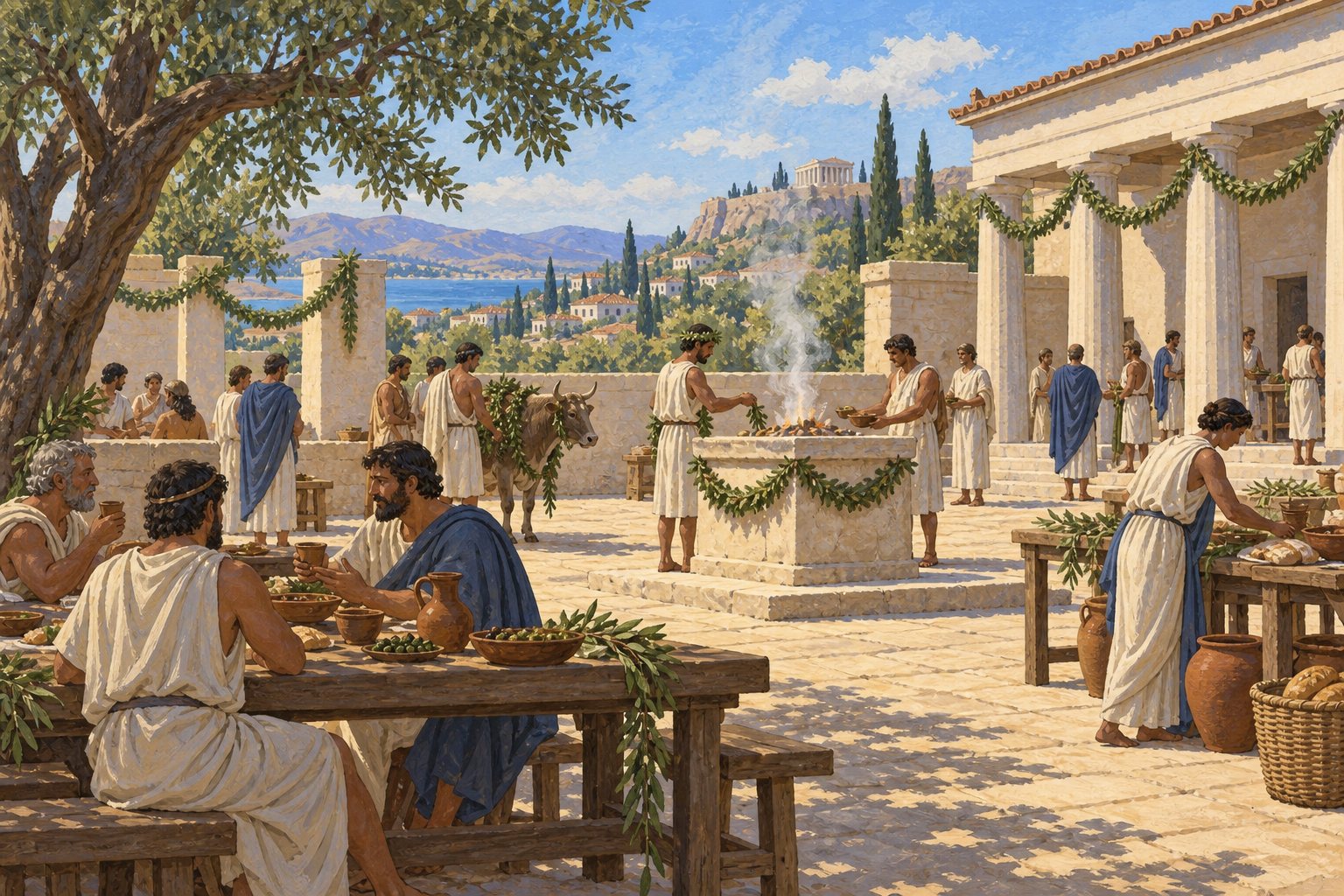
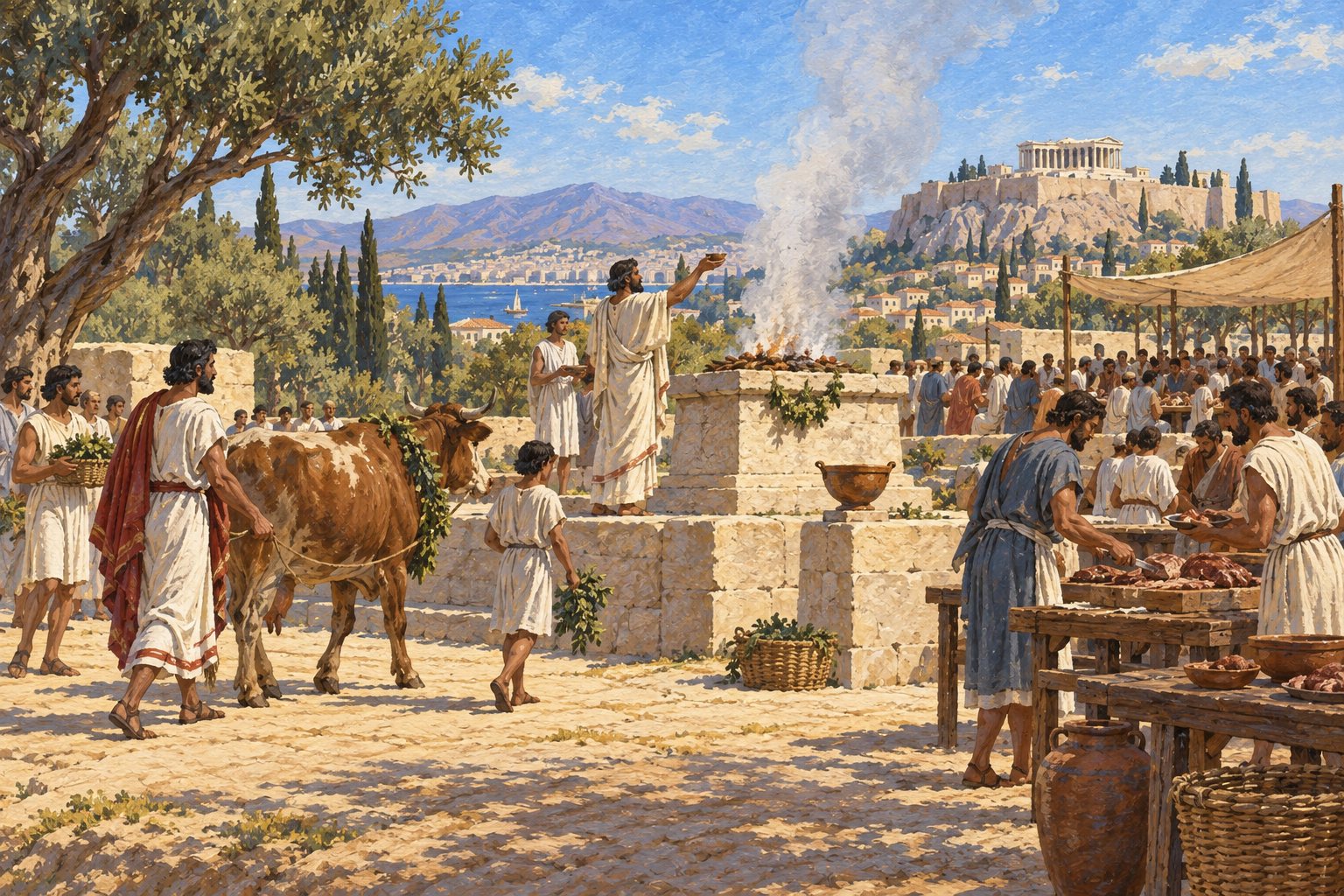
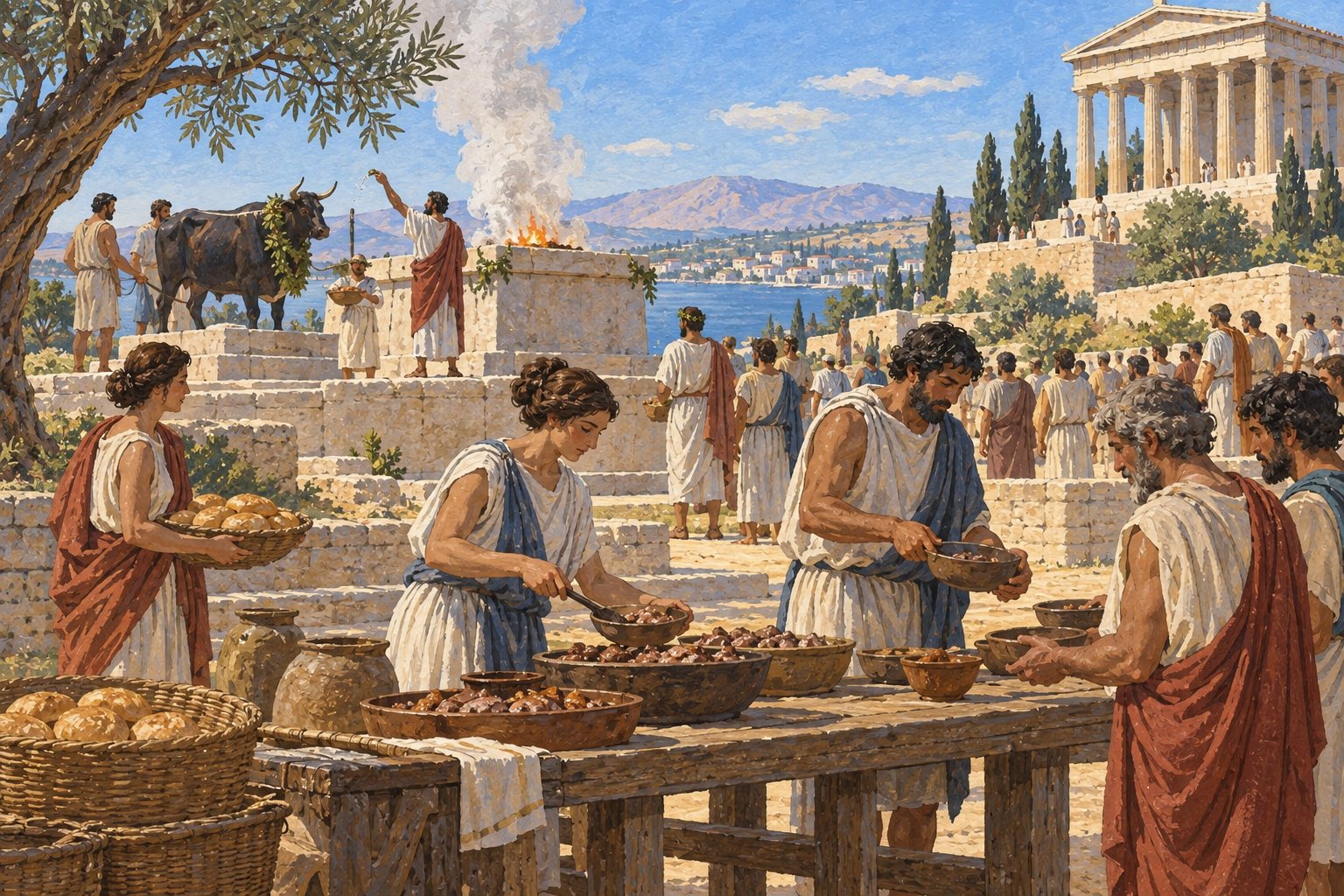
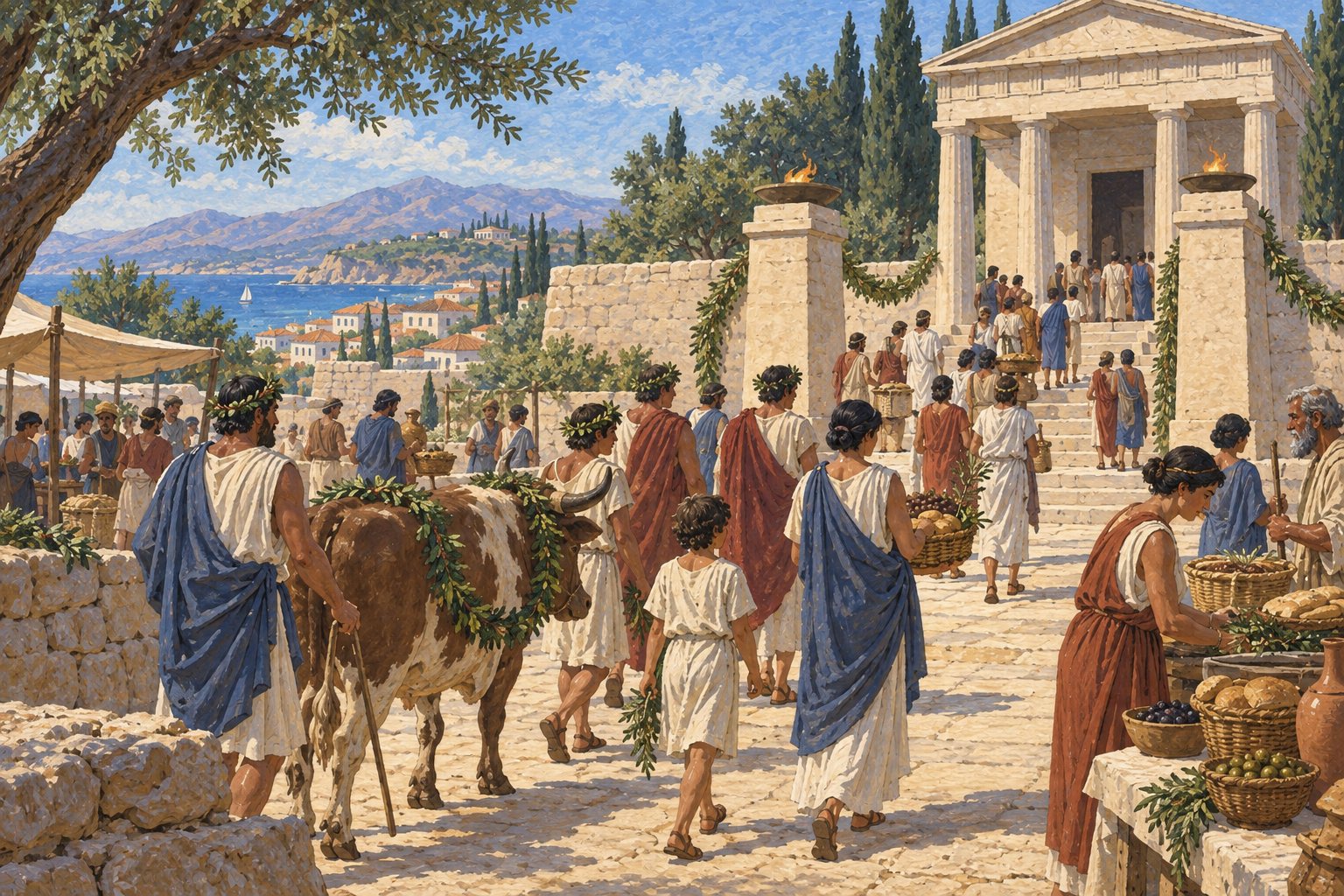
The civic meal. The central act was not belief but a procedure with food at the end — thysia, the animal led garlanded to the altar, the god’s portion burned, the meat divided among the participants — and Hesiod already tells it as a story about the division: Prometheus wrapping the bones in fat to trick Zeus, an origin-myth not of the world but of why the gods get smoke while the city eats; sacrifice was a civic act, its calendar public, its meat a distribution system, and eusebeia — the word usually translated “piety” — named the doing of it correctly, not the believing of anything.
How it was transmitted
The Missing Machine
There was no machine, and this chapter does the arguing: no creed, no catechism, no fixed teaching, no text that had to survive word for word — therefore no memorisation discipline like the Vedic World volume’s pāṭha checksums and no counting scribes like the Judaism volume’s, because replication technology exists to protect a payload and here there was no payload; what transmitted the tradition was the festival cycle, the sanctuary, and apprenticeship in practice — and the negative proof is Eleusis, whose initiates kept their secret for about a millennium with no written backup, so that when the practice stopped, the content ceased to exist.
The Locked Books
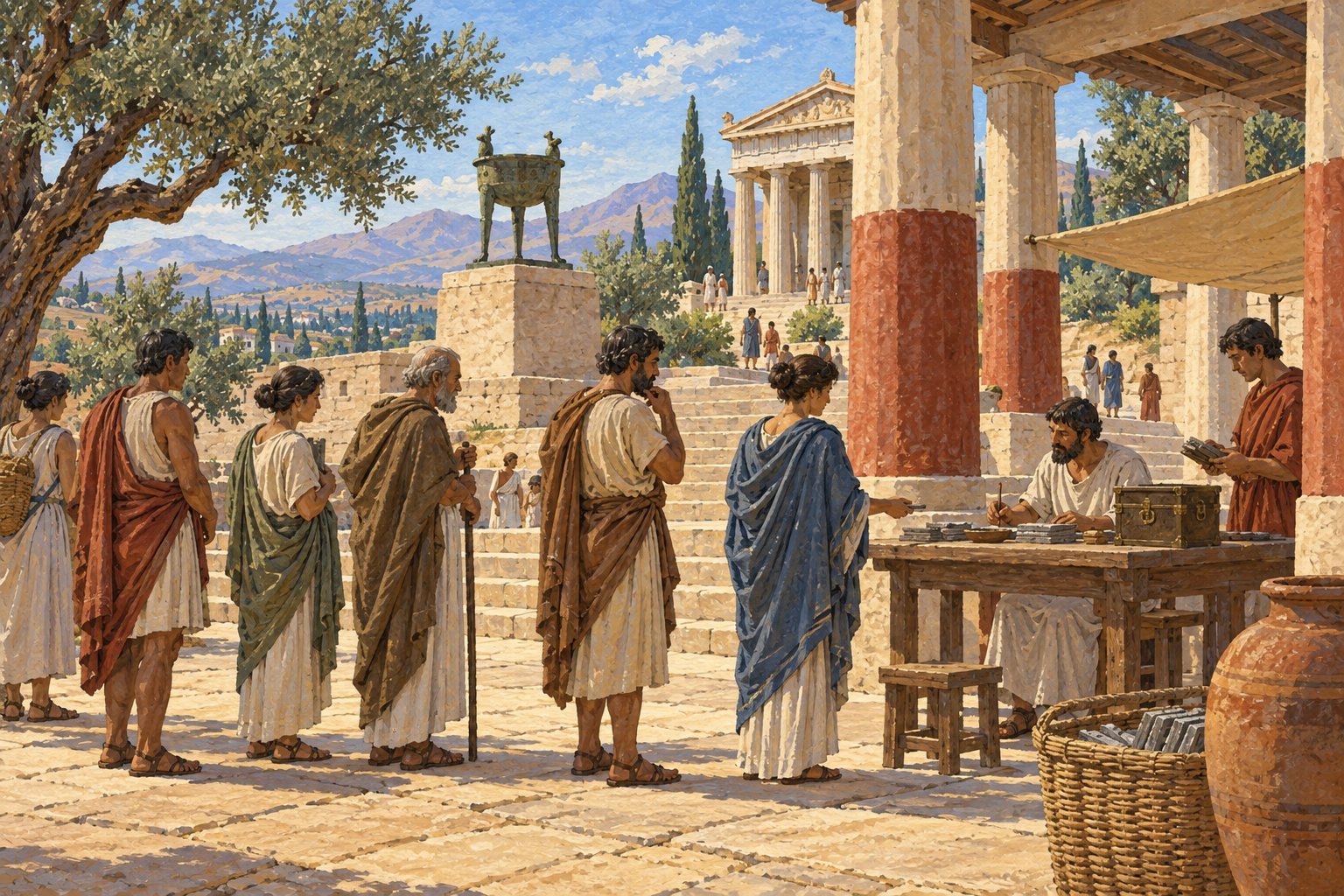
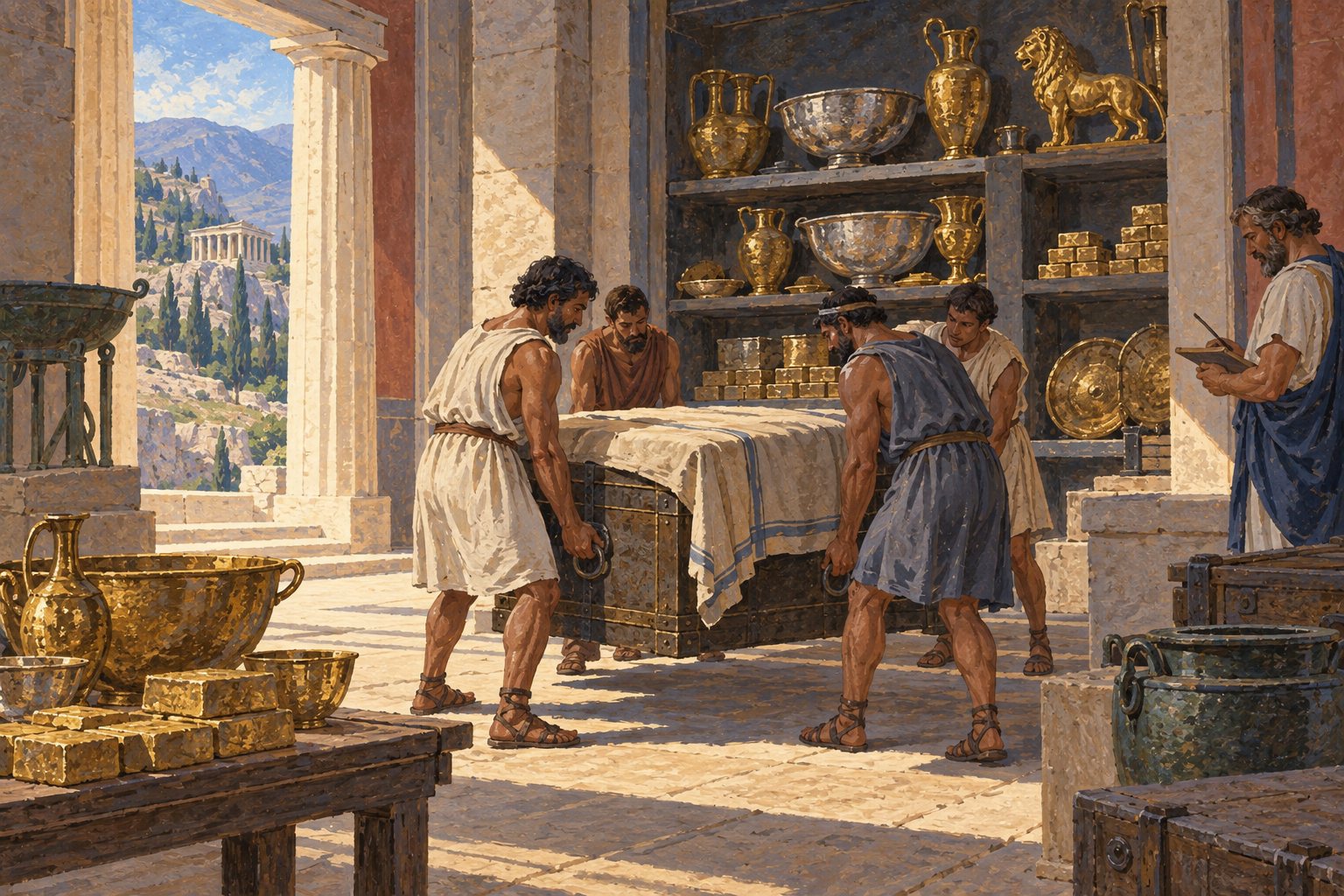
Rome did build one genuine sacred-text technology, and what it chose to protect proves the rule: the Sibylline Books — a state-owned oracle collection kept in a stone chest under the Capitoline temple, consultable only on the Senate’s instruction, by an appointed college, with capital penalties for leaking — had all the apparatus of a scripture, archive, custodians, authentication, and contained no teaching whatsoever; burned with the temple in 83 BCE, recollected by embassy from Erythrae and elsewhere, vetted verse by verse, weeded of forgeries by Augustus along with two thousand other prophetic books, and finally burned for good around 408 — a canon managed like a state secret, because the state was the church.
Explore the illustrations6 scenes · Questions in lead
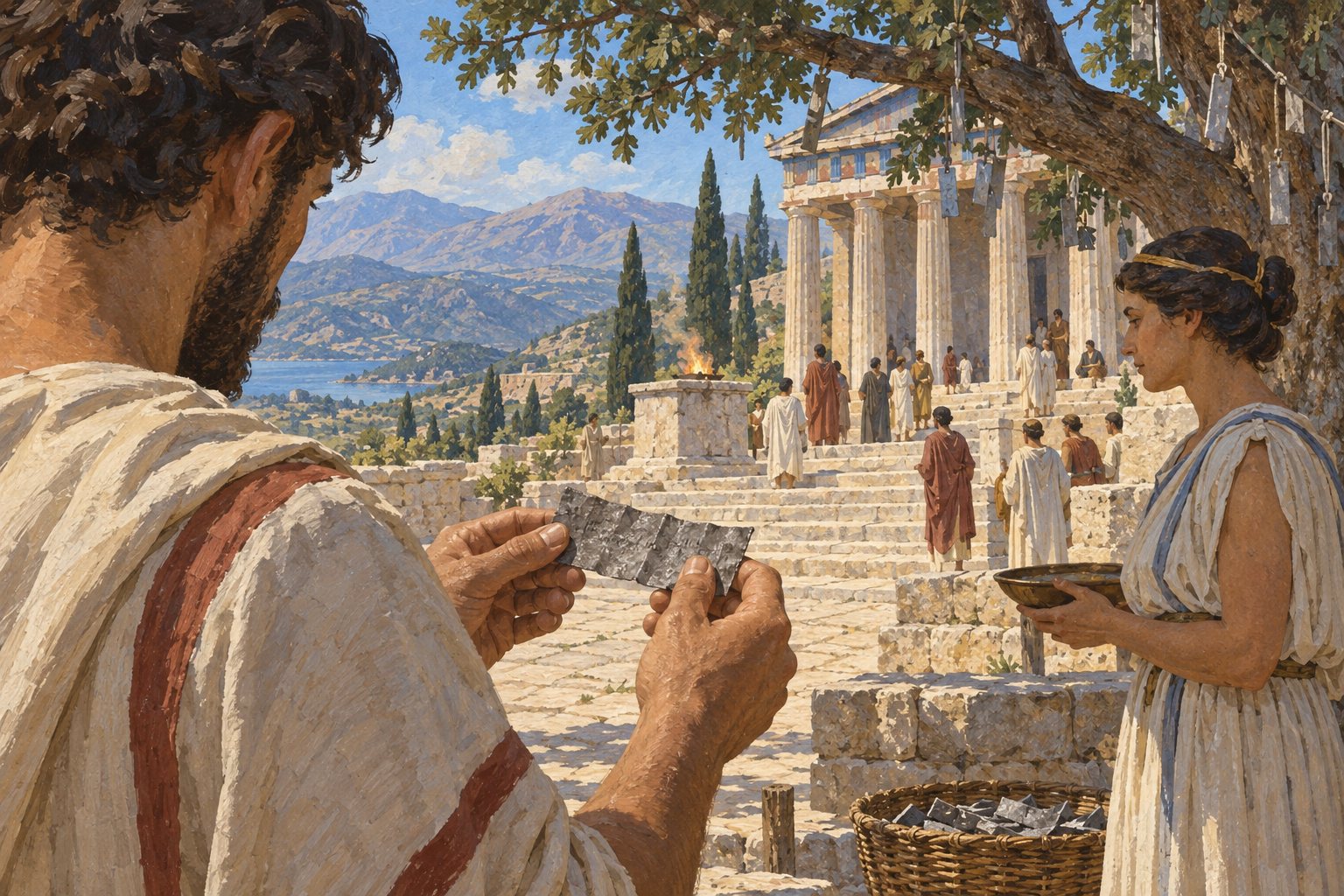
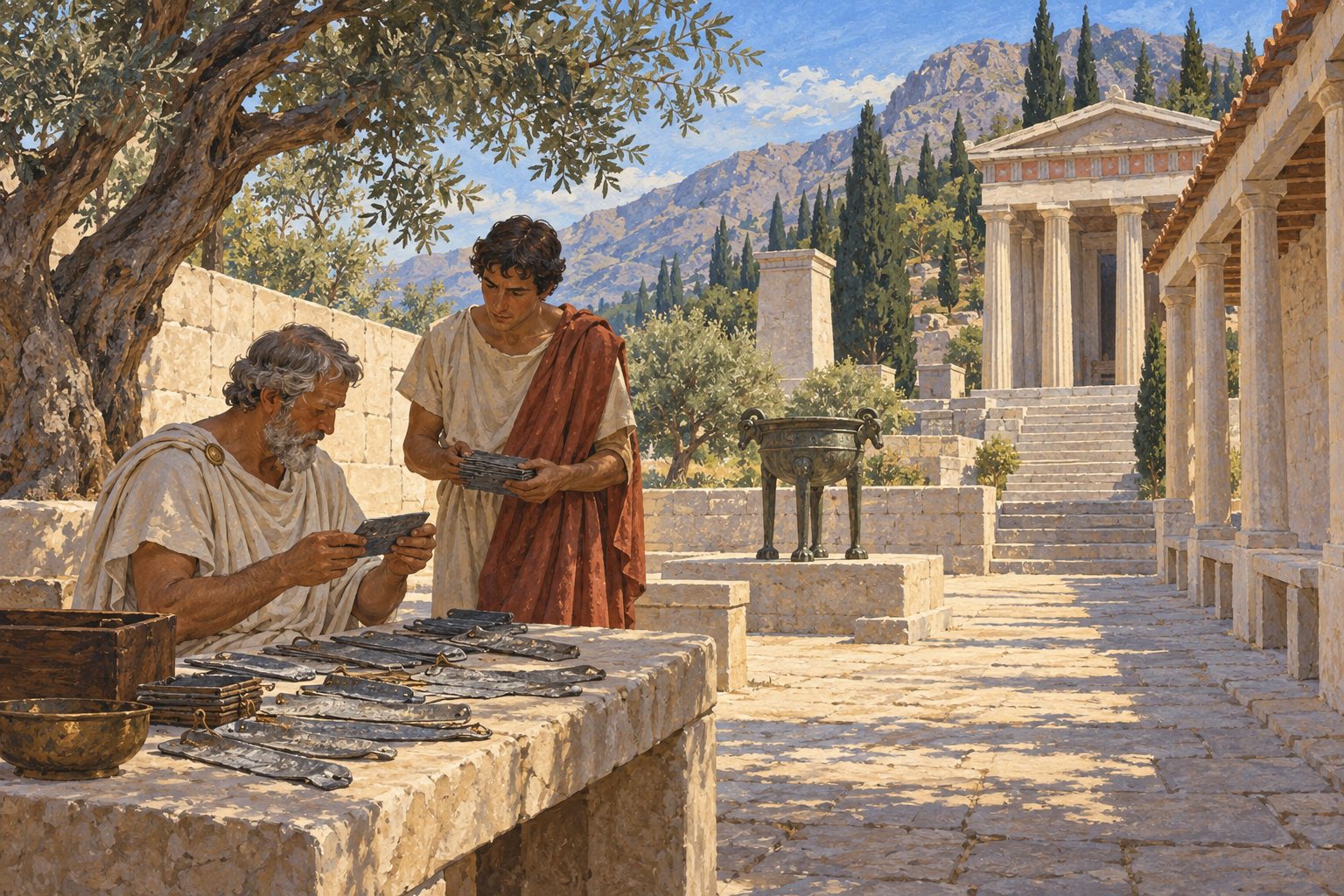
Questions in lead. The closest this tradition came to revelation was an answering service: oracles processed queries one at a time and stored nothing — at Dodona the questions survive physically, thousands of inscribed lead strips asking whether to marry, whether to sail, whether the child is his; at Delphi the procedure was an institution with a calendar, a fee and a staff — and Herodotus’s Croesus story is already a test protocol, a king benchmarking seven oracles with a question only he could verify; a query system, unlike a teaching system, replicates nothing, and when the questions stopped coming, nothing remained.
Texts and authority
A Religion Without a Book
The modern reader’s package — a scripture, a creed, a clergy trained on both, membership by assent — maps onto nothing in this volume, and the chapter says so in the open: there was no scripture, no office empowered to define one, and no word in the language for “religion” in the modern sense — the working vocabulary was eusebeia (right reverence, a practice), ta patria (the ancestral things) and at Rome mos maiorum (the custom of the elders); what did the normative work everywhere was ritual correctness and inherited usage, and Herodotus states the nearest thing to a canon-history in one sentence: Homer and Hesiod gave the Greeks their gods’ genealogies and titles — poets, credited with a taxonomy, holding no office at all.
Disagreeing with Homer
Nobody was ever heretical for contradicting Homer: Xenophanes wrote that Homer and Hesiod ascribed to the gods everything shameful among men — and founded no schism and stood no trial; Plato expelled Homeric theology from his ideal city in a book that circulated freely; Epicurus taught that the gods concern themselves with nothing, and his school met unmolested for centuries; and Cicero could serve as augur while writing a treatise dismantling augury, without a flicker of contradiction — because Homer was a shared reference, not an authority, and correctness lived in the rite, not in the reading.
Institutions and resources
The Goddess Who Lent at Interest
Athena was Athens’ biggest creditor: the city borrowed from her treasury on the Acropolis to fight the Peloponnesian War and the accounts were published on stone — the logistai inscription totals the loans of 426–423 with the interest computed to the day — while Pericles, in Thucydides, inventories the sacred reserves like a chancellor, down to the forty talents of removable gold on the statue itself; the treasurers were an annual board of citizens who published handover inventories like any magistracy, because the goddess’s property was the state’s strategic reserve and piety kept double books — the series’ standing question, who owned this and how do we know, answered here by the stones themselves.
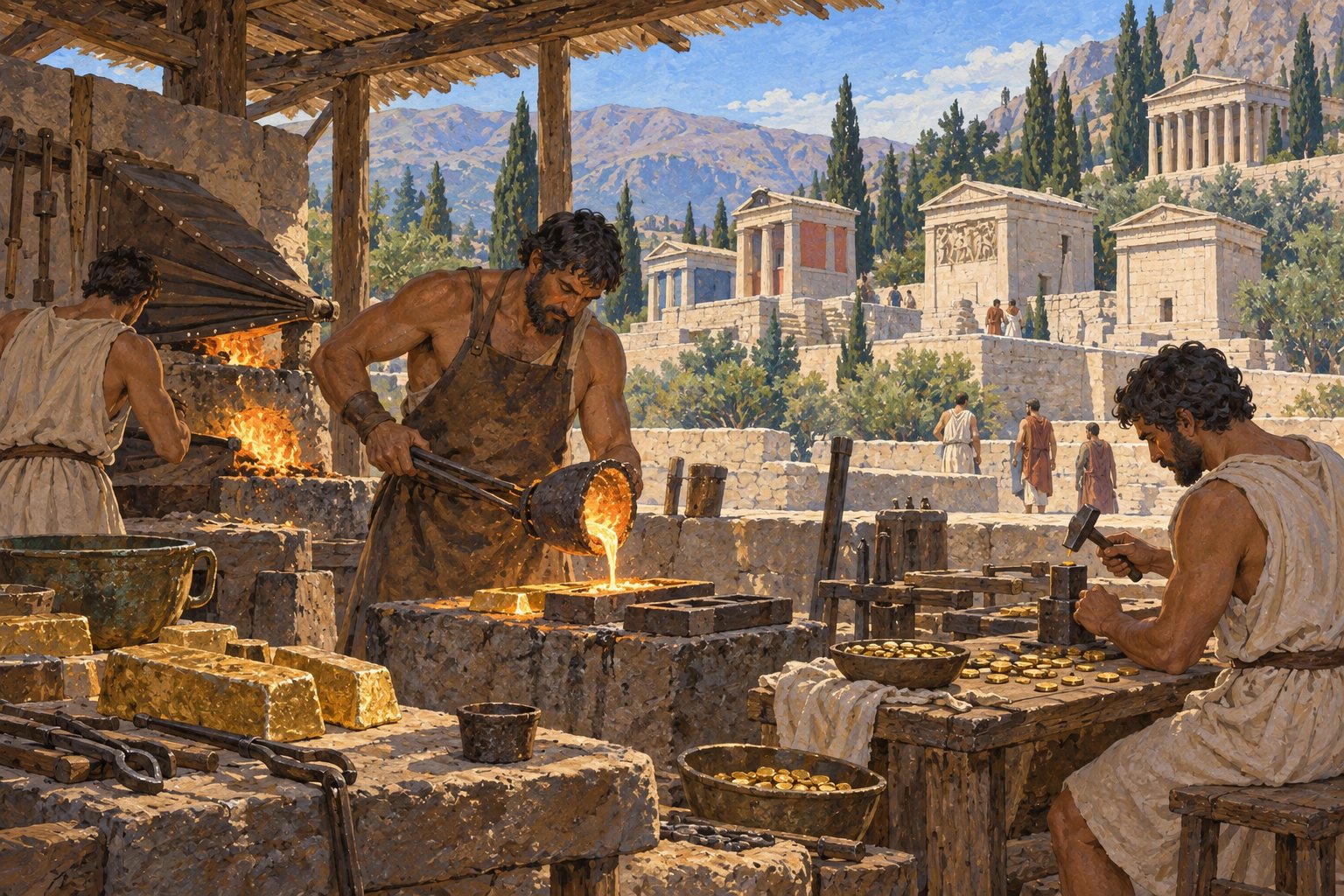
The Deposit Bank at Delphi
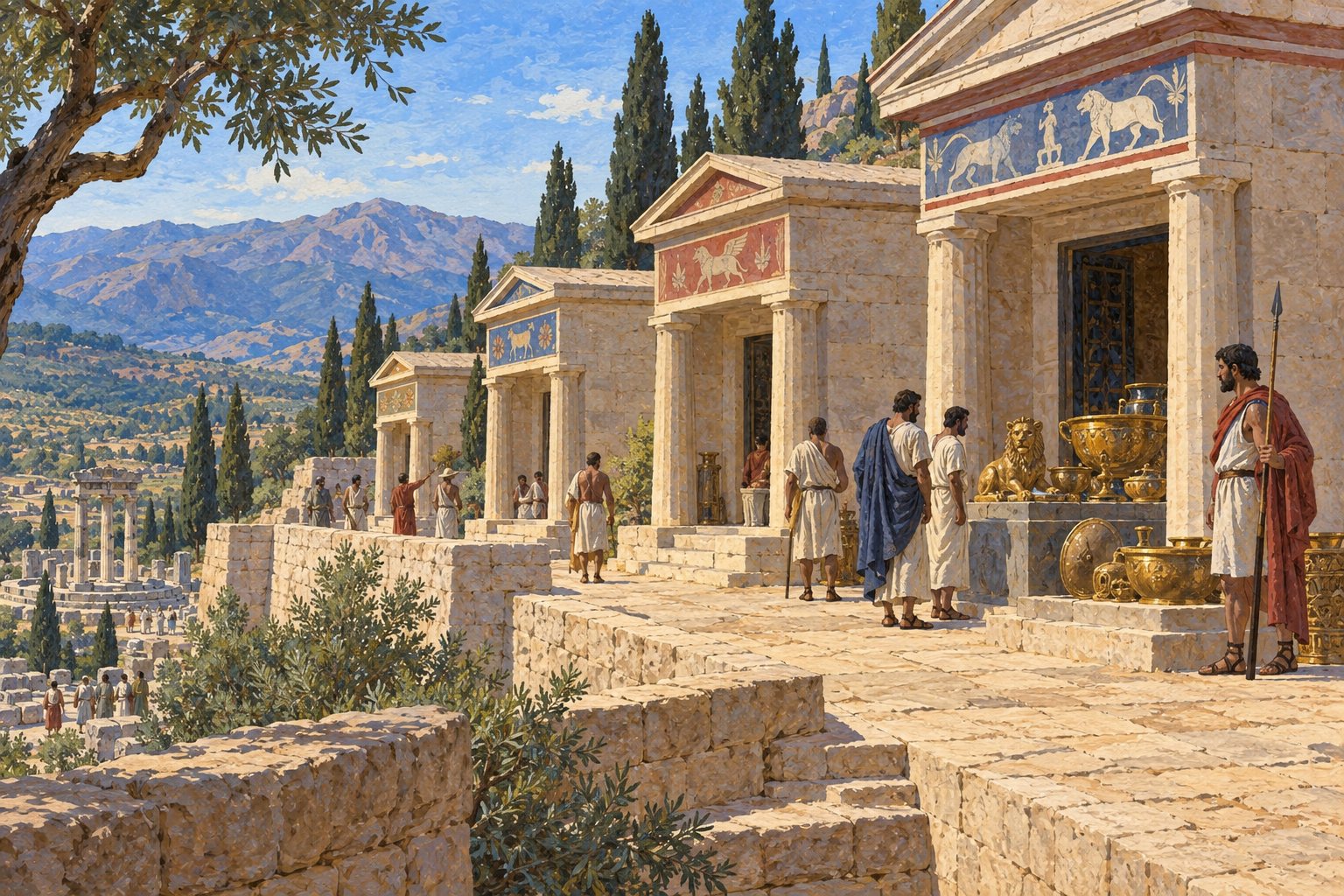
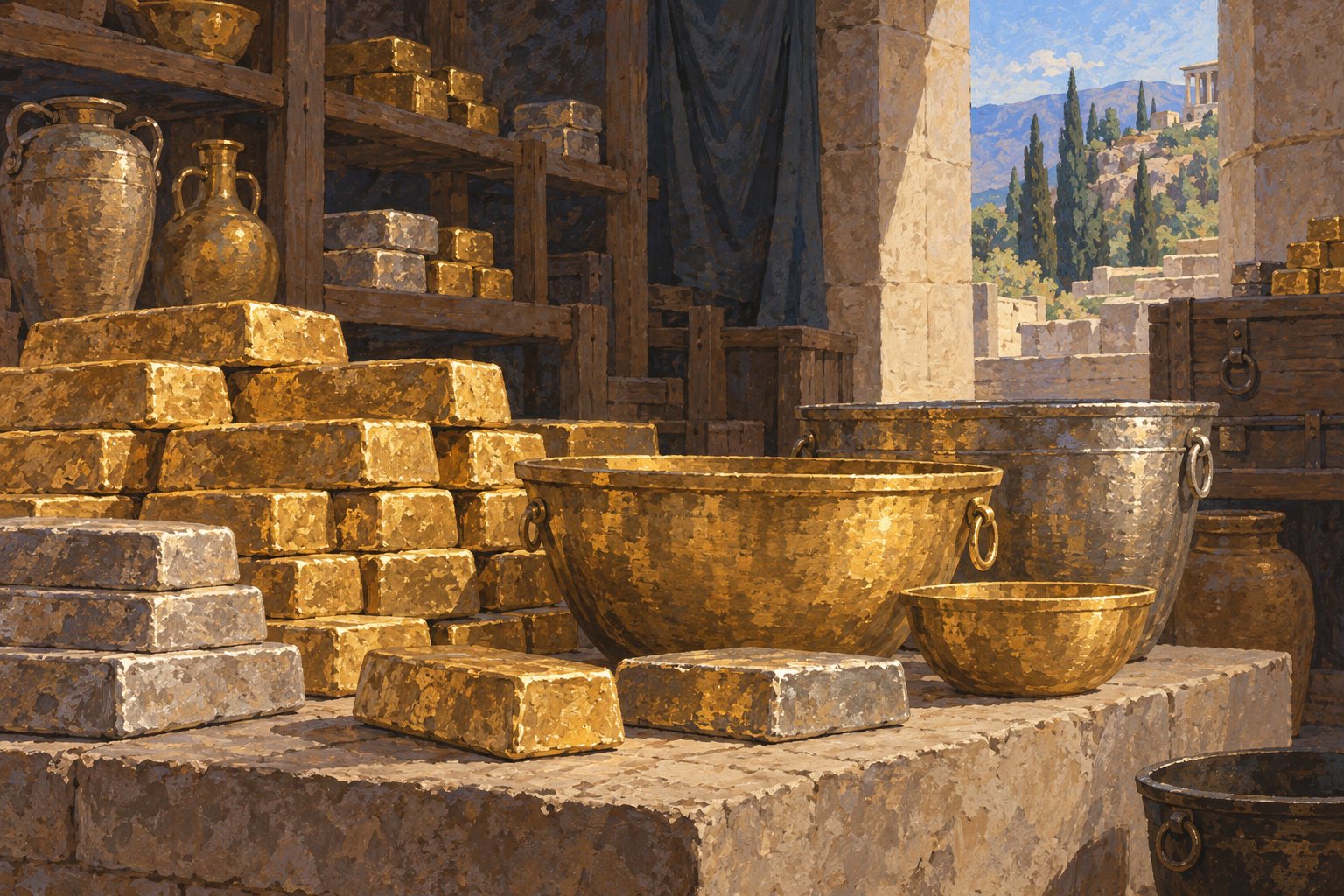
Delphi functioned as an international deposit institution — states built named treasury-houses on its terrace, kings banked prestige there in bullion, and Herodotus itemises Croesus’s deposits piece by piece, a hundred and seventeen half-bricks of precious metal, a lion of gold, great mixing bowls — until the Phocians seized the sanctuary in 356 and spent the next decade melting dedications into mercenary pay; Diodorus’s total for what the Sacred War consumed is ten thousand talents, an ancient figure and not an audit, and the aftermath is bookkeeping again: the Amphictyony fined Phocis and the repayment instalments were inscribed at Delphi, where they survive.
Explore the illustrations6 scenes · Treasuries on the terrace
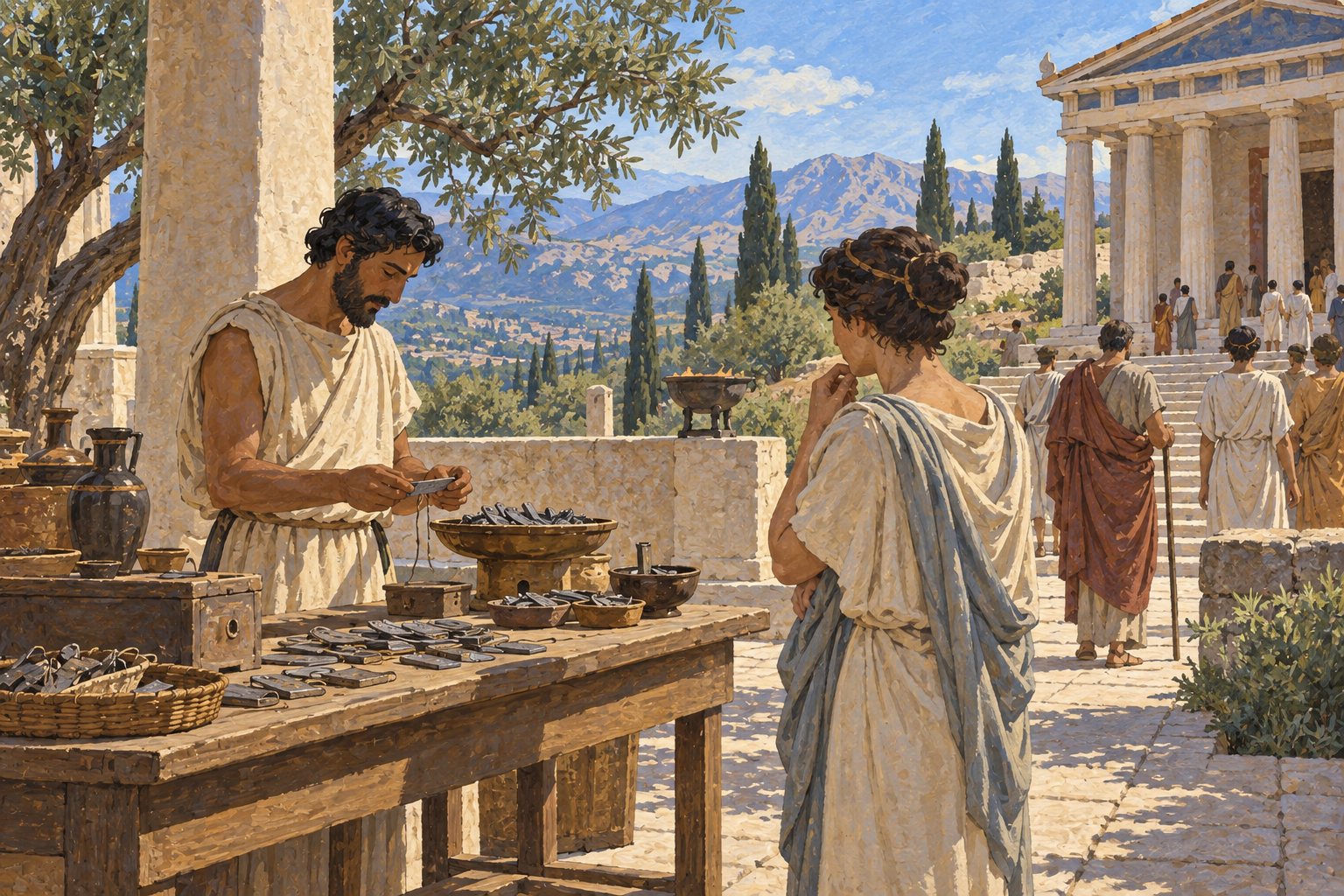
Treasuries on the terrace. Delphi functioned as an international deposit institution — states built named treasury-houses on its terrace, kings banked prestige there in bullion, and Herodotus itemises Croesus’s deposits piece by piece, a hundred and seventeen half-bricks of precious metal, a lion of gold, great mixing bowls — until the Phocians seized the sanctuary in 356 and spent the next decade melting dedications into mercenary pay; Diodorus’s total for what the Sacred War consumed is ten thousand talents, an ancient figure and not an audit, and the aftermath is bookkeeping again: the Amphictyony fined Phocis and the repayment instalments were inscribed at Delphi, where they survive.
Changes and divisions
The Confiscations
The fourth century’s first blows against the old religion were asset operations: Eusebius describes Constantine’s agents stripping temple doors and roofs and melting cult statues for their metal, a fourth-century military treatise says his seizures of temple wealth flooded gold into circulation, and Firmicus Maternus urges the emperors on in the language of the mint — take the ornaments, coin the gods; Constantius banned sacrifice in 341 in a two-line law, yet the priesthoods, the Vestals and the subsidies ran on for another generation — the defunding preceded the prohibition, enforcement was uneven, and a religion that was a funded practice rather than a believed doctrine had nothing else to stand on.
Julian Builds the Machine Too Late
The best evidence that the missing machine was fatal is the emperor who tried to install one: Julian, restoring the cults in 361, set about building a pagan church point for point on the Christian model — provincial high priests, moral discipline for clergy, hostels and grain doles, because, he wrote, the Galilaeans feed our poor as well as their own — and the project collapsed in under two years, outliving neither his Persian expedition nor the laughter of Antioch, where, expecting a civic procession at Apollo’s festival at Daphne, he found one priest with one goose from his own household; an emperor could decree the offices, but not the trained corps, the habit, or the constituency a transmission machine is made of.
Limits of the evidence
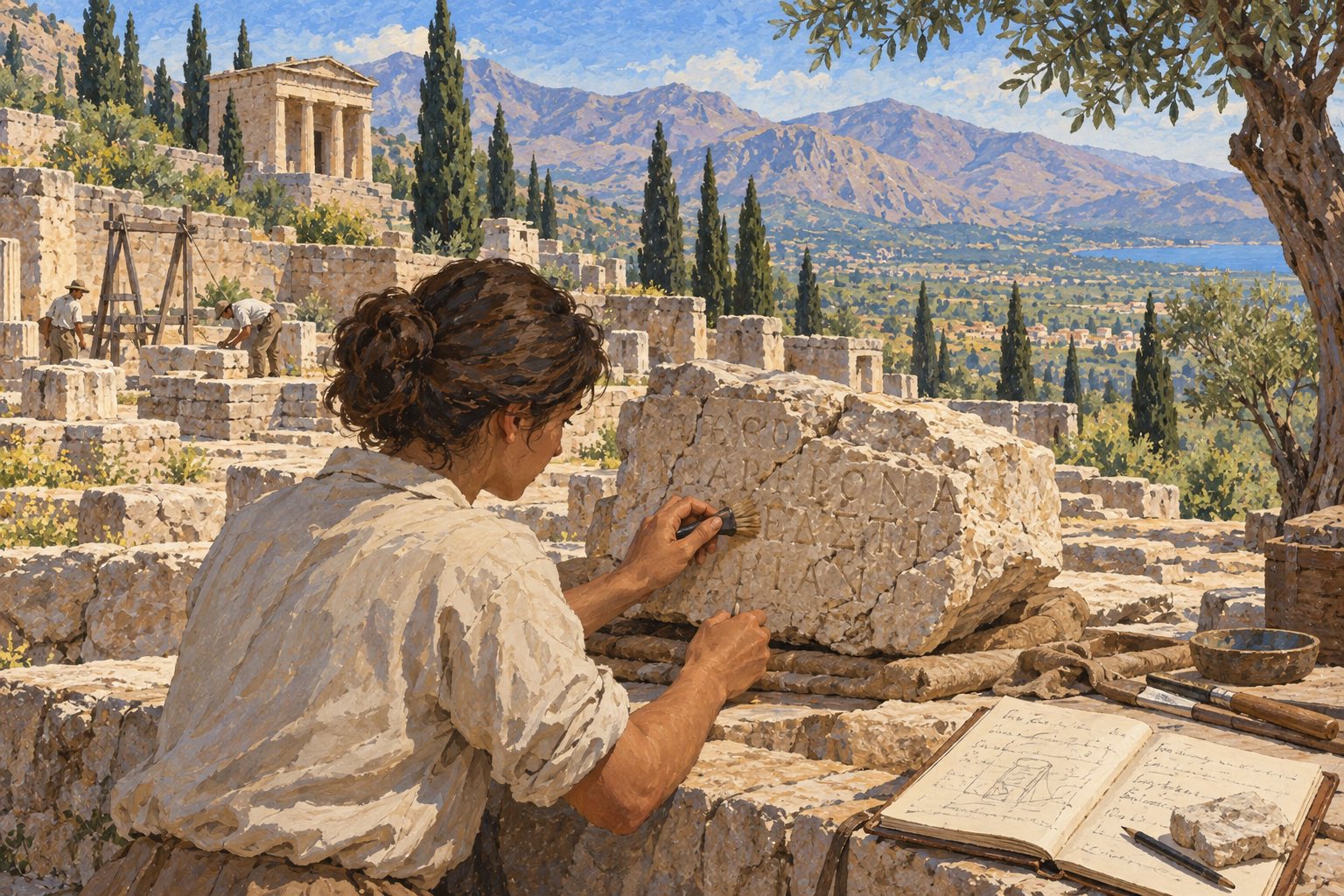
These limits are stated in the book before its argument.
- The interior of the practice The sources are calendars, account stones, laws, inventories and polemics; where statements of belief survive they are philosophers’ literature, not the practice’s own testimony. This volume can show what was done and what was paid, almost never what was believed — stated inside Movement One, and kept to.
- Mycenaean religion beyond the ledger line The Linear B tablets are palace accounts; the offerings they record are real entries, but whether PY Tn 316 records human beings dedicated to shrines is contested, and the equation of a tablet name with a later god is a name-match, not a demonstrated continuity of cult.
- Continuity across the post-palatial centuries, site by site Between the burning of the palaces (conventionally around 1200 BCE) and the eighth-century sanctuary boom lie roughly four centuries without writing. The names crossed; whether the practice crossed with them cannot be established from names alone, and the excavated claimants to continuity are argued case by case.
Sources and reading
This article brings together the series’ existing overview and chapter summaries. The linked book page provides the full outline and bibliography.
- PY Tn 316last Pylos accounts, c.1200 BCE. gold vessels and humans carried to named shrines
- KN Gg 702Knossos archive, date contested. a jar of honey to the mistress of the labyrinth
- KH Gq 513th–12th c. BCE. Dionysos named beside Zeus in an offering
- Ventris and Chadwick, Documents in Mycenaean Greek1956. the working edition of the Linear B corpus
- Dipylon jug and Pithekoussai cupc.740 and c.730 BCE. first alphabetic Greek as a dancing prize and a drinking joke
- Anthony Snodgrass, Archaic Greece1980. votive tallies at Olympia and Delphi
- Plutarch, Life of Numa, Bernadotte Perrinlate 1st–early 2nd c.; 1914 trans.. Hippias published the Olympic list from no secure basis
- Cicero, De Natura Deorum45 BCE. religio as cultus deorum; Cotta upholds rites without proof
Illustrations are newly generated interpretations of themes in the book. They are not surviving artifacts, historical photographs or evidence for the events described.