126 pages, 5.5 × 8.5 in. Three or more volumes in one order and every copy drops to $11.99.
United States, 8 to 11 days. All destinations
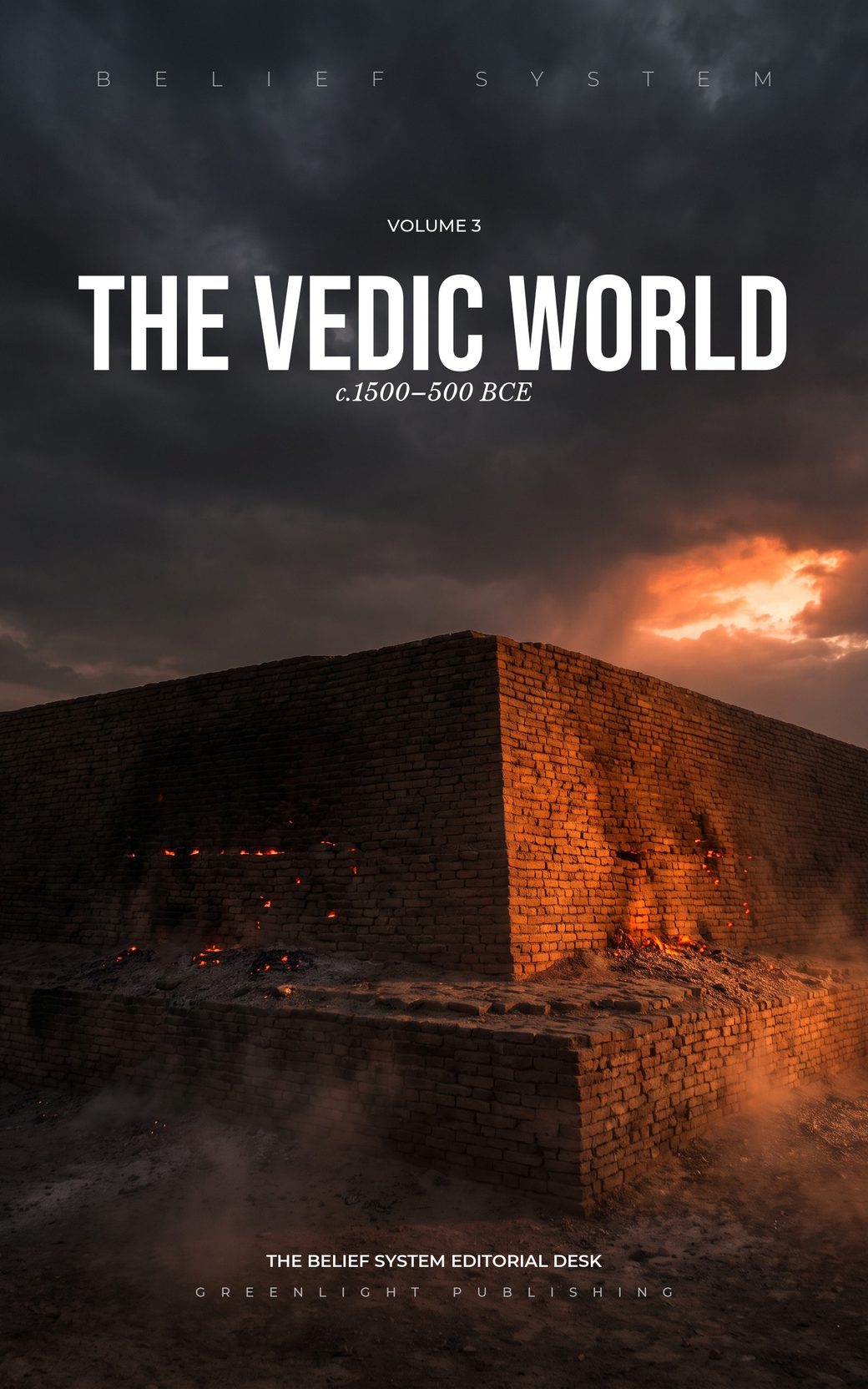
Volume 3 Belief System c.1500–500 BCE
The Vedic World
The machinerecitation with checksums — the pāṭha system
- Attested from
- c.1500 BCE
- Narrates
- c.1500–500 BCE
The earliest secure evidence, and the key this volume is filed under. All thirty-one
The period the book actually covers. It is rarely the same figure.
The argument in one sentence
A mobile pastoral society that built nothing durable engineered, in the trained voices of hereditary households, a recitation machine so redundant that its hymns crossed three thousand years without a manuscript and without a change of accent — and the machine’s perfection is the volume’s whole problem, because a text carried outside time has no date, no author, no places and no receipts; its economy survives only in the praise-stanzas of its own payees, and when the tradition finally divided, it divided first by recension and only at the very end over whether the sacrifice it existed to serve did anything at all.
the Veda is recited forwards, backwards and in braided permutations, because the modes are deterministic transforms of each other and therefore cross-check: a checksum sung for three thousand years.The commissioning line
What it is
A verse is held in five reordered forms at once, so that one dropped syllable fails to reconcile with the other four. The modes are deterministic transforms of each other. A checksum, sung, for three thousand years.
This is a history of the oldest living recitation machine we can describe, and of how we know.
The hymns never raise the question a modern reader arrives with — where the language and the gods came from. Three accounts of that question are held today by people with real evidence. This book prints all three, names who holds which, and stops. The cover window is a convention hung between two foreign documents a thousand years apart. Nothing inside it can be fixed to a year.
Five movements: the world the hymns answered, the machine that carried them, the canon nobody closed, the money paid in cattle, and the split into the later schools.
The book never adjudicates. Every figure arrives with the document it came out of, and where that document was composed by the men being paid, the sentence says so. Where something cannot be established, the book says so and says why.
Belief System, Volume 3.
In full
The Veda is not a book that was written down and then remembered. It is a recitation that was remembered and, much later, written down. That order is the whole of this volume.
What carried it was a set of transforms: the same verse recited forwards, backwards and in braided permutations, because the modes check each other. A pitch put on the wrong member of a compound reverses who kills whom, and the tradition kept the mistake as a warning about its own machinery. A price floor of a hundred cows for a soma-sacrifice, and a clause forbidding a priest to work under it. A recitation cancelled, by rule, when too many donkeys are braying.
The money movement has to say, every time, that the receipts sit inside the hymns themselves and are genre-inflated. The book does not convert a praise-price into an audit. The Vedic World is one of the eight volumes the series named in advance as hardest to write for exactly that reason.
The volume uses five fixed phrases, and no sixth, so a reader always knows which kind of claim is being made. It quotes Griffith and the Sacred Books of the East and names the translation in the visible text every time. It reports no miracle as fact and denies none. It never tells you what anybody was thinking. And it does not pick a side in the argument about where the language came from, because the corpus never raises it.
Belief System is a history of world religion, one tradition at a time: where it started, what carried it, who paid for it, and how it divided. Thirty-one volumes, ordered by earliest secure attestation.
The contents
25 chapters in five movements. Every volume in the series has the same five, in the same order, and each chapter below is printed with the idea it carries.
Movement OneThe World
The Punjab in the second millennium BCE, the ruined cities to its south, and the question the hymns answered. The Indo-Aryan question is set out position by position and settled nowhere — on this ground the series’ no-adjudication rule is not a constraint but the method.
- 1The Treaty of the Four GodsThe earliest datable trace of the Vedic gods is not in India: around 1380 BCE a treaty between the Hittite king Suppiluliuma I and Shattiwaza of Mitanni, filed at Hattusa, lists Mitra, Varuna, Indra and the Nasatyas among its divine witnesses, and a Mitanni horse-training manual counts its laps in recognisably Indo-Aryan numerals — so the volume opens on fired clay in Anatolia, two and a half thousand kilometres from the Punjab, holding gods the hymns share.
- 2The Cities That Were Already RuinsBy the conventional dating, the brick cities of the Indus — street grids, standardised weights, an undeciphered script, and no building anyone can securely call a temple — had declined by about 1900 BCE, generations before the hymns’ conventional window opens, and what if anything the Vedic world owes them is one of the two live questions this volume reports and does not settle.
- 3The QuestionWhere the people of the hymns came from is genuinely contested and politically live — the migration account (most philologists and archaeogeneticists, on the Indo-European family tree, the non-Indo-European loanword layer, the chariot horizon and the ancient-DNA transects), the indigenist account (a school of Indian archaeologists and much of the present-day Indian public sphere, on stratigraphic continuity and the Sarasvati identification), and the older invasion-massacre account (abandoned by the field that made it once the Mohenjo-daro skeletons were re-examined) — and this volume states each position with its holders and its evidence and adjudicates none of them.
- 4The RiversThe hymns carry their own map — the river-praise hymn of the tenth book lists the streams in geographical order from the Ganges westward, the Sarasvati is praised as a great river running “from the mountains to the sea” while the later texts describe it vanishing into the sands, and the one event the Rigveda narrates at length, the Battle of the Ten Kings, is fought on the Parusni, the modern Ravi — the corpus places itself in the Punjab and then, layer by layer, walks east, and the walking is itself a dating ladder.
- 5Wealth That WalksThe hymns describe a society whose wealth had legs — cattle above all (a Vedic word for battle, gaviṣṭi, is literally “the search for cows”), horses and the spoked-wheel chariot as the prestige technology, and no city, coin, field boundary or permanent shrine anywhere in the family books — a mobile pastoral world whose entire archive was what its specialists could carry in their mouths.
- 6Fire, Soma and ṚtaOn its own showing, the question this tradition answered is how the world is kept running: ṛta, the order that makes rivers flow and dawns return, is maintained by yajña, the offering into Agni’s fire, with soma — a pressed plant whose identity cannot now be established — drunk at the centre of the biggest rites; and none of it needed a building, because the ritual ground was measured out fresh for each performance and abandoned afterwards, which is why this religion left the archaeologist almost nothing and the reciter everything.
Movement TwoThe Machine
The transmission technology, named as a concrete object or institution — not an abstraction. Here: the pāṭha system — recitation modes that reorder the same words under fixed rules, so that a corruption anywhere fails to reconcile across modes — and the households that ran it. The best machine chapter available in the ancient world, and the reason to write this volume at all.
- 7A Perfect Text With No ObjectThe Rigveda’s oldest surviving manuscripts are roughly three thousand years younger than its conventional composition — the thirty codices UNESCO placed on the Memory of the World register in 2007 were copied between about 1500 and 1800 CE — yet specialists treat the received text as fixed to the syllable, and to the pitch-accent, since well before the Buddha; the machine that did this left no artefact at all, and this movement takes it apart.
- 8The Eight Ways of Saying One LineThe pāṭhas are recitation modes that reorder the same words of the same verse under fixed rules — saṃhitā runs the line continuously with its junctures fused; pada breaks it into words with the junctures dissolved; krama pairs them, ab bc cd; jaṭā braids each pair forward, backward, forward; ghana rolls it ab ba abc cba abc — deterministic transforms of one another, so that a corruption anywhere fails to reconcile across the modes and cannot propagate silently: error detection by cross-checking redundancy, two and a half thousand years before anyone said checksum.
- 9The Accent That Killed Its OwnerVedic recitation preserves a pitch accent that later written Sanskrit dropped, the accent bears meaning, and the tradition’s own parable of the cost of error is a demon: Tvastr, the Satapatha Brahmana says, accented indraśatru on the wrong member, turning “slayer of Indra” into “he whose slayer is Indra”, and Vrtra died of a recitation error — a warning label the ritual literature attaches to its own machine, and the pressure that produced the world’s earliest descriptive phonetics.
- 10The Boy Is the MediumThe machine’s hardware is a child: initiated around eight, a brahmin boy spent on the order of twelve years in daily svādhyāya — repetition before dawn, teacher’s mouth to pupil’s ear, checked syllable by syllable — because the text lived nowhere else; the Satapatha Brahmana ranks daily recitation as a sacrifice in its own right, the schools survive as hereditary households rather than institutions, and the tradition is not a relic: UNESCO proclaimed Vedic chanting a Masterpiece of the Oral and Intangible Heritage in 2003, and the Nambudiri houses of Kerala still carry a Rigveda line that Staal recorded in the 1950s.
- 11What the Machine Costs the HistorianThe pāṭha system preserved sound, not meaning, and its perfection is exactly why the dating is so hard: an oral text has no stratigraphy, no colophon and no carbon, so absolute chronology hangs on two external pegs with a millennium between them, and inside the window everything is relative — language layers, “black metal” appearing in the Atharvaveda, the geography walking east — while by the time the tradition’s first surviving commentator wrote, whole Vedic words were already obscure: Yaska’s Nirukta is a book of etymological rescue that preserves, and argues with, Kautsa’s position that the mantras carry no meaning at all.
Movement ThreeThe Canon
What is in, what is out, who decided. The real subject is who had the authority to close it — and the finding here is that nobody did: the canon accreted, layer on layer, school by school, and the boundary that matters is stated as an epistemology. Every chapter in this movement opens with an argument, never with a text list.
- 12Heard, Not RememberedThe tradition’s canon rule is the line between śruti, “what was heard” — the hymns and their attached prose, held to have been seen by the rishis rather than composed, and in the mature doctrine authorless altogether — and smṛti, “what was remembered”, which is human, secondary and revisable: a canon boundary stated as an epistemology, doing the work that councils and imprimaturs do elsewhere, and no assembly ever convened to draw it.
- 13Three Vedas, Then FourThe canon is organised by liturgical job, not by subject — ṛc the verse for the hotr who recites, sāman the melody for the udgatr who sings (nearly all of its verses are the Rigveda’s, reset to music), yajus the muttered formula for the adhvaryu who does the work — which is why the old collective term is trayī vidyā, the threefold knowledge; the Atharvaveda — healing charms, curses, house-rites, king-rites — was admitted late and knew it, arguing its own case for centuries while “threefold” persisted as the name of a four-part canon, the seam still showing.
- 14The Black and the WhiteEven inside one Veda the canon exists only as school recensions — the Yajurveda is “Black” where mantra and explanatory prose interleave (Taittiriya, Maitrayani, Katha) and “White” where they are separated (Vajasaneyi, with the enormous Satapatha Brahmana as its detached commentary) — and the tradition remembers the difference not as a doctrinal parting but as a teachers’ quarrel: Yajnavalkya, expelled, vomits up the yajus he had learned, and his fellow pupils, turned partridges (tittiri), peck it up — a canon whose divisions are lineage stories about who may transmit, not arguments about what is true.
- 15The LayersEach school’s corpus is a stratigraphy — Samhita, then Brahmana explaining the rite, then Aranyaka carrying it into the forest, then Upanishad turning the questions inward — accreted by attachment rather than decreed; and the strata run through the “earliest” text too: the Rigveda’s tenth book is visibly late (the Purusha hymn, carrying the Samhita’s only varna passage, and the Nasadiya’s cosmological doubt both live there), while the Brhadaranyaka Upanishad is literally the closing portion of the Satapatha Brahmana — the canon grew at its edges like a tree, and the rings are still countable.
- 16A Canon That Is a Performance“In the canon” here means “recited, in the rite, by a school that preserves it” — canonicity is enacted, not listed: there is no Vedic Uthman and no council; the policing is done by the machine itself (what no school carries in pāṭha does not survive) and by access (the later dharma texts fence who may hear the Veda at all, with penalties this volume reports exactly, with their dates); and the corpus shows its own patches — eleven Valakhilya hymns ride inside the Rigveda’s eighth book as a marked insertion, khila, “appendix”: canonical enough to keep, marginal enough to label.
Movement FourThe Money
Who paid, who was paid, and how we know. Thin ground, and the movement says so on its first page: there is no independent economic documentation of Vedic India — no coin, no archive, no receipt — and every figure below comes from inside the tradition’s own literature. That admission is not a weakness of the movement; it is the movement’s finding.
- 17The Fee Inside the HymnThe dānastuti is a praise-of-the-gift stanza riding at the end of a hymn — the poet names the patron, itemises the fee (cows, horses, gold niṣkas, chariots), and the stanza is then transmitted for three thousand years inside the liturgy the fee paid for: self-documenting payment, the closest thing to a receipt the Vedic economy ever produced — but it is praise, its numbers are a genre (steeds counted in the tens of thousands), and the volume prints them as poetry with a payee, never as accounts.
- 18The Price of a RitualThe śrauta system is a service economy — the yajamāna, the patron, hires the priests and pays the dakṣiṇā the manuals prescribe rite by rite, rising with ambition: the agnicayana stacks a five-layer brick altar (traditionally 10,800 bricks, a number the Satapatha Brahmana maps onto the divisions of the year), the aśvamedha turns a year of armed horse-guarding into a claim of paramountcy, and at the top of the scale a rite’s stated fee is everything the patron owns — on the tradition’s own arithmetic, the great sacrifices were instruments only kings could play, and the economy’s direction is legible even where its figures are not: cattle move from warband to priesthood, and legitimacy moves back.
- 19There Is No ReceiptThe movement’s ground truth, stated as its own chapter: Vedic India has no coinage (wealth is counted in cows and gold ornaments; punch-marked coins arrive, conventionally, only around the sixth century BCE, at the far edge of the span), no palace archive, no temple ledger and no tax roll — where the Ancient Egypt volume can weigh a temple economy in the Papyrus Harris’s acreage and the Mesopotamia volume can read interest rates off clay, this volume’s every figure is testimony from the payee’s own liturgy — and saying so is the finding: an economy transmitted only by its beneficiaries is itself a fact about who controlled the record.
- 20The Land Grant Arrives LateThe mature machine for paying priests — brahmadeya, tax-exempt land granted to brahmins in perpetuity — belongs to the centuries after this volume ends: the earliest external receipt for the sacrificial economy is an inscription at Naneghat in the Western Ghats, around the first century BCE, in which a Satavahana queen itemises Vedic sacrifices performed and fees paid in cows and coin, and the copper-plate boom that made priestly endowment a durable legal instrument is later still — the Vedic economy’s paper trail begins only once the Vedic period is over, the chapter says so in those words, and hands the trail on to the Classical Hinduism volume, whose machine is the copper plate itself.
Movement FiveThe Split
What divided it, what it became, what it handed on. Division here runs by transmission first — the śākhās, schools defined by recension rather than doctrine — and then, at the era’s edge, by a question: whether the sacrifice does anything. Next volumes named, never numbered.
- 21A School Is a RecensionThe śākhā, “branch”, is a school defined by which recension of which Veda it preserves — its own accent tradition, its own Brahmana, its own ritual manual — division by transmission rather than by doctrine; the tradition’s own census is a boast the survivors refute: Patanjali’s grammar-commentary counts twenty-one schools of the Rigveda, a hundred and one of the Yajurveda, a thousand of the Samaveda and nine of the Atharvan, while what survives complete today is one Rigveda śākhā, a handful of Yajurveda lines, three Samaveda schools and two Atharvan — a performed canon deletes itself one extinct school at a time, and the losses are the split’s quiet ledger.
- 22The Turn InwardBefore anyone outside attacked the sacrifice, the canon’s own last layer quietly demoted it — the Upanishads stage debates at royal courts where the prize is a thousand cows with gold on their horns (the fee structure intact even here), and the winning answers move the rite inside: breath as the offering, the self as the altar; in the Brhadaranyaka the doctrine that a person is made by action is first settled off the record — Yajnavalkya takes his questioner’s hand and speaks of karman in private — and the Mundaka will call the sacrificial forms “unsafe boats”: the canon’s edge had begun arguing with its centre, in the centre’s own transmitted words.
- 23The StriversAround the fifth century BCE the corpus’s eastern edge — the Ganges plain of the second urbanisation, with cities, kings and the first coins — produced men the texts call śramaṇas, “strivers”: renouncers outside the household-fire system, unattached to lineage or school, among whose teachers were Mahavira (whom the Jain tradition holds to be the twenty-fourth in a line historians cannot trace past the twenty-third) and the Buddha — and the pairing of śramaṇa and brāhmaṇa as stock opponents became proverbial enough for the grammarians to use it as a textbook example of innate antagonism.
- 24Does the Sacrifice Do Anything?The split that matters is an argument about efficacy — the Jain answer is that the sacrifice is violence and the only true offering is austerity (“Penance is my fire,” runs Jacobi’s rendering of the Uttaradhyayana’s Harikesa dialogue); the Buddhist answer, in the Kutadanta Sutta, is a king’s sacrifice re-specified until nothing is killed and the real offering is open-handedness and practice; and the tradition’s own house already held Kautsa’s mantras-mean-nothing thesis and the Nasadiya’s “or perhaps he knows not” — a three-cornered argument in which every position, including the doubt, is transmitted by professionals of the very machine under dispute, and this volume reports all three corners and adjudicates none.
- 25What the Vedic World Handed OnThe Vedic world never ended and never closed — it handed the Jainism and Buddhism volumes their founding argument and, less obviously, their machine, because the reciter guilds and councils that carried the Jain and Buddhist canons are heirs of the pāṭha discipline; it handed the Classical Hinduism volume its substrate — śruti as the fixed core that smṛti could grow around, with the temple and the land grant doing what the portable fire never did; it shares its deepest layer with the Zoroastrianism volume, where the same old words for god and offering travelled the other way up; and it remains, in the present tense, the oldest unbroken oral tradition on the planet — a canon that could not be closed because it was never a book, carried by households that are still reciting it.
What this volume cannot establish
Printed in the book before the argument is, and printed here for the same reason. A history of a tradition that will not say where its evidence runs out is not a history.
Hinduism, three ignitions
This tradition ignites more than once in the chronology. The other slots are Classical Hinduism, Modern Hinduism. See the thread.
Sources
68 works, dated, and specific enough that a reader can go and look at the thing. Nothing is on this list that the desk did not consult.
| # | Document or work | Date | Evidence for |
|---|---|---|---|
| 1 | Suppiluliuma–Shattiwaza treaty tablets, CTH 51 and 52, Boğazköy | 14th c. BCE; excavated 1906–07 | Mitra, Varuna, Indra and the Nasatyas as divine witnesses |
| 2 | Elena Devecchi, study of the Akkadian manuscripts, Die Welt des Orients | 2018 | the pair of tablets treated as one ratification set |
| 3 | Kikkuli horse-training manual, Boğazköy | same Hittite archive | Indo-Aryan lap-counts: aika-, tera-, panza- |
| 4 | Paul Thieme, “The 'Aryan’ Gods of the Mitanni Treaties,” JAOS | 1960 | the four names as specifically Indo-Aryan |
| 5 | Annelies Kammenhuber, Die Arier im vorderen Orient | 1968 | the same names as possibly Hurrian-mediated |
| 6 | John Marshall, Mohenjo-daro and the Indus Civilization | 1931 | the proto-Siva reading of Mackay’s seal 420 |
| 7 | Iravatham Mahadevan, Indus concordance, Archaeological Survey of India | 1977 | 2,906 inscribed objects; inscriptions averaging about five signs |
| 8 | Rajesh Rao, Mahadevan and others, Science | 2009 | a statistical reply to the claim that the signs are not writing |
| 9 | Herbert Sullivan on Marshall’s seal | 1964 | the figure read as female, the “phallus” as a waistband |
| 10 | Doris Srinivasan, Archives of Asian Art | 1975–76 | side projections as ears; a buffalo-man, not a proto-Siva |
| 11 | Sándor Bökönyi, Surkotada horse identification, South Asian Studies | 1997 | true horse argued from teeth and toe bones |
| 12 | Richard Meadow and Ajita Patel, reply in the same volume | 1997 | the bones not separable from the region’s half-asses |
| 13 | Tim Dyson, population history of India | 2018 | Mohenjo-daro at 30–60,000 — an estimate, not a count |
| 14 | F. B. J. Kuiper, Aryans in the Rigveda | 1991 | roughly 383 non-Indo-Aryan words in the hymns |
| 15 | Thomas Oberlies, review in Indo-Iranian Journal | 1994 | a smaller count of secure loanwords |
| 16 | Rahul Peter Das, Indo-Iranian Journal | 1995 | “not a single case” agreed to be foreign — four words this book quotes |
| 17 | Narasimhan and colleagues, “The formation of human populations in South and Central Asia,” Science | 6 September 2019 | steppe-related ancestry entering after the cities declined |
| 18 | Shinde and colleagues, Harappan genome, Cell | 2019 | one Rakhigarhi woman without steppe ancestry |
| 19 | Michel Danino, The Lost River: On the Trail of the Sarasvati | 2010 | the hymn-river identified with the dried Ghaggar-Hakra |
| 20 | Mortimer Wheeler, Ancient India | 1947 | “Indra stands accused” — the massacre reading the field later dropped |
| 21 | B. B. Lal, Hastinapura report, Ancient India | 1954–55 | Painted Grey Ware; houses and hearths, no temple |
| 22 | Rigveda 10.75, 7.95, 7.18 and 7.33, Ralph Griffith | 1889; revised 1920 | the river list; Sarasvati to the sea; the Ten Kings on the Parusni |
| 23 | Liviu Giosan and colleagues, Proceedings of the National Academy of Sciences | 2012 | the Ghaggar-Hakra as monsoon-fed, not glacial, in the relevant period |
| 24 | Satapatha Brahmana 1.4.1, Julius Eggeling, Sacred Books of the East | SBE from 1882 | Videgha Mathava carrying Agni east across the Sadanira |
| 25 | Macdonell and Keith, Vedic Index of Names and Subjects | 1912 | cow-compounds, ayas, niṣka, sale, and the cattle-standard |
| 26 | David Anthony, The Horse, the Wheel, and Language | 2007 | Sintashta chariot burials radiocarbon-dated around 2000 BCE |
| 27 | Rigveda 8.48, Griffith | 1889 | “We have drunk Soma and become immortal” |
| 28 | Aurel Stein, ephedra argument, BSOAS | 1931 | one candidate for the unidentified plant |
| 29 | R. Gordon Wasson, Soma: Divine Mushroom of Immortality | 1968 | the fly-agaric thesis |
| 30 | John Brough, BSOAS | 1971 | the hymns’ own descriptions not fitting a mushroom |
| 31 | Harry Falk, “Soma I and II,” BSOAS | 1989 | the return to ephedra |
| 32 | Thirty Rigveda manuscripts, Bhandarkar Oriental Research Institute, Pune | oldest dated copy 1464; UNESCO register 2007 | the three-thousand-year gap between composition and paper |
| 33 | India’s Memory of the World nomination form | 2006 | birch-bark 5/1875-76, the copy Max Müller used |
| 34 | Theodor Aufrecht, Rigveda edition | 1877 | 1,028 hymns and 10,552 verses |
| 35 | Griffith, The Hymns of the Rigveda | 1889; 3rd ed. 1920 | the public-domain English, caught revising itself |
| 36 | Frits Staal, “The Fidelity of Oral Tradition and the Origins of Science” | 1986 | the pāṭha modes as a formal checksum |
| 37 | Satapatha Brahmana 1.6.3, Eggeling, Sacred Books of the East | SBE | Tvastr’s wrong accent turning the slayer into the slain |
| 38 | William Dwight Whitney, Atharva-Veda Prātiśākhya | 1862 | a school’s recitation manual — named, not quoted |
| 39 | Panini’s grammar | conventionally 4th c. BCE | the downstream summit of the same phonetic discipline |
| 40 | Grihya-sutras, Hermann Oldenberg, Sacred Books of the East | later 1st millennium BCE; Oldenberg SBE | initiation at eight; twelve years, or until the Veda is learnt |
| 41 | Satapatha Brahmana on svādhyāya, Eggeling | SBE | daily recitation ranked as a sacrifice in its own right |
| 42 | UNESCO listing for the tradition of Vedic chanting | proclaimed 2003; Representative List 2008 | thirteen surviving branches; a living practice, in the present tense |
| 43 | Staal, Nambudiri Veda Recitation | 1961 | the Kerala households still carrying a conservative line |
| 44 | Yaska, Nirukta | conventionally 5th c. BCE | Kautsa’s mantras-mean-nothing thesis and Yaska’s rebuttal |
| 45 | Tevijja Sutta, Bhikkhu Sujato | Pali canon; Sujato CC0 | Vedic school names treated as ordinary furniture |
| 46 | Arthur Macdonell, A History of Sanskrit Literature | 1900 | śruti over smṛti; trayī vidyā; the survivor schools |
| 47 | Rigveda 10.71, Griffith | late tenth book | Vak found harbouring within the rishis; four offices in one verse |
| 48 | Atharvaveda fever charm, Maurice Bloomfield, Sacred Books of the East 42 | 1897 | the takman sent into a frog — a household procedure, not a public hymn |
| 49 | Gopatha Brahmana | conventional compilation, undated | the fourth Veda claimed as the brahman priest’s book |
| 50 | Eggeling, introduction to the Satapatha, Sacred Books of the East | 1882 | White versus Black as a formatting reform, named by the winners |
| 51 | Rigveda 10.90 and 10.129, Griffith | late tenth book | the only varna passage; “or perhaps he knows not” |
| 52 | Robert Ernest Hume, The Thirteen Principal Upanishads | 1921 | the Brihad-Aranyaka–Satapatha join; Janaka’s cows; the Mundaka boats |
| 53 | Valakhilya hymns inside Rigveda book 8 | marked khila | canonical enough to keep, marginal enough to label |
| 54 | Gautama Dharmasutra 12, Georg Bühler, Sacred Books of the East | 1879; centuries after the hymns | molten tin in the ear of a Sudra who listens |
| 55 | Rigveda 1.126, 8.46 and 10.107, Griffith | 1889 | Kakshivant’s fee; Vasa Asvya’s totals; the hymn in praise of dakṣiṇā |
| 56 | Satapatha Brahmana on dakṣiṇā, the agnicayana and the aśvamedha, Eggeling | SBE | the hundred-cow floor; 10,800 bricks; fees that become the kingdom |
| 57 | Staal, C. V. Somayajipad and Itti Ravi Nambudiri, AGNI | performance 1975; book 1983 | the Panjal fire-altar as a twentieth-century price tag without a figure |
| 58 | Mrs Rhys Davids, Journal of the Royal Asiatic Society | 1901 | barter mostly gone by the time of the Jatakas |
| 59 | Nanaghat cave inscription, Bühler, Archaeological Survey of Western India | 1883; letters dated by him 200–150 BCE | cows, kārṣāpaṇas and a village billed as sacrificial fees |
| 60 | Patanjali, Mahabhashya school-counts | conventionally 2nd c. BCE | 21, 101, a thousand and nine — round numbers, not a census |
| 61 | Caraṇavyūha, as Macdonell renders it | described in Macdonell 1900 | the tradition’s own “Exposition of Schools” |
| 62 | Rudolf von Roth, Der Atharvaveda in Kaschmir | 1875 | the Paippalada birch-bark witness thought to be the last |
| 63 | Leroy Carr Barret, Paippalada instalments | 1903–1940 | the recension edited from that single damaged codex |
| 64 | Dipak Bhattacharya, Paippalada critical edition, Asiatic Society | 1997 | the Odisha manuscripts Durgamohan Bhattacharya found in the 1950s |
| 65 | Sāmaññaphala Sutta, Sujato | Pali canon | six named founders, including the Jain teacher, in one stock formula |
| 66 | Uttaradhyayana, Hermann Jacobi, Sacred Books of the East | 1895 | Parsva’s four vows; “Penance is my fire” |
| 67 | Patanjali’s śramaṇabrāhmaṇam compound | conventionally 2nd c. BCE | innate antagonism used as a grammar exhibit |
| 68 | Kutadanta Sutta, Sujato | Pali canon | a king’s sacrifice re-specified until nothing is killed |
Common questions
When is The Vedic World first securely attested?
c.1500 BCE. That is the earliest date the surviving evidence supports, and it is the key this volume is filed under. It is not the same claim as when the tradition began: the tradition’s own account of its beginning is printed beside it in the book’s front matter, never instead of it.
What period does the book cover?
c.1500–500 BCE. The coverage span and the attestation date are two different facts, and the gap between them is often the most interesting thing about a volume.
What carried The Vedic World?
Recitation with checksums — the pāṭha system. Movement Two of every volume is about the transmission technology — the concrete object or institution that made copying possible, and would not have existed a century earlier.
How long is it?
About 29,500 words, roughly 125 minutes’ reading, 126 pages in the paperback. The audiobook runs 3h 04m, measured from the finished masters.
Does the book say which tradition is true?
No. Belief System does not adjudicate. Where the tradition’s account and the earliest evidence disagree, both are given, in their own vocabulary, attributed, and neither is given the last word. No miracle is reported as fact and none is denied.
Can I buy The Vedic World in print?
Yes. It is a 5.5 × 8.5 in paperback, 126 pages, $12.99 a copy, bought direct rather than through a retailer. All thirty-one together are $199.00, with the ebook and the audiobook of every volume included.
The edition
| Trim | 5.5 × 8.5 in / 140 × 216 mm |
|---|---|
| Binding | Perfect-bound paperback, matte laminate |
| Paper | 60# uncoated cream, black ink |
| Extent | 126 pages |
| Edition | Extent | ISBN |
|---|---|---|
| Paperback | 126 pages, 5.5 × 8.5 in | ISBN not yet issued |
| Ebook | EPUB | 979-8-90623-817-7 |
| Audiobook | 3h 04m | 979-8-90623-818-4 |
| BISAC 1 | `REL017000` RELIGION / Comparative Religion |
|---|---|
| BISAC 2 | `REL032010` RELIGION / Hinduism / History |
| BISAC 3 | `REL033000` RELIGION / History |