Belief System
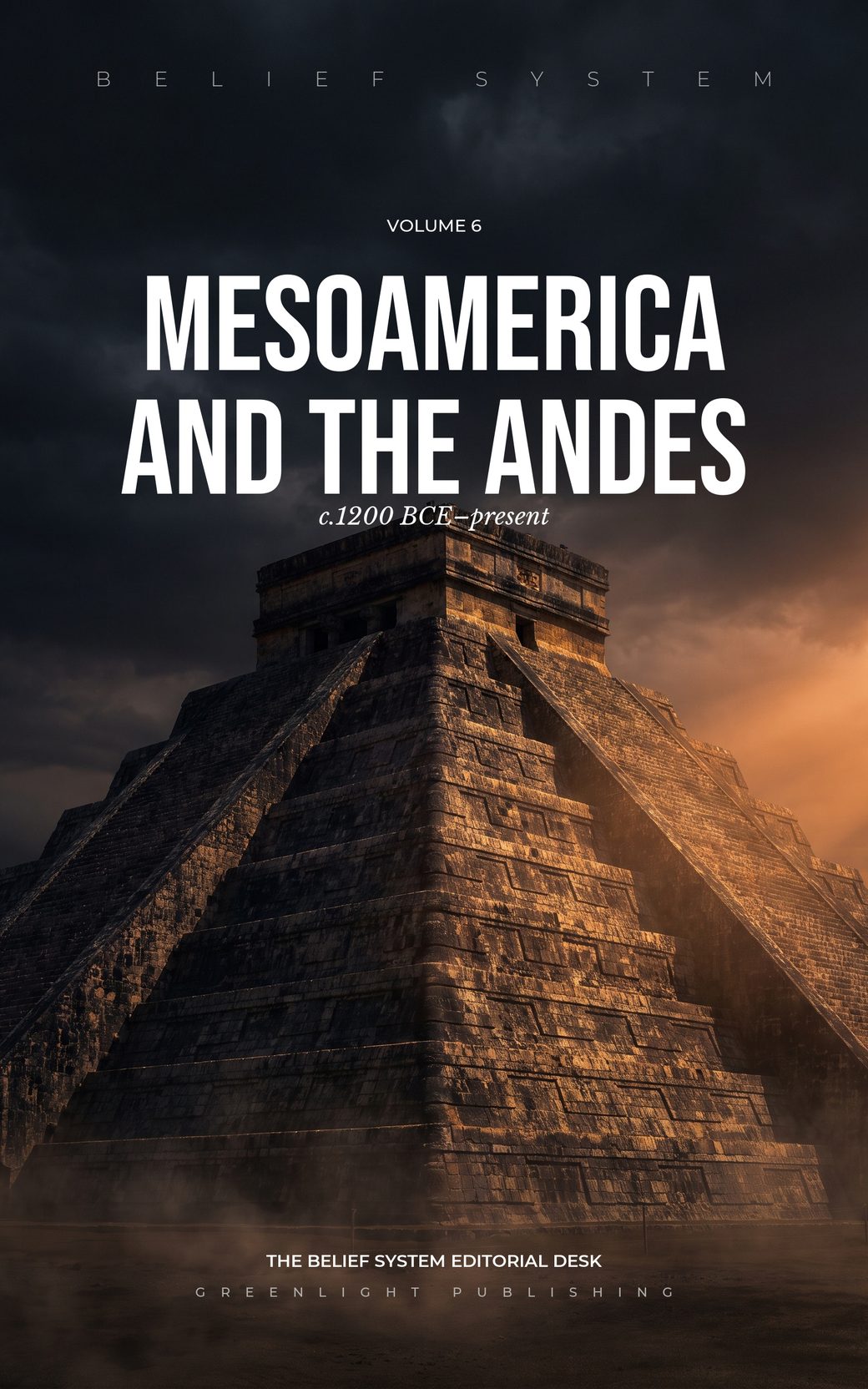
Jacket of Belief System volume 6, Mesoamerica and the Andes
$12.99paperback

132 pages, 5.5 × 8.5 in. Three or more volumes in one order and every copy drops to $11.99.

copies

United States, 8 to 11 days. All destinations

Volume 6 Belief System c.1200 BCE–present

Mesoamerica and the Andes

The machinethe screenfold codex, and the khipu

Attested from
c.1200 BCE

The earliest secure evidence, and the key this volume is filed under. All thirty-one

Narrates
c.1200 BCE–present

The period the book actually covers. It is rarely the same figure.

The argument in one sentence

The Americas’ two great tradition-complexes each built its cosmology into a landscape and invented a recording machine to run it — the painted screenfold and the knotted cord — and when conquerors destroyed both machines on purpose, and wrote down that they had, the traditions survived the loss of their media: by translation into the destroyers’ own alphabet, by brotherhoods and saints under local names, and by a 260-day count that is still being kept.

of every book the Maya wrote, four survive. Bishop Diego de Landa burned the rest at Maní in July 1562 and recorded that the Maya regretted it “to an amazing degree”.The commissioning line

What it is

Sixteen small figures of serpentine and jade were set upright in the ground at La Venta, arranged as a scene, and covered over. Centuries later somebody cut a pit down from a much later floor, through the fill, and stopped precisely at the tops of the heads.

Whoever dug it knew what was there. That is the volume’s subject: what was kept, by whom, and through what.

Two culture areas, and two of the clearest cases anywhere of a transmission machine destroyed on purpose. The screenfold codex in Mesoamerica and the knotted khipu in the Andes. Four Maya books survive; Diego de Landa burned the rest at Maní in 1562 and left a written account of doing it.

Then the part usually left out. The Popol Vuh is a post-conquest manuscript, written in Kiche using the alphabet of the people who destroyed the original medium. Syncretism was a survival strategy, not a corruption. And Maya daykeepers still count the 260-day cycle.

Five movements: the world, the machine, the canon, the money, and the split.

This book does not end in 1533, and it is not an obituary. It never adjudicates, and it refuses both the noble-victim register and the human-sacrifice spectacle. Much of what we know comes through hostile colonial informants, and the book says so every time it matters.

Belief System, Volume 6.

In full

Two culture areas in one jacket is a strain, and this volume says so in its own text rather than papering over it. What justifies the pairing is that Mesoamerica and the Andes are the series’ two clearest cases of a religion whose transmission technology was deliberately destroyed, and of what survived anyway.

The machines are a screenfold codex of painted bark paper, maintained by a scribal priesthood, and a knotted cord that recorded at minimum numerical and administrative data. The volume is exact about the khipu: the numerical system is well understood, and whether the cords encode narrative or language is genuinely contested. It reports the contest rather than resolving it. The Maya calendar is treated as what it is, a computational instrument, and the only substantially deciphered writing system in the Americas.

The canon movement is about a book-burning with a signed confession. Landa destroyed the Maya books at Maní and then described the act in writing. What replaced them is a canon that survives by translation: the Popol Vuh, alphabetic, post-conquest, copied by Ximenez around 1701, preserving pre-conquest material through the technology of the conquerors.

The money is tribute. The Codex Mendoza’s lists, the Inca state religion as fiscal infrastructure with the mit’a labour obligation and the state cult’s estates. Religion here is not funded by the state so much as it is a large part of the state’s accounting.

The split movement is where this volume refuses the obvious shape. It runs past the conquest into the cofradía, the Andean saints, the documented Taki Onqoy resistance of the 1560s, and the daykeepers counting today. Writing this material as an ending is the single biggest failure available, and the volume is structured against it.

Belief System is a history of world religion, one tradition at a time. Thirty-one volumes, ordered by earliest secure attestation.

The contents

26 chapters in five movements. Every volume in the series has the same five, in the same order, and each chapter below is printed with the idea it carries.

Movement OneThe World

The place, the moment, and the question — twice over, because this volume holds two culture areas in one jacket and its own text says so. The evidence for belief is thinnest here: buildings without readable texts. The confidence falls with it, in the same sentence.

  1. 1The Fold and the KnotThis volume holds two culture areas in one jacket and says so on its first page: Mesoamerica and the Andes share no demonstrated gods, no readable exchange of texts, and a contact question that remains open — metallurgy appears in West Mexico carrying South American technique, argued to have come north by sea, and the argument is contested — but what they do share, and what makes them one volume rather than two thin ones, is that each built its cosmology into a landscape with a recording machine of its own invention, and each machine was destroyed on purpose by men who wrote down what they had done: the series’ two clearest cases of deliberate destruction, and of what survived it anyway.
  2. 2The Buried OfferingAt La Venta, on an island in a Tabasco swamp, someone buried a tableau of sixteen serpentine and jade figurines arranged as a scene, covered it — and, the excavators reported, generations later a pit was cut precisely down to it, the deposit checked, and the hole closed again; the Olmec centres (San Lorenzo’s apogee conventionally c.1200–900 BCE, La Venta after it) are Mesoamerica’s earliest ceremonial architecture, and Offering 4 is this volume’s earliest evidence that a centre kept track of what it had hidden: memory administered across generations, before any surviving writing.
  3. 3The Stone in the GalleryAt Chavín de Huántar in the Peruvian highlands (main phases conventionally c.900–200 BCE) a carved granite blade taller than two men stands where it was set, inside a masonry gallery that admits a few visitors at a time, in a temple built with water channels and yielding twenty decorated Strombus-shell trumpets from a single gallery in 2001 — a built environment that modern acoustic measurement shows manipulates sound, breath and orientation, which is as close as archaeology can come to reporting an ancient experience without inventing one: the chapter describes the machine’s design and declines to state what a visitor felt.
  4. 4Kings Who Wrote in StoneThe Classic Maya city-states (conventionally 250–900 CE) covered their plazas with dated stone — rulers recording accession, war, ritual and calendar station to the day, in the only writing system of the Americas that is substantially deciphered — so this is the one stretch of the volume where the tradition speaks about itself in its own contemporary words, and the limit arrives in the same sentence: what survives is royal political theology, a king’s public claims about his rituals, not a catechism and not a commoner’s belief.
  5. 5The City Without a VoiceTeotihuacan was the largest city of the ancient Americas — conventionally estimated well over 100,000 people, planned on a single grid alignment, its Feathered Serpent Pyramid dedicated with (the excavators estimate) about two hundred sacrificed individuals, many dressed as soldiers with hands bound — and it left no readable texts of its own: nearly everything verbal about it comes from other people’s writing, above all the Maya inscriptions recording armed strangers from the west arriving at Tikal in January 378, so the reader meets the volume’s recurring condition early — a great power known chiefly through neighbours’ records, reported with that distance stated.
  6. 6The Lines from the Golden EnclosureCusco was a diagram you could walk: from the Coricancha, the Sun’s gold-clad enclosure, the capital’s shrines were organised — the chronicler Cobo’s account preserves the system — onto some forty-one sighting lines carrying 328 huacas, each line maintained by an assigned kin group; and the same state ran the capacocha, a ritual circuit that moved chosen children from the provinces to Cusco and out to mountain sanctuaries, where modern archaeology has recovered them — Ampato in 1995, Llullaillaco in 1999, with laboratory work reading a diet change in the children’s hair in their final months — so the Inca case closes the movement with cosmology as administration: a landscape wired to a centre, run on schedule, and paid for, which is the money movement’s cue.

Movement TwoThe Machine

The transmission technology, named as a concrete object or institution — not an abstraction. Here: the painted screenfold and the knotted cord — and the licensed specialists both of them required, because each was half a machine on its own.

  1. 7A Long Sheet, Doubled in FoldsThe Mesoamerican book was an industrial object — bark paper (amatl; Maya huun) beaten, coated with lime gesso, painted on both sides and folded like a screen between boards; Landa, who destroyed more of them than anyone, left the best short description, and his own phrase for the format gives this chapter its title — and exactly four Maya books now survive: the Dresden, the Madrid, the Paris, and the Códice Maya de México, which an INAH commission authenticated in 2018 as the oldest surviving book of the Americas; each survivor’s itinerary — a Saxon librarian’s purchase, a codex split in two, a rediscovery in a Paris library — is part of the machine’s history, because a machine is also known by where its last units washed up.
  2. 8The Count of DaysThe Maya calendar was a computational instrument — a 260-day divinatory count interlocking with a 365-day year into a 52-year round, and behind them the Long Count, a place-value tally of days with a zero — and the Dresden Codex shows the machine running: its Venus table tracks the 584-day synodic cycle (five Venus cycles equal eight 365-day years exactly) with built-in corrections, and its eclipse table spans 11,960 days, which is 46 turns of the 260-day count; the arithmetic was cracked in the 1880s and 1890s by Ernst Förstemann, the Dresden royal librarian, working on the book on his own shelves — the numbers were read decades before anyone could read a king’s name — and the 260-day count itself is attested as early as a painted “7 Deer” day-sign at San Bartolo, dated by its excavators to about 300–200 BCE.
  3. 9What the Knots Say for CertainThe khipu is a recording instrument of knotted cords, and the volume states exactly how much of it can be read: the numerical system is established — Leland Locke demonstrated in 1912, from museum specimens, that knot type and position encode decimal place-value, and later work has matched cord hierarchies to accounting practice — while the question of whether cords also encode narrative, names or language is genuinely contested: the Collata khipus were argued in 2017 to be logosyllabic letters, other specialists are unpersuaded, and this volume reports the contest rather than resolving it, because a machine we hold but cannot fully read is this jacket’s second signature fact — the Inca state’s own books survive by the hundreds and cannot yet be audited.
  4. 10The Trained ReaderBoth machines were half-machines — the screenfold and the cord were supports for a licensed specialist, the aj tz’ib’ scribe in Mesoamerica and the khipukamayuq in the Andes, and neither object tells a stranger how to read it, a design the series has met before in the consonantal skeleton of the Islam volume; the proof that the specialists were the system is documentary: in the 1540s colonial officials interviewed surviving khipukamayuq as archives-in-person, and in 1572 Sarmiento’s official history of the Incas was read aloud to assembled Inca notables for correction and certification — a Spanish notarial act that concedes, in procedure, where the record actually lived.
  5. 11The Oracle’s NetworkTransmission in both areas also ran on geography — pilgrimage as a synchronisation protocol, in the series’ terms: Chavín drew goods and visitors from far outside its valley; Pachacamac on the coast ran what colonial testimony describes as a network of subordinate shrines remitting to the centre; the Inca rebuilt the Island of the Sun in Lake Titicaca as a managed pilgrimage terminus; and at Chichén Itzá the Sacred Cenote’s dredged offerings — gold and jade from far beyond Yucatán — map a catchment no text records; the machine here is the circuit itself, and its measurable trace is the offering that travelled.

Movement ThreeThe Canon

What is in, what is out, who decided, when, and what the decision cost. The real subject is who had the authority to close it — and in this volume the closing was literal, external, and documented by the men who did it. The movement opens with that argument, never with a manuscript.

  1. 12The Working LibraryThe movement opens on its argument: before the conquest neither area had a closed canon in the sense every previous volume has used — Mesoamerica had working libraries, curated, recopied and revised by the scribal priesthood (the Dresden is conventionally read as a late copy of older material, its tables corrected in use), and the Andes had authorised memory-officials with cords, painted boards and song rather than books — so when closure came, it came from outside, as policy, from a church with a fixed canon of its own; who held authority over these texts before that, and how it was exercised, mostly cannot be established, and the movement’s real subject is the paper trail of the closing itself.
  2. 13The Fire at ManíOn 12 July 1562, at Maní in Yucatán, the Franciscan provincial Diego de Landa held an auto-da-fé at the end of an idolatry investigation that had used torture on its witnesses, and burned the Maya books his friars had gathered; the event is the rarest thing in the history of censorship — a book-burning with a signed confession, because Landa’s own Relación records that they burned the books and that the Maya grieved for them — and the case’s second twist is also documentary: the trial dossier survives and the interrogations can be read, and Landa, recalled to Spain and tried for exceeding his authority, was cleared and returned to Yucatán as its bishop.
  3. 14The Manuscript in ChicagoThe Popol Vuh survives by translation, twice over: composed in K’iche’ in Latin letters in the mid-1550s (conventionally) by writers who say in the text that they are writing under Christianity, from an original “instrument of seeing” now hidden; the alphabetic manuscript itself then lost, surviving only because the Dominican friar Francisco Ximénez copied it at Chichicastenango around 1701 with a facing Spanish translation — and his copy passed from a Guatemalan convent to a university shelf, was carried to Europe, published in Vienna and Paris, sold, and came to rest in the Newberry Library in Chicago: a pre-conquest tradition preserved inside the alphabet, the technology and finally the libraries of the people who destroyed its original medium, which is this movement’s whole argument in one object.
  4. 15The Town BooksThe canon Yucatán kept after the fire was decentralised into town books — the Books of Chilam Balam, named for their towns (Chumayel, Tizimín, Maní), alphabetic Maya miscellanies copied and recopied into the nineteenth century, holding katun chronicles, prophecy, medicine and Christian material side by side — while the highlands produced títulos, documents like the Título de Totonicapán (1554) that carry pre-conquest tradition inside the form of a Spanish land pleading: a canon that never closed, maintained in the conquerors’ script for the communities’ own purposes, one of which was being evidence in court.
  5. 16The Prosecutor’s BibleThe Andes had no books to burn, so the extirpators attacked the other media: Polo de Ondegardo hunted down the royal mummies in 1559 and shipped them to Lima, where Garcilaso reports having seen them before leaving for Spain and where their final resting place cannot be established; the Third Council of Lima (1583) ordered superstitious khipus destroyed (the decree’s exact wording carries a verify flag); and the closest thing to an Andean scripture — the Huarochirí manuscript, Quechua narratives set down around 1608 — exists because the extirpation campaigner Francisco de Ávila needed an inventory of what to prosecute: in both halves of this volume, the persecution’s paperwork is now a principal surviving record of the persecuted practice.

Movement FourThe Money

Who paid, who was paid, and how we know. Numbers get their provenance in the same sentence. In this volume religion is not funded by the state: it substantially is the state’s accounting, in both areas, and the movement’s evidence is the accounting itself.

  1. 17The Feather That Means Four HundredThe Codex Mendoza’s tribute section is an imperial balance sheet in pictures — provinces itemised page by page, a flag glyph counting twenty, a feather four hundred, a bag eight thousand, over mantles, warrior suits, cacao, paper, feathers and gold dust flowing to Tenochtitlan — painted by Nahua scribes around 1541 from pre-conquest-style originals for Spanish use, a provenance the chapter states with the evidence; and its physical cross-check is the Templo Mayor itself, where the offerings excavated since 1978 contain material from across the tributary map — the temple was where the empire’s geography was deposited, and the pictorial ledger and the archaeological one can be read against each other.
  2. 18Three FieldsThe tradition holds — through chroniclers writing for Spanish purposes, and the chapter says so — that Inca land was divided three ways, for the state, for the Sun and for the community, the Sun’s fields worked by the community’s labour turn (mit’a) and the produce stored against ritual and redistribution; the archaeological remainder is real — administrative centres like Huánuco Pampa with storehouse rows in the hundreds, mapped by Craig Morris’s project — and the honest summary is the movement’s thesis: the state cult was not funded by the economy so much as it was a working part of the economy’s machinery of record, and the ledgers that would audit it are the khipus the volume has already said cannot yet be fully read.
  3. 19The Chosen WomenThe aqllakuna — women selected young, housed in aqllawasi compounds, set to weaving fine cloth and brewing maize beer — were a fiscal institution: in an empire without money, Murra argued in a classic paper, cloth was the political currency, and the state’s stock of it was produced by this dedicated religious workforce; the Spanish eyewitnesses described the houses through the only lens they had, the convent, and the chapter treats that vocabulary itself as evidence of how hostile-informant sources distort — “virgins of the Sun” is a Spanish category, and it is reported here as one.
  4. 20The Oracle’s PortfolioPachacamac was a landowning god: the coastal oracle held estates, herds and serving personnel, took offerings from a catchment colonial witnesses describe as continental, and licensed subordinate shrines — and in early 1533 Hernando Pizarro rode there for gold, so the accounts of that visit, written to be read by the Crown, are simultaneously the best early description of a working Andean oracle and a looter’s inventory: Estete’s narrative and Hernando Pizarro’s own letter describe the compound, the graded thresholds a petitioner crossed, the fasting, the wooden image at the top, and what the Spaniards weighed.
  5. 21The Room in CajamarcaThe conquest enters this volume as an accounting event: Atahualpa’s offer — a room filled once with gold and twice over with silver — was recorded by Pizarro’s secretary with the room’s dimensions, the metal was melted under notarial supervision in the summer of 1533, the totals and the distribution roll survive to the peso, the king’s fifth was shipped, and Cusco’s Coricancha was stripped of its gold sheathing by the advance party; the figures are printed byte-exact from the official relation with their character stated — the conquerors’ audited record of their own taking, precise about weight and silent about everything the objects were — and the chapter ends on the fact that carries the canon movement’s logic into metal: the melt destroyed the artifacts and preserved the account.

Movement FiveThe Split

What divided it, what it became, what it handed on. Names the next volume by NAME, never by number. The single failure this movement is structured against is the obituary: the volume does not end in 1533, or in 1572. Living practice is written in the present tense.

  1. 22The Book at CajamarcaThe split movement opens with its source problem dramatised in a single scene: at Cajamarca on 16 November 1532 the friar Vicente de Valverde handed Atahualpa a sacred book, and what the Inca did with it — examined it, held it to his ear, threw it down — differs by teller, across accounts written by conquerors justifying an ambush, later chroniclers, and Inca witnesses dictating under colonial rule decades on; the volume reports the conquest of both areas through that lens, naming for each narrative who wrote it, when, and what the writer needed it to prove — the Tlatelolco scholars’ Nahuatl account of the fall of Tenochtitlan, Titu Cusi’s dictated history, Guaman Poma’s twelve-hundred-page illustrated letter to a king who never read it, found in Copenhagen in 1908 — and it refuses both costumes this material is usually dressed in, the noble victim and the savage spectacle, because both are adjudication.
  2. 23The Brotherhood’s LedgerWhat survived in Mesoamerica reorganised itself inside a Spanish legal container: the cofradía — a lay brotherhood that could hold property, keep books and pay for feasts — became the vehicle of community religion, and because brotherhoods and the later cargo systems kept accounts, the money movement continues past the conquest: colonial cofradía books survive in parish archives, and twentieth-century fieldwork measured the cargo economy directly, Cancian documenting in Zinacantán that sponsoring a fiesta could consume savings on the scale of years of a man’s wages — religion as the community’s own fiscal machine, run under, and partly against, the church that licensed it; in Santiago Atitlán the cofradías keep the Rilaj Mam to this day, and the sentence is in the present tense.
  3. 24The Sculptor of CopacabanaAndean Christianity was substantially built by Andeans, and the paper trail proves it in one biography: Francisco Tito Yupanqui, an Inca-descended sculptor, carved the Virgin installed at Copacabana in 1583 at a lakeside site already inside the Titicaca pilgrimage geography, and his own first-person account of learning the craft and petitioning for permission survives, embedded in Ramos Gavilán’s 1621 history; from there the chapter reports the syncretic settlement as a documented strategy rather than a corruption or a triumph — Pachamama alongside the Virgin, confession taken on khipus at the church’s own instruction, the mine devil receiving offerings in Potosí’s shafts in the present tense, the Qoyllur Rit’i pilgrimage climbing to its glacier sanctuary each year — while the claimed continuity between Pachacamac’s cult and Lima’s Señor de los Milagros is printed as Rostworowski’s argument, contested, never as a fact.
  4. 25The Huacas and the CrossTwice, three centuries apart, documented movements declared the old powers at war with the new god: in the 1560s the Taki Onqoy preachers of Huamanga announced that the huacas, starved of offerings since their shrines were broken, were seizing human bodies — a movement known almost entirely from the files of Cristóbal de Albornoz, the man whose career was built on suppressing it, a source problem the scholarship itself now argues about by name; and in 1850 in Yucatán, mid-Caste War, a cross at Chan Santa Cruz began to speak and issue written proclamations, founding a shrine polity whose successors still guard their sanctuaries — and here the volume states a restricted-material boundary and why: the nineteenth-century proclamations the movement itself circulated publicly, to enemies and newspapers, are quoted in the author’s rendering of the Yucatec; the books and papers the shrine centres keep under guard today are designated by their keepers as not for outsiders, and the volume describes the institution and does not reproduce them, because the designation is the community’s to make.
  5. 26The Count and the CodeThe volume ends in the present tense because the material does: in the K’iche’ highlands, daykeepers keep the 260-day count now — recorded by ethnographers in 1931 and 1982, publicly claimed by Maya organisations since Guatemala’s 1995 accord recognised Maya spirituality — and the highland count, run against the Classic inscriptions, is itself a load-bearing argument for the accepted correlation of Maya and European time, so a living practice sits inside the proof structure of the ancient chronology; in Huarochirí — the province of the prosecutor’s manuscript — villages kept khipus as regalia of civic office into the twentieth century; and the writing came back: Förstemann read the numbers, Knorozov in 1952 used Landa’s own recorded “alphabet” as the syllabary key, Proskouriakoff in 1960 proved the stones record history, and glyph workshops have since put the script back into the hands of Maya speakers, while the thirteenth bak’tun’s turn in December 2012 arrived as global apocalypse coverage that the count’s actual keepers spent the season correcting; what a burned canon hands on is the problem the next tradition answers differently — the Zoroastrianism volume opens on a community that also outlived the state that ran its machine, and answered with an alphabet engineered to freeze the sound of a dead liturgy.

What this volume cannot establish

Printed in the book before the argument is, and printed here for the same reason. A history of a tradition that will not say where its evidence runs out is not a history.

  • What any pre-conquest person believed, in their own contemporary words, outside the Maya inscriptions. The deciphered corpus is royal and political; nearly every other verbal account of both areas’ religion reaches us through colonial compilers — missionaries, prosecutors, converts and petitioners — writing under, and usually for, the power that had just destroyed the institutions being described. The volume names the compiler and the motive every time it leans on one. This is the volume’s signature condition and it is stated in Movement One, not saved for a coda.
  • Whether the khipu encodes narrative or language. The decimal accounting layer is established (Locke, 1912, onward); everything beyond it is genuinely contested, and Movement Two states the contest rather than resolving it. The Inca state’s own books survive by the hundreds and cannot yet be audited.
  • What the burned books contained. Four Maya books survive, all substantially calendrical-divinatory; whether the burned corpus held histories, tribute rolls or genres now unimagined cannot be established. Landa’s list of their subjects is his claim and is printed as one.
  • Any pre-conquest number reported only by chroniclers or conquerors. — populations, tribute totals, sacrifice counts, treasure weights before the notarised melts. Where archaeology provides a check (the Templo Mayor offerings, the Huei Tzompantli, the capacocha burials) it confirms the institution and still not the totals; the conquistadors’ counts served justification and the counter-tradition’s minimisations served defence, and printing either as measurement would be adjudication in costume.
  • An unbroken chain for the living 260-day count. The record shows the count kept by highland daykeepers today aligning with the colonial and Classic count under the accepted correlation; continuous transmission is the parsimonious reading, and it is not the same thing as a documented chain. The sentence in Movement Five says so.
  • Contact between the two culture areas. Metallurgical technique argues for maritime contact northward from the Andes; it is contested, and nothing in this volume depends on it.
  • The fate of the Inca royal mummies after Lima. , or the location of anything else this volume’s destroyers said they had destroyed thoroughly.
  • Anyone’s interior state.

Sources

64 works, dated, and specific enough that a reader can go and look at the thing. Nothing is on this list that the desk did not consult.

The bibliography, as the volume prints it
# Document or work Date Evidence for
1Dorothy Hosler, “Ancient West Mexican Metallurgy: South and Central American Origins and West Mexican Transformations,” American Anthropologist1988West Mexican alloys matching Andean technique — contested
2Drucker, Heizer and Squier, Excavations at La Venta, Tabasco, 1955, BAE Bulletin 1701959Offering 4 and the re-entry pit
3Richard Burger, Chavín and the Origins of Andean Civilization1992hydraulics built into the temple; the site’s catchment
4John Rick, Caracolas Gallery excavations2001twenty Strombus trumpets in one gallery
5Tatiana Proskouriakoff, “Historical Implications of a Pattern of Dates at Piedras Negras, Guatemala,” American Antiquity1960the stones record royal history
6Simon Martin and Nikolai Grube, Chronicle of the Maya Kings and Queens2000dynasties reconstructed reign by reign
7Palenque Temple of the Inscriptions, tomb opened by Alberto Ruz Lhuillier1952a text mounted above the ruler it recounts
8Copán Altar Qdedicated 776sixteen rulers in sequence
9René Millon, Teotihuacan Mapping Project1960sthe city surveyed structure by structure
10Cabrera, Sugiyama and Cowgill, Feathered Serpent Pyramid excavations1980s onwarddedicatory burials estimated above two hundred
11David Stuart, “The Arrival of Strangers,” in Mesoamerica’s Classic Heritage2000the 378 entrada on Tikal Stela 31 and the Marcador
12Bernabé Cobo’s ceque list1653forty-one lines and 328 huacas from the Coricancha
13Brian Bauer, The Sacred Landscape of the Inca1998shrines walked and only partly found
14Reinhard and Ceruti, Inca Rituals and Sacred Mountains2010Ampato 1995 and Llullaillaco 1999
15Wilson et al., “Stable isotope and DNA evidence for ritual sequences in Inca child sacrifice,” PNAS2007diet shift in the last twelve months
16Diego de Landa, Relación de las cosas de Yucatán, Brasseur de Bourbourg1560s; 1864the folded book; the burning at Maní; the scribal syllabus
17Ernst Förstemann, Dresden commentaries1880; 1888 Bureau English; 1906 Peabodyleaf count, Venus table, eclipse span
18INAH, Códice Maya de México, Martínez del Campo Lanz2018the fourth Maya book authenticated
19Stuart, Hurst, Beltrán and Saturno, “An early Maya calendar record from San Bartolo, Guatemala,” Science Advances2022Seven Deer, 300–200 BCE
20L. Leland Locke, “The Ancient Quipu,” American Anthropologist1912Bandelier 8713 sums in decimal place-value
21Cieza de León, Clements Markham1540s; 1864 and 1883 trans.khipu accounts that checked out; tribute and storehouses
22Urton and Brezine on Puruchuco, Science2005cords that sum into the level above
23Sabine Hyland, “Writing with Twisted Cords,” Current Anthropology2017Collata khipus argued as logosyllabic letters
24Sarmiento de Gamboa, Markham1572; 1907 trans.history certified by assembled Inca notables; painted boards
25Vaca de Castro interviews, Jiménez de la Espada, Una antigualla peruana1540s; pub. 1892surviving khipukamayuq questioned apart
26Edward H. Thompson, Sacred Cenote dredging1904–1911gold and jade from beyond Yucatán
27Brian Bauer and Charles Stanish, Ritual and Pilgrimage in the Ancient Andes2001the Island of the Sun rebuilt as managed traffic
28María Rostworowski on Pachacamac20th c.subordinate shrines remitting to the coast — her reading
29Inga Clendinnen, Ambivalent Conquests1987the 1562 interrogations and the torture that produced them
30Newberry Ayer MS 1515 (Ximénez Popol Vuh)copy c.1701K’iche’ beside Spanish, three removes from the hidden instrument
31Carl Scherzer’s Vienna Popol Vuh1857Ximénez’s Spanish first in print
32Brasseur de Bourbourg, Popol Vuh1861the K’iche’ with facing French
33Daniel Brinton, The Maya Chronicles1882Chilam Balam katun counts, including 1562
34Annals of the Cakchiquels, Brinton1885highland memory in the form of inheritance
35Título de Totonicapán1554pre-conquest tradition inside a Spanish land pleading
36Cristóbal de Molina, Markham, Narratives of the Rites and Laws of the Yncasc.1575; 1873painted boards; a Quechua prayer; Taki Onqoy via Olivera
37Garcilaso de la Vega on the royal mummies, Markham1559 scene; 1869–71 trans.five bodies at Polo’s lodging, then Lima
38Huarochirí manuscript, BNE 3169c.1608Quechua narratives compiled for a prosecutor — described, not quoted
39Codex Mendoza, Bodleian MS. Arch. Selden. A. 1, in Purchaspainted c.1541; printed 1625tribute in twenties, four hundreds and eight thousands
40Templo Mayor Project (Matos Moctezuma; López Luján)from 1978offerings from the tributary map
41Bernal Díaz, Maudslay16th c.; 1908 trans.a hundred thousand skulls at Xocotlan — a soldier’s estimate
42John Murra, The Economic Organization of the Inka State1956/1980tax as a labour turn
43Craig Morris and Donald Thompson, Huánuco Pampa1985storehouse rows in the hundreds
44John Murra, “Cloth and Its Functions in the Inca State,” American Anthropologist1962cloth as political currency
45Pedro Pizarro, Philip Ainsworth Means1571; 1921 trans.one door on the aqllawasi; the book thrown down
46Hernando Pizarro’s letter and Estete in Markham, Reports on the Discovery of Peru1533; 1872Pachacamac’s courts, fasts and takings
47Francisco de Xerez, Verdadera relación, Markham1534; 1872the room’s dimensions; the melt; the book at Cajamarca
48Pedro Sancho’s division roll17 June 1533shares to the peso, Church first
49James Lockhart, The Men of Cajamarca1972the company reconstructed from the roll
50Titu Cusi Yupanqui1570the book scene from the Vilcabamba side — described
51Guaman Poma, Nueva corónica, GKS 2232 4°c.1615twelve-hundred-page petition found in 1908 — described
52Cantares Mexicanos, Brinton, Ancient Nahuatl Poetry1887a lament dated by Brinton to 1511, not 1521
53Frank Cancian, Economics and Prestige in a Maya Community1965a cargo costing years of wages in Zinacantán
54Alonso Ramos Gavilán, Historia del Santuario de Nuestra Señora de Copacabana1621Tito Yupanqui’s account of the carving
55June Nash, We Eat the Mines and the Mines Eat Us1979el Tío in the Potosí shafts
56UNESCO inscription of Qoyllur Rit’i2011ninety thousand pilgrims, eight nations
57Albornoz informaciones, published by Luis Millones16th c.; 20th c. ed.Taki Onqoy known from its suppressor’s files
58Nelson Reed, The Caste War of Yucatán1964the Talking Cross as a shrine polity
59Paul Sullivan, Unfinished Conversations1989the shrine papers designated as not for outsiders
60La Farge and Byers, The Year Bearer’s People1931the 260-day count as ordinary highland life — cited, not quoted
61Barbara Tedlock, Time and the Highland Maya1982daykeepers’ training — cited, not quoted
62Accord on Identity and Rights of Indigenous Peoples1995Maya spirituality named in the peace settlement
63Frank Salomon, The Cord Keepers2004Tupicocha civic khipus as regalia of office
64Michael Coe, Breaking the Maya Code1992Förstemann, Knorozov, Proskouriakoff in one history

Common questions

When is Mesoamerica and the Andes first securely attested?

c.1200 BCE. That is the earliest date the surviving evidence supports, and it is the key this volume is filed under. It is not the same claim as when the tradition began: the tradition’s own account of its beginning is printed beside it in the book’s front matter, never instead of it.

What period does the book cover?

c.1200 BCE–present. The coverage span and the attestation date are two different facts, and the gap between them is often the most interesting thing about a volume.

What carried Mesoamerica and the Andes?

The screenfold codex, and the khipu. Movement Two of every volume is about the transmission technology — the concrete object or institution that made copying possible, and would not have existed a century earlier.

How long is it?

About 31,000 words, roughly 130 minutes’ reading, 132 pages in the paperback. The audiobook runs 3h 04m, measured from the finished masters.

What does this volume not claim to establish?

What any pre-conquest person believed, in their own contemporary words, outside the Maya inscriptions. The deciphered corpus is royal and political; nearly every other verbal account of both areas’ religion reaches us through colonial compilers — missionaries, prosecutors, converts and petitioners — writing under, and usually for, the power that had just destroyed the institutions being described. The volume names the compiler and the motive every time it leans on one. This is the volume’s signature condition and it is stated in Movement One, not saved for a coda. Every volume prints its own limits before it prints its argument; there are 8 on this one’s list.

Does the book say which tradition is true?

No. Belief System does not adjudicate. Where the tradition’s account and the earliest evidence disagree, both are given, in their own vocabulary, attributed, and neither is given the last word. No miracle is reported as fact and none is denied.

Can I buy Mesoamerica and the Andes in print?

Yes. It is a 5.5 × 8.5 in paperback, 132 pages, $12.99 a copy, bought direct rather than through a retailer. All thirty-one together are $199.00, with the ebook and the audiobook of every volume included.

The edition

The paperback
Trim5.5 × 8.5 in  /  140 × 216 mm
BindingPerfect-bound paperback, matte laminate
Paper60# uncoated cream, black ink
Extent132 pages
Editions and ISBNs
EditionExtentISBN
Paperback132 pages, 5.5 × 8.5 inISBN not yet issued
EbookEPUB979-8-90623-823-8
Audiobook3h 04m979-8-90623-824-5
Filed under
BISAC 1`REL017000` RELIGION / Comparative Religion
BISAC 2`REL114000` RELIGION / Ancient
BISAC 3`REL033000` RELIGION / History
  • Mesoamerica
  • Andes
  • Maya religion
  • Inca religion
  • Popol Vuh
  • khipu
  • Diego de Landa
  • history of religion
  • Olmec
  • comparative religion