Belief System
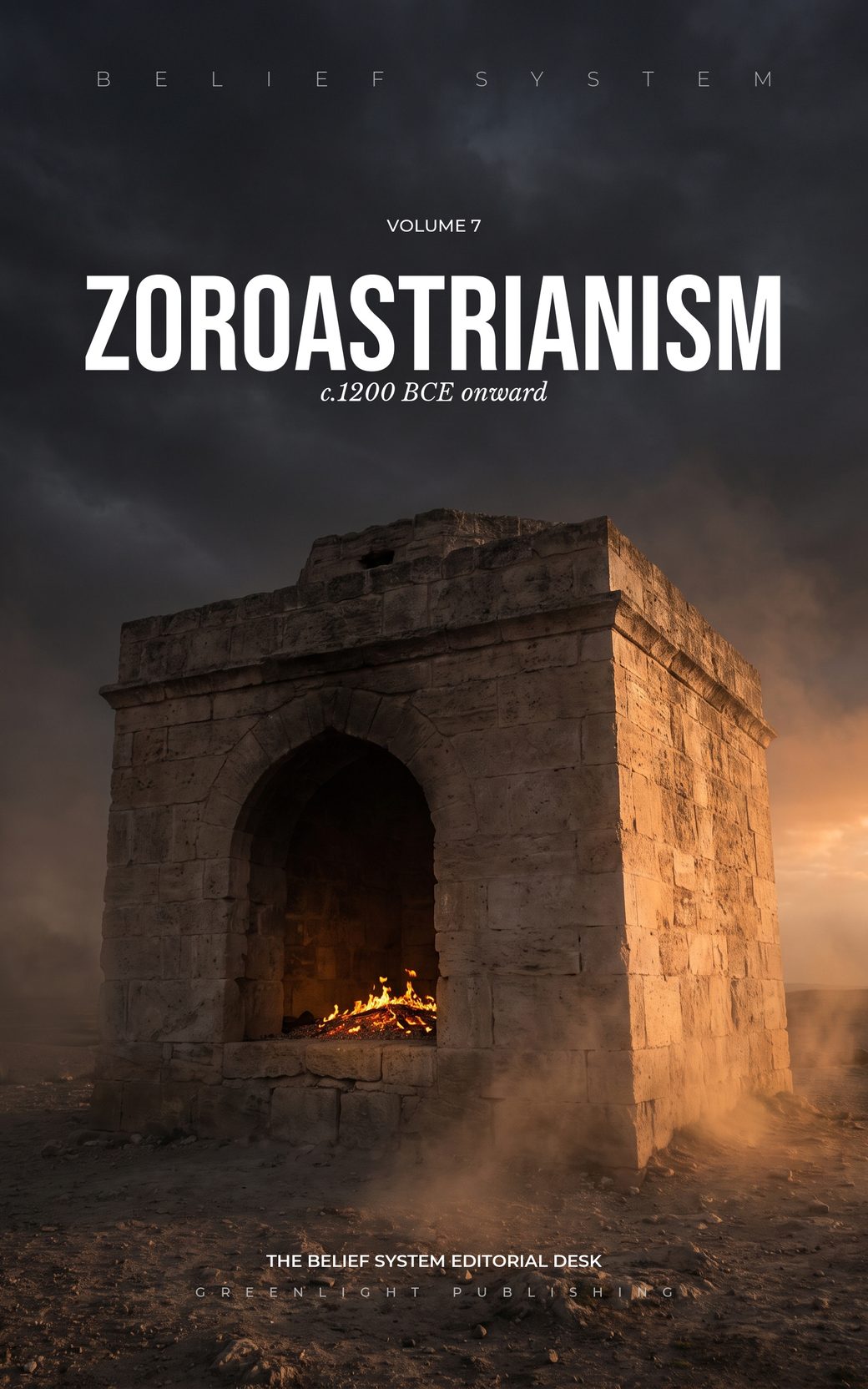
Jacket of Belief System volume 7, Zoroastrianism
$12.99paperback

132 pages, 5.5 × 8.5 in. Three or more volumes in one order and every copy drops to $11.99.

copies

United States, 8 to 11 days. All destinations

Volume 7 Belief System c.1200 BCE onward

Zoroastrianism

The machinean alphabet invented to freeze a dead language

Attested from
c.1200 BCE

The earliest secure evidence, and the key this volume is filed under. All thirty-one

Narrates
c.1200 BCE onward

The period the book actually covers. It is rarely the same figure.

The argument in one sentence

A liturgy memorised as pure sound in a language nobody spoke outlived the loss of most of its own canon, both empires that endowed it, and the tax that shrank it — preserved at last by an alphabet invented for no other purpose than to record it — while the book-built religion that grew up beside it, engineered from birth for writing and translation, spread from Carthage to the China coast and died entirely; and the questions that divide the survivors today are not doctrinal but arithmetical: which day it is, and who counts.

the scripture is written in a language that had been dead for more than a millennium before anyone’s surviving copy was made; the oldest Avestan manuscript dates to about 1288 CE.The commissioning line

What it is

The Unicode Standard gives the Avestan alphabet sixty-one positions, fifty-four of them named as letters. For Book Pahlavi, the script the Zoroastrian priesthood actually wrote its own books in, it has no block at all.

Two scripts, one priesthood, and one of them carries three times the inventory of the other.

That is because the Avestan alphabet was not a writing system. It was a recording instrument, invented in the Sasanian period to fix the pronunciation of a liturgy that had been transmitted orally for more than a thousand years in a language nobody spoke any more. An alphabet engineered for one purpose, by people who had a perfectly good script already.

Five movements: the world it began in, the machine, the canon that was mostly lost, the money, and the splits.

A founder whose dates range across nearly a millennium. A scripture of which perhaps a quarter survives, with a table of contents for books that no longer exist. A trust in Mumbai administering one of the city’s oldest charities. And a schism, in 1746, about which day it is.

Manichaeism belongs here too: a religion engineered from the start to be translated, which reached from Roman Africa to the China coast and died anyway.

Belief System, Volume 7.

In full

A tradition whose founder cannot be dated within a millennium, whose scripture is mostly gone, and whose community is now small and contracting has, nonetheless, the single most striking transmission artefact in this series.

The Avestan alphabet is a recording device. It was cut out of existing Pahlavi hands in the Sasanian period, given roughly fifty characters and a phonetic precision no ordinary script needed, and used for one job: to freeze the sound of a liturgy that priests had carried in memory for over a thousand years in a language that had died. Set it beside the Vedic reciters and the Masoretic pointing and you have three traditions solving the same problem three different ways. This is the only one that built a new alphabet to do it.

The canon movement is about loss that can be inventoried. The Denkard describes a corpus of twenty-one nasks; roughly a quarter survives. The volume prints the tradition’s account of Alexander’s destruction as the tradition’s account, and the philological picture separately.

The money is unusually well documented for a community this size: the Bombay Parsi Punchayet, its charitable trusts, the Doongerwadi estate, and the subsidised housing that makes a religious body a significant Mumbai landlord. Every figure carries its source, and the ones that could not be verified are printed as unverified.

The split is the purest in the series. In 1746 the community divided over a discrepancy in intercalation — a full communal rupture with no doctrinal content at all, about which day it is.

The volume also carries Manichaeism, as a control case: a religion designed from the outset to be translated and illustrated, which spread further than almost anything in the ancient world and disappeared almost entirely. Having a machine is not sufficient.

The influence question — whether this tradition supplied later ones with their eschatology — is reported as the live scholarly debate it is, and settled neither way.

Belief System is a history of world religion, one tradition at a time. Thirty-one volumes, ordered by earliest secure attestation.

The contents

26 chapters in five movements. Every volume in the series has the same five, in the same order, and each chapter below is printed with the idea it carries.

Movement OneThe World

The Iranian plateau and the shared Indo-Iranian inheritance; a founder whose dating band spans nearly a millennium; and an empire that named his god without ever naming him. The evidence is thinnest here, and the confidence falls with it, in the same sentence.

  1. 1The Cousin LanguagesOpen with the object: two hymn corpora, the Gathas and the Rig Veda, so close in grammar, metre and formula that a line of one can nearly be transposed into the other word by word — haoma and soma, ahura and asura, daeva and deva — and the kinship is not a curiosity, it is the volume’s dating instrument: the Gathas are composed in a language of the same age as the oldest Vedic hymns, which is the strongest single argument for putting their composer in the second millennium BCE, centuries before anything that could check him.
  2. 2The Complaint of the CowWhat the Gathas contain, described before anyone’s theory of them: seventeen hymns in five metres; a named poet, Zarathushtra Spitama, who names a royal patron (Kavi Vishtaspa), two allies at court (Frashaoshtra, Jamaspa) and a daughter (Pouruchista, in the wedding hymn); and a herding world of cattle and cattle-raiders in which the soul of the cow cries out against violence and is answered with a herdsman-prophet — the question the new teaching answered is audible in the complaint, and its vocabulary is the tradition’s permanent axis: asha, right order, against druj, the lie.
  3. 3A Birthday a Millennium WideZarathustra’s dates range from roughly 1500 to 600 BCE depending on which evidence is weighted, and the chapter gives the range, gives who argues what, and resolves nothing: the language of the Gathas argues the second millennium (Boyce put him at or before c.1200, and the Old Avestan philologists broadly agree); the later Persian reckoning of “258 years before Alexander” yields c.600, and Henning defended it; the Greeks relayed figures in the thousands of years; and Kellens argues the search for a single historical author is itself the mistake — a founder whose dating band spans nearly a millennium is not an embarrassment to be smoothed but the volume’s first exhibit of what the evidence is like.
  4. 4Sixteen Lands, None of Them PersiaThe Younger Avesta carries its own map, and Persia is not on it: the Videvdad opens with a catalogue of sixteen good lands — Sogdiana, Margiana, Bactria, Arachosia, the Land of the Seven Rivers — an eastern-Iranian world with no Persepolis, no Media, no western Iran at all, which is the geographic argument that the tradition grew up far from the empire that later spoke for it; and the Yashts show the tradition re-absorbing gods the Gathas never name — Mithra of the covenants, Anahita of the waters — the old Indo-Iranian pantheon returning under licence while daeva, the cousin-word for the Vedic gods, hardens into the word for demon.
  5. 5The Magi, Seen from GreeceThe first outside witnesses to Iranian religion are Greek, and what they describe is a priesthood, not a founder: Herodotus’s magi are a Median tribe who interpret dreams, chant a “theogony” over sacrifice, kill creeping things with their own hands, and expose their dead to birds and dogs — practices a reader of the Videvdad recognises at once — while the “Zoroaster” of Greek literature is a sage of fabulous antiquity credited with millions of lines of astrology and magic; the outsiders confirm the practice and garble the man, which is the shape of the external evidence for the next thousand years.
  6. 6The King Names His GodDarius carved at Behistun that Ahura Mazda made him king and repeated the name dozens of times; Xerxes boasted of destroying a sanctuary “where the daivas were worshipped”; and no Achaemenid king anywhere names Zarathustra — while the Persepolis archive tablets record state rations for priests of Elamite and Babylonian gods beside Ahura Mazda’s, Cyrus in Babylon credits Marduk, and the kings lie bodied in built tombs: the inscriptions establish royal devotion to Ahura Mazda; whether the kings were Zoroastrian in a later sense is contested, and the chapter reports the contest rather than a verdict.

Movement TwoThe Machine

The transmission technology, named as a concrete object or institution — not an abstraction. Here: a priesthood carrying a dead language as pure memorised sound, and, a thousand years on, an alphabet engineered as a recording device for it — with the neighbour-religion that made the opposite bet as the control case.

  1. 7A Liturgy Nobody UnderstoodBy the middle of the first millennium BCE Avestan was nobody’s mother tongue, and the liturgy was carried for something on the order of a thousand years as memorised sound by priests who could recite it exactly and understand it imperfectly or not at all — the proof is in the corpus itself, where late compositions in imitation Avestan break the grammar their models keep, which shows the transmitters preserving sound they could no longer generate; the unit of preservation was never the book but the performed ceremony, and the profession is not a relic: priests memorise the Yasna today, and the chapter describes the training in the present tense.
  2. 8Fifty Letters for a Dead LanguageThe Avestan alphabet, invented in the Sasanian period — conventionally dated to about the sixth century CE — is a script engineered for exactly one job: roughly fifty characters (the count varies with how ligatures are reckoned, and the printed number is one named authority’s), built out of the Pahlavi book hand and the Psalter script, fully vowelled, and phonetically fine-grained enough to record differences of sound that no difference of meaning depends on; nobody designs an alphabet like that to write a living language — it is a recording device, built to freeze the pronunciation of a liturgy in a language then dead for over a thousand years, and it is the single most striking transmission artefact in this series.
  3. 9Three Answers to One ProblemThree traditions met the same problem — sacred sound outliving the language that carried it — and engineered three different answers: the Vedic schools multiplied the recitation into deterministic transforms that cross-check one another (the pathas, a checksum sung for three thousand years); the Masoretes annotated a fixed consonantal skeleton with pointing that records the reading without touching the letters; and the Sasanian priesthood built a new alphabet and recorded the sound wholesale — the latest solution, the most radical, and the one with the sharpest limit, because what it froze was the recitation of its own era, not the composer’s.
  4. 10The Prophet Who Wrote His Own BooksMani — born about 216 CE near Ctesiphon, raised inside a baptist sect on the Sasanian empire’s Aramaic frontier — made the opposite bet to every tradition in this volume so far: he wrote his own canon himself, in his own language, in his own lifetime, seven books plus a volume of pictures designed so the illiterate could receive the doctrine by eye, and the tradition’s own literature lists written-ness among the proofs of his church’s superiority over predecessors whose disciples wrote for them; Manichaeism enters this volume because it is the same Iranian prophetic milieu and the perfect experimental control — beside a religion that refused writing for a millennium, a religion engineered for writing, translation and portability from its first day.
  5. 11The Oldest CopyThe oldest surviving Avestan manuscript is conventionally dated to about 1288 CE — younger than the alphabet it is written in by some seven centuries, younger than the Gathas by well over two thousand years, the widest such gap in this series — and the whole textual base of the religion is a handful of late-medieval manuscript families whose colophons name their scribes and their towns; the reason the gap matters less than it should is the machine: every copy descends from the Sasanian archetype, and the alphabet was built to carry sound across exactly this kind of distance — the recording device worked, and the manuscripts are the proof it was needed.

Movement ThreeThe Canon

What is in, what is out, who decided, when, and what the decision cost. The real subject is who had the authority to close it — and here, who had the power to lose it. The movement opens with that argument, never with a manuscript: this is a canon that can be inventoried but not read.

  1. 12What Alexander Is Said to Have BurnedThe movement’s argument up front: loss is this canon’s story, and the tradition tells the loss as an event — the whole Avesta and its commentary, written in gold ink on prepared ox-hides and deposited in the royal archive, burned by “the accursed Alexander”; whether any such written Achaemenid Avesta existed cannot be established, and a strong philological tradition doubts it — but the account itself is load-bearing either way, because a religion that explains its own gaps with an arson has told you what it believes a canon is: property of the crown, held in an archive, and mortal.
  2. 13Kings Collecting FragmentsThe tradition’s own transmission history is a chronicle of royal salvage: an Arsacid king, Valakhsh, orders whatever survives “in writing or in oral tradition” gathered; Ardashir, founder of the Sasanian house, commissions the priest Tansar to assemble an authorised religion; Shapur I adds medicine and astronomy hunted out of India and Rome; Adurbad son of Mahrspand proves the settled text by ordeal, molten metal poured on his chest; Khosrow closes the sequence — five reigns of canon-making in which the authority to decide is the crown’s, exercised through a priest, and the account of it survives only as a Sasanian church document making a Sasanian church claim, which the chapter labels every time it leans on it.
  3. 14Twenty-One Books, CountedThe Denkard’s eighth book is the single strangest object in this series’ canon movements: a book-by-book summary of the twenty-one nasks of the Sasanian Avesta, organised in three sevens keyed to the twenty-one words of the tradition’s holiest prayer — law codes, cosmologies, epics, a book on the making of images, each described in enough detail to know what it was and too little to reconstruct it — and of the twenty-one, one survives complete; the chapter is built on the reader seeing the thing directly: here is the table of contents for a library that no longer exists, and we can count what we cannot read.
  4. 15The Zand, and the Word for HereticThe canon’s second layer is a translation: the Middle Persian Zand, rendering and glossing an Avesta the priesthood no longer natively understood, so that “Avesta and Zand” became one compound noun and interpretation became part of the scripture’s own name — and authority migrated accordingly, because the community argued not over the frozen sound but over the living commentary; the conventional derivation of zandik — a commentary-man, a heretic — passed through the empire’s law into Arabic as zindiq, a capital charge, and the philological fossil records something real: in Iran, heresy was a crime about interpretation, and the first people executed under the word included the Manichaeans.
  5. 16The Liturgy Is the ArkWhy what survived survived: lay the extant Avesta against Denkard 8’s catalogue and the pattern is exact — what lived is what was recited, the Yasna and Visperad of the long liturgy, the Videvdad recited through the night office, the Khordeh Avesta in daily lay prayer, while the nasks that existed only to be consulted are the ones that are gone; the preservation machine was never the archive but the service, and the mirror case clinches it: Mani’s canon — written by its founder, prestige-copied, illuminated — is more completely lost than the Avesta ever was; a written canon without a liturgy or a state vanished, and an oral liturgy without a written canon survived. This movement’s answer to the series’ canon question is therefore inverted: nobody had the authority to close this canon; the liturgy had the authority to keep part of it open.

Movement FourThe Money

Who paid, who was paid, and how we know. Numbers get their provenance in the same sentence — and in this volume the money story runs from endowed fires with no surviving audit to one of the best-documented religious endowments anywhere, which is also one of Mumbai’s significant landlords.

  1. 17The Fire That Owns PropertyA consecrated fire in Sasanian law could be the beneficiary of an endowment — land, herds and slaves settled on it, foundations established “for the soul” of the founder and administered by priests — which made the great fires economic institutions and the priesthood their management; Kerdir’s inscriptions boast in stone of fires founded and priestly colleges endowed across the empire, the excavated sanctuary at Takht-e Soleyman shows the scale a royal fire could reach, and the scholarship argues these foundations as an ancestor of the Islamic waqf — reported as the argument it is, and handed by name to the Sufism volume, whose money movement runs on the waqf; what cannot be established is any total: the Sasanian church’s books do not survive, and the chapter says so in the sentence that wants them.
  2. 18The Price of StayingAfter the conquest the fiscal machine inverted: the jizya made remaining Zoroastrian a taxable status — money as a standing conversion pressure with a price printed on it — and the community’s own ninth-century books document the squeeze from inside, a high priest answering his postbag’s questions about what happens to inheritance when a brother converts; the conversion of Iran was nonetheless slow, generations not years, which is itself a finding about how the pressure worked.
  3. 19The Merchants of SuratThe community that would become the world’s most conspicuous religious philanthropy arrived in India as refugees on a story: the Qissa-ye Sanjan — a Persian verse account composed in 1599 about events some six centuries earlier, and the chapter’s confidence is priced accordingly — lands the migrants in Gujarat, plants the Iranshah fire, and carries it through sack and jungle to safety; the ledger years follow — Parsi brokers to the East India Company at Surat, the Wadia master-shipwrights running Bombay’s dockyard from 1736, and Jamsetjee Jejeebhoy’s cotton-and-opium fortune converted, spectacularly, into hospitals and a baronetcy — so that by the mid-nineteenth century “Parsi charity” was a Bombay institution and the community reached the Punchayet chapter rich, urban and organised.
  4. 20The PunchayetThe Bombay Parsi Punchayet began as a community court — Karaka documents its eighteenth- and nineteenth-century discipline, down to fines and excommunications — and became a charitable trust of a scale with few religious parallels anywhere: the estate the research verified includes more than five and a half thousand subsidised flats, which makes a religious body one of Mumbai’s significant landlords, and the city’s press styles it Mumbai’s oldest and richest charity; what the trust deeds promise, who qualifies for a flat, and who elects the trustees (the whole adult community, since the franchise reform — verify the year) are the live mechanics, and the corpus figures beyond the verified holdings are printed as UNVERIFIED rather than estimated, because a plausible number is not a number.
  5. 21Fifty-Five Acres of SilenceThe Doongerwadi estate on Malabar Hill is an endowment whose entire function is to refuse to become money: fifty-five forested acres of the most expensive residential land on earth, held inalienable so that the dead can be exposed in the dakhmas as the Videvdad requires — earth, fire and water being too pure to receive a corpse — and the system’s twenty-first-century crisis is biological, not theological: the published surveys record South Asia’s Gyps vultures collapsing by more than ninety-five per cent under the veterinary drug diclofenac, the towers’ scavengers gone in a decade, and the community’s response — solar concentrators, aviary proposals, a bitter argument over cremation — is a money-movement story because the estate is at once the community’s balance sheet, its most sacred infrastructure, and its boundary marker; hands the Split movement its question: who may be carried in.

Movement FiveThe Split

What divided it, what it became, what it handed on. Names other volumes by NAME, never by number. Two arcs share the movement: the neighbour-religion’s world run and total death, and the surviving tradition’s two boundary quarrels — the calendar, and the membership.

  1. 22From Carthage to the China CoastMani died in the Sasanian king’s prison — 274 or 277, the accounts disagree — and within a century his church ran further than any single religion had yet run: Augustine spent nine years as a Manichaean hearer in Roman Africa and left the movement’s best hostile description; Coptic psalm-books were being copied in Egypt; Sogdian merchants carried the faith up the silk roads; it reached the Tang court in 694; and in 762/3 the khagan of the Uyghurs converted, giving Mani’s church the only state it would ever hold — the machine chapter’s design brief executed in full, translation all the way down, Mani preached as the Buddha of Light in Chinese; this is the series’ high-water mark for pure transmission engineering, and the next chapter is what happened to it.
  2. 23The Religion That DiedEveryone persecuted it, everywhere, for the same structural reason: Mani’s church presented itself as the completion of whichever faith held power, so each power read it as heresy rather than as a foreign religion — Diocletian ordered its leaders burned with their scriptures, Kerdir’s church struck it as zandik, the Abbasids made zindiq a capital inquisition, and the Tang banned it in 843 within years of its Uyghur protector’s fall — while the elect-and-hearer structure made every congregation clergy-heavy and dependent; by the Ming proscriptions the last communities in Fujian fade from the record, and at Cao’an, near Quanzhou, the one surviving Manichaean shrine keeps a carved image of Mani that local worshippers have long venerated as a Buddha; the series’ clearest case of a religion with a superb machine, no lasting state, and no second act — it never split, because it never got the chance: it ended.
  3. 24A Quarrel About What Day It IsThe purest split in this series has no doctrinal content at all: the tradition’s 365-day calendar drifts against the seasons, the remedy the tradition holds was an intercalated month every 120 years had been applied differently — or not at all — on the two sides of the Iran–India correspondence, and when the Kermani priest Jamasp Vilayati reached Surat in 1720 he found the Indian new year sitting one month off the Iranian one; in 1746 a party adopted the Iranian reckoning (Kadmi, “the ancient”) against the majority practice (Shahenshahi, “the royal”), and a discrepancy in intercalation became a full communal rupture — rival high-grade fires, separate priesthoods, discouraged intermarriage, street violence in the record — over which day it is; a third, seasonal calendar (the Fasli reform, early twentieth century) then split the reformers, completing the arithmetic irony.
  4. 25The Borrowing QuestionResurrection of the dead, a last judgment, a structured angelology and a personal adversary, a saviour born of the prophet’s line, a renovated world at time’s end — the package appears in Judaism’s literature after two centuries of Achaemenid rule, and Zoroastrianism has every element; the claim that Iran supplied the eschatology of Judaism, Christianity and Islam is a real scholarly debate and the chapter reports it as one: the case for influence (the contact is documented, the direction of political prestige ran one way, and Second Isaiah hails Cyrus as the LORD’s anointed), the chronological problem against it (the full Zoroastrian eschatology is attested in ninth-century-CE Pahlavi books, and only seeds of it in the Gathas), the third position (parallel development in a shared milieu) — named advocates, named difficulties, no verdict, and a structural audit to ensure the volume has not quietly voted by arrangement.
  5. 26Who CountsThe volume ends in the present tense, on its firmest evidence, with the community’s live argument about its own boundary: the census of India counted 57,264 Parsis in 2011, down from about 114,000 in 1941 — the published tables, not an estimate — deaths outrun births in Mumbai year on year, and a government of India scheme has paid since 2013 to raise Parsi fertility, a state subsidising a religion’s demography; the boundary cases have run through the courts for over a century — the 1908 Bombay judgment that defined the trusts’ beneficiaries by patrilineal descent, the modern litigation over intermarried women’s access to Doongerwadi — while parts of the diaspora accept intermarried families and converts the orthodox anjumans do not; who counts as a Zoroastrian decides who may enter the fire temples, who may be carried into the towers, and who inherits five and a half thousand flats — the question of who counts is the question of who inherits the machine, and the volume reports it as what it is: a live communal debate, unsettled, in a small, old, rich, contracting community that has outlived everything else in this book. Hand-offs by name: the trust-and-temple machinery of a small mercantile minority recurs next door in the Jainism volume; the eschatology argument stays with the Judaism, Early Christianity and Islam volumes; and the calendar quarrel’s lesson — that a split needs no doctrine — travels the whole series.

What this volume cannot establish

Printed in the book before the argument is, and printed here for the same reason. A history of a tradition that will not say where its evidence runs out is not a history.

  • When Zarathustra lived, to within nearly a millennium. The language of the Gathas argues the second millennium BCE; the “258 years before Alexander” reckoning of the later tradition argues the sixth century; the Greek figures are fantastic; and some specialists argue the poems should not be read as one man’s work at all. Movement One prints the range, names who argues what, and resolves nothing — this is the series’ widest dating band and the front matter says so.
  • Whether the Achaemenid kings were Zoroastrian in any sense a Sasanian priest would have recognised. They name Ahura Mazda constantly; no royal inscription names Zarathustra; their archive tablets pay priests of other gods; their tombs hold bodies.
  • Whether a written Achaemenid Avesta ever existed for Alexander to burn. The destruction of the archive is the tradition’s account of its own loss, and the philologists’ doubt is part of the chapter that reports it.
  • The content of the lost nasks beyond the Denkard’s summaries. The volume can print the catalogue of the library; it cannot open the books.
  • What Avestan sounded like before the Sasanian period. The alphabet froze the recitation of its own era, roughly fifteen hundred years downstream of composition; behind that horizon the machine cannot reach. (The volume’s signature limit, stated inside Movement Two, not saved for a coda.)
  • The direction of borrowing between Zoroastrian and Jewish eschatology. The contact is documented; the chronology of the texts is the problem; the debate is reported and not settled, and the volume’s structure is audited so that it does not settle it quietly either.
  • Any audited figure before the colonial period. Sasanian endowment values, temple revenues and jizya receipts are the tradition’s and the conquerors’ numbers, and they are printed only as such. The first genuinely auditable money in this volume is Bombay trust money.
  • Mani’s death year. beyond “274 or 277, and the accounts disagree,” and anything about the last Manichaean communities beyond their disappearance from the record.
  • Anyone’s interior state.

Sources

62 works, dated, and specific enough that a reader can go and look at the thing. Nothing is on this list that the desk did not consult.

The bibliography, as the volume prints it
# Document or work Date Evidence for
1Ralph T. H. Griffith, The Hymns of the Rigveda1896the ninth book’s soma hymns set beside the Yasna’s haoma opening
2L. H. Mills, Yasna and Gathas, Sacred Books of the East 311887haoma = soma; the cow’s lament; the wedding hymn; the Chinvat line
3Christian Bartholomae, Altiranisches Wörterbuch1904the public-domain monument of Old Iranian–Vedic comparison
4James Darmesteter, Videvdad, Sacred Books of the East 41880the sixteen lands; corpse-exposure rules; the anti-daeva law
5James Darmesteter, Yashts, Sacred Books of the East 231883Mithra licensed by Ahura Mazda; Anahita described as if a statue
6E. W. West, Bundahishn, Sacred Books of the East 51880the 258-years-before-Alexander reign arithmetic; the renovation chapter
7W. B. Henning, Zoroaster: Politician or Witch-Doctor?1951the sixth-century defence of the traditional date
8Diogenes Laertius, prologue, R. D. Hicks trans.3rd c. CEGreek figures of five and six thousand years; Dinon’s etymology
9Pliny, Natural History 30, Bostock and Riley1st c. CE; trans. 1855Eudoxus and Aristotle on Zoroaster; Hermippus’s two million verses
10Herodotus, books 1.101, 1.132, 1.140, George Rawlinson trans.5th c. BCE; trans. 1858–60magi as a Median tribe; sacrifice; exposure of the dead; vermin-killing
11Artaxerxes II inscription naming Anahata404–361 BCEfirst datable royal record of Anahita worship
12Behistun inscription, L. W. King and R. C. Thompsoncarved c. 520 BCE; ed. 1907Darius attributes the kingdom to Auramazda and never names Zarathustra
13Xerxes’ daiva inscription5th c. BCE; found 1935destruction of a “house of the daivas”; worship of Ahuramazda and Arta
14Cyrus Cylinder6th c. BCE; found 1879Cyrus credits Marduk in Akkadian, not Ahura Mazda
15Persepolis Fortification tablets, Richard Hallocktablets 509–494 BCE; pub. 1969state rations to Humban, Adad and Ahuramazda from one treasury
16J. J. Modi, Religious Ceremonies and Customs of the Parsees1922navar versus maratab grades; the seventy-two-ha Yasna
17Kerman Daruwalla, Multimedia Yasna priestly-training studyfieldwork 2017–2020lesson-ledgers and seven-year memorisation at Dadar
18Karl Hoffmann, “Avestan language” / script, Encyclopaedia Iranica1987fifty-odd letters; a recording device built from Pahlavi and Psalter hands
19Unicode Standard, Avestan block (U+10B00–U+10B3F), version 5.22009fifty-four named letters; no block for Book Pahlavi
20Arthur A. Macdonell, A History of Sanskrit Literature1900Vedic patha transforms as a sung checksum
21Christian D. Ginsburg, Massoretic introduction1897vowel-pointing that records the reading without altering the letters
22Cologne Mani Codexpub. 1970Mani’s Elchasaite youth in a fist-sized Greek parchment
23Gustav Haloun and W. B. Henning, Manichaean canon notes1952the inventories’ disagreement on five books versus seven
24Karl F. Geldner, Avesta edition and Prolegomena1886–96colophons of Mihraban Kai-Khusrau; the 1288/1324 oldest-copy problem
25Anquetil-Duperron, Zend-Avesta1771the first European deposit of Avestan manuscripts; a source for nothing here
26Martin Haug and E. W. West, The Book of Arda Viraf1872gold ink on cow-skins at Stakhar Papakan; Alexander the burner; Adurbad’s ordeal
27E. W. West, Denkard 4 and 8 with the Persian Rivayats, SBE 371892royal salvage chronicle; twenty-one nasks; survival arithmetic
28Peshotan Dastur Behramjee Sanjana, Dinkard vol. 91900the same Ardashir–Tosar clause without West’s suppression
29H. W. Bailey, Zoroastrian Problems in the Ninth-Century Books1943the writing-down of the Avesta as Sasanian, not Achaemenid
30Letter of Tansar13th-c. Persian from lost Arabic from lost Middle Persiandescribed, not quoted: a three-language chain around a new settlement
31Kerdir’s inscriptions (Ka’ba-ye Zardosht and Fars)3rd centurya state priest’s titles, fires founded, and zandiks struck down
32E. W. West, Dadestan i Denig and Manushchihr’s epistles, SBE 181882convert-retention accounting; letters dated March 881 and June–July 881
33E. W. West, Shkand-gumanig Wizar, SBE 241885numbered polemics that name Judaism, Christianity and Mani, not Islam
34E. G. Browne, A Literary History of Persia1902zandik/zindiq etymologies; Abbasid inquisitions; the Fihrist’s seven books
35Madayan i Hazar Dadestan, via Encyclopaedia Iranicacompiled after year 26 of Khosrow II (7th c.)a fire as legal beneficiary of endowed property
36Mehr-Narseh’s bridge inscription, W. B. Henning reading5th centurya public work built at his own expense for the benefit of his soul
37Qur’an, tribute verse, Marmaduke Pickthall, The Meaning of the Glorious Koran1930jizya levied on “those who have been given the Scripture”
38al-Bukhari, chapters on the tributecompiled 9th c.the Hajar precedent that brought the Majus under the tax
39Qissa-ye Sanjan, via Dosabhai Framji Karakacompiled 1600the Gujarat landing, six centuries after the events it describes
40Dosabhai Framji Karaka, History of the Parsis1884Sanjan-date quarrel; Wadia dockyard; Punchayet shoes; Kabisa split
41T. Money, marine report to the Government of Bombay28 Sept. 1810Lavji Wadia brought from Surat to the Bombay dockyard
42William Hornby, order to the Bombay Parsi Panchayet5 July 1778power to exclude from feasts and to beat with shoes, nothing further
43Petit v. Jeejeebhoy, Bombay High Court1908trust beneficiaries defined by Parsi descent through the father
44Census of India, religion tables1941 and 2011about 114,000 Parsis, then 57,264
45J. Lindsay Oaks and colleagues, “Diclofenac residues…”, Nature 4272004Gyps vulture collapse of more than ninety-five per cent
46Vibhu Prakash and colleagues, PLOS ONE7 Nov. 20122006 veterinary-diclofenac ban; 2007 population fractions
47BBC, Sanjeev Srivastava, “Parsis turn to solar power”18 July 2001solar concentrators installed at the Bombay towers
48Times of India, Nauzer BharuchaSept. 2019Bombay Parsi Punchayet as landlord of 5,500 flats
49Indian ExpressFeb. 2015Doongerwadi put at fifty-five acres
50The HinduApril 2018the Punchayet styled the city’s oldest and richest trust
51DNA, MumbaiOct. 2008first trustees elected by universal adult franchise
52Augustine, Confessions, E. B. Pusey trans.written c. 397–400; trans. 1838nine years as a hearer; the interview with Faustus
53Compendium of the Doctrines and Styles of the Teaching of Mani, the Buddha of Light731Mani explained to the Tang court in Buddhist and Daoist vocabulary
54Mahrnamag colophon, Turfan M 1finished 808–21 or 824–32named Manichaean communities from Uch to Beshbalik
55Karabalgasun inscription, Chinese facesoon after 821Bögü Khan’s conversion, placed at Luoyang
56Collatio Mosaicarum et Romanarum Legum 15, M. Hyamson ed.rescript 292–302; ed. 1913leaders and scriptures to be burned; Persian novelty as the charge
57Ennin’s diary840sthe 843 Tang measures against foreign religions; described, not quoted
58Isaiah 45:1, Jewish Publication Society1917Cyrus hailed as the LORD’s anointed
59Daniel 12:2, Jewish Publication Society1917sleepers in the dust awakened; attested a millennium before the Bundahishn
60Matthew 2:1, World English Bible2000magoi from the east; a reception fact, not a transfer proof
61James Barr, eschatology-borrowing scepticism1985parallels from texts of different dates do not carry a direction
62Jiyo Parsi scheme, Ministry of Minority Affairslaunched 2013a state subsidy for Parsi fertility; outcome figures unverified

Common questions

When is Zoroastrianism first securely attested?

c.1200 BCE. That is the earliest date the surviving evidence supports, and it is the key this volume is filed under. It is not the same claim as when the tradition began: the tradition’s own account of its beginning is printed beside it in the book’s front matter, never instead of it.

What period does the book cover?

c.1200 BCE onward. The coverage span and the attestation date are two different facts, and the gap between them is often the most interesting thing about a volume.

What carried Zoroastrianism?

An alphabet invented to freeze a dead language. Movement Two of every volume is about the transmission technology — the concrete object or institution that made copying possible, and would not have existed a century earlier.

How long is it?

About 31,000 words, roughly 130 minutes’ reading, 132 pages in the paperback. The audiobook runs 3h 12m, measured from the finished masters.

What does this volume not claim to establish?

When Zarathustra lived, to within nearly a millennium. The language of the Gathas argues the second millennium BCE; the “258 years before Alexander” reckoning of the later tradition argues the sixth century; the Greek figures are fantastic; and some specialists argue the poems should not be read as one man’s work at all. Movement One prints the range, names who argues what, and resolves nothing — this is the series’ widest dating band and the front matter says so. Every volume prints its own limits before it prints its argument; there are 9 on this one’s list.

Does the book say which tradition is true?

No. Belief System does not adjudicate. Where the tradition’s account and the earliest evidence disagree, both are given, in their own vocabulary, attributed, and neither is given the last word. No miracle is reported as fact and none is denied.

Can I buy Zoroastrianism in print?

Yes. It is a 5.5 × 8.5 in paperback, 132 pages, $12.99 a copy, bought direct rather than through a retailer. All thirty-one together are $199.00, with the ebook and the audiobook of every volume included.

The edition

The paperback
Trim5.5 × 8.5 in  /  140 × 216 mm
BindingPerfect-bound paperback, matte laminate
Paper60# uncoated cream, black ink
Extent132 pages
Editions and ISBNs
EditionExtentISBN
Paperback132 pages, 5.5 × 8.5 inISBN not yet issued
EbookEPUB979-8-90623-825-2
Audiobook3h 12m979-8-90623-826-9
Filed under
BISAC 1`REL017000` RELIGION / Comparative Religion
BISAC 2`REL069000` RELIGION / Zoroastrianism
BISAC 3`REL033000` RELIGION / History
  • Zoroastrianism
  • Avesta
  • Zarathustra
  • Parsi
  • Manichaeism
  • Sasanian empire
  • history of religion
  • Ahura Mazda
  • Doongerwadi
  • comparative religion