19 illustrations · 2:22
Watch & listen.
Follow the images with a narrated journey through the book.



Overview
- Coverage
- c.1200 BCE–present
- Earliest secure evidence
- c.1200 BCE
- Transmission
- the screenfold codex, and the khipu
The machines are a screenfold codex of painted bark paper, maintained by a scribal priesthood, and a knotted cord that recorded at minimum numerical and administrative data. The volume is exact about the khipu: the numerical system is well understood, and whether the cords encode narrative or language is genuinely contested. It reports the contest rather than resolving it. The Maya calendar is treated as what it is, a computational instrument, and the only substantially deciphered writing system in the Americas.
The coverage period and the earliest secure evidence are different dates. A tradition’s own account of its beginnings may differ from both.
Historical setting
The Fold and the Knot
This volume holds two culture areas in one jacket and says so on its first page: Mesoamerica and the Andes share no demonstrated gods, no readable exchange of texts, and a contact question that remains open — metallurgy appears in West Mexico carrying South American technique, argued to have come north by sea, and the argument is contested — but what they do share, and what makes them one volume rather than two thin ones, is that each built its cosmology into a landscape with a recording machine of its own invention, and each machine was destroyed on purpose by men who wrote down what they had done: the series’ two clearest cases of deliberate destruction, and of what survived it anyway.
The Buried Offering
At La Venta, on an island in a Tabasco swamp, someone buried a tableau of sixteen serpentine and jade figurines arranged as a scene, covered it — and, the excavators reported, generations later a pit was cut precisely down to it, the deposit checked, and the hole closed again; the Olmec centres (San Lorenzo’s apogee conventionally c.1200–900 BCE, La Venta after it) are Mesoamerica’s earliest ceremonial architecture, and Offering 4 is this volume’s earliest evidence that a centre kept track of what it had hidden: memory administered across generations, before any surviving writing.
Explore the illustrations6 scenes · The planned city
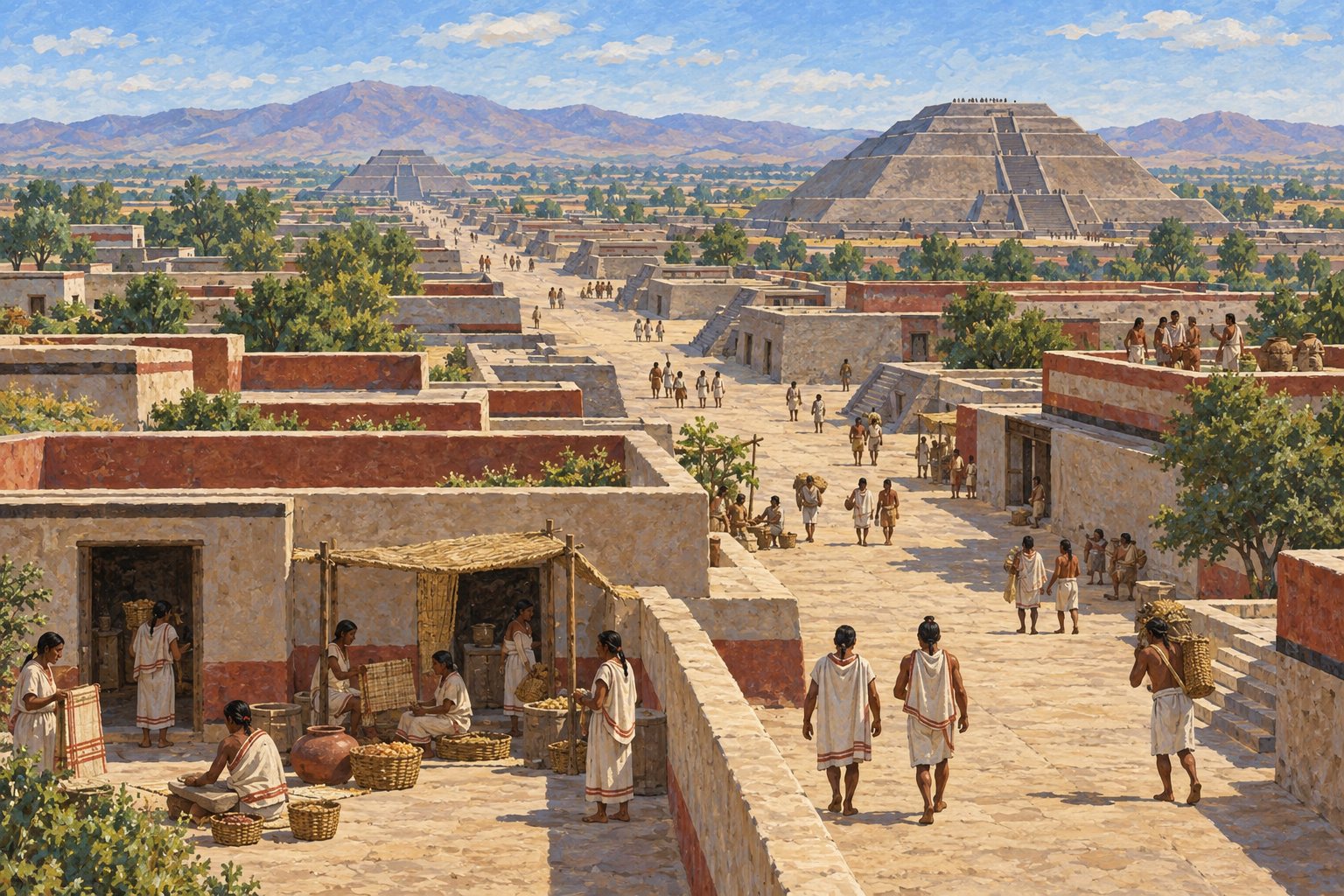
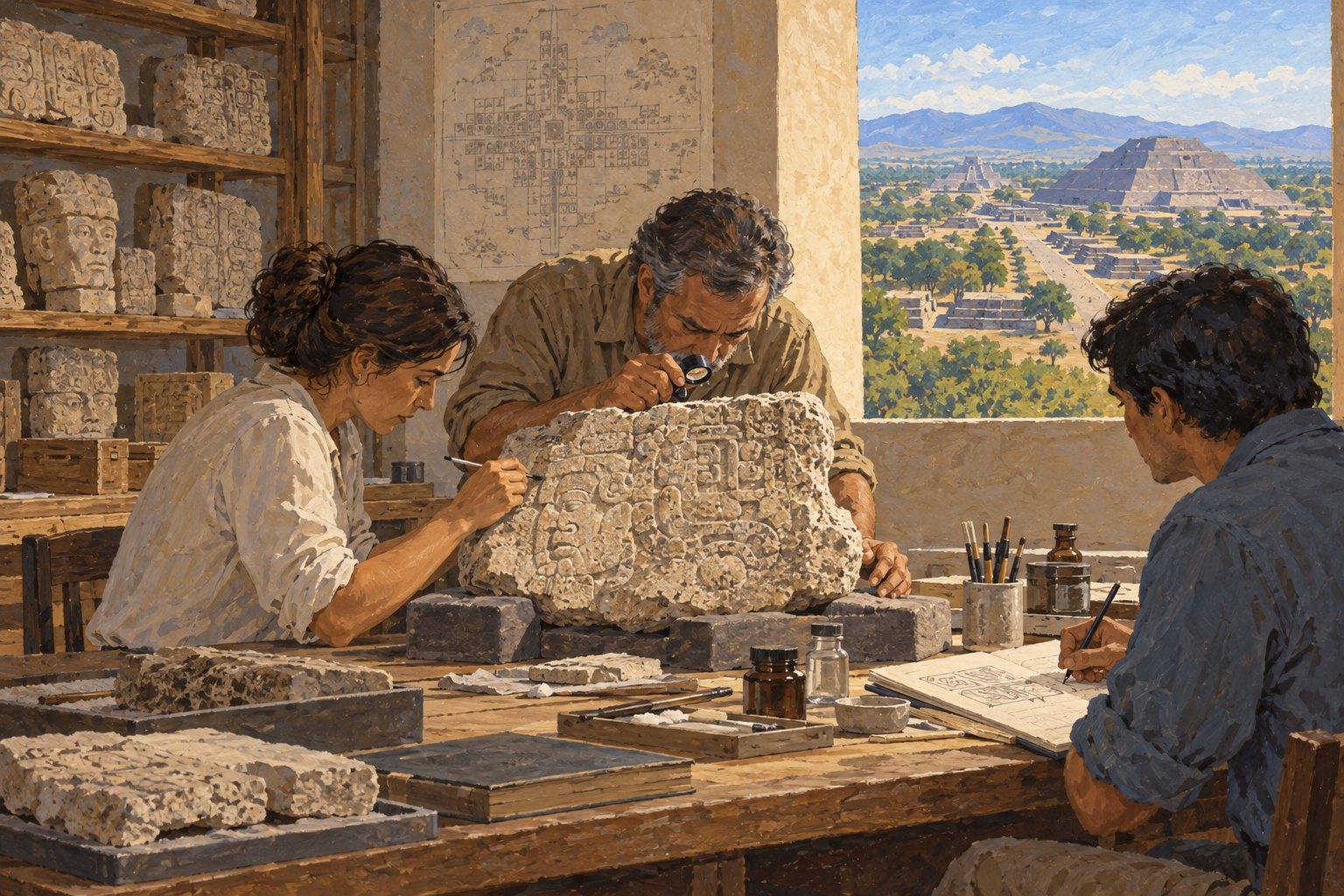
The planned city. Teotihuacan was the largest city of the ancient Americas — conventionally estimated well over 100,000 people, planned on a single grid alignment, its Feathered Serpent Pyramid dedicated with (the excavators estimate) about two hundred sacrificed individuals, many dressed as soldiers with hands bound — and it left no readable texts of its own: nearly everything verbal about it comes from other people’s writing, above all the Maya inscriptions recording armed strangers from the west arriving at Tikal in January 378, so the reader meets the volume’s recurring condition early — a great power known chiefly through neighbours’ records, reported with that distance stated.
How it was transmitted
A Long Sheet, Doubled in Folds
The Mesoamerican book was an industrial object — bark paper (amatl; Maya huun) beaten, coated with lime gesso, painted on both sides and folded like a screen between boards; Landa, who destroyed more of them than anyone, left the best short description, and his own phrase for the format gives this chapter its title — and exactly four Maya books now survive: the Dresden, the Madrid, the Paris, and the Códice Maya de México, which an INAH commission authenticated in 2018 as the oldest surviving book of the Americas; each survivor’s itinerary — a Saxon librarian’s purchase, a codex split in two, a rediscovery in a Paris library — is part of the machine’s history, because a machine is also known by where its last units washed up.
The Count of Days
The Maya calendar was a computational instrument — a 260-day divinatory count interlocking with a 365-day year into a 52-year round, and behind them the Long Count, a place-value tally of days with a zero — and the Dresden Codex shows the machine running: its Venus table tracks the 584-day synodic cycle (five Venus cycles equal eight 365-day years exactly) with built-in corrections, and its eclipse table spans 11,960 days, which is 46 turns of the 260-day count; the arithmetic was cracked in the 1880s and 1890s by Ernst Förstemann, the Dresden royal librarian, working on the book on his own shelves — the numbers were read decades before anyone could read a king’s name — and the 260-day count itself is attested as early as a painted “7 Deer” day-sign at San Bartolo, dated by its excavators to about 300–200 BCE.
Explore the illustrations7 scenes · Knotted records
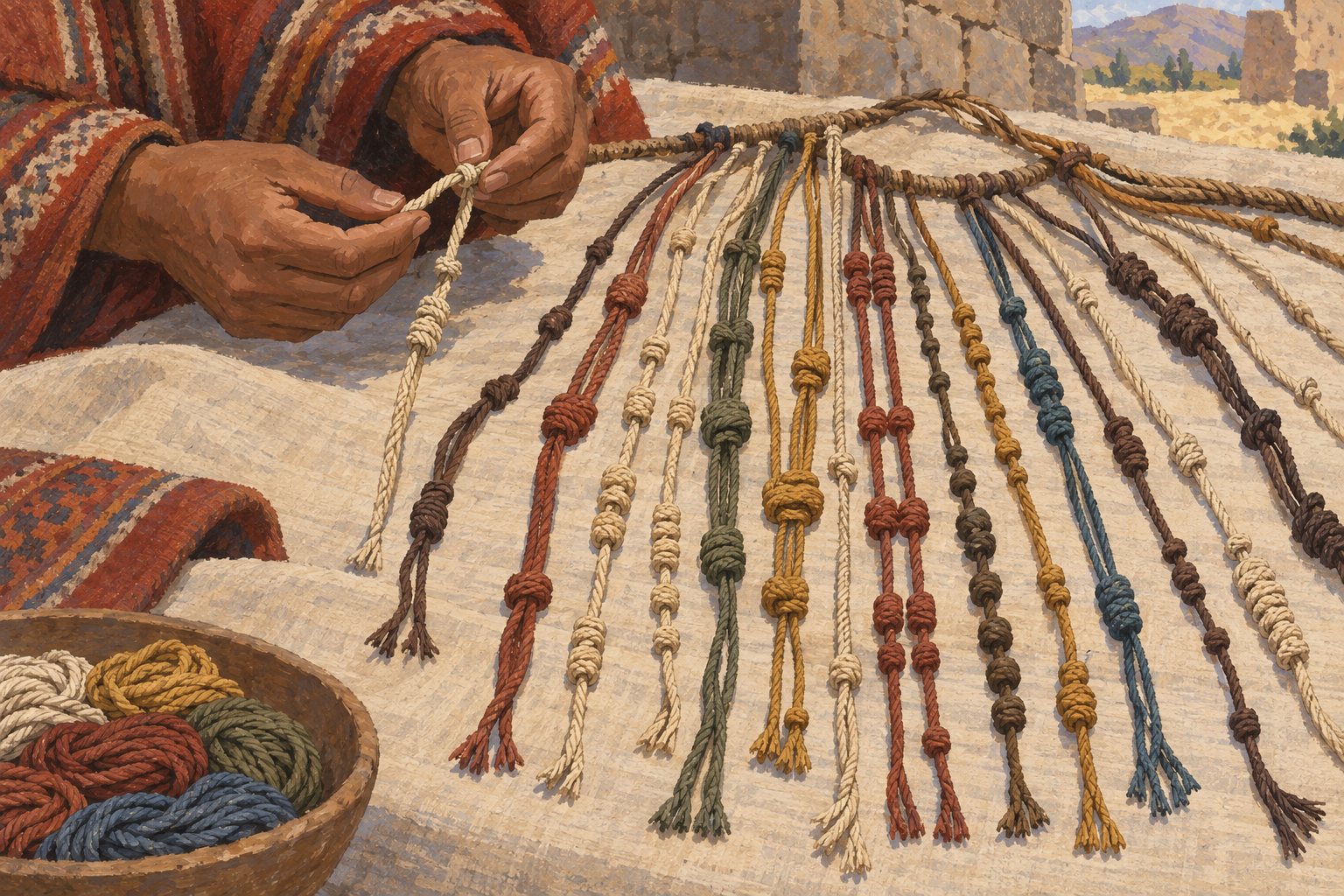
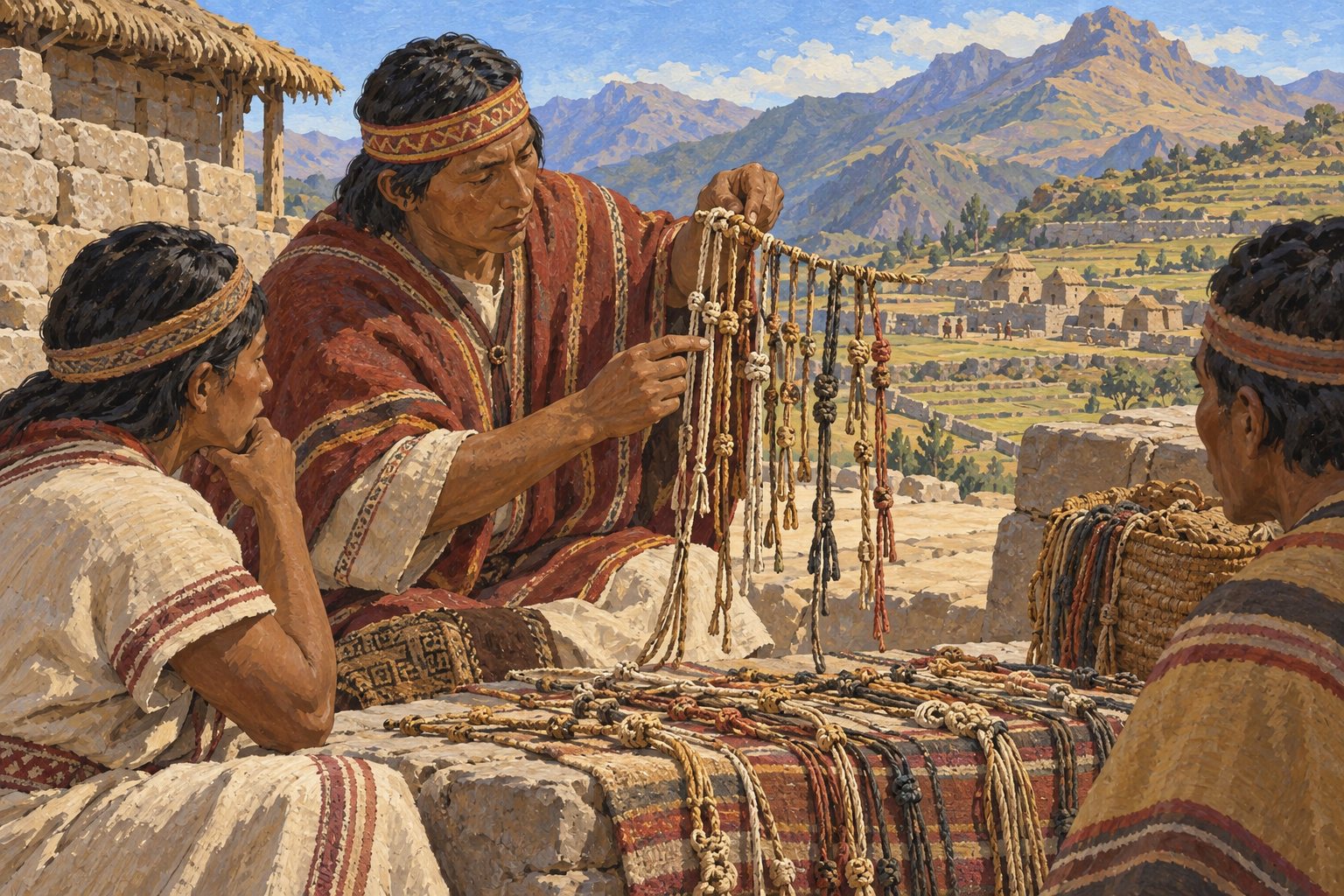
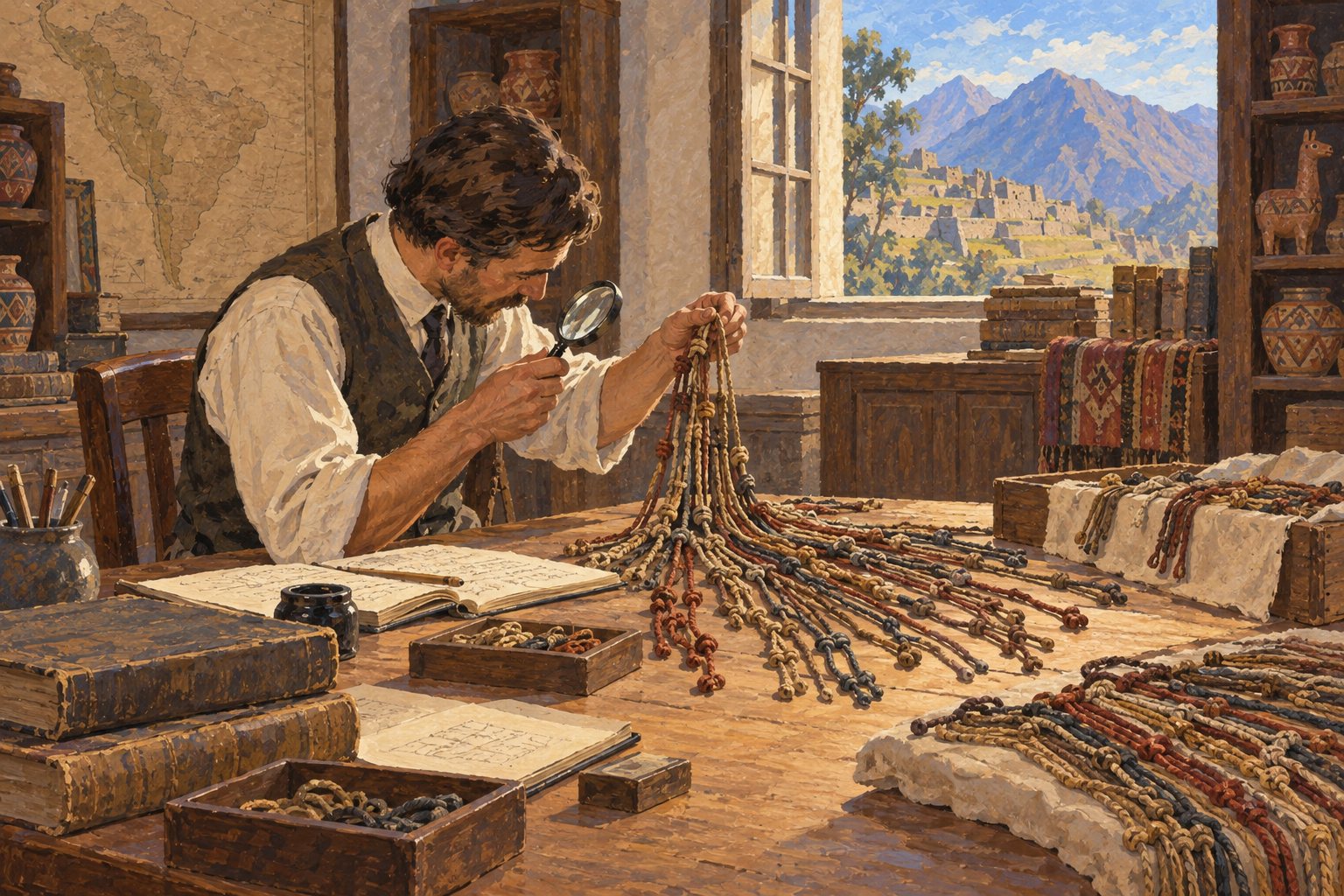
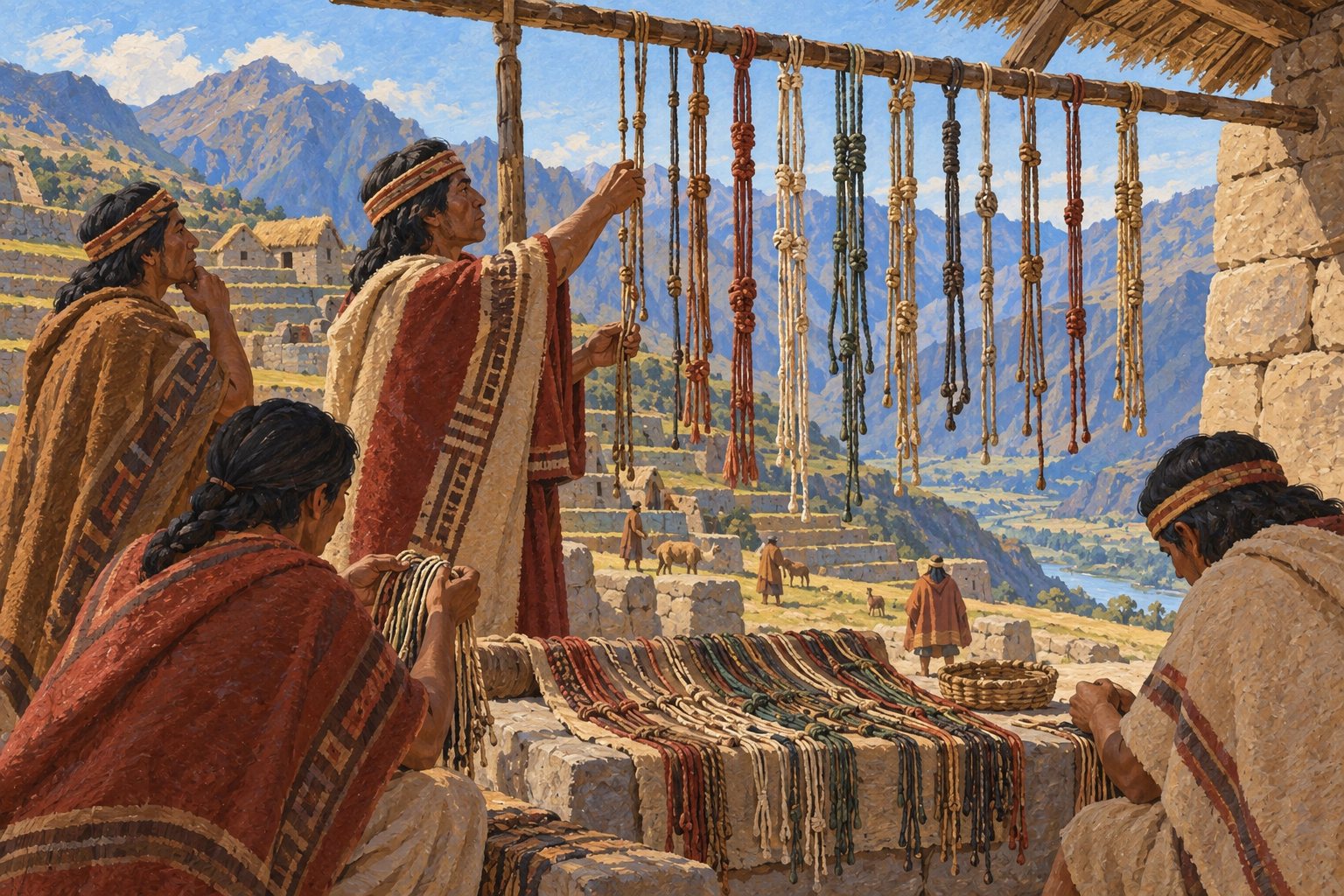
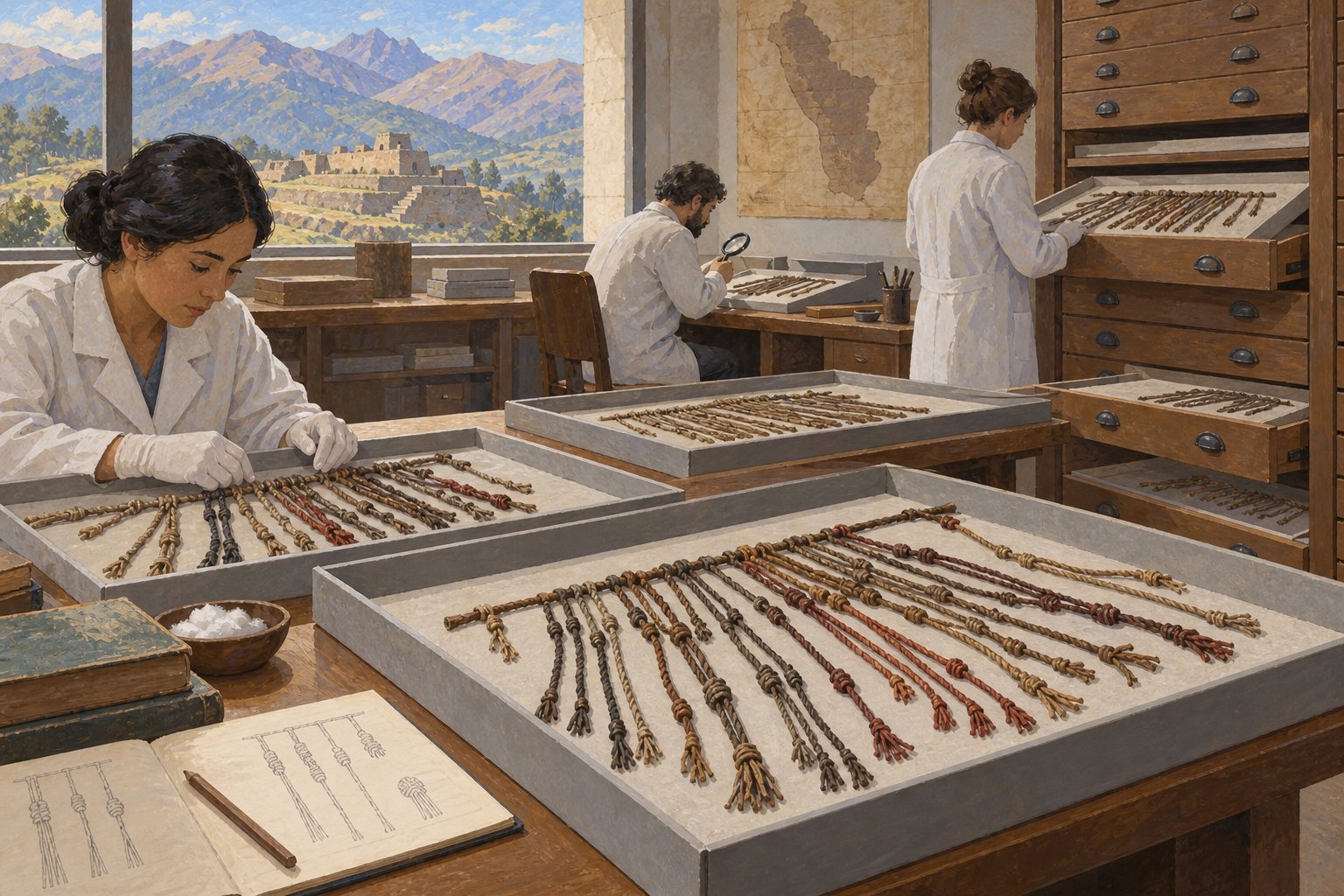
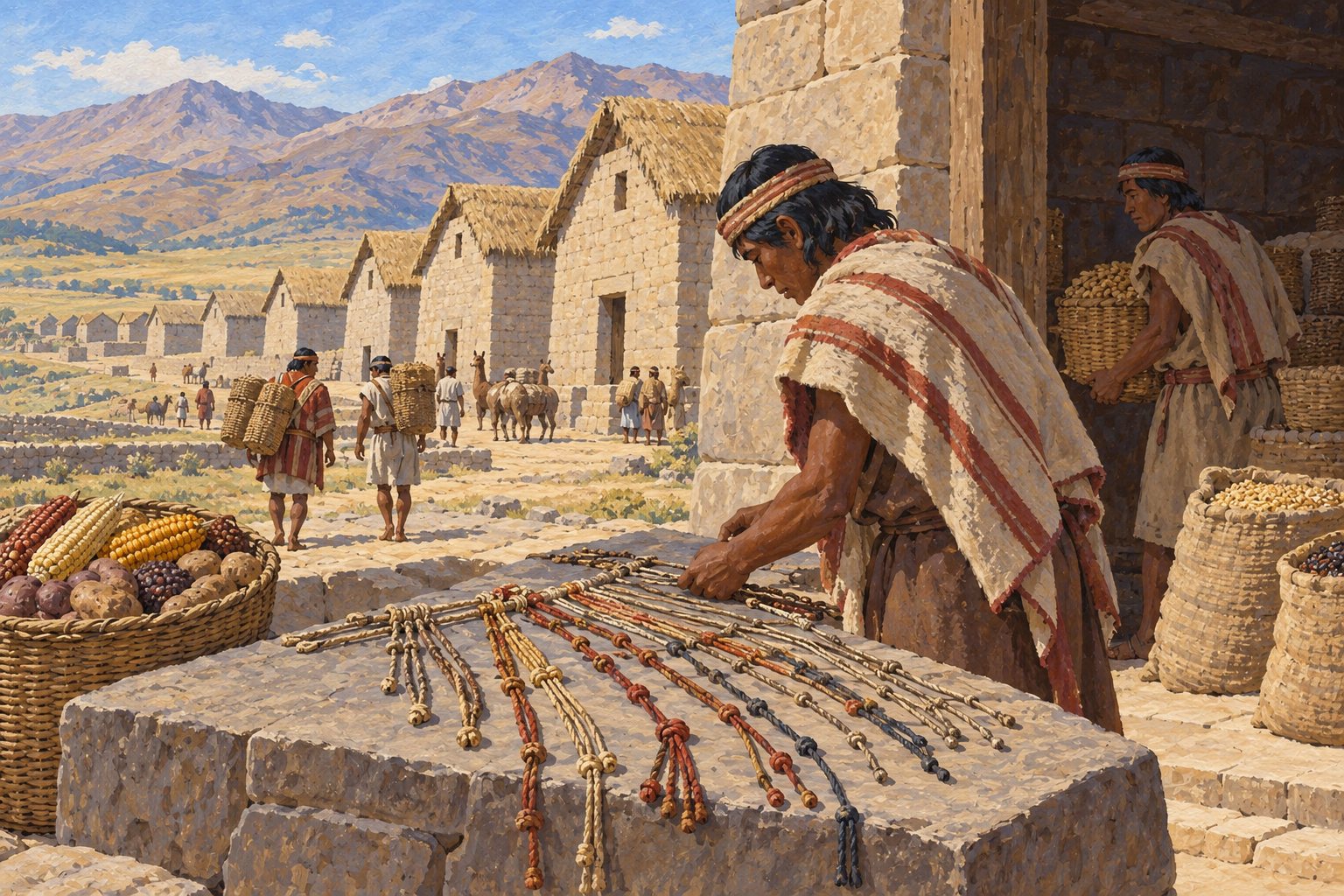
Knotted records. The khipu is a recording instrument of knotted cords, and the volume states exactly how much of it can be read: the numerical system is established — Leland Locke demonstrated in 1912, from museum specimens, that knot type and position encode decimal place-value, and later work has matched cord hierarchies to accounting practice — while the question of whether cords also encode narrative, names or language is genuinely contested: the Collata khipus were argued in 2017 to be logosyllabic letters, other specialists are unpersuaded, and this volume reports the contest rather than resolving it, because a machine we hold but cannot fully read is this jacket’s second signature fact — the Inca state’s own books survive by the hundreds and cannot yet be audited.
Texts and authority
The Working Library
The movement opens on its argument: before the conquest neither area had a closed canon in the sense every previous volume has used — Mesoamerica had working libraries, curated, recopied and revised by the scribal priesthood (the Dresden is conventionally read as a late copy of older material, its tables corrected in use), and the Andes had authorised memory-officials with cords, painted boards and song rather than books — so when closure came, it came from outside, as policy, from a church with a fixed canon of its own; who held authority over these texts before that, and how it was exercised, mostly cannot be established, and the movement’s real subject is the paper trail of the closing itself.
The Fire at Maní
On 12 July 1562, at Maní in Yucatán, the Franciscan provincial Diego de Landa held an auto-da-fé at the end of an idolatry investigation that had used torture on its witnesses, and burned the Maya books his friars had gathered; the event is the rarest thing in the history of censorship — a book-burning with a signed confession, because Landa’s own Relación records that they burned the books and that the Maya grieved for them — and the case’s second twist is also documentary: the trial dossier survives and the interrogations can be read, and Landa, recalled to Spain and tried for exceeding his authority, was cleared and returned to Yucatán as its bishop.
Institutions and resources
The Feather That Means Four Hundred
The Codex Mendoza’s tribute section is an imperial balance sheet in pictures — provinces itemised page by page, a flag glyph counting twenty, a feather four hundred, a bag eight thousand, over mantles, warrior suits, cacao, paper, feathers and gold dust flowing to Tenochtitlan — painted by Nahua scribes around 1541 from pre-conquest-style originals for Spanish use, a provenance the chapter states with the evidence; and its physical cross-check is the Templo Mayor itself, where the offerings excavated since 1978 contain material from across the tributary map — the temple was where the empire’s geography was deposited, and the pictorial ledger and the archaeological one can be read against each other.
Three Fields
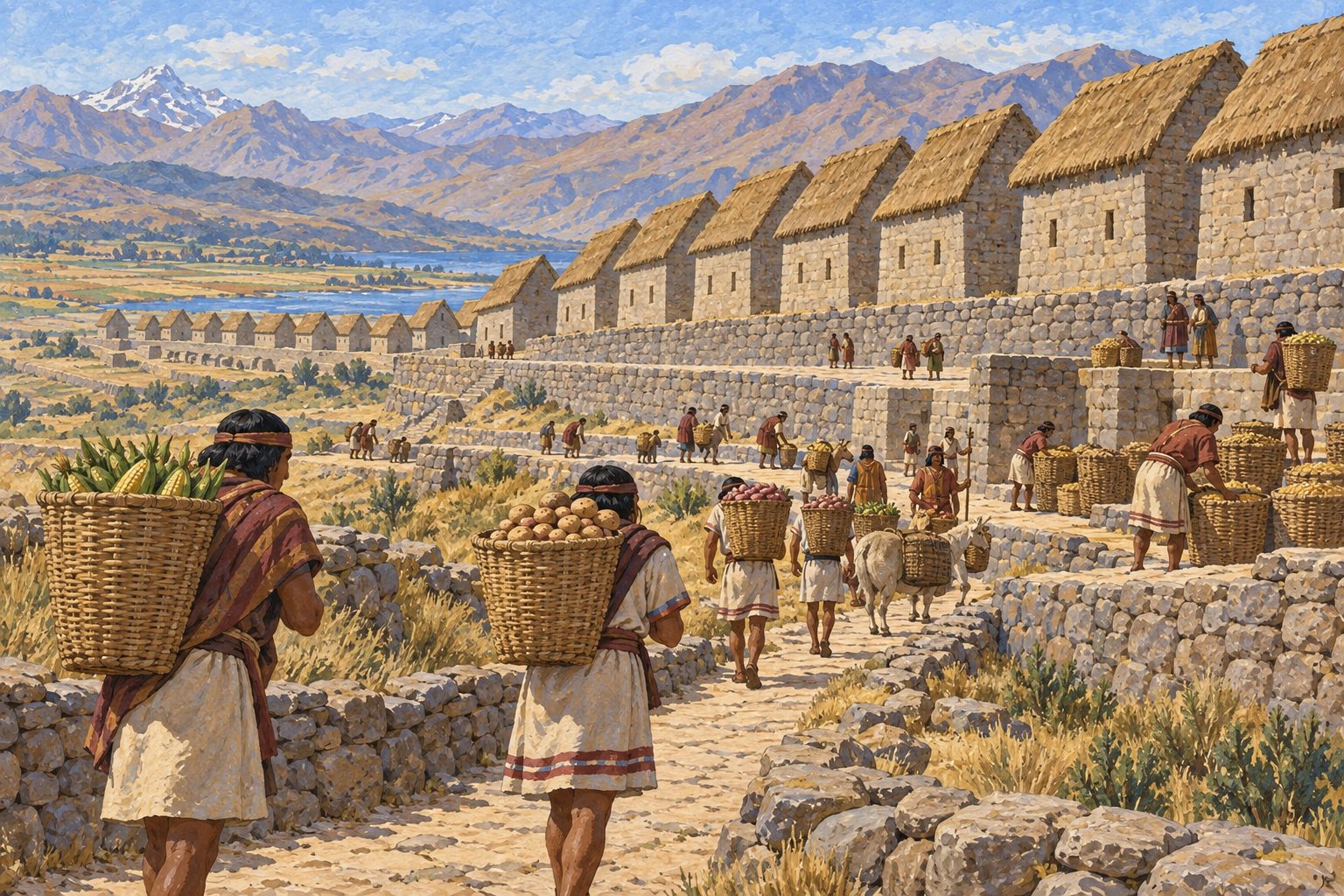
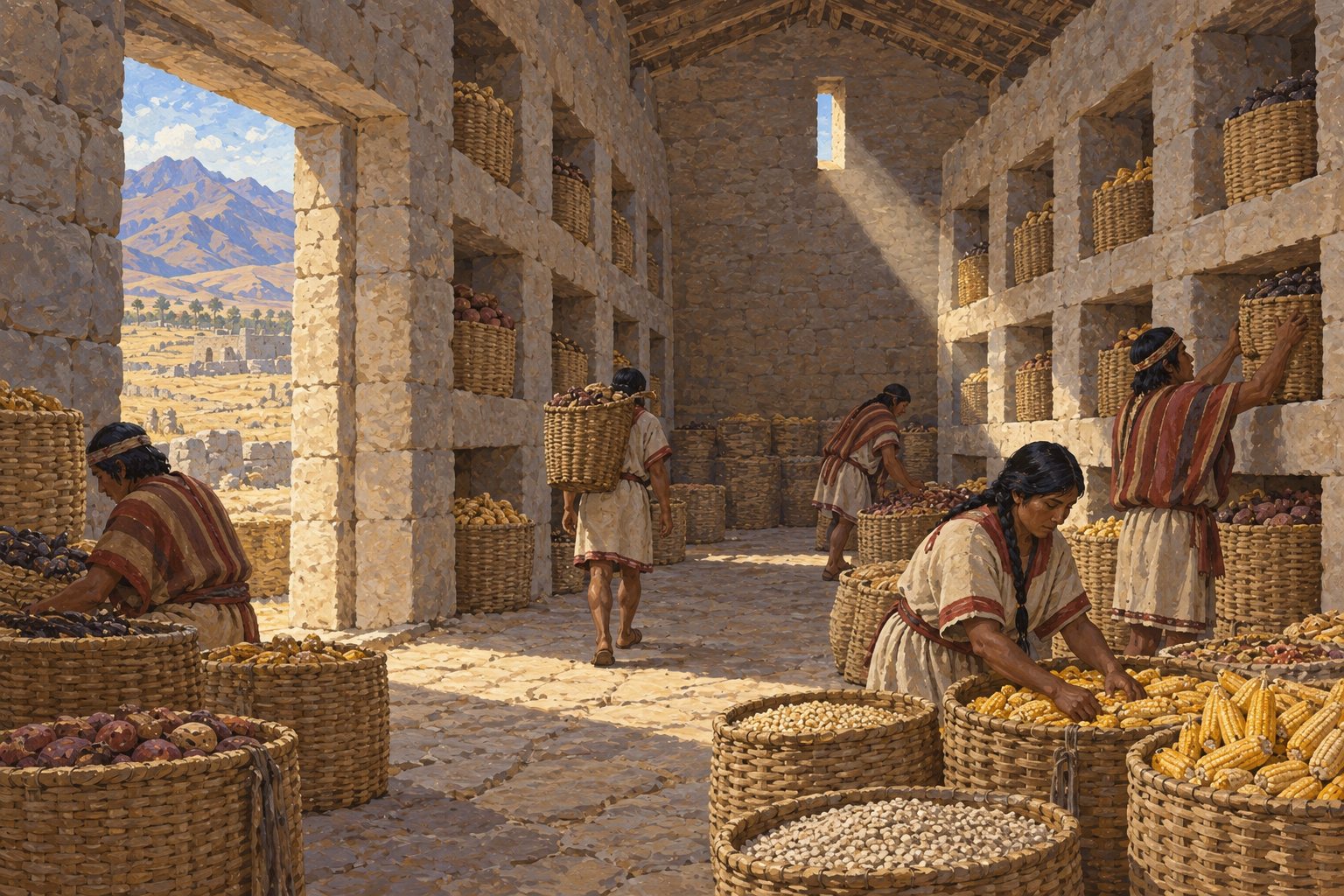
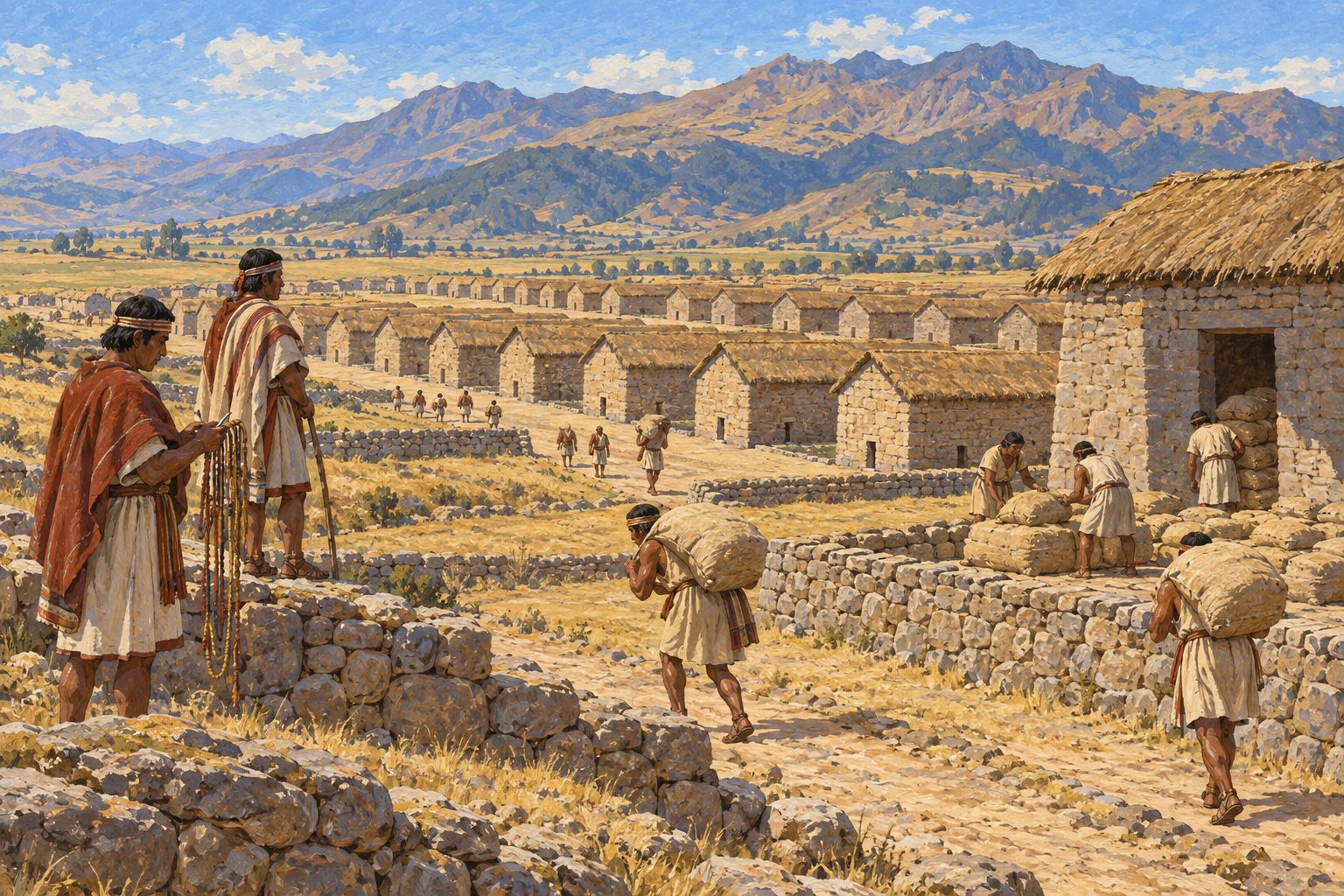
The tradition holds — through chroniclers writing for Spanish purposes, and the chapter says so — that Inca land was divided three ways, for the state, for the Sun and for the community, the Sun’s fields worked by the community’s labour turn (mit’a) and the produce stored against ritual and redistribution; the archaeological remainder is real — administrative centres like Huánuco Pampa with storehouse rows in the hundreds, mapped by Craig Morris’s project — and the honest summary is the movement’s thesis: the state cult was not funded by the economy so much as it was a working part of the economy’s machinery of record, and the ledgers that would audit it are the khipus the volume has already said cannot yet be fully read.
Explore the illustrations6 scenes · Storehouses in the highlands
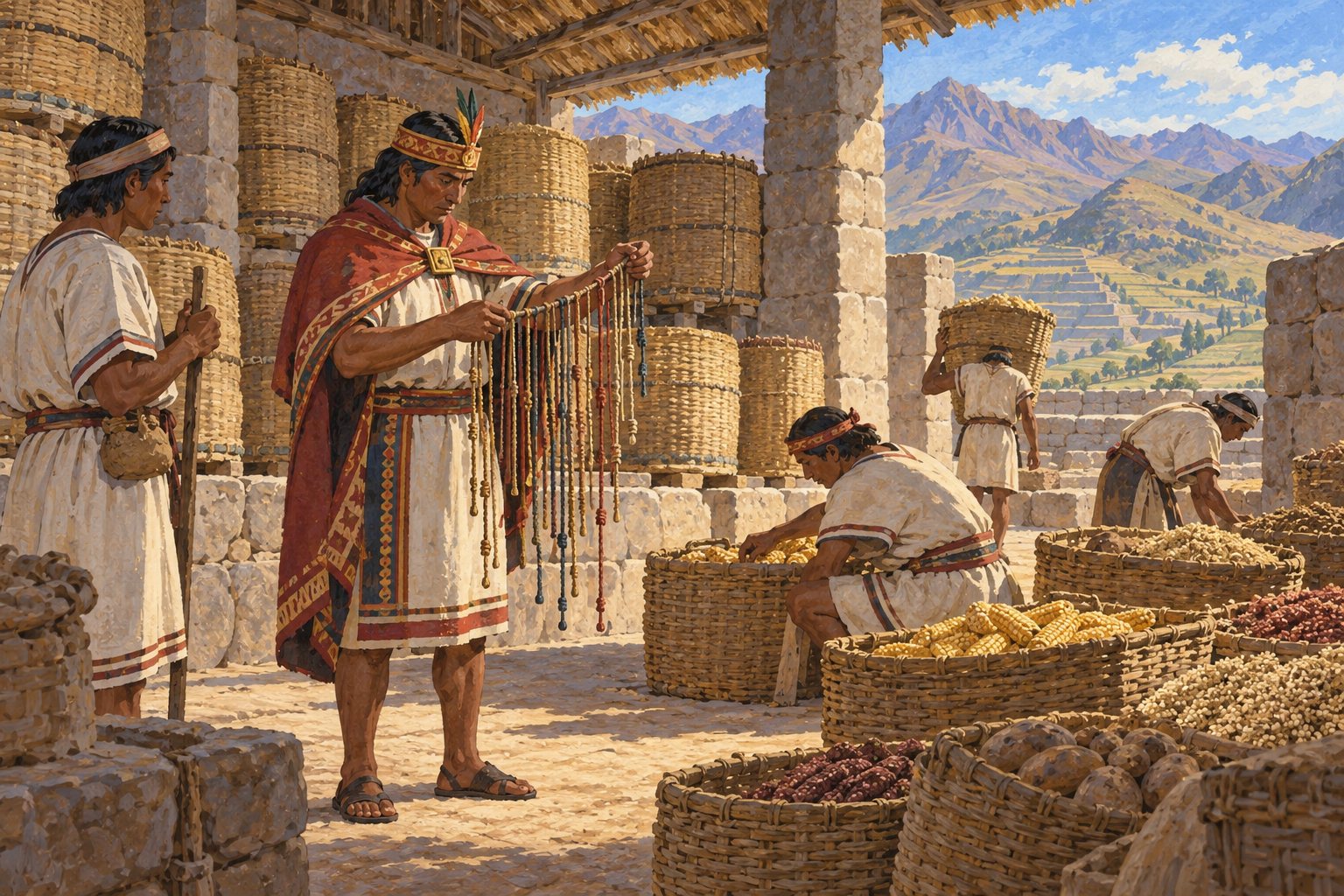
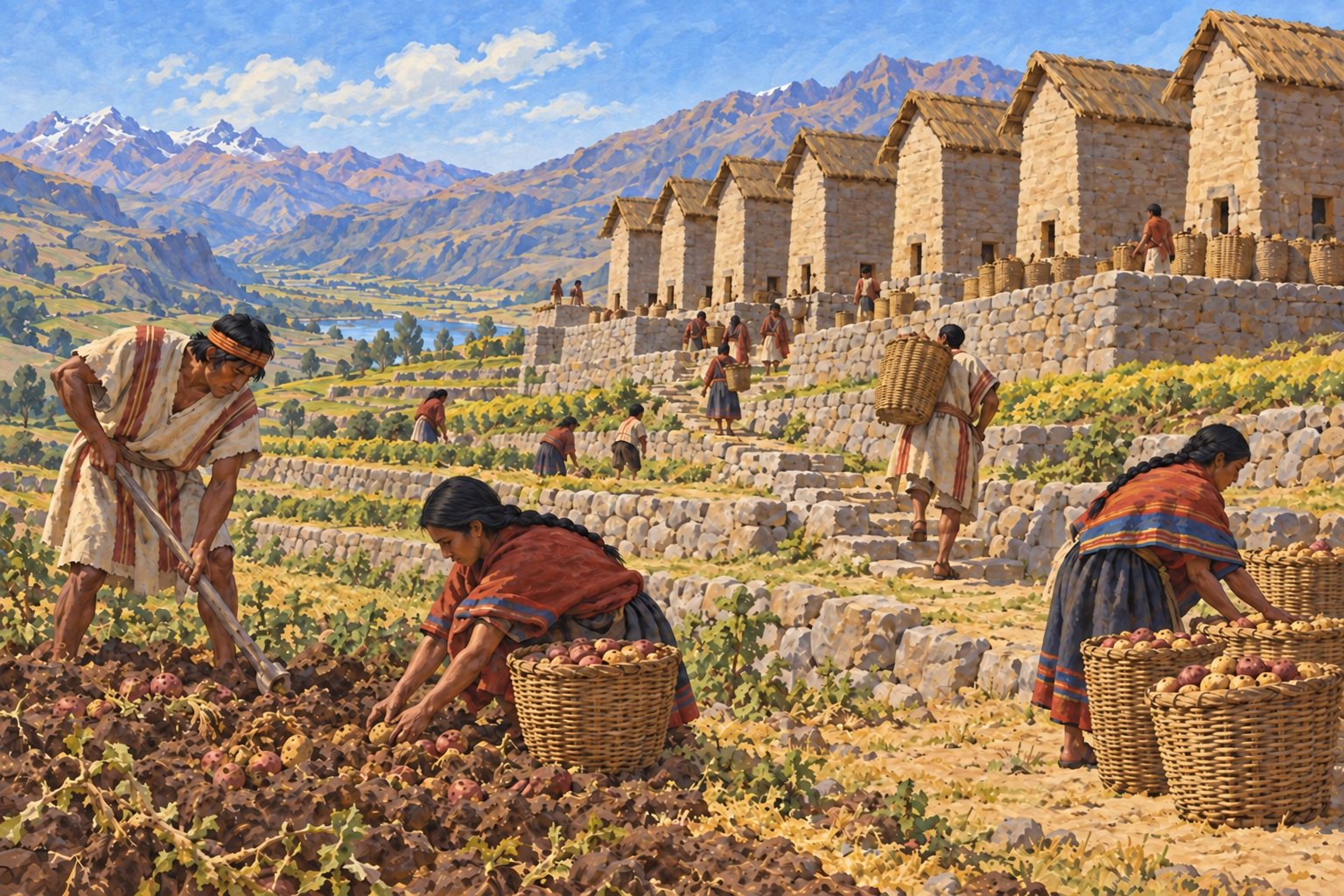
Storehouses in the highlands. The tradition holds — through chroniclers writing for Spanish purposes, and the chapter says so — that Inca land was divided three ways, for the state, for the Sun and for the community, the Sun’s fields worked by the community’s labour turn (mit’a) and the produce stored against ritual and redistribution; the archaeological remainder is real — administrative centres like Huánuco Pampa with storehouse rows in the hundreds, mapped by Craig Morris’s project — and the honest summary is the movement’s thesis: the state cult was not funded by the economy so much as it was a working part of the economy’s machinery of record, and the ledgers that would audit it are the khipus the volume has already said cannot yet be fully read.
Changes and divisions
The Book at Cajamarca
The split movement opens with its source problem dramatised in a single scene: at Cajamarca on 16 November 1532 the friar Vicente de Valverde handed Atahualpa a sacred book, and what the Inca did with it — examined it, held it to his ear, threw it down — differs by teller, across accounts written by conquerors justifying an ambush, later chroniclers, and Inca witnesses dictating under colonial rule decades on; the volume reports the conquest of both areas through that lens, naming for each narrative who wrote it, when, and what the writer needed it to prove — the Tlatelolco scholars’ Nahuatl account of the fall of Tenochtitlan, Titu Cusi’s dictated history, Guaman Poma’s twelve-hundred-page illustrated letter to a king who never read it, found in Copenhagen in 1908 — and it refuses both costumes this material is usually dressed in, the noble victim and the savage spectacle, because both are adjudication.
The Brotherhood’s Ledger
What survived in Mesoamerica reorganised itself inside a Spanish legal container: the cofradía — a lay brotherhood that could hold property, keep books and pay for feasts — became the vehicle of community religion, and because brotherhoods and the later cargo systems kept accounts, the money movement continues past the conquest: colonial cofradía books survive in parish archives, and twentieth-century fieldwork measured the cargo economy directly, Cancian documenting in Zinacantán that sponsoring a fiesta could consume savings on the scale of years of a man’s wages — religion as the community’s own fiscal machine, run under, and partly against, the church that licensed it; in Santiago Atitlán the cofradías keep the Rilaj Mam to this day, and the sentence is in the present tense.
Limits of the evidence
These limits are stated in the book before its argument.
- What any pre-conquest person believed, in their own contemporary words, outside the Maya inscriptions The deciphered corpus is royal and political; nearly every other verbal account of both areas’ religion reaches us through colonial compilers — missionaries, prosecutors, converts and petitioners — writing under, and usually for, the power that had just destroyed the institutions being described. The volume names the compiler and the motive every time it leans on one. This is the volume’s signature condition and it is stated in Movement One, not saved for a coda.
- Whether the khipu encodes narrative or language The decimal accounting layer is established (Locke, 1912, onward); everything beyond it is genuinely contested, and Movement Two states the contest rather than resolving it. The Inca state’s own books survive by the hundreds and cannot yet be audited.
- What the burned books contained Four Maya books survive, all substantially calendrical-divinatory; whether the burned corpus held histories, tribute rolls or genres now unimagined cannot be established. Landa’s list of their subjects is his claim and is printed as one.
Sources and reading
This article brings together the series’ existing overview and chapter summaries. The linked book page provides the full outline and bibliography.
- Dorothy Hosler, “Ancient West Mexican Metallurgy: South and Central American Origins and West Mexican Transformations,” American Anthropologist1988. West Mexican alloys matching Andean technique — contested
- Drucker, Heizer and Squier, Excavations at La Venta, Tabasco, 1955, BAE Bulletin 1701959. Offering 4 and the re-entry pit
- Diego de Landa, Relación de las cosas de Yucatán, Brasseur de Bourbourg1560s; 1864. the folded book; the burning at Maní; the scribal syllabus
- Ernst Förstemann, Dresden commentaries1880; 1888 Bureau English; 1906 Peabody. leaf count, Venus table, eclipse span
- INAH, Códice Maya de México, Martínez del Campo Lanz2018. the fourth Maya book authenticated
- Stuart, Hurst, Beltrán and Saturno, “An early Maya calendar record from San Bartolo, Guatemala,” Science Advances2022. Seven Deer, 300–200 BCE
- Cieza de León, Clements Markham1540s; 1864 and 1883 trans.. khipu accounts that checked out; tribute and storehouses
- Sarmiento de Gamboa, Markham1572; 1907 trans.. history certified by assembled Inca notables; painted boards
Illustrations are newly generated interpretations of themes in the book. They are not surviving artifacts, historical photographs or evidence for the events described.