Belief System
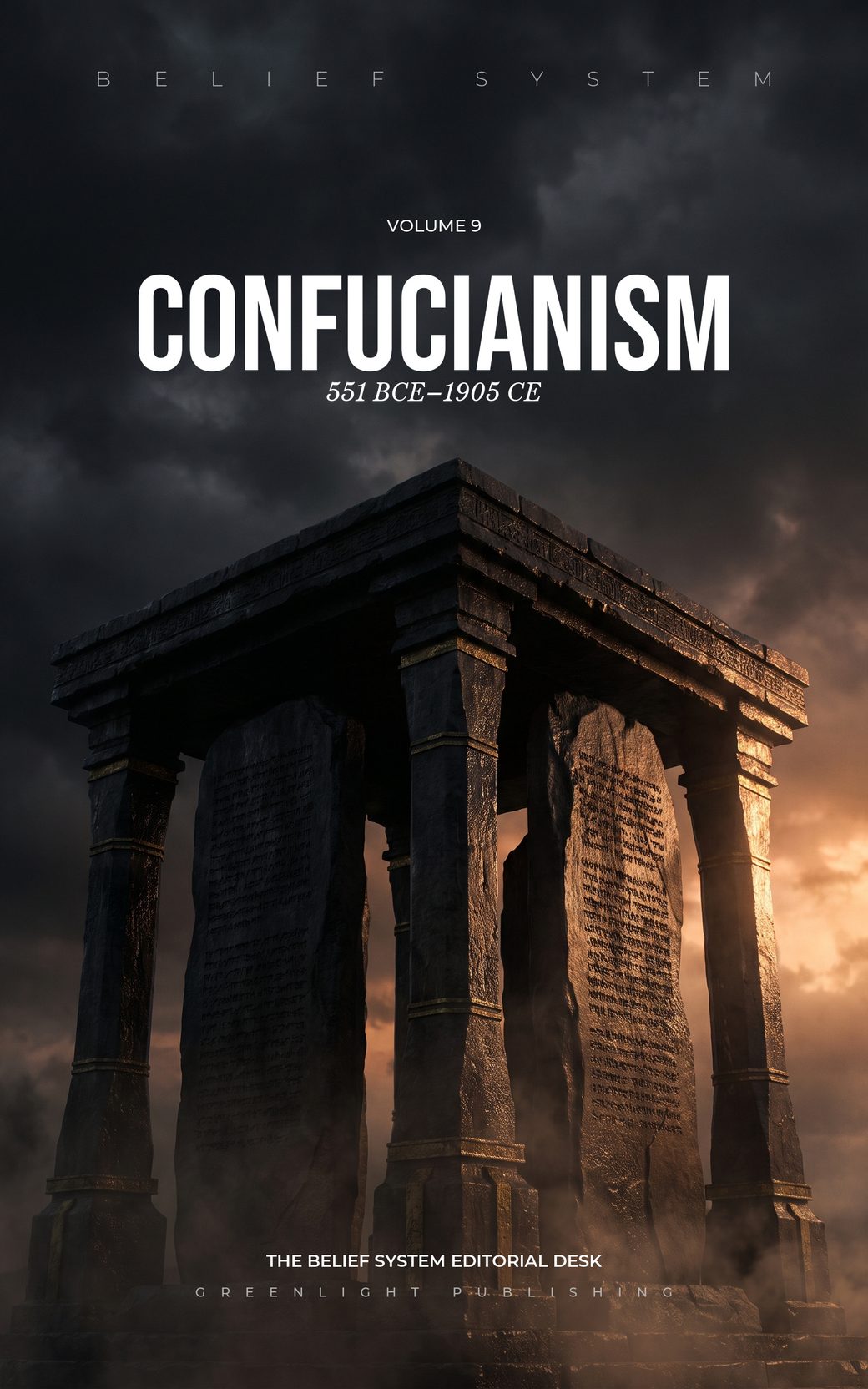
Jacket of Belief System volume 9, Confucianism
$12.99paperback

130 pages, 5.5 × 8.5 in. Three or more volumes in one order and every copy drops to $11.99.

copies

United States, 8 to 11 days. All destinations

Volume 9 Belief System 551 BCE–1905 CE

Confucianism

The machinethe canon carved in stone, then the exam

Attested from
551 BCE

The earliest secure evidence, and the key this volume is filed under. All thirty-one

Narrates
551 BCE–1905 CE

The period the book actually covers. It is rarely the same figure.

The argument in one sentence

A curriculum built around a teacher who by his own stated measure had failed acquired the best-documented transmission machinery in the pre-print world — an authorised text cut in stone so copies could be checked against it, then an examination that wired the canon directly into the state’s hiring — and its deepest divisions were fought over manuscripts and syllabi rather than gods, which is why four centuries of argument over whether it is a religion at all have produced legal consequences on three continents and no answer, and this volume reports that argument without joining it.

for thirteen hundred years the route to power in the world’s largest state was a memorisation exam on one man’s canon; by the 1250s a hundred thousand candidates a year were sitting it.The commissioning line

What it is

Fragments of forty-six stone slabs sit in Chinese museums today. Between 175 and 183 they stood upright outside the imperial academy, cut with something on the order of two hundred thousand characters.

They were not put up to save the classics. Copies were everywhere and nobody thought they were about to disappear. They were put up so that a copy could be brought and held against them.

A master text, in public, in the most durable medium the empire had — and rubbings taken from it. That is mass reproduction from an authorised original, three centuries before woodblock printing. Then the second machine, which no other tradition in this series built: an examination system that wired a curriculum directly into the state’s hiring, and made memorising a particular set of books the most consequential economic decision a family could make.

Five movements: the world it began in, the machine, the canon, the money, and the splits.

Nine centuries of continuous documented endowment at Qufu. A canon reordered fifteen hundred years after its founder. A forgery controversy that ran for two millennia and was settled by philology.

Whether this is a religion at all has been argued since the Jesuits, and the argument has moved law on three continents. This book reports it and joins neither side.

Belief System, Volume 9.

In full

This volume has the best-documented transmission machinery in the pre-print world, and the most contested category membership in the series. It takes both seriously.

The machinery came in two stages. The Xiping Stone Classics, carved from 175, put an authorised text in public in stone so that copies could be collated against it — and rubbings taken from those slabs are reproduction from a master, centuries before printing. Then the examination system, which did something no other tradition here managed: it made a canon the entry qualification for the state’s own hiring, so that studying it was a career decision before it was a religious one.

The canon movement follows the list through its own history. The Five Classics and the Four Books, the second set assembled by Zhu Xi in the twelfth century and made the syllabus — a canon reordered fifteen hundred years after its founder. The New Text and Old Text controversy is a dispute about forged and recovered manuscripts that ran for two millennia, and this volume follows it to the demonstration that a quarter of the received Documents are post-Han forgeries which stayed on the exam syllabus regardless.

The money is the Duke Yansheng: a hereditary title held by Kongzi’s descendants from 1055 to 1935, with the estate at Qufu, its land, its tenants and its exemptions. Nine centuries of continuous, documented religious endowment, which may be the longest-running anywhere. Where the estate’s extent could not be verified, the volume prints unverified rather than an estimate.

And the category question runs through the whole book without being answered. Whether Confucianism is a religion has had legal consequences from the Chinese Rites controversy to present-day state policy. The volume reports who holds what and why it mattered, and settles nothing — which it says plainly in its own preface.

Belief System is a history of world religion, one tradition at a time. Thirty-one volumes, ordered by earliest secure attestation.

The contents

26 chapters in five movements. Every volume in the series has the same five, in the same order, and each chapter below is printed with the idea it carries.

Movement OneThe World

The late Zhou world, the ru as a profession, and the question the movement answered. The founder’s dates are unusually secure; nearly everything else about him is transmission, and the confidence falls with it, in the same sentence.

  1. 1Cast in BronzeThe Western Zhou order ran on ritual and kept its paperwork in bronze — vessels cast to record investitures, gifts and land settlements — and by Kongzi’s birth in the mid-sixth century the machinery had outlived the power it recorded: the king a figurehead in the east since 770, states swallowing states, and the chronicle of Kongzi’s own Lu logging ritual violated by the men most obliged to it, which made the question of the age what holds a world together when its forms still stand and its substance has gone.
  2. 2A Profession of MournersThe ru were a trade before they were a school — ritual specialists for hire at funerals, sacrifices and court occasions in a world where getting the rite wrong had legal force — and the earliest outside description of them is an attack: Mozi’s “Against the Ru” caricatures elaborate funerals that beggar households, which is hostile testimony, and hostile testimony is still testimony that the profession existed and charged.
  3. 3By His Own MeasureWhat can be established about Kongzi is small and sharp — a minor office in Lu, the tradition holds; fourteen years moving between courts seeking a ruler who would adopt the Way; none did; he died a teacher in 479 — and by the standard he is reported to have set himself, restoration of the Zhou order, the career failed, which the tradition does not hide: it transmits the failure as the proof of the man.
  4. 4A Book He Did Not WriteThe Analects is a compilation by students and students’ students — masters other than Kongzi speak in it with honorifics, sayings repeat in variant forms across chapters, and the three Han recensions differed in chapter count — which is a transmission fact rather than a slight, and it makes the book the volume’s first machine exhibit: notebooks merged, over generations, into a canon.
  5. 5Heirs and EnemiesWithin two centuries the school had produced two rival systematisers — Mencius arguing the sprouts of goodness are innate, Xunzi that human nature is crooked wood needing the steam-press of ritual — a disagreement about first principles that the later tradition canonised on one side and this volume reports on both; meanwhile the state of Qi was already paying scholars to argue at Jixia, ranked and salaried without portfolio, which is the money movement’s subject arriving early: doctrine had become an employable skill.

Movement TwoThe Machine

The transmission technology, named as a concrete object or institution — not an abstraction. Here there are two, in sequence, and both are exceptional: an authorised text cut in stone for public checking, and an examination that turned the canon into the state’s hiring filter.

  1. 6Warp ThreadsThe word for a classic, jing, is the word for the warp thread of a loom, and the object it named was physical: a bundle of inscribed bamboo strips bound with cords, heavy, bulky, easily disordered and easily partial — which is why early “books” behave like collections of chapters rather than fixed wholes, and why the machine problems of the next eight centuries are all versions of how do you keep ten thousand strips identical across an empire.
  2. 7Thirty Thousand StudentsIn 124 BCE the Han founded an imperial academy with fifty official students and chairs in the classics; the transmitted figures have enrolment at three thousand within a century and thirty thousand under the Later Han — the tradition’s numbers, printed as such — and the pedagogy was replication by lineage: each classic taught in authorised master-successions, examined by recitation, so that the academy functioned as a copying machine whose output was men.
  3. 8Cut in StoneIn 175 CE the scholar Cai Yong memorialised that the classics were being corrupted — the Hou Hanshu says men bribed the keepers of the archive copies to alter readings toward their own — and the remedy was to publish the authorised text in stone: seven works, some 200,000 characters on 46 stelae at the Luoyang academy, where the history records the viewers and copyists arriving at more than a thousand carts a day; an error-correction standard erected in public, explicitly so that copies could be checked against it.
  4. 9Ink on StoneA rubbing taken from an engraved stele is an exact mechanical copy pulled from a master — mass reproduction three centuries before woodblock printing — and the state understood what it had: the canon was re-cut in stone again and again (the three-script classics of the 240s, the Kaicheng set of 837 that still stands in Xi’an’s Forest of Steles), and when printing arrived, the state’s first great use of it was the same act by other means — Feng Dao’s Nine Classics, cut to woodblocks between 932 and 953 from the stone-fixed text.
  5. 10The Examination HallThe examination — conventionally dated from 605, mature under the Song — became a machine tooled against its own graders: candidates’ names pasted over, papers recopied by clerks so no examiner could recognise a hand, a palace stage with the emperor as final examiner, regional quotas after the list of 1397 seated southerners only and the graders paid for it — and by the 1250s, on the transmitted figures, a hundred thousand men a year were sitting it.
  6. 11What a Candidate CarriedThe syllabus was a memory load with a published size — the Four Books and Five Classics run to some 431,000 characters by Miyazaki’s tally, learned verbatim before a candidate composed a word — and around that load a whole economy of drill schools, crib editions, model-essay publishing and miniature cheating shirts grew up, because the eight-legged essay form fixed in the 1480s made the performance as standardised as the text; which texts, and whose commentary, was therefore the most consequential question in the empire, and it is the canon movement’s question, handed over here.

Movement ThreeThe Canon

What is in, what is out, who decided, when, and what the decision cost. The real subject is who had the authority to close it — and here the canon was closed by employment, burned by decree, recovered from memory and a wall, fought over as manuscripts for two millennia, and reopened by one scholar fifteen hundred years after the founder. The movement opens with that argument, never with a text.

  1. 12Six Classics, One MissingThe canon claimed to be six — Changes, Documents, Odes, Rites, Music, Annals — and its first fact is a gap: no Classic of Music survives, if a text ever existed, so the tradition’s own count advertises a loss; the tradition holds Confucius edited all of them, scholarship contests every case, and the founder’s recorded sayings were not among the classics at all for the canon’s first millennium — a canon is what an authority says it is, and for a thousand years no authority said the Analects was one.
  2. 13The BurningIn 213 BCE the First Emperor’s chancellor memorialised that private ownership of the Odes, Documents and the sayings of the hundred schools be ended by fire, with the court’s own erudites exempt — the decree targeted circulation, not existence — and what was actually lost cannot be established: the palace copies survived the decree and then burned with Xianyang in 206, so the tradition’s founding catastrophe and the scholars’ minimisation of it are both on the table, and the chapter reports the fight rather than settling it.
  3. 14Out of the WallThe recovery ran on two channels the tradition itself distinguishes — an old man’s memory (Fu Sheng, past ninety, the tradition holds, dictating twenty-nine chapters of the Documents in Han clerical script: the “New Text”) and a demolition (books in archaic script reported found in the wall of Kongzi’s old house: the “Old Text”) — and the two-millennium quarrel that followed was about manuscripts, not metaphysics: which physical recensions were authentic, and who profited by saying so; it ended with a philologist’s proof — Yan Ruoqu, in the 1690s, demonstrated that twenty-five chapters of the received Old Text Documents were a post-Han fabrication, and the forged quarter of a scripture stayed on the examination syllabus for two more centuries anyway.
  4. 15The Emperor’s SyllabusIn 136 BCE the Han established erudite chairs for five classics and in doing so performed the canon’s real closure — a classic was a text with a chair, and the state paid the chair — after which canon disputes were personnel disputes, and the throne built machinery to hear them: conferences in 51 BCE and 79 CE where emperors presided over textual debate and the minutes of the second survive as a book, while the canon’s membership crept from five toward thirteen as chairs and commentaries were added.
  5. 16The Second CanonIn the twelfth century Zhu Xi extracted two chapters from the Rites compendium, paired them with the Analects and the Mencius, wrote the commentary, prescribed the reading order and supplied — by his own printed admission — a “missing” section of the Great Learning from his own hand; in 1313 the Yuan court made his edition the examination standard, and a canon was thereby reopened, reordered and re-closed fifteen hundred years after its founder — with consequences the throne felt: the Ming founder tried to expel Mencius from the temple and had the book expurgated rather than tolerate its doctrine that the people outweigh the ruler.

Movement FourThe Money

Who paid, who was paid, and how we know. Numbers get their provenance in the same sentence — and this volume holds one of the strongest money stories in the series: a hereditary endowment documented nearly nine centuries, with its own archive. Acreage figures it cannot source, it does not print.

  1. 17The State CultThe tradition holds that the founding emperor of the Han stopped at Qufu in 195 BCE and offered Confucius the great sacrifice of ox, sheep and pig — the first imperial payment into what became a two-thousand-year cult account — and the ledger only ever ratcheted: ducal title by 1 CE, kingly title in 739, augmentations under the Song, until 1530, when a reforming Ming court stripped the kingly title, removed the images and installed a plain tablet — the state deciding, sixteen hundred years in, whether it was worshipping a god or honouring a teacher, which is the oldest evidence the chapter on the category question will call.
  2. 18Receipts in StoneThe temple’s Han-era finance survives on its own stelae, in situ: one of 153 CE records the memorial and approval appointing a temple officer, one of 156 carries on its reverse a donor roll with names and cash amounts, one of 169 records a prefect’s sacrifice and works — contemporaneous administrative stone, which is why this money chapter can say the record shows where most volumes in this series must say the tradition holds.
  3. 19The Duke YanshengFrom 1055 the head of the Kong lineage held a hereditary dukedom that outlived every dynasty that granted or confirmed it — Song, Jin, Yuan, Ming, Qing — because each incoming house, including the conquest dynasties, re-confirmed the title on arrival as a cheap purchase of legitimacy; the line split with the empire (a southern duke following the Song to Quzhou, a northern rival installed at Qufu, briefly three claimants in the Mongol wars) and was reunified by Mongol decision; the title ended only in 1935, converted by the Republic into a sacrificial office, and the last man born to the dukedom died in Taipei in 2008.
  4. 20The Archive at QufuThe estate kept its own books and the books survive — the Kong mansion archive at Qufu, one of the largest premodern private archives in China: rent rolls, land deeds, case files from the estate’s own court, which held jurisdiction over its tenants up to capital cases while the estate’s temple households stood exempt from state levies — nearly nine centuries of continuously documented endowment, which may be the longest-running religious estate anywhere, printed here as a comparison for the reader to test, not a superlative to admire; what the chapter does not print is an acreage, because the circulating totals are unaudited, and UNVERIFIED is written where a figure would be.
  5. 21The Price of the LadderThe examination wired the canon into household economics: a family that could sustain a son through several hundred thousand memorised characters was buying a lottery ticket whose prizes — office, tax and corvée exemption, immunity from the magistrate’s bamboo — repaid generations, so lineages capitalised the bet with endowed charitable estates that fed clansmen and schooled candidates, and when the throne needed cash it sold the entry rank outright; no other tradition in this series made memorising its canon the single most consequential economic decision a family could take, and this chapter is where the machine and the money are shown to be one device.

Movement FiveThe Split

What divided it, what it became, what it handed on. The tradition’s first great schism — New Text against Old Text — was fought over manuscripts and is told in the canon movement, in the chapter called Out of the Wall; the divisions here are its heirs: a metaphysical split the syllabus froze, a four-century argument over what category the whole thing belongs to, and a twentieth century that abolished the machine, attacked the founder and then rebuilt his temple. Names the next volume by NAME, never by number.

  1. 22Goose LakeIn 1175 the two live wings of the revived learning met at Goose Lake and failed to agree — Zhu Xi’s programme of inquiry and study against Lu Jiuyuan’s appeal to the mind itself, the division later hardened as Cheng-Zhu against Lu-Wang — and the state settled it the way this tradition settles things, by syllabus: Zhu Xi’s school was first proscribed as “false learning” (a blacklist of fifty-nine names survives; he died under the ban in 1200), then canonised into the temple in 1241 and installed as the examination standard, so that Wang Yangming’s sixteenth-century revival of the other wing flourished everywhere except on the graded page.
  2. 23The Rites ControversyWhen the Jesuits decided a missionary should dress as a ru scholar, they also had to decide what the rites to ancestors and to Confucius were — civil custom or worship — and what to call God in Chinese; the argument escalated from Ricci’s accommodation to a papal prohibition (1704, confirmed 1715, hardened with an oath in 1742), against which the Kangxi emperor, who had certified the rites as civil in 1700, banned the missions in 1721 — and Rome held its answer for 235 years before reversing it in 1939; the category question, round one, fought entirely in law and licence.
  3. 24The Last ExaminationOn 2 September 1905 an imperial edict abolished the examination from the following year — a thirteen-hundred-year machine switched off by a memorial’s stroke, with the last metropolitan class already seated in 1904 and the machine’s Vietnamese franchise running on to 1919 — and the aftershocks were immediate: the court raised Confucius to the grand sacrifice in 1906 as compensation, reformers led by Kang Youwei tried to refit the tradition as a state religion with a church (Kongjiao), the clause was fought over in the Republic’s constitutional drafts and lost, and a president in sacrificial regalia at the Temple of Heaven in 1914 was photographed performing a rite the state could no longer pay anyone to memorise.
  4. 25The Kong Family ShopThe Republic’s new culture turned on the tradition by name — classics reading ordered out of the primary schools in 1912, New Youth arguing from 1915 that the Confucian ethic and the republic could not share a country, and in 1918 a story in which a madman reads the old books all night and finds, between the lines preaching virtue, the words eat people — and the campaign’s slogan, “overthrow the Kong family shop,” was eventually executed literally: in November 1966 Red Guards travelled to Qufu, smashed the stelae this volume has leaned on, and dug open the cemetery, before the state’s last mass campaign paired Confucius with a disgraced marshal in 1973–74.
  5. 26The Category QuestionThe present tense holds every position at once: the ceremony at Qufu runs again with officials presiding, the state names its language schools Confucius Institutes and promotes the sage as heritage while excluding Confucianism from its five recognised religions; a statue rose in front of the National Museum in January 2011 and was gone by April; Indonesia counts Confucianism among its six recognised religions and prints it on identity cards; scholars split between philosophy, religion and civil tradition and say so in print — so whether Confucianism is a religion currently has different legal answers in Beijing, Jakarta and Rome, and this volume, having reported four centuries of the argument, ends by declining to become a party to it: that the question is still open is the finding.

What this volume cannot establish

Printed in the book before the argument is, and printed here for the same reason. A history of a tradition that will not say where its evidence runs out is not a history.

  • The historical Kongzi beyond a hard minimum. His dates, conventionally 551–479 BCE, are among the best anchored in the ancient world — the chronicle tradition of his own state notices his death — but the connected biography is Sima Qian’s, from about 100 BCE, four centuries later and carrying legend, and the Analects is a compilation by students and later hands whose layers cannot be dated with confidence. Which sayings are the man’s cannot be established. (The compilation is a transmission fact, not a slight, and the volume treats it as its first piece of machine evidence.)
  • Whether Confucius compiled or edited any of the Five Classics. The tradition holds he did, in every case; scholarship contests every case; the volume prints both states and leans on neither.
  • What the Qin decree of 213 BCE actually destroyed. The loss cannot be separated from the burning of the Qin palace archives in 206 BCE or from ordinary transmission failure, and specialists disagree about the scale by name. The catastrophe narrative and its minimisation are both reported.
  • What the genuine pre-Qin Documents contained. That the received “Old Text” chapters are a post-Han fabrication is one of the few things this volume can establish — the demonstration is Yan Ruoqu’s, and it held. What the lost originals said cannot be recovered.
  • The Kong estate’s extent at any date. Acreage figures circulate without audit. The estate’s legal privileges — imperial land grants, tax-exempt temple households, its own jurisdiction — are documented and are printed; a total is printed only if fetched from the archive scholarship, and otherwise the word is UNVERIFIED.
  • Whether Confucianism is a religion. This is a definitional dispute with a four-hundred-year legal and political history, not an evidence gap that better sources could close. The volume reports who holds what — Rome, Beijing, Jakarta, the academy — and settles nothing. The preface says so in its own voice.
  • Any transmitted headcount. Academy enrolments, examination candidates, carts at the stelae — these are the tradition’s figures, printed as the tradition’s figures.
  • Anyone’s interior state.

Sources

63 works, dated, and specific enough that a reader can go and look at the thing. Nothing is on this list that the desk did not consult.

The bibliography, as the volume prints it
# Document or work Date Evidence for
1Yu ding, National Museum of ChinaWestern Zhou; found early 19th c.an investiture and a transfer of 1,700-odd dependents cast inside a sacrificial vessel
2Chunqiu of Lu, with Zuo commentary, James Legge, Chinese Classics Vannals 722–481 BCE; Legge 1872ritual violations; odes as interstate code; Kong Qiu’s death notice
3Hsu Cho-yun, Ancient China in Transition1965Zuozhuan prosopography of houses displaced by ministers
4Mozi, Fei ru5th–4th c. BCE compilationan enemy’s job description of the ru as funeral specialists who charge
5Hu Shih, “Shuo ru”1934Shang-descended ritualists; reported as a famous conjecture
6Analects, Legge, Chinese Classics Icompiled Han; Legge 1861dried-flesh tuition; the age-ladder; duplicate sayings as merged notebooks
7Sima Qian, Shijic. 100 BCEKongzi’s life; Jixia salaries; Gongsun Hong’s memorial; Li Si’s burning decree; the 195 BCE tailao
8Han shulate 1st / early 2nd c. CEthree Analects recensions; no Music Classic; the wall find as sixteen chapters; Five-Classic chairs in 136 BCE
9Dingzhou and Haihunhou Analects stripstombs sealed 55 and 59 BCE; finds 1973 and 2011burned Lu text; a reported Qi chapter still being published
10Bruce and Taeko Brooks, The Original Analects1998two-century stratification; a thesis with critics, not a result
11Mencius, Legge, Chinese Classics II4th c. BCE text; Legge 1861the child at the well; four sprouts; the people outweigh the sovereign
12Xunzi, “Human Nature is Evil”3rd c. BCEcrooked wood and the press-frame of ritual
13Guodian Ziyi strips, with Scott Cook (2012) and Legge’s received Black Robestomb c. 300 BCE; excavated 1993; Li Ki 1885a Rites chapter a century before the empire, in a different order
14Hou Hanshucompiled 5th centuryjia fa chairs; the 30,000 enrolment; Cai Yong and the bribery at the Orchid Terrace
15Xiping stone classics, with Wilkinson’s figures and de Crespigny’s reconstruction175–183 CEauthorised text cut in public so copies could be checked
16Later imperial stone canons and Feng Dao’s blocks, Old History of the Five DynastiesWei 241; Kaicheng 837; blocks 932–953the same fixity recut, then printed from the Chang’an stones
17Benjamin Elman, A Cultural History of Civil Examinations in Late Imperial China2000anonymisation dates; eight-legged form; what abolition did to the pipeline
18John Chaffee, Dieter Kuhn and Edward Kracke, Song candidate figuresChaffee 1985; figures as cited70–80,000 examinees in 1088; later registrations and ~200 doctorates a year
19Huang Ming da zheng jiMing compilationthe 1397 all-southern metropolitan list
20Ichisada Miyazaki, China’s Examination Hell1963; Eng. 1976Four Books and Five Classics as 400,000+ characters to be memorised
21Gu Yanwu on the eight-legged essay17th centurya form that did more harm than the Qin burning — his verdict
22Zhuangzi, six-classics listWarring States compilationa rival mocks a list already hardened
23Luke Waring, Early China; Shao Yichen2022; Shao d. 1861no Music Classic, or none that the Warring States evidence will carry
24Preface circulating under Kong Anguo’s namelater than the Han events it reportsfen shu keng ru; books hidden in the wall
25Liu Xin’s letter to the eruditeslast years BCEthe old-script texts unpublished in the vault
26Yan Ruoqu, Shangshu guwen shuzheng; Mao Qiling’s answer1690s; printed posthumouslytwenty-five received Old Text chapters shown to be post-Han
27White Tiger Hall conference record79 CE; attribution to Ban Gu contestedthree bonds sourced to a weft-text
28Sui shu bibliographical treatise7th centuryeighty-one chenwei sections; successive bans and a second burning
29Zhu Xi’s supplement note to the Great Learning, Legge12th century; Legge 1861a missing chapter supplied from his own hand and signed
30Yuan examination regulation11th month of 1313Zhu Xi’s Four Books made the first-session standard
31Ming standard history, biography of Qian Tangcompiled 18th centuryHongwu’s attempt to expel Mencius from the temple
32Peter Bol, Neo-Confucianism in History2008Cheng-Zhu as a social programme; syllabus as the settlement
33Thomas A. Wilson (ed.), On Sacred Grounds2002the 1530 Jiajing reform: king stripped, images replaced by tablets
34Qing draft history, treatise on ritescompiled after 1911Confucius moved to the grand sacrifice in 1906
35Yiying (153), Liqi (156) and Shichen (168–169) stelae, Qufu153–169 CEa salaried officer, a cash donor roll, an attendance of 907
36Patricia Ebrey, “Later Han Stone Inscriptions,” HJAS1980what the Qufu stones can and cannot yield
37Song creation of the Yansheng dukedom1055hereditary estate that ran to 1935
38Obituaries of Kong Dechengd. 28 Oct. 2008, Taipeithe last man born to the 1055 title
39Qufu Kongfu dang’an shiliao xuanbianselections from the 1980srent rolls, deeds and the estate court, 1534–1948
40Qian Gongfu, Record of the Charitable Fieldsc. 1050Fan Zhongyan’s Suzhou estate: rice, silk and wedding rates
41Denis Twitchett, “The Fan Clan’s Charitable Estate, 1050–1760”1959seven centuries of one lineage fund
42Ping-ti Ho, The Ladder of Success in Imperial China1962purchased rank as 22.4 per cent of local officials in 1764, 51.2 in 1871
43Lu Jiuyuan, Goose Lake verses, Xiangshan ji 251175“easy and simple work” against a fragmented enterprise
44Wang Yangming, Chuanxilu16th centurythe other wing taught everywhere except on the graded page
45Cum Deus optimus20 Nov. 1704papal condemnation of the Chinese rites
46Ex illa die19 March 1715Tianzhu required; missionary oath under excommunication
47Ex quo singulari1742eight permissions revoked; discussion forbidden
48Plane compertum est8 Dec. 1939rites permitted again; assurances taken from Manchukuo
49D. E. Mungello (ed.), The Chinese Rites Controversy; George Minamiki1994; 1985the documentary quarrel and the 1939 reversal’s setting
50James Legge, The Religions of China1880“Confucianism” defined to cover the ancient religion plus the man
51Guangxu edict abolishing the examinations2 Sept. 1905the machine switched off from the 1906 sitting
52Kang Youwei, Xinxue weijing kao1891Old Text classics as Han forgeries — the schism’s last political weapon
53Chen Huanzhang, The Economic Principles of Confucius and His School1911“Confucianism is the name of the new religion founded by Confucius”
54Temple of Heaven draft constitution31 Oct. 1913national education to take the way of Confucius as its root
55Li Dazhao, Jiayin30 Jan. 1917Confucius as the talisman of autocracy; no place in a constitution
56Vincent Goossaert and David Palmer, The Religious Question in Modern China2011church, clause, sacrifice and collapse, 1898–1920s
57Cai Yuanpei, opinion on the new education8 Feb. 1912veneration of Confucius incompatible with freedom of belief
58Chen Duxiu, New Youthfrom 1915the Confucian ethic and the republic cannot share a country
59Lu Xun, “Diary of a Madman”April 1918chiren between the lines of virtue
60Lionel Jensen, Manufacturing Confucianism1997“Confucius” and “Confucianism” as missionary coinages; answered in print
61Anna Sun, Confucianism as a World Religion2013who holds what: Jiang Qing, Tu Weiming, law and surveys
62Indonesia, Presidential Edict / Decree No. 61965 and 17 Jan. 2000Kong Fuzi named, then restored, among recognised religions
63Pew Research Center, Measuring Religion in China202310 per cent name a religion; 75 per cent visited a family grave

Common questions

When is Confucianism first securely attested?

551 BCE. That is the earliest date the surviving evidence supports, and it is the key this volume is filed under. It is not the same claim as when the tradition began: the tradition’s own account of its beginning is printed beside it in the book’s front matter, never instead of it.

What period does the book cover?

551 BCE–1905 CE. The coverage span and the attestation date are two different facts, and the gap between them is often the most interesting thing about a volume.

What carried Confucianism?

The canon carved in stone, then the exam. Movement Two of every volume is about the transmission technology — the concrete object or institution that made copying possible, and would not have existed a century earlier.

How long is it?

About 30,500 words, roughly 130 minutes’ reading, 130 pages in the paperback. The audiobook runs 3h 03m, measured from the finished masters.

What does this volume not claim to establish?

The historical Kongzi beyond a hard minimum. His dates, conventionally 551–479 BCE, are among the best anchored in the ancient world — the chronicle tradition of his own state notices his death — but the connected biography is Sima Qian’s, from about 100 BCE, four centuries later and carrying legend, and the Analects is a compilation by students and later hands whose layers cannot be dated with confidence. Which sayings are the man’s cannot be established. (The compilation is a transmission fact, not a slight, and the volume treats it as its first piece of machine evidence.) Every volume prints its own limits before it prints its argument; there are 8 on this one’s list.

Does the book say which tradition is true?

No. Belief System does not adjudicate. Where the tradition’s account and the earliest evidence disagree, both are given, in their own vocabulary, attributed, and neither is given the last word. No miracle is reported as fact and none is denied.

Can I buy Confucianism in print?

Yes. It is a 5.5 × 8.5 in paperback, 130 pages, $12.99 a copy, bought direct rather than through a retailer. All thirty-one together are $199.00, with the ebook and the audiobook of every volume included.

The edition

The paperback
Trim5.5 × 8.5 in  /  140 × 216 mm
BindingPerfect-bound paperback, matte laminate
Paper60# uncoated cream, black ink
Extent130 pages
Editions and ISBNs
EditionExtentISBN
Paperback130 pages, 5.5 × 8.5 inISBN not yet issued
EbookEPUB979-8-90623-829-0
Audiobook3h 03m979-8-90623-830-6
Filed under
BISAC 1`REL017000` RELIGION / Comparative Religion
BISAC 2`REL018000` RELIGION / Confucianism
BISAC 3`REL033000` RELIGION / History
  • Confucianism
  • Confucius
  • Chinese classics
  • imperial examinations
  • Zhu Xi
  • Qufu
  • history of religion
  • Xiping Stone Classics
  • Neo-Confucianism
  • comparative religion