Belief System
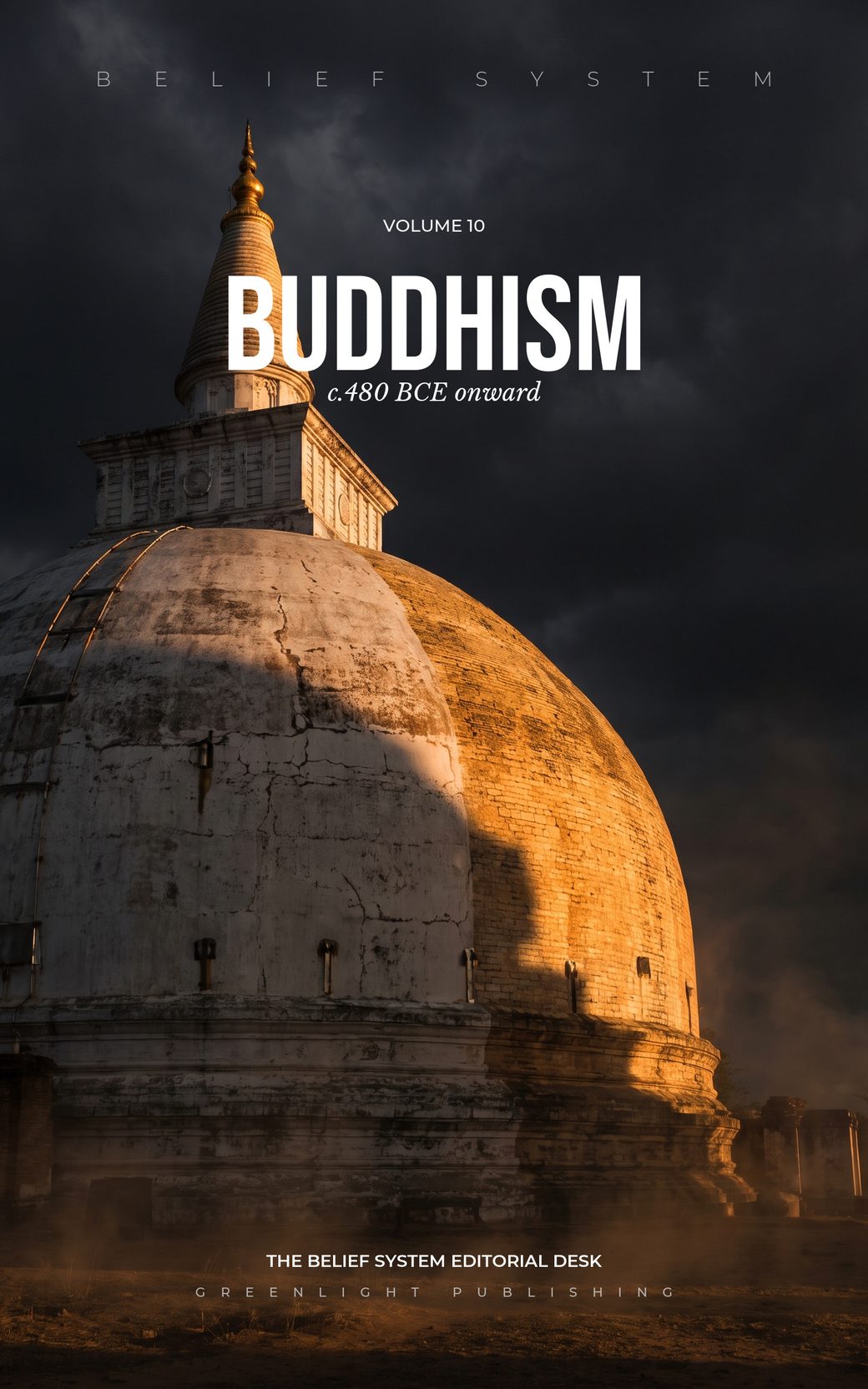
Jacket of Belief System volume 10, Buddhism
$12.99paperback

126 pages, 5.5 × 8.5 in. Three or more volumes in one order and every copy drops to $11.99.

copies

United States, 8 to 11 days. All destinations

Volume 10 Belief System c.480 BCE onward

Buddhism

The machinereciter guilds, and group chant as error-correction

Attested from
c.480 BCE

The earliest secure evidence, and the key this volume is filed under. All thirty-one

Narrates
c.480 BCE onward

The period the book actually covers. It is rarely the same figure.

The argument in one sentence

A teaching born with no usable writing survived its first four centuries as an organised act of group memory — specialist reciter guilds, a collection-by-collection division of labour, the chorus as error-correction — and this volume follows that machine from a famine-driven writing-down on palm leaf to the twelfth-century royal merger that decided which Buddhism survived, with every hinge along the way turning on property and discipline rather than metaphysics.

the canon was carried by organised reciter guilds for roughly four centuries and written down at Aluvihāra in the first century BCE by some five hundred monks racing a twelve-year famine that threatened to kill the last men who knew it.The commissioning line

What it is

At Aluvihāra, in a famine conventionally placed in the first century BCE, some five hundred monks wrote the canon onto palm leaf because the men who were the text were dying. The reciter guilds had carried it for roughly four centuries. The famine made the copy.

This is a history of that machine, and of how we know.

The event the tradition is named after is an event inside one man’s mind. This book cannot write it from the inside. It cannot tell you what the Buddha taught, only what a collection attributes to him, how that collection was carried, and how late the oldest surviving copy is. Three death-dates are printed, labelled, and none of them as history.

Five movements: the world it began in, the machine that carried it, the canon and who had the authority to close it, the money, and the first lasting split.

One number is absent: no share figure for monastic landholding in Sri Lanka appears at any date, because the figure in circulation did not verify.

The book never adjudicates. Every translation is named in the text. Every figure carries its source in the same sentence.

Belief System, Volume 10.

In full

Buddhism’s first four centuries are a transmission problem before they are a biography. Organised reciter lineages split the collections between them the way a firm splits files. Their job titles are cut into stone beside their donations. A chorus makes a variant audible the instant it is sung. A twelve-year famine threatened the men who were the text and put it onto palm leaf. A rule forbids a monk to handle silver, and a licensed layman holds it for him. A monastery payroll is cut into two stone slabs.

The teaching is given as the collections give it, dated to when those collections were written down. Sujato’s complete sutta translations, dedicated CC0, are the series’ licence copy and are named in the visible text every time they are used. The Theravada reckoning, the corrected long chronology and the post-Göttingen figure near 400 BCE are printed together and none of them as settled history.

The first lasting division — whether it came at the council the chronicles place about a century after the death, or generations later — is contested. The schools’ own accounts disagree. The fullest belongs to the winning party. This book names the disagreement instead of ending it.

The volume uses five fixed phrases, and no sixth. It reports no awakening as fact and denies none. It never tells you what anybody was thinking.

Belief System is a history of world religion, one tradition at a time. Thirty-one volumes, ordered by earliest secure attestation.

The contents

25 chapters in five movements. Every volume in the series has the same five, in the same order, and each chapter below is printed with the idea it carries.

Movement OneThe World

  1. 1Sixteen Kingdoms and a CoinOpen on the object — a bent bar of punch-marked silver: the teaching appears exactly where and when north India urbanises, with new cities, rice surplus, and money the old ritual order had no category for.
  2. 2The Man With Money and No StandingThe Vedic sacrificial economy had nothing to sell the new commercial class, and the renouncer movements did — the gahapati householder-donor is the figure the whole economy of this volume stands on.
  3. 3The Room Full of RenouncersThe Buddha was one wanderer in an established renunciation economy — the sramana movement is the room, the room is the historical datum, and this volume shares it explicitly with the Jainism volume: same cities, same patrons, Mahavira teaching in the same towns.
  4. 4The Life, ReportedThe canon contains no continuous life of the Buddha, and the familiar connected biography is a literary product of roughly half a millennium later — so this chapter reports the tradition’s story in the tradition’s voice, with no interior states and no adjudication.
  5. 5The Pillar at LumbiniNothing physical survives from within two centuries of the Buddha, so the earliest hard evidence for nearly everything in this volume is Ashoka’s — a pillar marking the birthplace, with a tax cut carved into it — and even the founder’s dates float within roughly eighty years.

Movement TwoThe Machine

The transmission technology, named as a concrete object or institution — not an abstraction.

  1. 6A Teaching With No WritingFor its first two centuries the teaching existed in a country with, as far as any evidence goes, no writing used for texts — so the community’s founding technical act was to convert forty-five years of a dead teacher’s talk into an institution of organised memory.
  2. 7The Reciter GuildsThe canon was divided among specialist lineages — Digha-bhanakas carrying the long discourses, Majjhima-bhanakas the middle-length, and so on, each lineage assigned one collection — a division of labour that turned an impossible individual memory problem into an ordinary institutional one.
  3. 8How a Chorus Corrects ItselfA lone reciter drifts and never knows it; a group chanting in unison exposes every variance the instant it occurs — so the unit of transmission was never one man’s memory but the synchronised assembly, with redundancy across independent lineages.
  4. 9Why the Texts Sound Like ThatThe repetition, the numbered lists and the formulaic passages that defeat modern readers are not bad writing but the visible engineering of a text built for choral memory — and this chapter proves it by demonstration, quoting one stock formula in Sujato’s translation each time it recurs, so the reader watches the same passage return word-for-word across different discourses and sees the machinery run.
  5. 10Five Hundred Monks Racing a FamineThe canon was written down not as progress but as triage: a twelve-year famine and a war threatened to kill the last men who carried the text, and the surviving reciters fixed it on palm leaf so that it could no longer die with them.
  6. 11Palm Leaf, and What Recopying DoesPrepared palm leaf rots in a tropical climate within a few centuries, so writing did not end transmission — it converted a chanting machine into a recopying machine, and every surviving Pali book is the far end of an unbroken chain of copies, with the standardisations and losses that a chain of copies imposes.

Movement ThreeThe Canon

What is in, what is out, who decided, when, and what the decision cost. The real subject is who had the authority to close it.

  1. 12Three Baskets, Unevenly OldThe canon sorts into discipline, discourse and systematics, and the third basket is visibly the youngest: the schools share versions of the first two and each built its own third — and the Pali third basket contains a book its own tradition dates two centuries after the Buddha.
  2. 13Who Had the Authority to Close ItNo decree ever closed the Pali canon; closure happened operationally — councils fixed agreed recitations, and in the fifth century the commentaries fixed the boundary by what they chose to comment on — so “closed” describes a practice, not an event, and the practice has been re-performed into living memory.
  3. 14What Is Actually in ThereA reader expecting three baskets of serenity finds case law with named repeat offenders, a chapter of medicine, snake-bite protection chants, building regulations and an anthology of enlightened women’s verse — the canon is a civilisation’s filing cabinet, and its contents are this chapter’s argument.
  4. 15The Canons That Did Not SurviveEvery early school carried its own canon and almost all of them are gone — so the Pali canon’s completeness is a fact about survival and institutional continuity, not about primacy, and the physically oldest Buddhist books in existence belong to a school that no longer exists.
  5. 16The Language ProblemThe tradition holds that the canon preserves the Buddha’s own tongue; the linguistics says Pali is a western literary dialect he would not have spoken, with eastern forms embedded in it like fossils — so even the oldest wording is a translation whose original is lost.

Movement FourThe Money

Who paid, who was paid, and how we know. Numbers get their provenance in the same sentence.

  1. 17Eight Possessions and a StewardThe rule of personal poverty is precise — three robes, a bowl, a razor, a needle, a belt, a water-strainer — and the same vinaya that forbids a monk to touch gold documents the lay-steward mechanism by which wealth moved anyway; the gap between the rule and the workaround is this movement’s subject.
  2. 18Ten Practices, and the One That MatteredAbout a century after the founder’s death, the tradition’s first constitutional crisis was a finance dispute: ten condemned practices with the acceptance of gold and silver at their centre, provoked — on the tradition’s account — by monks collecting money from the laity at the fortnightly assembly.
  3. 19The Poor Monk in the Rich MonasteryIndividual poverty and corporate wealth are a legal design, not a contradiction: property vests in “the sangha of the four quarters, present and absent” — a corporation that cannot die — and the earliest surviving picture of Buddhist money is literally a picture of money.
  4. 20The Monastery Owns the VillageIn Sri Lanka the corporate design scaled into monastic landlordism — monasteries holding villages, reservoirs and irrigation revenue, with salaried lay staff — and the evidence is administrative stone, not doctrine.

Movement FiveThe Split

What divided it, what it became, what it handed on. Names the next volume by NAME, never by number.

  1. 21The Separate RecitationIn a memorised religion, holding your own council is the schism: the first enduring division was expressed as a rival recitation — but whether it happened at the Second Council or generations later is contested, the losers’ own books tell a different story, and the losers’ monastic code is not the lax one.
  2. 22The Emperor’s MissionariesThe chronicle’s nine missions read as legend until the evidence splits cleanly: Ashoka’s own edicts prove envoys to five named Greek kings, and excavated relic caskets carry the names of the chronicle’s Himalayan missionaries — while for the mission this book most needs, Mahinda’s to Lanka, the hard evidence stays indirect.
  3. 23Two Monasteries, One ThroneFor over a thousand years Sri Lankan Buddhism was a two-party system — the same king who ordered the canon written founded the rival house — and the contest ran through royal patronage, textual policy and occasional demolition, with the chief surviving source written by one of the parties.
  4. 24The Merger of 1165Today’s Theravada is the Mahavihara lineage because a twelfth-century king forcibly merged the island’s three fraternities under Mahavihara discipline — the shape of a living world religion settled by one medieval act of consolidation, and the act left its own document in stone.
  5. 25The Other Answer to the Same ProblemWhile the Elders were closing a canon and fixing it on palm leaf, other Buddhists were composing new sutras and treating the copying of them as itself an act of merit — a different answer to the same transmission problem, and it becomes the Mahayana Buddhism volume, with the Tibetan Buddhism and Zen volumes further downstream.

What this volume cannot establish

Printed in the book before the argument is, and printed here for the same reason. A history of a tradition that will not say where its evidence runs out is not a history.

  • The founder’s dates, closer than about eighty years. The Theravada reckoning puts the death in 544/543 BCE; the corrected long chronology puts it about 486; since the Göttingen symposium of 1988 most specialists put it around 400. The volume gives all three, labels each, and never prints one as history.
  • Any fact about the founder from contemporary evidence. Nothing physical survives from within roughly two centuries of his conventional lifetime; the earliest hard evidence is Ashokan, and the connected biography is a literary product centuries later again.
  • What the Buddha actually said. The earliest surviving wording is in a western literary dialect he would not have spoken, first written down some four centuries after his death — and no manuscript survives from within roughly a thousand years of that writing-down.
  • Whether the First Council happened. The account of it is preserved inside the collection it authorises.
  • Whether the Mahasamghika separation occurred at the Second Council or generations later. The schools’ own accounts disagree, and so do the specialists.
  • The total scale of monastic landholding at any date. Grants are attested one by one, in stone; no defensible aggregate exists, and the commonly cited percentage for Kandyan temple land failed verification and does not appear in this book.

Buddhism, four ignitions

This tradition ignites more than once in the chronology. The other slots are Mahayana Buddhism, Zen, Tibetan Buddhism. See the thread.

Sources

76 works, dated, and specific enough that a reader can go and look at the thing. Nothing is on this list that the desk did not consult.

The bibliography, as the volume prints it
# Document or work Date Evidence for
1F. R. Allchin, The Archaeology of Early Historic South Asia1995Northern Black Polished Ware and the second urbanisation — surplus, not religion
2D. D. Kosambi on the Magadhan karsha weightmid-20th centuryfifty-four grains of silver for the royal punch-marked issue
3Osmund Bopearachchi on punch-marked chronologylate 20th–early 21st c.earliest issues possibly minted by sixth-century mahajanapadas
4Joe Cribb on punch-marked chronologylate 20th–early 21st c.a wholly independent Indian coinage from c. 1000 BCE no longer credited
5Numbered Discourses, sixteen-country list, Bhikkhu Sujato trans.SuttaCentral, CC0the soḷasa mahājanapada political map
6Jain Bhagavatī Sūtra (Vyākhyāprajñapti)compiled long after the eventsa rival sixteen-kingdom list that omits Gandhara and Kamboja
7Linked and Numbered Discourses on the gahapati / seṭṭhi, SujatoSuttaCentral, CC0householder-financier as the donor class the discourses address
8Sigālaka Sutta, SujatoSuttaCentral, CC0the household income split — enjoy, invest, reserve
9John Marshall, Alfred Foucher and N. G. Majumdar, The Monuments of Sanchi1940hundreds of merchant, banker, guild and village donor names
10Sanchi southern-gateway inscription of the ivory-workers of Vidisha1st c. BCEa craft guild signing the carving itself
11Long Discourses (Mallikā’s debate-hall; six teachers), SujatoSuttaCentral, CC0the sramana room and its six rival founders as a stock template
12Ashoka, seventh pillar edict, E. Hultzsch, Corpus Inscriptionum Indicarum I3rd c. BCE; ed. 1925officers assigned to the sangha, brahmins, Ajivikas and Niganthas
13Barabar cave dedications, Hultzschyear 12 of Ashoka; ed. 1925engineered caves given to the Ajivikas
14Nagarjuni Hill cave inscriptions, Hultzsch3rd c. BCE; ed. 1925the Ajivika donee-word later attacked with a chisel
15Mahāparinibbāna Sutta, SujatoSuttaCentral, CC0the one extended canonical narrative — the death, not the life
16Mahāvastulayers c. 2nd c. BCE–4th c. CEa connected life inside the Mahasamghika-Lokottaravada vinaya
17LalitavistaraSanskrit hagiography, centuries after the founderanother connected life
18Aśvaghoṣa, Buddhacarita, E. B. Cowell, Sacred Books of the Eastpoem c. early 2nd c. CE; trans. 1894court-epic life; last four Sanskrit cantos dated 1830
19Pali Nidānakathā5th c. CEJataka-commentary prologue underlying most English retellings
20Rummindei pillar, Hultzsch20th year of Ashoka; ed. 1925“Buddha Sakyamuni was born here”; tax cut; aṭhabhāgiya contested
21Nigali Sagar pillar, Hultzsch14th and 20th years of Ashoka; ed. 1925enlargement of Konakamana’s already standing stupa
22Heinz Bechert, Göttingen symposium on the dating of the historical Buddha1988short chronology around 400 BCE
23William Claxton Peppé, Piprahwa deposit1898the one contested pre-Ashokan relic claim
24Coningham, Allchin, Batt and Lucy, “Passage to India?”, Cambridge Archaeological Journal1996contested pre-Ashokan Brahmi on Anuradhapura potsherds
25Cullavagga, First Council, Bhikkhu Brahmali trans.SuttaCentral, CC0a communal recitation whose account lives inside the collection it authorises
26Heinrich Lüders, List of Brahmi Inscriptions1912bhāṇaka, suttantika, petaki, pañcanekāyika titles at Bharhut and Sanchi
27Mahinda Deegalle, Popularizing Buddhism: Preaching as Performance in Sri Lanka2006Sri Lankan cave inscriptions tying reciters to named collections
28E. W. Adikaram, Early History of Buddhism in Ceylon1946commentarial and inscriptional bhāṇaka lineages; famine narratives
29K. R. Norman, Pāli Literature1983reciter-group independence; eastern forms inside western Pali
30Chinese Dīrghāgama, Buddhayaśas recited, Zhu Fonian413Dharmaguptaka long collection as an independent stream
31Chinese Madhyamāgama, Saṅghadeva397–398Sarvastivada middle-length collection
32Richard Salomon, Ancient Buddhist Scrolls from Gandhāra1999British Library birch-bark scrolls, conventionally 1st c. BCE–3rd c. CE
33Ernst Waldschmidt, Turfan Sanskrit fragmentsmid-20th centurythird independent witness that lines up with Pali and Chinese
34Mark Allon, Style and Function1997Dīgha formulas and waxing-syllable regularities
35L. S. Cousins on Pali oral literature; five points in The Buddhist Forum vol. 2late 20th c.; Forum 1991oral composition; the Mahadeva theses reopened
36Rupert Gethin on the list as a memory devicelate 20th centurynumbered lists as the engineering of choral memory
37Dīpavaṃsa, Hermann Oldenberg trans.chronicle 4th–5th c.; trans. 1879writing-down notice; hostile “great recitation” of the seceders
38Mahāvaṃsa ch. 33, Wilhelm Geiger trans.chronicle 5th–6th c.; trans. 1912two-verse notice of the writing-down under Vaṭṭagāmaṇī
39David Drewes, Indo-Iranian Journal2015the first-century-BCE writing-down date contested
40Janice Stargardt, Pyu Pali inscriptionsobjects mid-5th to mid-6th c.oldest surviving pieces of canonical Pali, on durable material
41Oskar von Hinüber, The Oldest Pāli Manuscript1991four Kathmandu vinaya folios, c. 8th–9th c.
42Oskar von Hinüber, handbook of Pali literature1996apart from inscriptions and that fragment, manuscripts are late
43King Chulalongkorn’s Siamese printed canon1893first printed Pali canon — incomplete, in Thai script
44Günter Grönbold, bibliography of the canon’s printed editions1984which printed edition counts as the first complete one
45Kathāvatthuin-tradition Ashokan council; commentaries 5th c.a canonical book with an in-tradition author and date; shares only the genre with the Sarvastivada seven
46Ashoka, Calcutta-Bairat rock inscription, Hultzsch3rd c. BCE; ed. 1925seven named Buddhist titles; no mention of a Third Council
47Buddhaghosa’s commentarial corpus5th c., Mahaviharade facto boundary by what received a commentary
48Mandalay marble canon at the Kuthodaw Pagoda, 729 slabscarved 1860–68; Fifth Council 1871physical re-performance of closure
49Sixth Council, Rangoon1954–56another edited text claiming to add or remove nothing
50Vinaya “group of six” and medicine allowances, BrahmaliSuttaCentral, CC0case law and ointment boxes — a civilisation’s filing cabinet
51Therīgāthā, Sujato and C. A. F. Rhys Davids, Psalms of the Sistersverses early; Rhys Davids 1909anthology of nuns’ verse
52Dharmaguptaka vinaya in Chineseearly 5th c.the code still governing East Asian ordination
53Cullavagga, sakāya niruttiyā, BrahmaliSuttaCentral, CC0“own expressions” / “its own expressions” — both readings left standing
54Patimokkha relinquishment rules on gold and silver, BrahmaliSuttaCentral, CC0three consecutive forfeiture rules and the Upananda stories
55Mahāvagga, Meṇḍaka allowance, BrahmaliSuttaCentral, CC0deposits with a kappiyakāraka so a monk never holds the coin
56Cullavagga ch. 12, Vesālī council, BrahmaliSuttaCentral, CC0ten practices; money collected at the fortnightly assembly
57Lüders, Bharhut inscriptions, Corpus Inscriptionum Indicarum (B 32)c. 100 BCEAnathapindika’s Jetavana purchase carved as a carpet of coins
58Gregory Schopen, Bones, Stones, and Buddhist Monks1997monks and nuns as donors in the inscriptions
59Gregory Schopen, Buddhist Monks and Business Matters2004the same epigraphic file on monastic property
60Senarat Paranavitana, Inscriptions of Ceylon, vol. 11970early Brahmi cave-donations to the sangha of the four quarters
61R. A. L. H. Gunawardana, Robe and Plough1979Sri Lankan monastic landlordism
62Mihintale tablets of Mahinda IV, D. M. de Z. Wickremasinghe, Epigraphia Zeylanica10th c.; ed. 1912a monastery’s payroll on two public slabs
63Śāriputraparipṛcchā (Chinese)Mahasamghika account, later than the Pali hundred-year markthe losers’ story: elders expanding the vinaya
64André Bareau, survey of the early schools1955sorting of the council traditions
65Jan Nattier and Charles S. Prebish, History of Religions1977the Mahasamghika code in places the more conservative
66Ashoka, thirteenth rock edict, Hultzsch3rd c. BCE; ed. 1925Antiochus, Ptolemy, Antigonus, Magas, Alexander — the Greek synchronism
67Ashoka, second rock edict, Hultzsch3rd c. BCE; ed. 1925what the western envoys taught cannot be read from dhamma
68Alexander Cunningham, Bhilsa casket legendsopened 1851; pub. 1854Kassapagota, Majjhima and the Hemavatas matching the chronicle’s Himalayan mission
69Faxian, James Legge trans.on the island c. 399–414; trans. 1886five thousand monks at Abhayagiri, three thousand at the Mahavihara; texts taken to China
70Mahāvaṃsa on Vaṭṭagāmaṇī, Abhayagiri and Mahasena, Geiger5th–6th c.; trans. 1912the two-house contest, written by one of the houses
71Polonnaruwa Gal Vihara katikāvata12th c.the 1165 merger’s own monastic code in stone
72Continuation of the Mahāvaṃsa (Cūlavaṃsa) on Parākramabāhu Ireports 1165purification and absorption of the three fraternities
73Kalyani inscriptions, Taw Sein Ko trans.15th c. stones; trans. 1892foreign dating of the 1160s purification; Chapata’s Lankan ordination
74Lorna Dewaraja on the Siam Nikayadates the act 20 July 1753higher ordination reimported from Siam at Kandy
75Bhikkhu Sujato, Pali discourse translationsSuttaCentral, CC0the quoted English of the suttas
76Bhikkhu Brahmali, Vinaya translationsSuttaCentral, CC0the quoted English of the monastic law

Common questions

When is Buddhism first securely attested?

c.480 BCE. That is the earliest date the surviving evidence supports, and it is the key this volume is filed under. It is not the same claim as when the tradition began: the tradition’s own account of its beginning is printed beside it in the book’s front matter, never instead of it.

What period does the book cover?

c.480 BCE onward. The coverage span and the attestation date are two different facts, and the gap between them is often the most interesting thing about a volume.

What carried Buddhism?

Reciter guilds, and group chant as error-correction. Movement Two of every volume is about the transmission technology — the concrete object or institution that made copying possible, and would not have existed a century earlier.

How long is it?

About 29,500 words, roughly 125 minutes’ reading, 126 pages in the paperback. The audiobook runs 3h 07m, measured from the finished masters.

What does this volume not claim to establish?

The founder’s dates, closer than about eighty years. The Theravada reckoning puts the death in 544/543 BCE; the corrected long chronology puts it about 486; since the Göttingen symposium of 1988 most specialists put it around 400. The volume gives all three, labels each, and never prints one as history. Every volume prints its own limits before it prints its argument; there are 6 on this one’s list.

Does the book say which tradition is true?

No. Belief System does not adjudicate. Where the tradition’s account and the earliest evidence disagree, both are given, in their own vocabulary, attributed, and neither is given the last word. No miracle is reported as fact and none is denied.

Can I buy Buddhism in print?

Yes. It is a 5.5 × 8.5 in paperback, 126 pages, $12.99 a copy, bought direct rather than through a retailer. All thirty-one together are $199.00, with the ebook and the audiobook of every volume included.

The edition

The paperback
Trim5.5 × 8.5 in  /  140 × 216 mm
BindingPerfect-bound paperback, matte laminate
Paper60# uncoated cream, black ink
Extent126 pages
Editions and ISBNs
EditionExtentISBN
Paperback126 pages, 5.5 × 8.5 inISBN not yet issued
EbookEPUB979-8-90623-831-3
Audiobook3h 07m979-8-90623-832-0
Filed under
BISAC 1`REL017000` RELIGION / Comparative Religion
BISAC 2`REL007010` RELIGION / Buddhism / History
BISAC 3`REL033000` RELIGION / History
  • Buddhism
  • Pali canon
  • Aluvihara
  • Ashoka
  • Theravada
  • reciter guilds
  • history of religion
  • Vinaya
  • early Buddhism
  • comparative religion