126 pages, 5.5 × 8.5 in. Three or more volumes in one order and every copy drops to $11.99.
United States, 8 to 11 days. All destinations
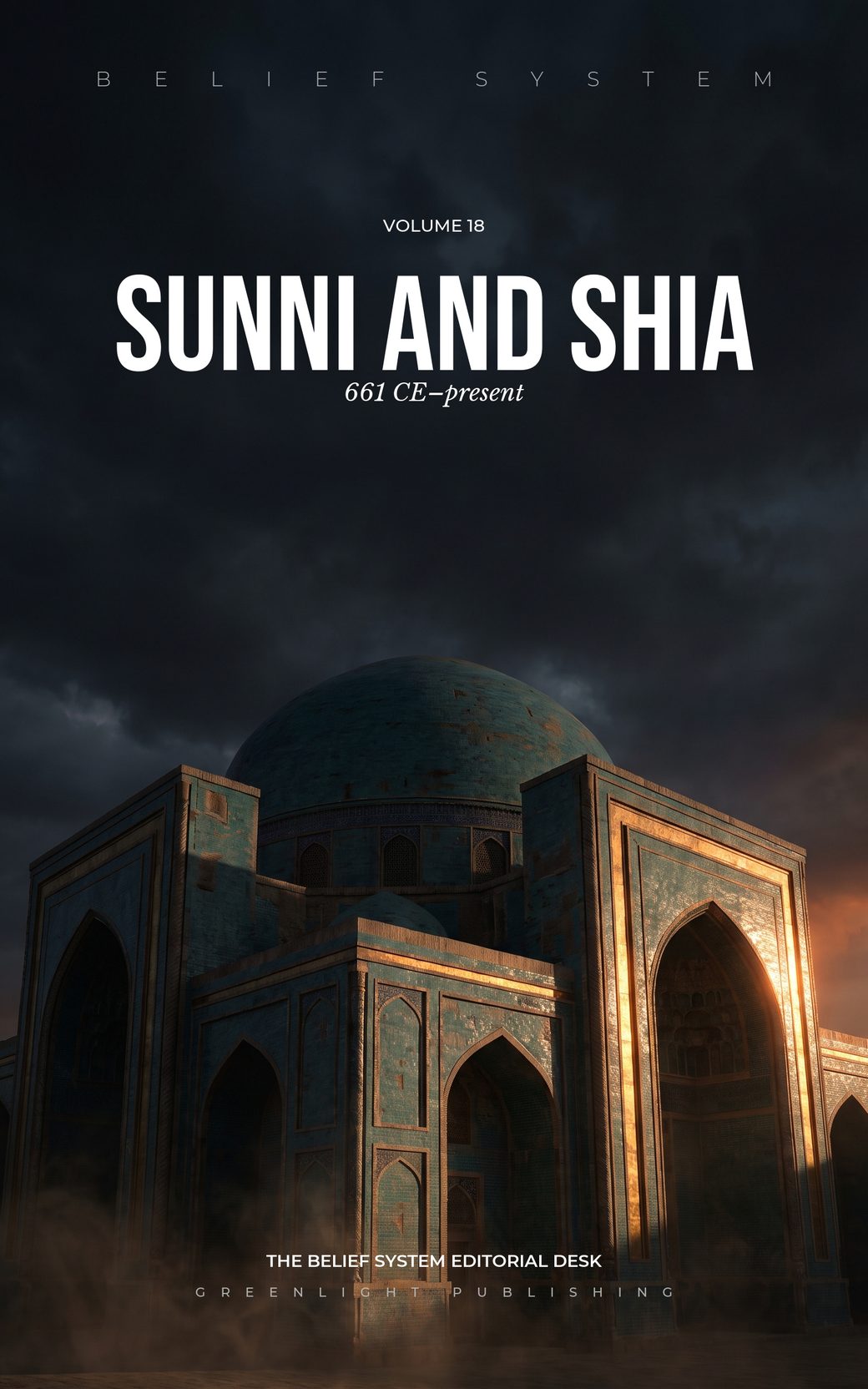
Volume 18 Belief System 661 CE–present
Sunni and Shia
The machinethe isnad — verification by named human chain
- Attested from
- 656 CE
- Narrates
- 661 CE–present
The earliest secure evidence, and the key this volume is filed under. All thirty-one
The period the book actually covers. It is rarely the same figure.
The argument in one sentence
The division that now runs through nearly two billion people began as a succession dispute no surviving seventh-century document records, and it endures not because either side won the argument but because everything built to settle it institutionalised it instead — a verification machine that grades men, two hadith canons grown from one shared scripture, a fifth of surplus paid to a jurist each payer chooses, and an annual mourning liturgy that renews the split without ever adjudicating it — until a state decree of 1501 drew the division onto the map the present still uses.
observant Twelver Shia pay a fifth of their annual surplus to a senior jurist of their own choosing: a voluntary transnational tax that keeps the Shia clergy financially independent of every state.The commissioning line
What it is
Observant Twelver Shia pay a fifth of their annual surplus to a senior jurist of their own choosing: a voluntary transnational tax that keeps the Shia clergy financially independent of every state.
This is a history of a split that began as a succession argument and became two verification machines, and of how we know.
Both sides agree on a death in 632 and a killing at Karbala. They do not agree on what was said at a pool, or in a portico, and this book does not choose. The reports come down through the same collectors, in the same kind of collection, transmitted by the same methods.
Five movements: the world after the first fitna, the machine of the isnad, the canons nobody closed, the money, and the map the present uses.
The book never adjudicates. Pickthall is named. Abdel Haleem and Saheeh are named only as unused.
Belief System, Volume 18.
In full
Sunni and Shia is a book about two cities and one method. Damascus leaves stones. Kufa leaves a party. The isnad — a named human chain — is the verification technology both sides built, and it is why neither corpus can be used to destroy the other.
Karbala is printed as a hard minimum: a date, a death, two framings, and neither given the last word. Ashura, the hidden Imam, the conversion of Iran, the call from Najd: each is dated to the documents that carry it. Wahhabism is the closing arc, not a thirty-second volume.
The fifth — khums paid to a jurist the payer chooses — is the money movement’s sharpest object, because it is still running and still voluntary. Endowments, salaried chairs, shrine economies: the figures that verify are printed; the ones that do not are left alone.
The volume uses five fixed phrases, and no sixth. It reports no designation as fact and denies none. It never tells you what anybody intended at Saqifa or at Ghadir Khumm.
Belief System is a history of world religion, one tradition at a time. Thirty-one volumes, ordered by earliest secure attestation.
The contents
26 chapters in five movements. Every volume in the series has the same five, in the same order, and each chapter below is printed with the idea it carries.
Movement OneThe World
The empire after 661, and the succession question stated twice — each account in its own terms, with its earliest sources named and dated. The two accounts run in the order of the volume’s title, an order the series fixed before this book was commissioned, and the text says so; neither gets the framing sentence, and neither gets the movement’s last word — the evidence chapter follows both.
- 1Two CitiesAfter 661 the empire is ruled from Damascus by the clan the conquests enriched, and the objection lives in Kufa — a garrison city on the Euphrates whose people had backed Ali and considered the settlement provisional — so that shi’at Ali, “the party of Ali,” is at first a political label from a civil war, decades older than any doctrine attached to it, and the earliest events this volume can date are a party being policed: Hujr ibn Adi, a partisan of Ali, executed on the government’s order in about 671.
- 2What Both Sides Agree HappenedBefore either case is put, the shared skeleton, because there is one: Muhammad died in 632 leaving no surviving son; Abu Bakr, Umar, Uthman and Ali held power in that sequence; Ali’s rule was contested from its first year; his son Hasan settled with Mu’awiya in 661 — none of this is disputed between the traditions, and the entire quarrel lives in one distinction the chapter states on the shared facts: whether holding the office made a man entitled to it, or entitled men were kept from an office others held.
- 3The Case for SelectionThe Sunni account, in its own terms: Muhammad left the choice to the community; legitimacy flows through the pledge (bay’a) and the community’s consensus (ijma'); the Companions as a generation are collectively probative ('adalat al-sahaba); and the first four rulers are remembered as the rightly guided caliphs, ranked in excellence in the order they ruled — a position with its own formation history, which the chapter dates rather than hides: ranking Ali fourth rather than contested took the better part of two centuries to become the badge of the majority.
- 4The Case for DesignationThe Shia account, in its own terms: legitimacy flows from designation (nass), not election; Muhammad designated Ali, and each imam designates his successor from the Prophet’s house (ahl al-bayt), carrying inherited knowledge ('ilm) and protection from error ('isma); and the account’s own strongest point, made in its own argument for centuries, is that its proof-texts stand in Sunni collections too — the Ghadir reports, the two weighty things, the Aaron-to-Moses comparison — so the fight is over reading, not over whether the reports exist.
- 5A Century Between Event and InkThe movement’s verdict on its own materials, applied to both accounts in the same sentence: the earliest connected narratives postdate the events by well over a century; the seventh century’s own documents — papyri, coins, inscriptions — tax, date and administer, and say nothing of Saqifa or Ghadir; near-contemporary outsiders attest the civil wars but not the claims; both cases stand on the same late shelf — and the tradition knew this about itself, because its answer, a named chain of men attached to every report, is the machine of the next movement.
Movement TwoThe Machine
The transmission technology, named as a concrete object: the isnad — a chain of named human transmitters attached to every report — and the rijal literature that audits the men in it. A citation apparatus with a reviewer database. No other tradition in this series built anything comparable, and that claim is the series’ own, made from having surveyed the shelf.
- 6The ChainEvery report (matn) travels with its sourcing (isnad) — A said that B told him that C heard D say — and the chapter opens with one real chain printed whole, name by name, before any theory, because the machine’s premise fits in one sentence: a claim is audited by auditing the people who carried it, which no reader of this series will mistake for a small idea.
- 7The JourneyChains were collected on foot: the rihla, the journey in search of hadith, is the machine’s supply line — a shorter chain to the source is a better chain, so scholars crossed the empire to hear old men and licensed what they heard through certified audition (sama') and onward permission (ijaza) — and the system’s paperwork survives physically, as audition certificates in manuscript margins, some listing women among the certified, because the licence followed the hearing, not the office.
- 8The Book of MenThe reviewer database: biographical dictionaries — the rijal literature, “the men” — logging tens of thousands of transmitters with dates, teachers, students and a verdict in a fixed vocabulary (thiqa, trustworthy; saduq, truthful; da’if, weak; matruk, abandoned; kadhdhab, liar), a genre whose own name for itself is the honest one — al-jarh wa-l-ta’dil, the wounding and the accrediting — and one entry is quoted whole, two lines long, so the reader sees that these are reviews, not biographies.
- 9Sound, Fair, WeakThe grading vocabulary — sahih (sound), hasan (fair), da’if (weak) — attaches to chains, not to events: the classical conditions ask whether the transmitters met, whether each was upright and accurate, and whether the report hides an 'illa, a defect only comparison of every known chain reveals — so a sahih grade is a verdict about transmission, which the tradition’s best graders said in their own terms, and grading is jurisprudence rather than arithmetic: the same report carries different grades from different graders, and does.
- 10Same Method, Different MenShia hadith science runs the same machine on a partly different pool: its own rijal dictionaries, its own grading scale — which contains the whole schism in one extra word, muwaththaq, reliable-but-of-the-wrong-allegiance — and a resolution device of its own, by which a contradictory report from an imam may be set aside as spoken under taqiyya, protective dissimulation, a rule that is itself a fact about what minority life cost; Companions central to one canon are marginal in the other, the imams are supreme links on one bench and ordinary transmitters on the other, and so the same technique applied to different men returns different results — the machine did not fail; it computed its inputs.
Movement ThreeThe Canon
Two canons out of one scripture. The movement opens with the argument, never with an entry — and the real subject is that nobody held the authority to close this canon, so grading scholars and buying readers closed it instead, twice, differently.
- 11The Canon Nobody ClosedThe argument first: the Qur’an was closed by a caliph inside a generation, but the second corpus — reports of what Muhammad said and did — had no Uthman, no council and no decree; it closed slowly, by scholars grading and communities adopting, across three centuries; the majority took its very name from the corpus it kept — ahl al-sunna wa-l-jama’a, the people of the practice and the community, a self-designation that crystallises among the hadith scholars in the ninth century — and the result is the oddity this movement exists to state plainly: a canon split without a scripture split, two traditions reciting one book and diverging almost entirely on the secondary corpus, a way of dividing that nothing else in this series exhibits.
- 12The SixThe Sunni canon: al-Bukhari (d. 870) and Muslim (d. 875) foremost, then the four Sunan — Abu Dawud (d. 889), al-Tirmidhi (d. 892), al-Nasa’i (d. 915), Ibn Majah (d. 887) — with al-Bukhari’s figures printed as exactly what they are, the tradition’s own numbers for itself: some six hundred thousand reports sifted to seven-thousand-odd with repetitions and under three thousand without, figures transmitted in biographies generations later and varying with the counting conventions — whether a matn recurring under different chains counts once or many times — because the traditional totals were reverence, never an inventory; and the set’s soft edge is the proof no one closed it: Ibn Majah’s seat was argued for centuries against Malik’s Muwatta and al-Darimi, and canonical rank arrived as commentary and curriculum, not decree.
- 13The FourThe Shia canon: al-Kafi of al-Kulayni (d. 941) foremost — “the Sufficient,” its doctrine, law and miscellany sections carrying a traditional count printed only as traditional — then Ibn Babawayh al-Saduq’s Man la yahduruhu al-faqih (d. 991) and al-Tusi’s Tahdhib al-Ahkam and al-Istibsar (d. 1067); the timing is the argument, and the chapter makes it once: the imams’ words were fixed into a corpus precisely across the decades in which, the tradition holds, the imam himself withdrew from availability — a canon assembled as a substitute for access — and the tradition audits its own shelf: later Shia scholars ran their own rijal grades over al-Kafi’s chains and marked many reports weak, the previous movement’s machine turned on this movement’s canon.
- 14One Scripture, Two CanonsThe comparison, symmetric by construction: across ritual, purity, commerce and ethics the two corpora agree massively — most of either canon would read as unremarkable in the other — and they diverge where legitimacy lives: succession, the standing of the Companions, the imamate; the transmitter pool splits along the seventh-century battle lines themselves — Aisha, a major transmitter in one canon, led an army against the first imam of the other — and the honest caveat is printed for both sides in the same paragraph: each tradition transmits early reports of material not in the codex, the Sunni collections carrying Umar’s stoning-verse sermon and early Shia circles having debated omissions before the mainstream settled on the standard text’s integrity, and both communities recite the same book anyway; then the movement hands Money its subject — canons and their scholars must be paid for, and how a scholar is paid sorts these traditions as cleanly as any doctrine.
Movement FourThe Money
Who paid, who was paid, and how we know. The strongest money story available to this series sits here: a voluntary transnational fifth that made one clergy fiscally independent of every state — set against the endowment and the salary, which made the other governable. Numbers get their provenance in the same sentence, and totals that cannot be sourced are not printed.
- 15The FifthKhums, “the fifth”: one verse assigns a fifth of ghanimtum — “that which ye take as spoils of war,” in Pickthall’s rendering — and the fiscal divergence of two traditions turns on the scope of that single verb, because Sunni law read it narrowly (war spoils, treasure, minerals) while Twelver jurisprudence read it as gain at large and by the classical period had defined the liable categories, the decisive one being arbah al-makasib, the year’s surplus of earnings — a levy on profit itself; half the fifth is the sahm al-imam, the imam’s share, and what to do with the imam’s money while the imam is hidden became a live juristic problem with a documented answer-history — bury it, hold it in trust, or spend it on his community through his deputies the jurists — which is the whole institutional future of Shia finance argued in advance.
- 16The Payer ChoosesThe marja’iyya: an observant Twelver selects a living jurist — a marja al-taqlid, a reference point for emulation — follows his rulings and pays the khums to his office, through agents (wukala) who collect and receipt it; the jurist’s treasury rises with his following, which makes the payers, collectively, the electorate — and the structural consequence is stated as structure: senior Shia jurists are funded by revocable personal allegiance, not by a state, a diocese or an endowment they must sit on, which makes the marja’iyya one of the very few clerical institutions in this series with real fiscal independence, an independence this movement documents and the volume’s final chapter complicates.
- 17The EndowmentThe first contrast: the waqf — property immobilised by deed, its income assigned in perpetuity to a named purpose — funded the Sunni world’s mosques, madrasas and scholars, and the deed is this series’ favourite kind of evidence, a document; but an endowment is real estate, and real estate sits where a state can see it, so the chapter follows the pattern — supervision, regulation, confiscation — through named, dated cases, and prints the test that proves the pattern structural rather than sectarian: Iran’s own great shrine endowments have sat under state-appointed custodians in every era, and khums never has, because allegiance is portable and land is not.
- 18The SalariedThe second contrast: the scholar on the payroll — the qadi appointed and paid from the first Islamic century; the Ottoman ilmiye as the fullest built version, a ranked hierarchy of judges and muftis on a salary ladder with the Şeyhülislam at its head; the modern successors as ministries — Turkey’s Diyanet (1924), al-Azhar reorganised by statute (1961), Saudi Arabia’s Council of Senior Scholars (1971) — and the great Sunni counter-example printed in the same chapter because fairness requires it and the story is better with it: the mihna, the ninth-century caliphal attempt to command doctrine, broken by the hadith scholars’ resistance with Ahmad ibn Hanbal’s imprisonment as its emblem, which made independence from the palace a Sunni credential too; the movement’s comparison then lands as structure, not motive — an establishment paid by the ruler answers, at a minimum, to a budget line, and the khums ledger runs the other way.
- 19The Shrine EconomyThe case study with receipts: Najaf and Karbala ran a documented transnational economy — pilgrimage; burial, because interment near Ali turned Najaf’s Wadi al-Salam into one of the largest cemeteries on earth, the corpse traffic taxed and fee’d in records the scholarship has used; and the Oudh Bequest, interest on a loan the king of Awadh made to the East India Company in the 1820s, earmarked for the mujtahids of Najaf and Karbala and disbursed for decades through British India, whose files itemise recipients and sums — a fifth-and-shrine economy passing, for a stretch of the nineteenth century, through an imperial ledger — and the movement closes on its hand-off: every account in this chapter exists because of one October morning in 680, which is where the next movement begins.
Movement FiveThe Split
What divided it, what it became, what it handed on. Karbala — and then the thing that matters more: a schism kept alive by a liturgy rather than by an argument. Then the branchings, the occultation, the map a state made, and the map the present uses. Present-day politics is reported as documented events with sources, and no living community’s motives are characterised. Hands on to the Sufism volume by name.
- 20KarbalaThe hard minimum first: Husayn ibn Ali, grandson of Muhammad, refused allegiance to the new caliph Yazid and was killed with a small company by government forces near the Euphrates on a date conventionally fixed as 10 Muharram 61 — 10 October 680; the earliest substantial narrative is a century younger than the day, the seventy-two dead and the speeches and the thirst belong to the maqtal genre and are printed as the tradition’s; then both framings, each in its own vocabulary, neither given the last word — in Shia telling the imam’s redemptive stand against usurpation, in Sunni telling a grievous crime against the Prophet’s family from within the community, with Yazid’s standing contested inside Sunni scholarship itself, where cursing him has been both defended and forbidden by named scholars — and no one’s thoughts are narrated: not Husayn’s, not Yazid’s, not anyone’s.
- 21AshuraThe chapter this movement exists for: the split is not carried by a proposition a council could rule on — it is renewed annually, in public, with bodies: the mourning assembly (majlis), the narrated lament (rawda, named for Kashifi’s Rawdat al-shuhada of about 1502), processions, chest-beating and in some communities self-flagellation, the ta’ziya passion drama of Qajar Iran, and the Arba’in walk to Karbala forty days on, today among the largest annual gatherings on earth — a living liturgy, written in the present tense — and its history is datable: the penitents at the grave in 684, expiating by dying where they had failed to fight; the Buyid decree of public mourning in Baghdad in 963 with markets shut, and the sectarian street-fighting the chroniclers report following it; so the argument lands plainly — an annually re-embodied grief does not need to win a debate; the liturgy transmits the verdict without ever holding the trial, a schism kept alive by a calendar.
- 22The BranchingsThe party of Ali divided over its own succession questions, at datable deaths, and each branch is given in its own terms: Zayd ibn Ali rose at Kufa in 740, and the Zaydi position — the imamate belongs to any qualified descendant who rises against injustice — built the least messianic and most durable of the smaller branches, a Zaydi imamate holding highland Yemen, with interruptions, from 897 to 1962; the death of Ja’far al-Sadiq in 765 parted the Ismaili and Twelver lines over which son carried the designation; the Ismaili trajectory ran to an empire — the Fatimid caliphate, 909–1171, a Shia dynasty ruling a mostly Sunni Egypt and founding al-Azhar, the future flagship of Sunni learning, a fact printed without comment — through the Nizari–Musta’li split of 1094, to a living imamate that still transfers by designation; and each branch’s dues follow its doctrine of the imam, which is the money movement echoed in miniature.
- 23The Hidden ImamIn 874 the eleventh imam died at Samarra, and the tradition holds that his young son entered concealment — ghayba — communicating for seven decades through four successive agents, then, from 941, through no one: the greater occultation, in which the community still lives, in the present tense; the chapter reports the doctrine in its own terms and documents what is documentable — the crisis, and the literature written to hold the line, because the tradition’s own writers describe a community fractured into more than a dozen positions at the imam’s death — and then draws the institutional consequence that completes the volume’s spine: an absent imam leaves his fifth and his rulings to his scholars, so the jurists’ custody of the imam’s share and the marja’iyya itself (the chapters called The Fifth and The Payer Chooses) are this doctrine’s fiscal and legal descendants.
- 24The Conversion of IranIn 1501 Ismail I took Tabriz and proclaimed Twelver Islam the religion of his new state — and Iran at that date was mostly Sunni, a fact the volume planted in the canon movement and cashes here: all six compilers of the Sunni canon had worked in the Persianate east; the conversion was a state programme prosecuted over two centuries — jurists imported from Jabal Amil (al-Karaki, d. 1534, granted lands and authority), public cursing of the first caliphs in the early decades, Sunni institutions suppressed — while on the other side of the new border the Ottomans hardened as the Sunni counter-state (Chaldiran, 1514; the chroniclers’ figures for the qizilbash persecuted are the chroniclers'), so the confessional map was drawn by two states from both sides, and it is the modern Middle East’s sectarian geography in first draft — the same principle the Reformation volume documents in Germany a generation later, the ruler’s religion becoming the realm’s, here applied at imperial scale.
- 25The Call from NajdThe closing arc opens in eighteenth-century Arabia: Muhammad ibn Abd al-Wahhab (d. 1792) preached, in his own vocabulary, tawhid against shirk — a stripped monotheism that condemned shrine visitation, intercession and saint-veneration, practices central to Shia devotion and to most Sufi practice alike — and his pact with the house of Saud (Diriyah, conventionally dated 1744) welded the call to a state; the documented collisions are printed as events with sources — the sack of Karbala in 1802 and the plunder of Husayn’s shrine, the demolitions of the al-Baqi tombs at Medina — with the register note applied in the text: “Wahhabi” is an exonym, the movement’s self-descriptions are muwahhidun and, later and more broadly, Salafi, and the chapter uses names the way this series always does, stating whose they are; the machine tie-back closes it — Salafism’s method is an appeal past the law schools to the graded report itself, and in the twentieth century al-Albani (d. 1999) re-graded the canonical collections and made hadith criticism a live public argument again: the volume’s machine, still running, still making communities.
- 26The Map the Present UsesThe volume ends on the present, kept strictly to documented events with sources and survey figures with dates, characterising no living community’s motives: the demography printed as the survey’s own ranges — Pew Research Center’s 2009 mapping put Sunnis at 87–90 per cent of Muslims and Shia at 10–13, with Oman’s Ibadis, heirs of the seceders in the Islam volume’s closing chapters, as the map’s third colour; Iran, 1979 — a revolution that put a jurist at the head of a state on a doctrine, velayat-e faqih, the guardianship of the jurist, described from Khomeini’s Najaf lectures of 1970, which converts the money movement’s independent marja’iyya into a governing office, a structural change the chapter reports as such while naming the contest over the doctrine among senior jurists as a contest; Iraq after 2003, with the February 2006 bombing of the al-Askari shrine at Samarra — the shrine of the two imams whose son the tradition holds entered concealment there — reported from the documentary record as the ignition of the worst sectarian killing in the country’s modern history; the Saudi–Iranian rivalry as datable acts — the execution of Nimr al-Nimr and the Tehran embassy attack of January 2016, the rupture, the 2023 restoration; and then the series’ close: the split survived because it was institutionalised — chains, canons, a fifth, a liturgy, a map — and the tradition’s next ignition is none of these but a method of devotion, franchised through lodges along the trade routes, that carried Islam further than any army: the Sufism volume.
What this volume cannot establish
Printed in the book before the argument is, and printed here for the same reason. A history of a tradition that will not say where its evidence runs out is not a history.
- Who was entitled to succeed Muhammad. The question the whole volume orbits. Both cases are given in full, each in its own vocabulary, with its earliest sources named and dated; the surviving evidence cannot decide between two theories of legitimacy articulated by later communities, and the volume does not try. The preface says this in terms.
- What was decided at Saqifa or said at Ghadir Khumm. The events belong to the Islam volume (the chapter called The Meeting in the Portico), which also established that the operative word at Ghadir cannot be fixed from the reports alone. This volume owns the doctrines built on those events, not the events.
- Anything about the succession dispute from the seventh century itself. The earliest connected narratives — Ibn Ishaq (d. 767) in Ibn Hisham’s (d. 833) recension, al-Baladhuri (d. 892), al-Tabari (d. 923) — postdate the founding events by well over a century. The gap bears on the Sunni account and the Shia account equally, and the volume says so wherever either account carries weight.
- What happened at Karbala beyond a hard minimum. — that Husayn ibn Ali and a small company were killed by Umayyad government forces near the Euphrates on a date conventionally fixed as 10 Muharram 61, October 680. The earliest substantial narrative is Abu Mikhnaf’s, roughly a century after the event, surviving embedded in later compilations; the speeches, the thirst and the count of seventy-two are the maqtal genre’s and are printed only as the tradition’s. No outside witness is known. And no one’s thoughts — on the field or before it.
- Whether any single hadith preserves Muhammad’s words. The grading vocabulary judges chains, not events; a sahih grade is a verdict about transmission. Whether the method reaches the founder’s generation is contested — Joseph Schacht argued the chains grow backward, Harald Motzki that parts of the corpus can be dated much earlier — and the contest is reported, not settled.
- The collection figures. Al-Bukhari’s six hundred thousand sifted to some seven thousand are the tradition’s own numbers for itself, transmitted in biographies written generations later and varying with counting conventions. There is no independent tally, of his corpus or any other.
- The birth, life or occultation of the twelfth imam. The tradition holds; what the volume can document is the holding itself — the crisis of 874 and the literature written to answer it.
- Which school’s rijal verdicts are right. The volume describes two graders applying one method to different pools of men. It does not grade the graders.
- Any modern total. Sectarian percentages are survey ranges, printed as ranges with source and date; Arba’in crowds, khums receipts and shrine revenues are printed as named claims or not at all.
- Anyone’s interior state. — at Saqifa, at Karbala, or in a present-day ministry.
Islam, three ignitions
This tradition ignites more than once in the chronology. The other slots are Islam, Sufism. See the thread.
Sources
89 works, dated, and specific enough that a reader can go and look at the thing. Nothing is on this list that the desk did not consult.
| # | Document or work | Date | Evidence for |
|---|---|---|---|
| 1 | Maronite Chronicle | Syriac, 660s | Mu’awiya’s throne at Damascus; outsiders see the fighting, not the claims |
| 2 | Hammat Gader bathhouse inscription | year 42 of the Arabs (662/3) | Mu’awiya named servant of God and commander of the faithful |
| 3 | Ta’if dam inscription, George Miles | 58 AH; pub. 1948 | Mu’awiya named as builder |
| 4 | al-Tabari | d. 923 | Hasan–Mu’awiya settlement; Hujr; Karbala via Abu Mikhnaf; the tawwabun of 684 |
| 5 | al-Baladhuri, Ansab al-Ashraf | d. 892 | settlement terms and Hujr’s execution, two centuries on |
| 6 | Najam Haider, The Origins of the Shi’a | 2011 | Kufa as the crucible |
| 7 | Hugh Kennedy, The Prophet and the Age of the Caliphates | 1986 | the Syrian court against the garrison city |
| 8 | al-Ya’qubi | d. c. 898 | the same four holders, from the other sympathy |
| 9 | Wilferd Madelung, The Succession to Muhammad | 1997 | the modern account that put the dispute back at the centre |
| 10 | Ibn Ishaq, in Ibn Hisham’s recension | Ibn Ishaq d. 767; Ibn Hisham d. 833 | Umar’s falta sermon; the connected biography at that distance |
| 11 | al-Bukhari, Sahih | d. 870 | the falta sermon; manzila; the opening isnad; the stoning-verse report |
| 12 | al-Fiqh al-Akbar, ascribed to Abu Hanifa | ascription contested; Abu Hanifa d. 767 | the four ranked as creed |
| 13 | al-Jahiz, Kitab al-Uthmaniyya | d. 869 | the argued case for the first three |
| 14 | Christopher Melchert, Ahmad ibn Hanbal | 2006 | Ali’s fourth seat consolidating; the hadith folk naming themselves |
| 15 | Patricia Crone, God’s Rule | 2004 | the political theory of selection |
| 16 | al-Tahawi, creed | d. 933 | the schoolbook caliphate clause |
| 17 | Ibn Hanbal, Musnad | d. 855 | Ghadir reports in a Sunni collection |
| 18 | Muslim, Sahih | d. 875 | the thaqalayn report; Ibn Sirin’s sentence on asking for men |
| 19 | Kitab Sulaym ibn Qays | dating contested | the book the tradition holds earliest |
| 20 | Hossein Modarressi, Tradition and Survival | 2003 | the Sulaym dating contest |
| 21 | al-Kulayni, al-Kafi | d. 941 | designation; the fifth as the house’s due; the taqiyya maxim |
| 22 | Mohammad Ali Amir-Moezzi, The Divine Guide in Early Shi’ism | 1994 | the doctrine in its own vocabulary |
| 23 | S. H. M. Jafri, The Origins and Early Development of Shi’a Islam | 1979 | the narrative history of designation |
| 24 | Robert Hoyland, Seeing Islam as Others Saw It | 1997 | the external file: wars visible, claims not |
| 25 | Gregor Schoeler, The Oral and the Written in Early Islam | 2006 English | why the first connected books are late |
| 26 | G. H. A. Juynboll, Muslim Tradition | 1983 | the isnad as a historical object |
| 27 | Harald Motzki, isnad-cum-matn studies | 1990s–2000s | the same machine reused on the historians’ bench |
| 28 | Joseph Schacht, The Origins of Muhammadan Jurisprudence | 1950 | chains grow backward — the other pole of the contest |
| 29 | Konrad Hirschler, The Written Word in the Medieval Arabic Lands | 2012 | audition certificates in manuscript margins |
| 30 | Garrett Davidson, Carrying on the Tradition | 2020 | later ijaza culture |
| 31 | al-Khatib al-Baghdadi on the rihla | d. 1071 | the tradition’s own theory of the journey |
| 32 | Ibn Abi Hatim al-Razi, al-Jarh wa-l-ta’dil | d. 938 | the quoted two-line review |
| 33 | Ibn Sa’d, Tabaqat | d. 845 | generations before the look-up book |
| 34 | al-Bukhari, al-Tarikh al-Kabir | ninth century | the look-up |
| 35 | al-Mizzi, Tahdhib al-Kamal | d. 1341 | the men of the six consolidated |
| 36 | Eric Dickinson, The Development of Early Sunnite Hadith Criticism | 2001 | early Sunni grading as a craft |
| 37 | Scott Lucas, Constructive Critics | 2004 | the reviewer culture around the six |
| 38 | Ibn al-Salah, Muqaddima | d. 1245 | grades codified two centuries after the collectors |
| 39 | al-Tirmidhi, Jami' | d. 892 | hasan as a working grade |
| 40 | Jonathan Brown, Hadith: Muhammad’s Legacy in the Medieval and Modern World | 2009 | the modern survey of the grading vocabulary |
| 41 | al-Kashshi, rijal | tenth century | Imami men, compiled from reports about the imams’ companions |
| 42 | al-Najashi, Rijal | d. c. 1058 | the other early Imami dictionary |
| 43 | al-Tusi, Rijal and Fihrist | d. 1067 | a list of men and a list of books |
| 44 | al-Tusi, al-Istibsar | d. 1067 | rules for contradictory reports, taqiyya among them |
| 45 | Etan Kohlberg, studies of Imami views of the Companions | late twentieth century | the transmitter pool split along the battle lines |
| 46 | Liyakat Takim, The Heirs of the Prophet | 2006 | same method, different supreme links |
| 47 | Andrew Newman, The Formative Period of Twelver Shi’ism | 2000 | a study built directly on al-Kafi |
| 48 | Jonathan Brown, The Canonization of al-Bukhari and Muslim | 2007 | canonicity as a slow, uncommanded consensus; the contested sixth seat |
| 49 | Michael Cook, “The Opponents of the Writing of Tradition in Early Islam,” Arabica | 1997 | early resistance to writing the second corpus |
| 50 | Abu Dawud, al-Nasa’i, Ibn Majah, Sunan | d. 889, 915, 887 | the rest of the six; Ibn Majah’s seat argued for centuries |
| 51 | Ibn Babawayh, Man la yahduruhu al-faqih | d. 991 | the second of the four |
| 52 | al-Tusi, Tahdhib al-Ahkam | d. 1067 | the legal recension of the four |
| 53 | Hossein Modarressi, Crisis and Consolidation in the Formative Period of Shi’ite Islam | 1993 | compilation across the occultation’s opening; the crisis after 874 |
| 54 | al-Majlisi, Mir’at al-'uqul | seventeenth century | later grading of al-Kafi; proportions of weak reports not printed |
| 55 | Hossein Modarressi, “Early Debates on the Integrity of the Qur’an,” Studia Islamica | 1993 | both caveats with names and dates; one Book anyway |
| 56 | Qur’an 8:41, Marmaduke Pickthall, The Meaning of the Glorious Koran | 1930 | ghanimtum — the verb the two laws split |
| 57 | Norman Calder, “Khums in Imami Shi’i Jurisprudence,” BSOAS | 1982 | bury it, hold it in trust, or spend it through deputies |
| 58 | Meir Litvak, Shi’i Scholars of Nineteenth-Century Iraq | 1998 | agencies, rival followings, the Oudh stream |
| 59 | Linda Walbridge (ed.), The Most Learned of the Shi’a | 2001 | the living office when the paperwork becomes visible |
| 60 | Nizamiyya of Baghdad, founded by Nizam al-Mulk | 1067 | endowed learning as a dated chair |
| 61 | Egyptian waqf statutes | 1952 | family endowments abolished; the rest absorbed by a ministry |
| 62 | R. C. Repp, The Müfti of Istanbul | 1986 | the ilmiye’s ranks and salaries |
| 63 | Muhammad Qasim Zaman, The Ulama in Contemporary Islam | 2002 | ministries as heirs of the payroll |
| 64 | Patricia Crone and Martin Hinds, God’s Caliph | 1986 | the mihna, 833 to the late 840s |
| 65 | Diyanet; al-Azhar reorganisation; Saudi Council of Senior Scholars | 1924; 1961; 1971 | modern budget lines for a salaried establishment |
| 66 | Juan Cole, “'Indian Money’ and the Shi’i Shrine Cities of Iraq, 1786–1850,” Middle Eastern Studies | 1986 | the Oudh Bequest through British clerks |
| 67 | Yitzhak Nakash, The Shi’is of Iraq | 1994 | corpse traffic and shrine revenue |
| 68 | Abu Mikhnaf, Karbala narrative embedded in al-Tabari | d. 774 | earliest substantial account; Kufan, pro-Alid pipe |
| 69 | Heinz Halm, Shi’ism | 1991 | the hard minimum and the later tellings |
| 70 | Ibn al-Jawzi | d. 1201 | cursing Yazid defended; the 963 riots, centuries on |
| 71 | al-Taftazani | fourteenth century | the other Sunni pole: cursing Yazid forbidden |
| 72 | Kashifi, Rawdat al-shuhada | c. 1502 | the preached lament that named the rawda |
| 73 | Ibn al-Athir | d. 1233 | the 963 decree and the street-fighting, centuries on |
| 74 | Yitzhak Nakash, “An Attempt to Trace the Origin of the Rituals of ʿAshuraʾ,” Die Welt des Islams | 1993 | from Kufan penitents to a public rite |
| 75 | Kamran Aghaie, The Martyrs of Karbala | 2004 | the liturgy as a transnational calendar |
| 76 | Peter Chelkowski (ed.), Ta’ziyeh: Ritual and Drama in Iran | 1979 | the Qajar passion play |
| 77 | al-Nawbakhti, Firaq al-Shi’a | c. 900 | earliest sect-list; his count of factions after 874 |
| 78 | Farhad Daftary, The Isma’ilis: Their History and Doctrines | 1990 | Fatimids to the living Nizari imamate |
| 79 | al-Saduq, Kamal al-din | tenth century | defence literature; purpose stated in its own preface |
| 80 | Rula Jurdi Abisaab, Converting Persia | 2004 | jurists imported from Jabal Amil; the two-century programme |
| 81 | Andrew Newman, Safavid Iran | 2006 | the state that drew the map |
| 82 | Ibn Bishr, 'Unwan al-majd | nineteenth century | the 1802 raid from inside the Najdi file |
| 83 | Michael Cook, “On the Origins of Wahhabism,” JRAS | 1992 | dating the call |
| 84 | Michael Crawford, Ibn 'Abd al-Wahhab | 2014 | the named modern life of the preacher |
| 85 | David Commins, The Wahhabi Mission and Saudi Arabia | 2006 | the mission into a state |
| 86 | Pew Research Center, Mapping the Global Muslim Population | 2009 | Sunni 87–90 per cent, Shia 10–13 — ranges as ranges |
| 87 | Khomeini, Islamic Government | Najaf lectures, 1970 | velayat-e faqih described, not quoted |
| 88 | Fanar Haddad, Sectarianism in Iraq | 2011 | after the 2006 Samarra bombing |
| 89 | International Crisis Group reporting on Samarra | 2006 | the bombing as ignition, from the documentary file |
Common questions
When is Sunni and Shia first securely attested?
656 CE. That is the earliest date the surviving evidence supports, and it is the key this volume is filed under. It is not the same claim as when the tradition began: the tradition’s own account of its beginning is printed beside it in the book’s front matter, never instead of it.
What period does the book cover?
661 CE–present. The coverage span and the attestation date are two different facts, and the gap between them is often the most interesting thing about a volume.
What carried Sunni and Shia?
The isnad — verification by named human chain. Movement Two of every volume is about the transmission technology — the concrete object or institution that made copying possible, and would not have existed a century earlier.
How long is it?
About 29,500 words, roughly 125 minutes’ reading, 126 pages in the paperback. The audiobook runs 3h 18m, measured from the finished masters.
What does this volume not claim to establish?
Who was entitled to succeed Muhammad. The question the whole volume orbits. Both cases are given in full, each in its own vocabulary, with its earliest sources named and dated; the surviving evidence cannot decide between two theories of legitimacy articulated by later communities, and the volume does not try. The preface says this in terms. Every volume prints its own limits before it prints its argument; there are 10 on this one’s list.
Does the book say which tradition is true?
No. Belief System does not adjudicate. Where the tradition’s account and the earliest evidence disagree, both are given, in their own vocabulary, attributed, and neither is given the last word. No miracle is reported as fact and none is denied.
Can I buy Sunni and Shia in print?
Yes. It is a 5.5 × 8.5 in paperback, 126 pages, $12.99 a copy, bought direct rather than through a retailer. All thirty-one together are $199.00, with the ebook and the audiobook of every volume included.
The edition
| Trim | 5.5 × 8.5 in / 140 × 216 mm |
|---|---|
| Binding | Perfect-bound paperback, matte laminate |
| Paper | 60# uncoated cream, black ink |
| Extent | 126 pages |
| Edition | Extent | ISBN |
|---|---|---|
| Paperback | 126 pages, 5.5 × 8.5 in | ISBN not yet issued |
| Ebook | EPUB | 979-8-90623-847-4 |
| Audiobook | 3h 18m | 979-8-90623-848-1 |
| BISAC 1 | `REL017000` RELIGION / Comparative Religion |
|---|---|
| BISAC 2 | `REL037010` RELIGION / Islam / History |
| BISAC 3 | `REL033000` RELIGION / History |