Belief System
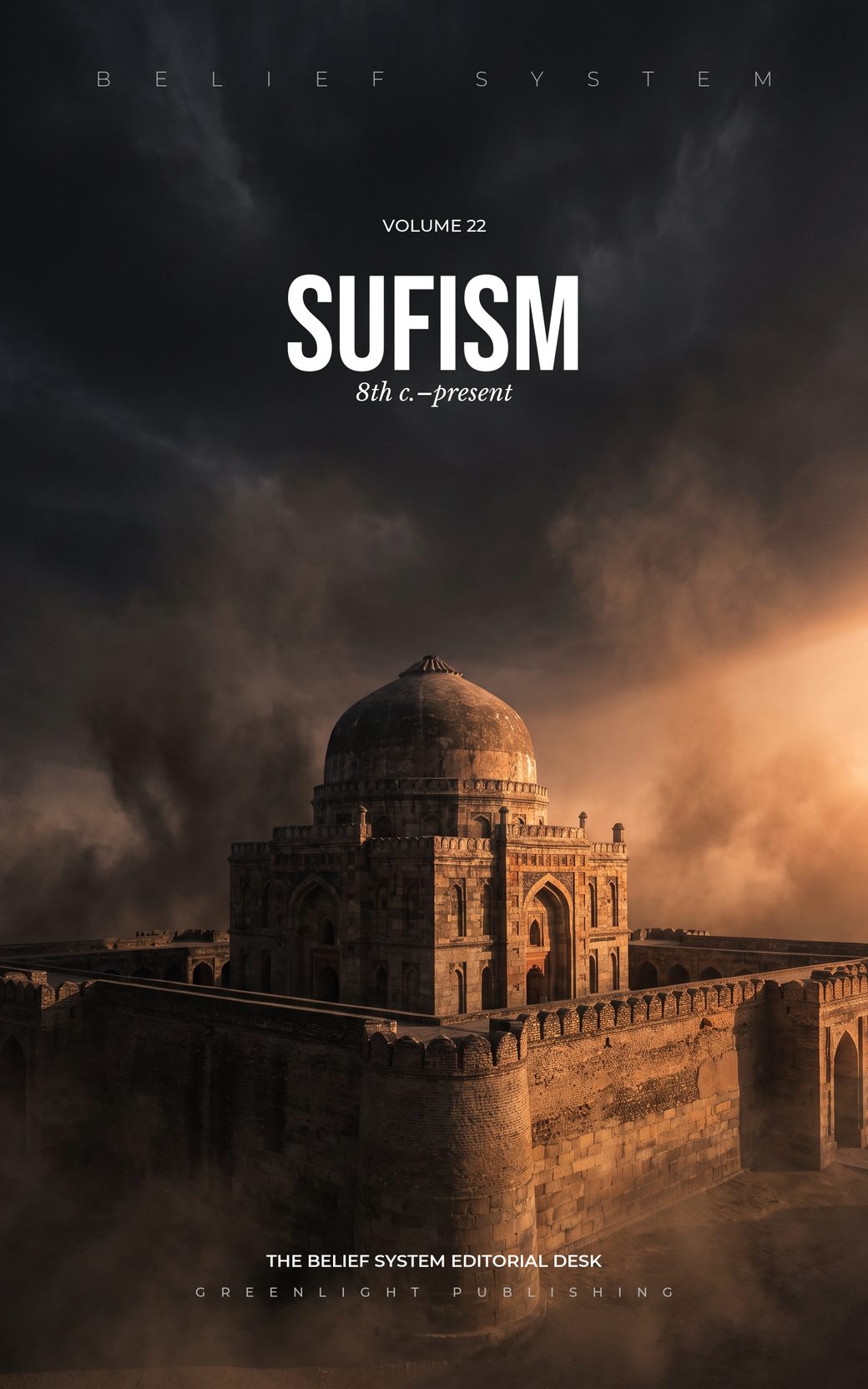
Jacket of Belief System volume 22, Sufism
$12.99paperback

130 pages, 5.5 × 8.5 in. Three or more volumes in one order and every copy drops to $11.99.

copies

United States, 8 to 11 days. All destinations

Volume 22 Belief System 8th c.–present

Sufism

The machinethe order as a franchise

Attested from
8th c. CE

The earliest secure evidence, and the key this volume is filed under. All thirty-one

Narrates
8th c.–present

The period the book actually covers. It is rarely the same figure.

The argument in one sentence

A private discipline of renunciation, visible by the eighth century, was packaged from the twelfth into something no other tradition in this series built — a franchise, in which a certified chain of transmission, a defined method, a licence to initiate and an endowed lodge could be replicated across languages and empires with no central authority at all — and the missing centre is the whole story, because nothing in Sufism could ever be closed: not its canon, which is manuals, poems and saints’ lives standing in for a scripture it never had; not its money, which survives as deeds without ledgers; and not its oldest argument, which runs from a Baghdad scaffold in 922 to demolished shrines within living memory.

a Sufi order governs Senegal’s second city. Touba, with 1.12 million people at the 2023 census, is run by the Mouride khalifa-general with its own legal status and tax exemptions inside the republic.The commissioning line

What it is

A Sufi order governs Senegal’s second city. Touba, with 1.12 million people at the 2023 census, is run by the Mouride khalifa-general with its own legal status and tax exemptions inside the republic.

This is a history of a franchise — a certified chain, a defined method, a licence to initiate, an endowed lodge — and of how we know.

Nothing in Sufism could ever be closed: not its canon, which is manuals, poems and saints’ lives standing in for a scripture it never had; not its money, which survives as deeds without ledgers; and not its oldest argument, which runs from a Baghdad scaffold in 922 to demolished tombs within living memory.

Five movements: the world of the wool-wearers, the machine of the lodge, the substitute canon, the money, and the argument that does not end.

The book never adjudicates. Nicholson is named. Barks is named as unused.

Belief System, Volume 22.

In full

Sufism is orders inside Islam, three memberships, no closer. A recited list of names licenses a living person to initiate others. A patched cloak and a written licence make a complete copy of the order in a new city. The building’s name changes with the language while the institution does not: khanqah, ribat, zawiya, tekke, dargah.

Hallaj is split into chronicle versus compilation. Hujwiri will not ban him and will not approve him. Rumi domesticates the scaffold by putting it in verse. Later jurists quote the charge. Later demolitions quote the charge again, with bulldozers.

Waqf deeds outlive everyone named in them. Order-specific figures that do not verify are not printed. The Magal totals that did not verify are left alone. Ottoman land-share is printed as contested.

The volume uses five fixed phrases, and no sixth. It reports no union as fact and denies none. It never tells you what the man on the scaffold intended.

Belief System is a history of world religion, one tradition at a time. Thirty-one volumes, ordered by earliest secure attestation.

The contents

26 chapters in five movements. Every volume in the series has the same five, in the same order, and each chapter below is printed with the idea it carries.

Movement OneThe World

Not a sect and not a schism — a set of orders inside Islam, and getting that framing right is the first chapter’s whole job. Then the two-stage ignition: eighth-century renunciants, and the twelfth-century turn from private piety to organised orders.

  1. 1Three MembershipsThe most venerated Sufi in the world was a Hanbali jurist — Abd al-Qadir al-Jilani preached law in Baghdad — and that is the framing fact the whole volume hangs on: a Muslim holds a school of law, a sect, and an order as three separate memberships, so Sufism is not a denomination beside Sunni and Shia Islam but a set of methods and institutions inside both; the popular Western picture — a poetry-and-tolerance package with the institutions removed — is named on page one as the thing this book corrects, by describing the institutions.
  2. 2The Preacher of BasraBasra in Hasan al-Basri’s lifetime (conventionally d. 728) was a garrison boomtown swollen with conquest revenue, and the renunciant style he came to stand for — coarse dress, weeping, contempt for the new wealth — answers that room; but the sentence carries the caveat: his sermons and sayings reach us in compilations assembled generations later, later movements from the Mutazila to the Sufi orders all claimed him as a founder, and the scholarship contests how much of the corpus is his.
  3. 3The Freedwoman of BasraRabia al-Adawiyya (conventionally d. 801) is the tradition’s great counter-figure — a freedwoman, unmarried, placed by the legend above the men who visit her — and the chapter’s real subject is the gap between the earliest notices, which are brief, and the connected life everyone knows, which is Attar’s, written about four centuries later; what the legend does institutionally is measurable even where the woman is not: it put a woman at the head of the genealogy of love-mysticism, and an early collection shows she was once one of dozens of recorded Sufi women, not the exception she became.
  4. 4The Wool-WearersIn ninth- and tenth-century Baghdad and Khurasan the scattered renunciant styles acquire a collective name — sufi, which the classical manuals themselves derive, doubtfully, from suf, wool — and a social form that is not yet an order: circles around masters, Junayd’s sober Baghdad school, Bayazid Bistami’s ecstatic sayings transmitted from Khurasan, and Nishapur’s Malamatiyya, who courted blame to kill reputation; everything the orders will later franchise — master, pupil, method, chain — exists here in prototype, with no lodge, no licence and no succession.
  5. 5The Professor ResignsIn 1095 the most prestigious law professor in Sunni Islam — al-Ghazali, holder of the Nizamiyya chair in Baghdad — walked out of his post, and the account of why survives in his own written autobiography, which is exactly the kind of source this series can use: his Deliverance from Error reports, in his own words, a crisis of certainty resolved by Sufi practice; the institutional event is bigger than the personal one, because his Revival of the Religious Sciences is built in the shape of a law book, and it argued to the jurists, in their own genre, that Sufi discipline was not a rival to the law but its completion — which is the respectability the orders would build on.
  6. 6The Posthumous FoundersEvery great order is named for a man who never knew it existed — al-Jilani (d. 1166) preached in Baghdad and the Qadiriyya was organised by his sons; al-Rifai (d. 1182), Abu’l-Hasan al-Shadhili (d. 1258), Mu’in al-Din Chishti (conventionally d. 1236) and Rumi (d. 1273) were all turned into orders by successors — and this pattern is the hinge of the whole volume: the twelfth-century turn is not a founder founding but a package crystallising, in a Seljuk and Ayyubid world that had just invented the endowed madrasa and could copy the model, and once the package existed it could be replicated by anyone holding a licence, which is Movement Two’s subject.

Movement TwoThe Machine

The transmission technology, named as a concrete object or institution — not an abstraction. Here it is a four-part package: the chain, the method, the licence and the lodge — the tariqa as a franchise, and the volume’s spine.

  1. 7The ChainEvery order’s authority is a recited list of names — the silsila, running from the living shaykh back through the eponym, through Junayd, to a companion of the Prophet and so to the Prophet himself — and it is structurally the same idea as the isnad, which the Sunni and Shia volume owns, with one decisive difference: it authenticates persons and practices rather than reports, so what travels down it is not a text but a licence to transform people; the links back to the mid-ninth century join men who demonstrably lived, the earlier links cannot be established and scholars treat them as retrospective, and the chapter uses the chain the way this volume always will — as evidence of what an order claimed.
  2. 8The MethodWhat a chain licenses is a method — a defined dhikr, the repetition of divine names counted, timed and breathed in the order’s own way — and the method is the product that differentiates one franchise from another: the Naqshbandi silent dhikr with its enumerated principles (“solitude in the crowd”, khalwat dar anjuman, in the order’s own Persian), the Mevlevi turning ceremony codified generations after Rumi, the Rifai loud dhikr that travellers reported with amazement, the Shadhili litanies a member could carry through a working urban life; the warrant every order cites is the same Qur’anic instruction, and the differentiation on top of it is where the machinery lives.
  3. 9The Cloak and the LicenceThe franchise replicates by investiture — the patched cloak (khirqa) laid on a disciple, the written ijaza or khilafat-nama that licenses him to initiate others, granted by an existing shaykh and by no one else — and this is the machine’s genius and its whole governance: there is no headquarters to consult and none to rebel against, a khalifa dispatched to a new city is a complete, self-certifying copy of the order, and the same mechanism that made expansion effortless made schism painless, because a disputed succession simply produces two lineages, both documented, both valid by their own chains.
  4. 10The Lodge in Four LanguagesThe package lands in a building, and the building’s name changes with the language while the institution does not — khanqah in the Persian east, ribat and zawiya in the Arab lands and the Maghreb, tekke in Turkish, dargah where a tomb anchors it in South Asia — which is the distribution map written into vocabulary; the lodge is residence, kitchen, school, hospice and stage in one endowed plant, it had a written rulebook, and a Cairo example shows the state building the plant deliberately: Saladin founded the Sa’id al-Su’ada in 1173 with stipends for resident Sufis, the tradition’s figure of three hundred printed as the tradition’s.
  5. 11Further Than the ArmiesPut the four parts together and the result out-travelled every rival institution of its age — Qadiri lodges from the Maghreb to Bengal, Naqshbandi lineages into China where the order’s sober-versus-vocal dhikr argument re-ran itself in Gansu, Bektashis moving with the Ottoman frontier into the Balkans, orders on the monsoon routes into the archipelago, the Qadiriyya and then the Tijaniyya across the Sahara — and the strong claim, that the orders and not the armies were Islam’s main expansion mechanism, is printed as what it is: the scholarship’s argument, supported in some regions and complicated in others, with Bengal as the named complication.

Movement ThreeThe Canon

What is in, what is out, who decided, when, and what the decision cost. Here the finding is prior: there is no canon, no closing ever happened, and no one held the authority to attempt one — so the movement is about the three bodies of writing that substituted. It opens with that argument, never with a book.

  1. 12A Canon With No CloserSufism never produced a scripture, a creed or a council, and could not have — its warrant was the Qur’an, which the Islam volume owns, and its authority structure was ten thousand independent chains with no synod above them — so the canonical function was performed by three substitute genres, each solving a different problem: manuals to prove respectability, poetry to carry the teaching across languages, and saints’ lives to underwrite the shrines; the chapter states the argument and the cost, which is that a canon nobody can close is also a canon nobody can defend a border of, and every later fight in Movement Five is downstream of that.
  2. 13The ManualsBetween the late tenth and mid-eleventh centuries the discipline wrote itself a defensive literature — al-Sarraj’s Kitab al-Luma' (author d. 988), al-Kalabadhi’s Ta’arruf, al-Qushayri’s Risala (which dates itself; verify the year before print), and Hujwiri’s Persian Kashf al-Mahjub — codifying the path as a ladder of stations earned and states bestowed, precisely so the jurists could inspect it; the codification is the institutional event: a discipline that writes its own syllabus and its own limits is applying for a place inside orthodoxy, and the application, though never formally granted, was never formally refused.
  3. 14The Curriculum in VerseThe nearest thing Sufism has to a transmitted canon is poetry — Sanai and Attar building the didactic masnavi, Rumi’s Masnavi (some twenty-six thousand couplets; the count varies by edition and the sentence says so) which a later tradition, attributed to Jami, called the Qur’an in the Persian tongue; Ibn al-Farid in Arabic, Yunus Emre in Anatolian Turkish, Hafiz — whose Sufism is itself contested, and the contest is reported — and the distribution fact worth a paragraph of its own: this tradition produced a vernacular literature of the first rank while Islam’s formal learning was overwhelmingly Arabic, so the curriculum travelled in languages the madrasa did not teach, memorised, sung, and carried by people who could not read the law books.
  4. 15The Greatest MasterIbn Arabi (d. 1240) is the tradition’s substitute for a theologian-in-chief — al-Shaykh al-Akbar, the greatest master — whose Fusus al-Hikam and vast Futuhat al-Makkiyya became the theoretical curriculum of orders from the Maghreb to the archipelago, carried by commentary the way a canon is carried by exegesis; the record shows an autograph of the Futuhat survives, Osman Yahia’s census counted the commentaries in three figures, and the label his system wears — wahdat al-wujud, the unity of being — is his readers’ coinage rather than his own phrase, which matters because the label, not the books, is what the jurists in Movement Five will condemn.
  5. 16Saints on PaperThe third substitute canon is the saints’ lives — from al-Sulami’s biographical dictionary (c. 1000) through Attar’s Tadhkirat al-Awliya to Aflaki’s lives of Rumi’s circle and Jami’s grand compilation of 1478 — and hagiography is canon in the sense that matters institutionally: a vita establishes the saint, the saint’s baraka authorises the tomb, the tomb anchors the lodge and its endowment, and the pilgrimage guidebooks that catalogued which tombs were worth visiting are the genre’s proof that sainthood had become infrastructure; canonisation here has no curia — a saint is made by acclamation, a hagiographer and a shrine, and the chapter says what that replaced and what it left undefended.

Movement FourThe Money

Who paid, who was paid, and how we know. The instrument is the waqf; the record is deeds without ledgers, and every number in this movement carries its provenance in the same sentence — including the two famous ones this volume refuses to print as facts.

  1. 17The Deed That Outlives EveryoneThe waqf is a legal machine for making charity immortal — property deeded before a judge, its revenue assigned to named purposes in perpetuity, inalienable and, in principle, beyond confiscation — and it is what turned the Sufi package from a teaching into an estate: a lodge with a waqf can feed disciples, pay a shaykh and survive its founder indefinitely; the chapter anatomises one surviving deed clause by clause, and then states the limit of the record plainly — a deed is a donor’s promise, not an institution’s accounts, the famous claims about what share of Ottoman land was waqf are contested and head this series’ verification backlog, and the sentence prints the contest, or UNVERIFIED, never a round number.
  2. 18The Traveller Checks InThe best surviving audit of the lodge network is a user’s — Ibn Battuta crossed the Islamic world in the fourteenth century sleeping and eating in Sufi hospices from the Maghreb to India, and his Rihla records what the endowments actually bought: lodging assigned by home region in Cairo, stipends, food, sweets money and clothing for resident Sufis, a functioning long-distance hospitality system that made the network self-provisioning for any traveller who could recite the right affiliations; the caveat travels with the witness — the Rihla was dictated years later, borrows from earlier travellers in places, and is one man’s memory of a continent — and the chapter uses it as what it is, the period’s only network-wide receipt.
  3. 19The Tomb as Treasury, and the Treasury’s New OwnerA dead saint is an endowment that appreciates — Ajmer’s shrine of Mu’in al-Din Chishti drew Mughal emperors on foot and imperial land grants, its great cauldrons feed pilgrims from donations to this day, and its hereditary attendants have serviced the tomb for centuries — and because shrines concentrate wealth they concentrate the state’s attention: the modern history of Sufi money is the state walking through the waqf’s supposedly confiscation-proof wall — the Ottomans abolishing the Bektashis and reassigning their lodges in 1826, Turkey’s Law 677 of 30 November 1925 closing every tekke and zaviye by statute, Egypt folding the endowments into a ministry, Pakistan’s Auqaf departments taking over the great shrines including Data Darbar — Hujwiri’s own tomb — and India administering Ajmer under an Act of Parliament since 1955.
  4. 20The City the Order BuiltTouba is the money movement’s living proof at maximum scale — a Senegalese city of 1.12 million people at the 2023 census, built around the tomb of Amadou Bamba (d. 1927), founded on land the Mouride order controls, governed in practice by the khalifa-general, and grown from a colonial-era agricultural machine in which disciples’ labour in the groundnut basin was devotion and revenue at once; the French exiled Bamba twice, the record of it survives in the colonial archive, and the annual Grand Magal pilgrimage commemorating the first exile now brings the city its defining crowd — for whose size no audited count exists, so the text writes UNVERIFIED where every other account writes millions.
  5. 21The Order That Became a StateThe Safaviyya of Ardabil is the extreme case on every axis — a fourteenth-century Sufi shrine order whose endowed wealth and armed devotion compounded until, in 1501 (conventionally dated; the sources give the Islamic year), its fifteen-year-old hereditary shaykh Ismail took Tabriz and converted Iran to Twelver Shiism by decree — and the case file is unusually documentary: the shrine’s own hagiography survives in redactions the dynasty doctored to upgrade its genealogy, the shrine’s property registers survive to show what a Sufi endowment at dynastic scale owned, and the sequel completes the argument, because the order that became a state then suppressed its rivals — the franchise model has no answer to a franchisee who acquires an army.

Movement FiveThe Split

What divided it, what it became, what it handed on. The split here is not one event but one argument in three eras — ecstasy versus sobriety, then the jurists versus the shrines, then the demolitions — reported with dates and sources, and never adjudicated.

  1. 22The Scaffold at BaghdadIn March 922 the Abbasid state executed the Sufi al-Hallaj after years of imprisonment and a trial the sources describe differently — the chronicles are closest to the event, the charge they report turns on his writings about substituting devotions for the hajj, while the Sufi tradition remembers the ecstatic utterance ana al-haqq, “I am the Truth”, transmitted in its own compilations rather than the trial record — and the execution crystallised the question the tradition never afterwards escaped: whether words spoken from inside the mystical state are testimony, blasphemy, or a category the law cannot reach; the chapter reports the event, the spread of the charges, and the fact that his tomb became a shrine.
  2. 23The Drunk and the SoberThe argument that followed ran inside the tradition before it ever ran against it — the manuals framed it as sobriety against intoxication, Junayd’s school against Bistami’s sayings and al-Hallaj’s fate, and Hujwiri says plainly which side he judges sounder; the ecstatic utterances were not suppressed but curated: collected, glossed and defended in Ruzbihan Baqli’s commentary, domesticated into poetry where Rumi could invoke al-Hallaj safely, and fenced with the manuals’ doctrine that a state is bestowed, not claimed — so the tradition’s own answer to its hardest case was editorial rather than judicial, which is what a community without a magisterium has instead of a verdict.
  3. 24The Jurists’ ObjectionThe external case against Sufi practice is old, learned, and specific, and the chapter lets each side state its grounds: Ibn al-Jawzi’s twelfth-century catalogue of devotional excess; Ibn Taymiyya (d. 1328), who wrote against saint-intercession and tomb-visitation and against Ibn Arabi’s doctrine by name, was imprisoned over his grave-visitation fatwa, and died in the Damascus citadel — while a scholarly argument, reported as such, holds that he was himself initiated in the Qadiri line; the direct rebuttal came within his lifetime’s reach in al-Subki’s defence of visitation; and the argument’s great modern staging is South Asian — the Deobandi and Barelvi positions, both fixed in nineteenth-century institutions and books, contesting shrine practice while sharing, the scholarship notes, Sufi lineages themselves.
  4. 25The DemolitionsIn the modern era the argument acquired bulldozers and bombs, and this chapter is a dated, sourced event record and nothing else: the domes of the Baqi cemetery demolished after the Saudi conquest of the Hijaz (1806, and again in 1926 — verify the exact dates before print); Timbuktu’s mausoleums destroyed in 2012, for which the International Criminal Court convicted Ahmad al-Faqi al-Mahdi on his own guilty plea in September 2016 and later assessed reparations — a court putting a euro figure on the destruction of shrines; the Data Darbar bombing in Lahore, 1 July 2010, at Hujwiri’s own tomb; the Sehwan shrine bombing of 16 February 2017, with the officials’ death toll printed as the officials'; the al-Rawda mosque attack in Sinai, 24 November 2017, with the state prosecutor’s figure of 305 printed as the prosecutor’s; and the 2012 shrine demolitions in Libya — each attributed exactly as its sources attribute it, claimed where claimed, adjudicated where a court adjudicated, and no living movement’s motive characterised beyond its own published statements.
  5. 26The Poet Without His OrderThe volume ends where the reader began — with the Western Rumi, a bestseller claim no sales audit supports (printed as the journalistic claim it is), rendered by a poet who states he does not read Persian, working from the very Victorian translations this volume quotes — and names what actually happened: the deracinated package is Sufism with its machine removed, the poems without the chain, the method, the licence or the lodge, while the machine itself runs on — the orders live, the lodges feed people, the Magal fills a city, and Turkey, which closed the lodges by statute in 1925, curates Rumi’s tomb as a museum and stages the turning ceremony for ticket-holders under a UNESCO listing; the hand-offs close the series’ loop: the verses of the Chishti saint Farid sit inside the scripture of the Sikhism volume, and the trade roads that carried the orders across the Sahara run on into the world of the Ifá and the Yoruba World volume, where this series goes next.

What this volume cannot establish

Printed in the book before the argument is, and printed here for the same reason. A history of a tradition that will not say where its evidence runs out is not a history.

  • A founding date. This is one of the traditions with no defensible single ignition, and the front matter prints the double date: the orders’ own genealogies reach back to the Prophet’s companions; the earliest secure attestation is of eighth-century renunciants and a ninth-century name, and the institutions this volume is about are twelfth-century. Even the name’s origin cannot be established — the classical manuals themselves survey the etymologies of sufi and reject most of them, and that disagreement is printed as what it is: the tradition’s own admission that its beginning was already out of reach a thousand years ago.
  • The first two centuries of named figures, beyond a hard minimum. Hasan al-Basri’s sayings reach us in compilations assembled generations later, and modern scholarship contests how much of the corpus is his; Rabia al-Adawiyya’s connected biography is essentially Attar’s, written about four centuries after her conventional death date, and what earlier notices establish is very small. Both chapters say so in the sentence, not in a note.
  • Any silsila’s early links, as history. The chains that carry every order’s authority run from twelfth-century founders back through Junayd to the Prophet’s companions. The links from the mid-ninth century forward connect people who demonstrably lived and in some cases demonstrably met; the earlier links are the orders’ own genealogies, and scholars treat them as retrospective. This volume uses a chain as evidence of what an order claimed — which is the use that matters institutionally — and never as a verified pedigree.
  • The order-by-order financial record — and here the honesty must be blunt. For no Sufi order before the Ottoman archival period can an income be totalled or a balance struck. What survives is deeds, not accounts: a waqfiyya records what a donor gave, not what a lodge received, spent or lost. The two best-documented Sufi economies in this book — the Ottoman waqf system and the Ardabil shrine — are documented precisely because states registered or seized them, and that survivorship bias is stated wherever their numbers appear. The widely repeated shares of Ottoman land held as waqf are contested and this volume does not print them as facts (they head the series’ verification backlog). The Grand Magal’s attendance has no audited count and the text writes UNVERIFIED rather than a round number.
  • What happened at al-Hallaj’s trial, beyond the chronicle minimum. That he was executed at Baghdad in 922 is recorded; what he was charged with is reported differently across the sources, and the utterance he is famous for is transmitted in Sufi compilation, not in the trial record. The chapter reports the spread, and settles nothing.
  • Membership, in any century including this one. No census counts initiation into an order. Survey data exists and measures self-identification, which is a different thing, and the gap between the two is printed as a finding.
  • Anyone’s interior state — and in this volume the rule bites hardest of all. A book about mystics that never narrates a mystical experience from inside is describing exactly what can be described: what practitioners wrote down, when, in what genre, and what institutions the writing built. Everything experiential in this volume is a quotation or a report, attributed and dated.

Islam, three ignitions

This tradition ignites more than once in the chronology. The other slots are Islam, Sunni and Shia. See the thread.

Sources

70 works, dated, and specific enough that a reader can go and look at the thing. Nothing is on this list that the desk did not consult.

The bibliography, as the volume prints it
# Document or work Date Evidence for
1Hujwiri, Kashf al-Mahjub, Nicholson’s rendering11th c.; Nicholson 1911etymologies that fail; Sufism not a sect; sama; Hallaj treated with sympathy and anxiety
2Pew Research Center, The World’s Muslims: Unity and Diversity2012self-identification with a Sufi order, by country — not counted initiations
3Carl Ernst, The Shambhala Guide to Sufism1997nineteenth-century European coinage of “Sufism” as an -ism detached from Islam
4Tradition’s biographies of Abd al-Qadir al-Jilanideath conventionally 1166a Hanbali chair at Baghdad; the Qadiriyya organised by sons
5Suleiman Mourad, Early Islam between Myth and History2006Hasan al-Basri as a substantially retrospective construction
6Ahmet Karamustafa, Sufism: The Formative Period2007the zuhd-to-tasawwuf arc; map of ninth-century schools
7Christopher Melchert, articles on early renunciantsnamedBasran zuhd as a style, not yet an order
8Rkia E. Cornell, Rabi’a From Narrative to Myth2019layering of the Rabia legend
9Attar, Tadhkirat al-Awliyaearly 13th c.the connected life of Rabia, written about four centuries after her death
10al-Sulami, Dhikr an-niswa al-muta’abbidat as-sufiyyatc. 1000some eighty notices of early Sufi women; Rabia one name among others
11Junayd’s surviving letters, Arabic ed. Ali Hassan Abdel-Kadercircle 9th–10th c.; ed. 1962sober Baghdad teaching addressed to named correspondents
12al-Sulami, Risalat al-Malamatiyya10th–11th c.the blame-seekers of Nishapur
13al-Ghazali, al-Munqidh min al-Dalalafter 1095his own account of leaving the Nizamiyya chair
14al-Ghazali, Ihya ulum al-dinafter 1095four-quarter architecture of a law book
15Frank Griffel, Al-Ghazali’s Philosophical Theology2009the scholarly frame
16J. Spencer Trimingham, The Sufi Orders in Islam1971khanqah–tariqa–ta’ifa stages; retrospective character of early silsila links
17Nile Green, Sufism: A Global History2012revisionist framing of the twelfth-century package
18al-Suhrawardi, Awarif al-Ma’arifauthor d. 1234lodge rulebook; khirqa investiture; caliph al-Nasir’s ambassador
19Qur’an, dhikr verse, Marmaduke Pickthall1930“Remember Allah with much remembrance” — the warrant every order cites
20Ibn Battuta, Rihla14th c.Rifai dhikr at Umm Ubayda; a text of the Hizb al-Bahr; lodge hospitality from the Maghreb to India
21Carl Ernst and Bruce Lawrence, Sufi Martyrs of Love2002Chishti succession documents as appointments
22al-Maqrizi, Khitat15th c.the Sa’id al-Su’ada, founded 1173, described at two centuries’ distance
23Leonor Fernandes, The Evolution of a Sufi Institution in Mamluk Egypt1988Cairo khanqah archaeology; Baybars al-Jashnakir’s waqfiyya
24Jonathan Berkey, The Transmission of Knowledge in Medieval Cairo1992institutional archaeology of the lodge
25Richard Eaton, The Rise of Islam and the Bengal Frontier1993pir-led agrarian expansion; the simple missionary story dismantled
26Joseph Fletcher’s Naqshbandi-in-China studies; Jonathan Lipman, Familiar StrangersFletcher; Lipman 1997Qing suppression of the Jahriyya, 1781
27al-Qushayri, Risalaself-dated 437 / 1045–46opening lament that the name has been emptied
28al-Sarraj, Kitab al-Luma'author d. 988earliest Arabic defensive manual
29al-Kalabadhi, al-Ta’arruflate 10th / early 11th c.shorter treatise aligned with the Sunni creed
30Rumi, Masnavi, Whinfield abridgment and Nicholson Books I–IV13th c.; Whinfield 1887; Nicholson from 1926reed-flute proem; Books V–VI not quoted
31Nicholson, Studies in Islamic Mysticism1921Ibn al-Farid’s wine ode; Abu Sa’id’s kitchen accounts
32E. J. W. Gibb, A History of Ottoman Poetry1900public-domain English this book is prepared to name for Yunus Emre
33Jean Boyd and Beverly Mack, Nana Asma’u edition1997Sokoto vernacular verse, cited not quoted
34Ibn Arabi, autograph Futuhat al-Makkiyyad. 1240; Konya recension at TIEM, Istanbulcatalogued autograph of the theoretical curriculum
35Osman Yahia, Histoire et classification de l’oeuvre d’Ibn 'Arabi1964commentary census in three figures
36William Chittick, The Sufi Path of Knowledge; Claude Addas, Quest for the Red Sulphur1989; Addas namedlife and reception, cited not quoted
37Aflaki, Manaqib al-Arifin1318–1353lives of Rumi’s circle; names patrons and sums
38al-Harawi, pilgrimage guideauthor d. 1215sainthood as a map of tombs worth visiting
39Jami, Nafahat al-Uns1478the tradition’s own consolidation of the vitae
40Baybars al-Jashnakir, Cairo waqfiyyacomplex 1306–10perpetuity and beneficiary clauses — a deed, not a ledger
41Timur Kuran on waqf economics; Amy Singer, Charity in Islamic SocietiesSinger 2008the institution’s scale, its critics, and the nationalisation arc
42Samuel Lee, Ibn Battuta abridgment1829named public-domain English door; the modern Gibb translation not lifted
43P. M. Currie, The Shrine and Cult of Mu’in al-Din Chishti of Ajmer1989Mughal grants and pilgrimages
44Akbarnama, Akbar’s foot pilgrimage to Ajmer1570; Beveridge pre-1930imperial visit on foot
45Ottoman abolition of the Bektashis1826lodges reassigned after the destruction of the Janissaries
46Turkey, Law 67730 November 1925every tekke and zaviye closed by statute
47Dargah Khwaja Saheb Act1955Ajmer administered under an Act of Parliament
48Pakistan waqf ordinances1959–61Data Darbar — Hujwiri’s tomb — put under Auqaf departments
49Senegal, RGPH-5 census2023Touba 1.12 million, with that provenance
50David Robinson, Paths of Accommodation; Cheikh Anta Babou, Fighting the Greater Jihad2000; 2007Bamba’s exiles, Gabon 1895–1902 and Mauritania 1903–1907
51Donal Cruise O’Brien, The Mourides of Senegal1971groundnut economy and dara labour
52Eric Ross, Sufi City2006Touba’s plan as theology in urbanism
53Ibn Bazzaz, Safvat al-Safa1358Ardabil vita; later genealogical tampering reported from Ahmad Kasravi onward
54A. H. Morton, Ardabil Sarih al-Milk studies, Iran1974–75shrine property register at dynastic scale
55E. G. Browne, A Literary History of Persia, volume fourpre-1930public-domain English for Ismail’s 1501 pulpit at Tabriz
56Roger Savory, Iran under the Safavids; Rula Jurdi Abisaab, Converting Persia1980; 2004the conversion’s enforcement over a century
57Akhbar al-Hallaj; Hallaj, Kitab al-Tawasin, ed. 1913execution March 922; Tawasin ed. 1913Sufi stratum of ana al-haqq against the chronicle minimum
58Louis Massignon, four-volume Hallaj reconstructionnamedthe scholarship that assembled the file, not quoted
59Ruzbihan Baqli, Sharh-i Shathiyyatauthor d. 1209the defence’s casebook of ecstatic utterances
60Carl Ernst, Words of Ecstasy in Sufism1985modern study of the shath file, cited not quoted
61Ibn al-Jawzi, Talbis Iblis12th c.catalogue of cloaks, dance, audition and tomb-visitation as excess
62Ibn Taymiyya’s grave-visitation fatwasimprisoned 1326; d. 1328the jurist’s objection; death in the Damascus citadel
63George Makdisi on Ibn Taymiyya’s Qadiri affiliation1973contested argument, printed as contested
64al-Subki, Shifa al-Siqam14th c.counter-brief for visiting the Prophet’s grave
65Qur’an 10:62 and 5:35, Pickthall1930friends-of-God and means-of-approach verses both sides read differently
66Barbara Metcalf, Islamic Revival in British India; Usha Sanyal on Ahmad Riza Khan1982; Sanyal namedDeobandi and Barelvi staging of the shrine quarrel
67Prosecutor v. Al Mahdi, ICC-01/12-01/15judgment 27 September 2016; reparations 17 August 2017Timbuktu mausoleums; nine years; 2.7 million euros
68Baqi cemetery demolitions1806; again 1926travel and diplomatic record; exact day-counts flagged
69Data Darbar bombing, Lahore; Sehwan bombing; al-Rawda mosque attack1 July 2010; 16 February 2017; 24 November 2017officials’ and prosecutor’s figures printed as theirs
70UNESCO inscription of the Mevlevi semaMasterpiece 2005; Representative List 2008ticketed ceremony at a tomb converted to a museum, 1926–27

Common questions

When is Sufism first securely attested?

8th c. CE. That is the earliest date the surviving evidence supports, and it is the key this volume is filed under. It is not the same claim as when the tradition began: the tradition’s own account of its beginning is printed beside it in the book’s front matter, never instead of it.

What period does the book cover?

8th c.–present. The coverage span and the attestation date are two different facts, and the gap between them is often the most interesting thing about a volume.

What carried Sufism?

The order as a franchise. Movement Two of every volume is about the transmission technology — the concrete object or institution that made copying possible, and would not have existed a century earlier.

How long is it?

About 30,500 words, roughly 125 minutes’ reading, 130 pages in the paperback. The audiobook runs 3h 01m, measured from the finished masters.

What does this volume not claim to establish?

A founding date. This is one of the traditions with no defensible single ignition, and the front matter prints the double date: the orders’ own genealogies reach back to the Prophet’s companions; the earliest secure attestation is of eighth-century renunciants and a ninth-century name, and the institutions this volume is about are twelfth-century. Even the name’s origin cannot be established — the classical manuals themselves survey the etymologies of sufi and reject most of them, and that disagreement is printed as what it is: the tradition’s own admission that its beginning was already out of reach a thousand years ago. Every volume prints its own limits before it prints its argument; there are 7 on this one’s list.

Does the book say which tradition is true?

No. Belief System does not adjudicate. Where the tradition’s account and the earliest evidence disagree, both are given, in their own vocabulary, attributed, and neither is given the last word. No miracle is reported as fact and none is denied.

Can I buy Sufism in print?

Yes. It is a 5.5 × 8.5 in paperback, 130 pages, $12.99 a copy, bought direct rather than through a retailer. All thirty-one together are $199.00, with the ebook and the audiobook of every volume included.

The edition

The paperback
Trim5.5 × 8.5 in  /  140 × 216 mm
BindingPerfect-bound paperback, matte laminate
Paper60# uncoated cream, black ink
Extent130 pages
Editions and ISBNs
EditionExtentISBN
Paperback130 pages, 5.5 × 8.5 inISBN not yet issued
EbookEPUB979-8-90623-855-9
Audiobook3h 01m979-8-90623-856-6
Filed under
BISAC 1`REL017000` RELIGION / Comparative Religion
BISAC 2`REL090000` RELIGION / Islam / Sufi
BISAC 3`REL033000` RELIGION / History
  • Sufism
  • tariqa
  • waqf
  • Rumi
  • Hallaj
  • Mouride
  • Touba
  • dhikr
  • history of Islam
  • comparative religion