122 pages, 5.5 × 8.5 in. Three or more volumes in one order and every copy drops to $11.99.
United States, 8 to 11 days. All destinations
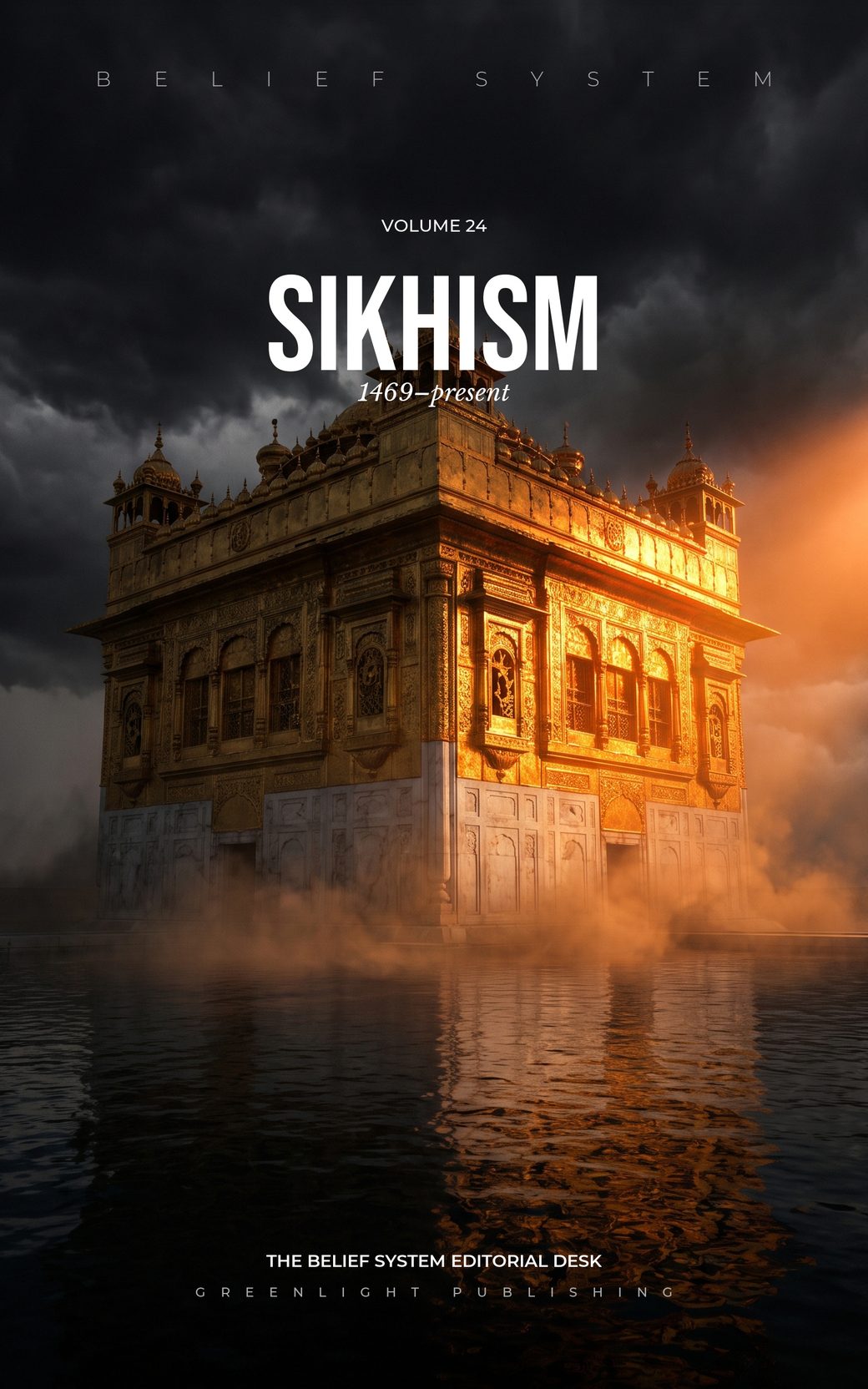
Volume 24 Belief System 1469–present
Sikhism
The machinea book that holds office
- Attested from
- 1469
- Narrates
- 1469–present
The earliest secure evidence, and the key this volume is filed under. All thirty-one
The period the book actually covers. It is rarely the same figure.
The argument in one sentence
The scripture other traditions assembled after their founders were gone was here compiled by the founders themselves — named editors, dated editions, a filing system keyed to music — and in 1708 the line of living Gurus ended by appointing the book, so the one canon in this series that closed on a date anyone can cite is also the only one that holds office: installed at dawn, attended through the day, put to rest at night, fed by a tenth, and, since 1925, administered under a statute by an elected committee.
in 1708 the line of living Gurus ended by appointing a book. Indian courts have since treated the scripture as a juristic person capable of owning property.The commissioning line
What it is
In 1708 the line of living Gurus ended by appointing a book. The scripture is installed at dawn, attended through the day, put to rest at night, and, since 1925, administered under a statute by an elected committee.
This is a history of the one canon in the series that closes on a date anyone can cite, and of how we know.
The life of Nanak beyond his own compositions is hagiography of later date and is labelled so. Whether the manuscript at Kartarpur is the 1604 original cannot be established from a public file. What was said at Baisakhi 1699 firms up in tellings composed generations later.
Five movements: the world of the corridor armies crossed, the machine of the raag-filed book, the canon closed by appointment, the money, and the split that is still a boundary argument.
The book never adjudicates. Macauliffe is named. The 2000 judgment that treated the scripture as a juristic person is named from the page.
Belief System, Volume 24.
In full
Sikhism is a founder who compiled, and nine successors who kept compiling under his name. The Babarvani hymns carry a datable claim about a datable campaign. Two executions: for the first, the emperor’s own memoir; for the second, a grieving son’s verse. The evidentiary gap is itself a lesson.
The book is organised by raag, thirty-one musical measures, every stanza numbered. Print arrived as lithography and standardised the page. Since 1708 the scripture holds office: prakash, hukam, sukhasan. A worn copy is retired with funerary rites.
No pre-colonial revenue total is invented to fill the gap the Dabistan left. The tenth that funds the kitchen now is a present-tense practice with a published protocol. The 1984 casualty totals stay untotalled: named counts, side by side, nothing added.
The volume uses five fixed phrases, and no sixth. It reports no appointment as a metaphor and does not treat it as one. It never tells you what anybody intended at Kartarpur.
Belief System is a history of world religion, one tradition at a time. Thirty-one volumes, ordered by earliest secure attestation.
The contents
26 chapters in five movements. Every volume in the series has the same five, in the same order, and each chapter below is printed with the idea it carries.
Movement OneThe World
Punjab under the Lodis and then the Mughals; the singing milieu the founder emerged from and argued with; and the design decision that makes this volume possible: a founder who compiled, and nine successors who kept compiling under his name. The evidence for the life is thinnest here, and the confidence falls with it, in the same sentence.
- 1The Land the Armies CrossedPunjab in 1469 is the corridor every invader from the northwest must cross — Lodi country about to become Mughal country — and the volume can open inside its own evidence, because the canon contains war reporting: the cluster of hymns known as the Babarvani, in which the first Guru describes Babur’s invasion as a thing seen, which makes this the rare tradition in the series whose founding text carries a datable claim about a datable campaign. The tradition’s dates for the founder — born 1469 at Talwandi, years as a steward at Sultanpur — are printed as the tradition’s dates.
- 2A Country Full of SingersNanak did not sing into silence. North India was loud with vernacular devotion — Kabir the weaver, Namdev the calico-printer, Ravidas the leather-worker, Farid’s Sufi couplets, the Nath yogis’ austerities — and the proof of the milieu is the canon itself, which preserves the compositions of the very singers the tradition emerged from and argued with. Where this chapter touches the loaded question of Sikhism’s relation to Hinduism and Islam, it reports the tradition’s own position as the tradition’s position, and no more.
- 3The Life, and When It Was Written DownThe narrative every reader knows — the call at the river, the journeys to Mecca and Hardwar, the death at Kartarpur with Hindus and Muslims disputing the body — is hagiography of later date: the janamsakhi manuscripts survive from the seventeenth century onward, divide into rival traditions (Puratan, Bala, Miharban) and contradict each other. What can be established is smaller and harder: the compositions under his signature, a community at Kartarpur, and a death conventionally dated 1539. The famous utterance “there is no Hindu, no Musalman” is located in the janamsakhis, and is labelled as theirs.
- 4The First AppointmentSuccession is the problem that breaks traditions — the Islam volume’s community divides over an unminuted meeting — and this tradition’s answer begins at the founder’s own death: the tradition holds Nanak tested and appointed Angad, a follower, over both his sons, and the appointment is documented inside the canon itself, in the var of Satta and Balvand, two court musicians, which describes the transfer in ceremonial detail. The disinherited line — Sri Chand’s Udasi order — persists for centuries as the road not taken, and returns in this volume’s money movement as a custodial class.
- 5Ten Men, One SignatureFor nearly two and a half centuries the office passed by designation — ten holders, each appointment documented, several contested by disinherited kin who kept their own shrines and their own manuscripts — and the design detail that matters most is textual: each Guru composed under the signature “Nanak,” distinguished in the canon only by a serial number, the mahala, so the scripture grew under a single continuing authorial office that would in the end be transferred to the book itself. Institutions accumulated with the verses: the kitchen protocol under Amar Das, the manji districts, the town of Amritsar under Ram Das. What is unusual is stated plainly: a founder who compiled, and successors who kept compiling.
- 6Two ExecutionsThe empire killed two holders of the office — Arjan in 1606, Tegh Bahadur in 1675 — and the evidentiary gap between the two deaths is itself a lesson the chapter states: for the first, the emperor’s own memoir records the order in his own voice; for the second, the nearest testimony is the tradition’s, led by a grieving son’s verse. Between the two deaths the office armed — Hargobind’s two swords, the Akal Takht — and the Dabistan’s author, who states he knew the sixth Guru personally, describes an armed court. No motive, on any side, is characterised beyond what the documents state.
Movement TwoThe Machine
The transmission technology, named as concrete objects: an alphabet, a filing system keyed to music, a scribal culture whose archives sat with the disinherited, and a book kept — and printed — under the protocol of a person.
- 7An Alphabet From the Guru’s MouthThe tradition holds the second Guru standardised Gurmukhi — the name means “from the Guru’s mouth” — and whatever the script’s exact pedigree (scholars trace it through the mercantile shorthands of Punjab, and the dating is contested), the decision it embodies is legible: a vernacular scripture in a script of its own is fenced, at a stroke, from the Sanskrit ecology of the pandits and the Persian ecology of the court. The boundary that later centuries will argue about in courtrooms is built into the letterforms first.
- 8Filed Under Its MusicThe Adi Granth is organised the way no other canon in this series is — not by subject, chronology or author, but by raag: thirty-one musical measures, and within each, fixed genre and author order, every stanza numbered in sequence. The filing system is a performance instruction — a hymn’s address in the book tells a trained musician how it is to be sung — and the running stanza-count lets any congregation audit its copy the way the Judaism volume’s scribes audited theirs by counting letters. In the standard text the page is an ang, a limb, 1,430 of them; the vocabulary is the argument, and kirtan — the singing the filing system exists to serve — is described in the present tense, because it never stopped.
- 9The Copyists and the CustodiansBetween compilation and print the text travelled as hand-copied birs, and the copying had a sociology the tradition itself records: authorised scribes, famous exemplars, variant lines — and this, which the chapter puts at the centre: the disinherited held the archives. The Kartarpur manuscript sat with Dhirmal’s descendants, the Goindval pothis with Amar Das’s; for three centuries the rival claimants to the office were the physical custodians of its title deeds, and access to the earliest witnesses still runs through the families the succession passed over. Print, arriving in the mid-nineteenth century as lithography, ended the copyist and standardised the page.
- 10The Book That Holds OfficeSince 1708 the scripture has been the Guru, and the claim is not a metaphor but a protocol that can be watched any morning, present tense: the book is installed at dawn (prakash), attended with a whisk of office, carried on a head or under a canopy, consulted — the day’s hukam taken by opening the text and reading — and put to rest at night (sukhasan). Everything downstream follows from the office, including manufacture: under a 1998 hukamnama and supporting Punjab legislation the printing of complete saroops is reserved, a complete copy travels like a person, and a worn copy is not discarded but retired with funerary rites. The modern state has learned the grammar: India’s Supreme Court has treated the Guru Granth Sahib as a juristic person capable of owning property. The appointment that created the office is told in the split movement, in the chapter on the last appointment.
Movement ThreeThe Canon
What is in, what is out, who decided, when, and what the decision cost. Opens with the argument, never with a manuscript: this is the one canon in the series that closes on a date.
- 11A Canon Closed by AppointmentCanons in this series close by attrition, by council consensus, or by the slow victory of one list over another — the Early Christianity volume’s competing lists, the Buddhism volume’s group recitals — and almost never by an act anyone can date. This one closes by decision, three times over: compiled by a named editor with a named scribe in 1604, re-edited once around 1705, sealed in October 1708 by the same authority the text had been accumulating under for two centuries. The chapter says plainly how rare that is, and then prices it: a closing that specific concentrates every later argument onto two questions — whether the surviving manuscripts are what they claim to be, and what to do with the tenth Guru’s own poetry, which the closed book does not contain.
- 12The First Edition, and the Manuscript That May Be ItThe tradition holds that Arjan compiled the Granth at Amritsar with Bhai Gurdas as scribe, drawing on earlier pothis, and installed it in the Harmandir in 1604 with Bhai Buddha as its first attendant — a documented editorial project: named editor, named amanuensis, named sources, dated launch. And there is a physical claimant: the bir at Kartarpur, colophon-dated to 1604, held by the Sodhi family, shown rarely. Whether it is Bhai Gurdas’s manuscript is contested — doubts in print since 1944, defences since — and in the 1990s a scholar’s textual analysis of the text’s formation drew a summons before the Akal Takht, which is a fact about the canon’s living authority as much as about the manuscript. The chapter reports; it does not settle.
- 13Who Is In the BookThe canon includes, by name, singers who were never Sikhs — fifteen bhagats by the usual count: Kabir, Farid, Namdev, Ravidas among them, Hindu and Muslim, weaver and leather-worker — alongside the Gurus and their court bards. And it excludes, traceably: manuscripts of the Banno line carry hymns the standard text does not (a hymn attributed to Mira Bai among them), and the tradition’s own category for what the Gurus rejected — kachi bani, unripe utterance — concedes that selection happened and was an exercise of authority. Who is in, who is out, and who decided is legible here to a degree no other volume in this series can match.
- 14The Recension That Left Out Its EditorThe tradition holds that at Damdama, around 1705, the tenth Guru dictated the complete text anew — the recension that is today’s printed standard — making one addition and one omission that define the canon’s edges: in came his father Tegh Bahadur’s hymns; out stayed his own. An editor closing a canon against himself is a checkable, remarkable fact about the finished book, whatever the mechanics of the recension (dictation from memory is the tradition’s account, and cannot be established). One boundary stayed soft: whether the Ragmala, the verse-index at the end, belongs is argued to this day — a live intra-communal dispute over the last two pages of a closed book, reported, not adjudicated.
- 15The Other BookThe tenth Guru’s poetry lives in a second, separate volume — the Dasam Granth, compiled after 1708, the tradition names Bhai Mani Singh — and its status is the tradition’s largest unresolved textual argument: parts of it are daily liturgy and part of the initiation rite itself; parts are attacked as court poetry wrongly attributed; a committee collated the manuscripts in 1897; and the argument runs today in journals and before the community’s own institutions. The volume reports the positions by name and resolves nothing. A canon closed as precisely as this one casts a precise shadow, and the shadow is where the arguing goes.
Movement FourThe Money
Who paid, who was paid, and how we know. A tenth, a network of deputies, the largest free kitchen in the world, and a king’s gold — with the caveat stated that the pre-colonial numbers are descriptions, not ledgers.
- 16The Tenth, and the Kitchen It Pays ForThe tradition’s fiscal instrument is daswandh — a tenth of income, owed not to a priesthood but to the community’s common works — and its most visible output is the langar, the free kitchen where all eat in one row regardless of caste, which the tradition traces to Nanak and institutionalises under Amar Das, whose rule that visitors eat before audience made commensality the admission fee to the Guru’s presence (the tradition seats the emperor Akbar himself in the row, and the volume labels the story). The tenth and the kitchen are one system: the same rupee collected as obligation is spent as open hospitality, and both run today, present tense.
- 17The Collection AgencyA tenth needs collectors, and the Gurus built a network: the masands, appointed deputies in distant congregations, who gathered daswandh and offerings and remitted them to the centre — a system described contemporaneously by the Dabistan’s Persian author, who sets out how the deputies forward what the faithful give. The machine worked: within two generations it financed a new town, a tank, a temple and a court. It also had the failure mode of every franchise — agents who keep the take — and what the tradition says happened next is the split movement’s opening chapter, handed there by name. No remittance totals survive, and the chapter says so.
- 18The Kitchen at ScaleThe Golden Temple’s langar is one of the largest continuously operating free-food systems in the world, and the mechanics are the story: donated grain and ghee, volunteer labour in shifts — seva as a staffing model — mechanised roti lines beside hand lines, service around the clock, funded by the same tenth plus the cash and kind that arrive daily. The working figure in the research file is 100,000-plus meals a day, labelled MEASURED there; the chapter prints a dated, attributed figure re-verified at write time, or prints UNVERIFIED — never a bare round number. Set against anything in this series — the waqf kitchens, the monastic estates — one feature is unusual and stated: the diners are not the poor by definition; they are everyone, because the row is the doctrine.
- 19Gold, Land, and ManagersWhen the tradition acquired an empire, the money reversed direction: Ranjit Singh sheathed the Harmandir in gilded copper — the recorded outlay is 500,000 rupees, and the chapter names the record it comes from — granted revenue-bearing lands to shrines, and struck his money as Nanakshahi coin, issued under the Guru’s name rather than the king’s. Then endowment did what endowment does in every volume of this series: it created managers. Through the nineteenth century the shrines settled under hereditary custodians — mahants, often from Udasi lineages, the road not taken in the chapter on the first appointment — whose tenure British endowment law protected, so the wealth of the shrines and the control of the shrines came apart. The fight to rejoin them is the twentieth century’s, handed to the split movement by name.
Movement FiveThe Split
What divided it, what it became, what it handed on: a purge of the collection agency, a re-founding by initiation, the last appointment, and the long fight over who keeps the shrines, who counts, and who decides. Names the next volume by NAME, never by number.
- 20The Purge of the Collection AgencyAround 1698 the tenth Guru abolished the masand system — the tradition says for corruption — ordering congregations by circular letter to sever ties with the deputies and bring the tenth directly. The orders survive as documents, and a near-contemporary poem narrates the expulsion. This is the series’ rarest kind of rupture: a split about the collection agency — not a doctrine, not a succession, an audit — and on the tradition’s own showing the centralisation of revenue and the reconstitution of the community the following year are one restructuring in two acts.
- 21The Double-Edged SwordAt Baisakhi 1699 at Anandpur, the tradition holds, the Guru re-founded the community by initiation — the khande di pahul, the five volunteers, the shared bowl, new names, a code — and the historical layers are stated as they are used: the near-contemporary Gursobha attests a re-founding and the Khalsa’s creation; the theatrical details firm up in accounts composed generations later; the standardised five Ks are later still, and the rahitnamas’ dates are contested by name. What is beyond dispute is the result, because it is still operative: the Khalsa drew a line inside the community between initiated and uninitiated that no earlier division had drawn, and it remains the tradition’s defining internal boundary, present tense.
- 22The Last AppointmentIn October 1708 at Nanded, dying of wounds, the tenth Guru ended the human succession — the tradition holds he conferred the guruship on the Granth — and the evidence is layered exactly as this series likes to state it: Persian court records place him in the imperial camp that year; the near-contemporary Gursobha has authority pass to the Word and the community; the couplet every Sikh knows is attested in later sources; and the first Sikh state’s own money is documentary confirmation of the design — the rebel Banda’s seal and the later Khalsa coinage strike money in the name of Nanak and Gobind Singh, not of any living ruler. The succession problem that split the Islam volume’s community within a generation was closed here by giving the office to a book: every rival line met earlier in this volume was disinherited at a stroke, by an heir that cannot die.
- 23Reform by Committee, and a War of TranslationsThe nineteenth century’s machine — the press, the voluntary society, the census — remade the boundary question, and the Singh Sabha (Amritsar 1873, Lahore 1879) fought it partly through scripture in English: Trumpp’s 1877 India Office translation, whose preface dismisses the text it renders, against Macauliffe’s 1909 counter-translation, produced with Singh Sabha scholars and openly on the tradition’s side. The volume quotes both throughout and names both biases where it uses them, because its two Tier 1 translations are not neutral instruments — they are artifacts of this chapter’s war. The era’s own summa is the title of Kahn Singh Nabha’s 1898 tract, Ham Hindu Nahin — “we are not Hindus” — which the volume reports as the tradition’s stated position on the politically loaded question, and leaves there.
- 24The Keys to the TreasuryThe Gurdwara reform movement of 1920–25 was a fight over exactly what the money movement left hanging — who keeps the shrines and their endowments — and it was fought at the sites: at Nankana Sahib in February 1921 the mahant’s men killed unarmed reformers by the score (the toll printed from named sources or not at all); in the Keys Affair the colonial government seized, and then surrendered, the keys to the Golden Temple’s treasury. The settlement was a statute: the Sikh Gurdwaras Act 1925 put the historic shrines and their property under an elected committee, the SGPC — and, in passing, did something no Guru ever did: wrote a legal definition of “Sikh,” a declaration to be affirmed, which is where the volume’s final chapter begins.
- 25June to November1984 is reported as documented events with named sources, and no one’s motive is characterised. In June the army assaulted the Golden Temple complex; the government’s White Paper gives its own casualty figures, and higher independent counts are printed beside them, each attributed. The Akal Takht was wrecked; the Sikh Reference Library’s manuscript collection was destroyed or removed, and the SGPC’s formal requests for the return of materials are part of the record — in a series about canons, an archive as casualty is not a side note. The government rebuilt the Akal Takht; the community demolished that rebuilding and raised it again by kar seva — a statement about authority over the shrine made in masonry. On 31 October the prime minister was assassinated by two Sikh bodyguards; in the days following, thousands were killed in Delhi and elsewhere, and the tolls, commissions and convictions are named. The chapter totals nothing itself.
- 26Who CountsThe century since the statute has argued over its question. The SGPC’s Rehat Maryada (1950) codified a definition after years of committee drafting; the Act’s franchise was litigated — a 2003 notification on sahajdhari voters, struck down in the High Court in 2011, restored retrospectively by amendment in 2016; a British court held Sikhs an ethnic group for discrimination law (Mandla v Dowell-Lee, 1983); and India’s constitution folds Sikhs into “Hindu” for stated legal purposes in Article 25’s explanation, while Sikh bodies formally object — the provision and the objections both documented, position reported as position. The volume closes where it began, on the book: every one of these disputes is argued before, and often adjudicated by reference to, the scripture that holds office — the one canon in this series that closed on a stated date, by a named authority, and then became its institution’s living head. And the hand-off: the series’ next ignition was already burning inside this volume’s first movement — while Nanak was alive and singing scripture in the vernacular, an Augustinian friar in Saxony turned a printing press on the sale of forgiveness, which is where the Reformation volume begins.
What this volume cannot establish
Printed in the book before the argument is, and printed here for the same reason. A history of a tradition that will not say where its evidence runs out is not a history.
- The life of Nanak beyond his own compositions. The hymns under his signature in the Adi Granth (conventionally counted at 974) are the primary evidence; the connected lives — the janamsakhis — are hagiography of later date, surviving in manuscripts from the seventeenth century onward, and the volume labels them so each time, including the travel narratives. Bhai Gurdas’s first var, the earliest connected verse account, is two generations removed and itself devotional.
- Whether the manuscript at Kartarpur is Bhai Gurdas’s 1604 original. Access is restricted, the authenticity contest is nearly a century old and live, and the volume reports it rather than settles it.
- What was said and staged at Baisakhi 1699. The earliest account, Sainapati’s, is near-contemporary and spare; the canonical five-beloved narrative firms up in tellings composed generations later, and the rahitnamas’ own dates are contested.
- Who wrote the Dasam Granth, in whole or in part. The argument is live in the scholarship and in the community’s institutions, and this volume reports it as unresolved.
- The mechanics of the Damdama recension. That the tenth Guru dictated the complete text from memory is the tradition’s account of its own standard edition, and it is printed as the tradition’s account.
- Any pre-colonial revenue figure. What the masands collected, what the court received and what the kitchen cost survive as descriptions, not ledgers; the Dabistan describes the machine and never audits it.
- A settled casualty total for June or November 1984. Official and independent counts differ widely; the volume prints named counts side by side, attributed, and totals nothing itself.
- Anyone’s interior state.
Sources
57 works, dated, and specific enough that a reader can go and look at the thing. Nothing is on this list that the desk did not consult.
| # | Document or work | Date | Evidence for |
|---|---|---|---|
| 1 | Babarvani hymns in the Adi Granth, in Max Arthur Macauliffe, The Sikh Religion | hymns sixteenth century; rendering 1909 | the first Guru’s war reporting on Babur’s invasion — testimony inside scripture, not a chronicle |
| 2 | Baburnama, in Annette Beveridge’s rendering | 1922 | Babur’s own campaigns and their gaps; Panipat 1526; the Punjab-road sack |
| 3 | J. S. Grewal, The Sikhs of the Punjab | 1990 | the Lodi-to-Mughal frame; the Guru’s court as political economy; 1920–25 |
| 4 | Bhagat compositions in the Adi Granth (Kabir, Farid and others), in Macauliffe | 1909 rendering | the singing milieu archived inside the canon |
| 5 | Siddh Gosht, in the Adi Granth | compiled 1604 | the first Guru’s staged debate with the Nath yogis |
| 6 | Karine Schomer and W. H. McLeod (eds.), The Sants | 1987 | North Indian vernacular devotion as a crowded field |
| 7 | Kahn Singh Nabha, Ham Hindu Nahin | 1898 | the tradition’s stated position on the boundary with Hinduism |
| 8 | W. H. McLeod, Guru Nanak and the Sikh Religion | 1968 | source-critical sorting of the janamsakhi traditions |
| 9 | Janamsakhi manuscripts (Puratan, Bala, Miharban) | seventeenth century onward | later hagiography: river-call, travels, “no Hindu, no Musalman,” the tests of Angad |
| 10 | Bhai Gurdas, first var | early seventeenth century | earliest connected verse account, two generations removed and itself devotional |
| 11 | Ramkali ki Var of Satta and Balvand, in the Adi Granth | inside the compiled book | the transfer to Angad described by two court musicians |
| 12 | Harjot Oberoi, The Construction of Religious Boundaries | 1994 | the Udasis’ later institutional role; mahant tenures; the Singh Sabha boundary |
| 13 | Dabistan-i-Mazahib, in David Shea and Anthony Troyer’s rendering | mid-1640s Persian; English 1843 | succession as one continuing spirit; an armed court the author says he knew; offerings, kitchen and masands |
| 14 | Hukamnamas, in Ganda Singh (ed.), Hukamname | documents of the Gurus’ chancery; edition 1967 | remittances in kind; anti-masand circulars — Punjabi quoted in this book’s rendering, not the editor’s apparatus |
| 15 | Jahangir, Tuzuk-i-Jahangiri, in Alexander Rogers and Henry Beveridge | 1909–14 | the order against Arjan: production, confiscation, death |
| 16 | Jerome Xavier, letter | 1606 | second outside notice of a public death at Lahore |
| 17 | Bachittar Natak, in the Dasam Granth | compiled after 1708; authorship contested | nearest verse testimony to Tegh Bahadur’s death — attribution caveat in the same sentence |
| 18 | Louis E. Fenech, Martyrdom in the Sikh Tradition | 2000 | how later tellings filled the space the Tuzuk leaves |
| 19 | George Grierson, Linguistic Survey of India | 1903–28 | the laṇḍā mercantile-shorthand family behind Gurmukhi |
| 20 | Gurinder Singh Mann, The Making of Sikh Scripture | 2001 | raag architecture; manuscript generations; the fullest defence of the 1604 sequence |
| 21 | Jeevan Deol, manuscript studies, Bulletin of the School of Oriental and African Studies | 2001 | technical companion on custody of the early birs and pothis |
| 22 | Kartarpur bir, colophon-dated 1604, held by the Sodhi family | 1604 colophon; identification contested | the physical claimant to Arjan’s first edition; access restricted |
| 23 | Goindval pothis, associated with Amar Das’s seat | dating contested | the earlier collections the tradition treats as Arjan’s sources |
| 24 | Akal Takht hukamnama reserving complete-saroop printing, with supporting Punjab legislation | 1998 | manufacture of the book that holds office |
| 25 | Shiromani Gurdwara Parbandhak Committee v Som Nath Dass | 29 March 2000 | the Guru Granth Sahib as a juristic person capable of owning property |
| 26 | SGPC published protocol for prakash and sukhasan | twentieth–twenty-first century | the morning installation and night retirement, watchable any day |
| 27 | G. B. Singh, Prachin Biran | 1944 | the published doubt that the Kartarpur volume is the 1604 original |
| 28 | Pashaura Singh, The Guru Granth Sahib: Canon, Meaning and Authority | thesis 1991; book 2000 | formation analysis; the 1992–94 Akal Takht summons |
| 29 | Pashaura Singh, The Bhagats of the Guru Granth Sahib | 2003 | singers who were never Sikhs, named on the page |
| 30 | Sainapati, Sri Gur Sobha | conventionally 1711; later dating noted | Damdama; masand expulsion; a spare Khalsa re-founding; authority to the Word and the community |
| 31 | SGPC Rehat Maryada | drafting 1930s–40s; published form conventionally 1950 | the Ragmala compromise clause; a committee definition of a Sikh |
| 32 | Robin Rinehart, Debating the Dasam Granth | 2011 | the authorship argument mapped, not settled |
| 33 | W. H. McLeod, descriptions of the Dasam Granth’s components | late twentieth century | Jaap, Bachittar Natak, Chandi narratives, Charitropakhyan, Zafarnama — an inventory, not a verdict |
| 34 | Sodhak committee, Amritsar | 1897 | collation of Dasam Granth manuscripts; a committee required because authorship was not settled |
| 35 | W. H. McLeod, The Chaupa Singh Rahit-nama | 1987 | rahitnama dates contested by name |
| 36 | W. H. McLeod, Sikhs of the Khalsa | 2003 | the Khalsa code as later consolidation |
| 37 | Purnima Dhavan, When Sparrows Became Hawks | 2011 | eighteenth-century Khalsa as a warrior band that had to become a community |
| 38 | Mughal camp notices of 1708 (akhbarat) | 1708 | the tenth Guru in Bahadur Shah’s Deccan orbit; exact entries not quoted line by line |
| 39 | Banda’s seal and later Nanakshahi and Khalsa coinage | early eighteenth century onward | money struck in the names of Nanak and Gobind Singh, not of a living ruler |
| 40 | Lahore court chronicle figure for Ranjit Singh’s gilding of the Harmandir | outlay conventionally 1830s | 500,000 rupees as the chronicle’s number, not this book’s audit |
| 41 | Ernest Trumpp, The Adi Granth | 1877 | India Office translation; the contempt of the preface, itself an event |
| 42 | Max Arthur Macauliffe, The Sikh Religion | 1909 | Singh Sabha collaboration and open advocacy — the counter-translation |
| 43 | Anand Marriage Act | 1909 | Sikh marriage as a statute of the same years |
| 44 | Singh Sabha, Amritsar then Lahore | 1873; 1879 | the voluntary society that fought the boundary partly through English scripture |
| 45 | Sikh Gurdwaras Act, Punjab Act VIII of 1925, section 2(9) (as substituted 1930) | 1925; definition 1930 | notified shrines under the SGPC; the declaration “I have no other religion” |
| 46 | Nankana Sahib record (trial proceedings and contemporary press) | 20 February 1921 | the mahant’s men and the reformers; counts attributed and not totalled |
| 47 | Keys Affair chronology | November 1921–January 1922 | colonial seizure and surrender of the Golden Temple treasury keys |
| 48 | White Paper on the Punjab Agitation, Government of India | July 1984 | official June figures (492 and 83; later restatements 554 and 92) |
| 49 | Mark Tully and Satish Jacob, Amritsar: Mrs Gandhi’s Last Battle | 1985 | contemporaneous hospital and eyewitness tallies, higher than the White Paper |
| 50 | Misra Commission report | 1987 | named inquiry into the November killings; figures differ from later commissions |
| 51 | Nanavati Commission report | 2005 | later named inquiry; figures still not added to anyone else’s |
| 52 | Delhi High Court judgment in a residual November 1984 case (including Sajjan Kumar) | 2018 | convictions upheld; still not a total |
| 53 | Mandla v Dowell-Lee [1983] 2 AC 548 | 1983 | Sikhs an ethnic group for the Race Relations Act 1976 |
| 54 | Constitution of India, Article 25, Explanation II | 1950 | Sikhs folded into “Hindu” for stated legal purposes; SGPC objections on the record |
| 55 | Sahajdhari franchise chain: notification; Punjab and Haryana High Court; amending statute | 2003; 2011; 2016 | who may vote for the committee that holds the shrines |
| 56 | Adi Granth architecture: mahala headings, thirty-one raags, 1,430 angs in the standard saroop | compiled 1604; print standard later | a canon filed under music, auditable by stanza-count |
| 57 | SGPC published accounts, and 2010s reportage of the Golden Temple langar | accounts current; reportage 2010s | the committee publishes line-items; a 100,000-meal figure was not audited here and is printed UNVERIFIED |
Common questions
When is Sikhism first securely attested?
1469. That is the earliest date the surviving evidence supports, and it is the key this volume is filed under. It is not the same claim as when the tradition began: the tradition’s own account of its beginning is printed beside it in the book’s front matter, never instead of it.
What period does the book cover?
1469–present. The coverage span and the attestation date are two different facts, and the gap between them is often the most interesting thing about a volume.
What carried Sikhism?
A book that holds office. Movement Two of every volume is about the transmission technology — the concrete object or institution that made copying possible, and would not have existed a century earlier.
How long is it?
About 28,000 words, roughly 115 minutes’ reading, 122 pages in the paperback. The audiobook runs 3h 02m, measured from the finished masters.
What does this volume not claim to establish?
The life of Nanak beyond his own compositions. The hymns under his signature in the Adi Granth (conventionally counted at 974) are the primary evidence; the connected lives — the janamsakhis — are hagiography of later date, surviving in manuscripts from the seventeenth century onward, and the volume labels them so each time, including the travel narratives. Bhai Gurdas’s first var, the earliest connected verse account, is two generations removed and itself devotional. Every volume prints its own limits before it prints its argument; there are 8 on this one’s list.
Does the book say which tradition is true?
No. Belief System does not adjudicate. Where the tradition’s account and the earliest evidence disagree, both are given, in their own vocabulary, attributed, and neither is given the last word. No miracle is reported as fact and none is denied.
Can I buy Sikhism in print?
Yes. It is a 5.5 × 8.5 in paperback, 122 pages, $12.99 a copy, bought direct rather than through a retailer. All thirty-one together are $199.00, with the ebook and the audiobook of every volume included.
The edition
| Trim | 5.5 × 8.5 in / 140 × 216 mm |
|---|---|
| Binding | Perfect-bound paperback, matte laminate |
| Paper | 60# uncoated cream, black ink |
| Extent | 122 pages |
| Edition | Extent | ISBN |
|---|---|---|
| Paperback | 122 pages, 5.5 × 8.5 in | ISBN not yet issued |
| Ebook | EPUB | 979-8-90623-859-7 |
| Audiobook | 3h 02m | 979-8-90623-860-3 |
| BISAC 1 | `REL017000` RELIGION / Comparative Religion |
|---|---|
| BISAC 2 | `REL061000` RELIGION / Sikhism |
| BISAC 3 | `REL033000` RELIGION / History |