Belief System
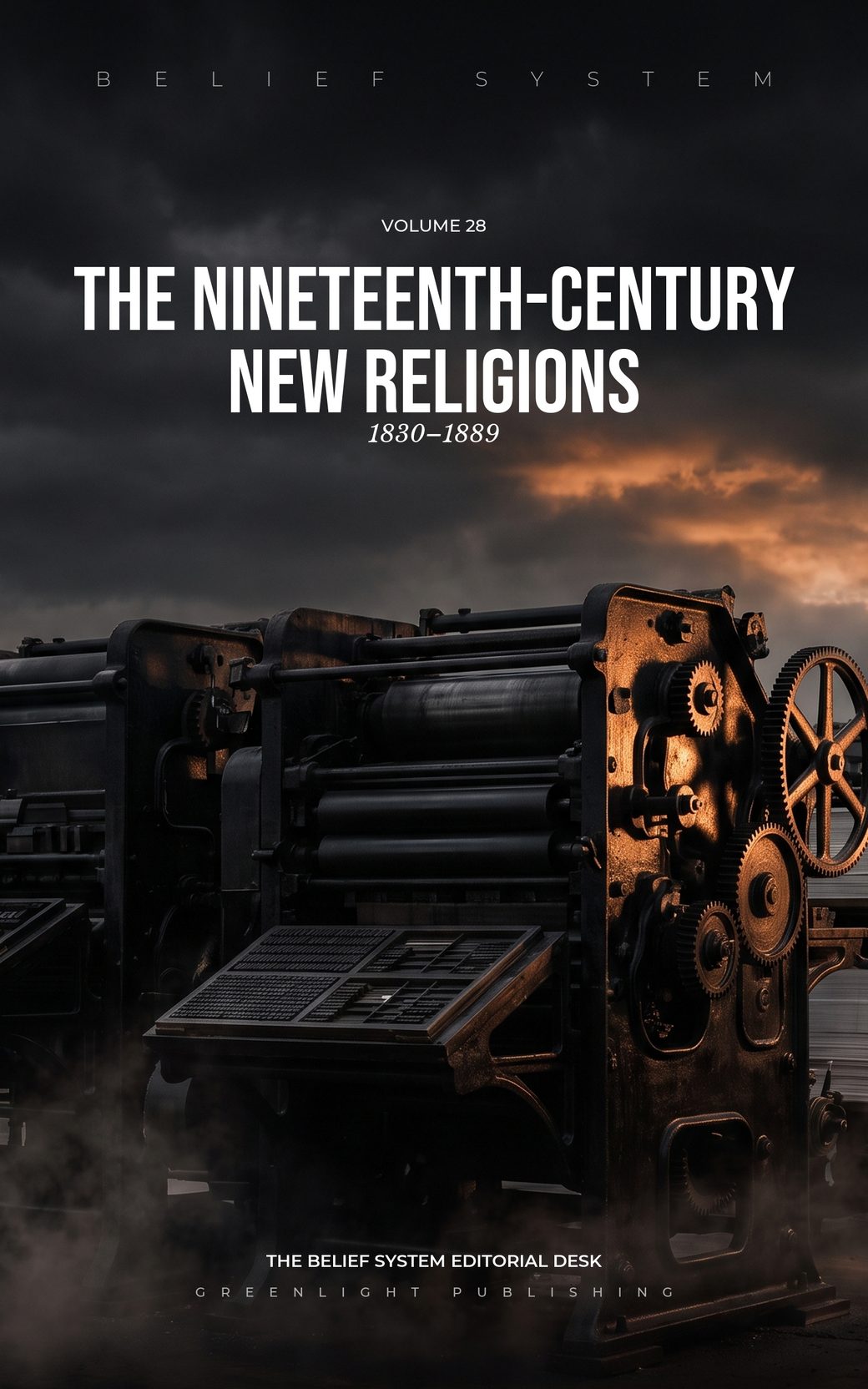
Jacket of Belief System volume 28, The Nineteenth-Century New Religions
$12.99paperback

128 pages, 5.5 × 8.5 in. Three or more volumes in one order and every copy drops to $11.99.

copies

United States, 8 to 11 days. All destinations

Volume 28 Belief System 1830–1889

The Nineteenth-Century New Religions

The machinethe print run and the mail

Attested from
1830

The earliest secure evidence, and the key this volume is filed under. All thirty-one

Narrates
1830–1889

The period the book actually covers. It is rarely the same figure.

The argument in one sentence

The movements in this volume share no doctrine — what binds them is a birth certificate: they are the first religions in history founded in front of a functioning press, a postal service and a newspaper industry, so their scriptures survive in dated and differing editions, their treasuries in mortgages, ledgers and a regulator’s order, and their schisms in minutes — and for once in this series the making of a canon, a treasury and a split can be read from the participants’ own paperwork, by their own hands and their hostile witnesses', rather than reconstructed from centuries of dark.

the largest religious fund ever disclosed was disclosed by accident: a 2019 whistleblower put the LDS reserve near $100 billion, and in 2023 the SEC fined the fund $4M and the church $1M for hiding it behind shell companies for twenty-two years.The commissioning line

What it is

The largest religious fund ever disclosed was disclosed by accident: a 2019 whistleblower put the LDS reserve near $100 billion, and in 2023 the SEC fined the fund $4 million and the church $1 million for hiding it behind shell companies for twenty-two years.

This is a history of a sixty-year millenarian wave, and of how we know.

Mormonism, Adventism, Bábism and Bahá’í, the Witnesses, Christian Science and Ahmadiyya sit in one jacket because they are one global print-and-mail wave inside sixty years. The 1830 Book of Mormon is public domain. Temple ceremony is described, never transcribed. Bahá’í has no clean commercial quotation path before 1 January 2028.

Five movements: the world of the burnt district, the machine of the mail, the canon with a version history, the money, and what the wave handed on.

The book never adjudicates. Shoghi Effendi is not quoted.

Belief System, Volume 28.

In full

The nineteenth-century new religions are a print run and a post office. Morse’s four words move as electricity the same spring as a Millerite deadline and a declaration in Shiraz. Dickens inspects a Mormon sailing and writes an orderly emigration. Eddy founds a daily whose object sentence is still quoted as a charter.

The Book of Mormon exists in three editions its founder saw through the press, and they differ. “Author and Proprietor” becomes “Translator” becomes “carefully revised by the translator.” The 1830 wording and the 1837 insertion are printed as title pages, years named. The modern versification is not used.

Four hundred title pages, a tenth defined in writing, Ensign Peak, a sanitarium and a watch tower’s backer: the money is unusually good because the paper is unusually good. The Most Great Separation, branches from a failed date, a confession at the Academy of Music: the splits are the growth.

The volume uses five fixed phrases, and no sixth. It reports no vision as fact and denies none. It never tells you what anybody saw in a grove.

Belief System is a history of world religion, one tradition at a time. Thirty-one volumes, ordered by earliest secure attestation.

The contents

26 chapters in five movements. Every volume in the series has the same five, in the same order, and each chapter below is printed with the idea it carries.

Movement OneThe World

The place, the moment, and the question each movement answered — a revival district wired for print in one empire, a millenarian countdown in another. The evidence here is abundant rather than thin; the discipline is labelling, because the traditional dates and the documented dates sit side by side.

  1. 1The Burnt DistrictWestern New York along the new Erie Canal (opened 1825) was the most heavily revivalled ground in the Protestant world — Finney’s own memoir coined the name this chapter borrows — a market of competing certainties in which the question a new religion answered was not “is there a God” but “which of these churches is true”; and the chapter states the volume’s jacket problem on its first page: several living traditions in one binding, held together by a moment and a machine, not by kinship of doctrine.
  2. 2The Arithmetic of the EndWilliam Miller computed the Second Coming from the 2,300 days of Daniel read as years from 457 BCE, and the innovation was not the vision but the publication: a checkable date, in print, argued like a proof — first “about the year 1843,” then, under Samuel Snow’s seventh-month refinement, 22 October 1844 — and when the date passed, the movement’s own papers printed the failure too; the name for the morning after, the Great Disappointment, is the tradition’s own coinage.
  3. 3Persia, Year 1260In the same year as the Millerite date — 1844, which in the Islamic calendar was 1260, one thousand lunar years after the Twelfth Imam’s occultation — a young Shirazi merchant announced himself the Bab, the Gate; a different empire, with a state clergy and no religious free market, answered with trials, troops and a public execution at Tabriz on 9 July 1850, followed by the pogrom of 1852; the synchrony of the two announcements is a fact of two calendars’ arithmetic — both movements computed expectation from scripture — and the chapter states it as exactly that, drawing no providence from it.
  4. 4A Religion You Could MailThe general condition that made a new religion a distributable product: mass literacy, the steam press and stereotype plate, cheap postage (Britain’s penny post of 1840, the US postal acts of 1845 and 1851), the railway timetable — and on 24 May 1844 the first intercity telegram, itself a verse of scripture chosen by a young woman named Annie Ellsworth: “What hath God wrought”; the incumbent evangelical societies had already industrialised the tract and the mailing list, and every movement in this volume copied the toolkit rather than inventing it.
  5. 5The Rappings and the PetitionSpiritualism ignited in 1848 in the same district — knockings in a Hydesville farmhouse, two girls, and within weeks a printed pamphlet of neighbours’ sworn statements: a founding religious event surviving as a set of depositions; taken up by Rochester’s radical Quakers and the penny press, it became a parlor practice with no founder-prophet, no church and no canon, and within six years its adherents could lay a mass petition before the United States Senate asking for a scientific investigation of the spirits — which the Senate, the record shows, tabled.

Movement TwoThe Machine

The transmission technology, named as a concrete object or institution — not an abstraction. Here: the press and the post, used deliberately and on contract. The tract is the standard unit; the missionary is a standing funded order; and one movement claimed a delivery mechanism that bypassed the mail, which a committee investigated the way an inspector investigates the mail.

  1. 6The Mortgaged FarmThe Book of Mormon is the only founding scripture in this series with a print contract, a named financier and a security instrument: 5,000 copies from E. B. Grandin’s shop in Palmyra, agreed at $3,000 and secured on 25 August 1829 by a mortgage on Martin Harris’s farm — and among the movement’s earliest printed revelations is one addressed to Harris ordering him to pay the printer’s debt: scripture about the print bill, printed as scripture.
  2. 7A Standing Order of MissionariesThe LDS missionary system was a funded, standing organisation almost from the start — the 1837 Preston mission put the movement in England seven years after the book was printed, the Millennial Star (Manchester, from 1840) gave the British converts a periodical of their own, and the church ran an emigration agency out of Liverpool with chartered ships and printed instructions, inspected in 1863 by Charles Dickens, who reported the emigrants “the pick and flower of England” in his own account; the machine’s long tail is genealogical — a church whose rites require ancestors’ names built the Granite Mountain vault: 2.4 million microfilm rolls, roughly three billion images, in a working facility cut into a Utah canyon wall.
  3. 8The Chart and the TractThe Millerites took Habakkuk’s instruction to write the vision and make it plain upon tablets as a design brief and lithographed the end of the world as an infographic — the 1843 chart, commissioned by conference resolution — while Himes’s papers moved the argument through the mail; after the Disappointment the survivors built publishing houses at industrial scale, the Review and Herald at Battle Creek and the Watch Tower in Pittsburgh, both distributing through colporteurs — door-to-door literature sellers with territories, quotas and report forms; the tract is the unit, and the unit is counted, by the movements themselves.
  4. 9The Spiritual Telegraph, and the Post Without a PostmanSpiritualism named its practice after the newest machine — a periodical actually titled The Spiritual Telegraph, the séance as receiving apparatus, the medium as operator — and Theosophy’s periodicals piped Sanskrit vocabulary into Western drawing rooms from a Bombay press after its founders sailed for India and briefly federated with the Arya Samaj (whose story is the Modern Hinduism volume’s); the Society’s founding teachers, though, were said to communicate by letters that arrived without passing through any mail, and the Society for Psychical Research investigated the claim the way an inspector investigates mail fraud, in an 1885 report whose own methods were formally criticised a century later — both documents are on the record, and both are reported.
  5. 10The Church That Founded a NewspaperChristian Science ran its machine on copyright and the periodical: Eddy enforced her book in court — Eddy v. Arens (1883), with the infringing pamphlets ordered destroyed — licensed her teaching through a chartered college, controlled distribution through authorised literature and reading rooms, and at eighty-seven founded a general-interest daily whose stated object she printed in its first issue, 25 November 1908: “to injure no man, but to bless all mankind,” quoted with issue and year; a church whose crowning piece of machinery was a newspaper closes the movement that a mortgaged print contract opened.

Movement ThreeThe Canon

What is in, what is out, who decided, when, and what the decision cost. The real subject is who had the authority to close it — and this movement is the volume’s spine, because it is the only place in the series where scripture formation survives with the paperwork intact: drafts, contracts, revision sheets, minutes, lawsuits. The movement opens with that argument, never with an edition; and every quotation names the year of its edition in the visible text, because the differences between editions are the subject.

  1. 11A Canon With a Version HistoryThe argument chapter: elsewhere in this series a canon forms over centuries, in the dark, and the historian infers a closing from its aftermath; here scripture was produced in front of witnesses, on contract, in numbered editions that differ — so this movement reads canons the way a textual critic reads drafts, and its working rule is mechanical: every quotation carries its edition’s year, because between one year and the next the words change, and the changes are signed. The control case is Spiritualism, which produced testimony and periodicals but never a closed book; the contrast between the movements that closed a text and the one that never did is the movement’s standing question, held open rather than answered — and the chapter restates the jacket problem: what these canons share is not content but a condition, formation in daylight.
  2. 12The 1830 Text, Revised by Its TranslatorThe Book of Mormon exists in three editions its founder saw through the press — 1830, 1837, 1840 — and they differ: the 1830 title page names Joseph Smith “Author and Proprietor” where the 1837 prints “Translator”; the 1837 revision alters wording in passages of doctrinal weight — “the mother of God” in the 1830 printing, “the mother of the Son of God” in the 1837 — among the thousands of smaller changes the critical text catalogues; and the 1840 edition, its title page stating “carefully revised by the translator,” restores readings from the original dictation manuscript. About a quarter of that original survives; the complete printer’s manuscript survives entire, and changed hands in 2017 for a documented price — a scripture whose textual apparatus is not reconstructed but archived, purchasable, and photographed page by page in the church’s own documentary edition.
  3. 13Revelations, EditedThe Doctrine and Covenants is a canon with a change-log: revelations first printed in the 1833 Book of Commandments — a printing that survives only in copies assembled from sheets rescued when a Missouri mob destroyed the press in July 1833, the record showing the destruction and the tradition holding the rescue story — reappear in the 1835 Doctrine and Covenants expanded and altered, offices and passages added, and the manuscript revelation books recording the edits in ink are published in facsimile by the church’s own documentary edition; the canon also subtracts: the 1835 volume’s “Article on Marriage” affirming monogamy was removed in 1876 when the plural-marriage revelation was added, and the Lectures on Faith, canonised in 1835 as the “Doctrine” of the book’s own title, were removed in 1921. A scripture that adds, edits and deletes, with the paperwork published by the tradition itself.
  4. 14The Tablets, and the Locked TranslationBaha’u’llah’s writings show canon control from the other end — not the drafting but the custody: the Bab’s Bayan, left deliberately unfinished for “Him Whom God Shall Make Manifest” (described, cited); Baha’u’llah’s tablets, catalogued by the community’s own archive in the tens of thousands of documents — its count, labelled; and the Kitab-i-Aqdas, conventionally dated to about 1873 at Akka, which governs Baha’i law and had no authorised English edition until 1992. Here, where a reader of this series would expect the quotation, the text states plainly that there is none: the authorised English translations are under copyright held by the Baha’i World Centre until the start of 2028, and this volume describes their content and cites their titles without quoting a sentence of them. The absence is a finding — the clearest case in the volume of a living canon whose stewards control not only the text but the language it may be read in, which is the chapter’s subject demonstrated in its own practice.
  5. 15The Prophetess and Her SourcesEllen White’s writings hold a status her church debated in a recorded room: the denomination’s frame follows her own printed phrase — “a lesser light to lead men and women to the greater light,” in the Review and Herald of 20 January 1903, quoted with source and year — and the 1919 Bible Conference argued inspiration and inerrancy in transcripts that were shelved, rediscovered in 1974, and published in 1979: a canon debate with literal minutes, embargoed for fifty-five years and then printed. The sources dispute is as documented as the status dispute — raised in print by an insider-turned-opponent in 1889, renewed by an ex-member researcher in 1982, and examined by the church’s own commissioned study of The Desire of Ages, published in 1990, whose stated findings on literary dependency are reported in its own terms. All of it reported; none of it adjudicated.
  6. 16Four Hundred Title PagesScience and Health is the most heavily versioned scripture in this series: from the 1875 first edition through the retitled and rearranged revisions of the 1880s and 1890s to the final form of 1907, the publisher numbered its printings as editions on their own title pages, and the numbering ran into the hundreds in Eddy’s lifetime — printed here as the publisher’s own numbering, with the bibliographers’ count left to the bibliographers. A retired Unitarian minister, James Henry Wiggin, worked as her editor from 1885, and how much of the book’s later polish is his is contested — claims published after his death, denials published by the church, both cited; the book’s relation to Phineas Quimby’s unpublished manuscripts is contested in the same documented way, argued in the Boston papers from 1883 and testable since the Quimby papers were published in 1921. Canon closure here ran through statute rather than council: copyright suits, authorised literature, and a church Manual whose by-laws fix the book’s place.

Movement FourThe Money

Who paid, who was paid, and how we know. In this volume, uniquely: a mortgage, tuition advertisements, an escheat proceeding, a bequest that bought a commission, and a securities regulator’s order. Numbers get their provenance in the same sentence, and UNVERIFIED is written where a headline number cannot be traced to a document.

  1. 17The Tenth, Defined in WritingLDS tithing moved in one decade from emergency subscription to defined obligation: the revelation of 8 July 1838 at Far West defines the standing law as one-tenth of annual interest — quoted from an early printing with the edition year named — and the obligation acquired documented compliance mechanisms that operate today, described in the present tense: the annual tithing settlement before the bishop, and the temple recommend, which conditions access to the highest rites on a declared full tithe. Alongside it the Perpetual Emigrating Fund (from 1849) ran as a revolving loan book moving converts from Liverpool to the valley — until the state closed it: the Edmunds–Tucker Act of 1887 dissolved the Fund, disincorporated the church, escheated its property above a threshold and put a receiver into its finances, litigated to the Supreme Court — a treasury whose seizure produced its best surviving inventory.
  2. 18Ensign PeakThe largest religious fund ever disclosed was disclosed by accident: in November 2019 a former employee’s whistleblower complaint put the church’s investment reserve, managed by the entity reported as Ensign Peak Advisors, near $100 billion — the complaint’s figure, never confirmed by any audited statement, and always labelled as the complainant’s; in February 2023 the Securities and Exchange Commission issued an order finding that the fund’s equity holdings had been reported through thirteen shell companies from 1997 to 2019, and the matter settled: a $4 million penalty against the fund and $1 million against the church. The chapter reports what the order states, quotes its operative findings with the order named and dated in the text, cites the church’s published response beside it, and characterises nobody’s intent — then connects the reserve to the volume’s oldest documents, because a reserve is what a defined tithe with documented compliance builds, compounded across the century between the receiver of 1887 and the regulator of 2023.
  3. 19The Right of GodBaha’i finance is defined inside the canon itself: the Kitab-i-Aqdas ordains Huququ’llah — the Right of God — at nineteen per cent of surplus wealth after essential expenses, payable once the surplus crosses a stated gold threshold, collected in the founder’s lifetime by named trustees and today by an institutionalised office, described in the present tense; the ordinance is described and its source cited, not quoted, and the text says so again here, briefly, because this is the second place a reader would expect the quotation. Around the intake sits the outflow the record preserves best: Babi property confiscations in the persecutions of the 1850s appear in the diplomatic file, and after the exiles the Ottoman state itself carried the banished parties on its books — which becomes the next movement’s evidence.
  4. 20The Sanitarium, and the Watch Tower’s BackerThe Adventist tithe was systematised in print — “Systematic Benevolence” from 1859, the full tithe adopted through the 1870s — and it capitalised institutions: the Western Health Reform Institute of 1866 grew into the Battle Creek Sanitarium and then into a denominational hospital and education system whose present scale is printed only as the denomination’s own published statistics, labelled as such and given in the present tense; the Watch Tower ran leaner and said so on its own pages — Russell put his merchant fortune in (the amount printed only as a sourced range or UNVERIFIED), priced the literature at cost through colporteurs, and the first volume of Zion’s Watch Tower (1879) declared that the paper had a divine backer and would therefore never solicit men for funds — a funding doctrine, stated on the masthead’s own terms, quoted with year, in an economy where every rival movement passed a plate.
  5. 21Three Hundred Dollars a Class, a Fee a SéanceThe two fee-for-service economies: Eddy’s Massachusetts Metaphysical College, chartered in 1881, advertised primary instruction at three hundred dollars — quoted from the college’s own advertisements in the Journal, year named — and fed a practitioner economy that still lists healers in a church directory, described in the present tense; Spiritualism ran the same shape with no institution at all — the medium’s fee, no treasury, no ledger, the fiscal architecture this series records for divination in the Ifá volume, named. Where the money became contested, the age funded investigations instead of audits: Henry Seybert’s bequest to the University of Pennsylvania bought a commission whose preliminary report of 1887 is quotable public record, and a London medium was convicted — and un-convicted on appeal — under the Vagrancy Act in 1876; the séance economy’s paper trail is largely a litigation trail, and the chapter reads it as one.

Movement FiveThe Split

What divided it, what it became, what it handed on. Succession without a rule, five times over — and what this volume can say that no other volume in the series can: these splits have minutes. Council records, dueling periodicals, colonial pension books, a signed confession and its signed recantation. Hand-offs are by NAME, never by number.

  1. 22The Press the Prophet BrokeThe LDS succession crisis began with a printing press: the Nauvoo Expositor published one issue, 7 June 1844, from dissidents inside the leadership; the city council — its minutes surviving — declared the paper a nuisance on 10 June, and the mayor, Joseph Smith, ordered the press destroyed; the charges that followed put him in Carthage jail, where a mob killed him on 27 June. He left no undisputed written designation of a successor, and every party to the division holds a document: the Twelve’s claim argued at the meeting of 8 August 1844 — where the contemporaneous minutes and diaries record one thing and the later “transfiguration” reminiscences add another, a gap between record and memory that is itself reported, with the two bodies of evidence dated; Sidney Rigdon’s guardianship claim; James Strang’s letter of appointment, a physical object with a contested postmark; and, sixteen years on, the Reorganization under the founder’s son, minuted at Amboy in 1860. The Nauvoo endowment of 1842 stands behind part of the succession argument, and the text states here that this volume describes the temple ceremony from published scholarship and does not transcribe it — the community designates it restricted, and an explained absence is a finding.
  2. 23The Most Great SeparationThe Babi succession produced the volume’s most formally instrumented split: the Bab’s own document appointing Mirza Yahya, Subh-i-Azal, survives, and what it appointed him to is contested — figurehead or successor; Baha’u’llah’s announcement from 1863 and the Edirne rupture of 1866–68 divided the community, and the Ottoman state resolved the quarrel administratively, exiling both claimants on files its archives preserve — Baha’u’llah to Akka, Azal to Famagusta; after 1878 the British administration of Cyprus inherited Azal on the pension list, and a religion’s losing claimant appears thereafter in colonial account books. E. G. Browne visited both parties in 1890 and printed his own eyewitness descriptions — his pen-portrait of Baha’u’llah is quoted in Browne’s own words from his 1891 introduction, which are his prose and not a translation: the one first-hand Western description of the founder in existence, and the only quotation the rights rule allows this story. The tradition’s later instrument — the Kitab-i-Ahd of 1892 and the expulsion mechanism the community names covenant-breaking — is described and cited as the most explicit formal machinery for excluding rival claimants anywhere in this series: a named offence, a named office that declares it, and a required severance.
  3. 24Branches from a Failed DateThe Millerite splits are dated to the day and printed in their own papers: after October 1844 the movement divided over what, if anything, had happened — the Albany conference of 1845, minuted, tried to close the question; the sabbatarian branch organised as the Seventh-day Adventists in 1863 after a debate about whether organising was itself apostasy, conducted in the Review and Herald's own columns and quoted from them; other branches took different roads from the same morning. A generation later the pattern repeated in Pittsburgh: Russell split from Barbour in 1879 in a dispute conducted in and about their shared periodical and resolved by founding a rival one — a schism executed as a change of mailing list — and in 1889 Russell’s press printed the next date, 1914; the volume closes before that date arrives, and the chapter states its sequel in one sentence, because it is the canon movement’s rule operating inside the split movement: when the date failed, the edition changed, and the same page reads differently in the 1889 and the post-1914 printings. The Watch Tower’s twentieth-century schisms and the name Jehovah’s Witnesses (1931) are named as the long tail.
  4. 25The Confession at the Academy of MusicThe movements without succession machinery split over testimony instead: on 21 October 1888 Margaret Fox, forty years after Hydesville, confessed fraud in a signed newspaper statement and demonstrated the method on stage at the New York Academy of Music — the World reported the fee it paid her — and in November 1889 she recanted the confession; Spiritualism survived both documents, and both are reported here, with neither adjudicated and the two dates a year apart carrying the whole problem. Theosophy’s crisis ran through the Coulomb letters (published in Madras, 1884), the Hodgson Report (1885) and its methodological rebuttal a century later (1986), with the American section’s 1895 secession under Judge named as the tail; Christian Science took its schism early and small — the Boston secession of 1888, after the Corner prosecution — and its larger separations fall outside this volume’s span, named forward. The chapter’s argument is the movement’s in miniature: where there is no covenant, no quorum and no letter of appointment, the split happens in the press, because the press is the only institution all parties share.
  5. 261889, and What the Wave Handed OnThe volume ends with the wave still breaking: in March 1889, at Ludhiana in the Punjab, Mirza Ghulam Ahmad accepted the first allegiances of the Ahmadiyya — the same pattern, an announcement, a press, and in time a contested succession, igniting inside Islam as the century closed, and named here as the wave’s last arrival inside this volume’s span; in the same year Russell’s press named 1914 and Margaret Fox unsaid her confession; the next year, just outside the span, the LDS church president issued the Manifesto on plural marriage with the receiver still in its finances — named as the sequel. What the wave hands on: the free newspaper, the mailing list and the funded mission pass directly to the revival at Azusa Street — the Pentecostalism volume, whose machine collapsed when a co-editor walked off with the list; the drawing-room orientalism of the Theosophists passes to the Modern Hinduism volume and, much later, to the seekers of the Unaffiliated volume; and the volume’s standing demonstration — that a canon, a treasury and a split can all be run through a print shop — stops being a novelty and becomes, in the twentieth century, simply how new religions are made.

What this volume cannot establish

Printed in the book before the argument is, and printed here for the same reason. A history of a tradition that will not say where its evidence runs out is not a history.

  • What the 1830 Book of Mormon was produced from. The record shows a federal copyright filing of June 1829, a print contract, a mortgage and a finished book of 5,000 copies; the statements of eleven witnesses, printed with the book from the 1830 edition onward, are documents about an object that cannot now be examined. The volume reports the claim, the documents, the dates and the disputes; it does not assess whether golden plates existed.
  • Whether any healing occurred, any communication with the dead took place, or any prophecy succeeded or failed in any sense beyond the calendar. The volume reports the date set, the date passed, and what the movement’s own press printed next.
  • Anyone’s sincerity, and anyone’s interior state. The ex-member literature reads these documents as fraud; the devotional literature reads the same documents as providence. Both literatures are catalogued, and neither register enters the prose — these are living communities of millions, and they get the same sentence this series gives Nicaea.
  • Which of Margaret Fox’s two statements tells the truth. — the signed confession of October 1888 or the recantation of November 1889. Both are reported, with the fee the newspaper reported paying for the first.
  • Any nineteenth-century membership figure as a count of people. Denominational totals are self-reports, the claimed Spiritualist millions are a newspaper artefact, and such numbers are printed only as the institutions’ or the papers’ own claims.
  • The present size of the LDS investment reserve. The figure near $100 billion is a 2019 whistleblower’s claim; the SEC’s 2023 order establishes filing conduct and two penalty figures, not a balance sheet; the church publishes no accounts. The order is quoted for what it states and no further.
  • Two further absences are choices, not gaps, and the text says so where they occur:. the interior of the LDS temple ceremony, which the community designates restricted and this volume describes but does not transcribe; and the wording of Baha’u’llah’s and Abdu’l-Baha’s writings in their authorised English translations, which are in copyright until 1 January 2028 and are described and cited here but never quoted.

Sources

70 works, dated, and specific enough that a reader can go and look at the thing. Nothing is on this list that the desk did not consult.

The bibliography, as the volume prints it
# Document or work Date Evidence for
1Whitney R. Cross, The Burned-over District1950historian’s map of the canal strip
2Charles G. Finney, Memoirs1876the “burnt district” coinage
3Joseph Smith’s 1838 history, serialised in the Times and Seasons15 March 1842“war of words and tumult of opinions,” quoted from that printing
4Richard L. Bushman, Joseph Smith: Rough Stone Rolling2005Palmyra’s canal-and-print economy
5William Miller, Evidence from Scripture and History of the Second Coming of Christ, about the Year 18431836 Troy editionthe 2,300-day computation in print
6Signs of the Timesfrom 1840Millerite argument in serial form
7The Midnight Cryfrom 1842Himes’s second paper
8Samuel Snow, The True Midnight CryAugust 1844seventh-month refinement; the 22 October date
9Hiram Edson’s undated manuscript reminiscencewritten decades after 1844“wept, and wept, till the day dawn,” labelled late
10George R. Knight, Millennial Fever and the End of the World1993Millerite print phenomenon; later splits
11Abbas Amanat, Resurrection and Renewal1989Shaykhi background, Babi expansion, the Azal contest
12Shoghi Effendi, The Dawn-Breakers1932cited; never quoted
13Moojan Momen, The Babi and Baha’i Religions, 1844–19441981Sheil’s dispatches; Gumoens’s 1852 letter; the Cyprus pension
14Richard R. John, Spreading the News1995American mail as a national nervous system
15David Paul Nord, Faith in Reading2004the Bible and Tract Societies as America’s first mass publishers
16Morse telegram, “What hath God wrought”24 May 1844four-word document; King James / World English Bible wording, the telegram the subject
17E. E. Lewis, A Report of the Mysterious Noises, Heard in the House of Mr. John D. Fox…1848Hydesville founding as a set of depositions
18Ann Braude, Radical Spirits1989Rochester radicals, the lecture circuit, the economics of mediumship
19Congressional Globe1854Spiritualist Senate petition presented and tabled
20Wayne County mortgage on Martin Harris’s farm25 August 1829security for 5,000 copies at $3,000
211830 Palmyra Book of Mormonfor sale 26 March 1830title page names Joseph Smith “Author and Proprietor”; eleven witnesses’ statements
221833 Book of Commandments1833printer-debt revelation (chapter XVI); press destroyed July 1833
23John H. Gilbert’s memorandum1892how the 1830 sheets were set and punctuated
241837 Kirtland and 1840 Nauvoo Books of Mormon1837; 1840“Translator”; “mother of the Son of God”; “carefully revised by the translator”
251835 Kirtland Doctrine and Covenants1835expanded revelations; Article on Marriage; Lectures on Faith
261844 Nauvoo Doctrine and Covenants1844first printing of the 1838 tithing revelation (section 107 of that edition)
27Joseph Smith Papers, Manuscript Revelation Booksfacsimile 2009Revelation Book 1: revisions visible on the page
28Royal Skousen, The Book of Mormon: The Earliest Text and Analysis of Textual Variants2009–collations; counts of variants printed as his
29Latter-day Saints’ Millennial Starfrom 1840British converts’ own periodical
30Charles Dickens, “Bound for the Great Salt Lake,” The Uncommercial Traveller1863“the pick and flower of England”
31Habakkuk 2:2, World English Biblenamed in the textdesign brief for the 1843 Fitch–Hale chart
32Zion’s Watch Tower and Herald of Christ’s PresenceJuly and August 1879first issue; the divine-backer funding doctrine
33The Spiritual Telegraph1852–1860practice named after the newest machine
34Banner of Lightfrom 1857messages printed as despatches
35The Theosophistfrom October 1879Bombay press piping Sanskrit vocabulary west
36Richard Hodgson, report in Proceedings of the Society for Psychical Research vol. 31885Mahatma letters investigated as mail fraud
37Vernon Harrison, “J’Accuse,” Journal of the Society for Psychical Research1986methodological rebuttal of Hodgson
38Eddy v. Arens1883infringing pamphlets ordered destroyed
39Gillian Gill, Mary Baker Eddy1998independent biography from the court record
40The Christian Science Monitor, first issue25 November 1908“to injure no man, but to bless all mankind”
41Kitab-i-Aqdas, with the Kitab-i-Iqan and the Hidden WordsAqdas conventionally dated c. 1873titles cited; content described; authorised English not quoted
42Peter Smith, The Babi and Baha’i Religions; Juan R. I. Cole, Modernity and the Millennium1987; 1998handbook to the titles; the Aqdas as a modern legal project
43Ellen White, “lesser light” letter, Review and Herald20 January 1903“a lesser light to lead men and women to the greater light”
441919 Bible Conference transcripts, as published in Spectrum1979minuted inspiration debate, embargoed fifty-five years
45D. M. Canright, Seventh-day Adventism Renounced1889 editioninsider-turned-opponent, named as such
46Fred Veltman, Desire of Ages study, Ministry1990literary dependency in the church’s own terms
47Ronald L. Numbers, Prophetess of Health1976health-reform writings and the sanitarium economy
48Mary Baker Eddy, Science and Health, 1875 first edition and later lifetime printings1875–1907discovery sentence revised; publisher’s edition numbering
49The Quimby Manuscripts1921Dresser–Eddy priority contest made testable
50Manual of The Mother Churchfrom 1895by-laws that close the book as pastor
51Edmunds–Tucker Act1887dissolved the Perpetual Emigrating Fund; escheat
52Late Corporation of the Church of Jesus Christ of Latter-day Saints v. United States, 136 U.S. 11890Supreme Court sustained the escheat
53Sarah Barringer Gordon, The Mormon Question2002fiscal companion of the antipolygamy campaign
54SEC administrative order, In the Matter of Ensign Peak Advisors, Inc. and The Church of Jesus Christ of Latter-day Saints, Release No. 34-9695121 February 202313F findings and the two penalty figures; church newsroom response the same day
55Necati Alkan, Dissent and Heterodoxy in the Late Ottoman Empire2008stipend and exile files
56The Journal of Christian Science, advertisements and practitioner listingsfrom 1883three hundred dollars a class, year named
57Preliminary Report of the Seybert Commission1887bequest-funded investigation of mediums
58Nauvoo Expositor7 June 1844one issue from dissidents inside the leadership
59Nauvoo city council minutes, Joseph Smith Papers8 and 10 June 1844paper declared a nuisance; press ordered destroyed
60Richard S. Van Wagoner, Dialogue; Lynne Watkins Jorgensen, BYU Studies1995; 19968 August 1844 minutes against later “transfiguration” reminiscences
61True Latter Day Saints’ Herald1860Amboy conference accepting the founder’s son
62David John Buerger, The Mysteries of Godliness1994published scholarship the endowment description rests on; ceremony not transcribed
63Denis MacEoin, The Messiah of Shiraz2009the Azal appointment and its contest
64E. G. Browne, introduction to A Traveller’s Narrative1891his own narrative prose; his translations of Babi and Baha’i texts not used
65Review and Herald organisation columns1860–1863sabbatarian debate on whether organising was apostasy
66The Time Is at Hand1889 edition, beside later printings1914 horizon; wording later altered
67Reuben Briggs Davenport, The Death-Blow to Spiritualism1888Margaret Fox’s signed confession
68New York Press recantation interview20 November 1889Fox unsaid the confession
69Coulomb letters, Christian College Magazine1884housekeeper’s cache printed at Madras
70Yohanan Friedmann, Prophecy Continuous1989Ludhiana allegiances of March 1889

Common questions

When is The Nineteenth-Century New Religions first securely attested?

1830. That is the earliest date the surviving evidence supports, and it is the key this volume is filed under. It is not the same claim as when the tradition began: the tradition’s own account of its beginning is printed beside it in the book’s front matter, never instead of it.

What period does the book cover?

1830–1889. The coverage span and the attestation date are two different facts, and the gap between them is often the most interesting thing about a volume.

What carried The Nineteenth-Century New Religions?

The print run and the mail. Movement Two of every volume is about the transmission technology — the concrete object or institution that made copying possible, and would not have existed a century earlier.

How long is it?

About 30,000 words, roughly 125 minutes’ reading, 128 pages in the paperback. The audiobook runs 3h 10m, measured from the finished masters.

What does this volume not claim to establish?

What the 1830 Book of Mormon was produced from. The record shows a federal copyright filing of June 1829, a print contract, a mortgage and a finished book of 5,000 copies; the statements of eleven witnesses, printed with the book from the 1830 edition onward, are documents about an object that cannot now be examined. The volume reports the claim, the documents, the dates and the disputes; it does not assess whether golden plates existed. Every volume prints its own limits before it prints its argument; there are 7 on this one’s list.

Does the book say which tradition is true?

No. Belief System does not adjudicate. Where the tradition’s account and the earliest evidence disagree, both are given, in their own vocabulary, attributed, and neither is given the last word. No miracle is reported as fact and none is denied.

Can I buy The Nineteenth-Century New Religions in print?

Yes. It is a 5.5 × 8.5 in paperback, 128 pages, $12.99 a copy, bought direct rather than through a retailer. All thirty-one together are $199.00, with the ebook and the audiobook of every volume included.

The edition

The paperback
Trim5.5 × 8.5 in  /  140 × 216 mm
BindingPerfect-bound paperback, matte laminate
Paper60# uncoated cream, black ink
Extent128 pages
Editions and ISBNs
EditionExtentISBN
Paperback128 pages, 5.5 × 8.5 inISBN not yet issued
EbookEPUB979-8-90623-867-2
Audiobook3h 10m979-8-90623-868-9
Filed under
BISAC 1`REL017000` RELIGION / Comparative Religion
BISAC 2`REL033000` RELIGION / History
BISAC 3`REL000000` RELIGION / General
  • Mormonism
  • Adventism
  • Baha'i
  • Jehovah's Witnesses
  • Christian Science
  • Book of Mormon
  • history of religion
  • Millerite
  • Ahmadiyya
  • comparative religion