18 illustrations · 2:14
Watch & listen.
Follow the images with a narrated journey through the book.











Overview
- Coverage
- 1830–1889
- Earliest secure evidence
- 1830
- Transmission
- the print run and the mail
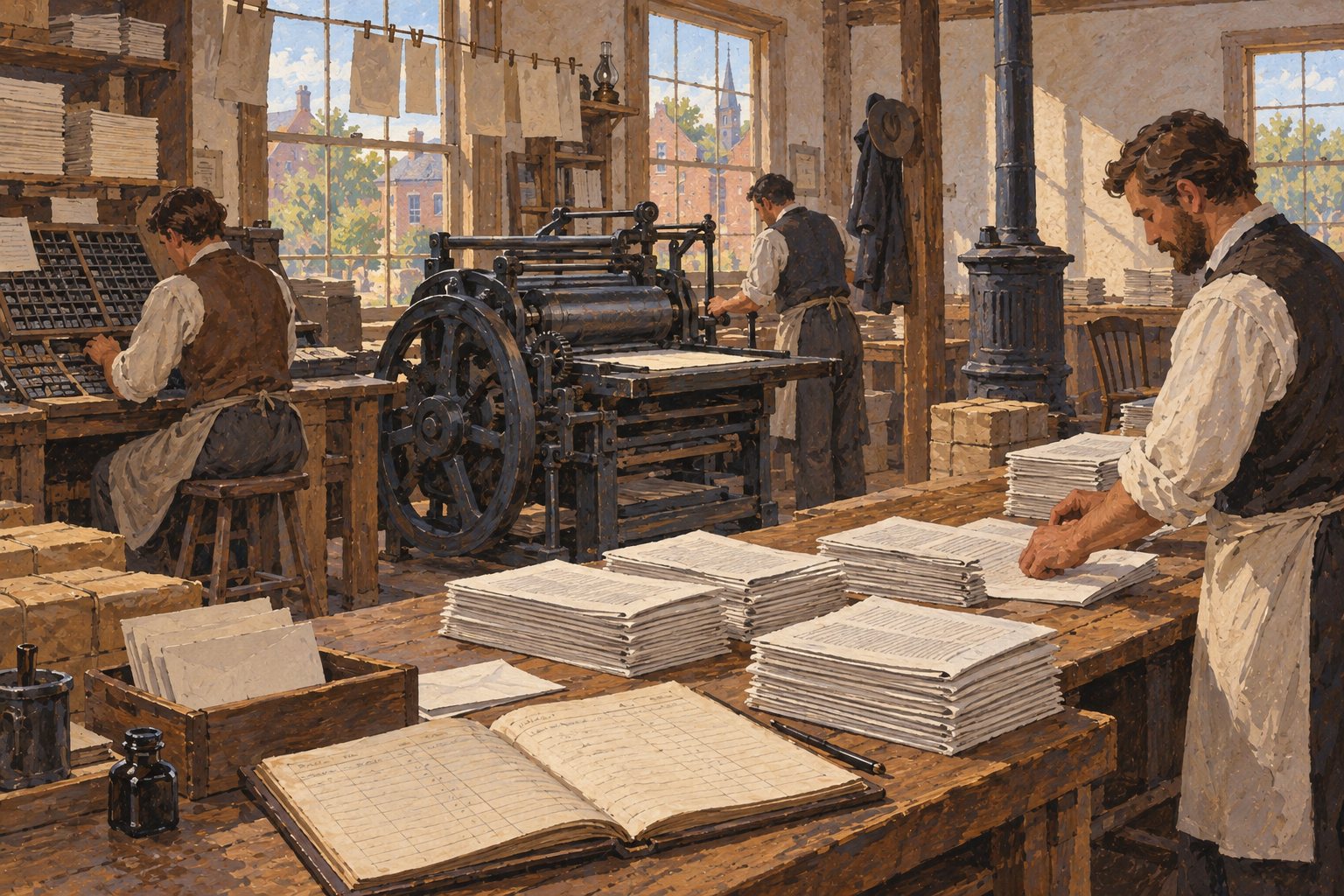
The Book of Mormon exists in three editions its founder saw through the press, and they differ. “Author and Proprietor” becomes “Translator” becomes “carefully revised by the translator.” The 1830 wording and the 1837 insertion are printed as title pages, years named. The modern versification is not used.
The coverage period and the earliest secure evidence are different dates. A tradition’s own account of its beginnings may differ from both.
From the Belief System account of The Nineteenth-Century New Religions
Historical setting
The Burnt District
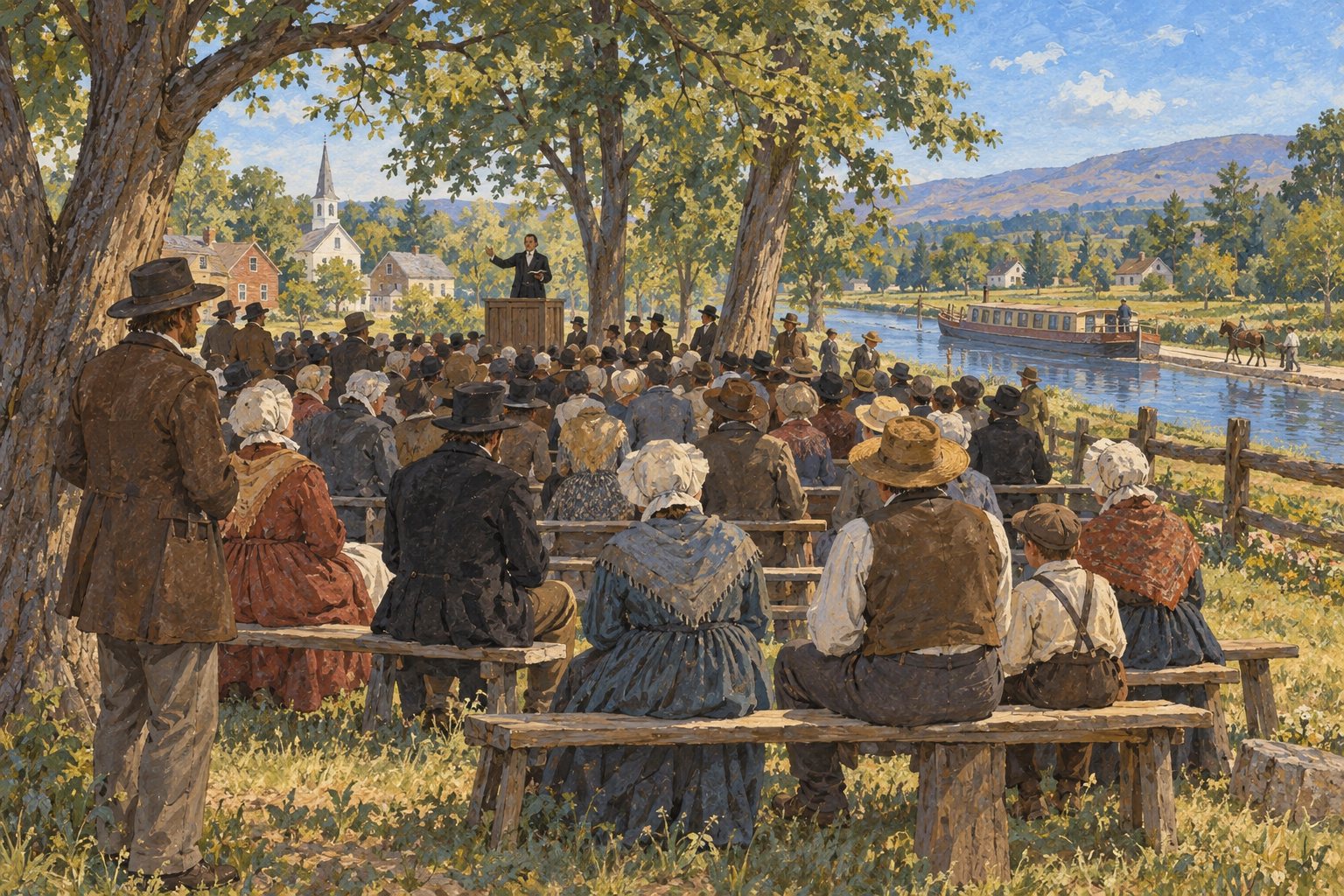
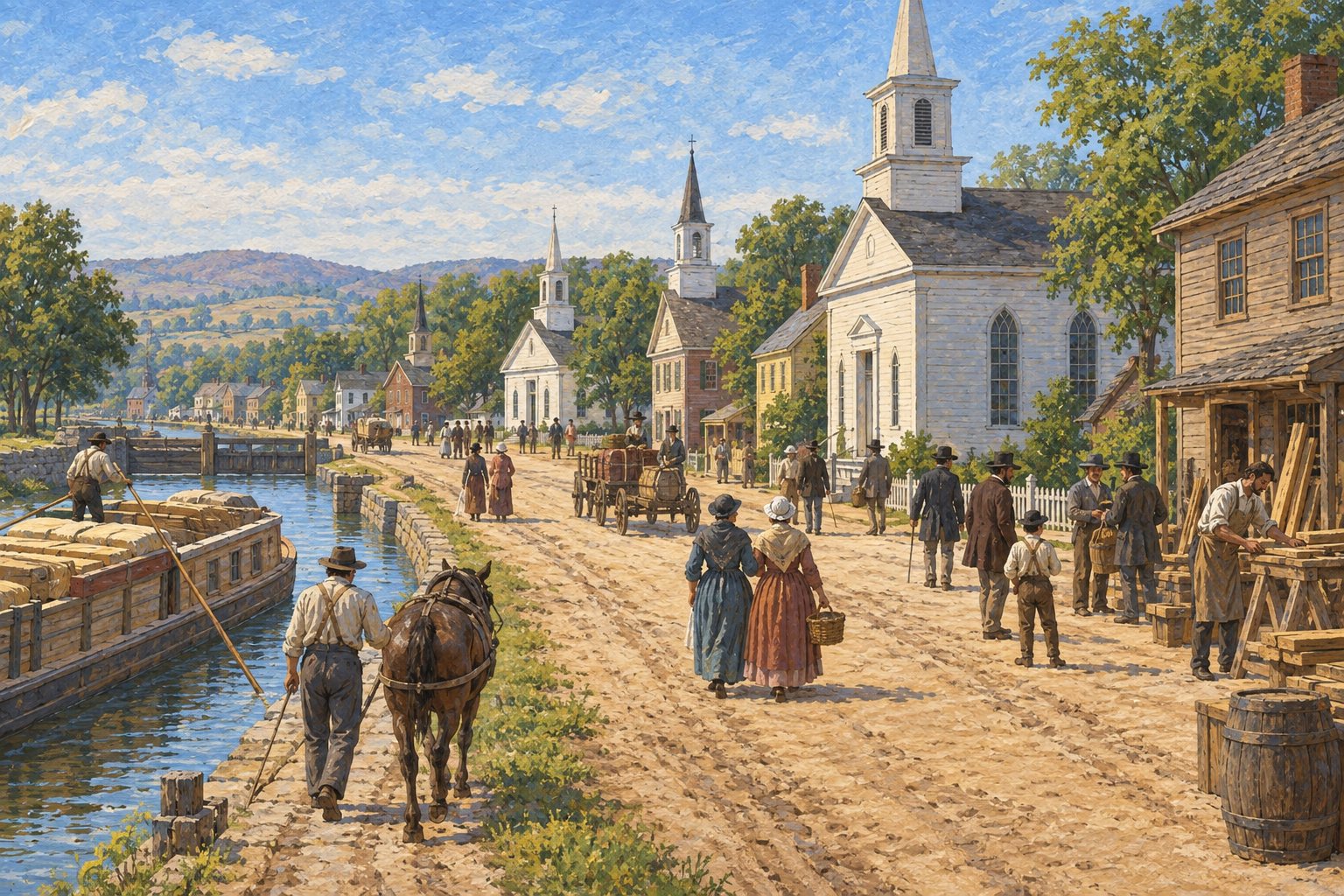
Western New York along the new Erie Canal (opened 1825) was the most heavily revivalled ground in the Protestant world — Finney’s own memoir coined the name this chapter borrows — a market of competing certainties in which the question a new religion answered was not “is there a God” but “which of these churches is true”; and the chapter states the volume’s jacket problem on its first page: several living traditions in one binding, held together by a moment and a machine, not by kinship of doctrine.
The Arithmetic of the End
William Miller computed the Second Coming from the 2,300 days of Daniel read as years from 457 BCE, and the innovation was not the vision but the publication: a checkable date, in print, argued like a proof — first “about the year 1843,” then, under Samuel Snow’s seventh-month refinement, 22 October 1844 — and when the date passed, the movement’s own papers printed the failure too; the name for the morning after, the Great Disappointment, is the tradition’s own coinage.
Explore the illustrations5 scenes · Along the Erie Canal
Along the Erie Canal. Western New York along the new Erie Canal (opened 1825) was the most heavily revivalled ground in the Protestant world — Finney’s own memoir coined the name this chapter borrows — a market of competing certainties in which the question a new religion answered was not “is there a God” but “which of these churches is true”; and the chapter states the volume’s jacket problem on its first page: several living traditions in one binding, held together by a moment and a machine, not by kinship of doctrine.
How it was transmitted
The Mortgaged Farm
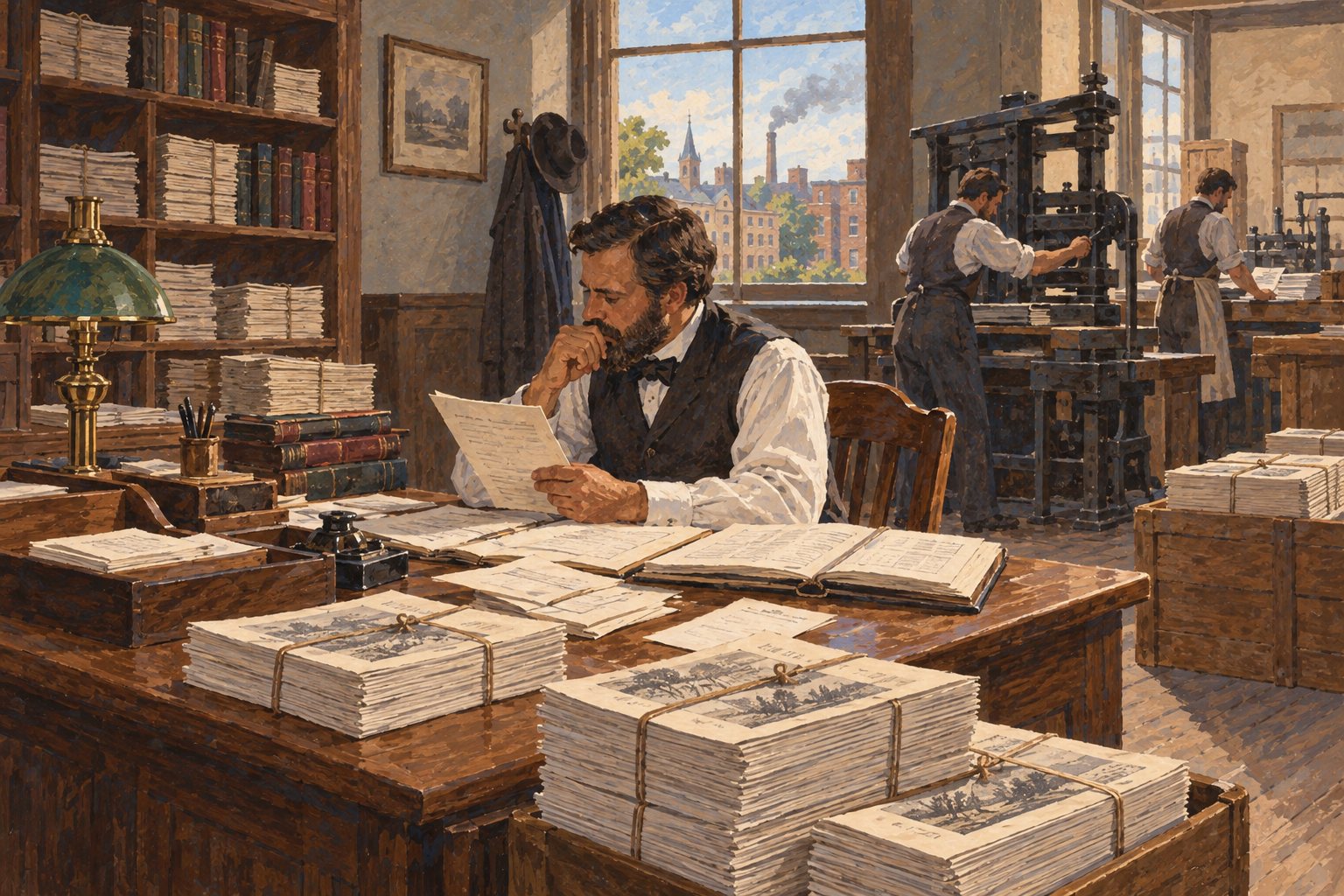
The Book of Mormon is the only founding scripture in this series with a print contract, a named financier and a security instrument: 5,000 copies from E. B. Grandin’s shop in Palmyra, agreed at $3,000 and secured on 25 August 1829 by a mortgage on Martin Harris’s farm — and among the movement’s earliest printed revelations is one addressed to Harris ordering him to pay the printer’s debt: scripture about the print bill, printed as scripture.
A Standing Order of Missionaries
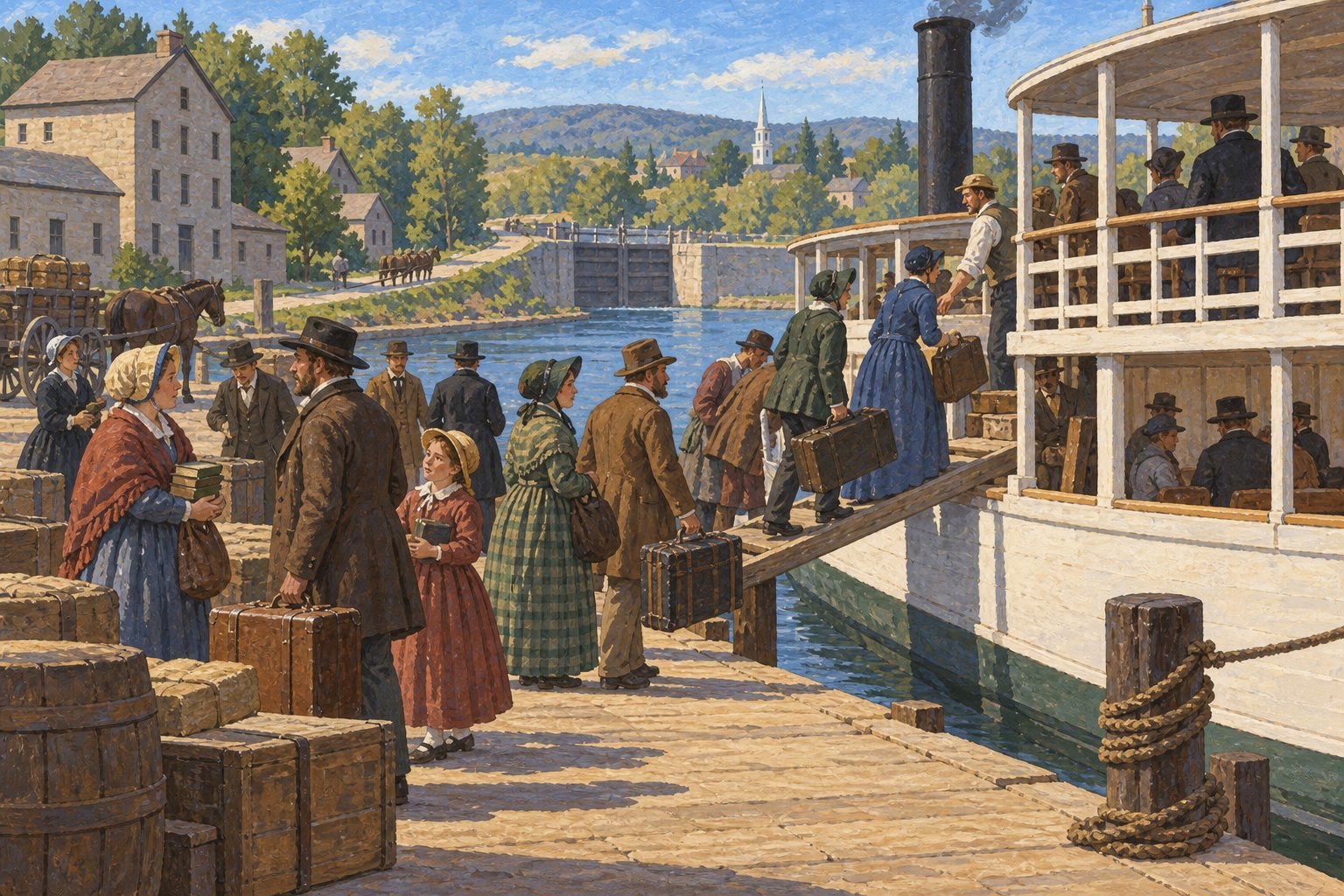
The LDS missionary system was a funded, standing organisation almost from the start — the 1837 Preston mission put the movement in England seven years after the book was printed, the Millennial Star (Manchester, from 1840) gave the British converts a periodical of their own, and the church ran an emigration agency out of Liverpool with chartered ships and printed instructions, inspected in 1863 by Charles Dickens, who reported the emigrants “the pick and flower of England” in his own account; the machine’s long tail is genealogical — a church whose rites require ancestors’ names built the Granite Mountain vault: 2.4 million microfilm rolls, roughly three billion images, in a working facility cut into a Utah canyon wall.
Explore the illustrations5 scenes · A Religion in the Mail
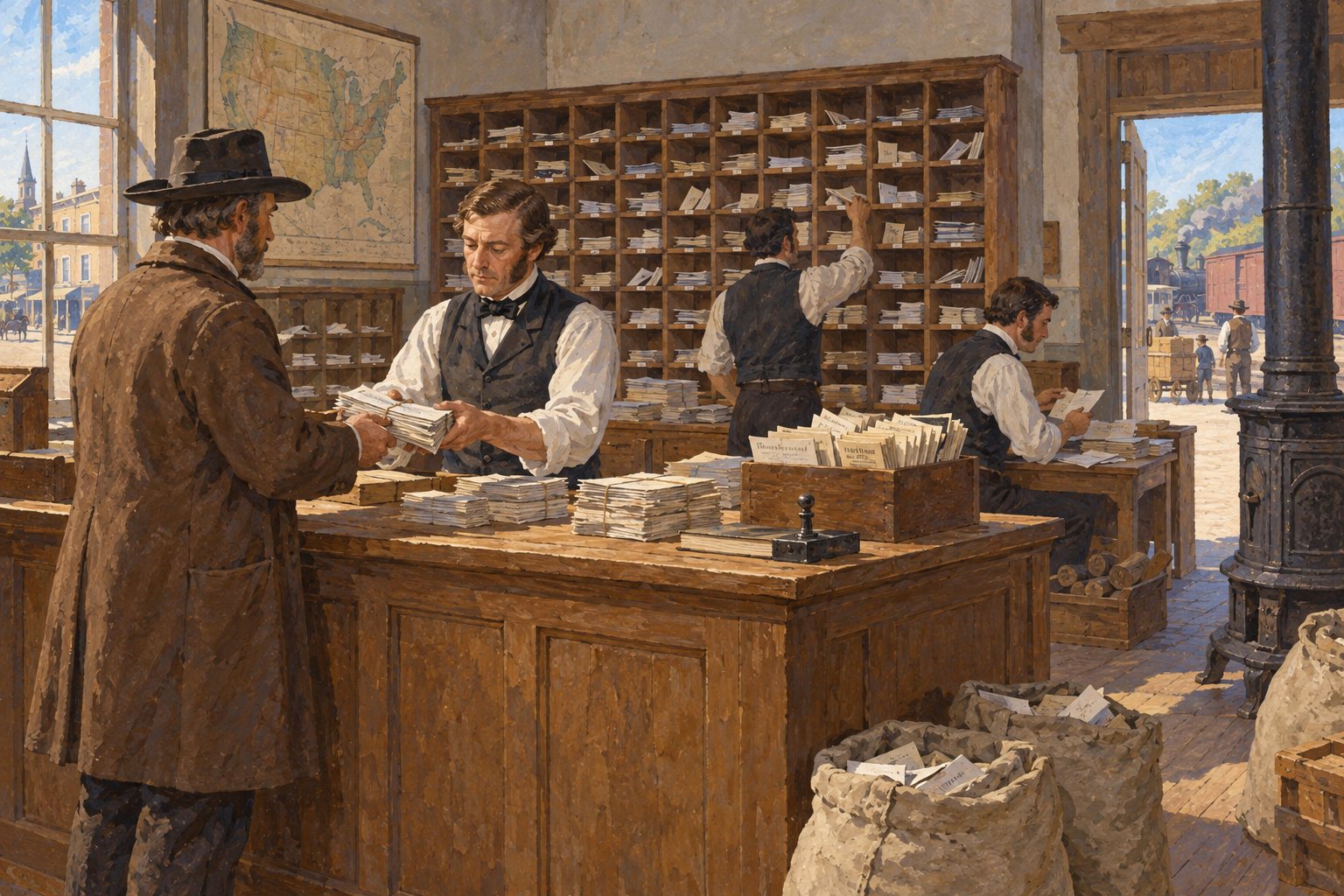
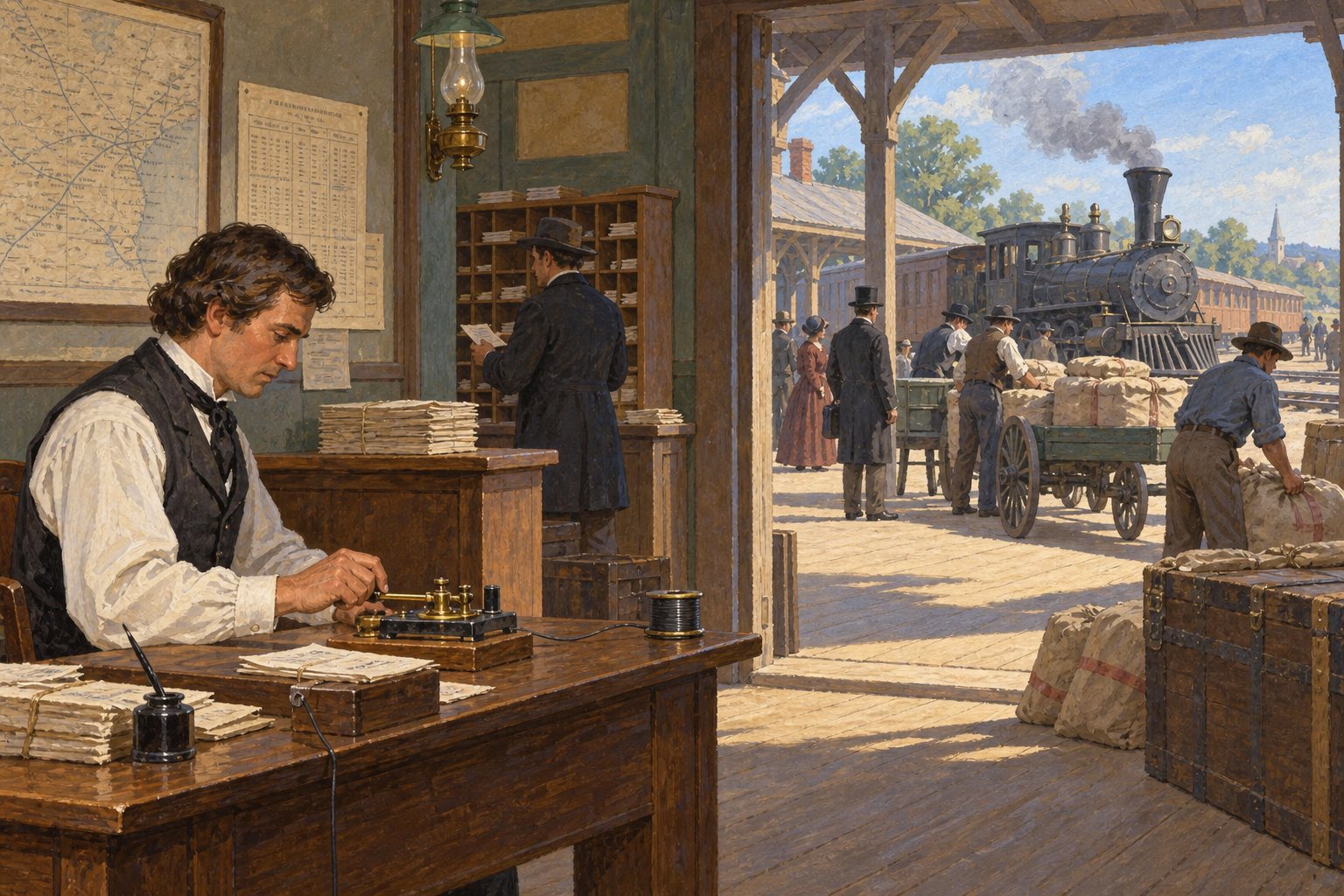
A Religion in the Mail. The general condition that made a new religion a distributable product: mass literacy, the steam press and stereotype plate, cheap postage (Britain’s penny post of 1840, the US postal acts of 1845 and 1851), the railway timetable — and on 24 May 1844 the first intercity telegram, itself a verse of scripture chosen by a young woman named Annie Ellsworth: “What hath God wrought”; the incumbent evangelical societies had already industrialised the tract and the mailing list, and every movement in this volume copied the toolkit rather than inventing it.
Texts and authority
A Canon With a Version History
The argument chapter: elsewhere in this series a canon forms over centuries, in the dark, and the historian infers a closing from its aftermath; here scripture was produced in front of witnesses, on contract, in numbered editions that differ — so this movement reads canons the way a textual critic reads drafts, and its working rule is mechanical: every quotation carries its edition’s year, because between one year and the next the words change, and the changes are signed. The control case is Spiritualism, which produced testimony and periodicals but never a closed book; the contrast between the movements that closed a text and the one that never did is the movement’s standing question, held open rather than answered — and the chapter restates the jacket problem: what these canons share is not content but a condition, formation in daylight.
The 1830 Text, Revised by Its Translator
The Book of Mormon exists in three editions its founder saw through the press — 1830, 1837, 1840 — and they differ: the 1830 title page names Joseph Smith “Author and Proprietor” where the 1837 prints “Translator”; the 1837 revision alters wording in passages of doctrinal weight — “the mother of God” in the 1830 printing, “the mother of the Son of God” in the 1837 — among the thousands of smaller changes the critical text catalogues; and the 1840 edition, its title page stating “carefully revised by the translator,” restores readings from the original dictation manuscript. About a quarter of that original survives; the complete printer’s manuscript survives entire, and changed hands in 2017 for a documented price — a scripture whose textual apparatus is not reconstructed but archived, purchasable, and photographed page by page in the church’s own documentary edition.
Institutions and resources
The Tenth, Defined in Writing
LDS tithing moved in one decade from emergency subscription to defined obligation: the revelation of 8 July 1838 at Far West defines the standing law as one-tenth of annual interest — quoted from an early printing with the edition year named — and the obligation acquired documented compliance mechanisms that operate today, described in the present tense: the annual tithing settlement before the bishop, and the temple recommend, which conditions access to the highest rites on a declared full tithe. Alongside it the Perpetual Emigrating Fund (from 1849) ran as a revolving loan book moving converts from Liverpool to the valley — until the state closed it: the Edmunds–Tucker Act of 1887 dissolved the Fund, disincorporated the church, escheated its property above a threshold and put a receiver into its finances, litigated to the Supreme Court — a treasury whose seizure produced its best surviving inventory.
Ensign Peak
The largest religious fund ever disclosed was disclosed by accident: in November 2019 a former employee’s whistleblower complaint put the church’s investment reserve, managed by the entity reported as Ensign Peak Advisors, near $100 billion — the complaint’s figure, never confirmed by any audited statement, and always labelled as the complainant’s; in February 2023 the Securities and Exchange Commission issued an order finding that the fund’s equity holdings had been reported through thirteen shell companies from 1997 to 2019, and the matter settled: a $4 million penalty against the fund and $1 million against the church. The chapter reports what the order states, quotes its operative findings with the order named and dated in the text, cites the church’s published response beside it, and characterises nobody’s intent — then connects the reserve to the volume’s oldest documents, because a reserve is what a defined tithe with documented compliance builds, compounded across the century between the receiver of 1887 and the regulator of 2023.
Explore the illustrations8 scenes · Health as an Institution
Health as an Institution. The Adventist tithe was systematised in print — “Systematic Benevolence” from 1859, the full tithe adopted through the 1870s — and it capitalised institutions: the Western Health Reform Institute of 1866 grew into the Battle Creek Sanitarium and then into a denominational hospital and education system whose present scale is printed only as the denomination’s own published statistics, labelled as such and given in the present tense; the Watch Tower ran leaner and said so on its own pages — Russell put his merchant fortune in (the amount printed only as a sourced range or UNVERIFIED), priced the literature at cost through colporteurs, and the first volume of Zion’s Watch Tower (1879) declared that the paper had a divine backer and would therefore never solicit men for funds — a funding doctrine, stated on the masthead’s own terms, quoted with year, in an economy where every rival movement passed a plate.
Changes and divisions
The Press the Prophet Broke
The LDS succession crisis began with a printing press: the Nauvoo Expositor published one issue, 7 June 1844, from dissidents inside the leadership; the city council — its minutes surviving — declared the paper a nuisance on 10 June, and the mayor, Joseph Smith, ordered the press destroyed; the charges that followed put him in Carthage jail, where a mob killed him on 27 June. He left no undisputed written designation of a successor, and every party to the division holds a document: the Twelve’s claim argued at the meeting of 8 August 1844 — where the contemporaneous minutes and diaries record one thing and the later “transfiguration” reminiscences add another, a gap between record and memory that is itself reported, with the two bodies of evidence dated; Sidney Rigdon’s guardianship claim; James Strang’s letter of appointment, a physical object with a contested postmark; and, sixteen years on, the Reorganization under the founder’s son, minuted at Amboy in 1860. The Nauvoo endowment of 1842 stands behind part of the succession argument, and the text states here that this volume describes the temple ceremony from published scholarship and does not transcribe it — the community designates it restricted, and an explained absence is a finding.
The Most Great Separation
The Babi succession produced the volume’s most formally instrumented split: the Bab’s own document appointing Mirza Yahya, Subh-i-Azal, survives, and what it appointed him to is contested — figurehead or successor; Baha’u’llah’s announcement from 1863 and the Edirne rupture of 1866–68 divided the community, and the Ottoman state resolved the quarrel administratively, exiling both claimants on files its archives preserve — Baha’u’llah to Akka, Azal to Famagusta; after 1878 the British administration of Cyprus inherited Azal on the pension list, and a religion’s losing claimant appears thereafter in colonial account books. E. G. Browne visited both parties in 1890 and printed his own eyewitness descriptions — his pen-portrait of Baha’u’llah is quoted in Browne’s own words from his 1891 introduction, which are his prose and not a translation: the one first-hand Western description of the founder in existence, and the only quotation the rights rule allows this story. The tradition’s later instrument — the Kitab-i-Ahd of 1892 and the expulsion mechanism the community names covenant-breaking — is described and cited as the most explicit formal machinery for excluding rival claimants anywhere in this series: a named offence, a named office that declares it, and a required severance.
Limits of the evidence
These limits are stated in the book before its argument.
- What the 1830 Book of Mormon was produced from The record shows a federal copyright filing of June 1829, a print contract, a mortgage and a finished book of 5,000 copies; the statements of eleven witnesses, printed with the book from the 1830 edition onward, are documents about an object that cannot now be examined. The volume reports the claim, the documents, the dates and the disputes; it does not assess whether golden plates existed.
- Whether any healing occurred, any communication with the dead took place, or any prophecy succeeded or failed in any sense beyond the calendar The volume reports the date set, the date passed, and what the movement’s own press printed next.
- Anyone’s sincerity, and anyone’s interior state The ex-member literature reads these documents as fraud; the devotional literature reads the same documents as providence. Both literatures are catalogued, and neither register enters the prose — these are living communities of millions, and they get the same sentence this series gives Nicaea.
Sources and reading
This article brings together the series’ existing overview and chapter summaries. The linked book page provides the full outline and bibliography.
- Whitney R. Cross, The Burned-over District1950. historian’s map of the canal strip
- Charles G. Finney, Memoirs1876. the “burnt district” coinage
- Joseph Smith’s 1838 history, serialised in the Times and Seasons15 March 1842. “war of words and tumult of opinions,” quoted from that printing
- Richard L. Bushman, Joseph Smith: Rough Stone Rolling2005. Palmyra’s canal-and-print economy
- William Miller, Evidence from Scripture and History of the Second Coming of Christ, about the Year 18431836 Troy edition. the 2,300-day computation in print
- Signs of the Timesfrom 1840. Millerite argument in serial form
- The Midnight Cryfrom 1842. Himes’s second paper
- Samuel Snow, The True Midnight CryAugust 1844. seventh-month refinement; the 22 October date
Illustrations are newly generated interpretations of themes in the book. They are not surviving artifacts, historical photographs or evidence for the events described.