11 illustrations · 1:13
Watch & listen.
Follow the images with a narrated journey through the book.



Overview
- Coverage
- c.3100 BCE–394 CE
- Earliest secure evidence
- c.3100 BCE
- Transmission
- the fill-in-the-blank funerary scroll
That is the argument of this volume, and it is traceable in objects at every stage. Writing kept the accounts before it kept the hymns. The Nile flood was measured, so the promise the system made was auditable annually. The funerary literature was a manufactured product with workshop production, price tiers and blanks left for the buyer’s name. And when the state stopped paying, the last dated hieroglyphic inscription was cut at Philae in 394 CE.
The coverage period and the earliest secure evidence are different dates. A tradition’s own account of its beginnings may differ from both.
Historical setting
The River That Could Be Measured
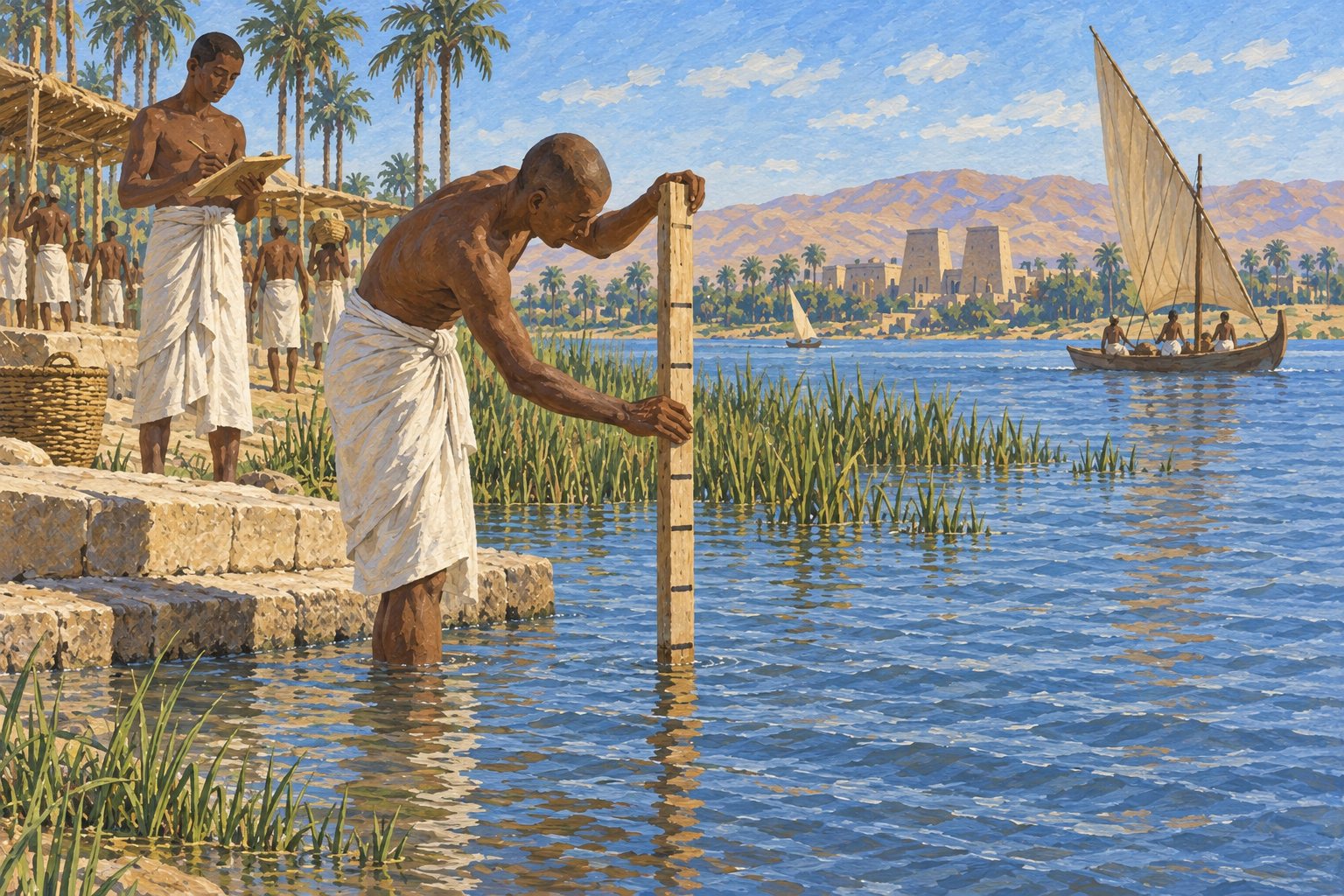
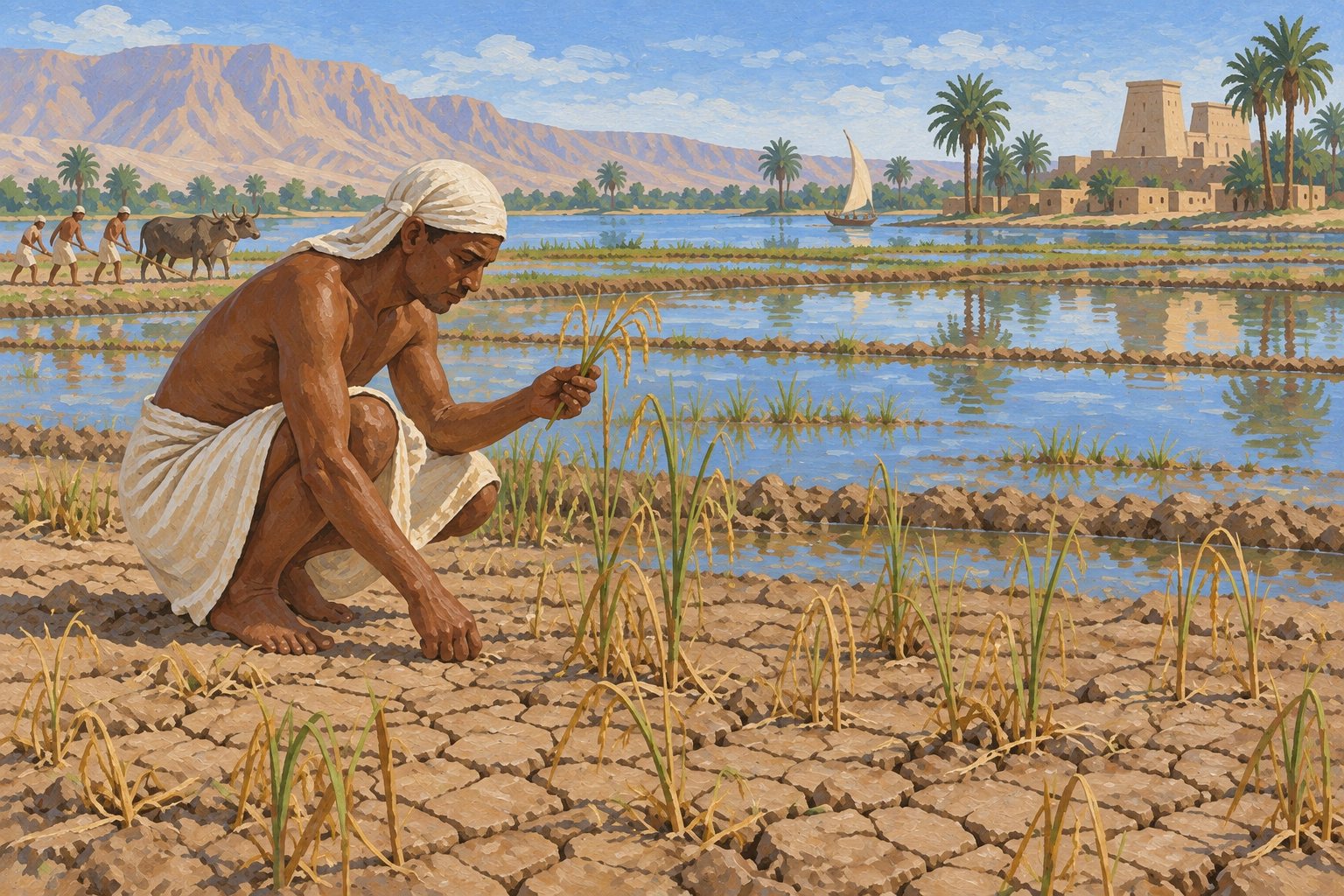
The flood was an annual, measurable, bankable event — the state recorded its height to fractions of a cubit from the first dynasties — so the religion’s basic bargain, order maintained against chaos, carried a number every year, and a bad number was a theological event with a famine attached.
Two Crowns on One Palette
Unification, conventionally dated c.3100 BCE, is attested first on a religious object: a carved votive palette from a temple deposit at Hierakonpolis showing one king smiting under the falcon on one face and wearing the other land’s crown on the reverse — and whether it records a war, a rite, or a rite about a war is contested.
Explore the illustrations3 scenes · Measuring the Nile
Measuring the Nile. The flood was an annual, measurable, bankable event — the state recorded its height to fractions of a cubit from the first dynasties — so the religion’s basic bargain, order maintained against chaos, carried a number every year, and a bad number was a theological event with a famine attached.
How it was transmitted
The Words of the God
Egypt ran three scripts as one tiered technology — monumental hieroglyphs, “the god’s words,” for eternity; cursive hieratic for administration, letters and literature; demotic beneath that — one language stacked from temple wall down to tax receipt, so sacred text was never locked to a script: the same spell could be carved for ever or copied fast for a customer.
Be a Scribe
The whole apparatus rested on a profession manufactured in schools, whose recruitment propaganda survives because schoolboys copied it — every other trade is misery, “be a scribe” — and whose working discipline is visible in what it left behind: exercise copies, master texts, and colophons certifying that the copy matches what was found.
Explore the illustrations4 scenes · The scroll workshop
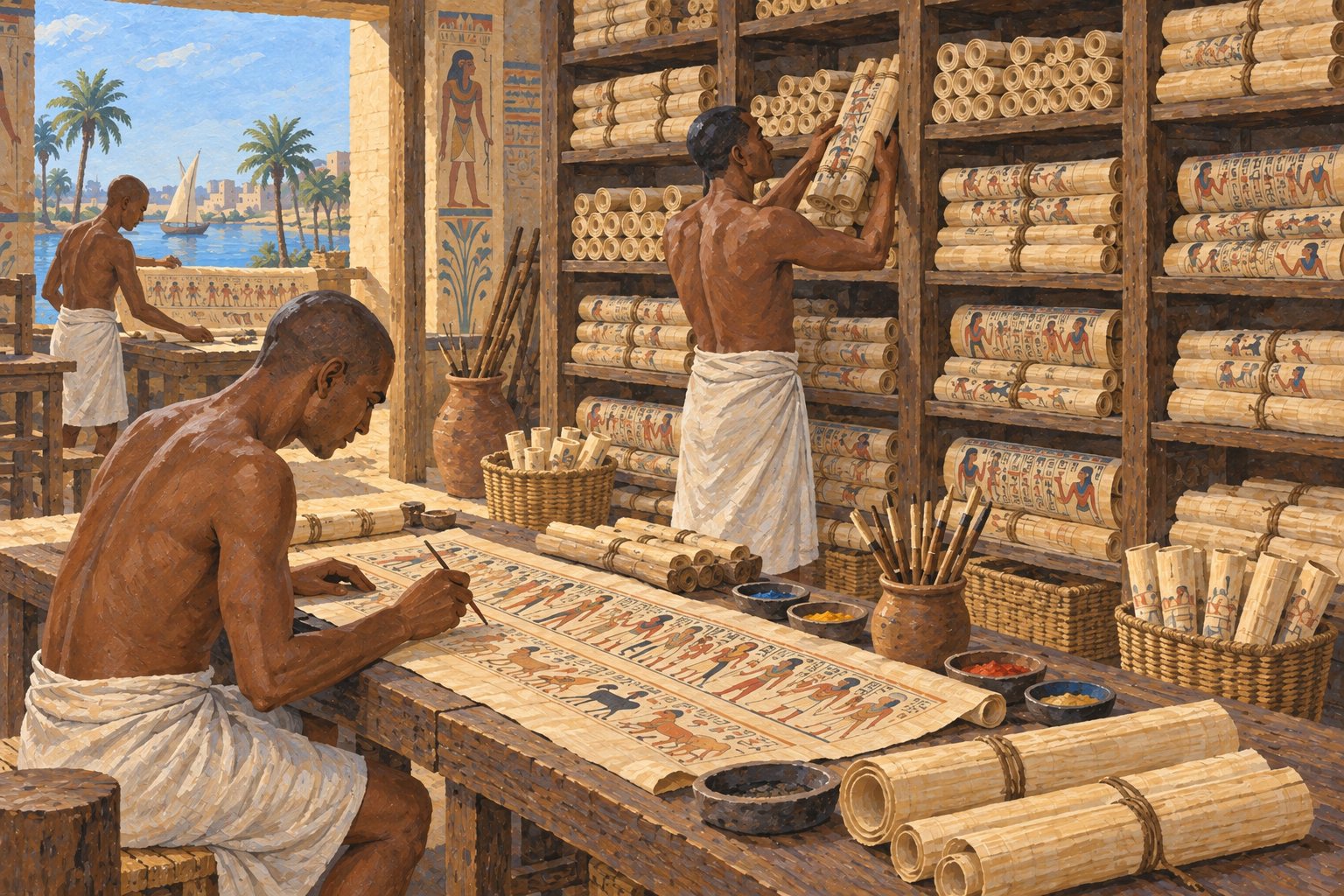
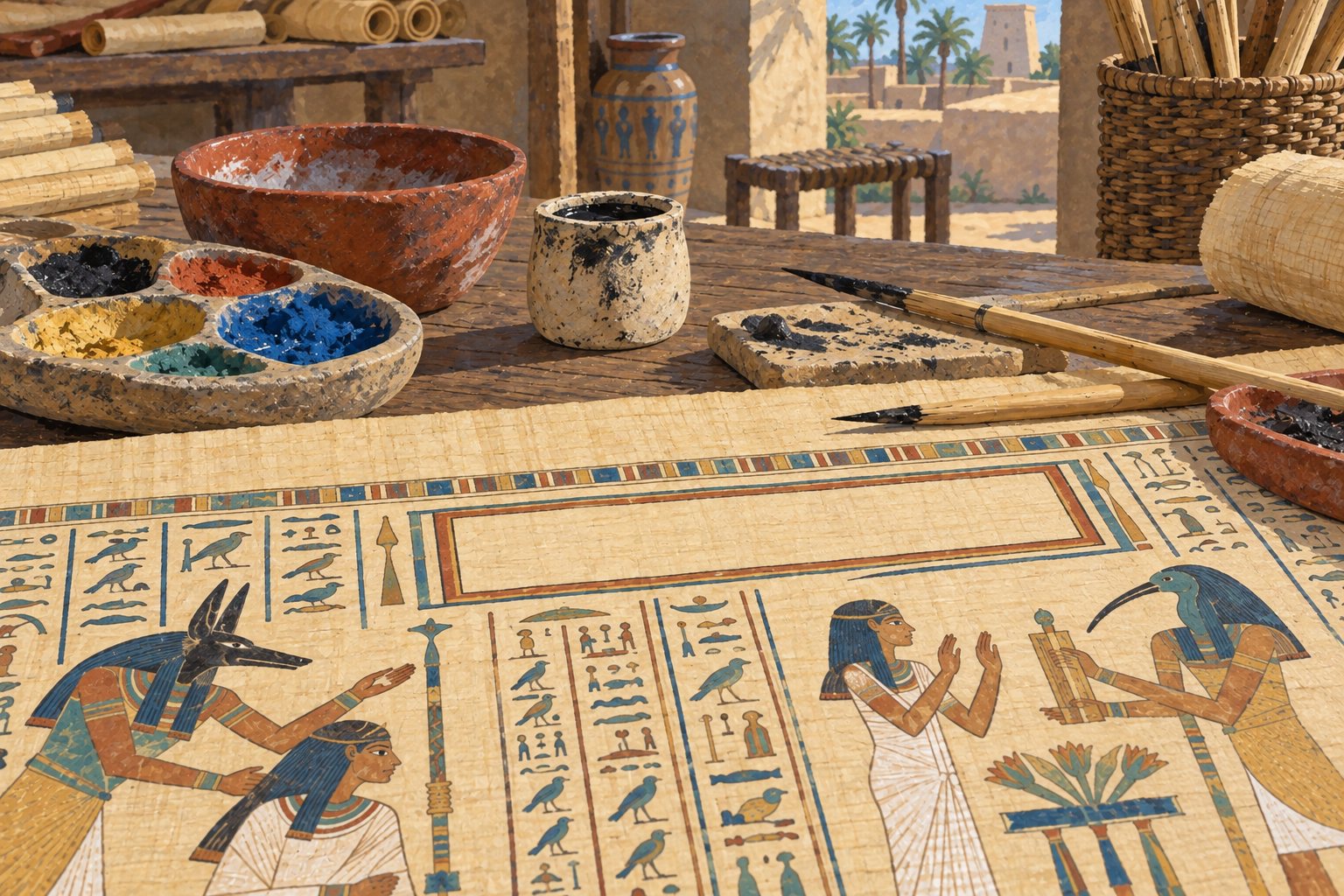
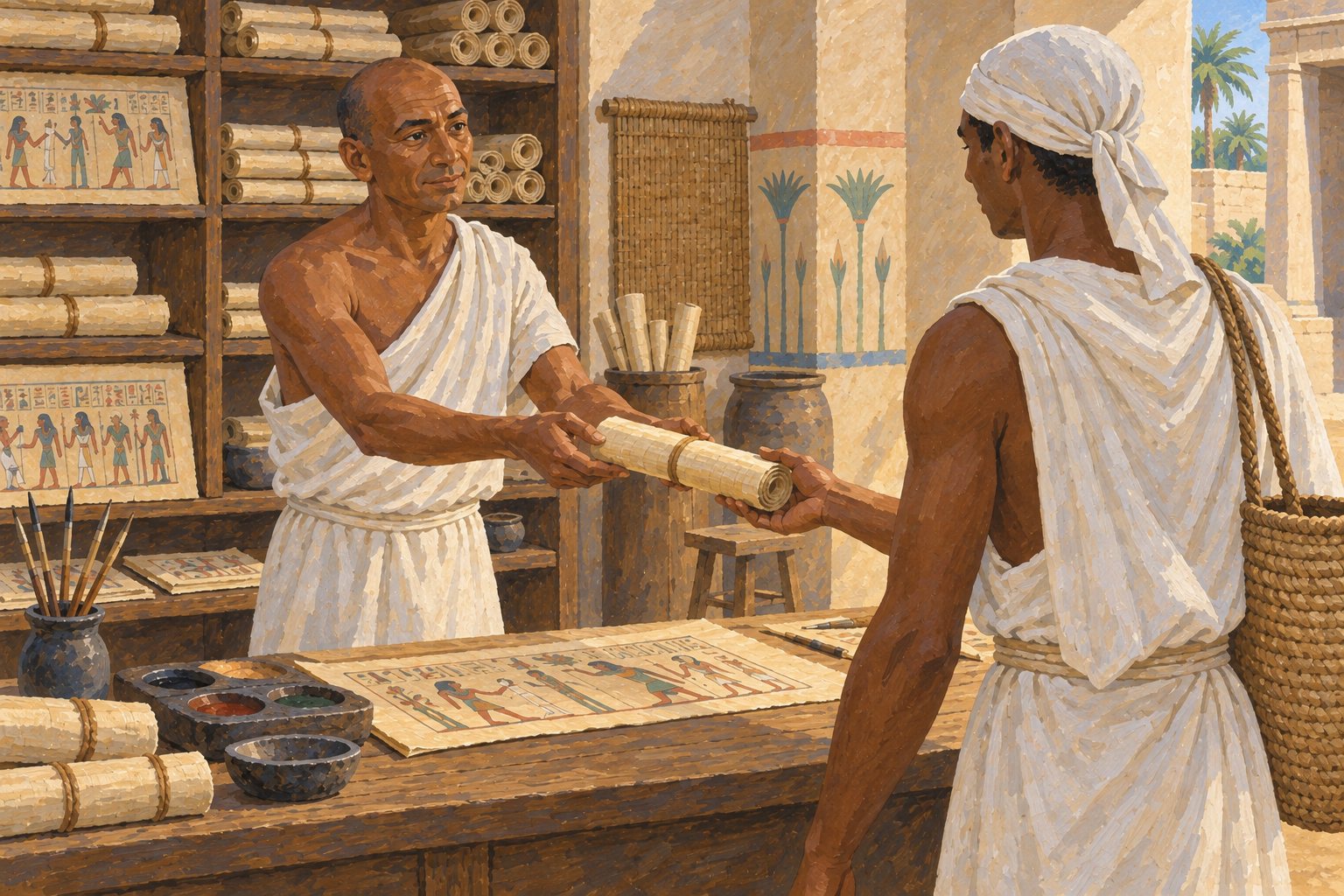
The scroll workshop. A Book of the Dead was often not commissioned but stocked: workshops produced scrolls in advance — vignettes painted, spells copied, spaces left where the buyer’s name would go, filled in at sale — and in the Papyrus of Ani the name “Ani” sits in those blanks in a different hand from the body text and is in places misspelled or omitted: personal salvation, held as inventory.
Texts and authority
A Canon With No Council
There is no Egyptian canon — no list, no closing, no council, no trial over contents in three thousand years — and what exists instead is a two-thousand-year editorial tradition in which the same material is copied, re-selected, renumbered and re-sold down the social scale; the cleanest proof of the openness is that the religion’s central story survives nowhere as a connected Egyptian narrative — the only continuous account of the Osiris myth is Plutarch’s, a Greek priest of Delphi writing two millennia after the first allusions.
The Spells in the Pyramid
The corpus enters history at the top: in 1881 Maspero opened the pyramid of Unas (conventionally dated c.2350 BCE) and found the chambers walled with spells — the oldest substantial body of religious text surviving anywhere — written for exactly one man, the king, and including utterances in which he consumes the power of the gods; the “utterance” numbers scholars cite were assigned in Berlin in 1908.
Institutions and resources
The God’s Estate
A temple was an economic unit — fields, herds, ships, workshops, granaries — staffed by rotating lay watches and paid through a circuit in which offerings presented to the god “reverted” to the staff as wages; and from the Old Kingdom on, kings granted temples immunity from levy and corvée: the untaxed sector is as old as the state.
What Ramesses Gave Amun
The scale survives on one object: Papyrus Harris I, at about forty-one metres the longest papyrus known, compiled under Ramesses IV, itemises what Ramesses III conferred on the temples — on the order of a hundred thousand people, half a million cattle, seven hundred thousand acres, with Amun’s Thebes taking roughly four-fifths of it — and the same chapter prints the limits in the same breath: whether the lists record new gifts or confirmed totals is debated, and the leap from them to “the temples owned a third of Egypt” is a modern extrapolation resting mainly on one further document.
Explore the illustrations4 scenes · Temple granary court
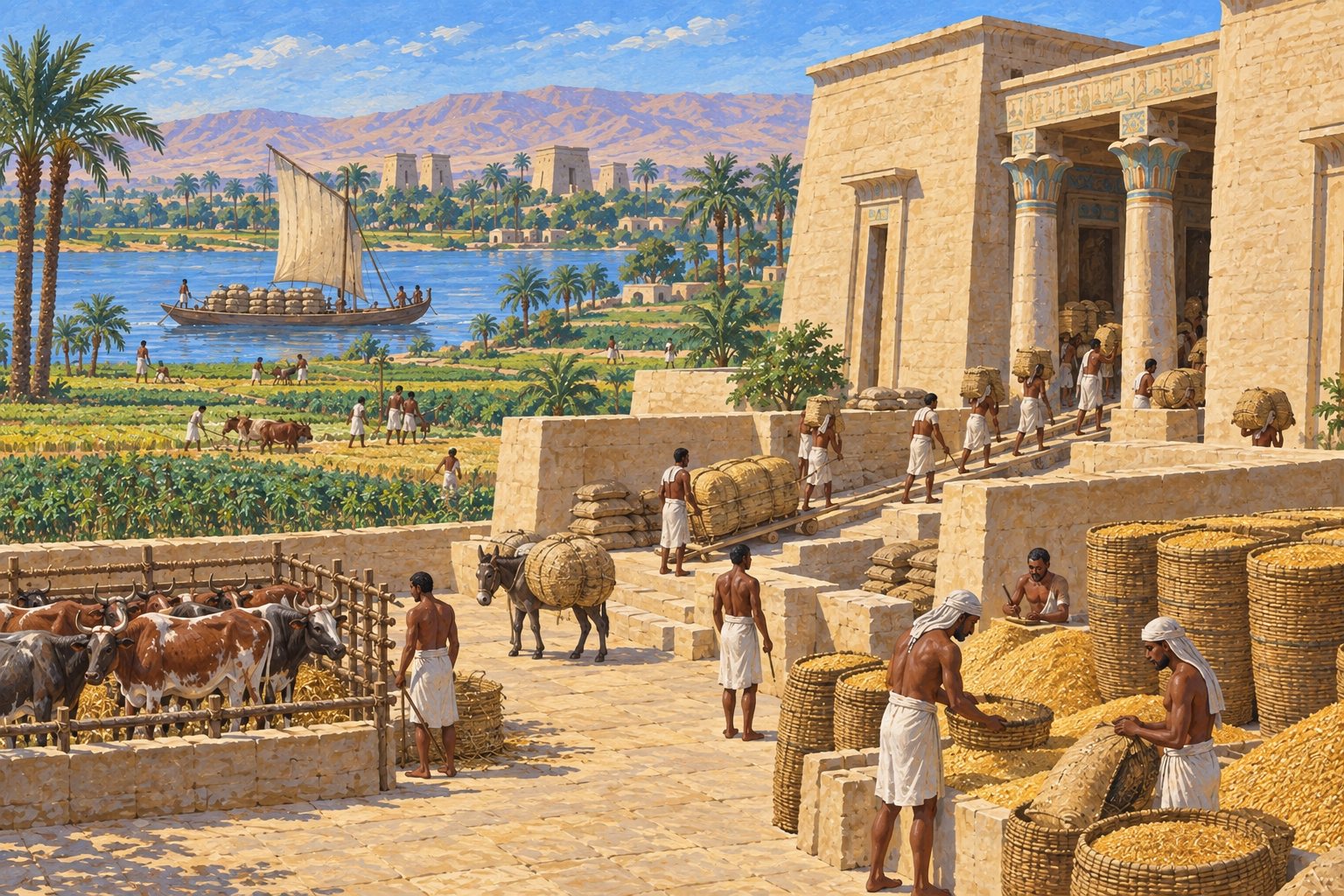
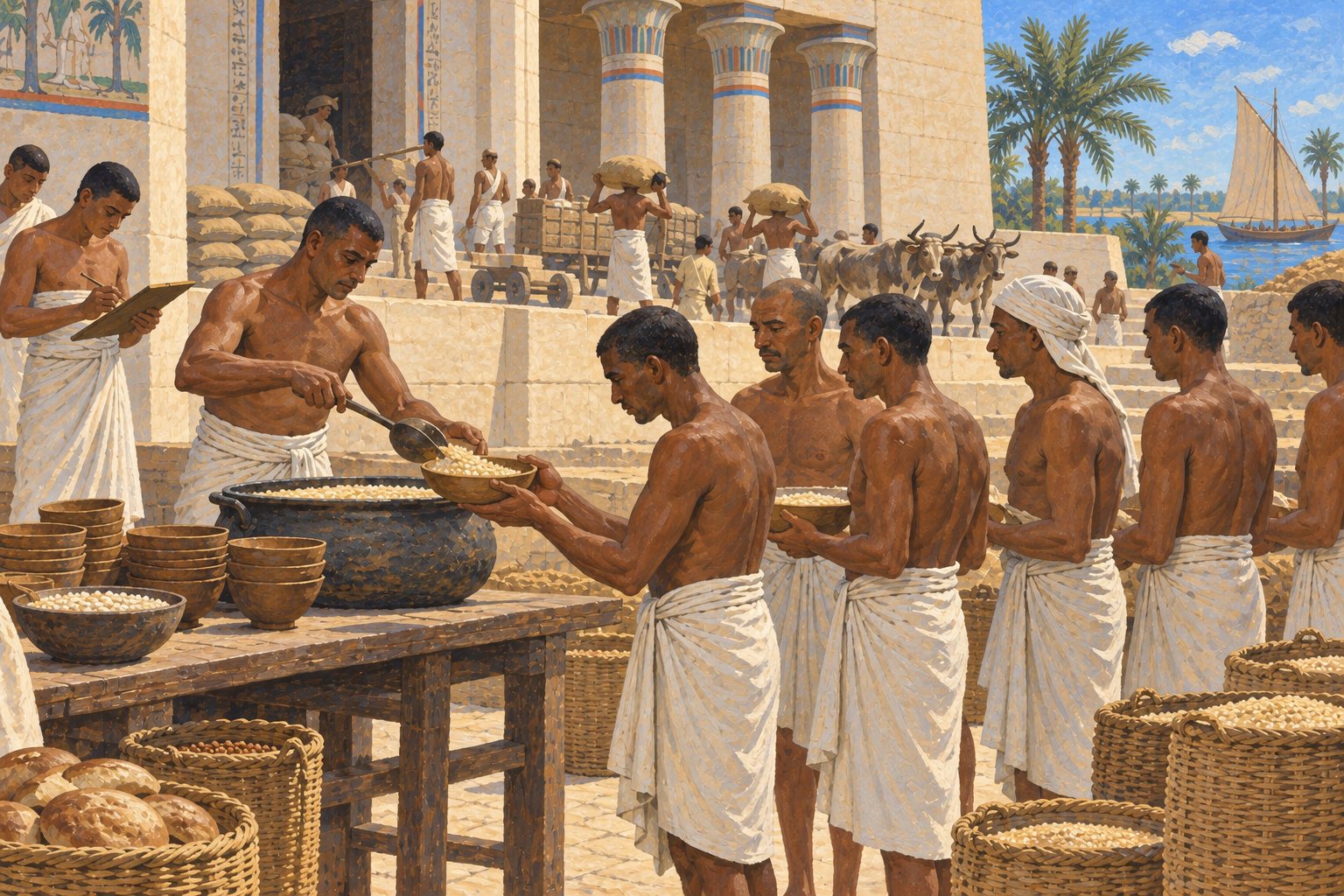
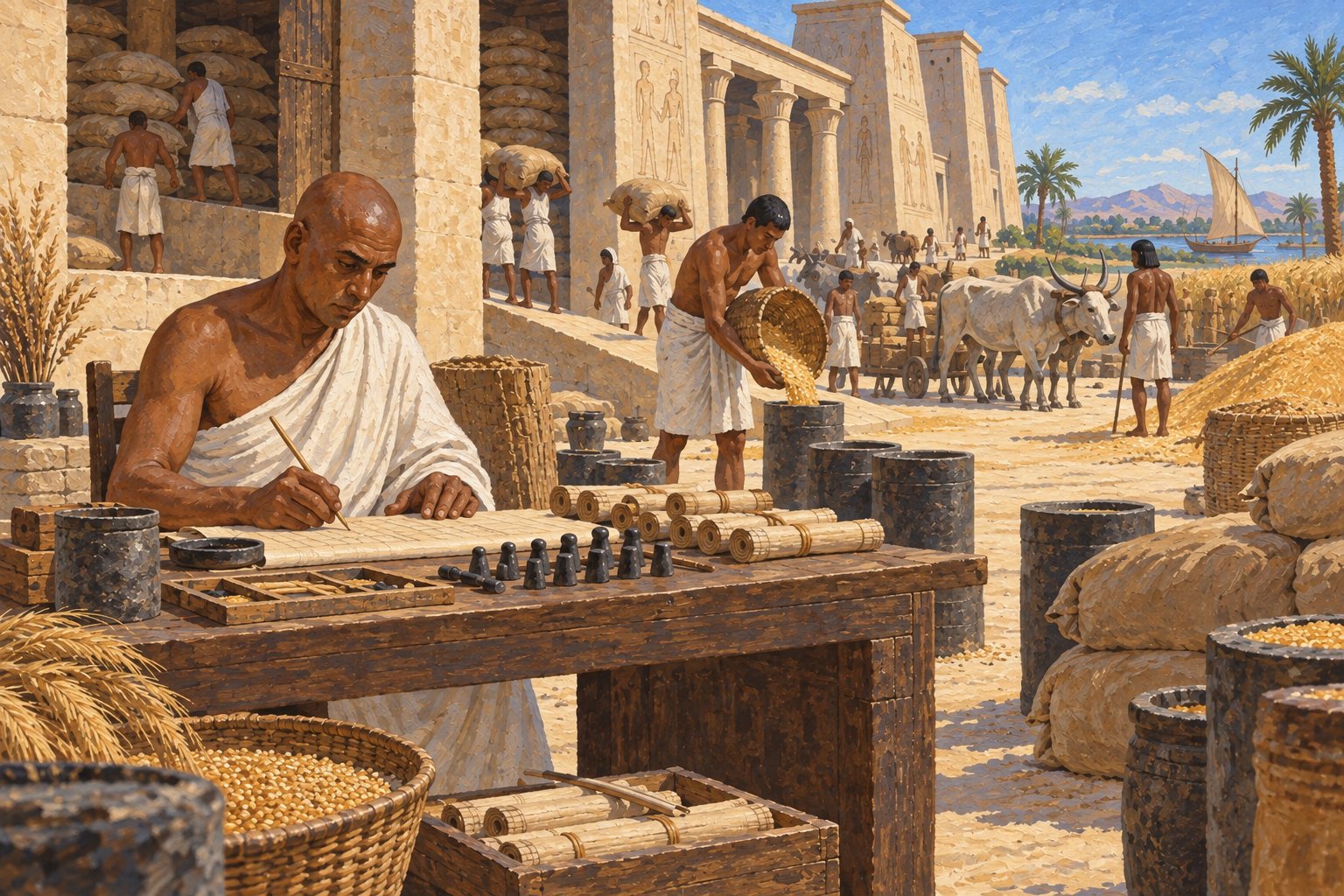
Temple granary court. A temple was an economic unit — fields, herds, ships, workshops, granaries — staffed by rotating lay watches and paid through a circuit in which offerings presented to the god “reverted” to the staff as wages; and from the Old Kingdom on, kings granted temples immunity from levy and corvée: the untaxed sector is as old as the state.
Changes and divisions
The Horizon of the Aten
Whatever Akhenaten’s theology was — and no source states his motive — his measurable acts were fiscal and administrative: the god with the largest estate in Egypt had his name hacked from monuments, his temples’ revenues redirected, and a rival capital for a rival cult raised on virgin ground; read as economics, Amarna is a crown striking the one institution rich enough to rival it — and that reading is printed as a reading, beside the theological one, with neither adjudicated.
Overgrown with Weeds
The restoration is the measurement: within a few years of Akhenaten’s death the court had left his city, and a stela in Tutankhamun’s name describes the temples fallen into ruin, their shrines become mounds overgrown with weeds, and itemises re-endowment — then the machinery of erasure ran in reverse, the Aten temples quarried for fill under Horemheb and the whole episode omitted from Seti I’s king list at Abydos: the estate outlived the king, and it kept the books.
Limits of the evidence
These limits are stated in the book before its argument.
- What any Egyptian believed The sources are overwhelmingly funerary and monumental, produced by and for the fraction who could write or pay — Baines and Eyre’s much-cited estimate puts literacy around one per cent, and it is printed as an estimate. The volume can establish what was written, copied, sold, endowed, erased and restored; inner assent, for thirty centuries of farmers, cannot be established. The phrase “the Egyptians believed” appears nowhere in this book: it is a sentence about thirty centuries and therefore about nothing.
- A founding This is one of the eleven volumes with no defensible ignition date, and here even the tradition offers no founder and no founding story — the gods are simply present in the earliest records, and the Turin king list assigns them reigns before any human king. The span opens at the earliest secure attestation of the state cult — the Narmer Palette, conventionally dated c.3100 BCE — and the front matter prints that distinction, per the series rule.
- Absolute dates before 664 BCE Chronology is fixed to the year only from Psamtik I (664 BCE) backwards, via Assyrian and Greek synchronisms; before that it is built from edited king lists, one heavily-worked Sothic observation, and radiocarbon — and the schemes disagree by decades, in the third millennium by a century or more. The traditional and the scientific datings are both given and labelled; “conventionally dated” carries more weight in this volume than in any other.
Sources and reading
This article brings together the series’ existing overview and chapter summaries. The linked book page provides the full outline and bibliography.
- Palermo Stone royal annals, in Breasted, Ancient Records of Egypt IFifth Dynasty compilation; Breasted 1906. year-by-year Nile heights in cubits, palms and fingers
- Strabo, Geography 17, Hamilton and FalconerRoman; Hamilton and Falconer trans.. the Elephantine nilometer as a flood gauge and a tax base
- Herodotus, book 2, G. C. Macaulay440s BCE; Macaulay trans.. the land as “a gift of the river”; three grades of embalming by price
- Hymn to the Nile, in Erman, Blackman’s English19th Dynasty school copies; Blackman 1927. praise to a flood no organised cult could compel
- Narmer Palette, Cairo JE 32169conventionally c. 3100 BCE; found 1897–98. unification first attested as a votive cosmetic palette
- Quibell and Green, Hierakonpolis plates, with Petrie’s notes1900. findspot, faces, crowns — and Petrie’s obsolete 4800 BCE dating
- Nicholas Millet on the related macehead1990. objects of this class as dated temple donations, not war monuments
- Whitney Davis, Masking the Blow1992. the smiting image as a scheme of representation
Illustrations are newly generated interpretations of themes in the book. They are not surviving artifacts, historical photographs or evidence for the events described.