15 illustrations · 1:40
Watch & listen.
Follow the images with a narrated journey through the book.



Overview
- Coverage
- c.1500–500 BCE
- Earliest secure evidence
- c.1500 BCE
- Transmission
- recitation with checksums — the pāṭha system
What carried it was a set of transforms: the same verse recited forwards, backwards and in braided permutations, because the modes check each other. A pitch put on the wrong member of a compound reverses who kills whom, and the tradition kept the mistake as a warning about its own machinery. A price floor of a hundred cows for a soma-sacrifice, and a clause forbidding a priest to work under it. A recitation cancelled, by rule, when too many donkeys are braying.
The coverage period and the earliest secure evidence are different dates. A tradition’s own account of its beginnings may differ from both.
Historical setting
The Treaty of the Four Gods
The earliest datable trace of the Vedic gods is not in India: around 1380 BCE a treaty between the Hittite king Suppiluliuma I and Shattiwaza of Mitanni, filed at Hattusa, lists Mitra, Varuna, Indra and the Nasatyas among its divine witnesses, and a Mitanni horse-training manual counts its laps in recognisably Indo-Aryan numerals — so the volume opens on fired clay in Anatolia, two and a half thousand kilometres from the Punjab, holding gods the hymns share.
The Cities That Were Already Ruins
By the conventional dating, the brick cities of the Indus — street grids, standardised weights, an undeciphered script, and no building anyone can securely call a temple — had declined by about 1900 BCE, generations before the hymns’ conventional window opens, and what if anything the Vedic world owes them is one of the two live questions this volume reports and does not settle.
Explore the illustrations5 scenes · Rivers of the Punjab
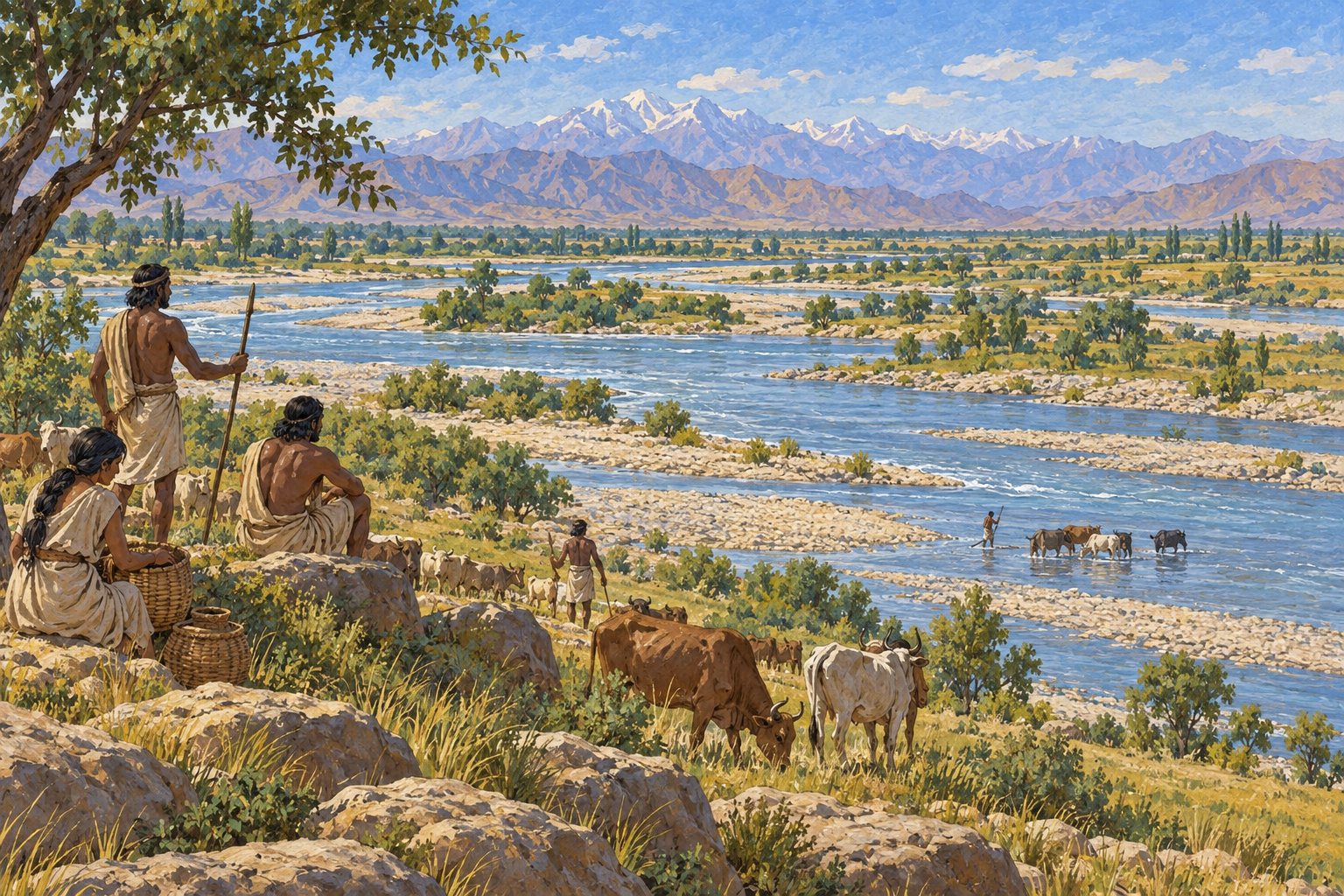
Rivers of the Punjab. The hymns carry their own map — the river-praise hymn of the tenth book lists the streams in geographical order from the Ganges westward, the Sarasvati is praised as a great river running “from the mountains to the sea” while the later texts describe it vanishing into the sands, and the one event the Rigveda narrates at length, the Battle of the Ten Kings, is fought on the Parusni, the modern Ravi — the corpus places itself in the Punjab and then, layer by layer, walks east, and the walking is itself a dating ladder.
How it was transmitted
A Perfect Text With No Object
The Rigveda’s oldest surviving manuscripts are roughly three thousand years younger than its conventional composition — the thirty codices UNESCO placed on the Memory of the World register in 2007 were copied between about 1500 and 1800 CE — yet specialists treat the received text as fixed to the syllable, and to the pitch-accent, since well before the Buddha; the machine that did this left no artefact at all, and this movement takes it apart.
The Eight Ways of Saying One Line
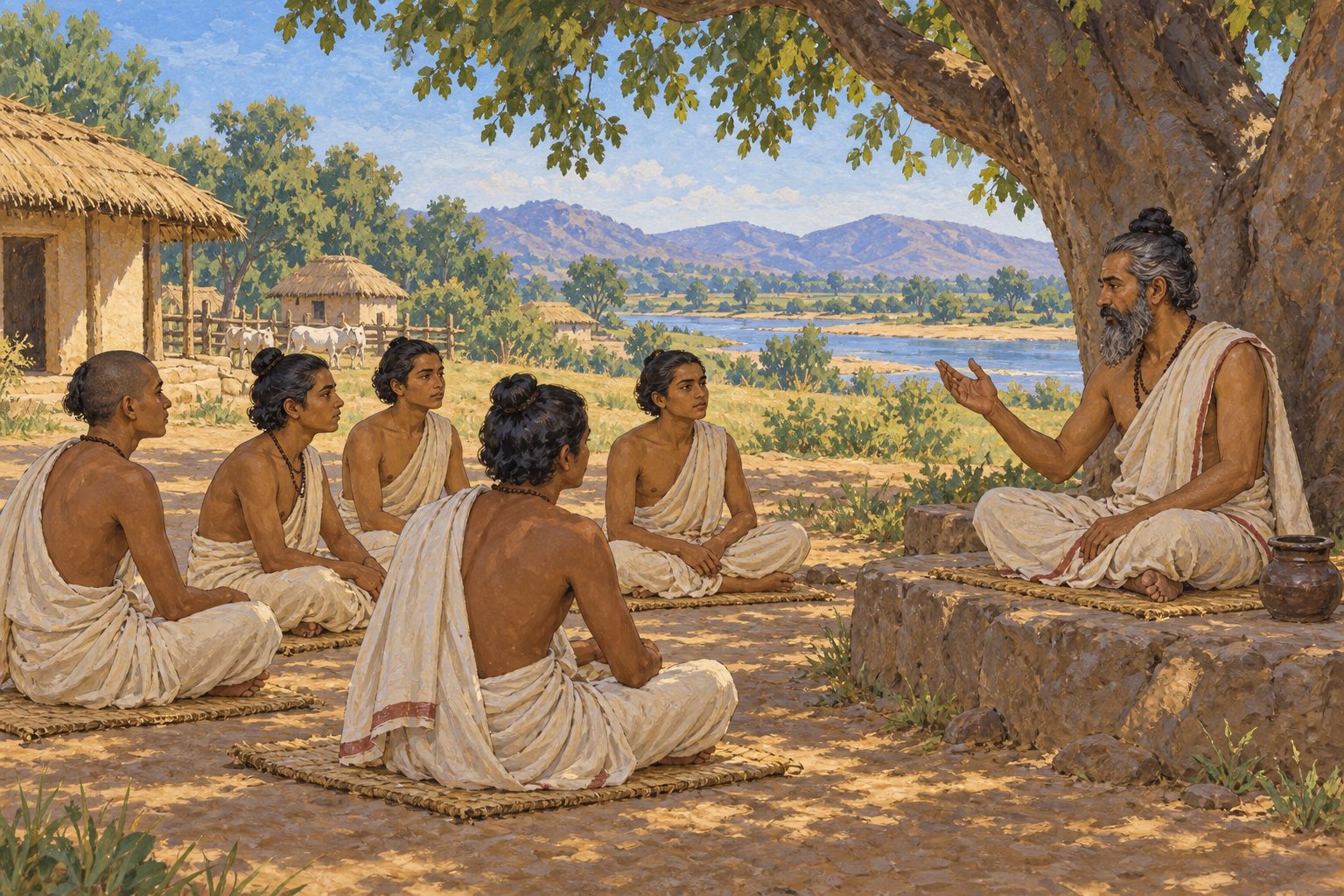
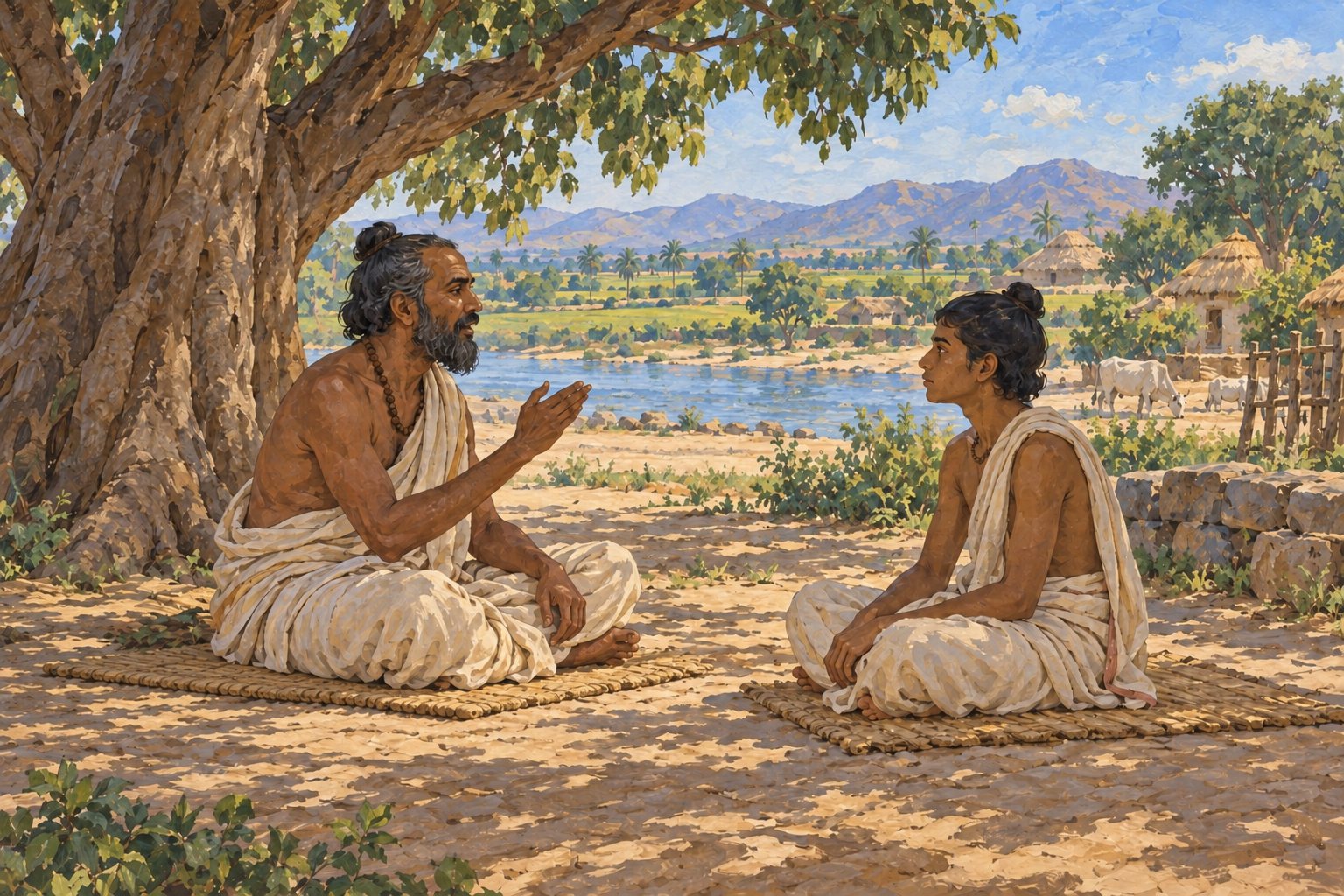
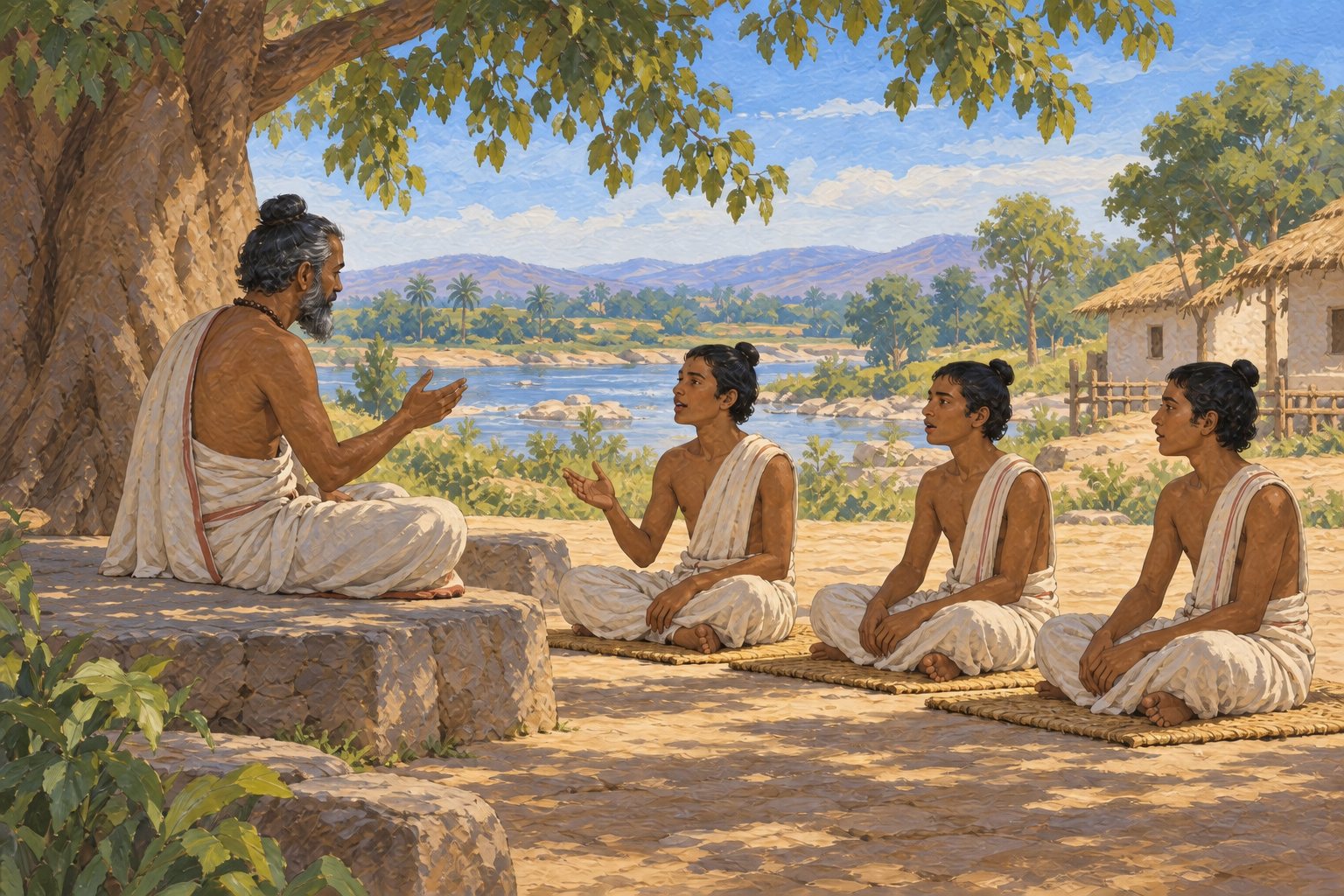
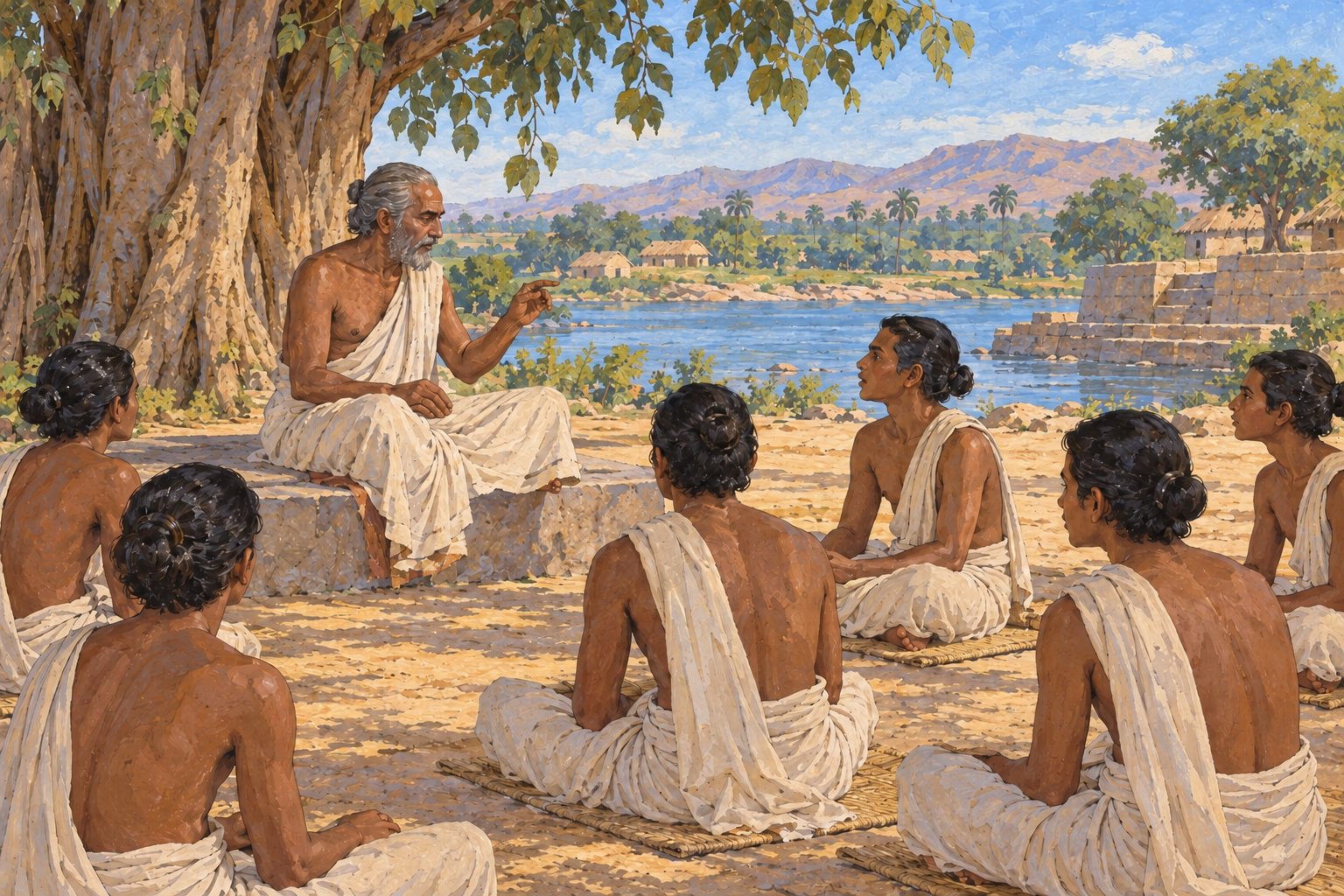
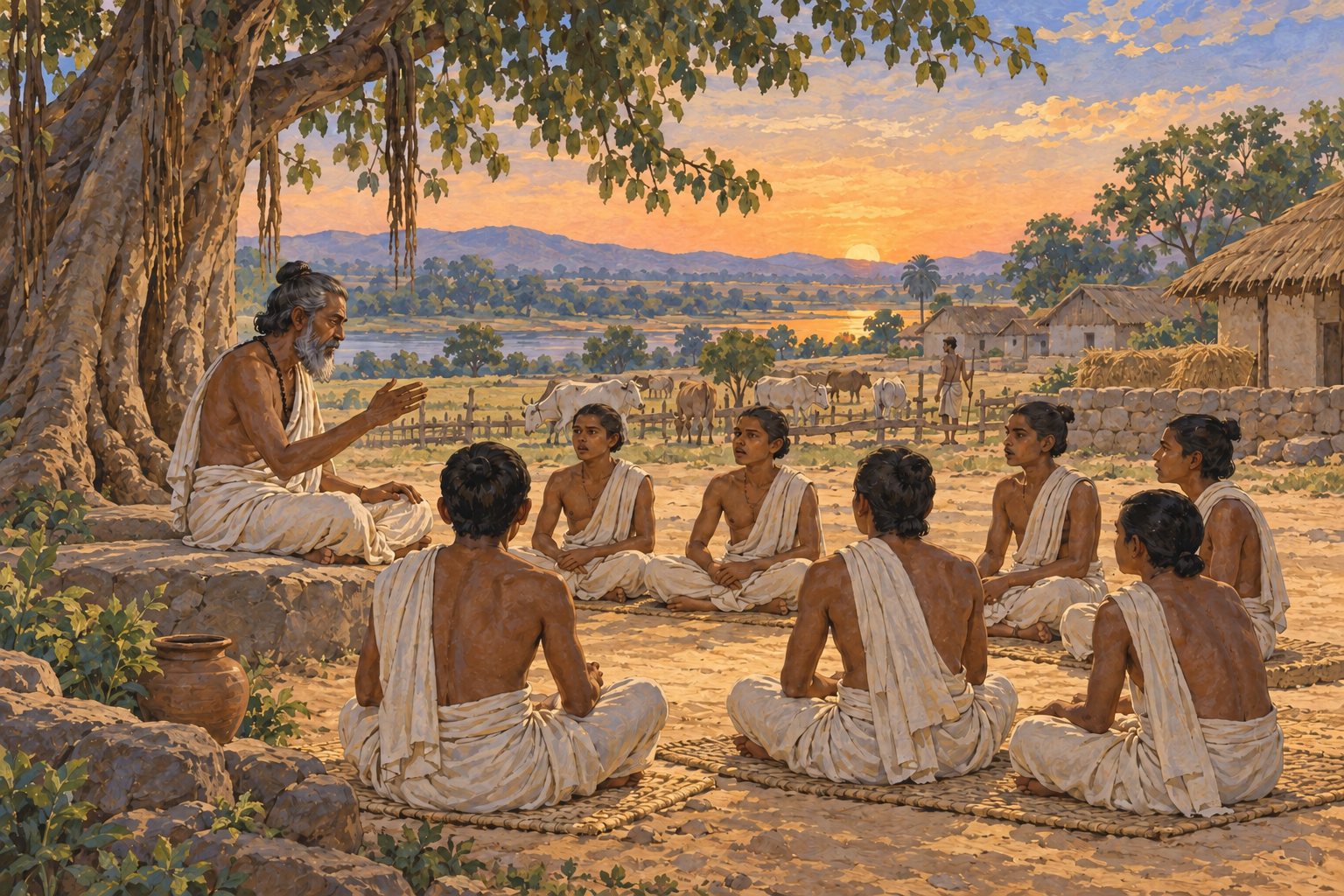
The pāṭhas are recitation modes that reorder the same words of the same verse under fixed rules — saṃhitā runs the line continuously with its junctures fused; pada breaks it into words with the junctures dissolved; krama pairs them, ab bc cd; jaṭā braids each pair forward, backward, forward; ghana rolls it ab ba abc cba abc — deterministic transforms of one another, so that a corruption anywhere fails to reconcile across the modes and cannot propagate silently: error detection by cross-checking redundancy, two and a half thousand years before anyone said checksum.
Explore the illustrations6 scenes · The recitation lesson
The recitation lesson. The pāṭhas are recitation modes that reorder the same words of the same verse under fixed rules — saṃhitā runs the line continuously with its junctures fused; pada breaks it into words with the junctures dissolved; krama pairs them, ab bc cd; jaṭā braids each pair forward, backward, forward; ghana rolls it ab ba abc cba abc — deterministic transforms of one another, so that a corruption anywhere fails to reconcile across the modes and cannot propagate silently: error detection by cross-checking redundancy, two and a half thousand years before anyone said checksum.
Texts and authority
Heard, Not Remembered
The tradition’s canon rule is the line between śruti, “what was heard” — the hymns and their attached prose, held to have been seen by the rishis rather than composed, and in the mature doctrine authorless altogether — and smṛti, “what was remembered”, which is human, secondary and revisable: a canon boundary stated as an epistemology, doing the work that councils and imprimaturs do elsewhere, and no assembly ever convened to draw it.
Three Vedas, Then Four
The canon is organised by liturgical job, not by subject — ṛc the verse for the hotr who recites, sāman the melody for the udgatr who sings (nearly all of its verses are the Rigveda’s, reset to music), yajus the muttered formula for the adhvaryu who does the work — which is why the old collective term is trayī vidyā, the threefold knowledge; the Atharvaveda — healing charms, curses, house-rites, king-rites — was admitted late and knew it, arguing its own case for centuries while “threefold” persisted as the name of a four-part canon, the seam still showing.
Institutions and resources
The Fee Inside the Hymn
The dānastuti is a praise-of-the-gift stanza riding at the end of a hymn — the poet names the patron, itemises the fee (cows, horses, gold niṣkas, chariots), and the stanza is then transmitted for three thousand years inside the liturgy the fee paid for: self-documenting payment, the closest thing to a receipt the Vedic economy ever produced — but it is praise, its numbers are a genre (steeds counted in the tens of thousands), and the volume prints them as poetry with a payee, never as accounts.
The Price of a Ritual
The śrauta system is a service economy — the yajamāna, the patron, hires the priests and pays the dakṣiṇā the manuals prescribe rite by rite, rising with ambition: the agnicayana stacks a five-layer brick altar (traditionally 10,800 bricks, a number the Satapatha Brahmana maps onto the divisions of the year), the aśvamedha turns a year of armed horse-guarding into a claim of paramountcy, and at the top of the scale a rite’s stated fee is everything the patron owns — on the tradition’s own arithmetic, the great sacrifices were instruments only kings could play, and the economy’s direction is legible even where its figures are not: cattle move from warband to priesthood, and legitimacy moves back.
Explore the illustrations4 scenes · Wealth on the move
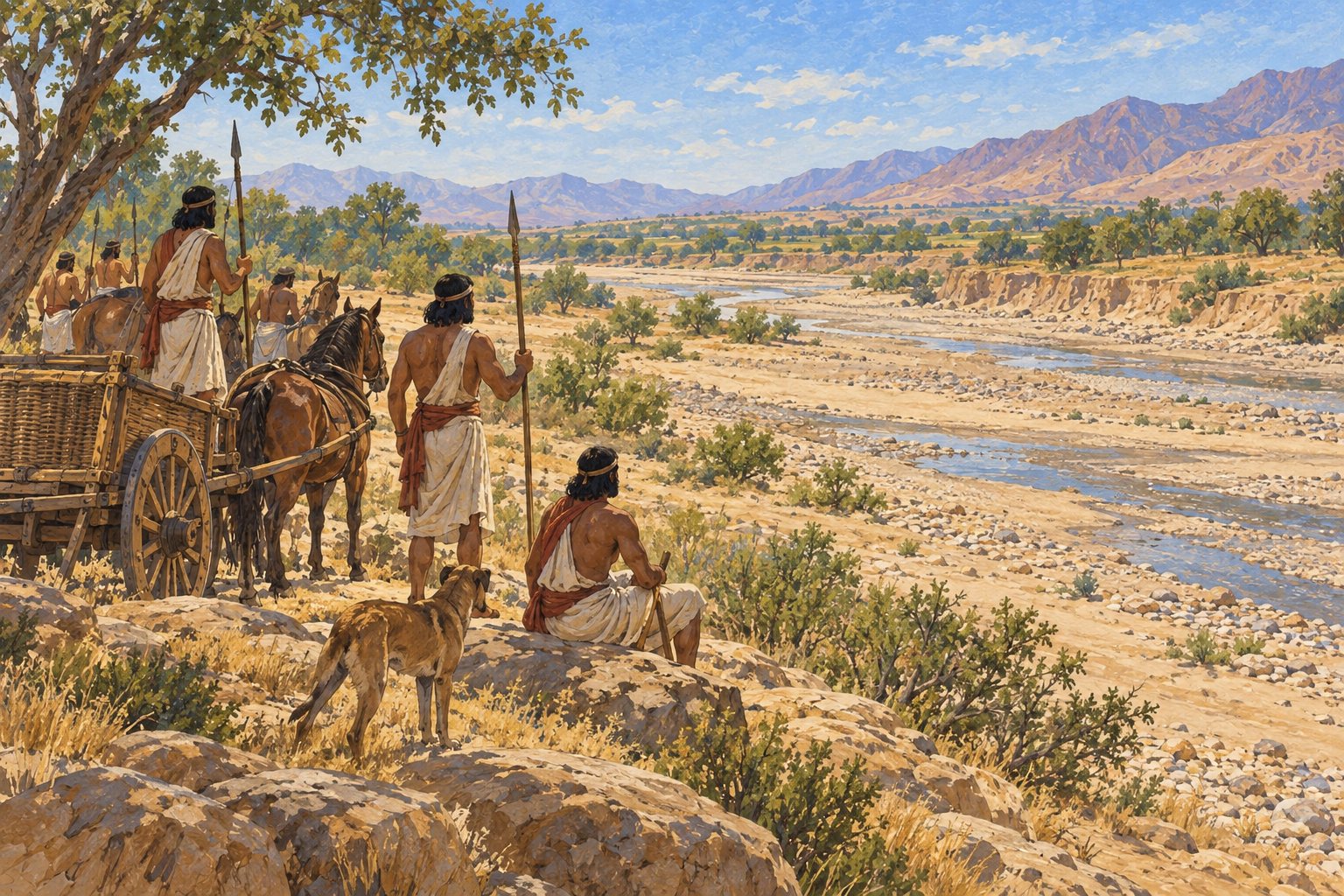
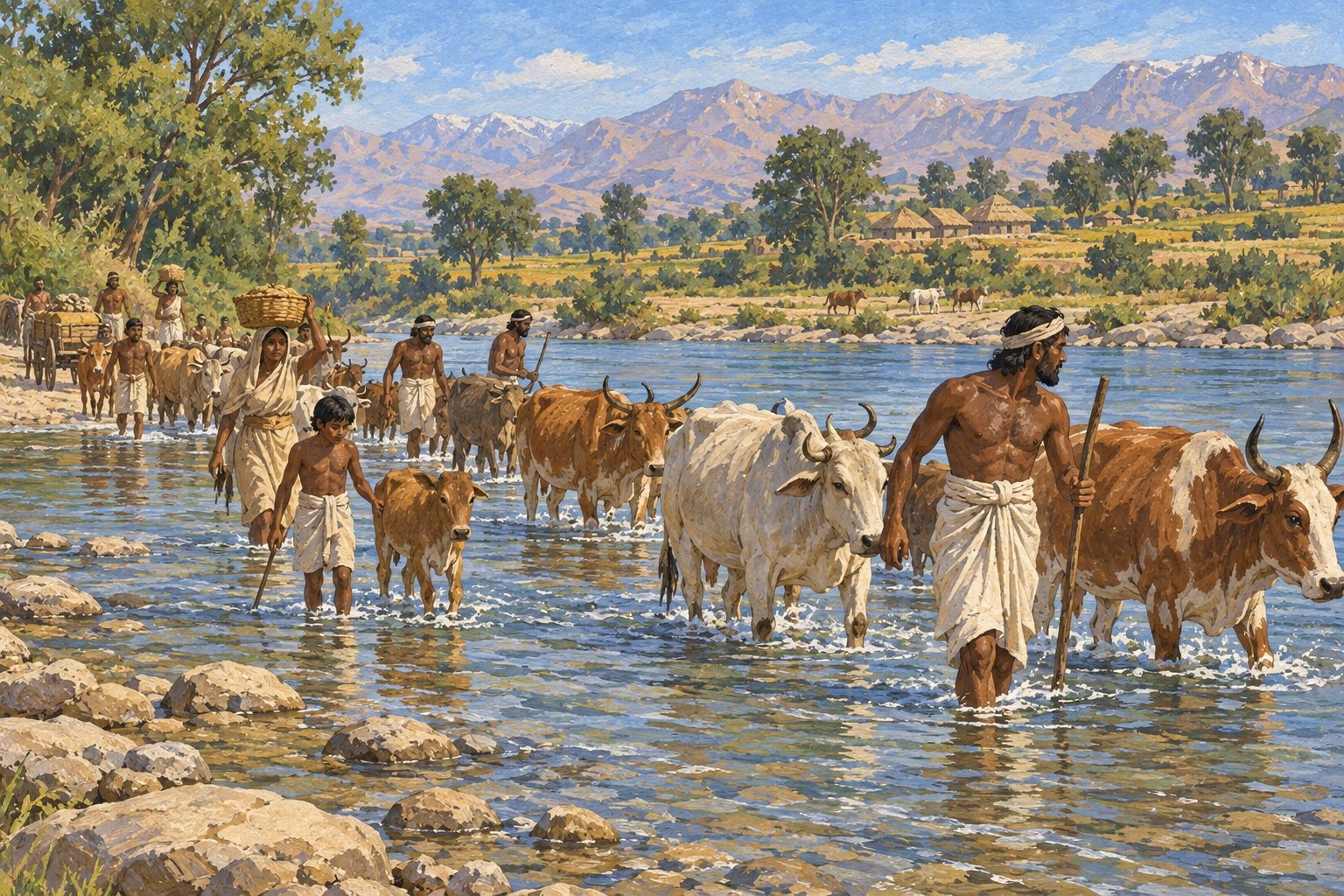
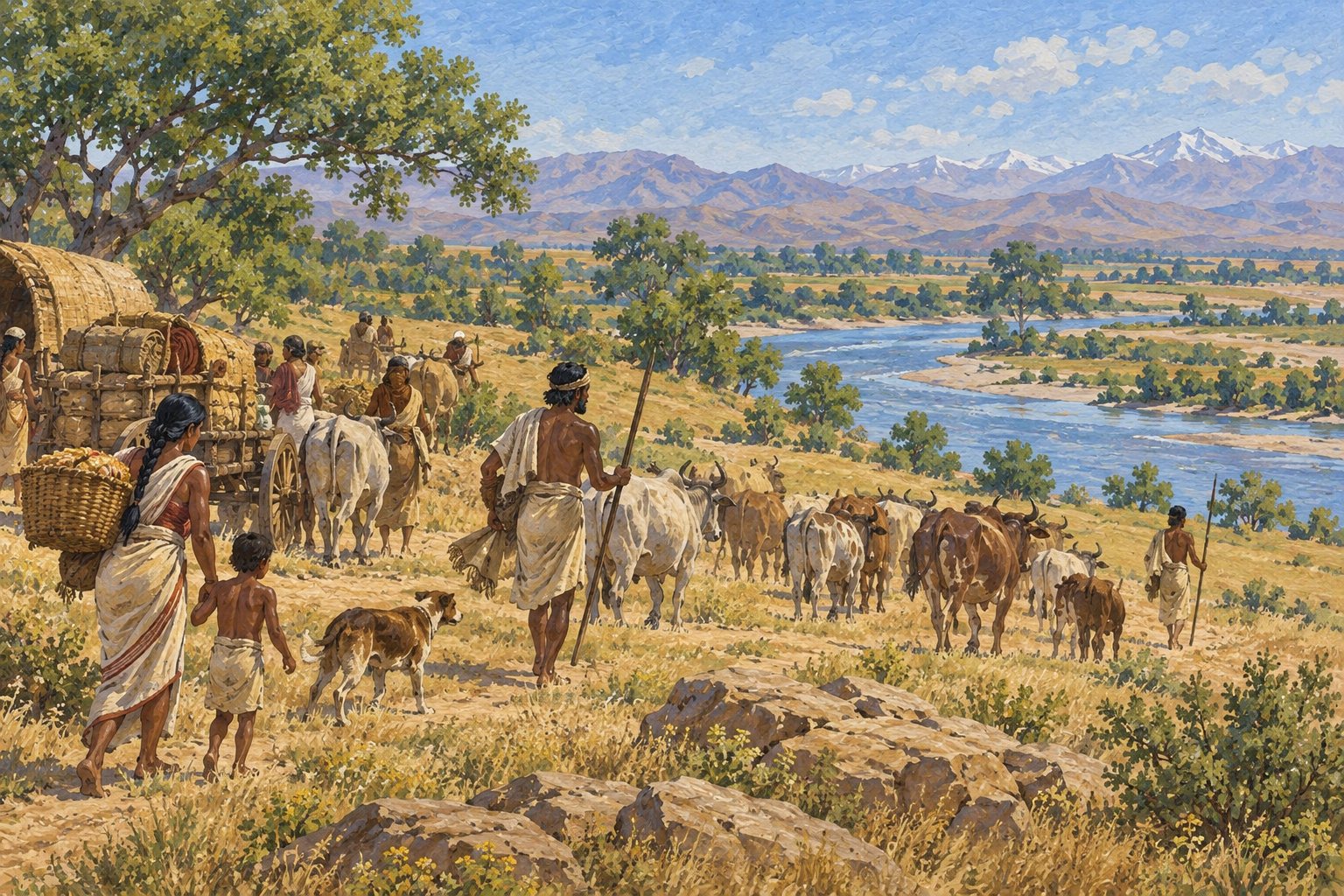
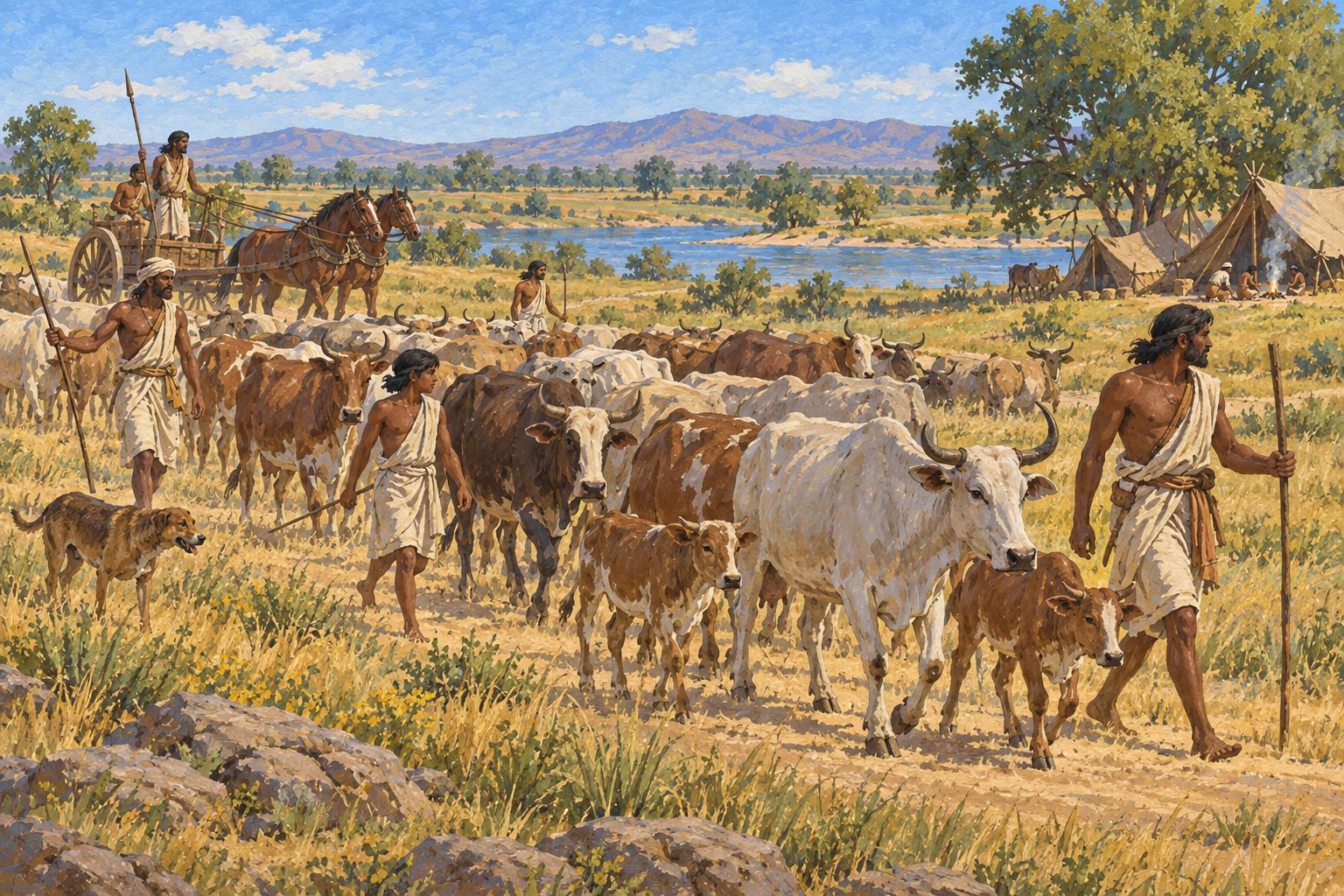
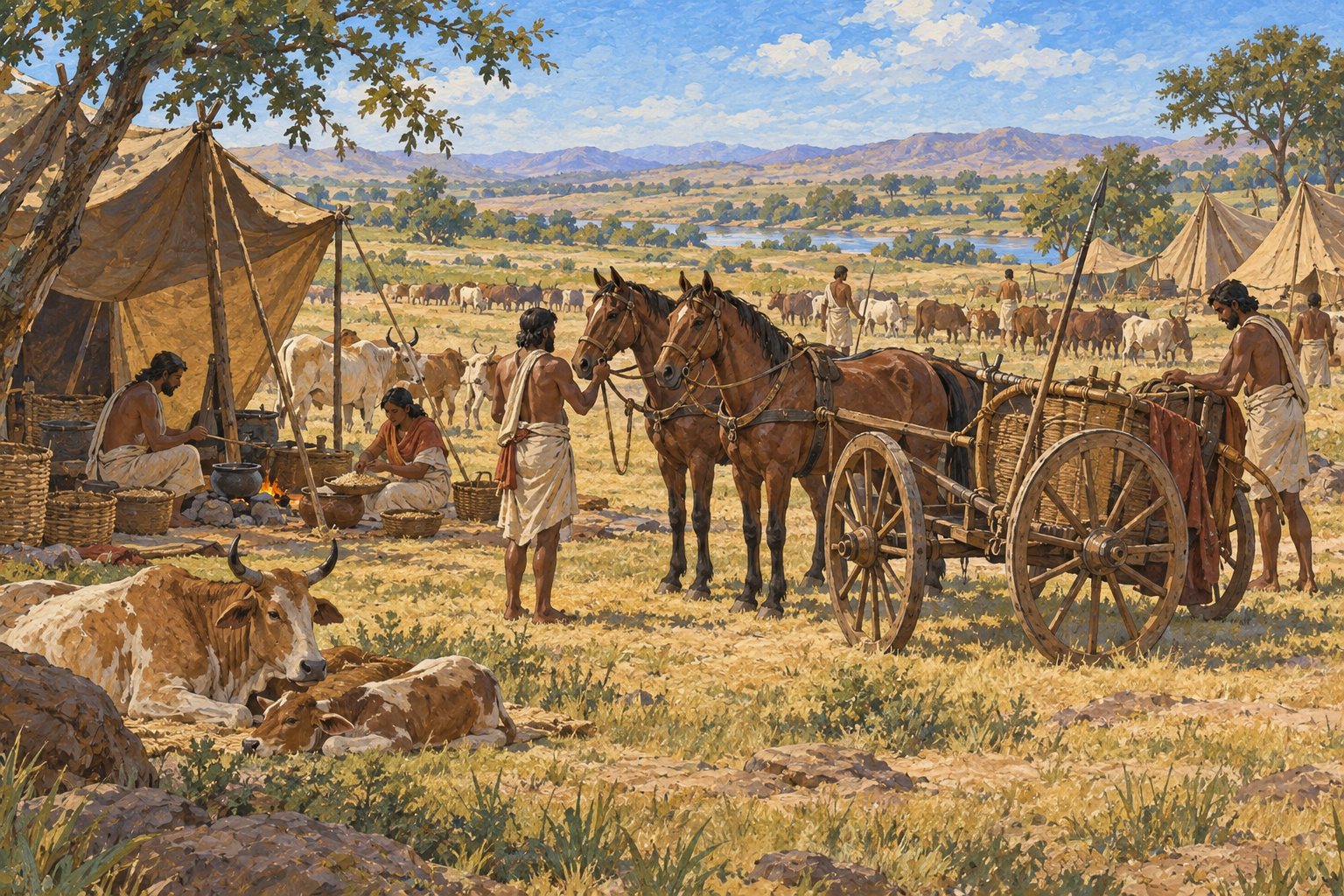
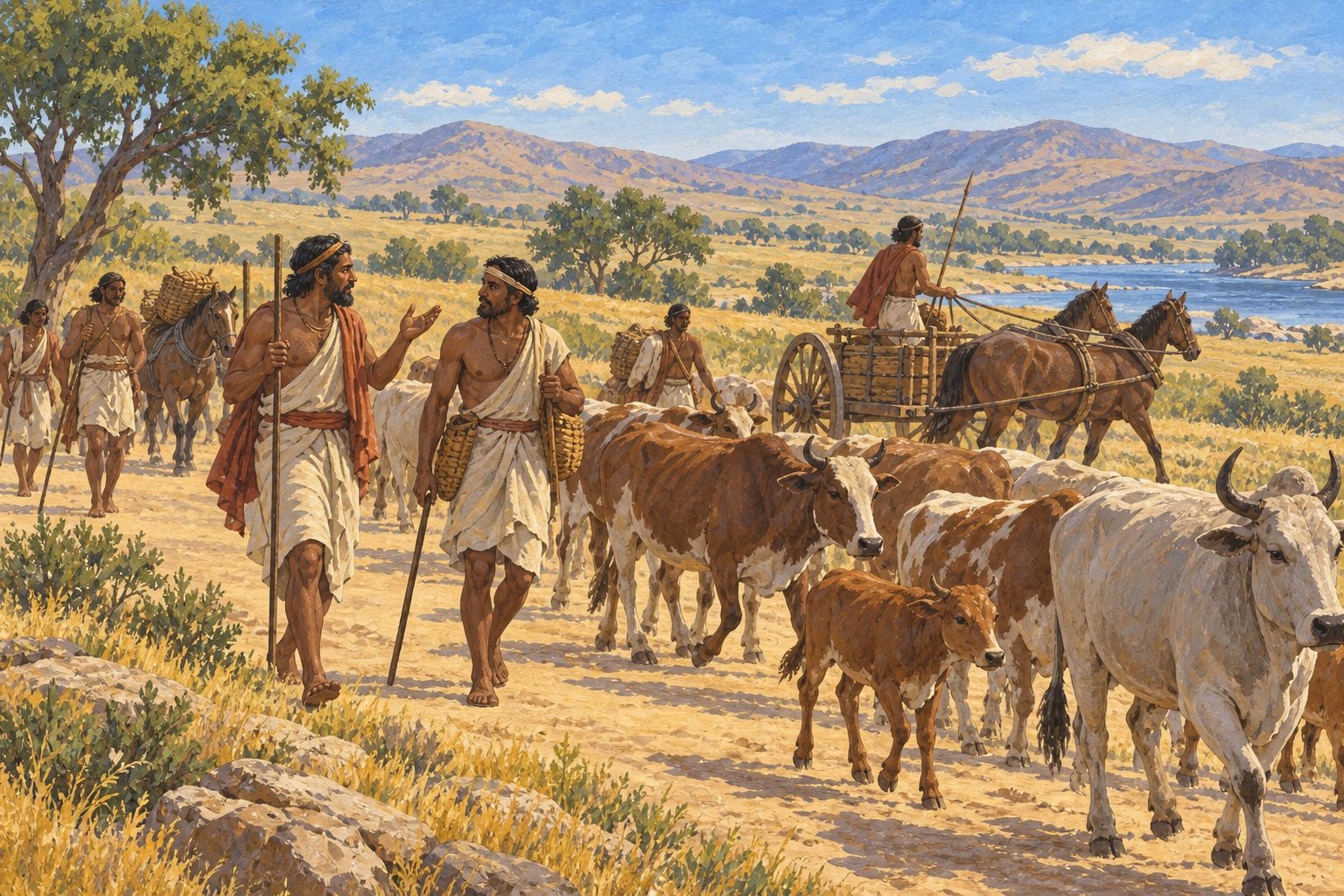
Wealth on the move. The hymns describe a society whose wealth had legs — cattle above all (a Vedic word for battle, gaviṣṭi, is literally “the search for cows”), horses and the spoked-wheel chariot as the prestige technology, and no city, coin, field boundary or permanent shrine anywhere in the family books — a mobile pastoral world whose entire archive was what its specialists could carry in their mouths.
Changes and divisions
A School Is a Recension
The śākhā, “branch”, is a school defined by which recension of which Veda it preserves — its own accent tradition, its own Brahmana, its own ritual manual — division by transmission rather than by doctrine; the tradition’s own census is a boast the survivors refute: Patanjali’s grammar-commentary counts twenty-one schools of the Rigveda, a hundred and one of the Yajurveda, a thousand of the Samaveda and nine of the Atharvan, while what survives complete today is one Rigveda śākhā, a handful of Yajurveda lines, three Samaveda schools and two Atharvan — a performed canon deletes itself one extinct school at a time, and the losses are the split’s quiet ledger.
The Turn Inward
Before anyone outside attacked the sacrifice, the canon’s own last layer quietly demoted it — the Upanishads stage debates at royal courts where the prize is a thousand cows with gold on their horns (the fee structure intact even here), and the winning answers move the rite inside: breath as the offering, the self as the altar; in the Brhadaranyaka the doctrine that a person is made by action is first settled off the record — Yajnavalkya takes his questioner’s hand and speaks of karman in private — and the Mundaka will call the sacrificial forms “unsafe boats”: the canon’s edge had begun arguing with its centre, in the centre’s own transmitted words.
Limits of the evidence
This public outline does not list separate evidence limits. Consult the chapter summaries and sources for the scope of its claims.
Sources and reading
This article brings together the series’ existing overview and chapter summaries. The linked book page provides the full outline and bibliography.
- Suppiluliuma–Shattiwaza treaty tablets, CTH 51 and 52, Boğazköy14th c. BCE; excavated 1906–07. Mitra, Varuna, Indra and the Nasatyas as divine witnesses
- Elena Devecchi, study of the Akkadian manuscripts, Die Welt des Orients2018. the pair of tablets treated as one ratification set
- Kikkuli horse-training manual, Boğazköysame Hittite archive. Indo-Aryan lap-counts: aika-, tera-, panza-
- Paul Thieme, “The 'Aryan’ Gods of the Mitanni Treaties,” JAOS1960. the four names as specifically Indo-Aryan
- Annelies Kammenhuber, Die Arier im vorderen Orient1968. the same names as possibly Hurrian-mediated
- John Marshall, Mohenjo-daro and the Indus Civilization1931. the proto-Siva reading of Mackay’s seal 420
- Iravatham Mahadevan, Indus concordance, Archaeological Survey of India1977. 2,906 inscribed objects; inscriptions averaging about five signs
- Rajesh Rao, Mahadevan and others, Science2009. a statistical reply to the claim that the signs are not writing
Illustrations are newly generated interpretations of themes in the book. They are not surviving artifacts, historical photographs or evidence for the events described.