Belief System
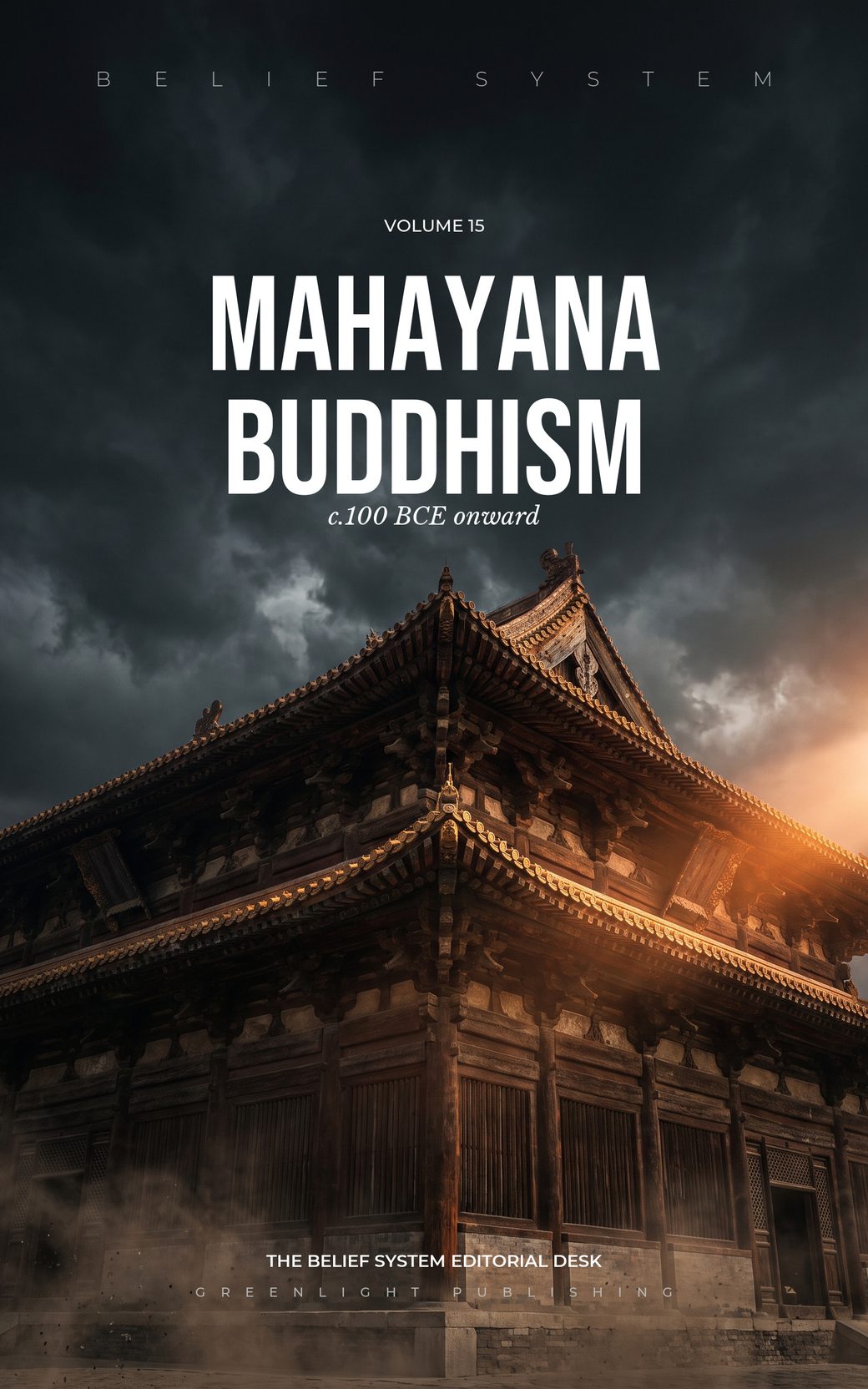
Jacket of Belief System volume 15, Mahayana Buddhism
$12.99paperback

124 pages, 5.5 × 8.5 in. Three or more volumes in one order and every copy drops to $11.99.

copies

United States, 8 to 11 days. All destinations

Volume 15 Belief System c.100 BCE onward

Mahayana Buddhism

The machinemerit as a print run

Attested from
c.100 CE

The earliest secure evidence, and the key this volume is filed under. All thirty-one

Narrates
c.100 BCE onward

The period the book actually covers. It is rarely the same figure.

The argument in one sentence

A movement with no founder, no council and no origin point answered the problem of an absent Buddha with an open canon that would not stop growing — and because copying that canon was itself the act of devotion, it invented mass printing seven centuries before Gutenberg, financed itself into the largest corporate economy in medieval East Asia, and was broken not by schism, which it never had, but by an imperial confiscation in 845 from which its institutional position in China never fully recovered.

a Japanese empress mass-produced a million printed prayers between 764 and 770, seven centuries before Gutenberg; over 45,000 of the little pagodas and 3,962 of the printed slips survive.The commissioning line

What it is

A Japanese empress mass-produced a million printed prayers between 764 and 770, seven centuries before Gutenberg. Over 45,000 of the little pagodas and 3,962 of the printed slips survive. Merit as a print run.

This is a history of texts that open by naming a speaker they do not name as author, and of how we know.

Every scripture in this book is anonymous, and nearly every one begins thus have I heard. The tradition’s account is that they are the Buddha’s word, withheld until there were hearers ready. The philologists’ account is that they grew over centuries. Both are set out at length. Neither is ruled on.

Five movements: the world of the new sutras, the machine of the copy, the canon that would not close, the money, and the split into the schools that carried them on.

What early Mahayana was as an institution cannot be established: the texts circulate for four centuries or more before the word appears in an Indian donative inscription.

The book never adjudicates. Every translation is named in the text.

Belief System, Volume 15.

In full

Mahayana is a book about copies. Birch-bark scrolls from a clay jar, older than any surviving manuscript of the canon beside them. A court order of the 760s that sealed roughly a million printed charms inside wooden pagodas, unread. The Diamond Sutra of 868, whose colophon is the first known public-domain dedication. The Korean Goryeo blocks. Jikji. Round numbers later on — a million printed texts, 4,600 monasteries suppressed — are the figures of the chronicle or the edict that reports them, never counts.

No author, no place and no date of composition has been established for one of the sutras, and this book supplies none. The Perfection of Wisdom is filed by size, at eight thousand lines, twenty-five thousand and a hundred thousand, which is the tradition’s own shelving half-agreeing with the philologists’ growth account.

Sujato is not the translator here; the Mahayana corpus is quoted from named Tier 1 English where it exists, and described where it does not. The volume uses five fixed phrases, and no sixth. It reports no revelation as fact and denies none. It never tells you what anybody was thinking.

Belief System is a history of world religion, one tradition at a time. Thirty-one volumes, ordered by earliest secure attestation.

The contents

26 chapters in five movements. Every volume in the series has the same five, in the same order, and each chapter below is printed with the idea it carries.

Movement OneThe World

  1. 1A Jar of Birch BarkOpen on the object: birch-bark scrolls in clay jars, acquired by the British Library in 1994 — the oldest Buddhist manuscripts in existence, from Gandhara, conventionally dated between the first century BCE and the second century CE — and the physical horizon in which Mahayana texts first become visible: among the recovered collections are a Prajnaparamita and a Mahayana sutra in Gandhari, older than any surviving text of the canon they sit beside.
  2. 2The Empire in the MiddleThe world is the Kushan empire astride the Silk Road — a state minting gods from three pantheons, taxing the caravan trade between Rome and China, and putting the Buddha on a gold coin with his name in Greek letters — the commercial cosmopolis in which a Buddhism built for travel appears.
  3. 3The Absent BuddhaThe question the movement answered: the founder was dead, the tradition held that he was beyond reach, and the relic and stupa economy was the existing answer — the new texts offer a stronger one: Buddhas who are present now, in fields that can be seen, visited and reborn into, so that the dead teacher problem becomes a geography.
  4. 4From Arhat to BodhisattvaThe new books redefine the goal: not the arhat who ends his own rebirth, but the bodhisattva who postpones his to work for everyone’s — and the polemical vocabulary is the texts’ own coinage: a “great vehicle” against a “defective” one, reported here as polemic, never adopted as description.
  5. 5A Movement With No FounderMahayana has no founder, no founding council and no single origin point — it is identifiable in texts for centuries before it is identifiable in institutions, and every modern attempt to give it a social origin is a reconstruction from those texts, reported here side by side and held nowhere.
  6. 6Dated by TranslationThe first hard dates in Mahayana history are shipping records: the earliest fixed points for these texts are the years they were translated at the Han capital — so the movement enters verifiable history not where it was composed but where it was received, and the chapter that proves a sutra existed is a Chinese library catalogue.

Movement TwoThe Machine

The transmission technology, named as a concrete object or institution — not an abstraction. Here: the printing block, and the doctrine that made every copy an act of merit.

  1. 7The Sutra That Advertises ItselfThe Mahayana sutras carry their own reproduction clause: copying, reciting and venerating this text generates merit exceeding any material gift — so the incentive runs opposite to every other tradition in this series, where copying is a cost to be borne; here more copies is more devotion, and mechanical reproduction, when it arrives, will arrive as worship.
  2. 8The Translation BureauBefore the press there was the assembly line: Kumarajiva’s state-funded translation workshop at Chang’an from 401, with a staff the tradition counts in the hundreds, produced the Chinese Lotus, Diamond and Amitabha texts East Asia actually reads — and the bureau’s word-by-word decisions are themselves historical events, because a billion people inherited them.
  3. 9A Million Charms Nobody Could ReadBetween 764 and 770 the Japanese court mass-produced roughly one million printed dharani sealed inside miniature wooden pagodas — the earliest large print run on earth whose date, commissioner and motive are all documented — and the motive was not circulation: the texts were Sanskrit sound in Chinese characters, printed to exist, not to be read, and buried in their pagodas on completion.
  4. 10The Book of 11 May 868The oldest dated printed book in existence is a Buddhist sutra from Dunhuang, and its colophon is a merit receipt: it names who paid, for whom, and why — “for universal free distribution, on behalf of his two parents” — so the world’s first dated printed book documents, in its own last line, the economic logic this movement built printing on.
  5. 11Metal Type Before GutenbergThe canon industrialised the press: China printed its first complete Tripitaka from more than a hundred thousand blocks in the tenth century, Korea carved its canon twice and cast the metal type that produced, in 1377, the oldest movable-metal-type book in existence — some three-quarters of a century before the Gutenberg Bible — and the driver throughout was the size of a corpus that would not stop growing.

Movement ThreeThe Canon

What is in, what is out, who decided, when, and what the decision cost. The real subject is who had the authority to close it — and here, the finding is that nobody did, and what the tradition built instead. The movement opens with that argument, never with a text.

  1. 12Thus Have I HeardEvery closing this series has reported — a council’s list, a caliph’s recension, a commentator’s boundary — required an authority; the Mahayana’s problem was the inverse: new sutras kept appearing for centuries, each opening with the closed canon’s own authentication formula, evam maya srutam, “thus have I heard”, and no institution existed anywhere with the standing to refuse them — an open canon is the opposite problem to closing one, and the tradition solved it without ever acquiring a door.
  2. 13The Buried TreasureThe tradition’s own answer to “where did these texts come from”: they are the Buddha’s word, taught once, withheld until hearers were ready — kept by the nagas until Nagarjuna retrieved them, on the traditional biography; released as later “turnings of the wheel”, on the sutras’ own self-ranking; justified by upaya, skilful means, in the Lotus’s parable of the father who promises the wrong toys to get his children out of a burning house — a complete, internally coherent doctrine of delayed publication, reported in the tradition’s voice and adjudicated nowhere.
  3. 14The Texts That GrewThe philologists’ answer: the sutras are compositions that grew for centuries — the tradition itself files the Perfection of Wisdom by size, in eight thousand, twenty-five thousand and one hundred thousand lines, and the dated Chinese translations catch the same text thicker at each arrival — so the corpus looks less like a library being discovered and more like one being written, and this too is reported, not held.
  4. 15Ranking the UnrankableChina inherited the whole open corpus at once, out of order and internally contradictory, and solved it by hermeneutics: the panjiao classification schemes rank every sutra as authentic teaching delivered to a different audience at a different stage of one career — Tiantai’s five periods, Huayan’s five teachings — a canon problem answered not by a list of exclusions but by a chronology of pedagogy, at the price that each school’s own charter text lands on top.
  5. 16The Catalogue Is the CanonThe nearest the open canon ever came to a door was a bibliography: from Dao’an’s catalogue of 374 through Sengyou’s of about 515 — with its class for “suspect” scriptures — to the Kaiyuan catalogue of 730, entry in the state-recognised list determined what the state canon copied, printed and transmitted; a catalogue revised by each dynasty is a door that opens and closes by administration, and it made canonicity a government classification.

Movement FourThe Money

Who paid, who was paid, and how we know. Numbers get their provenance in the same sentence — and this volume’s money movement runs, unusually for the series, on surviving account books.

  1. 17The Emperor’s Grain HouseholdsIn China the sangha’s corporate design met a state willing to endow it with people: the Northern Wei assigned grain-levy households to the monasteries and convict “Buddha households” to temple service, while in the south an emperor donated himself to a monastery four times and made the treasury ransom him back — the state was the biggest donor, and both mechanisms are recorded in the dynastic histories, not in sermons.
  2. 18The Mill, the Press and the LedgerThe monasteries ran the industrial plant of their regions — water mills, oil presses, grain loans at interest, rents from dependent households — and the evidence is not accusation but accountancy: the Dunhuang library cave preserved the monasteries’ own account rolls, audited annually and read out to the assembly, which makes this the rare volume in the series whose money chapter can cite the ledgers themselves.
  3. 19The Inexhaustible TreasuryThe Sanjie movement — the sect whose books the catalogue banned — operated at Huadu monastery in Chang’an a deposit fund fed by anonymous mass donation and paid out in repairs, offerings, charity and loans: a functioning monastic bank built on the doctrine that in a degenerate age the safest merit is giving — until the state shut it by decree in 713 and dispersed its assets, keeping the useful parts of the machine and deleting its owner.
  4. 20Selling the ExemptionThe ordination certificate began as a control document and became government paper: because the certified monk owed no tax and no corvée, the certificate itself had a cash value, and from the An Lushan emergency onward the state sold them outright — by the Song, blank certificates were issued in bulk, granted in lieu of funds and traded — the clergy’s exemption converted into a revenue instrument sold by the exempting power.
  5. 21The Finger Bone and the MemorialIn 819 the emperor brought the Famen finger-bone relic to the capital and the capital emptied its pockets; one official’s protest — substantially an economic complaint — earned him exile; and the money movement closes on the hardest evidence in the volume: the Famen crypt, sealed in 874 and opened in 1987, held the relic and a stone tablet itemising the imperial offerings piece by piece — a donation ledger in stone, excavated.

Movement FiveThe Split

What divided it, what it became, what it handed on. Names the next volumes by NAME, never by number. Here the movement’s first job is a correction: the split this volume reports is not a schism, because there never was one.

  1. 22The Schism That Never HappenedMahayana never established a separate vinaya: it produced sutras, treatises and philosophies, but no rival code of discipline and no ordination lineage of its own — Mahayana and non-Mahayana monks ordained in the same lineages and lived in the same monasteries, the Chinese pilgrims say exactly that, and stating it cleanly is this volume’s most useful correction, because nearly every shelf treats “Mahayana versus Theravada” as a schism on the model of the ones this series has reported elsewhere.
  2. 23The Second OrdinationWhat Mahayana added was a layer, not a replacement: the bodhisattva precepts — from the Brahma Net Sutra the canon movement reported as a Chinese-milieu composition — were conferred on top of a vinaya ordination that remained a non-Mahayana school’s code, and the exception proves the rule’s age: only in Japan, a millennium after the first Mahayana texts, did Saicho win a separate ordination platform on the bodhisattva precepts alone.
  3. 24The Emperor Closes the MonasteriesThe real rupture was external and fiscal: in 845 the Huichang persecution suppressed the monasteries of the entire empire — the edict’s own accounting claims more than 4,600 monasteries demolished, some 40,000 shrines, 260,500 monks and nuns returned to the tax registers, lands confiscated, bronze images melted for coin — a confiscation, not a schism, carried out by a state that had spent two centuries watching the numbers this volume’s money movement reported.
  4. 25What Survived the ConfiscationThe suppression selected for cheapness: the exegetical schools that needed libraries, endowed lecture halls and state patronage — the very schools that built the ranking systems — lost their base and never recovered their position, while the traditions that could run on labour and require no plant, Chan and Pure Land, became the future of Chinese Buddhism; the institutional position never fully recovered, and the split in Chinese Buddhism was ultimately between the sangha and the treasury — and the treasury won.
  5. 26The Open Canon, Still OpenThe streams hand on by name — to the Zen volume, the lineage certificate and the Diamond Sutra’s Chan career; to the Tibetan Buddhism volume, the late Indian synthesis carried north into a canon that kept growing until it was carved at Derge — and the volume ends in the present tense, where Mahayana remains the majority form of a tradition whose adherents cannot be counted by any single number, and where the machine is still running: sutras copied by hand for merit in temple halls, printed for free distribution, and now transmitted in digital canons whose print run is costless.

What this volume cannot establish

Printed in the book before the argument is, and printed here for the same reason. A history of a tradition that will not say where its evidence runs out is not a history.

  • Where, when, or by whom any Mahayana sutra was composed. Every one is anonymous and speaks in the Buddha’s voice. No author’s name, no place of composition and no date of composition has been established for a single text; the earliest hard evidence is manuscripts and dated translations, and both are downstream of composition.
  • What early “Mahayana” was institutionally. — one movement, several movements, or a genre of books. The word appears in Indian donative inscriptions only from about the fifth to sixth century CE (Schopen’s demonstration), four or more centuries after the texts exist. A movement identifiable in texts before it is identifiable in institutions is a movement whose early sociology cannot be recovered, and this volume reports the competing reconstructions without joining them.
  • Whether the Kanishka council happened. It is reported by Xuanzang five centuries later; no inscription mentions it.
  • Any print run before its survival count. The Hyakumanto “one million” is the court chronicle’s commissioning figure; what can be counted is 45,000-plus pagodas and 3,962 printed slips. The Kaibao canon’s 130,000 blocks is a transmitted figure, not an inventory. The Huichang edict’s totals — 4,600 monasteries, 260,500 laicised — are the confiscating state’s own claims, and no independent audit exists for any of them.
  • Whether the Korean Pure Light Dharani predates the Hyakumanto printing. The Seokgatap scroll is undated and its dating is contested; both positions are reported.
  • The scale of the Inexhaustible Treasury. Its deposits are described in sources that are either devotional or hostile; no ledger survives.
  • Aggregate monastic landholding in China at any date. Grants, exemptions and confiscations are attested one by one; no defensible total exists, and this volume prints none — the same refusal the Buddhism volume makes for Lanka.
  • Anyone’s interior state. — including, especially, the anonymous authors who wrote in the voice of a Buddha dead four centuries.

Buddhism, four ignitions

This tradition ignites more than once in the chronology. The other slots are Buddhism, Zen, Tibetan Buddhism. See the thread.

Sources

79 works, dated, and specific enough that a reader can go and look at the thing. Nothing is on this list that the desk did not consult.

The bibliography, as the volume prints it
# Document or work Date Evidence for
1British Library Kharosthi fragments; Richard Salomon, Ancient Buddhist Scrolls from Gandharaacquired 1994; Salomon 1999oldest Buddhist manuscripts; Dharmaguptaka pot inscription
2Senior collectionearly centuries CEfurther Gandhari bark in a pot with its own inscription
3Bajaur collection, Ingo Strauchearly centuries CEa Mahayana sutra in Gandhari
4Split collection Prajnaparamita, Harry Falk and Seishi Karashimabark 1st or 2nd c. CEradiocarbon interval named to the publication, not approximated
5Rabatak inscriptionfound 1993Bactrian in Greek script: Kanishka’s era and four royal ancestors
6Harry Falk on Kanishka’s accession127 CE now conventional78, 115, 127 and 144 have all been defended
7Kanishka BODDO gold coin, British MuseumKanishka’s reignstanding Buddha labelled in Greek letters
8Begram hoard, Joseph Hackinexcavated 1930sRoman glass, Chinese lacquer and Indian ivory in one storeroom
9Xuanzang on Kanishka’s Kashmir council, Samuel Bealpilgrim in the 630s; Beal 1884a tradition with no inscription behind it
10Smaller Sukhavati-vyuha, Max Müller, SBE 49trans. 1894Amitabha’s field as a location, not an abstraction
11Pratyutpanna-samadhi sutra; Lokaksema’s Chinesetrans. attributed 178–189 CEmanual for meeting a present Buddha in vision
12Paul Harrison on the visualisation textslate 20th–early 21st c.scholarship reading these sutras as practice, not conceit
13Alfred Foucher’s aniconic reading; Susan Huntington’s reply20th c.whether early Buddhist art avoided depicting the Buddha — contested
14Vajracchedika (Diamond Cutter), Müller, SBE 49trans. 1894vow to deliver all beings; four lines outweigh worlds of treasure
15Saddharma-Pundarika (Lotus), Hendrik Kern, SBE 211884one vehicle; burning-house parable; shrine without relics
16Jan Nattier on the Ugrapariprcchaearly 21st c.earliest recoverable bodhisattva path as austere monastic discipline
17DasabhumikaIndian Mahayana, date unestablishedten-stage bodhisattva career as a monastic curriculum
18Gregory Schopen, Indian donative epigraphydemonstration late 20th c.the word mahayana appears in stone only from about the 5th–6th c.
19Hirakawa Akira, lay-and-stupa origin thesis20th c.one reconstruction of early Mahayana, reported not held
20Paul Harrison and Daniel Boucher, forest-ascetic reconstructionlate 20th–early 21st c.rival origin theory, reported not held
21Sengyou, Chu sanzang ji jicompleted 515catalogue embedding Dao’an; Lokaksema dates; translators’ prefaces
22Dao’an’s catalogue374; lost, embedded in Sengyouearlier list through which second-century dates reach a reader
23Lokaksema at Luoyang: Daoxing jing (Astasahasrika)conventionally 179first hard year a Prajnaparamita text can be shown to exist
24An Shigao at Luoyangfrom c. 148non-Mahayana control: Buddhism arrived as mixed cargo
25Hou Hanshu notice of Prince Ying of Chuevent 65 CE; history compiled 5th c.earliest Chinese court reference, asserted on the standard reading
26Gregory Schopen, “cult of the book,” Indo-Iranian Journal1975reproduction clauses as institutional evidence
27David Drewes, reply in the same journal2007the shrine clause as rhetorical commonplace, not a built cult
28Ye dharma verse on clay sealings and tabletsarchaeological, pre-printtext mass-produced as relic before printing exists
29Huijiao, Gaoseng zhuan, biography of Kumarajivacompiled c. 530Chang’an bureau from the end of 401; staff figures as the tradition’s
30Kumarajiva’s Chinese Lotus (Miaofa lianhua jing), Taisho 262first decade of the 5th c.seven scrolls, 28 chapters — against Kern’s Sanskrit 27
31Xuanzang’s five untranslatables, as later attributedTang sources, labelled attributedwhy dharani is left as sound
32Shoku Nihongi notice of the Hyakumanto commissioncompleted 770; chronicle compiled 797one million pagodas — the court’s figure, not a survival count
33Hyakumanto pagodas and printed slips764–770; modern inventoriesmore than 45,000 pagodas, principally at Horyu-ji; 3,962 slips
34Seokgatap Pure Light dharani scroll, Bulguksafound 1966; undatedrival for priority, possibly before 751; dating contested both ways
35Shosoin documents, Nara scriptorium8th c.scribes paid by the sheet and fined by the error
36British Library Or.8210/P.2; Aurel Steincolophon 15th day, 4th month, Xiantong 9 / 11 May 868; taken 1907oldest dated printed book; Wang Jie’s merit receipt
37Kaibao canon, Chengdu971–983first printed Tripitaka; ~130,000 blocks as a transmitted figure
38Tripitaka Koreana at Haeinsafirst set 1011–1087, burned 1232; recarved 1236–125181,258 blocks, a modern inventory
39Yi Gyu-bo on the 1234 ritual compendium13th c.cast-metal type attested; no copy surviving
40Jikji, Heungdeok temple, Cheongju1377; vol. 2 in the BnF; UNESCO 2001oldest surviving movable-metal-type book
41SAT Daizokyo Text Database, University of TokyomodernTaisho coverage stated as 85 volumes; no single text-count printed
42Samdhinirmocana three-turnings schemeassembled no earlier than the 3rd c.a sutra ranking itself as the definitive turning
43Traditional Nagarjuna-and-the-nagas biography (Longshu pusa zhuan)Chinese, authorship contestedretrieval story, labelled a tradition
44Shantideva’s anthology quoting the Adhyasayasamcodana, Bendall and Rouse1922“anything well said is a word of Buddha”
45Bunyiu Nanjio’s catalogue, used in Kern’s Lotus table19th c.Chinese chapter orders laid side by side; later growth of chs. xxi–xxvi
46Jnanagupta’s verses for a Lotus chapter Kumarajiva left in prose2nd half of the 6th c.one chapter reaching Chinese readers in two deliveries
47Edward Conze’s nine-stage Prajnaparamita chronology20th c.scholarship named; his translations not used
48Zhiyi’s Tiantai five-period panjiaoZhiyi 538–597whole corpus sequenced; Lotus and Nirvana at the end
49Fazang’s Huayan five teachingsTangsame instrument, opposite summit: the Flower Ornament on top
50Zhisheng, Kaiyuan catalogue730the list that later organised the printed canons
51Brahma Net Sutratradition: Kumarajiva 406; scholarship: mid-5th-c. East Asiaten major and forty-eight minor bodhisattva precepts
52Awakening of Faith, attributed to Ashvaghosha / Paramarthatraditionally 553; origin contestedno Sanskrit found; shaped East Asian Buddhism anyway
53Humane King SutraIndian origin suspected, not settleda state-facing text that entered the canon
54Sanjie (Three Stages) books; XinxingXinxing 540–594; bans under Sui and Wu Zetiancatalogue as a delete key; copies surviving at Dunhuang and in Japan
55Wei Shu treatise on Buddhism and Daoismcompleted 554Tanyao’s sangha households and Buddha households
56Liang Shu on Emperor Wu at Tongtai7th c. history; acts 527, 529, 546, 547self-donation and ransom; sums printed as the annals print them
57Dunhuang Jingtu account rolls P.2032, P.2040, P.2049, P.3234conventionally 920s–940smill-rent, oil-press, loans; the house’s own ledgers
58Turfan monastic contract documentssame centuriesmonastery as named creditor: due date, pledge, officer
59Jacques Gernet, Buddhism in Chinese Society20th c. (Eng. later)the study that assembled the economic file
60Inexhaustible Treasury (wujinzang) at Huadu; 713 confiscationshut in Kaiyuan 1 / 713monastic bank; deposits cannot be established; closure can
61Jamie Hubbard on the Sanjielate 20th–early 21st c.named modern account of the sect and the state’s moves
62Dudie sales from the An Lushan emergencyonset conventionally 755–756ordination certificate as government paper; prices omitted
63Han Yu, Memorial on the Bone of the Buddha819; exile to Chaozhourelic procession as fiscal emergency, in this book’s Chinese
64Herbert A. Giles, Gems of Chinese Literature1884whitelist English of the memorial, unused for wording
65Famen crypt inventory stele; 1987 excavationsealed 874; opened 1987donation ledger in stone; no total printed here
66Faxian, Record of Buddhistic Kingdoms, James Leggejourney 399–414; Legge 1886monasteries counted as Mahayana, the older vehicle, or both in one house
67Xuanzang, Buddhist Records of the Western World, Samuel Beal7th c.; Beal 1884same survey at larger scale; school and vehicle as two axes
68Yijing, Takakusu Junjiro671–695; Takakusu 1896both vehicles adopt one vinaya; a Mahayanist defined by what he reads
69Saicho’s Kenkairon and the Mount Hiei platform grantgranted 822; platform built 827exclusive bodhisattva ordination, a millennium after the first texts
70Paul Groner on Saicho and the Tendai schoollate 20th c.modern reconstruction of the petitions and refusals
71Huichang edict “On demolishing the Buddhist monasteries…”8454,600 monasteries, 260,500 laicised — the confiscating state’s own claims
72Ennin’s diaryin China 838–847eyewitness of the 845 sweep; three hundred a day; four provinces that refused
73Jingde Transmission of the Lamp on Baizhangcompiled c. 1004–1007“a day without work, a day without food” — late attribution
74Chegwan’s Tiantai guideChegwan d. 971a Chinese school handed back its own summary from Korea
75Later Zhou ordinance on monks and nuns, in the Wudai huiyao5th month of 955licensing test, five platforms, Bureau of Sacrifices warrant
76Taisho canon, Takakusu and Watanabe1924–100 volumes, 5,320 texts — the modern edition now digitised
77CBETA electronic canonmodernTaisho, Xuzangjing and Jiaxing, free to download
78Pew Research Center, global religious landscape2025324 million Buddhists — no Mahayana subtotal
79Pew Research Center, religion in China202310 per cent identify with a religion; 33 per cent believe in Buddha or bodhisattvas

Common questions

When is Mahayana Buddhism first securely attested?

c.100 CE. That is the earliest date the surviving evidence supports, and it is the key this volume is filed under. It is not the same claim as when the tradition began: the tradition’s own account of its beginning is printed beside it in the book’s front matter, never instead of it.

What period does the book cover?

c.100 BCE onward. The coverage span and the attestation date are two different facts, and the gap between them is often the most interesting thing about a volume.

What carried Mahayana Buddhism?

Merit as a print run. Movement Two of every volume is about the transmission technology — the concrete object or institution that made copying possible, and would not have existed a century earlier.

How long is it?

About 28,500 words, roughly 120 minutes’ reading, 124 pages in the paperback. The audiobook runs 2h 57m, measured from the finished masters.

What does this volume not claim to establish?

Where, when, or by whom any Mahayana sutra was composed. Every one is anonymous and speaks in the Buddha’s voice. No author’s name, no place of composition and no date of composition has been established for a single text; the earliest hard evidence is manuscripts and dated translations, and both are downstream of composition. Every volume prints its own limits before it prints its argument; there are 8 on this one’s list.

Does the book say which tradition is true?

No. Belief System does not adjudicate. Where the tradition’s account and the earliest evidence disagree, both are given, in their own vocabulary, attributed, and neither is given the last word. No miracle is reported as fact and none is denied.

Can I buy Mahayana Buddhism in print?

Yes. It is a 5.5 × 8.5 in paperback, 124 pages, $12.99 a copy, bought direct rather than through a retailer. All thirty-one together are $199.00, with the ebook and the audiobook of every volume included.

The edition

The paperback
Trim5.5 × 8.5 in  /  140 × 216 mm
BindingPerfect-bound paperback, matte laminate
Paper60# uncoated cream, black ink
Extent124 pages
Editions and ISBNs
EditionExtentISBN
Paperback124 pages, 5.5 × 8.5 inISBN not yet issued
EbookEPUB979-8-90623-841-2
Audiobook2h 57m979-8-90623-842-9
Filed under
BISAC 1`REL017000` RELIGION / Comparative Religion
BISAC 2`REL007010` RELIGION / Buddhism / History
BISAC 3`REL033000` RELIGION / History
  • Mahayana
  • Lotus Sutra
  • Diamond Sutra
  • Hyakumanto
  • Buddhist printing
  • Nagarjuna
  • history of religion
  • Pure Land
  • bodhisattva
  • comparative religion