14 illustrations · 1:40
Watch & listen.
Follow the images with a narrated journey through the book.



Overview
- Coverage
- c.779 onward
- Earliest secure evidence
- c.779 CE
- Transmission
- a printing house that never stopped
A canon without a council: the test was the Sanskrit. The hidden library is terma, reported as the tradition’s own open-shelf policy, not as a verdict on concealment. The world’s most famous “Tibetan book” is one cycle, chosen and framed by its Western editors, put into English in Sikkim and published at Oxford in 1927 under a title borrowed from Budge.
The coverage period and the earliest secure evidence are different dates. A tradition’s own account of its beginnings may differ from both.
Historical setting
The Pillar That Outlasted Both Empires
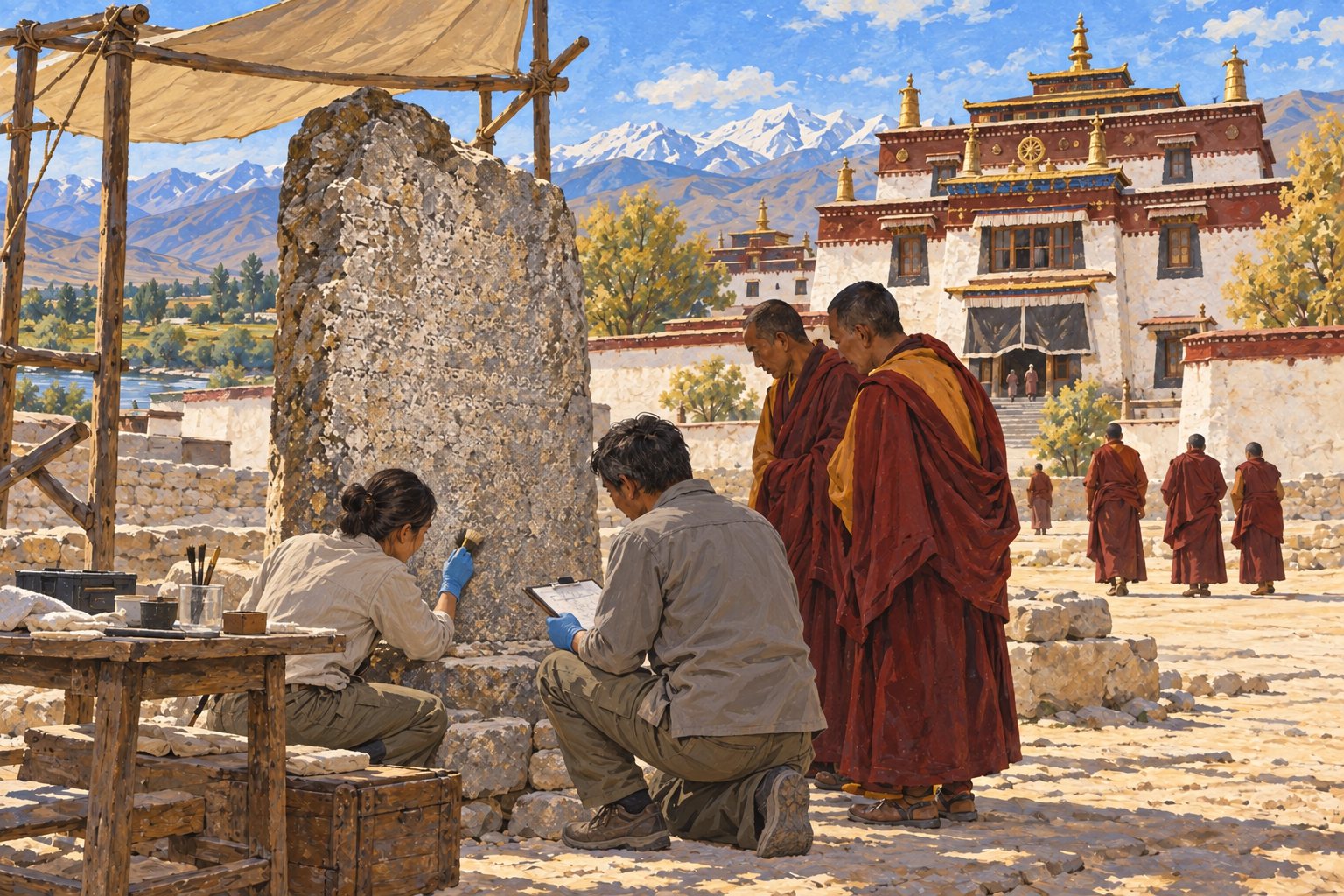
Open on the stone outside the Jokhang: a treaty of 821–822 between the Tibetan and Tang empires, carved bilingually on a pillar that still stands — the record shows a Central Asian great power treating with China as an equal, running a chancery, keeping annals; the room this tradition ignited in was an empire that needed what literate religions carry.
The King the Tradition Remembers
Songtsen Gampo (d. c.649) is the tradition’s first Buddhist king — two Buddhist queens, the Jokhang conventionally dated to the 640s, the king an emanation of Avalokiteshvara — and the datable record shows a state-builder: conquests, law, the marriage alliance with the Tang in 641; the gap between the two portraits is the chapter, and neither is adjudicated.
Explore the illustrations4 scenes · An endowed monastery
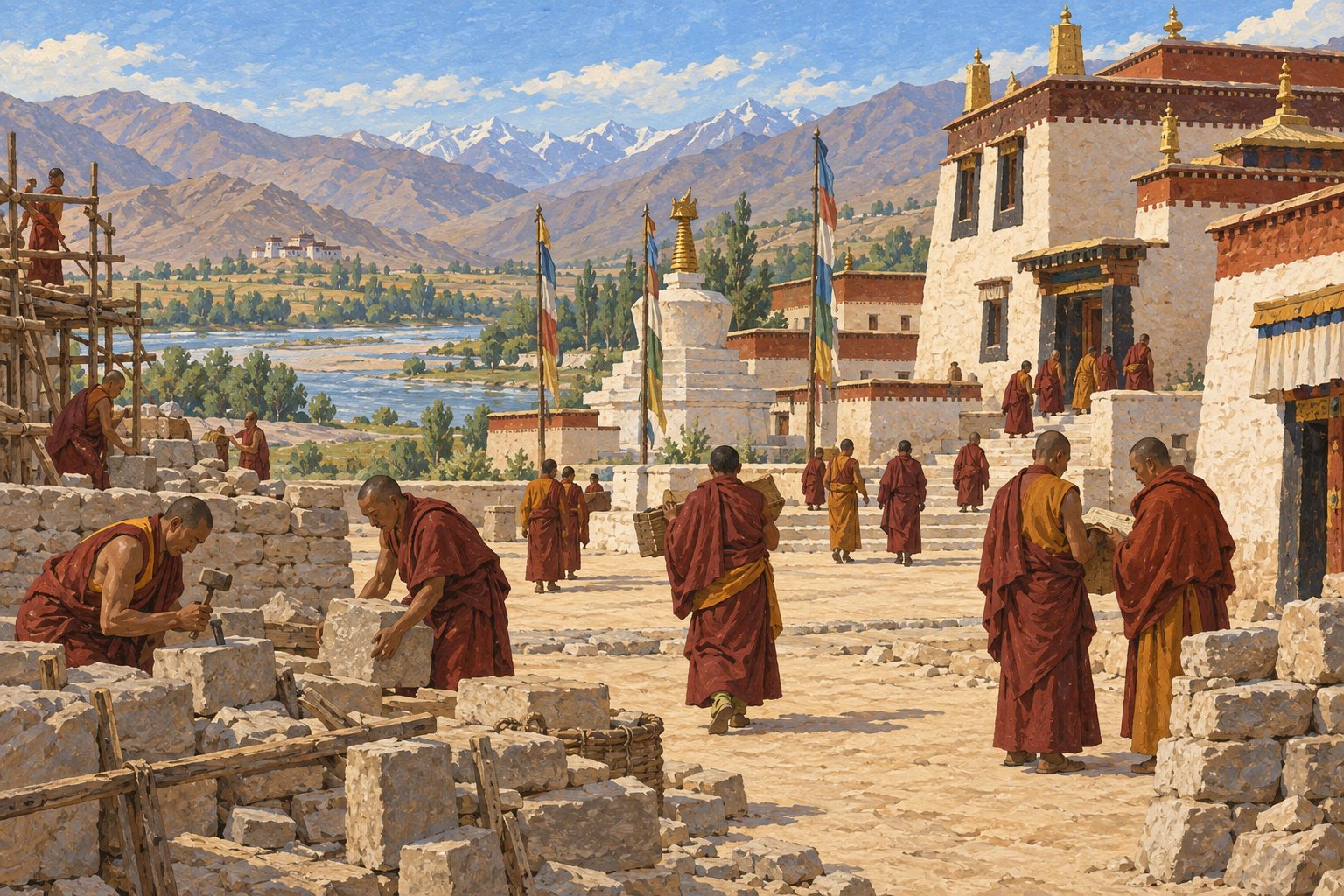
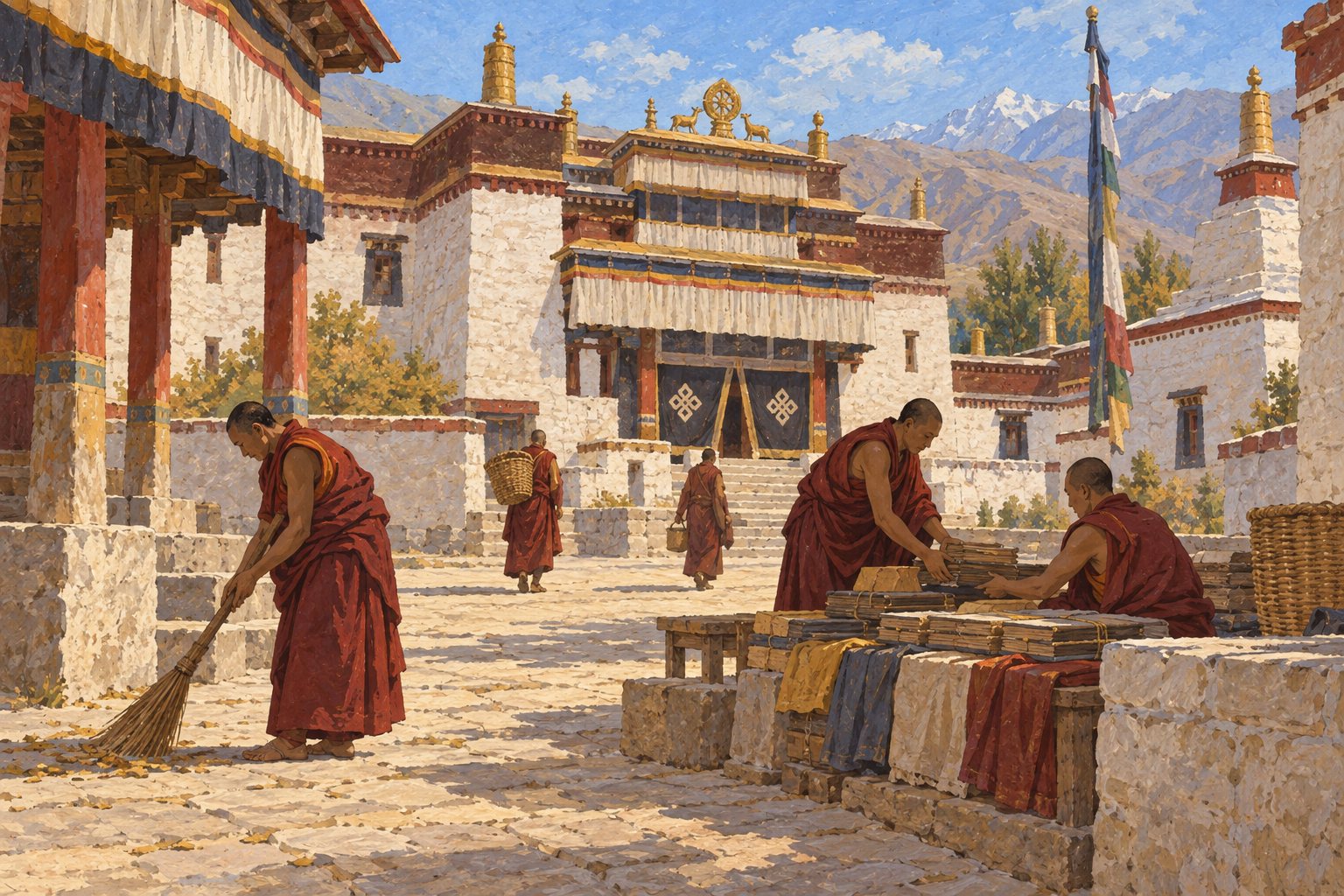
An endowed monastery. Samye, conventionally dated c.779, is the earliest secure institutional attestation — a monastery built on the Indian model, the first seven Tibetan monks ordained, and a king’s oath on stone that the endowment of the Three Jewels shall never be abandoned: a state committing revenue to a religion, in its own words, in its own era.
How it was transmitted
The Terminology Committee
The imperial translation project was standards-setting as religious policy: two-man teams of Indian pandita and Tibetan lotsawa, a royal decree revising the old translations into a new standard idiom, a state-funded glossary — the Mahavyutpatti — fixing Sanskrit–Tibetan equivalents so that different translators produced compatible texts, and a companion manual whose preamble reserves the coining of new terms to the committee; the result is why a fourteenth-century editor could bolt translations made centuries apart into one canon.
The Block Is the Archive
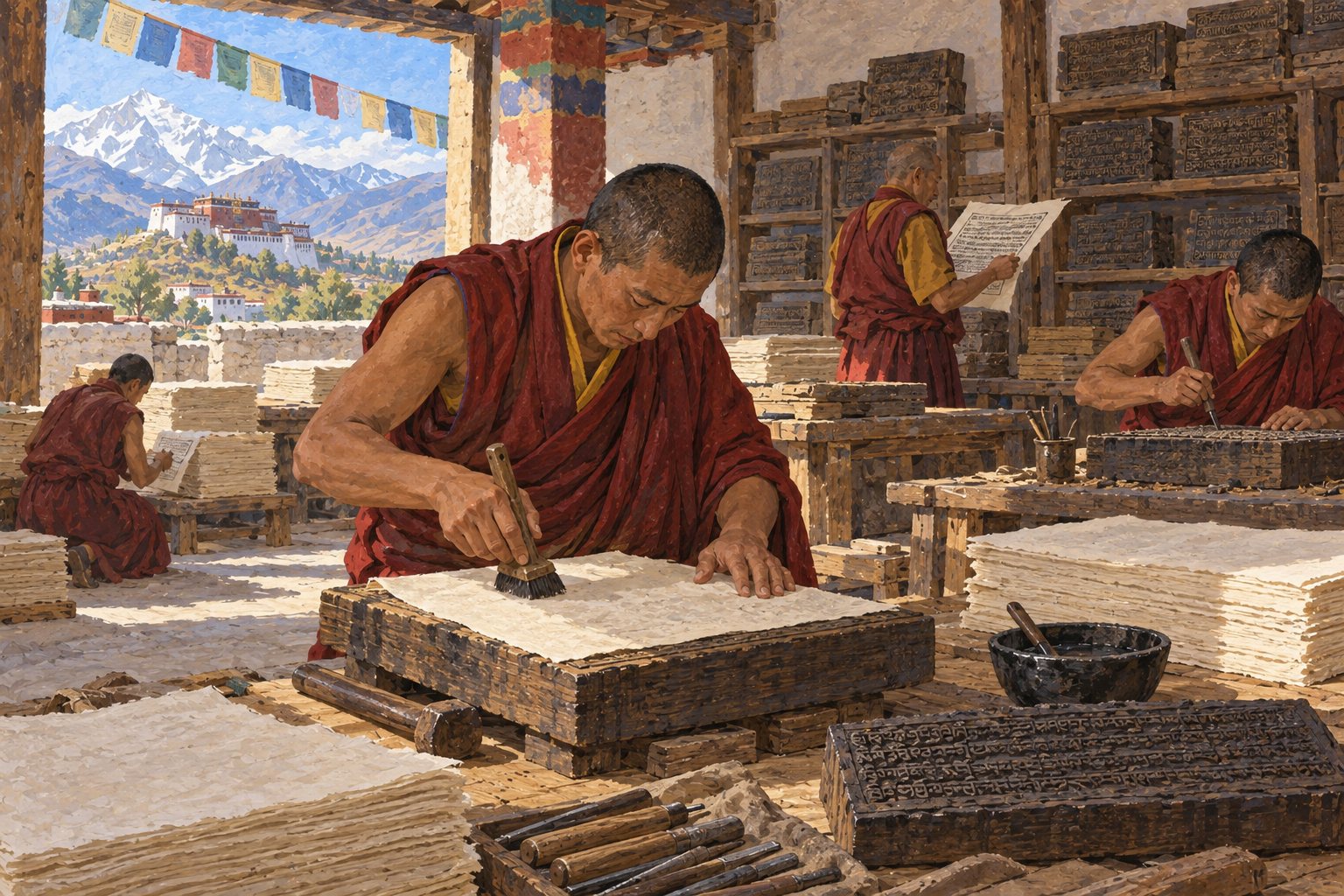
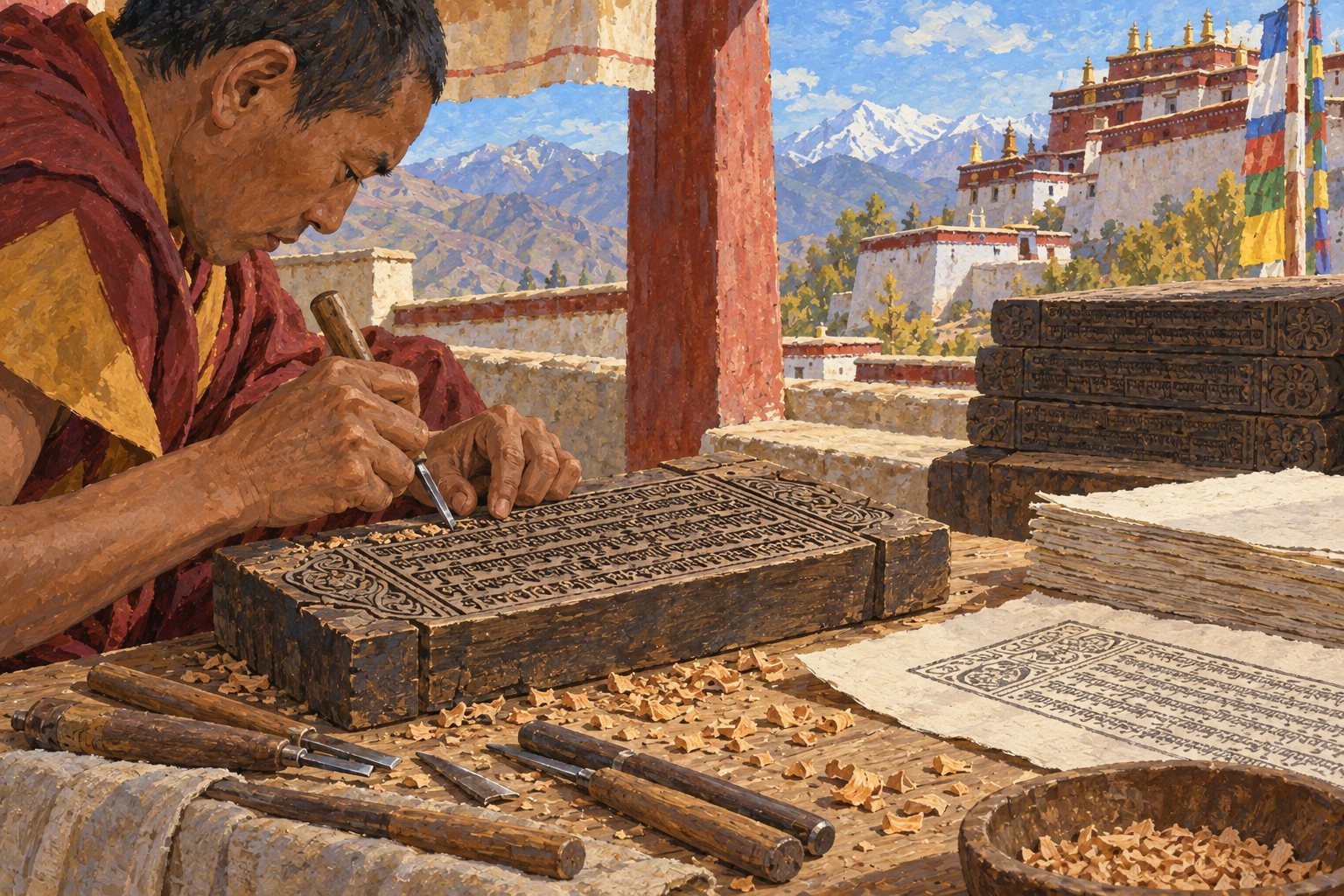
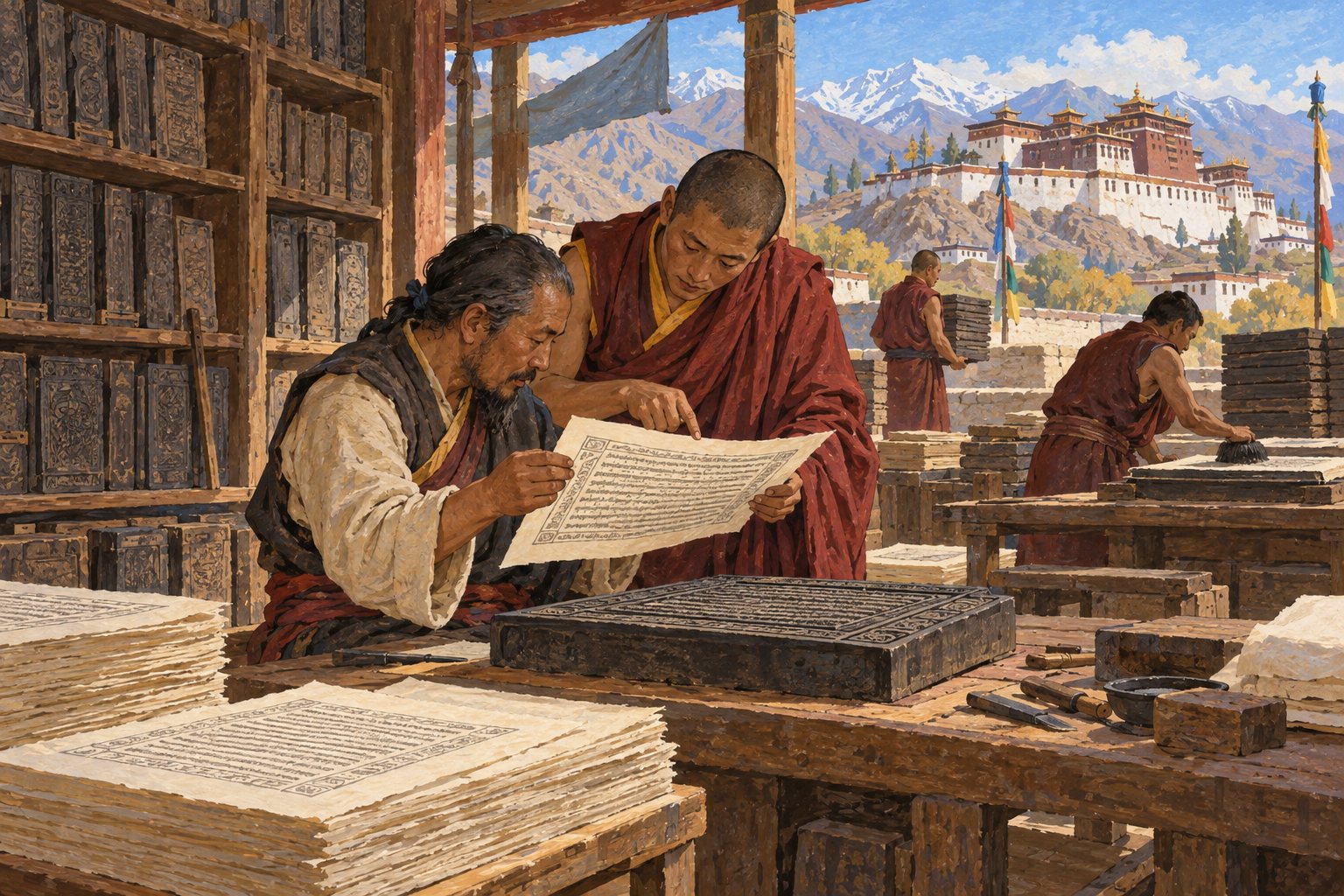
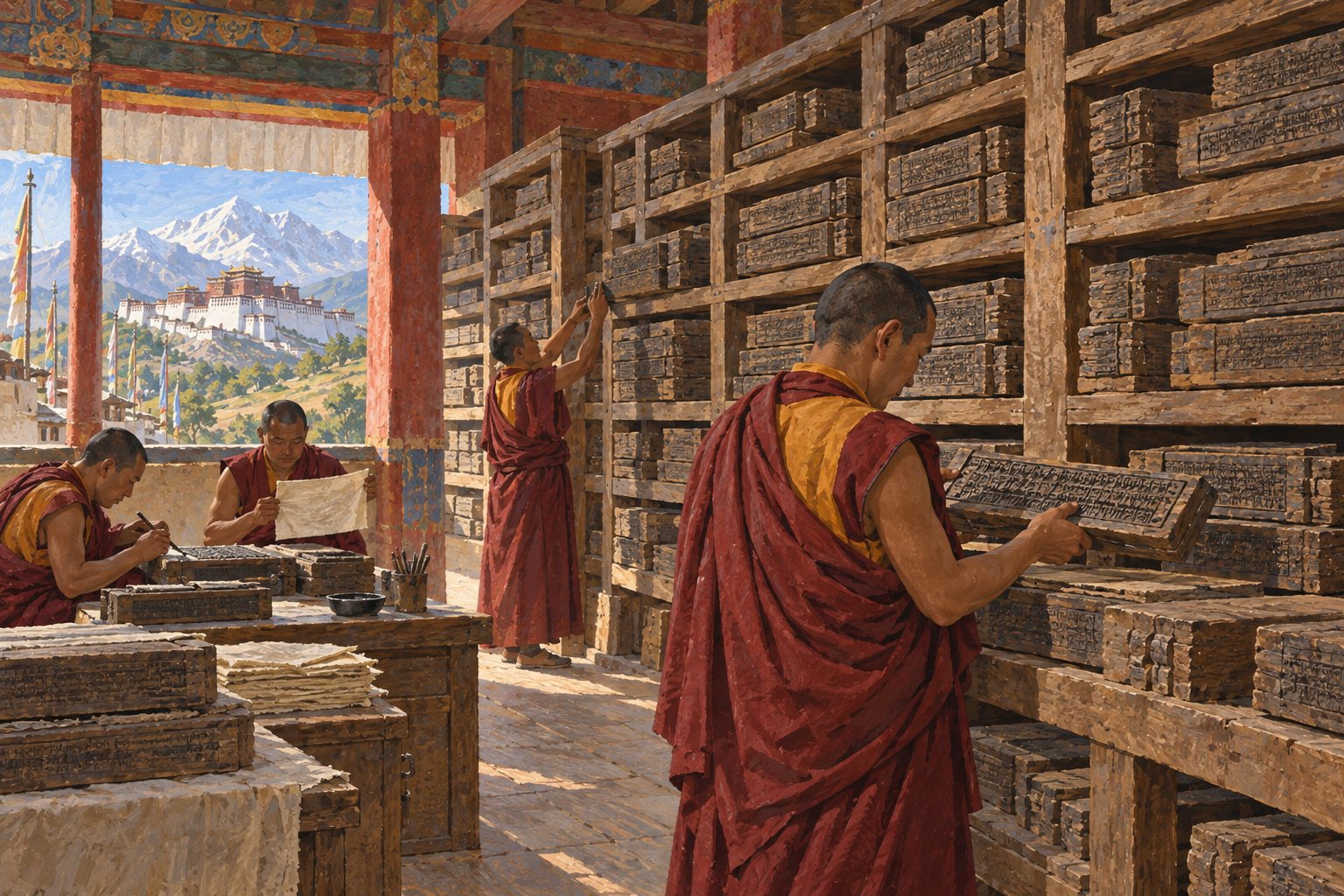
Tibetan printing is xylography, and its unit is the edition carved once: a scribe’s page pasted face-down, carved in mirror, proofed by named correctors, then stored — after which the block is simultaneously the press, the archive and the backup, printable on demand for centuries; editions are known by their printery — Derge, Narthang, Beijing, Choné — and the first complete printed Kangyur was produced in 1410 in Beijing, under Ming patronage, before any full printing existed inside Tibet: the canon’s first printing was itself an act of foreign patronage.
Explore the illustrations5 scenes · The block archive
The block archive. Tibetan printing is xylography, and its unit is the edition carved once: a scribe’s page pasted face-down, carved in mirror, proofed by named correctors, then stored — after which the block is simultaneously the press, the archive and the backup, printable on demand for centuries; editions are known by their printery — Derge, Narthang, Beijing, Choné — and the first complete printed Kangyur was produced in 1410 in Beijing, under Ming patronage, before any full printing existed inside Tibet: the canon’s first printing was itself an act of foreign patronage.
Texts and authority
A Canon Without a Council
The movement opens with the argument: this canon was closed by editors, not councils, and never entirely — the Kangyur (“translated word”) and Tengyur (“translated treatises”) were assembled in the fourteenth century out of imperial-era catalogues, and Buton Rinchen Drup’s editorial choices at Zhalu did what no Tibetan council ever convened to do; what resulted is not one text but a family of editions — Tshalpa and Thempangma manuscript lines, then the great printings — and no two agree exactly on the contents.
The Test Was the Sanskrit
Buton’s criterion for admission was philological — a demonstrable Indian original — and it cut hardest against the Ancients: many Nyingma tantras, lacking attested Sanskrit sources, were left out of the canon; the excluded answered with a counter-canon, the Nyingma Gyubum, collected and eventually printed on its own blocks — a canon defines its out-group, and in Tibet the out-group replied in kind.
Institutions and resources
The Estate That Cannot Die
The strongest money story in this series: when a lama of standing dies, his labrang — the household-estate of lands, herds, endowments, treasury, trade stock and debts — does not disperse to heirs; it waits, and the recognition of a child as his reincarnation transfers the whole of it intact to the successor — recognised reincarnation is, among other things, an inheritance mechanism, a legal-economic innovation in religious form that keeps capital inside an institution across every death; the corporate sangha of the four quarters, inherited from the Buddhism volume, is here upgraded: Tibet made the individual master’s estate immortal too.
The Search, the Urn and the Regent
Recognition is a procedure — predictions, oracles, visions at the lake, the predecessor’s possessions picked from among duplicates — and the procedure has two structural weak points the record shows plainly: the interregnum, since a child heir means fifteen to twenty years of regency, and the regent is an office with an estate of its own; and the state, since in 1793 the Qing wrote itself into the mechanism with a golden urn and a lottery ordinance — the most famous regency began with a concealed death, and the urn returns at the end of this book.
Explore the illustrations5 scenes · Tea in the courtyard
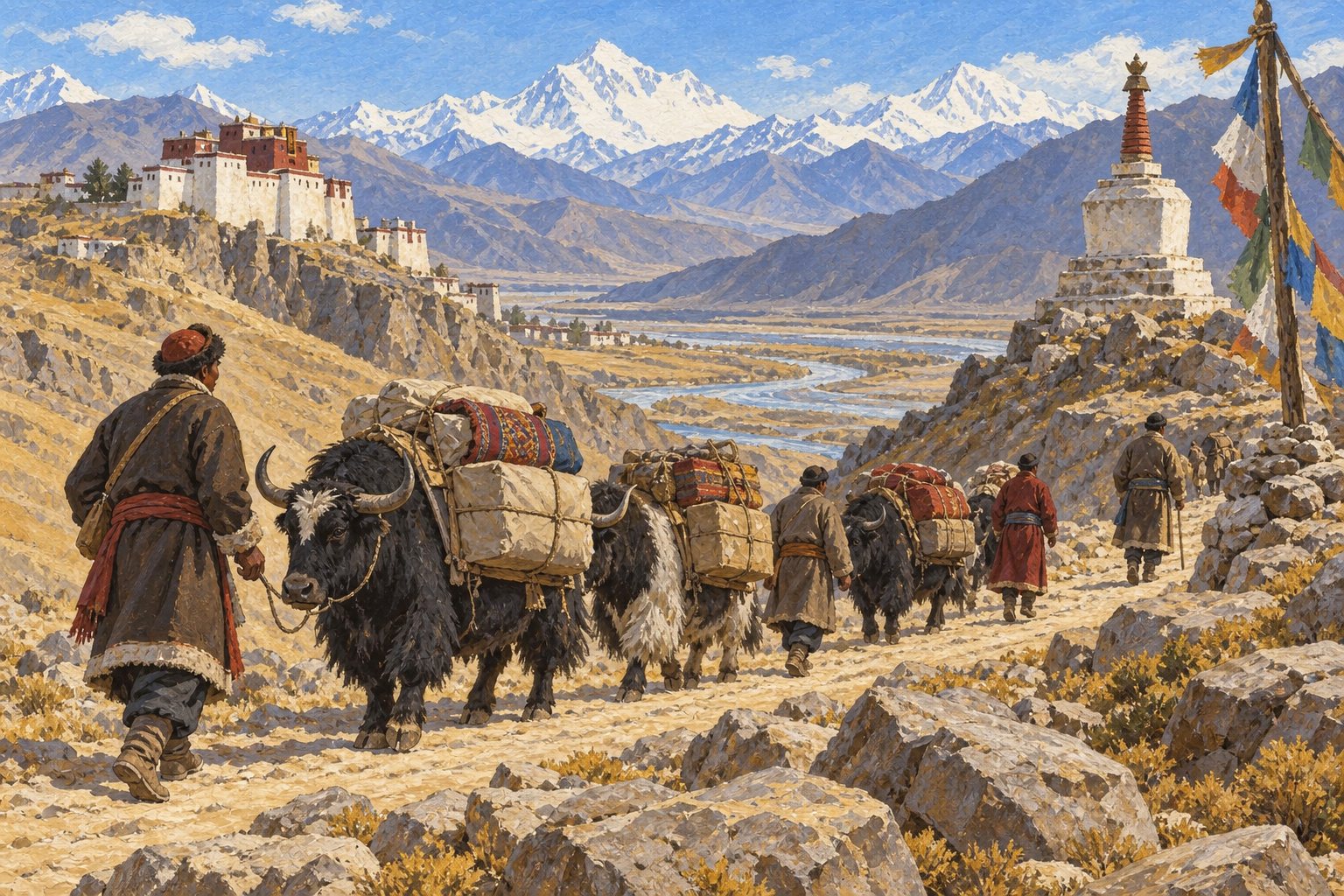
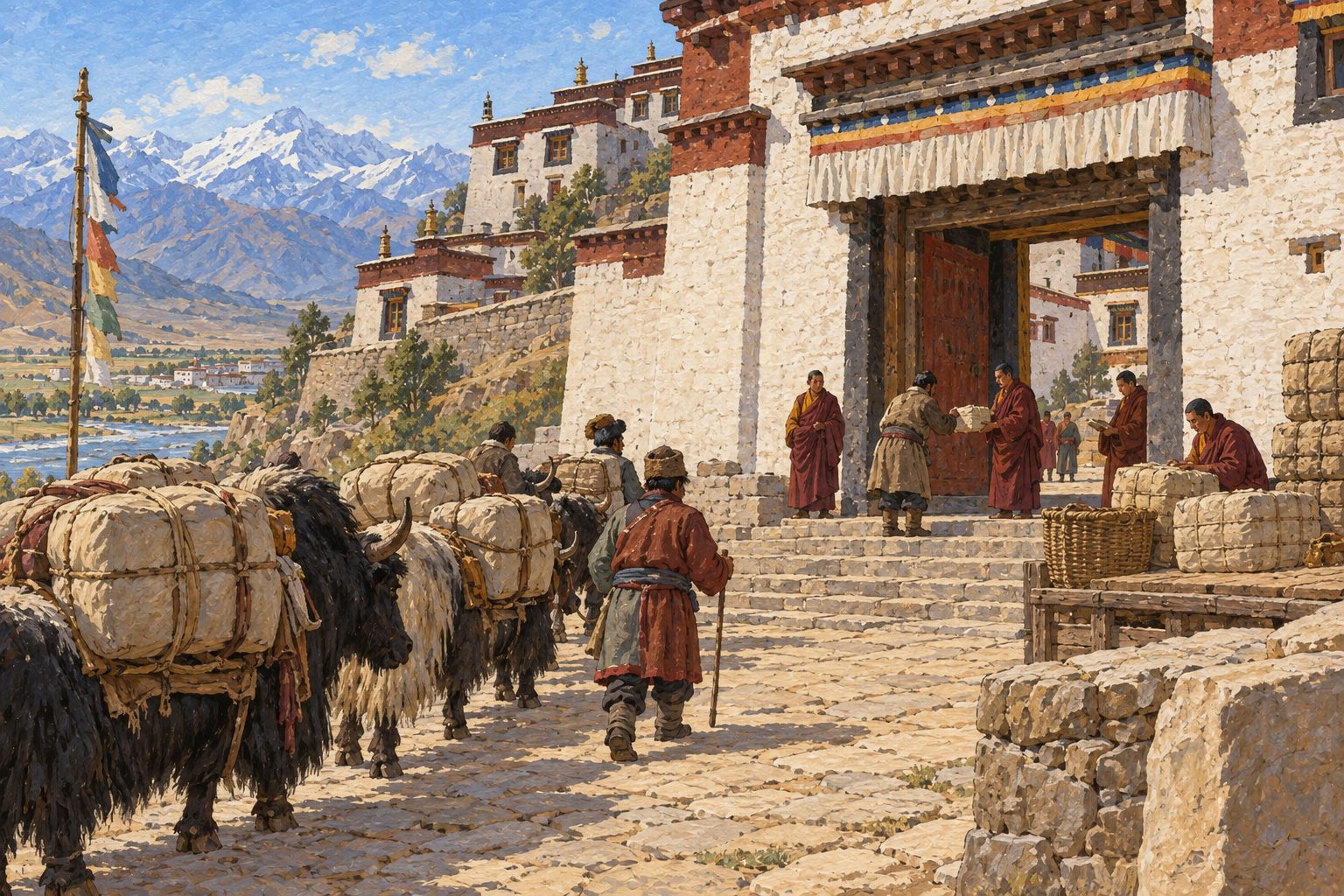
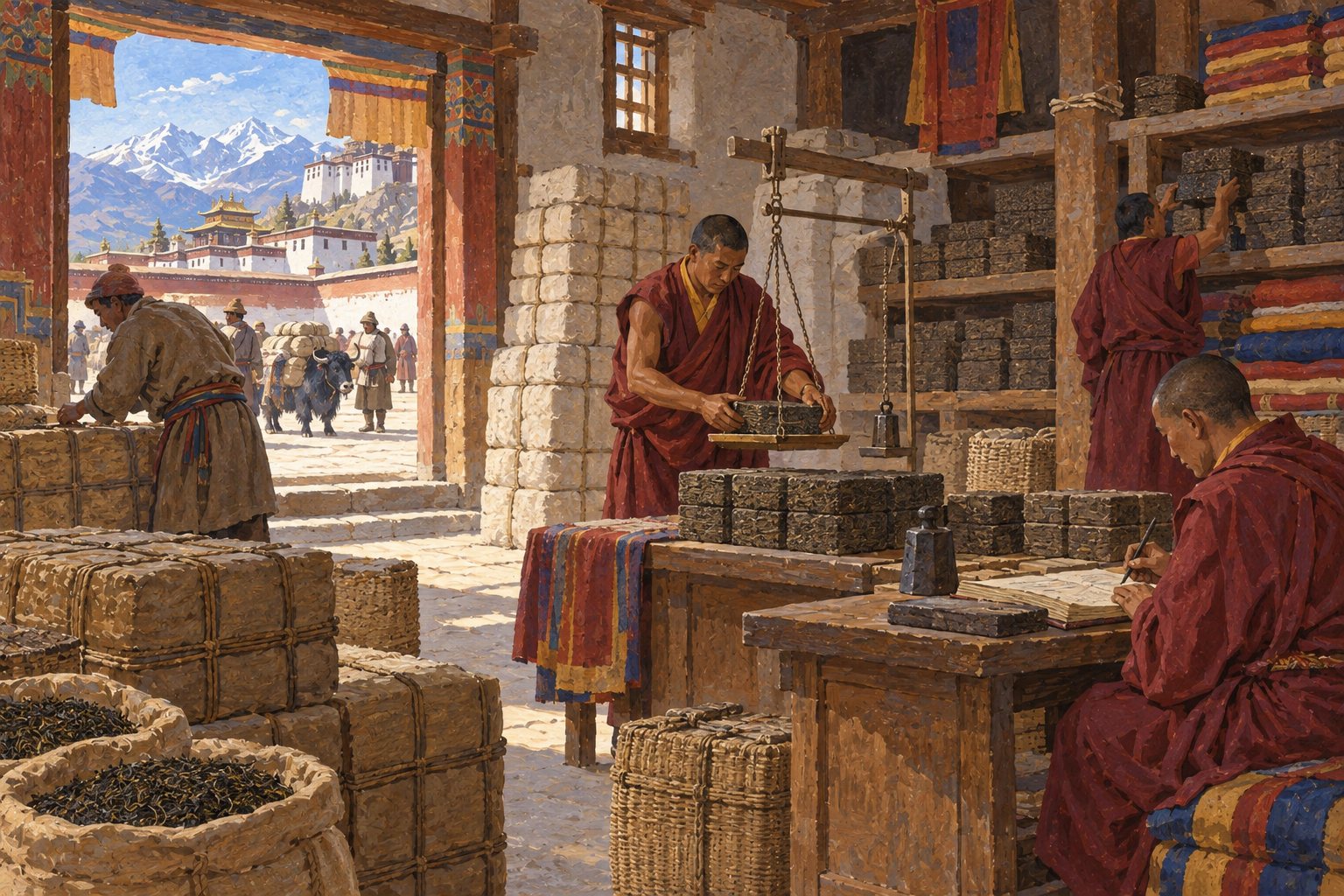
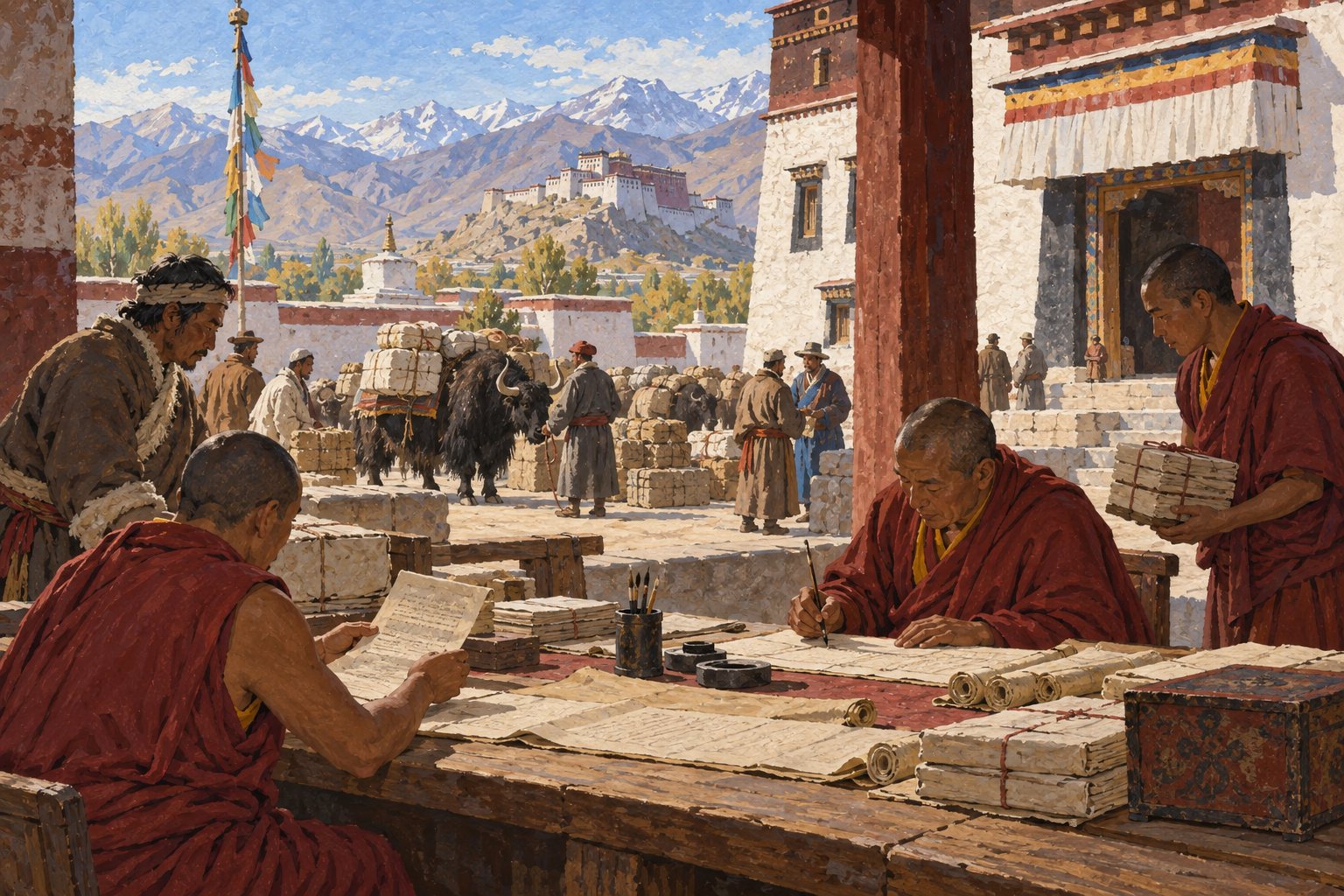
Tea in the courtyard. The tradition’s foreign relations were, structurally, its fundraising: the cho-yon relation bound a lama to an outside military patron — Sakya to the Mongol court, with tax exemptions, an imperial preceptorship and the administration of Tibet’s districts; Ming emperors distributing titles and gifts across the schools; the Qing patronising the Gelug — while at ground level the monastery was a trading house: caravans, the tea trade, treasuries lending at interest; patronage and commerce are described with dates and documents, and no party’s motives are characterised.
Changes and divisions
The Debate Both Sides Won
Conventionally dated 792–794, the Samye debate set the Indian gradualist Kamalashila against the Chinese Chan master Moheyan on whether awakening is cultivated or sudden — and the finding is the sources: the Tibetan dossier records the Indian side’s victory and a royal ruling for the gradual path; the Chinese dossier, recovered at Dunhuang, records the Chinese side vindicated; some specialists doubt a single staged contest occurred at all; the volume reports all three states of the record and crowns nobody — the series’ stance rule demonstrated on an eighth-century case before the reader needs it for the twentieth.
Four Schools from Two Waves
The school map is a product of the two diffusions, and the units of division are lineages and estates as much as doctrines: the Nyingma — “the Ancients” — crystallising retroactively around the old translations and the terma; and from the second diffusion the new-translation schools — the Kadam of Atisha’s line, later absorbed; the Sakya of the Khon family, who solved succession by heredity, uncle to nephew, and needed no tulku; the Kagyu of Marpa’s line, whose Karma branch invented the recognised reincarnation; and the Gelug of Tsongkhapa, whose seats industrialised the curriculum — a split landscape in which what a school owns is as defining as what it teaches.
Limits of the evidence
These limits are stated in the book before its argument.
- Whether Songtsen Gampo was, in any personal sense, a Buddhist The earliest secure evidence of royal Buddhist commitment is Trisong Detsen’s, on stone at Samye, more than a century after him; the familiar portrait — two Buddhist queens, the king as an emanation of Avalokiteshvara — is retrospective, and its fullest source, the Mani Kabum, is itself presented by the tradition as rediscovered treasure.
- Who created the Tibetan script, or when, closer than this: it derives from a Gupta-era Indian script and was in use for state business by the mid-eighth century, when the dated inscriptions begin. Thonmi Sambhota’s mission to India appears in later sources; the volume reports it as the tradition’s account.
- Whether the Samye debate took place as a single formal contest, and who won Each side’s surviving dossier records its own victory, and some specialists doubt there was a face-to-face event at all. The disagreement of the sources is the chapter’s finding, not an obstacle to it.
Sources and reading
This article brings together the series’ existing overview and chapter summaries. The linked book page provides the full outline and bibliography.
- Treaty pillar outside the Jokhang821–822; pillar conventionally 823. bilingual equal-to-equal oath; Tibetans happy in Tibet, Chinese in China
- Hugh Richardson, edition of the four faces1978. published epigraphy checked for the treaty pillar
- Fang-kuei Li, treaty-pillar edition1956. earlier published text of the same stone
- Old Tibetan Annals and Chronicle, Dunhuangimperial era. year-by-year court records; Songtsen Gampo’s death about 649
- S. W. Bushell, Tang annals’ Tibet chapters1880. Princess Wencheng’s marriage, 641; Tibetan armies at Chang’an, 763 — a rival archive
- Dunhuang and Silk Road contracts, loans and army rosters8th–9th c.. the Tibetan alphabet at work on secular business
- Royal tumuli at Chongyephysical fact. early kings’ burial field in the Yarlung valley
- Mani Kabum12th–13th c. compilation. retrospective Songtsen-as-Avalokiteshvara portrait, presented by the tradition as terma
Illustrations are newly generated interpretations of themes in the book. They are not surviving artifacts, historical photographs or evidence for the events described.