Belief System
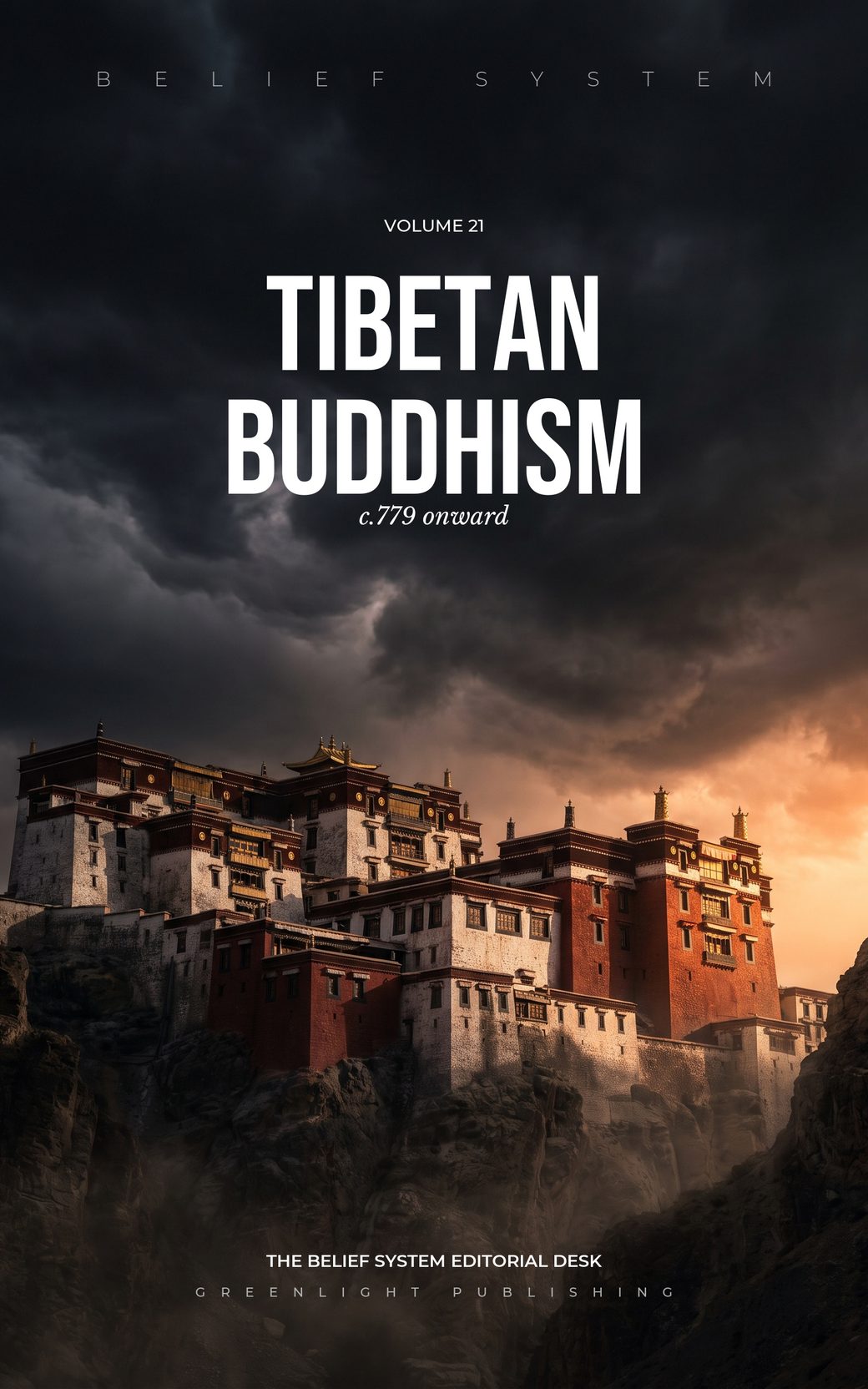
Jacket of Belief System volume 21, Tibetan Buddhism
$12.99paperback

128 pages, 5.5 × 8.5 in. Three or more volumes in one order and every copy drops to $11.99.

copies

United States, 8 to 11 days. All destinations

Volume 21 Belief System c.779 onward

Tibetan Buddhism

The machinea printing house that never stopped

Attested from
c.779 CE

The earliest secure evidence, and the key this volume is filed under. All thirty-one

Narrates
c.779 onward

The period the book actually covers. It is rarely the same figure.

The argument in one sentence

A religion that arrived in Tibet as state infrastructure — an alphabet commissioned to translate it, a state-funded terminology committee to standardise it, a printing house that has now been running for three centuries — went on to solve monasticism’s oldest institutional problem, what happens to the estate when the master dies, by recognising the dead lama’s return in a living child; that invention, the tulku with his labrang, made property immortal and succession political, and it is why every division this volume reports — from a debate at Samye in the 790s that both sides’ sources record winning, to a protector dispute and a succession question still open today — is given with names, dates and documents, and adjudicated nowhere.

reincarnation doubles as an inheritance mechanism: a recognised child inherits the labrang, an estate with lands, herds and treasury that survives its holder’s deaths.The commissioning line

What it is

Reincarnation doubles as an inheritance mechanism: a recognised child inherits the labrang, an estate with lands, herds and treasury that survives its holder’s deaths.

This is a history of a printing house that never stopped, and of how we know.

A pillar outlasted both empires. An emperor ordered an alphabet. A terminology committee closed a vocabulary. Derge still pulls pages by hand. The land-share figures that circulate in both directions are not printed, because they did not verify.

Five movements: the world of the oath at Samye, the machine of the block, the canon that stays open on purpose, the money, and the succession question.

The book never adjudicates. Every translation is named in the text. No percentage of Tibetan land is invented to fill a political sentence.

Belief System, Volume 21.

In full

Tibetan Buddhism is a book about estates that cannot die and blocks that do not wear out. The search, the urn and the regent are administrative acts. The monastery as landlord is a file, not a sermon. The patron and the priest is a fiscal relationship both sides documented.

A canon without a council: the test was the Sanskrit. The hidden library is terma, reported as the tradition’s own open-shelf policy, not as a verdict on concealment. The world’s most famous “Tibetan book” is one cycle, chosen and framed by its Western editors, put into English in Sikkim and published at Oxford in 1927 under a title borrowed from Budge.

Nineteen fifty is reported. The dispute over a protector is reported. The succession question is left as a question. The Kadam as a named school thinned as its syllabus moved into other seats; absorption is not a doctrine test in this book.

The volume uses five fixed phrases, and no sixth. It reports no terton as fact and denies none. It never tells you what anybody remembered from a previous life.

Belief System is a history of world religion, one tradition at a time. Thirty-one volumes, ordered by earliest secure attestation.

The contents

26 chapters in five movements. Every volume in the series has the same five, in the same order, and each chapter below is printed with the idea it carries.

Movement OneThe World

  1. 1The Pillar That Outlasted Both EmpiresOpen on the stone outside the Jokhang: a treaty of 821–822 between the Tibetan and Tang empires, carved bilingually on a pillar that still stands — the record shows a Central Asian great power treating with China as an equal, running a chancery, keeping annals; the room this tradition ignited in was an empire that needed what literate religions carry.
  2. 2The King the Tradition RemembersSongtsen Gampo (d. c.649) is the tradition’s first Buddhist king — two Buddhist queens, the Jokhang conventionally dated to the 640s, the king an emanation of Avalokiteshvara — and the datable record shows a state-builder: conquests, law, the marriage alliance with the Tang in 641; the gap between the two portraits is the chapter, and neither is adjudicated.
  3. 3The Emperor’s AlphabetThe Tibetan script is a writing system commissioned as translation infrastructure — the tradition holds Thonmi Sambhota was sent to India to build it so that Buddhist texts could be rendered; what the record shows is a Gupta-derived alphabet appearing in dated inscriptions by the mid-eighth century and immediately running an empire’s law, tax and mail as well as its scripture — and the spelling has been frozen so long that modern orthography is a fossil of the translation era’s phonology.
  4. 4The Oath at SamyeSamye, conventionally dated c.779, is the earliest secure institutional attestation — a monastery built on the Indian model, the first seven Tibetan monks ordained, and a king’s oath on stone that the endowment of the Three Jewels shall never be abandoned: a state committing revenue to a religion, in its own words, in its own era.
  5. 5The Empire Falls, the Books Come BackThe empire fragments in the 840s — the tradition blames Langdarma’s persecution and gives him an assassin-monk; some modern specialists read the evidence as a withdrawal of patronage rather than a hunt, and the disagreement is reported — then a dark century with almost no records, an ordination lineage kept alight in Amdo, and from the late tenth century the second diffusion: new kingdoms in the west funding new translations, which is where every school in this book except the Ancients begins.

Movement TwoThe Machine

The transmission technology, named as a concrete object or institution — not an abstraction.

  1. 6The Terminology CommitteeThe imperial translation project was standards-setting as religious policy: two-man teams of Indian pandita and Tibetan lotsawa, a royal decree revising the old translations into a new standard idiom, a state-funded glossary — the Mahavyutpatti — fixing Sanskrit–Tibetan equivalents so that different translators produced compatible texts, and a companion manual whose preamble reserves the coining of new terms to the committee; the result is why a fourteenth-century editor could bolt translations made centuries apart into one canon.
  2. 7The Block Is the ArchiveTibetan printing is xylography, and its unit is the edition carved once: a scribe’s page pasted face-down, carved in mirror, proofed by named correctors, then stored — after which the block is simultaneously the press, the archive and the backup, printable on demand for centuries; editions are known by their printery — Derge, Narthang, Beijing, Choné — and the first complete printed Kangyur was produced in 1410 in Beijing, under Ming patronage, before any full printing existed inside Tibet: the canon’s first printing was itself an act of foreign patronage.
  3. 8The Printing House That Never StoppedThe Derge Parkhang in Kham, founded 1729 under the Derge king Tenpa Tsering, is a functioning three-hundred-year-old text factory: printers working in pairs — one inks, one lays the page and pulls — at a measured rate on the order of 2,500 pages a day, from a block store whose circulating count of about two hundred thousand has never been audited; it prints by hand today, and pilgrims circumambulate the building, because the factory is itself a sacred object.
  4. 9The Text You May Not Simply ReadA printed book is not yet a usable text: the tradition requires transmission — lung, the reading heard aloud from a holder of the line; tri, the explanation; wang, the empowerment — so the machine is two-channel, a carved block that fixes the wording and a human chain that licenses its use, and a text whose living transmission lapses is functionally dead even while the blocks sit in Derge; whole assemblies still sit through the reading of a hundred-volume Kangyur, because the licence travels by ear.
  5. 10The Debate CourtyardGelug monastic education is replication with adversarial error-correction: years of memorising root texts, then public dialectic in the courtyard — thesis, challenge, the clap — with degrees at the end of a curriculum measured in decades; the three great seats near Lhasa ran this machine at industrial scale, with nominal quotas in the thousands and circulating counts higher still, and the honest sentence gives both with their sources.

Movement ThreeThe Canon

What is in, what is out, who decided, when, and what the decision cost. The real subject is who had the authority to close it.

  1. 11A Canon Without a CouncilThe movement opens with the argument: this canon was closed by editors, not councils, and never entirely — the Kangyur (“translated word”) and Tengyur (“translated treatises”) were assembled in the fourteenth century out of imperial-era catalogues, and Buton Rinchen Drup’s editorial choices at Zhalu did what no Tibetan council ever convened to do; what resulted is not one text but a family of editions — Tshalpa and Thempangma manuscript lines, then the great printings — and no two agree exactly on the contents.
  2. 12The Test Was the SanskritButon’s criterion for admission was philological — a demonstrable Indian original — and it cut hardest against the Ancients: many Nyingma tantras, lacking attested Sanskrit sources, were left out of the canon; the excluded answered with a counter-canon, the Nyingma Gyubum, collected and eventually printed on its own blocks — a canon defines its out-group, and in Tibet the out-group replied in kind.
  3. 13The Hidden LibraryThe thing that makes this canon movement unlike any other in the series: terma — texts held to have been concealed by Padmasambhava and his circle for later discovery, recovered by named discoverers at datable moments, from rock, pillar, lake and mind, with a doctrine explaining how new scripture can be old; the tradition polices its own registry — recognised discoverers, contested ones, false ones — and the scholarly account reads the same record as a mechanism by which new revelation entered a tradition pegged to an eighth-century golden age; both accounts are reported side by side and neither is adjudicated.
  4. 14The Book of the Dead, Assembled in OxfordThe world’s most famous “Tibetan book” is one terma cycle, chosen and framed by its Western editors: the Bardo Thodol, held by the tradition to have been concealed by Padmasambhava and recovered by Karma Lingpa in the fourteenth century, was translated in Sikkim by Kazi Dawa Samdup, and published at Oxford in 1927 by W. Y. Evans-Wentz under a title borrowed from Budge’s Egyptian Book of the Dead — a transmission history in which every link is documented, including the ones that happened in English.
  5. 15A Canon That Stays Open on PurposeThe open canon got its own canonising anthology: in the nineteenth century, amid the Rime movement’s rescue of thinning lineages, Jamgon Kongtrul compiled the Rinchen Terdzo — a treasury of rediscovered teachings running to dozens of volumes — an editor curating the uncloseable; and discovery did not stop: the tradition recognises treasure-finders into the twentieth century and describes the mechanism in the present tense, which this book therefore also does.

Movement FourThe Money

Who paid, who was paid, and how we know. Numbers get their provenance in the same sentence.

  1. 16The Estate That Cannot DieThe strongest money story in this series: when a lama of standing dies, his labrang — the household-estate of lands, herds, endowments, treasury, trade stock and debts — does not disperse to heirs; it waits, and the recognition of a child as his reincarnation transfers the whole of it intact to the successor — recognised reincarnation is, among other things, an inheritance mechanism, a legal-economic innovation in religious form that keeps capital inside an institution across every death; the corporate sangha of the four quarters, inherited from the Buddhism volume, is here upgraded: Tibet made the individual master’s estate immortal too.
  2. 17The Search, the Urn and the RegentRecognition is a procedure — predictions, oracles, visions at the lake, the predecessor’s possessions picked from among duplicates — and the procedure has two structural weak points the record shows plainly: the interregnum, since a child heir means fifteen to twenty years of regency, and the regent is an office with an estate of its own; and the state, since in 1793 the Qing wrote itself into the mechanism with a golden urn and a lottery ordinance — the most famous regency began with a concealed death, and the urn returns at the end of this book.
  3. 18The Monastery as LandlordMonastic estates were worked by mi ser — households bound to estates, owing shares of harvest and the ula transport corvée — and this chapter runs the series’ discipline at its hardest: the percentage claims in circulation for how land divided among government, aristocracy and monasteries, and for what share of men wore robes, come from politically committed sources on both sides, so the book prints the range, names who published which number — state publications on one side, exile publications on the other, Western estimates between — and says the matter is contested; even the word for the system is a named scholarly fight, and the fight is reported, not refereed.
  4. 19The Patron and the PriestThe tradition’s foreign relations were, structurally, its fundraising: the cho-yon relation bound a lama to an outside military patron — Sakya to the Mongol court, with tax exemptions, an imperial preceptorship and the administration of Tibet’s districts; Ming emperors distributing titles and gifts across the schools; the Qing patronising the Gelug — while at ground level the monastery was a trading house: caravans, the tea trade, treasuries lending at interest; patronage and commerce are described with dates and documents, and no party’s motives are characterised.
  5. 20The Colophon Is the ReceiptWho paid for scripture is written inside the scripture: Tibetan colophons name the sponsor, the editor, the carvers and proofreaders, sometimes the costs — the colophon is the edition’s receipt and payroll — and by that paper trail the Derge court funded the Parkhang, the Ming court funded the first printed Kangyur as diplomacy, and sponsoring an edition earned the sponsor merit, which is the engine that carved the blocks; the full merit-as-print-run argument belongs to the Mahayana Buddhism volume and is pointed to by name, not retold.

Movement FiveThe Split

What divided it, what it became, what it handed on. Names the next volume by NAME, never by number.

  1. 21The Debate Both Sides WonConventionally dated 792–794, the Samye debate set the Indian gradualist Kamalashila against the Chinese Chan master Moheyan on whether awakening is cultivated or sudden — and the finding is the sources: the Tibetan dossier records the Indian side’s victory and a royal ruling for the gradual path; the Chinese dossier, recovered at Dunhuang, records the Chinese side vindicated; some specialists doubt a single staged contest occurred at all; the volume reports all three states of the record and crowns nobody — the series’ stance rule demonstrated on an eighth-century case before the reader needs it for the twentieth.
  2. 22Four Schools from Two WavesThe school map is a product of the two diffusions, and the units of division are lineages and estates as much as doctrines: the Nyingma — “the Ancients” — crystallising retroactively around the old translations and the terma; and from the second diffusion the new-translation schools — the Kadam of Atisha’s line, later absorbed; the Sakya of the Khon family, who solved succession by heredity, uncle to nephew, and needed no tulku; the Kagyu of Marpa’s line, whose Karma branch invented the recognised reincarnation; and the Gelug of Tsongkhapa, whose seats industrialised the curriculum — a split landscape in which what a school owns is as defining as what it teaches.
  3. 23The Year of the Great FifthIn 1642 Gushri Khan of the Khoshut Mongols, having defeated the king of Tsang — patron of the Karma Kagyu — conferred supreme authority over Tibet on the Fifth Dalai Lama, and the resulting government took its name from the lama’s own estate: the Ganden Phodrang, the labrang become the state, which is this volume’s money thesis written into a polity’s letterhead; the consolidation had losers, reported with dates — monasteries converted, the Jonang school’s houses sealed or converted in the 1650s while its line survived in Amdo, where it continues — and a building: the Potala, begun 1645.
  4. 24Nineteen Fifty, ReportedThe head-note states the register: this chapter and the two after it concern living memory and a live international dispute, and they run on the same rules as the eighth century — the half-century before is compressed to its documents (an armed British expedition extracting a treaty at Lhasa in 1904, a 1913 proclamation whose legal weight is disputed, a 1914 convention initialled and not ratified), then the documented sequence: the People’s Liberation Army enters Kham in October 1950; the Seventeen-Point Agreement is signed in Beijing on 23 May 1951 — a text whose own validity is disputed between the parties, and the dispute is about seals and authority, which makes it this series’ kind of dispute; the Dalai Lama leaves Lhasa in March 1959 and repudiates the agreement from India; the 1960s destruction of monasteries is reported through the counts each side publishes, attributed; from the 1980s, rebuilding; in exile, the three great seats re-founded in south India, functioning today.
  5. 25The Dispute Over a ProtectorThe Shugden dispute, reported as a dispute: the practice centres on a protector figure whose origin the parties themselves date to the death of the lama Drakpa Gyaltsen in 1656 — the accounts of what he became diverge by party and are reported side by side; the practice grew within the Gelug in the early twentieth century under Pabongkha; from the mid-1970s the Fourteenth Dalai Lama advised against it and from 1996 restricted it publicly; societies of practitioners protested by name and date — London 1996, the demonstrations of 2008–2015, an organisation dissolved in 2016; in February 1997 three monks were murdered in Dharamsala, and the chapter prints exactly what the investigating police stated and no more: named suspects, no convictions, a case linked by investigators to the dispute; a 2015 wire-service investigation into outside funding of the protest campaign is attributed to its publisher by name.
  6. 26The Succession QuestionThe volume ends where its money movement began, because the live dispute is the tulku mechanism itself: in May 1995 the Dalai Lama recognised six-year-old Gedhun Choekyi Nyima as the Panchen Lama; the child ceased to appear publicly within days, his condition since attested only by official statements, which are quoted as statements; in November 1995 a golden-urn ceremony selected Gyaincain Norbu; the Karmapa line split in parallel — one candidate recognised in 1992 with both Dharamsala’s and Beijing’s assent, another enthroned in 1994, the two men meeting jointly in 2018; in 2007 a state regulation made the reincarnation of lamas subject to government approval; and the Fourteenth Dalai Lama has issued dated statements — 2011, and again in July 2025 — that the authority to recognise his successor rests solely with his own trust, to which the state party has replied, also in dated statements, that succession must follow its law and its urn; two procedures, each with named champions, each claiming an eighteenth-century precedent, both reported, neither endorsed.

What this volume cannot establish

Printed in the book before the argument is, and printed here for the same reason. A history of a tradition that will not say where its evidence runs out is not a history.

  • Whether Songtsen Gampo was, in any personal sense, a Buddhist. The earliest secure evidence of royal Buddhist commitment is Trisong Detsen’s, on stone at Samye, more than a century after him; the familiar portrait — two Buddhist queens, the king as an emanation of Avalokiteshvara — is retrospective, and its fullest source, the Mani Kabum, is itself presented by the tradition as rediscovered treasure.
  • Who created the Tibetan script, or when, closer than this:. it derives from a Gupta-era Indian script and was in use for state business by the mid-eighth century, when the dated inscriptions begin. Thonmi Sambhota’s mission to India appears in later sources; the volume reports it as the tradition’s account.
  • Whether the Samye debate took place as a single formal contest, and who won. Each side’s surviving dossier records its own victory, and some specialists doubt there was a face-to-face event at all. The disagreement of the sources is the chapter’s finding, not an obstacle to it.
  • The age and authorship of any terma text. The tradition’s account — concealed in the eighth century, recovered at the destined moment — and the scholarly account — composed near the moment of discovery — are reported side by side, and the volume adjudicates neither.
  • The Derge printing house’s block count, closer than an order of magnitude. Figures around two hundred thousand circulate; no audited count verified, and the book prints a named range or the honest phrase “no audited count,” never a bare number.
  • The scale of monastic landholding, or the share of men in monasteries, before 1950. The figures in circulation come from politically committed sources on both sides. The volume gives the range, names who published which number, states that the matter is contested, and settles nothing.
  • The whereabouts or condition of Gedhun Choekyi Nyima since May 1995. , beyond attributed official statements. What can be established is who said what, and when, and the chapter establishes exactly that.
  • Any government’s motives, in any century. The post-1950 chapters establish acts, dates and signed texts — not intentions.
  • Anyone’s interior state.

Buddhism, four ignitions

This tradition ignites more than once in the chronology. The other slots are Buddhism, Mahayana Buddhism, Zen. See the thread.

Sources

61 works, dated, and specific enough that a reader can go and look at the thing. Nothing is on this list that the desk did not consult.

The bibliography, as the volume prints it
# Document or work Date Evidence for
1Treaty pillar outside the Jokhang821–822; pillar conventionally 823bilingual equal-to-equal oath; Tibetans happy in Tibet, Chinese in China
2Hugh Richardson, edition of the four faces1978published epigraphy checked for the treaty pillar
3Fang-kuei Li, treaty-pillar edition1956earlier published text of the same stone
4Old Tibetan Annals and Chronicle, Dunhuangimperial erayear-by-year court records; Songtsen Gampo’s death about 649
5S. W. Bushell, Tang annals’ Tibet chapters1880Princess Wencheng’s marriage, 641; Tibetan armies at Chang’an, 763 — a rival archive
6Dunhuang and Silk Road contracts, loans and army rosters8th–9th c.the Tibetan alphabet at work on secular business
7Royal tumuli at Chongyephysical factearly kings’ burial field in the Yarlung valley
8Mani Kabum12th–13th c. compilationretrospective Songtsen-as-Avalokiteshvara portrait, presented by the tradition as terma
9Zhol pillar, Lhasaconventionally 760searliest dated long inscription in Tibetan — a war memorial, not a scripture
10Berthold Laufer, “Loan-Words in Tibetan,” T’oung Pao1916philological residue of the translation traffic
11Samye pillar edict of Trisong Detsenc. 779vow that the endowment of the Three Jewels shall never be abandoned or diminished
12Samye bell inscription, in Richardson’s corpus8th c.; Richardson 1985royal donor queen Rgyal mo brtsan; named gift for the Three Jewels
13dBa’ bzhed (Testament of Ba)layered recensionsSamye foundation narrative — not an eyewitness; recensions differ
14Yeshe Ö of Guge, ordinance against village tantristslater copiessecond-diffusion policy document, labelled as the copies’
15Atisha, Lamp for the Path to Enlightenmentarrival conventionally 1042seed of the gradual-path curriculum the Gelug later industrialises
16Mahavyutpatti, Sakaki numberingimperial glossary; Sakaki 1916–259,565 authorised Sanskrit–Tibetan equivalents in 277 chapters
17Alexander Csoma de Kőrös, Sanskrit–Tibetan–English vocabularyfirst part Calcutta, 1834first Western apparatus drawn from the Mahavyutpatti
18sGra sbyor bam po gnyis pa preamblerevision conventionally 814translate for meaning; transliterate mantras; submit new terms to the committee
19Cristina Scherrer-Schaub on the revision edict2002named dating of the 814 new-language decision
20Denkarma catalogueearly 9th c.imperial inventory of what had been translated
21Phangthangma catalogueimperial erasecond accession list; the canon’s skeleton with the Denkarma
22Yongle Kangyur1410first complete printed Kangyur — Ming patronage at Beijing, before any full printing inside Tibet
23Derge Parkhang; Derge Kangyur colophonfounded 1729; Kangyur 1733Tenpa Tsering sponsor; Situ Panchen editor; still pulling pages by hand
24Derge Tengyur1744same house, same patronage
25Jamgon Kongtrul and Khyentse Wangpo’s collecting itinerary19th c.Rime rescue of dying reading-transmissions, not only of books
26L. A. Waddell, The Buddhism of Tibet, or Lamaism1895seat-population figures he was told — Ganden 3,300, Sera 5,500, Drepung 7,700 — not a census
27Freddie Spencer Chapman, visit notes1936–37Drepung 7,700 and sometimes 10,000, printed as his figures
28Old Narthang compilationearly 14th c.first gathering of the translated word at one monastery
29Buton Rinchen Drup, catalogues and history1290–1364editorial closing of Kangyur and Tengyur at Zhalu; the Sanskrit-original test
30Eugene Obermiller, translation of Buton’s historycited as scholarshipnamed, never quoted
31Csoma de Kőrös, Kangyur and Tengyur analysis, Asiatic Researches and JASB1836–39first Western description of a canon organised by printery
32Nyingma Gyubum, including the Derge printingcompilation from Ratna Lingpa (1403–1478) onwardcounter-canon of tantras left out of the Kangyur
33Jamgon Kongtrul, registry of the hundred great discoverers19th c.the tradition’s own canon of terma-finders
34Rinchen TerdzoPalpung 60 vols; Tsurphu 63; Shechen 71anthology of rediscovered teachings; count printed as edition-dependent
35W. Y. Evans-Wentz / Kazi Dawa Samdup, The Tibetan Book of the DeadOxford, 1927Dawa Samdup translated; Evans-Wentz framed the liturgy in Theosophy
36E. A. Wallis Budge, Egyptian Book of the Deadtitle borrowedthe invented English title of the Oxford terma
37Leary, Metzner and Alpert, The Psychedelic Experience1964later career of the Oxford title; described, not quoted
38Karma Pakshi succession records13th c.first recognised tulku; the labrang that does not die
39Sarat Chandra Das, Journey to Lhasa and Central Tibet1902Tashilhunpo estates, kitchens, twenty-per-cent interest — a British agent’s notes
40Ekai Kawaguchi, Three Years in Tibet1909Sengchen Lama executed by drowning, June 1887
41Qianlong, Lama Shuo1792the emperor’s essay on reincarnation and the lottery
4229-Article Ordinance1793the golden urn written into high-incarnation selection
43Pedro Carrasco, Land and Polity in Tibet1959compiled estate and corvée descriptions; no plateau-wide percentage
44Melvyn Goldstein on mi ser; Beatrice Miller and Eva Dargyay, critics1970s–1990sthe “serfdom” word-war, reported and not refereed
45W. W. Rockhill, The Land of the Lamas1891diplomat’s period description of estates and obligations
46W. W. Rockhill, The Dalai Lamas of Lhasa and Their Relations with the Manchu Emperors of China1910Qing titles, invitations and imperial confirmations
47Fifth Karmapa’s visit to the Yongle court1407same patronage stream as the 1410 printed Kangyur
48Kamalashila, Bhavanakramatradition holds composed for Samyethe gradualist’s own statement; later syllabus still runs on that path
49Ratification of the True Principle, Dunhuang8th–9th c.Moheyan’s party presenting the Chan side as unrefuted
50Paul Demiéville, Le concile de Lhasa1952Chinese dossier set beside the Tibetan accounts
51Schools’ own founding historiesSakya 1073; Ganden 1409four schools from two waves, labelled the tradition’s accounts of themselves
52Fifth Dalai Lama, autobiographical record and history of Tibet17th c.1642 conferral as a party’s history; Ganden Phodrang as an estate’s name
53Younghusband treaty at Lhasa1904armed expedition’s extracted treaty; Waddell entered with the guns
54Proclamation in the Thirteenth Dalai Lama’s name1913a text whose legal weight is disputed between the parties
55Simla convention1914initialled; not ratified by China
56Seventeen-Point Agreementsigned Beijing, 23 May 1951articles 4 and 17; validity disputed as a question of seals and authority
57Fifth Dalai Lama’s writings on Drakpa Gyaltsen1650shostile account of a harmful ghost arising from the 1655/56 death
58Reuters special report on the Shugden protest campaign21 December 2015that publisher’s investigation into outside funding
59State Religious Affairs Bureau Order No. 5passed 13 July 2007; in force 1 September 2007reincarnation of living Buddhas made subject to government approval
60Dalai Lama statement on succession24 September 2011authority to recognise a future Dalai Lama rests with the Gaden Phodrang Trust
61Dalai Lama statement and Mao Ning response2 July 2025two procedures, same day, neither endorsed

Common questions

When is Tibetan Buddhism first securely attested?

c.779 CE. That is the earliest date the surviving evidence supports, and it is the key this volume is filed under. It is not the same claim as when the tradition began: the tradition’s own account of its beginning is printed beside it in the book’s front matter, never instead of it.

What period does the book cover?

c.779 onward. The coverage span and the attestation date are two different facts, and the gap between them is often the most interesting thing about a volume.

What carried Tibetan Buddhism?

A printing house that never stopped. Movement Two of every volume is about the transmission technology — the concrete object or institution that made copying possible, and would not have existed a century earlier.

How long is it?

About 30,000 words, roughly 125 minutes’ reading, 128 pages in the paperback. The audiobook runs 3h 08m, measured from the finished masters.

What does this volume not claim to establish?

Whether Songtsen Gampo was, in any personal sense, a Buddhist. The earliest secure evidence of royal Buddhist commitment is Trisong Detsen’s, on stone at Samye, more than a century after him; the familiar portrait — two Buddhist queens, the king as an emanation of Avalokiteshvara — is retrospective, and its fullest source, the Mani Kabum, is itself presented by the tradition as rediscovered treasure. Every volume prints its own limits before it prints its argument; there are 9 on this one’s list.

Does the book say which tradition is true?

No. Belief System does not adjudicate. Where the tradition’s account and the earliest evidence disagree, both are given, in their own vocabulary, attributed, and neither is given the last word. No miracle is reported as fact and none is denied.

Can I buy Tibetan Buddhism in print?

Yes. It is a 5.5 × 8.5 in paperback, 128 pages, $12.99 a copy, bought direct rather than through a retailer. All thirty-one together are $199.00, with the ebook and the audiobook of every volume included.

The edition

The paperback
Trim5.5 × 8.5 in  /  140 × 216 mm
BindingPerfect-bound paperback, matte laminate
Paper60# uncoated cream, black ink
Extent128 pages
Editions and ISBNs
EditionExtentISBN
Paperback128 pages, 5.5 × 8.5 inISBN not yet issued
EbookEPUB979-8-90623-853-5
Audiobook3h 08m979-8-90623-854-2
Filed under
BISAC 1`REL017000` RELIGION / Comparative Religion
BISAC 2`REL007050` RELIGION / Buddhism / Tibetan
BISAC 3`REL033000` RELIGION / History
  • Tibetan Buddhism
  • Dalai Lama
  • Derge
  • Kangyur
  • tulku
  • labrang
  • history of religion
  • Samye
  • Gelug
  • comparative religion