18 illustrations · 2:15
Watch & listen.
Follow the images with a narrated journey through the book.




Overview
- Coverage
- 1469–present
- Earliest secure evidence
- 1469
- Transmission
- a book that holds office
The book is organised by raag, thirty-one musical measures, every stanza numbered. Print arrived as lithography and standardised the page. Since 1708 the scripture holds office: prakash, hukam, sukhasan. A worn copy is retired with funerary rites.
The coverage period and the earliest secure evidence are different dates. A tradition’s own account of its beginnings may differ from both.
Historical setting
The Land the Armies Crossed
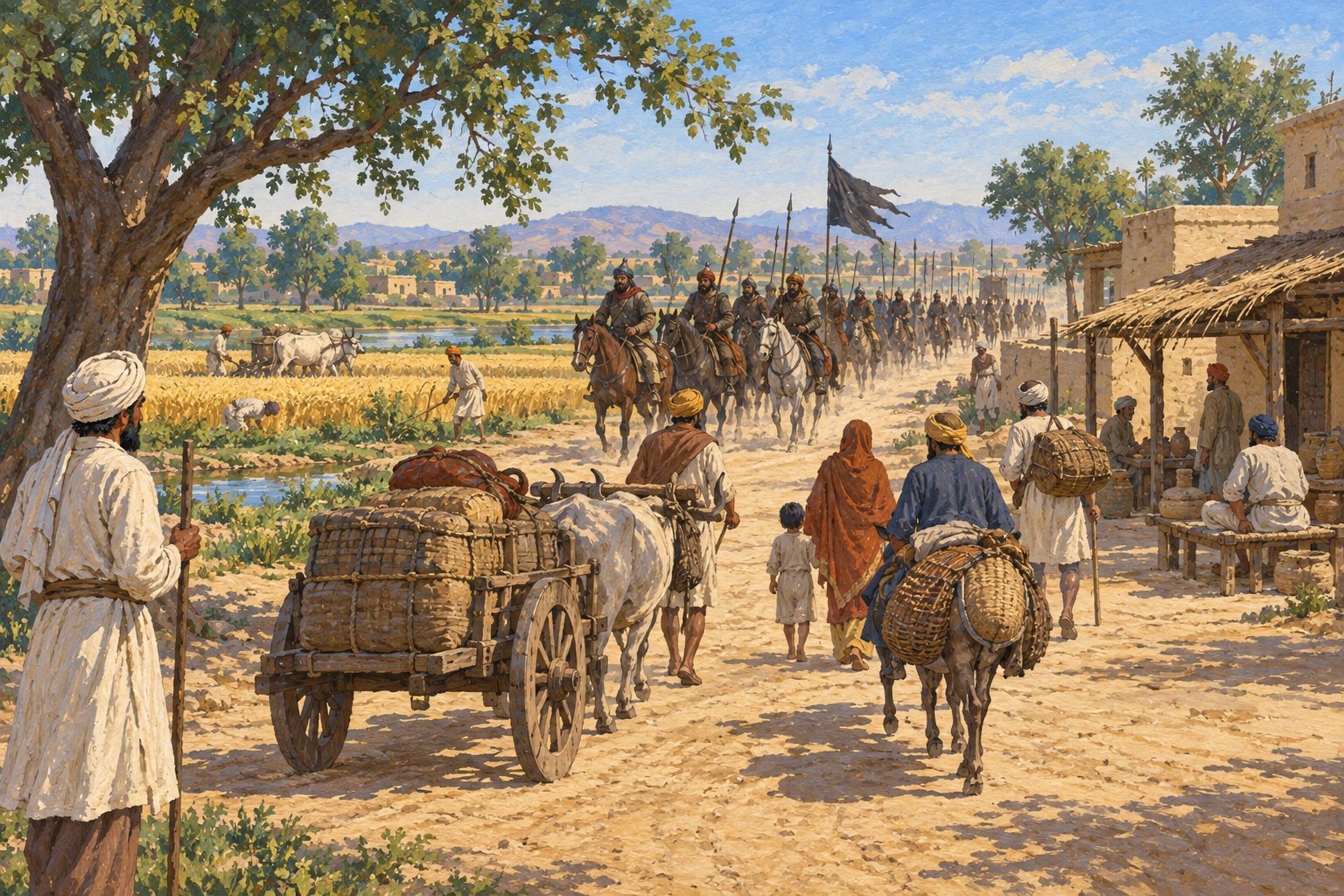
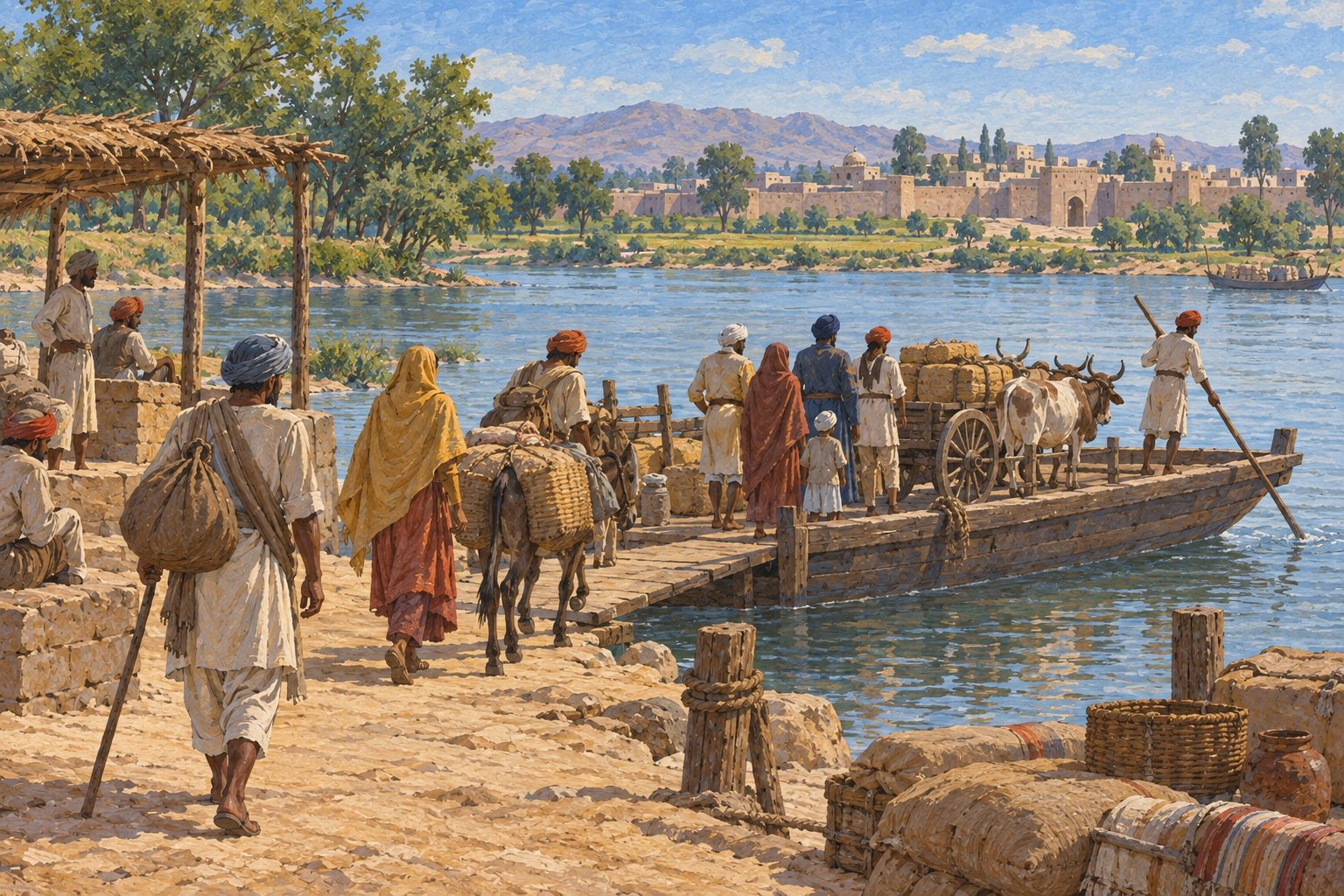
Punjab in 1469 is the corridor every invader from the northwest must cross — Lodi country about to become Mughal country — and the volume can open inside its own evidence, because the canon contains war reporting: the cluster of hymns known as the Babarvani, in which the first Guru describes Babur’s invasion as a thing seen, which makes this the rare tradition in the series whose founding text carries a datable claim about a datable campaign. The tradition’s dates for the founder — born 1469 at Talwandi, years as a steward at Sultanpur — are printed as the tradition’s dates.
A Country Full of Singers
Nanak did not sing into silence. North India was loud with vernacular devotion — Kabir the weaver, Namdev the calico-printer, Ravidas the leather-worker, Farid’s Sufi couplets, the Nath yogis’ austerities — and the proof of the milieu is the canon itself, which preserves the compositions of the very singers the tradition emerged from and argued with. Where this chapter touches the loaded question of Sikhism’s relation to Hinduism and Islam, it reports the tradition’s own position as the tradition’s position, and no more.
Explore the illustrations5 scenes · Punjab’s Crossing Roads
Punjab’s Crossing Roads. Punjab in 1469 is the corridor every invader from the northwest must cross — Lodi country about to become Mughal country — and the volume can open inside its own evidence, because the canon contains war reporting: the cluster of hymns known as the Babarvani, in which the first Guru describes Babur’s invasion as a thing seen, which makes this the rare tradition in the series whose founding text carries a datable claim about a datable campaign. The tradition’s dates for the founder — born 1469 at Talwandi, years as a steward at Sultanpur — are printed as the tradition’s dates.
How it was transmitted
An Alphabet From the Guru’s Mouth
The tradition holds the second Guru standardised Gurmukhi — the name means “from the Guru’s mouth” — and whatever the script’s exact pedigree (scholars trace it through the mercantile shorthands of Punjab, and the dating is contested), the decision it embodies is legible: a vernacular scripture in a script of its own is fenced, at a stroke, from the Sanskrit ecology of the pandits and the Persian ecology of the court. The boundary that later centuries will argue about in courtrooms is built into the letterforms first.
Filed Under Its Music
The Adi Granth is organised the way no other canon in this series is — not by subject, chronology or author, but by raag: thirty-one musical measures, and within each, fixed genre and author order, every stanza numbered in sequence. The filing system is a performance instruction — a hymn’s address in the book tells a trained musician how it is to be sung — and the running stanza-count lets any congregation audit its copy the way the Judaism volume’s scribes audited theirs by counting letters. In the standard text the page is an ang, a limb, 1,430 of them; the vocabulary is the argument, and kirtan — the singing the filing system exists to serve — is described in the present tense, because it never stopped.
Explore the illustrations6 scenes · Before the Printed Page
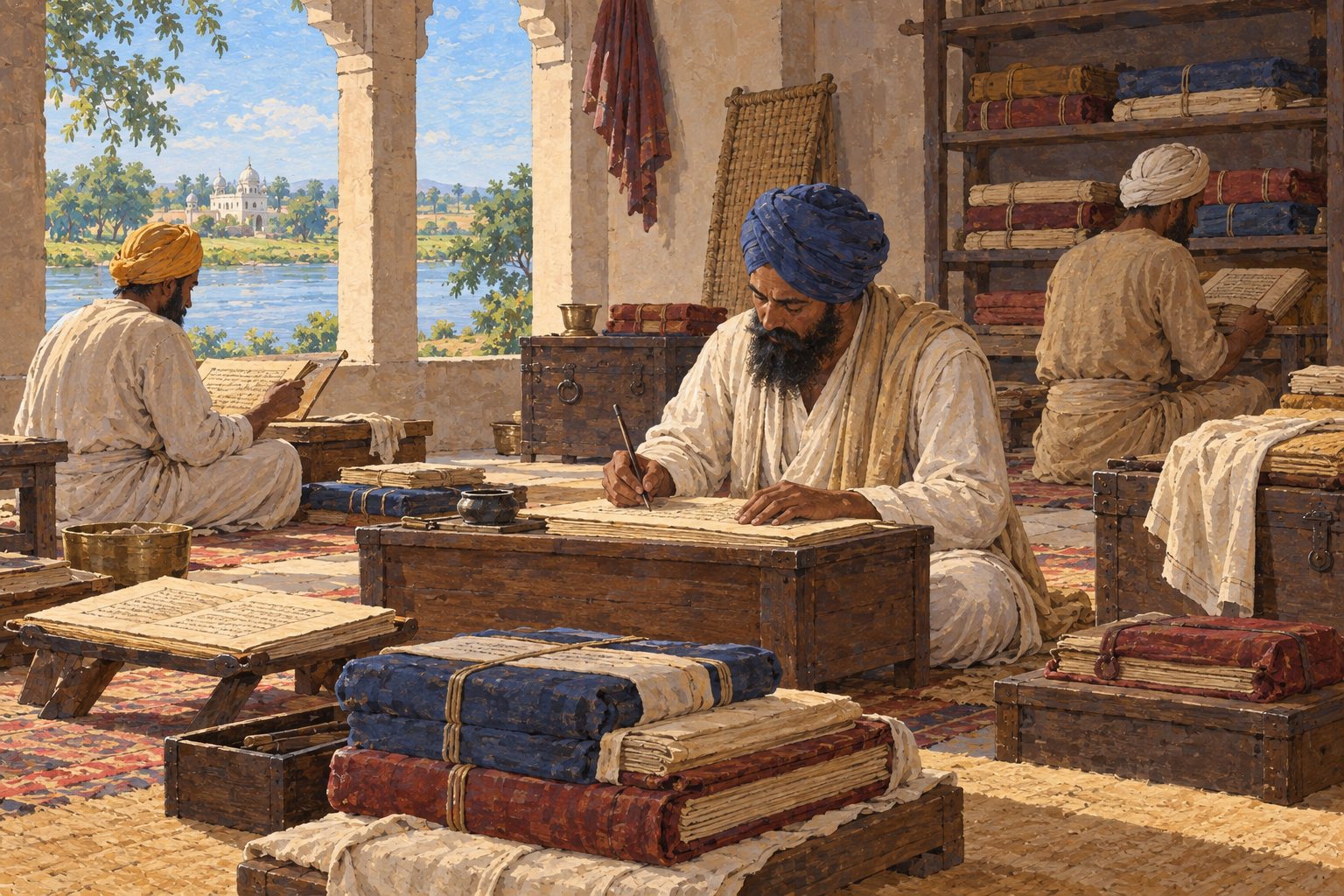
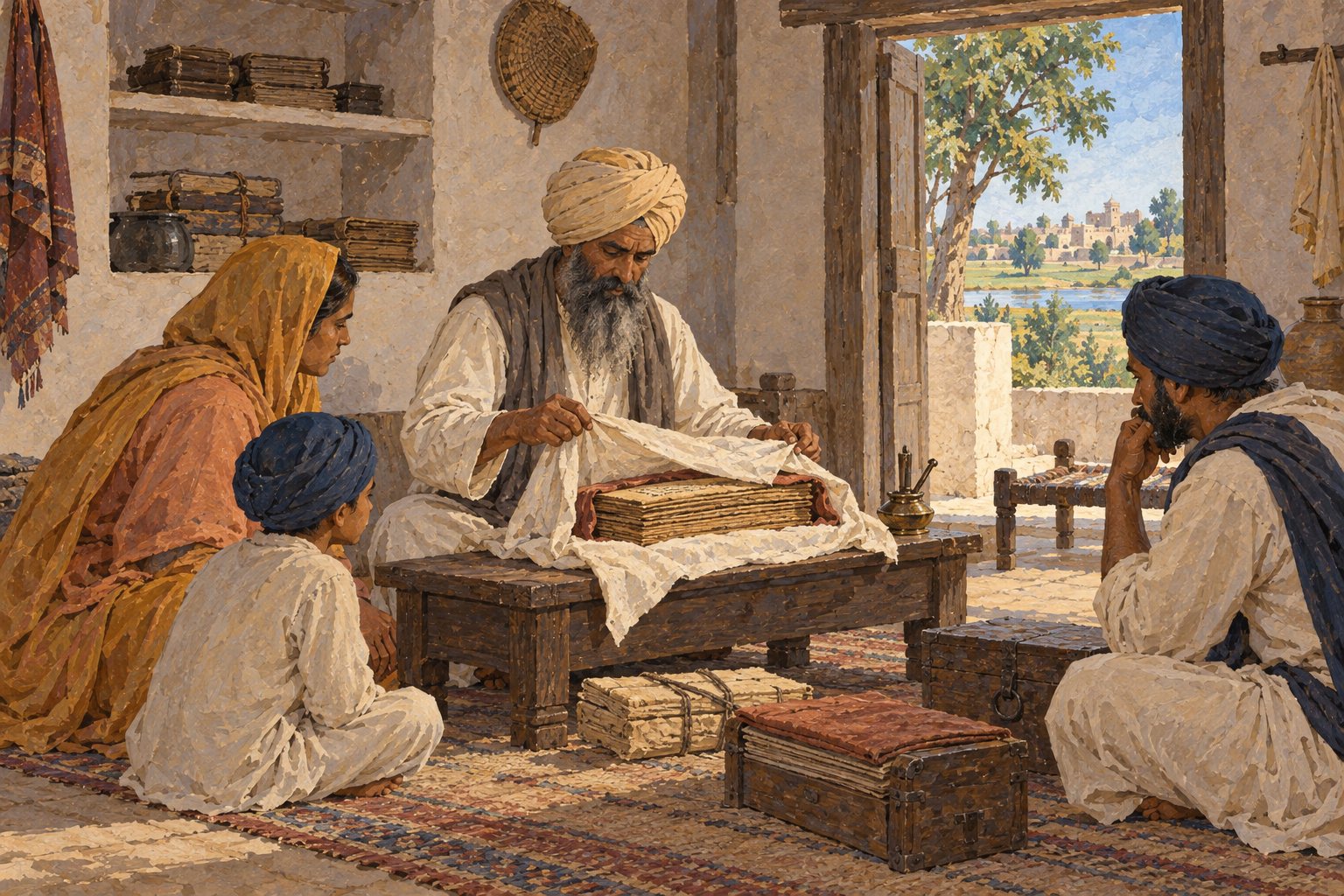
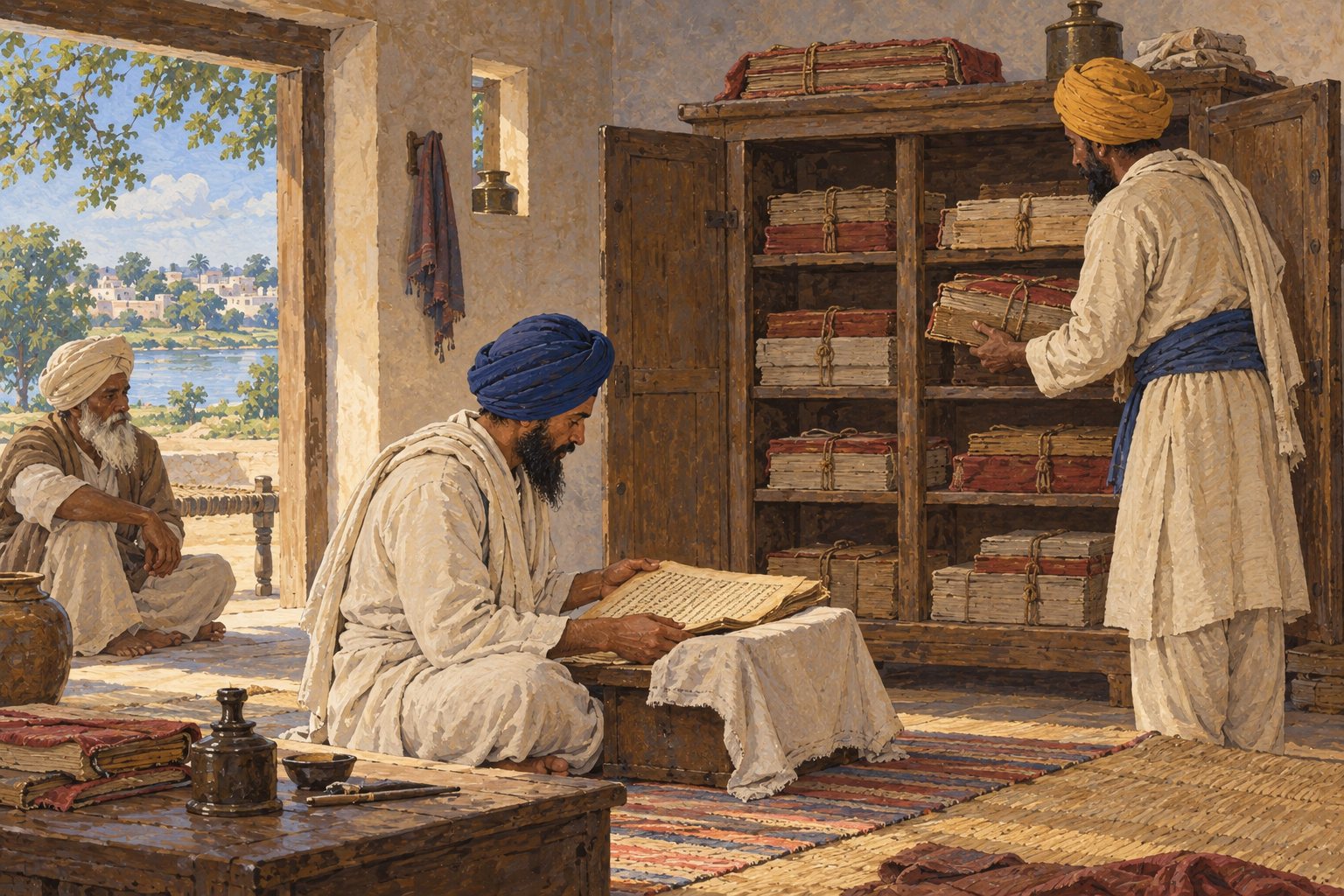
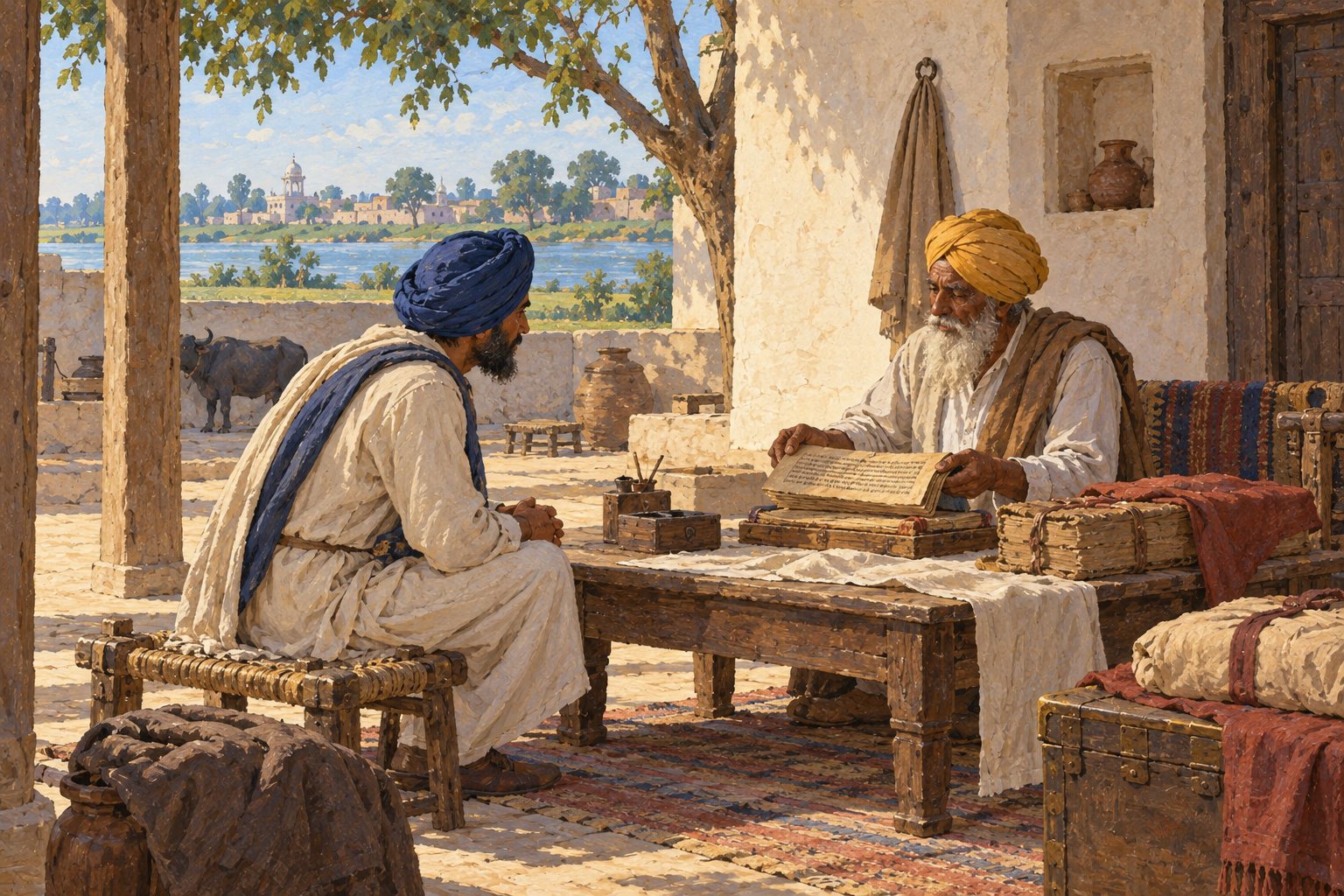
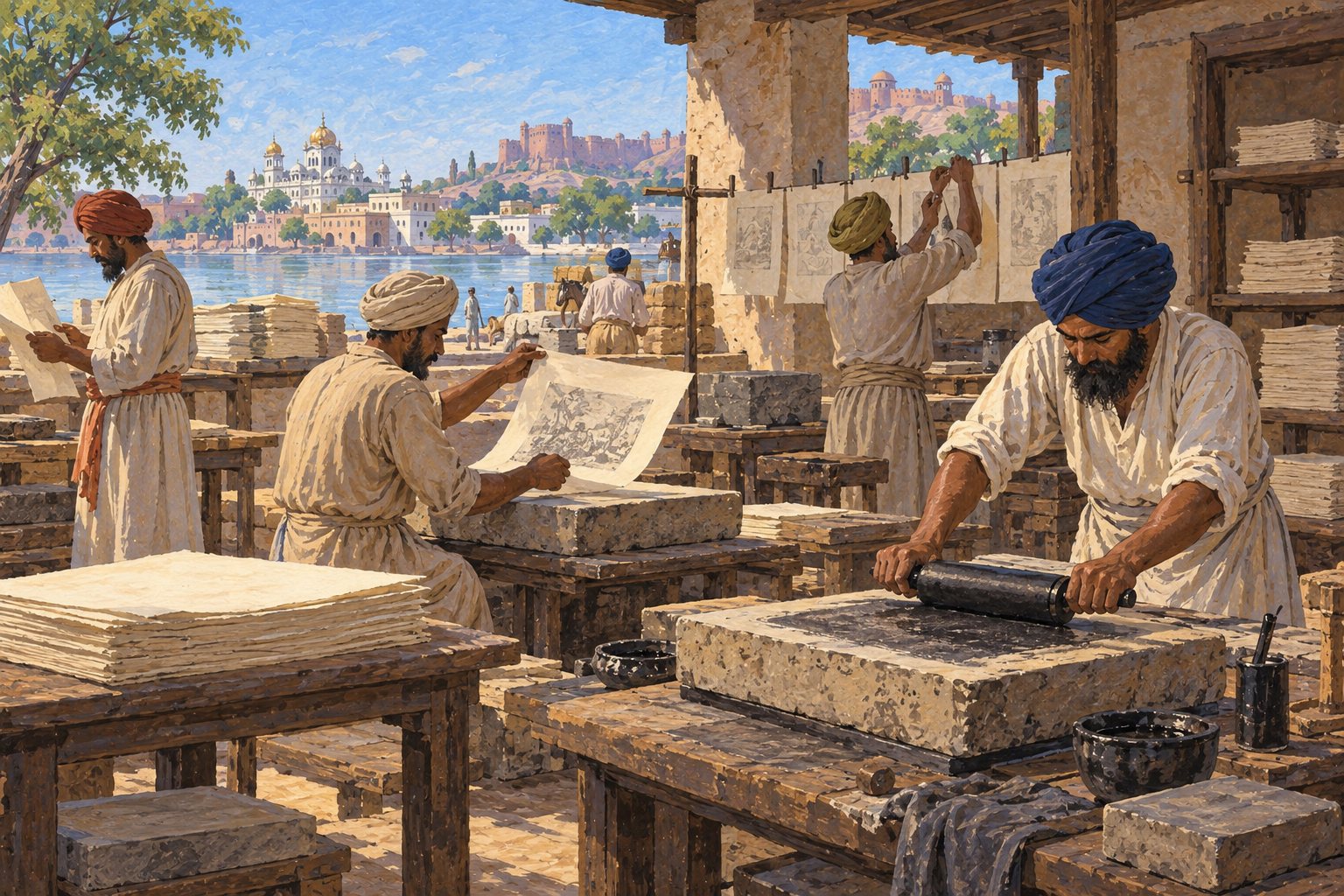
Before the Printed Page. Between compilation and print the text travelled as hand-copied birs, and the copying had a sociology the tradition itself records: authorised scribes, famous exemplars, variant lines — and this, which the chapter puts at the centre: the disinherited held the archives. The Kartarpur manuscript sat with Dhirmal’s descendants, the Goindval pothis with Amar Das’s; for three centuries the rival claimants to the office were the physical custodians of its title deeds, and access to the earliest witnesses still runs through the families the succession passed over. Print, arriving in the mid-nineteenth century as lithography, ended the copyist and standardised the page.
Texts and authority
A Canon Closed by Appointment
Canons in this series close by attrition, by council consensus, or by the slow victory of one list over another — the Early Christianity volume’s competing lists, the Buddhism volume’s group recitals — and almost never by an act anyone can date. This one closes by decision, three times over: compiled by a named editor with a named scribe in 1604, re-edited once around 1705, sealed in October 1708 by the same authority the text had been accumulating under for two centuries. The chapter says plainly how rare that is, and then prices it: a closing that specific concentrates every later argument onto two questions — whether the surviving manuscripts are what they claim to be, and what to do with the tenth Guru’s own poetry, which the closed book does not contain.
The First Edition, and the Manuscript That May Be It
The tradition holds that Arjan compiled the Granth at Amritsar with Bhai Gurdas as scribe, drawing on earlier pothis, and installed it in the Harmandir in 1604 with Bhai Buddha as its first attendant — a documented editorial project: named editor, named amanuensis, named sources, dated launch. And there is a physical claimant: the bir at Kartarpur, colophon-dated to 1604, held by the Sodhi family, shown rarely. Whether it is Bhai Gurdas’s manuscript is contested — doubts in print since 1944, defences since — and in the 1990s a scholar’s textual analysis of the text’s formation drew a summons before the Akal Takht, which is a fact about the canon’s living authority as much as about the manuscript. The chapter reports; it does not settle.
Chapter 12: The First Edition, and the Manuscript That May Be It
Institutions and resources
The Tenth, and the Kitchen It Pays For
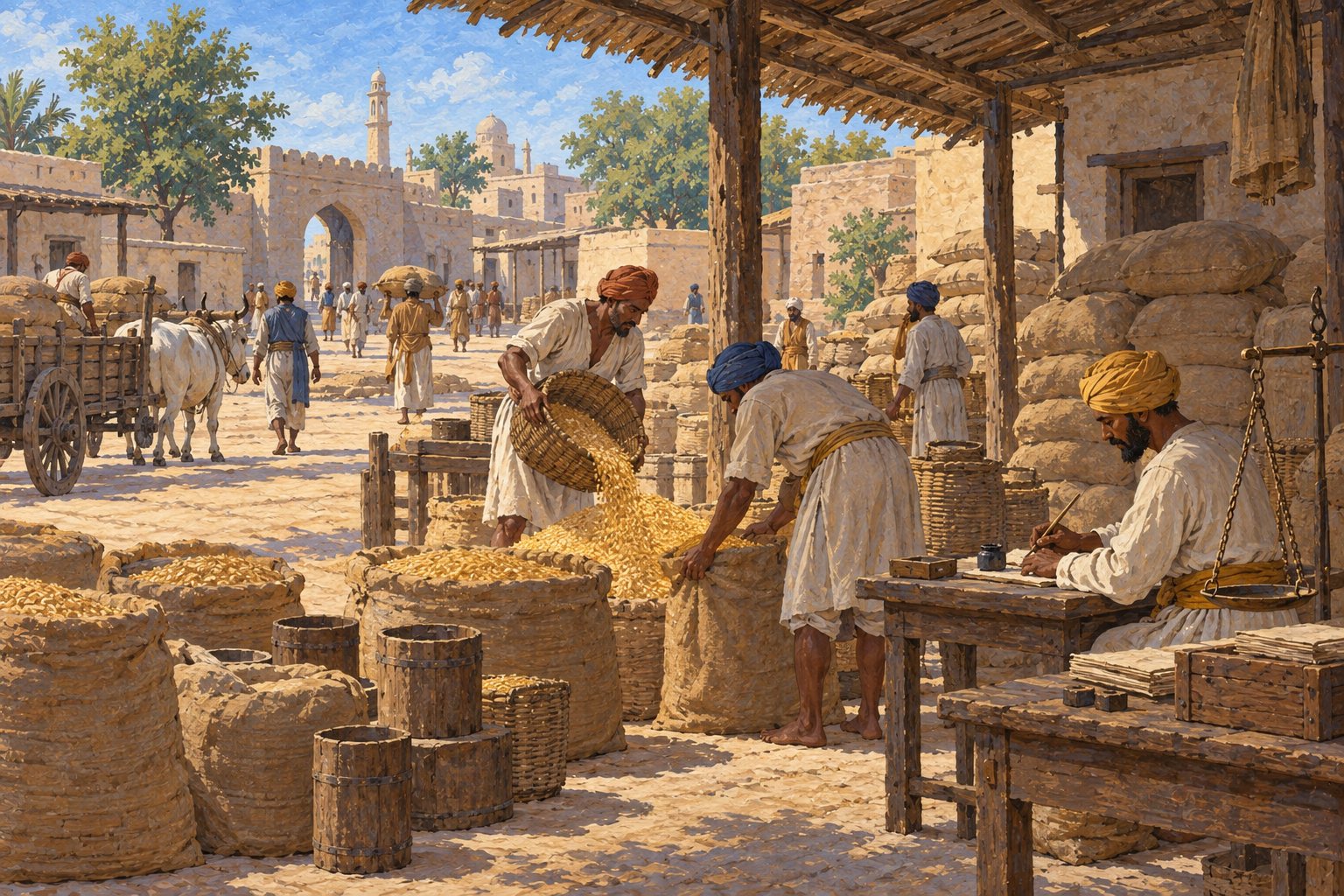
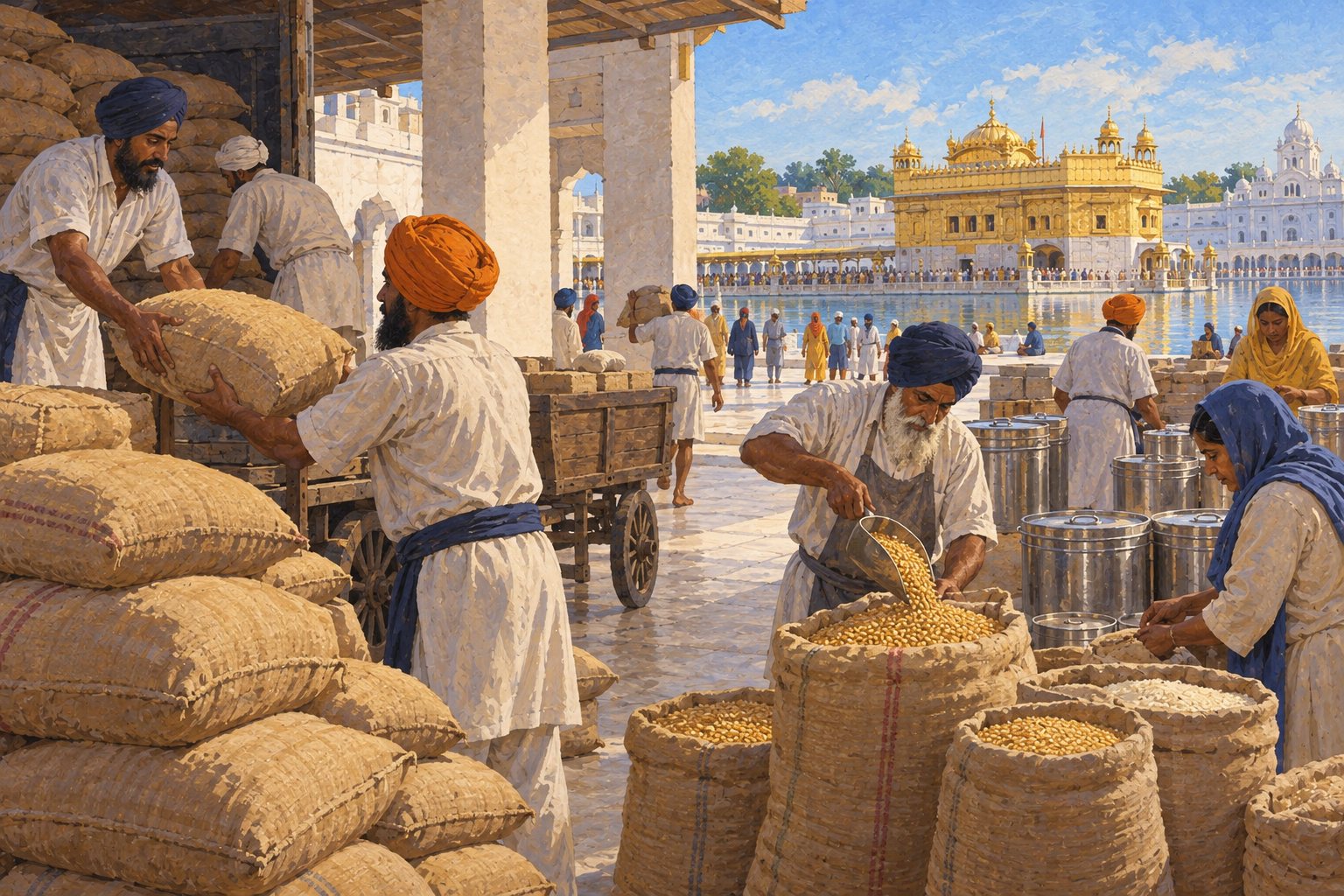
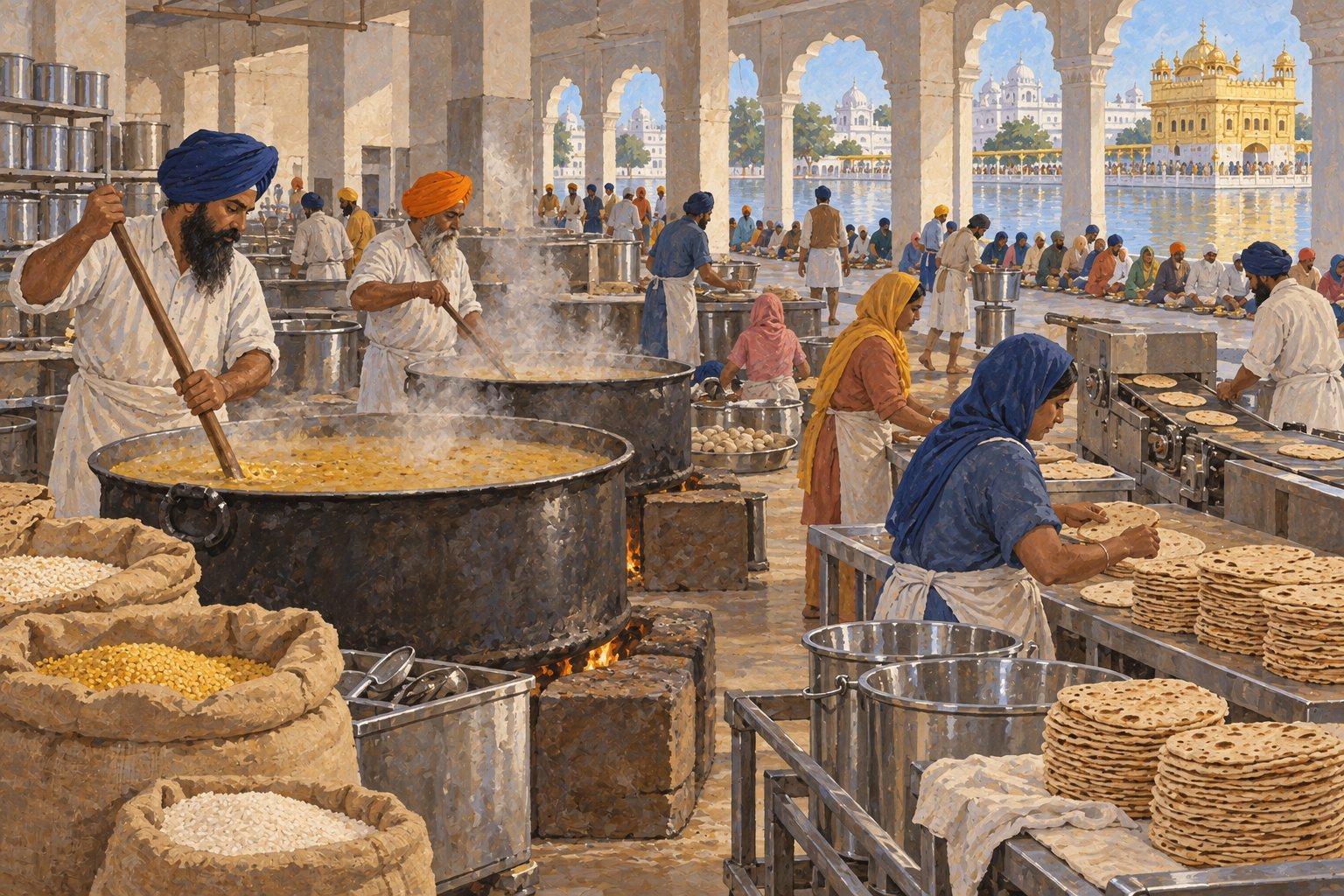
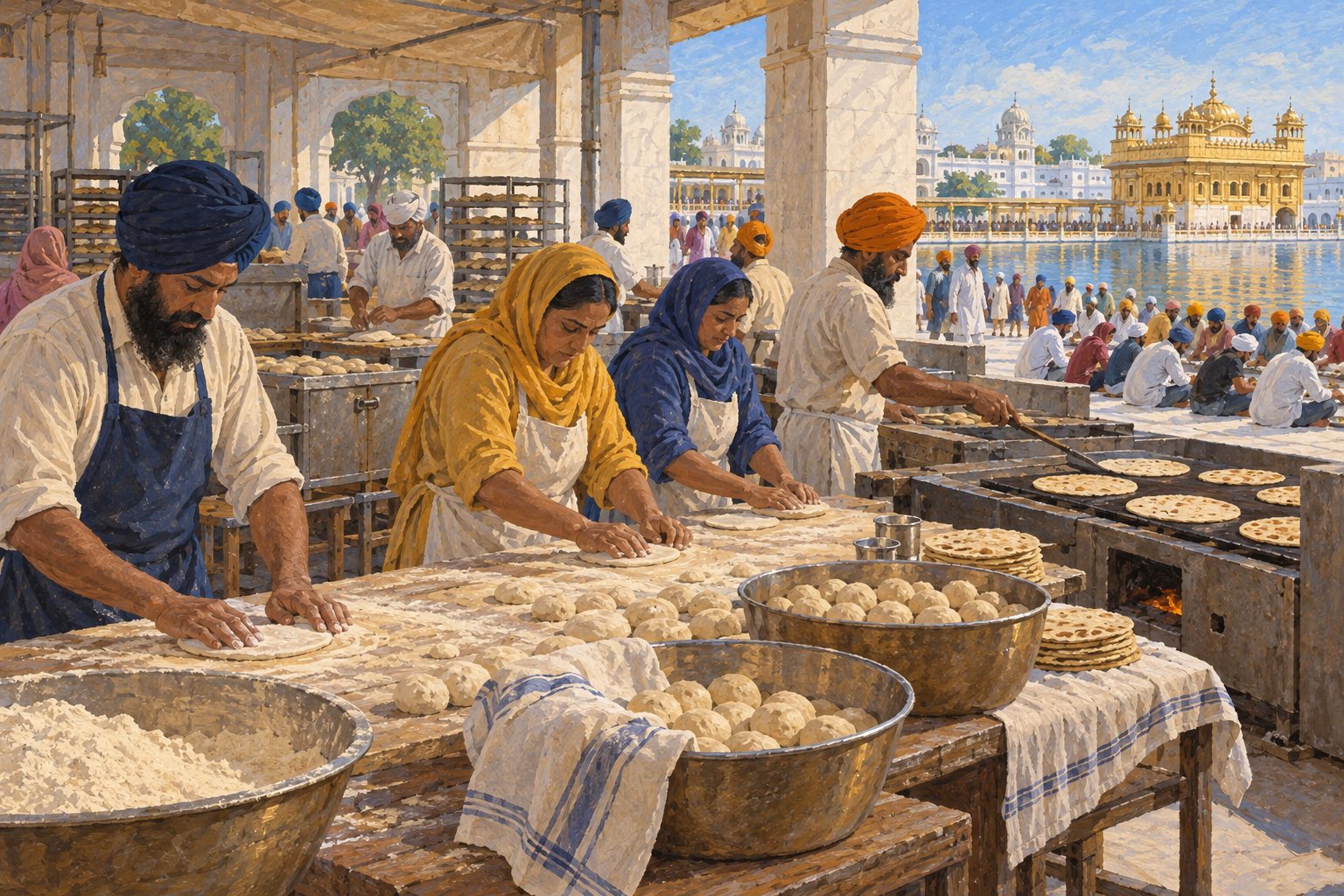
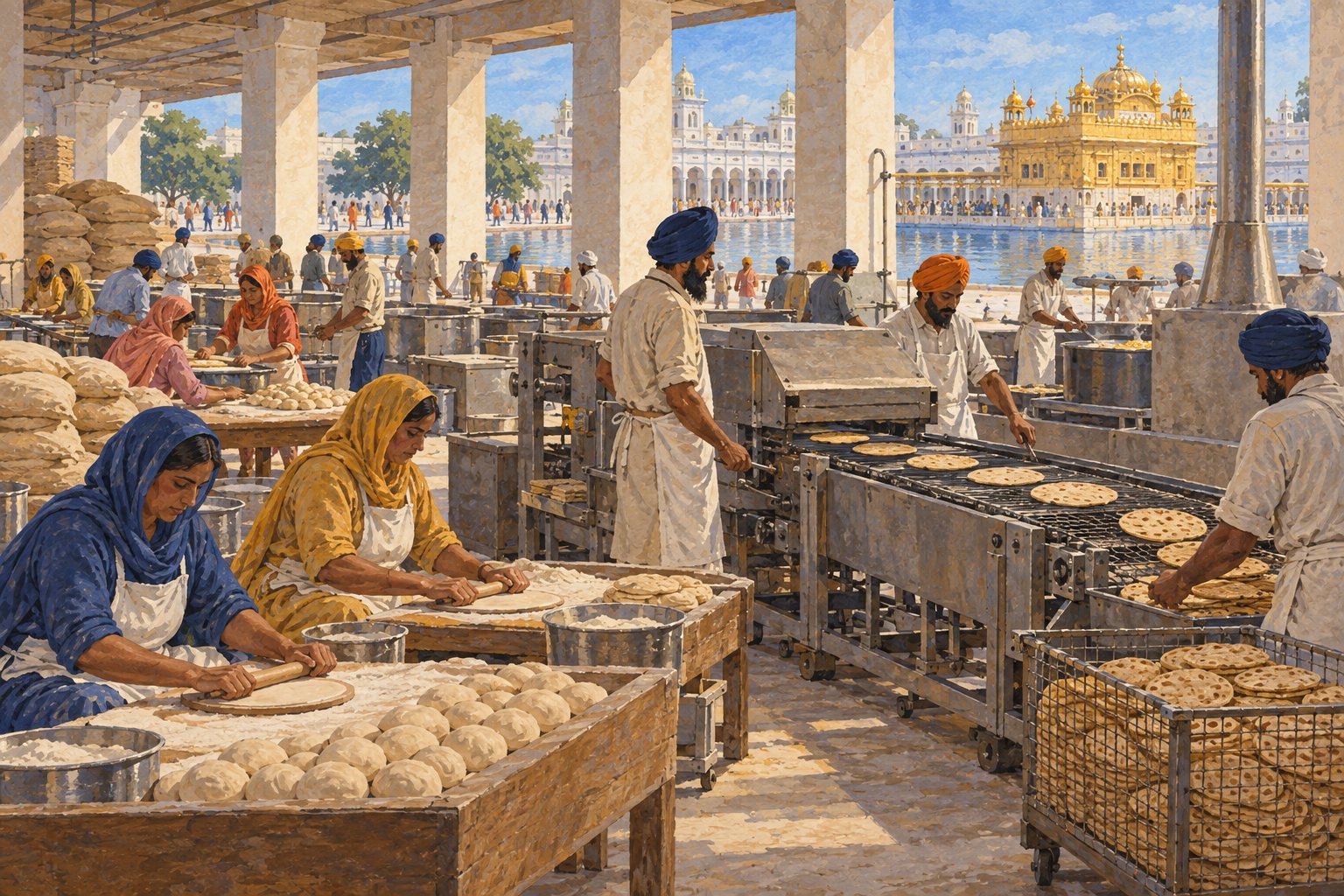
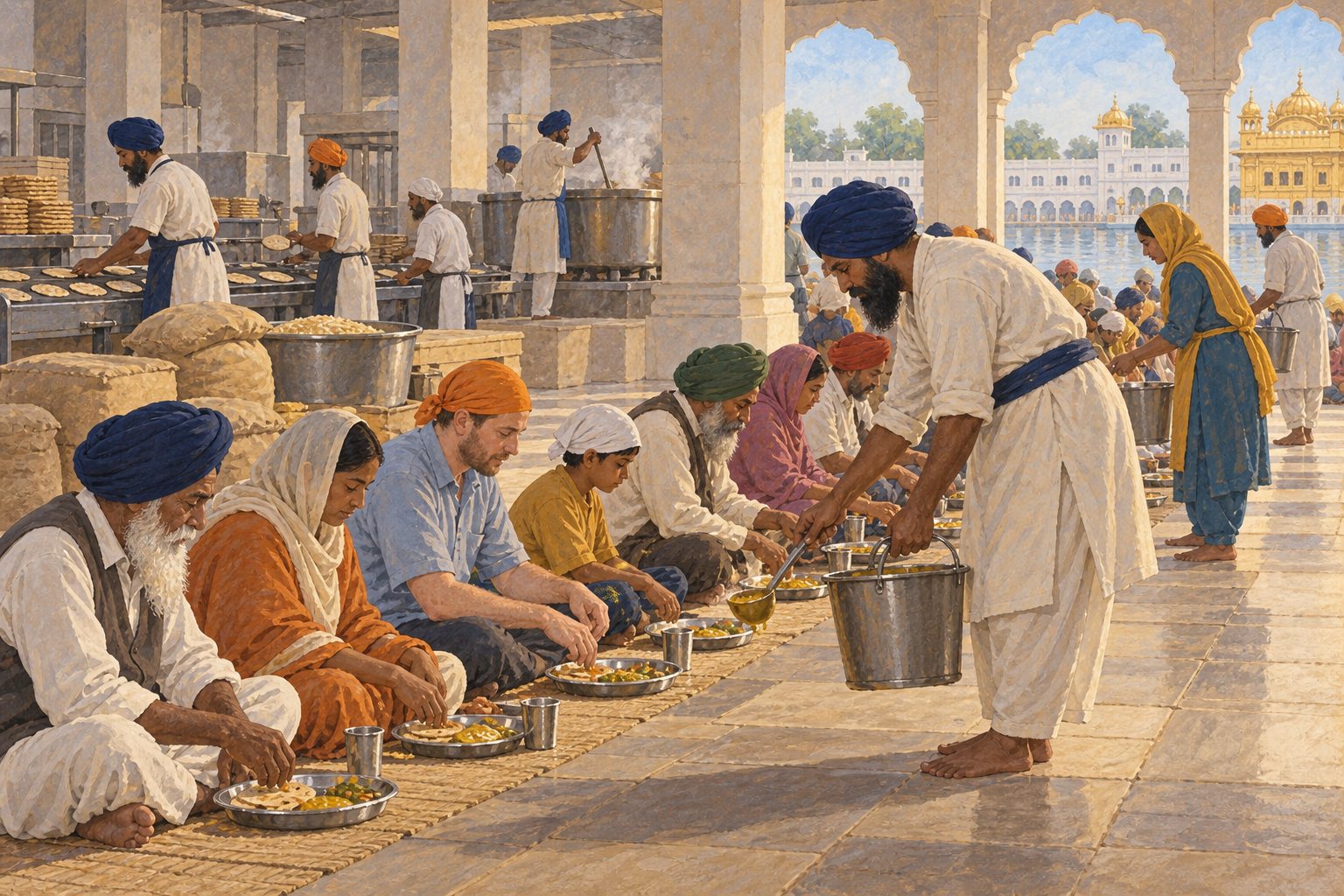
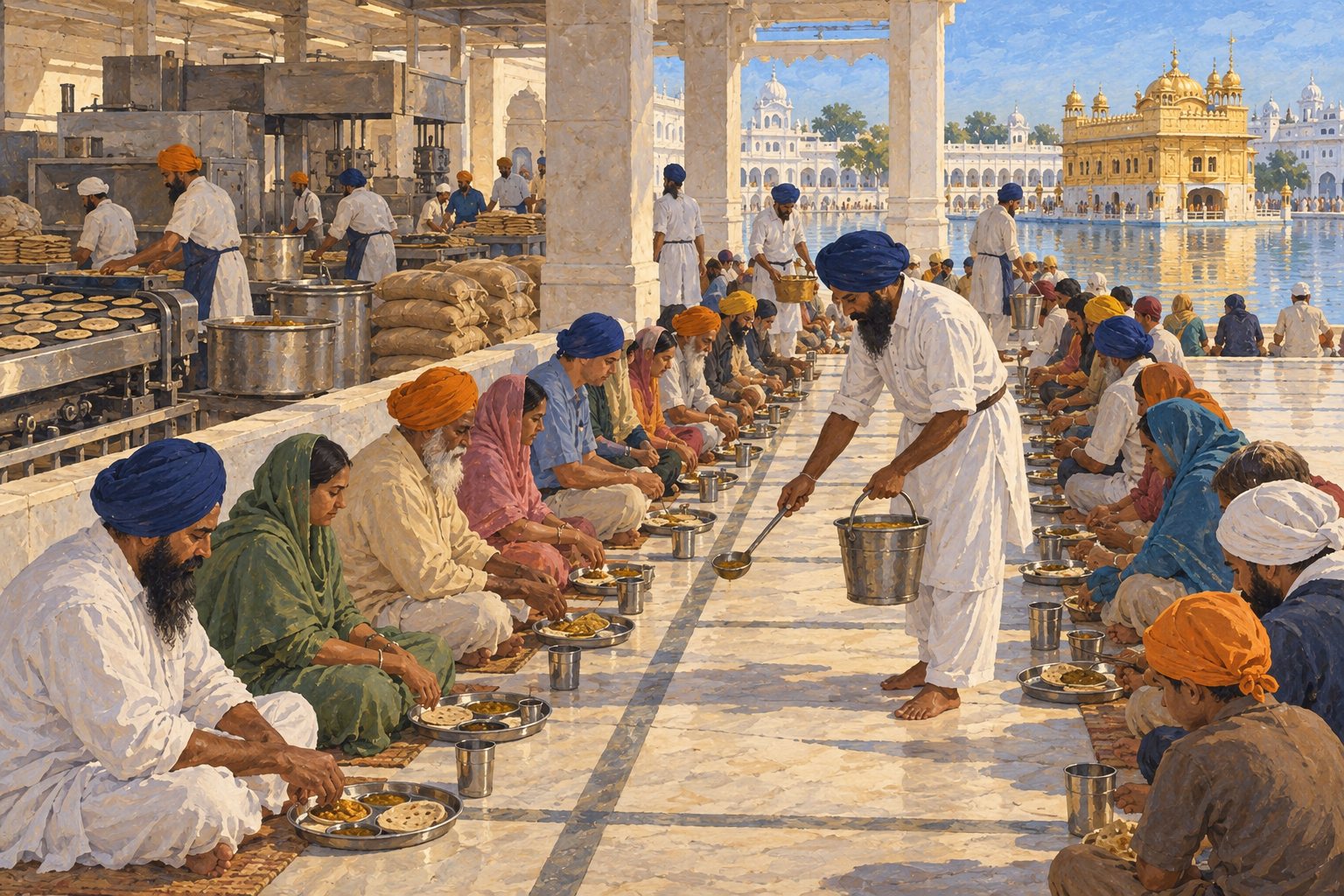
The tradition’s fiscal instrument is daswandh — a tenth of income, owed not to a priesthood but to the community’s common works — and its most visible output is the langar, the free kitchen where all eat in one row regardless of caste, which the tradition traces to Nanak and institutionalises under Amar Das, whose rule that visitors eat before audience made commensality the admission fee to the Guru’s presence (the tradition seats the emperor Akbar himself in the row, and the volume labels the story). The tenth and the kitchen are one system: the same rupee collected as obligation is spent as open hospitality, and both run today, present tense.
The Collection Agency
A tenth needs collectors, and the Gurus built a network: the masands, appointed deputies in distant congregations, who gathered daswandh and offerings and remitted them to the centre — a system described contemporaneously by the Dabistan’s Persian author, who sets out how the deputies forward what the faithful give. The machine worked: within two generations it financed a new town, a tank, a temple and a court. It also had the failure mode of every franchise — agents who keep the take — and what the tradition says happened next is the split movement’s opening chapter, handed there by name. No remittance totals survive, and the chapter says so.
Explore the illustrations7 scenes · The Shared Kitchen
The Shared Kitchen. The Golden Temple’s langar is one of the largest continuously operating free-food systems in the world, and the mechanics are the story: donated grain and ghee, volunteer labour in shifts — seva as a staffing model — mechanised roti lines beside hand lines, service around the clock, funded by the same tenth plus the cash and kind that arrive daily. The working figure in the research file is 100,000-plus meals a day, labelled MEASURED there; the chapter prints a dated, attributed figure re-verified at write time, or prints UNVERIFIED — never a bare round number. Set against anything in this series — the waqf kitchens, the monastic estates — one feature is unusual and stated: the diners are not the poor by definition; they are everyone, because the row is the doctrine.
Changes and divisions
The Purge of the Collection Agency
Around 1698 the tenth Guru abolished the masand system — the tradition says for corruption — ordering congregations by circular letter to sever ties with the deputies and bring the tenth directly. The orders survive as documents, and a near-contemporary poem narrates the expulsion. This is the series’ rarest kind of rupture: a split about the collection agency — not a doctrine, not a succession, an audit — and on the tradition’s own showing the centralisation of revenue and the reconstitution of the community the following year are one restructuring in two acts.
The Double-Edged Sword
At Baisakhi 1699 at Anandpur, the tradition holds, the Guru re-founded the community by initiation — the khande di pahul, the five volunteers, the shared bowl, new names, a code — and the historical layers are stated as they are used: the near-contemporary Gursobha attests a re-founding and the Khalsa’s creation; the theatrical details firm up in accounts composed generations later; the standardised five Ks are later still, and the rahitnamas’ dates are contested by name. What is beyond dispute is the result, because it is still operative: the Khalsa drew a line inside the community between initiated and uninitiated that no earlier division had drawn, and it remains the tradition’s defining internal boundary, present tense.
Limits of the evidence
These limits are stated in the book before its argument.
- The life of Nanak beyond his own compositions The hymns under his signature in the Adi Granth (conventionally counted at 974) are the primary evidence; the connected lives — the janamsakhis — are hagiography of later date, surviving in manuscripts from the seventeenth century onward, and the volume labels them so each time, including the travel narratives. Bhai Gurdas’s first var, the earliest connected verse account, is two generations removed and itself devotional.
- Whether the manuscript at Kartarpur is Bhai Gurdas’s 1604 original Access is restricted, the authenticity contest is nearly a century old and live, and the volume reports it rather than settles it.
- What was said and staged at Baisakhi 1699 The earliest account, Sainapati’s, is near-contemporary and spare; the canonical five-beloved narrative firms up in tellings composed generations later, and the rahitnamas’ own dates are contested.
Sources and reading
This article brings together the series’ existing overview and chapter summaries. The linked book page provides the full outline and bibliography.
- Babarvani hymns in the Adi Granth, in Max Arthur Macauliffe, The Sikh Religionhymns sixteenth century; rendering 1909. the first Guru’s war reporting on Babur’s invasion — testimony inside scripture, not a chronicle
- Baburnama, in Annette Beveridge’s rendering1922. Babur’s own campaigns and their gaps; Panipat 1526; the Punjab-road sack
- J. S. Grewal, The Sikhs of the Punjab1990. the Lodi-to-Mughal frame; the Guru’s court as political economy; 1920–25
- Bhagat compositions in the Adi Granth (Kabir, Farid and others), in Macauliffe1909 rendering. the singing milieu archived inside the canon
- Siddh Gosht, in the Adi Granthcompiled 1604. the first Guru’s staged debate with the Nath yogis
- Karine Schomer and W. H. McLeod (eds.), The Sants1987. North Indian vernacular devotion as a crowded field
- Kahn Singh Nabha, Ham Hindu Nahin1898. the tradition’s stated position on the boundary with Hinduism
- Dabistan-i-Mazahib, in David Shea and Anthony Troyer’s renderingmid-1640s Persian; English 1843. succession as one continuing spirit; an armed court the author says he knew; offerings, kitchen and masands
Illustrations are newly generated interpretations of themes in the book. They are not surviving artifacts, historical photographs or evidence for the events described.