Belief System
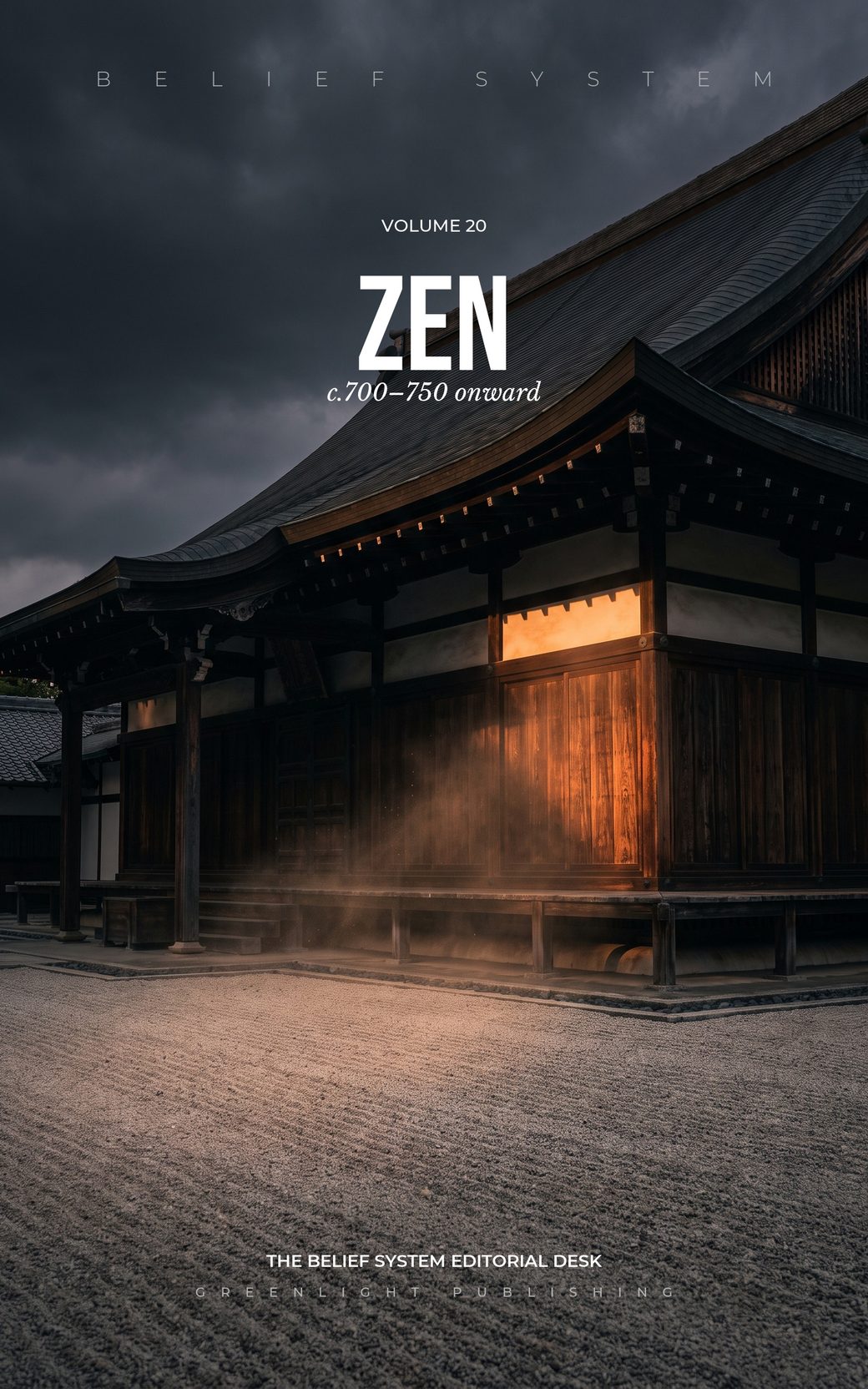
Jacket of Belief System volume 20, Zen
$12.99paperback

128 pages, 5.5 × 8.5 in. Three or more volumes in one order and every copy drops to $11.99.

copies

United States, 8 to 11 days. All destinations

Volume 20 Belief System c.700–750 onward

Zen

The machinethe lineage certificate

Attested from
c.700 CE

The earliest secure evidence, and the key this volume is filed under. All thirty-one

Narrates
c.700–750 onward

The period the book actually covers. It is rarely the same figure.

The argument in one sentence

A tradition that advertised itself as a transmission outside the scriptures ran, from its first datable trace, on paper about persons — lineage charts on tombstones, transmission certificates, monastic rulebooks, recorded dialogues — and this volume follows that credential machine from two Tang funeral inscriptions through a schism won by a publicity campaign, a literature the size of a canon, a monastery built by a licensed trading ship and a compulsory parish registry, to the twentieth century’s public arguments over what the certificates had actually certified — with the standing caution, repeated at every use, that the tradition’s account of its own first two centuries was composed by the winners, generations after the fact.

the world’s oldest dated printed book is a Chan-milieu text, the Diamond Sutra of 868, whose colophon — for universal free distribution — is the first known public-domain dedication.The commissioning line

What it is

The world’s oldest dated printed book is a Chan-milieu text, the Diamond Sutra of 868, whose colophon — for universal free distribution — is the first known public-domain dedication.

This is a history of a school that answered a five-thousand-scroll catalogue by pointing at a man rather than a title, and of how we know.

It opens on Zhisheng’s 730 count, not on a find. The lineage certificate is the machine. The motto of textlessness is itself a datable text. The school that recited it then produced one of the largest sectarian literatures in Buddhism.

Five movements: the world of the counted canon, the machine of the chart, the slogan and the shelf, the money, and the split asked from inside — is Zen Buddhism?

The book never adjudicates. Every translation is named in the text.

Belief System, Volume 20.

In full

Zen is a transmission argument with a paperwork trail. A robe, a bowl, a name in a chart. An examination in the wordless that still produces a written pass. Rules attributed backward to Baizhang. A temple ship licensed to fund a foundation. An abbacy that is a public office.

Bodhidharma grows a biography the way a code needs a founder. The four-line motto is a Song assembly of older parts, and is dated as one. Welter is named for that textual history. The sealed library at Dunhuang is the other date-stamp.

The Mahayana volume hands this one the merit economy by name. What this volume adds is the credential market, the parish register, and the moment the monopoly broke and the teaching went on sale.

The volume uses five fixed phrases, and no sixth. It reports no enlightenment as fact and denies none. It never tells you what anybody realised under a wall.

Belief System is a history of world religion, one tradition at a time. Thirty-one volumes, ordered by earliest secure attestation.

The contents

26 chapters in five movements. Every volume in the series has the same five, in the same order, and each chapter below is printed with the idea it carries.

Movement OneThe World

  1. 1Five Thousand Scrolls, CountedOpen on the object — the state catalogue of 730, which fixed the Chinese Buddhist canon at 1,076 works in 5,048 scrolls: the tradition that would advertise a transmission outside the scriptures appears in the one century when the scriptures had just been counted, translated and state-licensed, and the question it answered was the question that count created — which of five thousand scrolls carries the Buddha’s mind, and who in China has the standing to say. The inherited machinery — the translated canon, the merit economy of copying — is handed in by name from the Mahayana Buddhism volume.
  2. 2The Man Who GrewThe tradition holds that Bodhidharma came from the west in about 520, sat nine years facing a wall at Shaolin, told Emperor Wu his pious works earned no merit, and transmitted the mind-seal to Huike — and the volume reports that account whole, in the tradition’s voice; the record shows a different shape: a datable series of texts in which the biography visibly accretes, and this chapter prints the two accounts separately and dates each layer as it appears.
  3. 3An Address on East MountainThe earliest identifiable institutional base is not a patriarch but a farm with a timetable: Daoxin and then Hongren at Huangmei — the “East Mountain teaching,” the name outsiders used — where a wandering ascetic movement acquired land, a settled community the mid-seventh-century record puts in the hundreds, and therefore a succession problem; the succession problem is the seed of everything in Movement Two.
  4. 4Two Tombstones and a PalanquinThe school’s earliest secure attestation — the reason this volume sits where it does in the series — is funerary: an epitaph of 689 for the obscure monk Faru is the first surviving statement of the Bodhidharma succession, and when Empress Wu had the aged Shenxiu carried into the Luoyang palace in a palanquin in about 701 and honoured him as a teacher of the realm, the lineage chart got its imperial debut on a second stone — his epitaph by the court grandee Zhang Yue, listing six generations from Bodhidharma to Shenxiu. The chart is born as ancestry for the dead, published at the apex of the state.
  5. 5The Last School StandingWhen the state broke Buddhism’s economic spine in 845 — a story that belongs to the Mahayana Buddhism volume — Chan emerged within a few generations as the dominant monastic form in China, and by the Song most of the empire’s great public monasteries ran under Chan abbots; the tradition holds it survived because it was rural, self-sufficient and had no libraries to lose, and that explanation is contested — the chapter reports both the story and the caveats, notes the school’s export to Korea as Seon and Vietnam as Thien in passing, and hands Movement Two the question of what, institutionally, a “Chan” monastery even was.
  6. 6Two Boats to JapanZen reached Japan as a state proposition: Eisai came back from China in 1191 and wrote a tract whose title is its thesis — Promotion of Zen for the Protection of the Country — and got Kennin-ji founded under shogunal patronage in 1202; Dogen came back in 1227 and walked away from the capital to found what became Eihei-ji in 1244; émigré Chinese masters made Kamakura a Chan outpost — Kencho-ji, 1253, under Hojo patronage. Rinzai settles in with the warrior capitals; Soto spreads through the provinces; the two establishments of Movement Five are both founded here.

Movement TwoThe Machine

The transmission technology, named as a concrete object or institution — not an abstraction. Here: the lineage certificate — authority as a document about a person — and the monastic rule, a teaching carried as a timetable.

  1. 7A Robe, a Bowl, a Name in a ChartWhat Chan transmits is not a text but a person, and a person needs authentication: the regalia (the tradition holds Bodhidharma’s robe passed to Huineng and then deliberately stopped), the portrait, and above all the document — a certificate naming the successor, and behind it a chart of names running to the Buddha. The chapter treats the certificate as an artefact: who writes it, what it physically says, and what it is for — a credential, individually issued, that makes authority portable and disputable at once.
  2. 8Ancestors for a ChurchThe chart is a genealogy because the model is the Chinese family: patriarch is the ancestor word, the halls where the charts hang are ancestral halls, the death-day offerings are ancestor rites — Chan built a monastic clan inside a civilisation where descent was the strongest legitimacy there was. And the chart runs backward: the twenty-eight Indian patriarchs were stabilised in 801 after the school’s own earlier texts had disagreed on the count — the disagreement is the evidence of construction. Compare, by name, the isnad of the Sunni and Shia volume: also a chain of named humans, but one that authenticates a report and can be cross-checked; the Chan chain authenticates a successor and carries no checkable content — which is why the chart itself, not any text, is what the school would fight over.
  3. 9The Credential MarketA credential individually issued is individually disputable — and forgeable, refusable and salable, and all three are documented: the Tang state sold ordination papers to fund a war from the 750s and the Song made the sale routine revenue from the 1060s; Ikkyu tore up his own inka in the fifteenth century and his polemics accuse a rival of selling certificates of enlightenment to merchants; and in 1700 the Soto reformer Manzan Dohaku petitioned the shogunate over how transmission must pass — and got a government ruling on the mechanics of enlightenment’s paperwork. The state regulating the certificate is the strongest proof of what the certificate had become.
  4. 10Rules Attributed BackwardThe other machine is the rulebook. The tradition holds that Baizhang wrote the first Chan monastic code and coined “a day without work, a day without food”; the record shows the earliest surviving description of his system is an appendix of 1004, the earliest surviving code is the Chanyuan qinggui of 1103, and the received “Baizhang’s Pure Rules” was compiled by imperial order in the 1330s — the rule is backdated to a founder exactly as the lineage was, and the volume names the move once and uses it twice. What the codes actually regulate is administration: offices, fundraisers, tea protocol, abbot installations — a corporation’s operating manual for a teaching that cannot be written down.
  5. 11The Day Is the DoctrineWhat the certificate cannot carry, the timetable does: the sodo day — the wooden han struck before dawn, its memento-mori verse in the author’s rendering; sutra chanting in the school beyond scriptures, reported without comment; the zazen periods; the master’s interview; the formal meal; the work rotation — is a teaching transmitted as a schedule, learned the way an apprentice learns a craft. And the school’s meditation manuals prove the point in reverse: the earliest surviving zazen instruction is a Chinese template of 1103, and Dogen’s universal manual of 1227 adapts it nearly phrase for phrase — the wordless practice travelled as a copied text and a daily grind, and the grind runs today, in the present tense.

Movement ThreeThe Canon

What is in, what is out, who decided, when, and what the decision cost. The real subject is who had the authority to close it. The movement opens with an argument, never with an entry.

  1. 12The Slogan and the ShelfOpen with the argument, stated as the tradition’s own paradox and resolved without a gotcha: the four-line slogan — a separate transmission outside the scriptures, not depending on words and letters — is attributed to Bodhidharma but assembled in the Song, so the motto of textlessness is itself a datable text; and the school that recited it produced one of the largest sectarian literatures in Buddhism. The resolution is structural, and it is this movement’s thesis: a tradition whose authority is a person needs documents about persons — genealogy, biography, dialogue, certificate — so Chan wrote people instead of doctrine, in bulk, and its canon is exactly the shape its machine required.
  2. 13The Sutra That Edits ItselfThe case study: the Platform Sutra, the only Chinese composition its tradition titled a sutra — Huineng’s autobiography, the verse contest, the midnight transmission. The Dunhuang manuscript preserves a text roughly half the length of the received one, with the famous verses in different wording; the received text every modern reader knows descends from thirteenth-century Yuan editions. The chapter states the finding exactly and no further: the foundational document of a school built on person-to-person transmission was maintained, expanded and re-edited across five centuries — which is what documents in institutional custody do; it discredits nothing, and what it demonstrates is that the school’s continuity was institutional rather than textual. One more turn of the screw, from the Dunhuang text itself: possession of the sutra is there declared the proof of transmission — the anti-textual school’s charter text functioning as a certificate.
  3. 14Sayings, Recorded LaterThe golden age is a Song literary product: the shouts of Mazu, the blows of Linji and the dog of Zhaozhou reach us in compilations one to three centuries after the men they quote — the Zutang ji of 952, the great lamp history of 1004 with its 1,701 lives (the tradition’s “seventeen hundred koans” is a table of contents), the standard Linji lu edition of 1120 for a master who died in 866. What the genre was for: exhibiting that the certified person teaches with certified spontaneity — the dialogue is the credential performed on the page. Every date is printed beside every quotation, and whether any Tang master said any of it cannot be established.
  4. 15An Examination in the WordlessThe koan collections turn the person-literature into a curriculum: the Blue Cliff Record of the 1120s — whose printing blocks, the tradition holds, were burned by the compiler’s own heir to stop students memorising answers, a story reported from its late attestation; the Gateless Gate of 1228 with its forty-eight cases; Hakuin’s eighteenth-century systematisation into a graded syllabus with checking questions. And where there is an examination there is cheating: a Japanese exposé of 1916 printed the model answers, and Tokugawa Soto circulated its own secret paper answer-keys. A written, gradable, crib-able examination system for a teaching outside words and letters — the volume’s engine at maximum compression, reported deadpan.
  5. 16The Sealed LibraryAround the turn of the first millennium somebody walled up a storeroom at Dunhuang; in 1900 a caretaker broke into it, and in 1907 Aurel Stein carried off the world’s oldest dated printed book — the Diamond Sutra of 868, a Chan-favoured scripture whose colophon dedicates it to universal free distribution, and whose printing story belongs, by name, to the Mahayana Buddhism volume. What belongs here is the rest of the shelf: the Dunhuang Platform Sutra, the Northern school’s own treatises, Shenhui’s sermons, the rival robe-histories — the losers’ books, surviving only where the winners never got to weed them. Hu Shih found them in Paris and London in 1926, published them in 1930, and the school’s first two centuries had to be rewritten. Then the coda, reported and not adjudicated: in 1953 Hu Shih and D. T. Suzuki argued in print over whether Zen has a history at all — the historian against the tradition’s greatest modern advocate, who is also this volume’s permitted translator, which the reader deserves to be told.

Movement FourThe Money

Who paid, who was paid, and how we know. Numbers get their provenance in the same sentence.

  1. 17Nothing to Attain, Rice to GrowOpen on the self-image — the work-day maxim, the hoe, the school that farms — and then audit it: Chan monasteries held estates, mills and bound labourers like every other large Buddhist house, the tradition’s claim that self-sufficiency carried it through the 845 confiscations is contested, and the Song base was the conventional one — land, donors and the state. The movement’s method is set here: the school’s economic self-description is a source about its ideals, and the record of what it owned is a different source, and the volume prints both with their dates.
  2. 18The Abbacy Is a Public OfficeIn Song China the great monasteries were “public” houses: the abbacy could not pass master-to-disciple within the house but was filled from the certified lineages and ratified by officials — the state as clearing-house for the credential machine of Movement Two — and the empire ranked the top houses into the Five Mountains. Japan copied the ranking: the gozan network under the Kamakura and Muromachi shogunates was a Zen civil service — monk-diplomats, monk-secretaries, monk-accountants, with their own publishing houses (whose technology’s story stays, by name, with the Mahayana Buddhism volume). A school of sudden awakening administered by career examination and government appointment: reported without irony, because it is how the institution actually persisted.
  3. 19The Temple ShipOpen on the vessel: the Tenryuji-bune. To build Tenryu-ji — founded 1339 for the spirit of the emperor the new shogun had just outlived, at the urging of the Zen master Muso Soseki — the bakufu licensed trading voyages to China in 1342, profits to the building fund: an ecclesiastical venture in the China trade, and it normalised. Inside the Ming tally system from 1404, Zen temples came to near-monopolise Japan’s legitimate China trade — the monks held the classical Chinese and the diplomatic forms, so the school that transmitted mind outside scriptures drafted the state’s trade correspondence for a living. The financial terms of the 1342 licence did not verify and no figure ships without a source.
  4. 20The Parish RegisterOpen on a page of a register: under the Tokugawa ban on the foreign religion, every household in Japan came to need a temple’s certificate — terauke — renewed in an annual register of religious scrutiny; the temple became the state’s registrar of persons, its paper required for travel, marriage and service, and the funeral became, in practice, a temple monopoly. Zen’s share was enormous — Soto grew into one of the largest temple networks in the country (its modern self-count runs above ten thousand temples, printed as a self-report) — and the price is argued in the named scholarship: guaranteed customers, obligatory rites, and, arguably, a long institutional softening that the tradition’s own reformers said out loud. The unbundling of 1868 belongs, by name, to the Shinto volume; its bill lands in the next chapter.
  5. 21Losing the Monopoly, Selling the TeachingThe Meiji state dissolved the arrangement: the 1868 separation orders (the Shinto volume’s story, named), the wave of temple-smashing, the land measures of the 1870s that stripped endowments, and the end of compulsory registration took away the guaranteed base in a decade. What the school did next is the money story nobody frames as one: it exported. Shaku Soen spoke at Chicago in 1893; his student D. T. Suzuki spent a decade employed by Paul Carus’s Open Court press in Illinois; Sermons of a Buddhist Abbot (1906) and the Essays (1927) re-priced Zen for the West as pure experience — precisely when its domestic parish economy had collapsed. The Western romance of Zen has named employers, dates and a balance sheet, and the volume reports it as institutional history, without mockery — the answer to the romance is the paperwork, not a sneer.

Movement FiveThe Split

What divided it, what it became, what it handed on. Names the next volume by NAME, never by number.

  1. 22The Assembly at HuataiIn 732, at a convocation at Huatai, a provincial monk named Shenhui publicly indicted the dominant metropolitan line — the heirs of Shenxiu — as a collateral branch teaching a gradualism the true school rejected, and named Huineng, robe and all, the real sixth patriarch. The campaign worked, and part of how it worked was fiscal: after the rebellion of 755 emptied the treasury, the government employed Shenhui’s preaching platforms to sell ordination certificates for the war effort — the propagandist as revenue agent, rewarded after death with a place in the succession. The essential point, well supported in the named modern scholarship: the Northern–Southern split was substantially manufactured by its winner’s campaign, and “the Northern school” as described is largely its opponents’ construction — a schism written into history by the side that won the publicity.
  2. 23Sudden, Gradual, and the Words for LosingWhat did the argument actually claim? The chapter reports both positions from the surviving texts — and then reports the philology: the Northern school’s own recovered treatises do not teach the caricatured gradualism, the labels “Northern” and “Southern” were themselves the winner’s weapons, and the deepest irony is institutional: Shenhui’s publicity won and his lineage died anyway — every surviving house of Chan routes through Huineng by other disciples, so the propaganda victor was not the institutional victor. The argument echoed abroad: at the Samye debate in Tibet a Chan master argued the sudden case and, on the Tibetan tradition’s account, lost — a story that belongs, by name, to the Tibetan Buddhism volume.
  3. 24Five Houses, Two SurvivorsThe tradition sorts classical Chan into Five Houses — a retrospective Song taxonomy, labelled as one — of which two lasted: Linji and Caodong, which Japan received as Rinzai and Soto. The division’s working content was set in the 1130s–40s in a documented polemic: Dahui of the Linji line attacked “silent illumination” meditation while promoting concentrated koan inspection, and Hongzhi of the Caodong line wrote the silent-illumination case — rivals in doctrine and, the record suggests, civil in person; the named scholarship reads the quarrel partly as product differentiation in a competitive abbacy market. In Japan the pair hardened into establishments: Hakuin’s eighteenth-century reform fixed the modern Rinzai koan path; Soto, spreading on the funeral economy of the money movement, became the larger network; both counts today are self-reports and are printed as such.
  4. 25The Certificates at WarBetween Meiji and 1945 the Zen establishments backed the imperial state in print: named teachers published war exhortations with dates, sect bodies raised war funds, and “imperial-way Zen” was a phrase its proponents used themselves. The chapter is a documents chapter, and its three layers are reported in order: the wartime texts themselves, quoted only if the Japanese originals are fetched and otherwise described with their dates; the inside critique — the Rinzai priest-scholar Ichikawa Hakugen’s war-responsibility work from 1970; and the outside reckoning — Brian Victoria’s Zen at War (1997) and the institutional statements that followed and preceded it, including Soto’s 1992 statement of repentance and Myoshin-ji’s statements of 2001. The contested case of D. T. Suzuki — Victoria’s charges, Sato Kemmyo Taira’s documented defence — is reported with neither exoneration nor prosecution, and with the disclosure, again, that Suzuki is this volume’s permitted translator. What the record shows is what they printed and when; what cannot be established is anyone’s interior conviction, on any side.
  5. 26Is Zen Buddhism? — Asked from InsideThe last split is internal and scholarly, and it began with a scandal: in 1979 the Soto secretary-general told a world religious conference that discrimination against the burakumin did not exist in Japan, and the sect’s reckoning that followed opened every drawer. Out of Soto’s own university came Critical Buddhism: from 1989 the Komazawa scholars Hakamaya Noriaki and Matsumoto Shiro argued in print that original-enlightenment thought and lineage veneration — the school’s engine — are not Buddhism at all. The volume reports the argument and its rebuttals and adjudicates nothing, because a truth claim about Zen’s Buddhist-ness is still a truth claim. Then the hand-off: the next tradition by ignition is the Tibetan Buddhism volume, which this school already met at Samye; and the lineage certificate’s modern stress test — a Western meditation market built on paperbacks and apps that checks no credentials, running on texts this volume’s own machine would not authenticate — belongs, by name, to the volume on the Unaffiliated. The book ends on the machine, present tense: the certificate is still issued, one name at a time.

What this volume cannot establish

Printed in the book before the argument is, and printed here for the same reason. A history of a tradition that will not say where its evidence runs out is not a history.

  • Bodhidharma, beyond a sixth-century notice. A monk of that name from the western regions appears in a Luoyang gazetteer of about 547 admiring a pagoda; everything else — Shaolin, the nine years, the interview with Emperor Wu, the robe — enters the record in datable later layers. The layers can be dated; the man behind them cannot.
  • The historical Huineng. The earliest notices are eighth-century and thin; the autobiography every reader knows is the charter document of the party that won by claiming him. What he taught, or whether he could read, cannot be established.
  • Any link in the Indian half of the lineage chart. The tradition’s own early texts disagree about the number and names of the patriarchs between the Buddha and Bodhidharma, and the founding scene of the whole transmission — the flower held up, the smile — is first attested in Song works of the eleventh century, some fifteen hundred years after its setting.
  • Whether any recorded saying of a Tang master was said by him. The dialogues reach us in compilations one to three centuries later than the men they quote. The lamp histories are retrospective constructions, and every chapter that uses them says so.
  • What the “Northern school” was to itself. Its opponents’ caricature is the version history kept; its own recovered texts contradict the caricature but are partisan in their own direction.
  • What an inka certificate certifies, in any sense a historian can check. The document attests that a named person recognised another named person on a date. The awakening it names is not a historian’s object, and this volume does not pretend to reach it.
  • Any aggregate number. Tang and Song clergy counts and estate totals are state or polemical figures; the financial terms of the 1342 temple ship did not verify and are UNVERIFIED; modern temple and membership counts are denominational self-reports and are printed only as such.
  • Anyone’s interior state. — at awakening, and at war.

Buddhism, four ignitions

This tradition ignites more than once in the chronology. The other slots are Buddhism, Mahayana Buddhism, Tibetan Buddhism. See the thread.

Sources

69 works, dated, and specific enough that a reader can go and look at the thing. Nothing is on this list that the desk did not consult.

The bibliography, as the volume prints it
# Document or work Date Evidence for
1Zhisheng, Kaiyuan catalogue730state list of the Chinese Buddhist canon: standard totals 1,076 works in 5,048 scrolls
2Samuel Beal, Life of Hiuen-Tsiang1888Xuanzang’s return inventory of 657 works
3Yang Xuanzhi, Record of the Monasteries of Luoyangc. 547a monk Bodhidharma from the western regions at the Yongning pagoda — no wall, no robe, no lineage
4Two Entrances and Four Practices, with Tanlin’s prefaceearly text attributed to Bodhidharmathe one treatise attached to the name; quoted from the Chinese, not from Suzuki’s post-1929 English
5D. T. Suzuki, Essays in Zen Buddhism, First Series1927pre-1929 English discussion of Bodhidharma and the finished biography; also the export product of 1927
6Daoxuan, Continued Biographies of Eminent Monks645a wall-contemplating teacher and Huike; Daoxin’s East Mountain community in the hundreds
7Anthology of the Patriarchal Hall (Zutang ji)952Song assembly of the full Bodhidharma legend; lost in China, preserved in the 1245 Haeinsa supplement
8Jingde Record of the Transmission of the Lamp10041,701 lives as the collection’s standard count; finished saint-biography
9John McRae, Seeing through Zen2003the Bodhidharma layers as a sequence of texts; the Faru epitaph at the front of the file
10Chuan fabao ji710scapital retrospective of the East Mountain line; palace reception of Shenxiu
11Lengqie shizi ji710sLankavatara-line history; the same palace scene as the school’s own telling
12Faru epitaph, Mount Song689earliest surviving statement of a Bodhidharma succession
13Zhang Yue, epitaph for Shenxiuafter 706six generations from Bodhidharma to Shenxiu, carved at court
14Zanning, Song Biographies of Eminent Monks988state-commissioned establishment retrospect after 845
15T. Griffith Foulk, studies of Song monastic institutions1990sChan as a public-monastery designation; the Baizhang myth; portraiture with Robert Sharf
16Morten Schlütter, How Zen Became Zen2008Song Chan abbacy law; ordination-certificate sales as routine revenue; the silent-illumination quarrel
17Eisai, Kozen gokoku ron1198Zen offered as protection of the country
18Dogen, Fukanzazengi1227; Tenpuku copy 1233sitting manual; the autograph claim for 1233 is flagged, not treated as established
19Dogen, Hokyo-ki1220sChina journal of questions to Tiantong Rujing — a student’s file, not a Song abbacy roll
20Martin Collcutt, Five Mountains1981Kennin-ji, Kencho-ji, gozan ranks, and Zen temples in the Ming tally trade
21William Bodiford, Soto Zen in Medieval Japan1993Soto’s provincial spread from the mountain house
22Wong Mou-lam, Sutra of Wei LangShanghai, 1930robe-at-midnight narrative and the Yuan verse contest — a translation of the received Yuan text
23Lidai fabao jic. 774rival text that walks the robe to Sichuan; Wendi Adamek’s study named
24Dogen, Shobogenzo chapter on the shisho1220seyewitness inventory of Song transmission certificates
25Baolin zhuan801twenty-eight Indian patriarchs fixed after the school’s own earlier lists disagreed
26John Jorgensen, Inventing Hui-neng2005the sixth patriarch as the ancestor a southern church needed
27Albert Welter on the slogan, the flower-sermon and the Linji lunamedfour-line motto assembled in the Song; flower-sermon first attested in the eleventh century
28Ikkyu, Jikaishu, via James Sanford15th c.; Sanford namedtearing his own inka; accusation that a rival sold certificates to merchants
29Bodiford, Manzan reform study, Monumenta Nipponica1991petition 1700; bakufu ruling on transmission paperwork by 1703
30Chanmen guishi, appendix to the 1004 lamp collection1004earliest account of “Baizhang’s” system; first surviving attestation of the work-day maxim
31Chanyuan qinggui1103earliest surviving Chan monastic code; Yifa’s study named
32Chixiu Baizhang qinggui1330simperially commissioned “Baizhang’s Pure Rules,” compiler Dongyang Dehui
33Zuochan yi, inside the 1103 code1103earliest surviving zazen instruction
34Carl Bielefeldt, Dogen’s Manuals of Zen Meditation1988documented textual dependence of the Fukanzazengi on the 1103 sitting text
35Holmes Welch, The Practice of Chinese Buddhism1967hour-by-hour meditation-hall timetable from living informants of the pre-1949 halls
36D. T. Suzuki, The Training of the Zen Buddhist Monk1934named as description and never quoted — post-1929
37Dunhuang Platform Sutra, Stein 5475copy 9th c.; text c. 780recension roughly half the length of the received Yuan book
38Hu Shih, Shenhui edition and 1930s Platform studies1930Dunhuang Shenhui corpus; the two-recension file
39Philip Yampolsky, Platform Sutra critical edition1967named as scholarship, never quoted
40Max Müller, Diamond Sutra, Sacred Books of the East 491894the midnight scripture of the Platform plot; the 868 scroll’s closing image
41Standard Linji lu1120blows of a master who died in 866
42Mario Poceski on the Hongzhou recordsnamedMazu’s shouts dated to the books, not to an eighth-century tape
43Wumen guan1228Zhaozhou’s dog; forty-eight cases
44Blue Cliff Record1120shundred cases; block-burning story attested in the Yuan reprint preface
451916 Japanese koan-answer exposé; Yoel Hoffmann named1916; Hoffmann latermodel answers set in type; Hoffmann never quoted
46Bodiford on Soto kirigaminamedTokugawa paper answer-keys
47Diamond Sutra printed scroll, Xiantong colophon868Wang Jie’s free-distribution dedication, dated from the colophon itself; Stein’s 1907 removal
48Hu Shih and D. T. Suzuki, Philosophy East and West 3.11953whether Zen has a history at all; Suzuki’s reply not quoted
49Jacques Gernet, Buddhism in Chinese Society1956; English 1995land, mills, bound labour, loans — the instruments under a Chan abbot
50Tenryuji-bune licence1342two licensed ships for the 1339 temple’s building fund; financial terms UNVERIFIED
51Tokugawa shumon aratame registers and terauke papersmid-17th c.the temple as the state’s registrar of persons
52Tamamuro Fumio on the funeral economynamedmemorial and funeral fees as working revenue
53Duncan Ryuken Williams, The Other Side of Zen2005Soto village-temple archives: funerals, talismans, prayer services
54John Henry Barrows, World’s Parliament proceedings1893Shaku Soen’s Chicago address as a public act
55Shaku Soen, Sermons of a Buddhist Abbot, Suzuki’s English1906the export product after the parish monopoly collapsed
56Shenhui’s Dunhuang convocation recordconventionally 732Huatai indictment of Shenxiu’s heirs
57John McRae, The Northern School and the Formation of Early Ch’an1986the Northern–Southern split as the winner’s construction
58Bernard Faure, The Will to Orthodoxy1997Northern treatises recovered at Dunhuang against Shenhui’s caricature
59Paul Demiéville, Le concile de Lhasa1952Chan suddenist at Samye — pointed at the Tibetan Buddhism volume
60Dahui’s letters and sermons against silent illumination1130s–40sLinji polemic, dated
61Hongzhi’s silent-illumination texts1130s–40sthe Caodong case, dated
62Brian Victoria, Zen at War1997the compilation that forced the wartime question; translations never quoted
63Ichikawa Hakugen, war-responsibility workfrom 1970inside critique from a Rinzai priest-scholar
64Soto statement of repentance1992institutional reckoning; wording flagged
65Myoshin-ji statements2001Rinzai head-temple reckoning; wording flagged
66Sato Kemmyo Taira, defence in The Eastern Buddhistnameddocumented reply to Victoria on Suzuki
67Bodiford, “Zen and the Art of Religious Prejudice”1996the 1979 Machida incident and the drawers that opened
68Hakamaya Noriaki and Matsumoto Shiro, Critical Buddhismfrom 1989original-enlightenment thought and lineage veneration argued not to be Buddhism
69Pruning the Bodhi Tree1997English anthology of the controversy

Common questions

When is Zen first securely attested?

c.700 CE. That is the earliest date the surviving evidence supports, and it is the key this volume is filed under. It is not the same claim as when the tradition began: the tradition’s own account of its beginning is printed beside it in the book’s front matter, never instead of it.

What period does the book cover?

c.700–750 onward. The coverage span and the attestation date are two different facts, and the gap between them is often the most interesting thing about a volume.

What carried Zen?

The lineage certificate. Movement Two of every volume is about the transmission technology — the concrete object or institution that made copying possible, and would not have existed a century earlier.

How long is it?

About 30,000 words, roughly 125 minutes’ reading, 128 pages in the paperback. The audiobook runs 3h 03m, measured from the finished masters.

What does this volume not claim to establish?

Bodhidharma, beyond a sixth-century notice. A monk of that name from the western regions appears in a Luoyang gazetteer of about 547 admiring a pagoda; everything else — Shaolin, the nine years, the interview with Emperor Wu, the robe — enters the record in datable later layers. The layers can be dated; the man behind them cannot. Every volume prints its own limits before it prints its argument; there are 8 on this one’s list.

Does the book say which tradition is true?

No. Belief System does not adjudicate. Where the tradition’s account and the earliest evidence disagree, both are given, in their own vocabulary, attributed, and neither is given the last word. No miracle is reported as fact and none is denied.

Can I buy Zen in print?

Yes. It is a 5.5 × 8.5 in paperback, 128 pages, $12.99 a copy, bought direct rather than through a retailer. All thirty-one together are $199.00, with the ebook and the audiobook of every volume included.

The edition

The paperback
Trim5.5 × 8.5 in  /  140 × 216 mm
BindingPerfect-bound paperback, matte laminate
Paper60# uncoated cream, black ink
Extent128 pages
Editions and ISBNs
EditionExtentISBN
Paperback128 pages, 5.5 × 8.5 inISBN not yet issued
EbookEPUB979-8-90623-851-1
Audiobook3h 03m979-8-90623-852-8
Filed under
BISAC 1`REL017000` RELIGION / Comparative Religion
BISAC 2`REL092000` RELIGION / Buddhism / Zen (see also PHILOSOPHY / Zen)
BISAC 3`REL033000` RELIGION / History
  • Zen
  • Chan
  • Diamond Sutra
  • lineage certificate
  • Bodhidharma
  • koan
  • history of religion
  • Song Buddhism
  • Dogen
  • comparative religion